Jahangir: The Fourth Mughal Emperor
Jahangir (r. 1605-1627) succeeded his father Akbar as the fourth Mughal emperor. His reign is remembered for the flourishing of Mughal painting, his marriage to Nur Jahan, the memoir he kept of his own reign, and the steady growth of European trading contact through the English East India Company.
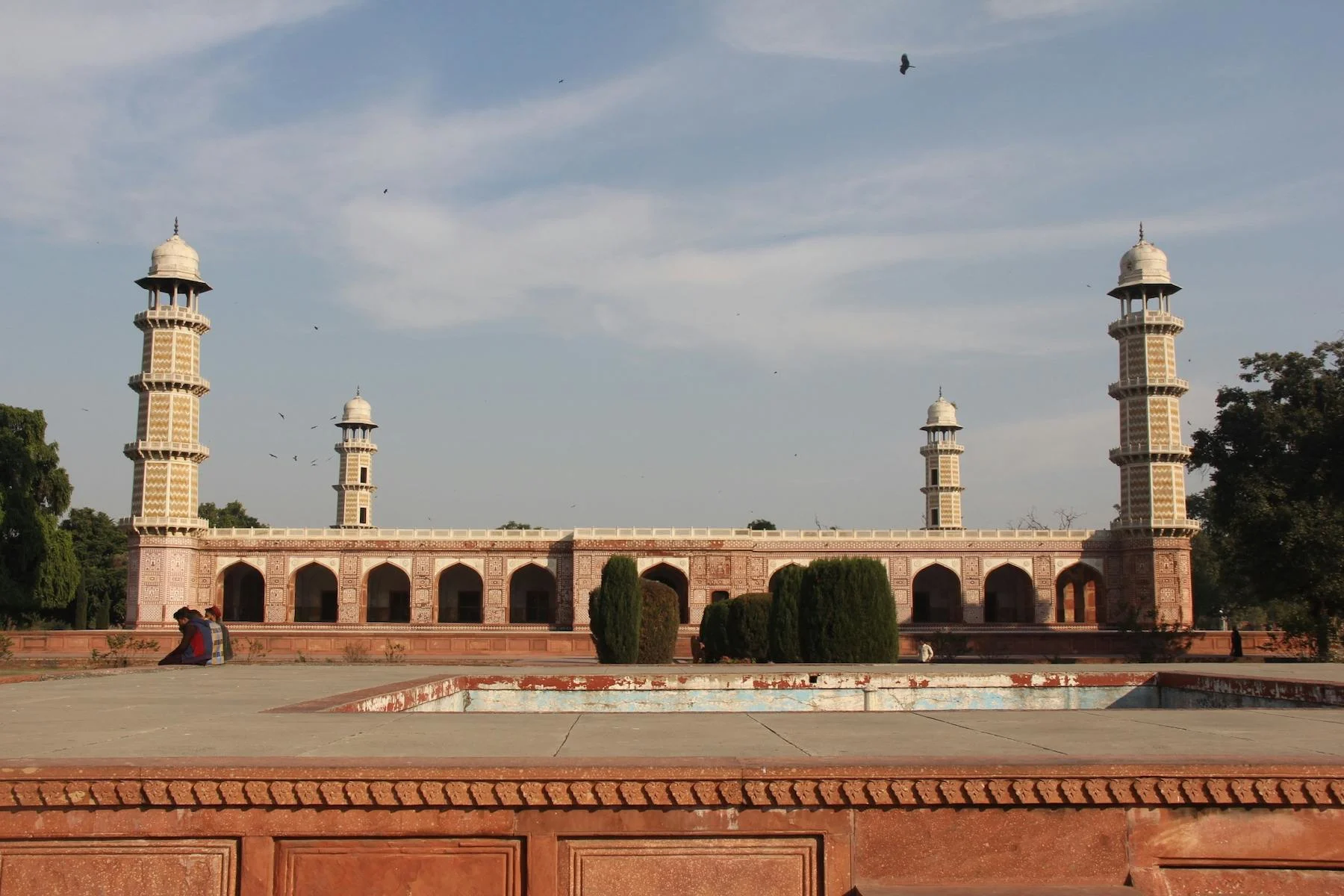
Jahangir was the fourth emperor of the Mughal Empire, reigning from 1605 until his death in 1627. Born Prince Salim, the eldest son of the Emperor Akbar, he took the regnal name Jahangir — "world-seizer" — on his accession, together with the honorific Nur al-Din, "light of the faith," which he recorded he adopted because the sun rose as he took the throne. His twenty-two years as emperor were marked by the suppression of rebellions by his own sons, a long and largely successful contest with the Deccan general Malik Ambar, sustained diplomatic engagement with the Safavid state and with the English East India Company, and a flourishing of painting and garden design that later ages have judged among the finest achievements of Mughal art. He is remembered as well for his marriage to Nur Jahan, and for the memoir of his own reign, the Tuzk-i Jahangiri, which he kept in his own hand.
Birth and Upbringing
Salim was born on 30 August 1569 at Fatehpur Sikri, southwest of Agra, the son of Akbar and of Raja Bihari Mal's daughter, a Rajput princess later known as Mariam-uz-Zamani. Akbar named his son after the Sufi shaikh Salim Chishti, for whom he held great affection, though at court the prince was known by the name Shaikhu Baba. According to Jahangir's own memoir, as quoted in the Diyanet/TDV İslâm Ansiklopedisi, he avoided using the name Salim as emperor for fear it would be confused with that of the Ottoman sultan Selim I ("Yavuz Sultan Selim"), and chose Jahangir instead as a name he judged fitting for a sovereign.
Accession and Early Measures
Jahangir ascended the Mughal throne at Agra on 21 October 1605, immediately after Akbar's death, and had coins struck and the Friday sermon read in his name. Shortly after his accession he issued a decree containing twelve ordinances: he abolished the stamp duty and the harbour tax along with taxes of every kind, ordered that inns and mosques be built along the roads for the convenience of travellers so that merchants could journey safely, prohibited the manufacture and sale of alcoholic drink, forbade the levying of taxes on the population without their consent, banned the slaughter of animals on Sundays and Thursdays, and proclaimed a general amnesty. He continued his father's policy of alliance with the Rajputs, and employed Muslims in the administration; only three Hindu governors are recorded as having held provincial governorships during his reign.
The Rebellion of Khusrau
Jahangir was not long on the throne before he had to deal with the revolt of his eldest son, Khusrau, who rose against him. Failing to hold his own against his father, Khusrau took refuge in the Punjab on 6 April 1606 and sought the help of the Sikhs, who were then in rivalry with the Muslims of the region. Guru Arjan supported the rebellious prince and gave soldiers to fight against Dilawar Khan, the governor of Lahore. Jahangir sent reinforcements to the Punjab to prevent the weakening of Mughal authority there, and the rebellion was suppressed. Khusrau was defeated and captured at Bhairoval; Jahangir had his son's eyes put out with a needle and then exiled him to Burhanpur, where Khusrau died in 1622.
Malik Ambar's Rebellion
Another matter that occupied Jahangir was the rebellion of Malik Ambar. Of Abyssinian origin, Malik Ambar had risen to the rank of malik at the court of the Nizam Shahi rulers of Ahmadnagar. He allied with the Marathas, who inhabited the mountainous country of the Deccan, and rose against Jahangir. In response, Jahangir's son Khurram — later the Emperor Shah Jahan — led a successful campaign against Malik Ambar and recovered the territories the Mughals had lost, in 1608. It was for this success that his father conferred on him the title Shah Jahan. Malik Ambar continued to occupy the Mughals for a long period, though he was able to maintain himself only in the Deccan region. Meanwhile the Mughal position also came under threat when Kandahar was besieged and taken by the Persians.
Marriage to Nur Jahan
In 1611 Jahangir married Mihr al-Nisa, daughter of Ghiyas al-Din al-Tihrani, giving her the titles Nur Mahal and later Nur Jahan Begum, and gave her a voice in the administration of the country as well. A year later he had to deal with a succession of revolts that broke out in Bengal. He charged a commander named Shuja al-Dawla with suppressing the Bengal uprising; after defeating Usman, one of the ringleaders of the revolt, the Mughals took the rebels' centre, Dhaka, which was afterward renamed Jahangirnagar.
Foreign Relations
Jahangir pursued a successful policy in foreign relations as well. When Kandahar, on the frontier between the Safavid and Mughal states, was seized by Shah Abbas I on 11 June 1622, envoys were exchanged between the two sides and the matter was settled, and the foundations of friendship between the two states were laid. At the same time the Shaybanids, the great rivals of the Safavids, drew closer to the Mughals and sent an envoy to the court at Agra bearing various gifts, establishing good relations.
The English, in rivalry with the Portuguese, who sought to control Indian maritime trade and to hold onto the places they occupied, formed the East India Company and, through it, established colonies along the coasts of India. The Company made contact with Jahangir and requested trading privileges of the kind the Portuguese enjoyed. Travellers such as William Hawkins, William Finch, John Jourdain, Nicholas Withington, Thomas Coryat, Sir Thomas Roe, and Edward Terry came to India in Jahangir's time and introduced the Mughal realm to the West. Surat, Ahmadabad, Lahore, Ajmer, Agra, Delhi, and Burhanpur became centres of trade where foreign merchants could buy and sell in security.
The Rebellion of Mahabat Khan and Later Years
In 1626 Jahangir marched against the rebellious Mahabat Khan, but was taken captive on the road to Kabul; he was freed from captivity through the efforts of his wife Nur Jahan. Around this time his son Shah Jahan cooperated with Mahabat Khan against his own father, and in 1627 Jahangir went to Kashmir, where he fell ill; violent attacks of asthma left him greatly weakened. On his doctors' advice he set out to return to Lahore, but died on the way, at Rajauri-Bhimber, on 7 November 1627. His body was carried to Lahore and buried on the bank of the river Ravi at Shahdara; his tomb, among the masterpieces of seventeenth-century Mughal art, was completed in 1637.
In his twenty-two years as emperor Jahangir skilfully put down the Maratha, Sikh, Afghan, Bengali, and princely rebellions that arose during his reign. His one weakness, in the judgement of the sources, was that he fell for a time under the influence of his wife Nur Jahan.
Character and Patronage
Numismatic evidence records a curious episode of coinage: at Nur Jahan's request Jahangir had coins struck bearing her name, a wholly unusual step in Mughal practice. Jahangir was described as just and compassionate, sound of judgement, firm in faith, fond of company, and a friend to the learned. He took pleasure in art and aesthetics, and it was above all in his reign that the art of painting reached its golden age. Like his great-grandfather Babur, Jahangir was himself a man of letters and a poet, and he also studied hadith under Shaikh Muhammad Sa'id al-Harawi and the Mufti Sadr-i Jahan al-Pihani.
Under Jahangir many parts of India were adorned with works of architecture; fine examples of this may be seen at Agra, Lahore, Sheikhupura, and in Kashmir. The Shalimar Garden on Dal Lake in Kashmir is a fine specimen of garden architecture from his reign. The planting of a double row of trees along the main road connecting Agra, Delhi, and Lahore was, for its time, an original undertaking.
The Tuzk-i Jahangiri and Other Writings
Jahangir wrote a work containing his memoirs, the Tuzk-i Jahangiri, which was published together with the continuation added by Muhammad Hadi. He also left a Pandnama, a book of counsel for his children. The Tuzk was translated into English by David Price, and portions of the Pandnama were also rendered into English by Elliot and Dowson.
Jahangir had the Qur'an translated into Persian by Shaikh Muhammad ibn Jalal al-Husayni al-Gujarati. His minister Mu'tamad Khan wrote a work on his reign entitled Iqbalnama-i Jahangiri, and Izzat Khan likewise wrote a work entitled Ma'athir-i Jahangiri, portions of which were also translated into English.
Historiographical Note
This article is drawn from the Diyanet/TDV İslâm Ansiklopedisi's entry on Jahangir, an encyclopaedia entry that itself draws on Jahangir's own memoir, the Tuzk-i Jahangiri, and its continuations by Mu'tamad Khan and Izzat Khan, together with the English-side record of the embassy of Sir Thomas Roe. Neither the Tuzk-i Jahangiri nor Roe's own journal is in the approved source library consulted for this article, and neither has been independently read; passages quoting or summarising them are reported here as the Diyanet entry presents them, not as this article's own direct reading of the originals. The date given here for Khusrau's flight to the Punjab, 6 April 1606, and the account of the rebellion's suppression, likewise follow the Diyanet entry; other studies of the period give varying detail on the exact sequence of the Sikh involvement, and only the established outline — Khusrau's flight, Guru Arjan's support, the rebellion's defeat, and Khusrau's blinding and exile — is asserted here.
References and Further Reading
Primary Islamic Sources
- Jahangir. Tuzk-i Jahangiri [Memoirs of Jahangir] — Jahangir's own memoir of his reign, as discussed and quoted in the Diyanet/TDV İslâm Ansiklopedisi entry cited below; not independently consulted for this article.
- Mu'tamad Khan. Iqbalnama-i Jahangiri — a continuation of Jahangir's memoir written by a minister in his service, as discussed in the same entry; not independently consulted for this article.
- Izzat Khan. Ma'athir-i Jahangiri — as discussed in the same entry; not independently consulted for this article.
Classical Islamic Sources
- Jahangir's own commissioning of a Persian translation of the Qur'an by Shaikh Muhammad ibn Jalal al-Husayni al-Gujarati, as recorded in the Diyanet entry.
Academic and Scholarly Sources
- Beveridge, H., and later contributors. "CİHANGİR." TDV İslâm Ansiklopedisi. Istanbul: Türkiye Diyanet Vakfı İslâm Araştırmaları Merkezi. [approved external source: islamansiklopedisi.org.tr] — the principal source for this article.
Further Reading
- Jahangir. The Tuzuk-i Jahangiri, or Memoirs of Jahangir, translated by Alexander Rogers, edited by Henry Beveridge. London, 1909-1914. — for the reader's further research into Jahangir's own memoir; not consulted for this article.
- Roe, Sir Thomas. The Embassy of Sir Thomas Roe to India, 1615-19, edited by William Foster. London, 1926. — for the English side of the embassy described above.
Mentioned In
2 articles reference this topic