Zubayr ibn al-Awwam: The Disciple of the Prophet
Zubayr ibn al-Awwam (594-656 CE) was one of the earliest converts to Islam, one of the Ten Promised Paradise, and the Prophet's cousin. Known for his exceptional bravery and loyalty, he died at the Battle of the Camel fighting against Ali ibn Abi Talib.
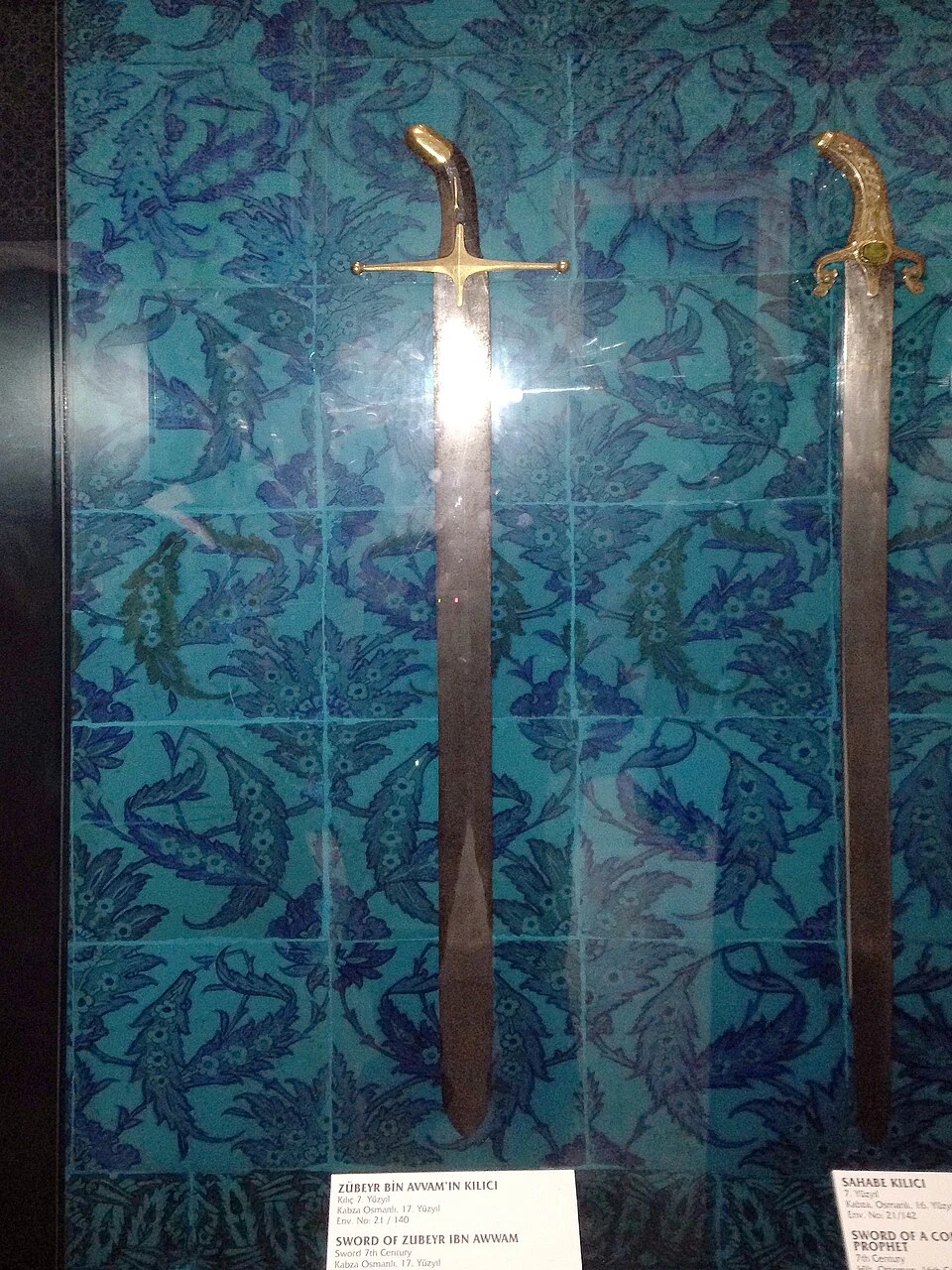
Zubayr ibn al-Awwam was one of the most distinguished companions of Prophet Muhammad ﷺ, honored with the title "Hawari" (Disciple) of the Prophet. As one of the earliest converts to Islam and one of the Ten Promised Paradise, Zubayr was known for his exceptional courage in battle and his unwavering loyalty to the Prophet. He was also the Prophet's cousin, being the son of Safiyyah bint Abd al-Muttalib, the Prophet's paternal aunt. Despite his honored status and heroic service, Zubayr's life ended tragically at the Battle of the Camel in 656 CE, where he fought against Ali ibn Abi Talib before withdrawing from the battle and being killed while traveling home. His death marked one of the great tragedies of the First Fitna, the civil war that divided the early Muslim community.
Early Life and Conversion to Islam
Zubayr was born around 594 CE in Mecca into the Banu Asad clan of the Quraysh tribe. His father, al-Awwam ibn Khuwaylid, died when Zubayr was young, and he was raised by his mother, Safiyyah bint Abd al-Muttalib, who was the Prophet Muhammad's aunt. This family connection meant that Zubayr grew up knowing his cousin Muhammad and was familiar with his character and reputation even before the advent of Islam.
Zubayr was one of the very first converts to Islam, accepting the faith when he was only about sixteen years old. According to tradition, he was either the fourth or fifth person to convert, making him one of the earliest Muslims. His early conversion brought severe persecution from his family and tribe. His uncle subjected him to particularly harsh treatment, hanging him upside down and lighting fires beneath him to force him to renounce Islam. Despite this torture, Zubayr refused to abandon his faith, demonstrating the steadfastness that would characterize his entire life.
As one of the earliest Muslims, Zubayr was part of the small, persecuted community that gathered around the Prophet in Mecca. He endured years of harassment, social ostracism, and physical abuse for his faith. This early period of persecution strengthened the bonds between the early Muslims and established Zubayr's reputation for courage and commitment. The Prophet recognized Zubayr's exceptional qualities and gave him the special title "Hawari" (Disciple), comparing him to the disciples of Jesus. This title reflected the close relationship between Zubayr and the Prophet and Zubayr's role as one of the Prophet's most trusted companions.
The Hijra and Military Service
When the Muslims emigrated to Medina in 622 CE, Zubayr was among those who made the journey. In Medina, the Muslim community could practice their faith openly and began to establish an Islamic society. Zubayr quickly became one of the Prophet's most important military commanders, participating in virtually every major battle and expedition during the Prophet's lifetime.
Zubayr fought at the Battle of Badr in 624 CE, the first major military engagement between the Muslims and the Meccans. At Badr, Zubayr distinguished himself through his bravery, and the Muslims' unexpected victory established their credibility as a military force. Zubayr's courage at Badr was remembered throughout his life as evidence of his commitment to Islam and his willingness to risk his life for the faith.
At the Battle of Uhud in 625 CE, Zubayr again demonstrated exceptional bravery. When the Muslim army was thrown into confusion by a surprise cavalry attack, Zubayr was one of the few companions who remained steadfast, fighting to protect the Prophet. His actions at Uhud, along with those of Talha ibn Ubaydullah and a few others, prevented the Meccans from killing or capturing the Prophet and allowed the Muslim army to regroup and survive the defeat.
Zubayr participated in the Battle of the Trench in 627 CE, where the Muslims defended Medina against a large coalition of Meccan and allied forces. He also participated in the Treaty of Hudaybiyyah negotiations in 628 CE and was present at the conquest of Mecca in 630 CE, when the Prophet entered his hometown in triumph and the Meccans accepted Islam. Throughout these campaigns, Zubayr established himself as one of the most capable and courageous Muslim warriors, earning the Prophet's trust and the respect of the Muslim community.
One of the Ten Promised Paradise
Zubayr was one of the ten companions whom the Prophet specifically named as being promised Paradise. This honor, known as al-'Ashara al-Mubashshara, was the highest recognition a companion could receive. The Prophet's declaration that Zubayr was promised Paradise was based on his early conversion, his steadfastness under persecution, his bravery in battle, and his overall character and devotion to Islam.
The naming of the ten is a prophetic statement rather than a passage of revelation, and it is reported here as such. It is transmitted in Jami' at-Tirmidhi 3747 and in Sunan Abu Dawud, and it is not among the material in Sahih al-Bukhari or Sahih Muslim; the hadith scholars grade its chain sound. Within Sunni tradition the report is understood to place the ten named in it beyond the reach of the disputes that later divided the community, and Zubayr's standing in that tradition rests on it.
The title "Hawari" (Disciple) that the Prophet gave to Zubayr further emphasized his special status. Just as Jesus had his disciples who were his closest followers and supporters, the Prophet had Zubayr as his disciple, a companion of exceptional loyalty and devotion. This title reflected the close personal relationship between Zubayr and the Prophet and Zubayr's role as one of the Prophet's most trusted companions.
Role During the Rashidun Caliphate
After the Prophet's death in 632 CE, Zubayr played an important role in the early Muslim community. He was present at the Saqifah meeting where Abu Bakr was chosen as the first caliph, and he pledged his allegiance to Abu Bakr. During Abu Bakr's brief caliphate (632-634 CE), Zubayr continued to serve the Muslim community, participating in military campaigns against the apostasy movements that threatened the unity of the Muslim state.
Under Umar ibn al-Khattab's caliphate (634-644 CE), Zubayr participated in the great Islamic conquests that expanded Muslim territory into Syria, Iraq, Egypt, and Persia. He fought at the Battle of Yarmouk in 636 CE, one of the most decisive battles in Islamic history, where the Muslims defeated the Byzantine army and secured control of Syria. Zubayr's military skills and courage were crucial to these conquests, and he earned a reputation as one of the most capable Muslim commanders.
Umar, mortally wounded in 644 CE, named six men to settle the succession among themselves, and Zubayr was among them. The other five were Uthman, Ali, Talha, Sa'd ibn Abi Waqqas and Abd al-Rahman ibn Awf — all of them, like Zubayr, among the ten named in the report discussed above. This selection demonstrated Zubayr's high standing in the community and his recognition as one of the most qualified potential leaders. The council ultimately chose Uthman ibn Affan as the third caliph, and Zubayr pledged his allegiance to him.
Opposition to Uthman and the Crisis
The grievances that accumulated against Uthman during his caliphate (644-656 CE) — over provincial appointments, the disposition of conquered land, and the standing of his Umayyad kinsmen — are set out in the article on his caliphate. What concerns Zubayr here is his own position within that opposition.
The exact nature and extent of Zubayr's opposition to Uthman is debated by historians. Some sources suggest that Zubayr was among the leaders of the opposition, actively criticizing Uthman's policies and supporting demands for reform. Other sources suggest that while Zubayr had concerns about some of Uthman's decisions, he did not actively participate in the opposition movement until the final crisis. What is clear is that by the final years of Uthman's caliphate, Zubayr was among those who believed that reforms were necessary.
The siege of Uthman's house in 656 CE and his killing are narrated in the article on his caliphate. On Zubayr's conduct during those weeks the accounts diverge — some holding that the senior companions in Medina could have intervened and did not, others that they attempted mediation and failed — and the sources do not permit the question to be settled. No version is adopted here.
The Battle of the Camel
The course of events after Uthman's killing — the acknowledgement of Ali as caliph, the demand that Uthman's killers be pursued, the withdrawal of Zubayr, Talha and Aisha to Basra, and the failure of the negotiations that preceded the fighting — is narrated in the article on the Battle of the Camel. What follows concerns Zubayr's own part in it.
The sources record that Zubayr and Ali met privately before the battle, and that Ali reminded him of the Prophet's words and of their long association. According to tradition, Ali asked Zubayr: "Do you remember when the Prophet said to you that you would fight against me while you were in the wrong?" Zubayr reportedly replied that he did remember and that he would not have come if he had recalled this earlier. Moved by this conversation, Zubayr decided to withdraw from the battle.
Fighting broke out notwithstanding the attempts at reconciliation. Zubayr, having resolved to withdraw, left the field and set out back toward Medina. However, he was pursued and killed by a man named Amr ibn Jurmuz, who apparently did not know who Zubayr was or believed he was acting righteously by killing a rebel against Ali.
When Ali learned of Zubayr's death, he was deeply grieved. According to tradition, Ali said: "Give the killer of the son of Safiyyah the tidings of Hell." When Amr ibn Jurmuz brought Zubayr's sword to Ali, expecting a reward, Ali refused to accept it and condemned the killing. The Prophet's sword, which Zubayr had carried, was returned to Zubayr's family. Zubayr died at the age of about 62, one of the Ten Promised Paradise killed in the first Muslim civil war.
Legacy and Historical Memory
Zubayr's legacy is complex and has been debated throughout Islamic history. On one hand, he is honored as one of the earliest converts to Islam, one of the Ten Promised Paradise, the Prophet's "Disciple," and a hero of numerous battles. His courage, loyalty, and devotion to the Prophet are universally acknowledged. Against that stands his part in the events leading to the Battle of the Camel, which has been assessed very differently across the tradition.
Traditional Sunni scholarship has generally taken a sympathetic view of Zubayr, arguing that he acted with good intentions even if his actions had tragic consequences. The principle of "withholding judgment" on the disputes between the companions has been applied to Zubayr, with scholars arguing that the conflicts of the early civil war were matters of ijtihad (independent reasoning) in which sincere Muslims disagreed about the right course of action. Zubayr's status as one of the Ten Promised Paradise is seen as proof that despite his mistakes, he remained a righteous companion whose place in Paradise was assured.
The tradition that Zubayr withdrew from the Battle of the Camel after being reminded of the Prophet's words has been emphasized by those who wish to present him in a positive light. In this view, Zubayr recognized his error and attempted to correct it by withdrawing from the battle, demonstrating his fundamental righteousness even if he had initially made a mistake. His death while withdrawing is seen as a tragedy rather than as punishment for wrongdoing.
Critics of Zubayr, particularly in Shia tradition, have been less forgiving. They argue that Zubayr's opposition to Uthman contributed to the crisis that led to the caliph's murder, and that his subsequent rebellion against Ali was unjustified and contributed to the fitna that divided the Muslim community. In this view, Zubayr's actions, whatever his intentions, had disastrous consequences for Islamic unity.
Modern historians have attempted to understand Zubayr's actions in their historical context, recognizing the complexity of the political situation after Uthman's assassination and the genuine disagreements about how to respond to the crisis. Zubayr's demand that Uthman's killers be punished was not unreasonable, and his frustration with Ali's delay in taking action was understandable. However, the decision to raise an army and confront Ali militarily had tragic consequences that Zubayr may not have fully anticipated.
Zubayr's withdrawal from the Battle of the Camel, whether motivated by Ali's reminder of the Prophet's words or by his own realization of the wrongness of the conflict, suggests that he recognized his error. His death while withdrawing adds a tragic dimension to his story, as he was killed not in battle but while attempting to leave the conflict. This has led some to view Zubayr's end as particularly tragic—a righteous companion who made a mistake, recognized it, and attempted to correct it, only to be killed by someone who did not understand the situation.
Zubayr's Military Career in Detail
The First Muslim to Draw a Sword
The Islamic tradition records that Zubayr ibn al-Awwam was the first Muslim to draw a sword in the cause of Islam — an event that occurred in Mecca during the early years of persecution. According to the account, a rumor spread that the Prophet had been killed. Zubayr, then a youth of approximately sixteen, drew his sword and rushed through the streets of Mecca toward where the Prophet was believed to be, prepared to fight anyone responsible. He encountered the Prophet, who was unharmed, and the Prophet prayed for him and for his sword. This episode — whether precisely historical or shaped by the biographical tradition — established Zubayr's reputation as a man of immediate martial response whose first instinct in a crisis was to fight.
The Battles of the Prophetic Era
Zubayr participated in virtually every major military engagement of the Prophetic period:
Badr (624 CE): At the first great battle of Islam, Zubayr fought in the front ranks. He wore a distinctive yellow turban that the Prophet had tied for him, and he is reported to have killed several enemy combatants. The Prophet later declared him one of the heroes of Badr — a status that carried permanent honor in the Muslim community.
Uhud (625 CE): At the Battle of Uhud, when the Muslim army was thrown into confusion after the archers abandoned their positions, Zubayr was among those who stood firm beside the Prophet. He fought to protect Muhammad when the Prophet was wounded and surrounded by enemy fighters.
Khandaq (627 CE): During the siege of Medina, Zubayr served as one of the commanders who organized the defense of the trench and who maintained morale during the weeks of siege.
Khaybar (628 CE): Zubayr fought at the conquest of the Jewish fortress of Khaybar, demonstrating his characteristic courage in the assault on the fortified position.
The Conquest of Mecca (630 CE): At the conquest of Mecca, Zubayr commanded one of the four columns that entered the city — the northern approach. His role as a column commander in the most symbolically important military operation of the Prophetic era reflected his standing as one of the Prophet's most trusted military leaders.
The Early Conquests
After the Prophet's death, Zubayr participated in the great conquests that carried Islam beyond Arabia. He fought at the Battle of Yarmouk (636 CE), the decisive engagement that broke Byzantine power in Syria, where his bravery was once again conspicuous. He also participated in the conquest of Egypt under Amr ibn al-As — one of the most important campaigns of the early expansion.
At Yarmouk, the sources record that Zubayr led a critical cavalry charge that broke through the Byzantine center at a moment when the battle's outcome hung in the balance. His physical courage — always his most celebrated quality — contributed to one of the most consequential Muslim victories in history. His participation in these campaigns added to the extraordinary military record of a man who had fought in every major battle from Badr to the conquest of Egypt.
The Prophet's Special Honors for Zubayr
"The Disciple of the Prophet"
The Prophet gave Zubayr the title "Hawari" — the Disciple — the same term the Quran uses for the disciples of Prophet Isa (Jesus). This title, unique among the companions, reflected the Prophet's recognition of Zubayr's extraordinary loyalty and devotion. When the Prophet asked at the Battle of the Trench: "Who will bring me news of the enemy?" Zubayr volunteered. The Prophet asked again; again Zubayr volunteered. A third time; again Zubayr. The Prophet then said: "Every prophet has a hawari, and my hawari is al-Zubayr."
This triple volunteering — offering himself repeatedly for a dangerous reconnaissance mission while others hesitated — was characteristic of Zubayr's temperament: immediate, unhesitating, willing to risk his life without calculation. The title "hawari" honored this quality and placed Zubayr in the company of those who had served previous prophets with similar devotion.
Kinship with the Prophet
Zubayr's connection to the Prophet was not merely one of companionship but of blood kinship. His mother was Safiyya bint Abd al-Muttalib — the Prophet's paternal aunt — making Zubayr the Prophet's first cousin. Additionally, Zubayr married Asma bint Abi Bakr — the daughter of Abu Bakr and the sister of Aisha — creating a further bond of kinship with the Prophet's closest companion and father-in-law. Their son, Abdullah ibn al-Zubayr, would later establish a rival caliphate in Mecca against the Umayyads.
The First Fitna and the Battle of the Camel
The Political Crisis
After the assassination of Uthman ibn Affan in 656 CE, the Muslim community was plunged into its first civil war. Zubayr, along with Talha ibn Ubaydullah and Aisha bint Abu Bakr, demanded that the new caliph Ali ibn Abi Talib immediately punish Uthman's killers. When Ali argued that he needed to consolidate his authority before pursuing the killers (many of whom were in his own army), the three raised an army and marched toward Basra.
The sources debate Zubayr's precise motivations. Some accounts portray him as genuinely outraged by Uthman's murder and determined to see justice done. Others suggest political ambition — that he hoped the crisis might elevate him to the caliphate itself (he had been a member of Umar's shura council that selected Uthman). Still others emphasize his close relationship with Talha and Aisha, suggesting that personal loyalty to these individuals drew him into a conflict he might otherwise have avoided.
Zubayr's Withdrawal and Death
At the Battle of the Camel (656 CE), negotiations were attempted before the fighting began. According to the most common account, Ali sent a message to Zubayr reminding him of a hadith: that the Prophet had once told Zubayr "You will fight Ali, and you will be in the wrong." Zubayr, reminded of this prophetic warning, was shaken. He reportedly said: "I had forgotten it, and now that I remember it, I cannot fight." He withdrew from the battlefield — abandoning his army before the battle was joined.
However, withdrawal was not enough to save him. As Zubayr rode away from the battlefield, he was pursued by a man named Amr ibn Jurmuz, who caught up with him at a place called Wadi al-Siba' and killed him — either treacherously (while Zubayr was resting or praying) or in a confrontation (the accounts differ). Zubayr was approximately sixty-seven years old.
When Zubayr's sword was brought to Ali after the battle, Ali wept and said: "A sword that often protected the face of the Messenger of God." This response — mourning the loss of a companion despite having been his opponent in the battle — demonstrated the tragic nature of the First Fitna: men who had been brothers in faith fighting and dying in a conflict that none of them had truly wanted.
Legacy
Zubayr ibn al-Awwam is remembered across the Islamic tradition as one of the bravest warriors of the Prophetic era, one of the Ten Promised Paradise, and a man whose end was as tragic as his career was glorious. His military record — from the first drawn sword in Mecca through the conquests of Syria and Egypt — places him among the greatest warriors in early Islamic history. His title as the Prophet's "Disciple" honors a loyalty that was tested and proven across decades of danger and sacrifice.
Yet his participation in the Battle of the Camel and his tragic death have added complexity to his legacy. The Sunni scholarly tradition applies to Zubayr (as to Talha) the principle of withholding judgment on the disputes between companions — recognizing that both sides in the First Fitna were acting on sincere interpretations of duty, even if one side was ultimately in error. Zubayr's withdrawal from the battle before it began — prompted by his recollection of the Prophet's warning — is cited as evidence that he recognized his error at the last moment, even if that recognition came too late to prevent the tragedy.
Conclusion
Zubayr ibn al-Awwam's life reflects both the heroism of the early Muslim community and the tragic divisions that emerged after the Prophet's death. As one of the earliest converts to Islam, he endured severe persecution with steadfastness. As the Prophet's "Disciple" and one of the Ten Promised Paradise, he was honored with the highest recognition a companion could receive. As a warrior, he demonstrated exceptional courage in numerous battles, contributing to the survival and expansion of the Muslim community.
Yet Zubayr's life ended in tragedy at the Battle of the Camel, fighting against Ali ibn Abi Talib in the first major civil war in Islamic history. His withdrawal from the battle and his death while traveling home add poignant dimensions to his story, suggesting a man who recognized his error and attempted to correct it but was unable to escape the consequences of the conflict he had helped initiate. The record therefore holds two things together that later readers have found difficult to reconcile: his standing among the earliest Muslims and the named ten, and his part in the first armed conflict between Muslims. This article sets both out and does not resolve the tension between them, which the sources themselves do not resolve.
References and Further Reading
Primary Islamic Sources
- Quran, Surah Al-Ahzab (33:23) — "Among the believers are men true to what they promised Allah. Among them is he who has fulfilled his vow [to the death], and among them is he who awaits [his chance]" — applied to Zubayr and companions who pledged to die defending Islam
- Quran, Surah Al-Fath (48:29) — describes the companions of the Prophet including Zubayr
- Sahih al-Bukhari, Book of Merits of the Companions, Hadith 3717 — the Prophet designates Zubayr as his "Disciple" (Hawari)
- Jami' at-Tirmidhi 3747; also Sunan Abu Dawud — the naming of the ten companions given glad tidings of Paradise (al-'Ashara al-Mubashshara), in which Zubayr is named. The report is not in Sahih al-Bukhari or Sahih Muslim; it is transmitted in these two collections, and its isnad is graded sound
- Sahih Muslim, Book of the Merits of the Companions, Hadith 2417 — prophetic praise for Zubayr
- Sunan al-Tirmidhi, Book of Virtues, Hadith 3745 — "Every prophet has a disciple and my disciple is Zubayr ibn al-Awwam"
- Sahih al-Bukhari, Book of Military Expeditions, Hadith 4113 — Zubayr's role at the Battle of Yarmouk
Classical Islamic Sources
- Al-Tabari, Muhammad ibn Jarir. Tarikh al-Rusul wa al-Muluk. Edited by M.J. de Goeje. Leiden: Brill, 1879–1901. [Completed c. 915 CE] — Battle of the Camel and Zubayr's death
- Ibn Sa'd, Muhammad. Al-Tabaqat al-Kubra. Edited by Eduard Sachau. Leiden: Brill, 1904–1940. [Compiled c. 845 CE]
- Al-Dhahabi, Shams al-Din. Siyar A'lam al-Nubala'. Beirut: Mu'assasat al-Risalah, 1981–1988. [Compiled c. 1348 CE]
- Ibn Kathir, Ismail. Al-Bidaya wa al-Nihaya. Beirut: Dar al-Kutub al-Ilmiyyah, 1994. [Compiled c. 1373 CE]
- Ibn Hajar al-Asqalani. Al-Isabah fi Tamyiz al-Sahabah. Beirut: Dar al-Kutub al-Ilmiyyah, 1995. [Compiled c. 1449 CE]
- Al-Baladhuri, Ahmad ibn Yahya. Ansab al-Ashraf. Beirut: Dar al-Fikr, 1996. [Original c. 892 CE]
- Ibn Abd al-Barr, Yusuf. Al-Isti'ab fi Ma'rifat al-Ashab. Cairo: Nahdat Misr, 1960. [Compiled c. 1070 CE]
Academic and Scholarly Sources
- Madelung, Wilferd. The Succession to Muhammad: A Study of the Early Caliphate. Cambridge: Cambridge University Press, 1997.
- Hinds, Martin. "The Murder of the Caliph Uthman." International Journal of Middle East Studies 3, no. 4 (1972): 450–469.
- Kennedy, Hugh. The Great Arab Conquests: How the Spread of Islam Changed the World We Live In. London: Weidenfeld and Nicolson, 2007.
- Kaegi, Walter E. Byzantium and the Early Islamic Conquests. Cambridge: Cambridge University Press, 1992.
- Hawting, G.R. The First Dynasty of Islam: The Umayyad Caliphate AD 661–750. London: Routledge, 2000.
Further Reading
- Rogerson, Barnaby. The Heirs of the Prophet Muhammad: Islam's First Century and the Origins of the Sunni-Shia Split. London: Little, Brown, 2006.
- Shaban, M.A. Islamic History: A New Interpretation. Cambridge: Cambridge University Press, 1971.
- Petersen, Erling Ladewig. 'Ali and Mu'awiya in Early Arabic Tradition. Copenhagen: Munksgaard, 1964.
- Watt, W. Montgomery. The Formative Period of Islamic Thought. Edinburgh: Edinburgh University Press, 1973.
Mentioned In
24 articles reference this topic
and 12 more articles
More from Prophetic Era
Battle of Badr - The First Great Victory
The first major military victory of the Muslim community on March 13, 624 CE, where 313 Muslims defeated a much larger Meccan army. This decisive battle established the military credibility of the Islamic state and marked the beginning of Islamic expansion.
Battle of Uhud
The Battle of Uhud (March 625 CE) was the second major engagement between Medina's Muslims and the Meccan Quraysh. After an early Muslim advantage, archers left their posts, enabling a Qurayshi cavalry attack that wounded the Prophet, killed Hamza, and ended in a strategic draw.
The Meccan Period: The Foundation of Islam and Early Persecution
The Meccan Period (610-622 CE) encompasses the first thirteen years of Prophet Muhammad's mission, from the first revelation to the Hijra. This period saw the establishment of Islamic monotheism and the formation of the early Muslim community.
Al-Masjid al-Nabawi: The Prophet's Mosque
Al-Masjid al-Nabawi (the Prophet's Mosque) in Medina is the second holiest mosque in Islam. Founded by Prophet Muhammad in 622 CE after the Hijra, it served as the center of the early Muslim community and contains the Prophet's tomb beneath the Green Dome.