Amir Khusraw: Poet of the Delhi Sultanate, 1253–1325
Amir Khusraw (1253–1325) was a Persian-language poet of Delhi who wrote at the courts of the Balbanid, Khalji and early Tughluq sultans, and a disciple of the Chishti shaykh Nizam al-Din Awliya.
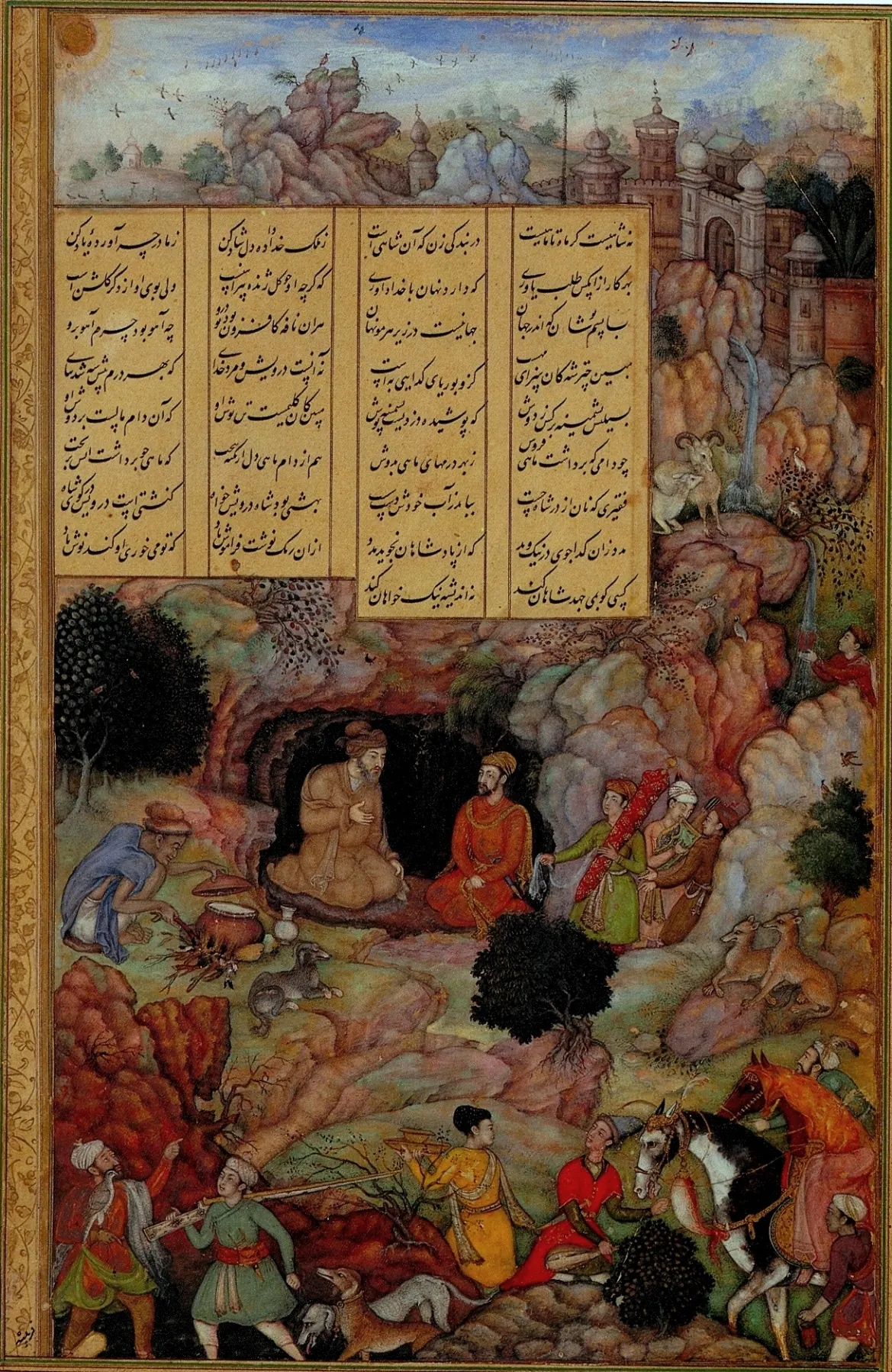
Amir Khusraw (651–725 AH / 1253–1325 CE), also written Amir Khusrau and known as Khusraw Dihlawi, "Khusraw of Delhi", was a Persian-language poet of the Delhi Sultanate. He wrote at the courts of Balban's sons and of the Khalji and early Tughluq sultans, served for a time as an officer in the army, and was a disciple of the Chishti shaykh Nizam al-Din Awliya, beside whose tomb in Delhi he is buried.12 The Encyclopaedia of Islam describes him as "the great Indo-Persian poet".1 He composed five divans of lyric and panegyric verse, a Khamsa in answer to Nizami's, narrative poems on the events of his own time, and prose works.12
He called himself an "Indian Turk" and, in another passage, "the Parrot of India", and in the same passage invited his reader to question him in Hindi.3 His father belonged to a Turkish tribe from Transoxiana; his mother was born in India.4 The two descriptions together frame most of what follows: a Turkish-descended courtier writing in Persian in a Delhi that, in Habib's account, had become a refuge for those driven out of Central Asia and Iran by the Mongol conquests.5
The evidence for his life is largely his own writing. The prefaces to his divans and the narrative poems carry autobiographical passages, and the modern biographies by Mohammad Habib (1927) and Wahid Mirza (1935) are built chiefly on them, together with the chronicle of Ziya al-Din Barani and the hagiography of the Chishti masters, the Siyar al-Awliya.67 Where these sources disagree on a date or an event, the disagreement is set out in the Historiographical Note at the end of the article.
Family and early years
His parents
His father, Sayf al-Din Mahmud, was one of the leaders of the Lachin Turks, a tribe from Transoxiana whom the Mongol conquests drove out of Central Asia.4 The TDV İslâm Ansiklopedisi traces the family's journey from Kesh to Balkh and then, away from Chinggis Khan, to India; Habib places the tribe's original home at the town of Takash.24 The sultan Iltutmish received the immigrants, and Sayf al-Din entered his service.42 According to the TDV, Iltutmish assigned him the estate of Mu'minpur, where he settled and married the daughter of the amir Imad al-Mulk.2
The Encyclopaedia of Islam calls Imad al-Mulk the "muster master of the kingdom"; Wahid Mirza says that he held the office of 'arid-i mamalik for thirty years, and Habib calls him Balban's Minister of War.184 His mother, the daughter of Imad al-Mulk, was of Indian birth, according to Habib; Wahid Mirza describes her as being of Indian origin, and the Amir Khusrau Memorial Volume calls Imad al-Mulk an Indian nobleman.9310 Habib adds that in families newly settled from Central Asia, such as Khusraw's, Persian was the dominant language of the household, although for many Indian Muslims Hindi and Persian were almost equally mother tongues.9
Khusraw was one of three sons. His brothers were Izz al-Din Ali Shah and Husam al-Din Qutlugh, the latter the younger.1112
Birth and childhood
The Encyclopaedia of Islam, the TDV, Wahid Mirza and the translators' note in Bada'uni's Muntakhab al-Tawarikh give his birth as 651 AH / 1253 CE; Habib gives 652 / 1254.1213144 The birthplace is Patiyali, a town of the Etah district of Uttar Pradesh that, in his day, lay on the bank of the Ganges, from which the river has since moved away.113 Wahid Mirza quotes Khusraw's own preface to the Ghurrat al-Kamal for the fact that the fortified town of Mu'minpur was "commonly known as Patiyali", so the two names in the sources denote one place.13
His father died while he was a child. The Encyclopaedia of Islam gives his age as eight, Habib as seven and the TDV as seven or eight.142 He passed into the care of his maternal grandfather, in whose house literary and learned conversation, according to the TDV, shaped his interest in poetry and music.2 He wrote verse from boyhood. The TDV has him composing at twelve and assembling his first divan, Tuhfat al-Sighar ("The Gift of Youth"), at nineteen; the Encyclopaedia of Islam dates the collection to about 671/1272.21
A story in the Siyar al-Awliya has the infant Khusraw taken to a mystic who told his father that the child would go "two steps beyond Khaqani"; Wahid Mirza regards the story as probably a myth and gives it "for what it is worth".413 Habib records a link with the later shaykh from the same period: Nizam al-Din Awliya, newly arrived in Delhi, lodged for two years in the house of Imad al-Mulk, Khusraw's grandfather, before the sons of the house returned and he had to leave.15
At the courts of Balban and his sons
Patrons in the 1270s
His first patron, according to Habib, was Alauddin Muhammad Kishlu Khan, called Malik Chajju, a nephew of Balban and his chamberlain, whom Khusraw is said to have entered the service of in 1277. Habib relies here on Barani, who says he had often heard of Chajju's generosity from Khusraw himself.16 After about two years Khusraw passed to Nasir al-Din Bughra Khan, Balban's second son, who was then governor of Samana. Habib attributes the move to a quarrel: Bughra Khan rewarded the poet with a basin of silver coins at a gathering, and Chajju resented it.16 When the governor of Lakhnauti, Tughril, rebelled, Balban marched against him in person and Bughra Khan took Khusraw on the campaign. Bughra Khan was made governor of the conquered province, and Khusraw stayed on for a time before returning to Delhi.162
The victory announcement (fath-nama) that he wrote for Balban on this occasion was, by his own claim, the first he composed; the Encyclopaedia of Islam notes that he was not at that date in the service of the Delhi court, so that it is unclear whether he was commissioned to write it.17
Multan
In Delhi he met Balban's eldest son, Sultan Muhammad, whom later generations called the Martyr Prince (Khan-i Shahid).18 According to Habib, who follows the account of Khusraw's biographers, the prince came to Delhi in 1280 and took Khusraw and the poet Amir Hasan back with him to Multan, where they remained in his service for five years.18 Khusraw recalled the time in a line Wahid Mirza translates: "For five years I watered the five rivers of Multan with the seas of my delectable verses."19 The prince had charge of the frontier against the Mongols; his court at Multan, Habib says, was known throughout the Persian-reading world and he twice invited the poet Sa'di of Shiraz to join it, a request Sa'di declined on the ground of age while sending verses written in his own hand.18 The Encyclopaedia of Islam names Hasan Dihlawi, the author of a collection of verse, as the close friend and fellow courtier of Khusraw at the courts of Prince Muhammad and, later, of Alauddin Khalji.20
The battle against the Mongols, 683 AH / early 1285
The Encyclopaedia of Islam records Mongol attacks on Multan in 643/1245 and in 683/1284–5.21 Prince Muhammad was killed in battle with the Mongols at the close of the year 683 AH, which falls in early 1285, a date consistent with the second of these attacks.19181
The sources describe the action differently. Habib places the Mongol army under a general he names I-tmar, thirty thousand strong, and says the prince, misreading "thirty thousand" as "three thousand" in a report, fortified himself in a village on the eastern bank of the Ravi near Lahore; the Mongols crossed the river at midday, and the prince was mortally wounded by an arrow at sunset.18 A passage of Elliot and Dowson that Habib quotes elsewhere in the same book places the death at Dipalpur.12 In Habib's narration, Delhi and Multan mourned him, and Balban, an old man, attended to the business of government by day and wept by night.18
Khusraw was with the army as an officer and was taken prisoner.18 He describes it himself, in verses Habib and Wahid Mirza both translate: the martyrs dyed the desert with their blood, the captives had their necks tied together like flowers in a garland, his captor sat his horse like a lion on a spur of a mountain, and the poet, stripped of his clothes, was driven on foot until his feet were covered in blisters.1819 At a stream, probably the Ravi, the thirsty Mongol and his horse drank and, according to the account, the man died; Khusraw drank a little and ran away.18 Habib and Wahid Mirza read his own lines as describing a captivity and an escape that took place within a single day, and the Encyclopaedia of Islam likewise says that he was captured "only to escape soon after".18191 Habib adds that, being an officer, he would have been kept apart from the ordinary captives with a view to ransom.18
On returning to Delhi he composed an elegy on the prince. Habib writes that it was the first of his verses to become known beyond educated readers, and that it was recited in court and camp for over a month.18 Another account of the captivity, which has him carried to Balkh and held for two years, is discussed in the Historiographical Note.
After Balban
For a time he stayed at Patiyali with his mother.18 The TDV has him living at Mu'minabad among relatives until Balban's death in 686/1287; Habib adds that under Balban's grandson Mu'izz al-Din Kaiqubad the minister Nizam al-Din was in power in Delhi and that Khusraw judged it impossible to find a footing at court while that minister lasted.218 He went to Oudh in the service of Amir Ali Sarjandar, called Hatim Khan, a senior officer who had begun as a freedman of Balban; he stayed two years and then, missing his mother, returned to Delhi with Hatim Khan's permission and two plates of gold coins for the journey.182
Under the Khaljis
Kaiqubad and Jalal al-Din Khalji
Back in Delhi, Khusraw was invited to the court of Kaiqubad and asked to write an account of the sultan's meeting with his father, Bughra Khan, who had assumed sovereignty in Bengal. The result was his first historical mathnawi, the Qiran al-Sa'dayn ("The Conjunction of the Two Auspicious Stars"), which Habib says was completed after six months of continuous work in Shawwal 688 AH (October 1289) when he was, by his own account, thirty-six.1822 The Encyclopaedia of Islam records that the meeting took place on the banks of the Ghaghra in Oudh.22
Kaiqubad's reign ended in 689/1290 with the accession of Jalal al-Din Khalji, whom Habib calls an old admirer of the poet. The Encyclopaedia of Islam records that under Jalal al-Din he received a royal pension of twelve hundred tankas a year and was, in Barani's words, a great favourite; the TDV says he served the sultan as mushafdar, the keeper of the Qur'an.1218 In 690/1291 he completed the Miftah al-Futuh ("The Key of Victories"), a mathnawi on four victories of Jalal al-Din.1
Alauddin Khalji
On 16 Ramadan 695 (14 July 1296) Alauddin Khalji, Jalal al-Din's nephew and son-in-law, had the sultan killed near Karra, and he took the throne.18 The Encyclopaedia of Islam says that Khusraw "transferred his allegiance" to the new sultan, who confirmed his pension but "proved an exacting patron".1 Habib observes that neither the Khaza'in al-Futuh nor the Dawal Rani refers to the assassination.18 Barani wrote that a poet of Khusraw's standing would have been given territory and office by earlier sultans, and that Alauddin gave him his annual stipend; Habib considers the complaint and concludes that Khusraw's tributes to Alauddin's generosity show that his work did not go unrewarded.18
According to the Encyclopaedia of Islam, the reign of Alauddin (695–715/1296–1316) "saw Amir Khusraw's most prolific period".1 Between 698 and 701 AH (1298–1301 CE) he wrote the five poems of his Khamsa (see below).23 While he was at work on the third of them, Habib says, his mother and his younger brother Qutlugh died, and he wrote in the Majnun u Layla of his grief at their loss.18 He wrote the Khaza'in al-Futuh ("The Treasuries of Victory"), a prose account of Alauddin's campaigns that Habib later translated into English,24 and, near the end of the reign, the Dawal Rani Khidr Khan, also called 'Ashiqa, completed in 715/1316 and telling of the love of the sultan's son Khidr Khan and Devaldi, the daughter of Raja Karn of Nahrwala. The Encyclopaedia of Islam notes a later continuation that tells of Khidr Khan's estrangement from his father, his confinement in the fortress of Gwalior, and his blinding and eventual murder at the instigation of Malik Kafur.12
Qutb al-Din Mubarak Shah and Khusraw Khan
Alauddin's son Qutb al-Din Mubarak Shah (1316–1320) took an interest in poetry and music, which, the TDV says, restored Khusraw's standing at court.2 The Nuh Sipihr ("The Nine Heavens"), a mathnawi in nine parts on this reign and on the customs of the Muslims of India, was completed in 718/1318, according to the correction printed in volume 2 of the Encyclopaedia of Islam.125 The I'jaz-i Khusrawi, a work on the principles of prose composition, was completed in 719/1319.12 Mubarak Shah was murdered by Khusraw Shah (Khusraw Khan), who usurped the throne in 720/1320; Ghazi Malik rebelled against him and reigned as Ghiyath al-Din Tughluq, 720–5/1320–5.26 Khusraw's Tughluq-nama is a mathnawi on Ghiyath al-Din's victory over Khusraw Khan in 720/1320.1
Ghiyath al-Din Tughluq
According to the TDV, Khusraw took part in Ghiyath al-Din's Bengal campaign of 1324.2 The Encyclopaedia of Islam lists the Tughluq-nama among his works and notes that he was a favourite at the court of Ghiyath al-Din, whose successor Muhammad (bin Tughluq) acceded in 725/1325, a few months before the poet's death.1
Khusraw and Nizam al-Din Awliya
The shaykh
Nizam al-Din Awliya was born at Badaun in 1238, studied in Delhi, was initiated by Farid al-Din Ganj-i Shakar at Ajodhan, and made Ghiyathpur, outside the city, his residence. He refused the grants that Jalal al-Din offered, and Alauddin did not visit him.15 Habib calls him, on the strength of the malfuzat recorded by Khusraw and Amir Hasan and the Siyar al-Awliya of Amir Khurd, "better known to us than any other figure in mediaeval India".15
The disciple
Accounts of how and when Khusraw came to him differ. Habib reports a tradition in which Khusraw became a disciple at the age of eight, and says that the friendship probably began in the reign of Jalal al-Din Khalji and grew closer every day.15 The TDV says that Khusraw may have met the shaykh in his childhood and visited his convent as a boy, and gives 713/1313 as the date of his formal initiation (bay'a), when, short of funds under a sultan who showed little interest in poets, he joined the shaykh's following.2 Khusraw dedicated the five poems of his Khamsa to Nizam al-Din, according to Habib, as well as presenting them to Alauddin.18
In the Encyclopaedia of Islam's account, Khusraw "became a disciple of the Cishti saint Nizam al-Din Awliya of Ghiyathpur" during his lifetime.1 The same work states that, though associated with the Chishti order, he "did not produce any work exclusively on mysticism", although some poems contain verses that throw light on the mystical tendencies of the age.27 His Afdal al-Fawa'id, which he presented to the shaykh in 719/1319, is a collection of the shaykh's sayings.1 The TDV dates the notes from which it was made to 1313–1319.2
Under Qutb al-Din Mubarak Shah the sultan and the shaykh fell out, and the TDV reports that Khusraw kept up his link with Nizam al-Din in spite of the court's prohibition.2 The Encyclopaedia of Islam mentions that Khusraw received a large number of letters, which he had buried with him, but that they were of a personal character and were never collected.28
Death and burial
Nizam al-Din died in 725/1325. According to the TDV, Khusraw heard of it, returned to Delhi, went to the shaykh's grave at Ghiyathpur and retired there for a time, and he died shortly afterwards, in Shawwal 725 AH (September 1325).2 Habib says that he died before six months had passed, and writes that the shaykh had told him: "Pray for my life, for you will not be able to survive me long."15 He was buried at the foot of the shaykh's grave.115 Khwandamir's editor adds that the poet died six months after the shaykh.29
The shaykh's tomb and the poet's are, in the TDV's phrase, the most important places of pilgrimage in Delhi.2 Wahid Mirza records that the anniversary ('urs) of the shaykh is observed on the 17th and 18th of Rabi' II, and that of the poet on the 17th and 18th of Shawwal, and that both tombs are looked after by descendants of the shaykh's sister, the pirzadas.30 The Encyclopaedia of Islam, in its entry on Delhi, lists his grave among the numerous graves to the south of the enclosure of the shaykh's tomb, which include those of Jahanara, daughter of Shah Jahan, Muhammad Shah, and a son of Akbar II.31 The historian Khwandamir, who died in 942/1535 in India, was buried at his own request at Delhi near the tombs of Nizam al-Din and the poet.3229
Bada'uni, who wrote under Akbar, records an episode concerning the poet's tomb in the sixteenth century. Mir Murtaza Sharif Shirazi was buried at Delhi near the tomb of "Mir Khusrau". The Sadr, the Qazi and the Shaikh al-Islam then represented to Akbar that Khusraw was a native of India and a Sunni, while Mir Murtaza was a native of Iraq, and that Khusraw would be much disturbed by his company; the emperor ordered the body taken up and buried elsewhere. Bada'uni calls the order an act of injustice to both men.33
Works
The divans and the poems
The Encyclopaedia of Islam and the TDV list the following principal works. The dates are those the two give; where they differ the difference is noted.
| Work | Kind | Date given |
|---|---|---|
| Tuhfat al-Sighar | divan: youth | c. 671/1272 (EI); c. 670/1272 (TDV) |
| Wasat al-Hayat | divan: middle age | c. 683/1284 (EI) |
| Ghurrat al-Kamal | divan: maturity | 693/1293 (EI); 693/1294 (TDV) |
| Baqiyya Naqiyya | divan | 716/1316 |
| Nihayat al-Kamal | divan: the last | c. 725/1325 |
| Qiran al-Sa'dayn | historical mathnawi | 688/1289 |
| Miftah al-Futuh | historical mathnawi | 690/1291 |
| Dawal Rani Khidr Khan ('Ashiqa) | historical mathnawi | 715/1316 |
| Nuh Sipihr | historical mathnawi | 718/1318 |
| Tughluq-nama | historical mathnawi | on the victory of 720/1320 |
| Matla' al-Anwar | Khamsa | 698/1298 |
| Shirin u Khusraw | Khamsa | 698/1298 |
| Majnun u Layla | Khamsa | 698/1298 |
| Hasht Bihisht | Khamsa | 701/1301 |
| A'ina-i Iskandari | Khamsa | 699/1299 |
| I'jaz-i Khusrawi | prose: five treatises | 719/1319 |
| Afdal al-Fawa'id | prose: the shaykh's sayings | 719/1319 |
| Khaza'in al-Futuh | prose: Alauddin's campaigns | — |
The TDV describes the divans: the first, from the poet's sixteenth to nineteenth year, contains 35 qasidas, tarji'band and tarkibband and a short mathnawi; the second, written between his twentieth and thirty-third year, has 8,441 couplets; the third, written after the age of thirty-four, ends with two qasidas, the 221-couplet Mir'at al-Safa in praise of the Prophet and the 218-couplet Darya-yi Abrar addressed to Nizam al-Din; and the fourth, of 716/1316, was written between his forty-third and sixty-sixth year by the TDV's reckoning.2 Each, in the TDV's account, was prefaced by a dibacha in which the poet describes how he came to write and how he assembled the collection, which is why the divans are a principal source for his life.26
The number of his works is variously given. Jami, as Wahid Mirza reports, puts it at ninety-nine, and the Memorial Volume attributes the same figure to Amir Khurd, the author of the Siyar al-Awliya, while the TDV observes that the biographical dictionaries and the tazkiras give different numbers.34352
The Khamsa
His five narrative poems from 698 to 701 AH follow the scheme of Nizami's Khamsa. The Encyclopaedia of Islam calls his the earliest imitation of Nizami's cycle: it contains the Matla' al-Anwar, Shirin u Khusraw, Majnun u Layla, Hasht Bihisht and A'ina-i Iskandari, and the last poem consists of a single part dealing mainly with Iskandar (Alexander) as a seeker of wisdom.23 The same work says he kept strictly to Nizami's plan but showed originality in the emphasis he gave to elements of the stories and by choosing new subsidiary tales for the Hasht Bihisht, his answer to Nizami's Haft Paykar.36 His Majnun u Layla, the first in the series of imitations of Nizami's treatment of the story, is much shorter than its model (2,660 couplets) and puts less stress on didactic matter.37 His Shirin u Khusraw is livelier in narration and simpler in style than Nizami's.38
One feature of his epic verse is that it takes events from the history of his time. The Encyclopaedia of Islam writes that he "introduced items taken from contemporary history, either romances or glorious events in the reigns of the sultans of Dihli" into the mathnawi form, an example followed by Salman-i Sawaji in his Firaq-nama.36
The ghazal
The TDV credits him with contributing to the development in India of the ghazal, a form little used there before him.2 Jami arranged his own lyric poetry in three divans, of youth, of middle age and of old age, on the model of Khusraw, who together with Sa'di and Kamal-i Khujandi provided models for his ghazals.36 The TDV records that the lovers' ghazals from the divans were collected and copied under the title Kulliyyat-i 'Anasir-i Dawawin-i Khusraw, and that Said-i Nafisi published 1,726 ghazals of his in Tehran and Iqbal Salahuddin 1,981 in Lahore in 1972.2
Prose
The I'jaz-i Khusrawi is a work on the principles of prose composition. The TDV describes it as five long treatises, the first four on language, style, secretarial writing and music and the fifth on the historical and social events of his youth, with his first prose work, the fath-nama of Lakhnauti, among them.2 The Encyclopaedia of Islam, discussing the writing of official documents under the sultans, finds that it and Mahmud Gawan's Manazir al-Insha' contain next to nothing on the position and functions of the secretary, although they are the two best-known treatises on insha'.17
The Khaza'in al-Futuh is thin by comparison; Habib describes it as "a thin volume on the history of Alauddin's wars".18
Works ascribed to him wrongly
The Chahar Darwish, a Persian collection of interrelated stories about four dervishes, has been ascribed to him. Two entries of the Encyclopaedia of Islam say that this ascription is wrong; the entry on the form says that the work was probably composed in the eleventh/seventeenth century. A third entry, on the Urdu tale, describes Mir Amman's Bagh o Bahar, a retelling of the story, as based on a Persian tale by Amir Khusraw. The disagreement is set out in the Historiographical Note.394041
Language, and the question of his Hindi verse
Khusraw wrote overwhelmingly in Persian. Habib remarks that Persian was the natural vehicle of his thought and that he lived in it "as a fish lives in water".42 Habib also says that Khusraw had some knowledge of Sanskrit, which Khusraw himself acknowledges, and that his works show an acquaintance with Turkish although he never seems to have written in it, possibly because the audience would have been extremely limited.42 The TDV adds that he knew Turkish, Arabic and Persian as well as the language and literature of India.2
On the question of Hindi, he said of himself: "I am an Indian Turk, and can reply to you in Hindi. I have no Egyptian sugar to talk of Arabia and Arabic", and "As I am in fact the Parrot of India, question me in Hindui that I may talk sweetly", and in the preface to his third divan he wrote that he had scattered among his friends "a few chapters of Hindui poetry also", mentioning the fact only briefly.3 Wahid Mirza observes that Khusraw seems to have had little regard for his own Hindi verses.3
Whether the Hindi verses attributed to him are his is disputed. The pieces in question are small songs, couplets (dohas), riddles and conundrums, a ghazal with alternate Persian and Hindi lines, a mukhammas in which every fifth line is Persian, some quatrains and the short rhyming word-list called Khaliq Bari; they were handed down by anthologists and were not collected in his lifetime.3 The TDV states that it has not been established with certainty that the verses attributed to him are his, and that the Khaliq Bari and some riddles and verses have reached their present forms by being passed on from generation to generation.2 Wahid Mirza reports that scholars who have studied the development of Hindi had begun to doubt them because their language is almost that of modern Khari Boli; he himself finds it unreasonable to declare the poetry apocryphal on linguistic grounds, while allowing that parts of it may be later compositions added to a genuine core.3 The Encyclopaedia of Islam names Khusraw as "the first Muslim poet of Hindi whose works have come down to us" and says his Hindi output is small beside his Persian, consisting of "a few riddles and macaronic Hindi/Persian verses, and the short rhyming Persian-Hindi dictionary, the Khaliq-bari".43 Habib wrote in 1927 that a number of his Hindi compositions survive, but that their volume could not have been large.42
Music
What the sources say
The Encyclopaedia of Islam describes Khusraw as "expert in both Indian and Persian music at the court of 'Ala' al-Din Khaldji" and quotes him, citing Wahid Mirza, as stating that Indian music, "the fire that burns heart and soul, is superior to the music of any other country".44 He is, it adds, "credited with the introduction into Indian music of a number of Persian and Arabic elements which include new vocal forms, as well as new rags, tals and instruments." Of the vocal forms it names two: the qawl, "said to be the origin of qawwali, at present a form of religious song", and the tarana, "a song composed of meaningless syllables"; both, the entry says, are prominent today.44
Habib agrees that his standing as a musician is generally admitted, quoting the poet's statement, as given by Daulat Shah, that his musical compositions would fill three volumes if they could be written down.45 He adds that Shibli Nu'mani quotes a number of rags and raginis "which Khusrau is said to have invented" from the Rag Darpan, a Persian translation of Manik Sohal's work made in the reign of Aurangzeb, and that the same later authority is the source of an anecdote about the musician Naik Gopal at the court of Alauddin.45 A work of Aurangzeb's reign is much later than the events, and neither the rags nor the anecdote is treated here as established. The TDV calls him the founder of the Indo-Muslim musical tradition.2
Attributed inventions
The invention of the sitar is ascribed to him, and in one work that of the tabla. The sources used here record these as ascriptions. Wahid Mirza writes that "tradition ascribes to him the invention of the sitar" together with several new melodies combining Persian and Indian tunes; the Encyclopaedia of Islam, in its entry on the tunbur, describes the sitar as an instrument "fretted and played with a plectrum" whose invention in India "is attributed" to him; and Jawaharlal Nehru wrote that he is "said to have invented the sitar".464748 None of these sources states that he invented it. The Amir Khusrau Memorial Volume, by contrast, states in one essay that "he invented Sitar" by combining the Indian vina and the Iranian tambura, and that the mridangam was modified into the tabla; no other source consulted says so, and the statement is not repeated here.49
The credit for the khayal is divided. The Encyclopaedia of Islam's entry on the form says that it "is regarded by some to have been invented by Amir Khusraw and attributed by others to Husayn Shah Sharqi".50 Its entry on Indian music calls Husayn Shah Sharqi of Jaunpur "an incomparable performer and an innovator second only to Amir Khusraw" and credits him with a new form of song, the khayal, which allowed more technical virtuosity than the older dhrupad.44
Khusraw as a source for the sultanate
The Encyclopaedia of Islam closes its entry by saying that he wrote to please his patrons, that he "was not an historian", that his "historical poems" do not attempt "a critical account of the human past", and that his works "provide the fullest single expression extant of medieval Indo-Muslim civilisation".1 The same encyclopaedia nevertheless draws on his poems and prose for matters of fact throughout its pages on the sultanate. Its entries cite him for what appears to be the earliest mention of the mace called durbash, in the Nuh Sipihr, where the raja of Warangal hands to Khusraw Khan, general of Mubarak Shah, the durbash he had received from the former sultan, to be replaced by one from the reigning sultan;51 for the black, red, white, green and tamarisk parasols at Delhi at Nawruz in 686/1287, in the Qiran al-Sa'dayn;52 for the number of the gates of Delhi, which he gave as thirteen where Barani gave twelve;53 and for the "stone of the West" (sang-i maghribi) used by the army of Alauddin, which he and Barani mention and which the Encyclopaedia does not read as a gun.54
The TDV observes that his habit of writing historical events in mathnawi form is one of his most important features, and that it makes it possible to learn about the history of the Delhi Sultanate from these works.2
Reception and legacy
Barani and the later biographers
Habib opens his biography with the praise of Ziya al-Din Barani, who wrote in the Tarikh-i Firuz Shahi that there were poets in the reign of Alauddin "such as had never existed before and have never appeared since", and that Amir Khusraw stood unequalled for "the volume of his writings and the originality of his ideals".55
The Encyclopaedia of Islam's survey of Persian poetry in India calls him "the most eminent Persian poet of India" and says that, though he served under successive sultans, he was the favourite disciple of Nizam al-Din; it counts verse chronicles of dynasties among the traditions that began with the Delhi Sultanate and cites his Tughluq-nama as casting light on the latter part of the Khalji period and the early Tughluq period.56 The TDV adds that the Turkish divan poets regarded him as one of the great masters and that, in their mathnawis on the story of Layla and Majnun especially, they followed his path.2
Imitators and manuscripts
The poets who answered Nizami after him took Khusraw's Khamsa as a second model. Ali Shir Nawa'i's Khamsa in Chagatay Turkish, written in 888–90/1483–5, was inspired by both Nizami and Amir Khusraw, according to the Encyclopaedia of Islam, and his Sadd-i Iskandari is modelled on Nizami's Iskandar-nama and on Khusraw's A'ina-i Iskandari.2357 The Encyclopaedia of Islam lists Wahshi's Farhad u Shirin as drawing on details taken from Khusraw's Shirin u Khusraw.38
Illustrated copies of his Khamsa survive. The Encyclopaedia of Islam lists one written in 890/1485 by Muhammad b. Azhar, with four miniatures close to the style of Bihzad, and a Mughal copy of 42 of the Ilahi era (1597–8), now at Baltimore, among the manuscripts produced at the court of Akbar.5859 In the same section the Encyclopaedia calls the earliest evidence for the painting it discusses indirect: a literary reference to drawing in poems of Amir Khusraw of 1301 and 1315, and a dispersed Khamsa of his, datable to the later fifteenth century, that appears to reflect the style of the early fourteenth.59
Modern commemoration
The TDV records that national and international congresses were held in his memory in India, Pakistan and the Soviet Union in 1975.2 The Amir Khusrau Memorial Volume, published by the Government of India's Publications Division in October 1975, collects essays on his life and work.60
Historiographical Note
The sources do not agree on several points, and where they do not the article has followed one account and says so here.
Date of birth. The Encyclopaedia of Islam, the TDV, Wahid Mirza and the translators' note in Bada'uni's Muntakhab al-Tawarikh (citing Ouseley) give 651/1253. Habib gives 652/1254, which he reasons from the statement in the Qiran al-Sa'dayn that the poet was thirty-six when it was completed in 688 AH.4 This article uses 651/1253.
Place of birth. The TDV says that he was born in Mu'minpur (Mu'minabad) "north of Delhi"; the Encyclopaedia of Islam and Wahid Mirza say Patiyali in the Etah district. Wahid Mirza shows from the poet's own preface that Mu'minpur was commonly called Patiyali, so the two are taken to be one place.2113
Place of origin of the family. The TDV traces the family from Kesh to Balkh; Habib gives the town of Takash in Transoxiana as the tribe's original home. The article records both.24
Date of death. The TDV gives 8 Shawwal 725 (17 September 1325). Wahid Mirza gives 18 Shawwal in a footnote, as the more reliable date because the annual commemoration is held on that day; in his main text, following Firishta, he gives Dhu'l-Qa'da 725. The Memorial Volume gives 18 Shawwal but prints the year as 1324 CE, which corresponds to the Hijri year 725 only in its first months.23061 The article gives Shawwal 725 AH (September 1325) and does not choose between the 8th and the 18th. Habib and Khwandamir's editor agree on a death roughly six months after Nizam al-Din's.1529
The capture of 683/1285. The Encyclopaedia of Islam places the attack on Multan in 683/1284–5; Habib's own text gives "687 AH (1285 CE)", which is not internally consistent (687 AH is 1288), while the passage of Elliot and Dowson he quotes gives the close of 683 AH; Wahid Mirza gives 683. The TDV gives 1285. The article puts the death of Prince Muhammad at the close of 683 AH, in early 1285. Habib describes the battle as fought east of the Ravi near Lahore, in an April heat; the quotation from Elliot and Dowson names Dipalpur. No source consulted gives a day of the month.181219212
Whether he was taken to Balkh. The Memorial Volume says that he and Hasan Dihlawi were taken to Balkh and that he was released after two years. Habib writes that Shibli's statement that he was taken to Balkh "is incorrect" and that his captivity and release were events of one day; Wahid Mirza argues the same from the poet's own verses, and the Encyclopaedia of Islam says that he escaped soon after his capture. The article follows these three.6218191
Date of his initiation by Nizam al-Din. The TDV gives 713/1313. Habib reports a tradition that he became a disciple at the age of eight, and Wahid Mirza prints the year 671. This article uses the TDV's date, on the decision of its editor.21563
His mother's origin. The article states what Habib, Wahid Mirza and the Memorial Volume say: that she was of Indian birth and that Imad al-Mulk was an Indian nobleman. The TDV and the Encyclopaedia of Islam give the name and the office of Imad al-Mulk and say nothing of his origin.9310
The Hindi verses. The attribution is debated, as set out above: the TDV and the linguistic objection reported by Wahid Mirza on one side, and Wahid Mirza's own argument for a genuine core on the other.23
Music. The sitar, the tabla and a number of rags are ascribed to him by tradition or by later works such as the Rag Darpan; the sources used here do not support any of these as established facts. The Encyclopaedia of Islam records the credit given to him for the qawl, the tarana and new rags, tals and instruments as a credit and not as a documented invention, and the credit for the khayal is shared with Husayn Shah Sharqi.445046
The Chahar Darwish. Two entries of the Encyclopaedia of Islam ('Hikaya' and 'Tahsin') say that the tale was wrongly attributed to Amir Khusraw, and the first adds that it was probably composed in the eleventh/seventeenth century. The entry 'Kissa' describes Mir Amman's Bagh o Bahar (1801) as based on a Persian tale by Amir Khusraw. The article reports both statements and does not decide between them.394041
The Afdal al-Fawa'id. The entry on Amir Khusraw and the TDV treat it as his record of the sayings of Nizam al-Din. The entry 'Cishtiyya' places a title of that name in a list of collections of the conversations of Chishti saints that it calls apocryphal, and the list does not make clear whether it means this work. The article follows the two entries that name Khusraw as its author.1227
See also
- Nizam al-Din Awliya — the Chishti shaykh of Delhi whose disciple Khusraw was
- Alauddin Khalji — the sultan whose reign was the poet's most productive period
- Delhi Sultanate — the state in which he lived and wrote
- Ghiyath al-Din Tughluq — the sultan whose victory over Khusraw Khan is the subject of the Tughluq-nama
- Muhammad bin Tughluq — the sultan under whom the poet died
- Sufi Orders in South Asia — the Chishtiyya and the other orders of the subcontinent
- Islamic Music — music in the Islamic world, including the devotional listening (sama') of the Chishtis
References
Citations
Footnotes
-
'Amir Khusraw Dihlawi', The Encyclopaedia of Islam, vol. 1 (P. Hardy) — the dedicated entry. ↩ ↩2 ↩3 ↩4 ↩5 ↩6 ↩7 ↩8 ↩9 ↩10 ↩11 ↩12 ↩13 ↩14 ↩15 ↩16 ↩17 ↩18 ↩19 ↩20 ↩21 ↩22 ↩23 ↩24 ↩25 ↩26
-
Rıza Kurtuluş, 'Emîr Hüsrev-i Dihlevî', TDV İslâm Ansiklopedisi, vol. 11 (1995) — https://islamansiklopedisi.org.tr/emir-husrev-i-dihlevi, register entry 2, islamansiklopedisi.org.tr. ↩ ↩2 ↩3 ↩4 ↩5 ↩6 ↩7 ↩8 ↩9 ↩10 ↩11 ↩12 ↩13 ↩14 ↩15 ↩16 ↩17 ↩18 ↩19 ↩20 ↩21 ↩22 ↩23 ↩24 ↩25 ↩26 ↩27 ↩28 ↩29 ↩30 ↩31 ↩32 ↩33 ↩34 ↩35 ↩36 ↩37 ↩38 ↩39 ↩40 ↩41
-
Mirza, The Life and Works of Amir Khusrau, the chapter on Khusrau's Hindi poetry — his statements about Hindi, "the Parrot of India", the controversy over his Hindi verse, and the footnote on his mother's origin. ↩ ↩2 ↩3 ↩4 ↩5 ↩6 ↩7 ↩8
-
Mohammad Habib, Hazrat Amir Khusrau of Delhi (1927), the chapter on his life — the Lachin Turks of Transoxiana, his father and mother, his birth at Patiali in 652/1254 and its derivation from the Qiran al-Sa'dayn, the age at which his father died, the anecdote of the mystic and Khaqani. ↩ ↩2 ↩3 ↩4 ↩5 ↩6 ↩7 ↩8 ↩9 ↩10
-
Habib, Hazrat Amir Khusrau of Delhi, the chapter on his life — Delhi in the later thirteenth century as a refuge for those driven out of Muslim Asia by the Mongol conquests. ↩
-
Mirza Mohammed Wahid, The Life and Works of Amir Khusrau (1935), the preface — the facts "gleaned from the poet's own writings". ↩ ↩2
-
Habib, Hazrat Amir Khusrau of Delhi, the first footnote of the first chapter — the sources for his life, with Shibli Nu'mani's Shi'r al-'Ajam and the caution that its historical part relies on secondary authorities. ↩
-
Mirza, The Life and Works of Amir Khusrau, the chapter on his birth and early youth — Imad al-Mulk, the Rawat-i 'Arz, who held the post of 'arid-i mamalik for thirty years. ↩
-
Habib, Hazrat Amir Khusrau of Delhi, the chapter on his life, the footnote on his languages — born in India of a mother "of Indian birth"; Hindi and Persian as mother tongues. ↩ ↩2 ↩3
-
Amir Khusrau Memorial Volume (1975), the biographical essay — his father's migration from Kush and marriage to the daughter of "an Indian nobleman, Imad-ul-Mulk". ↩ ↩2
-
Mirza, The Life and Works of Amir Khusrau, the chapter on his birth and early youth — Izz al-Din Ali Shah, Abu'l-Hasan Khusrau and Husam al-Din Qutlugh. ↩
-
Habib, Hazrat Amir Khusrau of Delhi, the chapter on his poetical works — the passage of Elliot and Dowson quoted there, which places the death of Prince Muhammad at Dipalpur at the close of 683 AH, and the poet's brothers. ↩ ↩2 ↩3
-
Mirza, The Life and Works of Amir Khusrau, the chapter on his birth and early youth — the three sons of Sayf al-Din and Imad al-Mulk's daughter, his birth in 651/1253 at Patiyali, its other name Mu'minpur, and the anecdote of the mystic. ↩ ↩2 ↩3 ↩4 ↩5
-
Bada'uni, Muntakhab al-Tawarikh, vol. 2, translated by Lowe, the note on Patiyali — the father's settlement at Patiyali, his marriage to the daughter of Imad al-Mulk and the poet's birth in 651/1253 on the authority of Ouseley. ↩
-
Habib, Hazrat Amir Khusrau of Delhi, the chapter on his life — the account of Nizam al-Din Awliya, his stay in the house of Imad al-Mulk, the tradition that Khusraw became a disciple at eight, the friendship under Jalal al-Din, and the death of the poet before six months had passed. ↩ ↩2 ↩3 ↩4 ↩5 ↩6 ↩7 ↩8
-
Habib, Hazrat Amir Khusrau of Delhi, the chapter on his life — Malik Chajju (Kishlu Khan), his entry into his service in 1277 according to Barani, the transfer to Bughra Khan, and the Lakhnauti campaign. ↩ ↩2 ↩3
-
'Katib', The Encyclopaedia of Islam, vol. 4 — the first fath-nama in the I'jaz-i Khusrawi, and the two treatises on insha'. ↩ ↩2
-
Habib, Hazrat Amir Khusrau of Delhi, the chapter on his life — Prince Muhammad at Multan, the Mongol battle on the Ravi, the captivity and its translated verses, the footnote on Shibli's Balkh statement, the elegy, the service of Hatim Khan, Kaiqubad and the Qiran al-Sa'dayn, Jalal al-Din Khalji, the murder of Jalal al-Din, Barani on Alauddin, the Khamsa, and the death of his mother and brother. ↩ ↩2 ↩3 ↩4 ↩5 ↩6 ↩7 ↩8 ↩9 ↩10 ↩11 ↩12 ↩13 ↩14 ↩15 ↩16 ↩17 ↩18 ↩19 ↩20 ↩21 ↩22 ↩23 ↩24 ↩25
-
Mirza, The Life and Works of Amir Khusrau, the chapter on his career under Balban and Kaiqubad — the five years at Multan, the prince's death in 683 AH, the poet's description of his captivity, and the conclusion that he escaped soon after. ↩ ↩2 ↩3 ↩4 ↩5 ↩6
-
'Hasan Dihlawi', The Encyclopaedia of Islam, vol. 3 — his friendship with Amir Khusraw and their service at the courts of Prince Muhammad and Alauddin Khalji. ↩
-
'Multan', The Encyclopaedia of Islam, vol. 7 (Y. Friedmann) — the attacks of 643/1245 and 683/1284–5. ↩ ↩2
-
'Kaykubad', The Encyclopaedia of Islam, vol. 4 — the meeting of Kaykubad and Bughra Khan on the Ghaghra and its commemoration in the Qiran al-Sa'dayn. ↩ ↩2
-
'Khamsa', The Encyclopaedia of Islam, vol. 4 — the first imitation of Nizami's cycle (698–701/1298–1301), its five poems, and the Chagatay Khamsa of Ali Shir Nawa'i. ↩ ↩2 ↩3
-
Habib (tr.), The Campaigns of 'Ala'u'd-Din Khilji, being the Khaza'inul Futuh (Madras, 1931) — the title page only. ↩
-
The Encyclopaedia of Islam, vol. 2, the corrigenda to vol. 1 — the date of the Nuh Sipihr read as 718/1318 and the titles Tuhfat al-Sighar and Baqiyya Naqiyya. ↩
-
'Tughluk', The Encyclopaedia of Islam, vol. 10 — Khusraw Shah's murder of Mubarak Shah and usurpation in 720/1320, and Ghazi Malik's revolt. ↩
-
'Cishtiyya', The Encyclopaedia of Islam, vol. 2 — Khusraw's association with the order, the absence of a work exclusively on mysticism, and the list of collections of conversations called apocryphal. ↩ ↩2
-
'Maktubat', The Encyclopaedia of Islam, vol. 12 (Supplement) — his letters, buried with him. ↩
-
Khwandamir, Qanun-i Humayuni, translated by Baini Prasad, the editor's footnote on Khwandamir's burial — Amir Khusrau's name as Amir Abu'l Hasan b. Saif al-Din Mahmud Shamsi, his birth in 651/1253 and his death in Delhi in 725/1325 six months after Nizam al-Din. ↩ ↩2 ↩3
-
Mirza, The Life and Works of Amir Khusrau, the chapter on his career under the Khaljis and Ghiyath al-Din — the death of the poet, the footnote on the date, the anniversaries of the shaykh and the poet, and the pirzadas. ↩ ↩2
-
'Dihli', The Encyclopaedia of Islam, vol. 2 — the enclosure of the shaykh's tomb and the graves in it, including Amir Khusraw's. ↩
-
'Khwandamir', The Encyclopaedia of Islam, vol. 4 — his death in 942/1535 and burial at Delhi near the tombs of Nizam al-Din and Amir Khusraw. ↩
-
Bada'uni, Muntakhab al-Tawarikh, vol. 2, translated by Lowe, the account of Mir Murtaza Sharif Shirazi — his burial near the tomb of Mir Khusrau and its removal. ↩
-
Mirza, The Life and Works of Amir Khusrau, the chapter on the works — Jami's figure of ninety-nine. ↩
-
Amir Khusrau Memorial Volume, the essay on his writings — Amir Khurd on about ninety-nine works, and the loss of most of them. ↩
-
'Iran', literature section, The Encyclopaedia of Islam, vol. 4 — the models for Jami's divans and ghazals, the first of the imitators of Nizami, the Hasht Bihisht, and contemporary history in the mathnawi. ↩ ↩2 ↩3
-
'Madjnun Layla', The Encyclopaedia of Islam, vol. 5 — Khusraw's poem written in 698/1299, first of the imitations of Nizami's cycle, its 2,660 couplets and its lesser emphasis on the didactic. ↩
-
'Farhad wa-Shirin', The Encyclopaedia of Islam, vol. 2 — Wahshi's Farhad u Shirin and the livelier narration of Khusraw's Shirin u Khusraw. ↩ ↩2
-
'Hikaya', The Encyclopaedia of Islam, vol. 3 — the Chahar Darwish "wrongly attributed" to Amir Khusraw. ↩ ↩2
-
'Tahsin', The Encyclopaedia of Islam, vol. 10 — the Chahar Darwish, "wrongly attributed to Amir Khusraw". ↩ ↩2
-
'Kissa', The Encyclopaedia of Islam, vol. 5 — Mir Amman's Bagh o Bahar "based on a Persian tale by Amir Khusraw". ↩ ↩2
-
Habib, Hazrat Amir Khusrau of Delhi, the chapter on his life — his languages, and the footnote on the volume of his Hindi compositions. ↩ ↩2 ↩3
-
'Hind', The Encyclopaedia of Islam, vol. 3, the section on language — the first Muslim poet of Hindi whose works survive, and the Khaliq-bari. ↩
-
'Hind', The Encyclopaedia of Islam, vol. 3, the section on music — his expertise, his statement that Indian music is superior to that of any other country, and the credit for the qawl, the tarana and new rags, tals and instruments; Husayn Shah Sharqi. ↩ ↩2 ↩3 ↩4
-
Habib, Hazrat Amir Khusrau of Delhi, the chapter on his life, the footnote on his eminence as a musician — his statement as quoted by Daulat Shah, and Shibli's quotation of rags from the Rag Darpan and the Naik Gopal anecdote. ↩ ↩2
-
Mirza, The Life and Works of Amir Khusrau, the chapter on the man or on the artist — the tradition that he invented the sitar and defeated Nayak Gopal in a contest. ↩ ↩2
-
'Tunbur', The Encyclopaedia of Islam, vol. 10 — the sitar, "fretted and played with a plectrum", whose invention in India is attributed to Amir Khusraw. ↩
-
Jawaharlal Nehru, The Discovery of India, the section on the synthesis of cultures and Amir Khusrau — his languages, his music and "said to have invented the sitar". ↩
-
Amir Khusrau Memorial Volume, an essay on his music — the statements that he invented the sitar and that the mridangam was modified into the tabla. ↩
-
'Khayal', The Encyclopaedia of Islam, vol. 4 — the khayal "regarded by some to have been invented by Amir Khusraw and attributed by others to Husayn Shah Sharqi". ↩ ↩2
-
'Durbash', The Encyclopaedia of Islam, vol. 2 — the earliest mention in the Nuh Sipihr. ↩
-
'Mizalla', The Encyclopaedia of Islam, vol. 7 — the parasols at Nawruz in Delhi in 686/1287, from the Qiran al-Sa'dayn. ↩
-
'Suk', The Encyclopaedia of Islam, vol. 9 — the gates of Delhi, thirteen according to Amir Khusraw and twelve according to Barani. ↩
-
'Barud', The Encyclopaedia of Islam, vol. 1 — the sang-i maghribi of Alauddin's army mentioned by Barani and Amir Khusraw. ↩
-
Habib, Hazrat Amir Khusrau of Delhi, the opening of the first chapter — Barani's praise of the poets of Alauddin's reign. ↩
-
'Sha'ir', The Encyclopaedia of Islam, vol. 9 — dynastic histories in verse from the Delhi Sultanate, the Tughluq-nama, and Amir Khusraw as "the most eminent Persian poet of India" and favourite disciple of Nizam al-Din. ↩
-
'Mir Ali Shir Nawa'i', The Encyclopaedia of Islam, vol. 7 — the Sadd-i Iskandari and its models. ↩
-
'Bihzad', The Encyclopaedia of Islam, vol. 1 — the Khamsa of Amir Khusraw Dihlawi written in 890/1485 by Muhammad b. Azhar, with four miniatures close to Bihzad. ↩
-
'Mughals', The Encyclopaedia of Islam, vol. 7, the section on painting — the Ilahi 42 Khamsa at Baltimore, the dispersed Khamsa of the later fifteenth century, and the poems of 1301 and 1315. ↩ ↩2
-
Amir Khusrau Memorial Volume (New Delhi: Publications Division, first edition October 1975) — the title page. ↩
-
Amir Khusrau Memorial Volume, the essay on the historian in Khusrau — the death on 18 Shawwal 725 AH, printed as 1324 CE. ↩
-
Amir Khusrau Memorial Volume, the biographical essay — the capture with Hasan Dehlavi and the two years' captivity at Balkh. ↩
-
Mirza, The Life and Works of Amir Khusrau, the chapter on his career under the Khaljis — the passage on his becoming a disciple of Nizam al-Din, in which the year is printed 671. ↩
Sources
Works in the approved library. Cited by title and author, and with the entry or section used.
- Bearman, P. J., et al., eds. The Encyclopaedia of Islam, second edition, vols. 1–5, 7, 9, 10 and 12 — the entries named in the citations below, chiefly P. Hardy's 'Amir Khusraw Dihlawi' in volume 1.
- Khwandamir. Qanun-i Humayuni, translated by Baini Prasad — the editor's footnote on Amir Khusrau.
- Bada'uni, Abd al-Qadir. Muntakhab al-Tawarikh, vol. 2, translated by Lowe — the translators' note on Patiyali and the burial of Mir Murtaza.
- Nehru, Jawaharlal. The Discovery of India — the passage on Khusrau and the sitar. Works read at archive.org (register entry 12, archive.org).
- Habib, Mohammad. Hazrat Amir Khusrau of Delhi. Aligarh: Aligarh Muslim University Publications, 1927.
- Mirza, Mohammed Wahid. The Life and Works of Amir Khusrau. Lahore: Panjab University Oriental Publications, 1935.
- Amir Khusrau Memorial Volume. New Delhi: Publications Division, Ministry of Information and Broadcasting, 1975.
- Habib, Muhammad, trans. The Campaigns of 'Ala'u'd-Din Khilji, being the Khaza'inul Futuh of Hazrat Amir Khusrau of Delhi. Madras, 1931 — the title page only. Encyclopaedia entry read at the TDV (register entry 2, islamansiklopedisi.org.tr).
- Kurtuluş, Rıza. 'Emîr Hüsrev-i Dihlevî'. TDV İslâm Ansiklopedisi, vol. 11, Istanbul, 1995.
Further reading
Offered to the reader for further study. Nothing in this article rests on the works below beyond what the TDV entry's bibliography records.
- The bibliography to the TDV entry lists, among others, Mumtaz Husain's Amir Khusrow Dehlawi (New Delhi, 1986) and Sabahuddin Abdur Rahman's Amir Khusrau as a Genius (Delhi, 1982).
- Zia al-Din Barani, Tarikh-i Firuz Shahi — the contemporary chronicle on which Habib relies for the sultans' attitude to the poet.
- Amir Khurd, Siyar al-Awliya — the Chishti hagiography that records Khusraw's relation to Nizam al-Din.
- Nizam ad-din Awliya: Morals for the Heart, translated by Bruce B. Lawrence — the conversations of the shaykh as recorded by Amir Hasan Sijzi, who was Khusraw's friend.
External links
Approved sources only, each with its number on the Register of Approved External Web Sources.
- Emîr Hüsrev-i Dihlevî — the TDV İslâm Ansiklopedisi, register entry 2, islamansiklopedisi.org.tr: the dedicated entry, in Turkish
- Hazrat Amir Khusrau of Delhi — Mohammad Habib, register entry 12, archive.org
- The Life and Works of Amir Khusrau — Mohammad Wahid Mirza, register entry 12, archive.org
- Amir Khusrau: memorial volume — Publications Division, register entry 12, archive.org
Mentioned In
2 articles reference this topic
More from South Asian Islam
Delhi Sultanate: Islamic Rule in Medieval India
The Delhi Sultanate (1206-1526 CE) was a series of five successive Islamic dynasties that ruled northern India for over three centuries, establishing Muslim political power in the subcontinent, creating a unique Indo-Islamic culture, and leaving an enduring architectural and administrative legacy.
The Sufi Orders in South Asian Islam
Four Sufi orders shaped religious life in the Indian subcontinent: the Chishti, Naqshbandi, Qadiri and Suhrawardi. This article traces how they functioned there in the eighteenth and nineteenth centuries, and how initiation into several orders at once weakened the identity of each.
Ahmed Raza Khan Barelvi and the Barelvi Movement
Ahmed Raza Khan of Bareilly (1856-1921) was an Indian Hanafi jurist, Sufi of the Qadiri order and prolific writer whose defence of the veneration due to the Prophet and the saints gave rise to the movement known as Barelvi, whose adherents call themselves the ulama of the Ahl-i Sunnat wa Jamaat.
Darul Uloom Deoband: The Seminary and the School of Thought
Darul Uloom Deoband is an Islamic seminary founded in northern India in 1866 or 1867 and the origin of the Deobandi school of thought. Its innovation was institutional: it carried the traditional religious sciences in the form of a modern school funded by public subscription.