Ghiyath al-Din Tughluq: Founder of the Tughluq Dynasty
Ghiyath al-Din Tughluq (r. 1320-1325) rose from the Mongol frontier at Dipalpur to seize Delhi after the murder of the last Khalji sultan, founding the Tughluq dynasty. He moderated Khalji fiscal severity, built Tughluqabad, and died when a pavilion collapsed at Afghanpur.
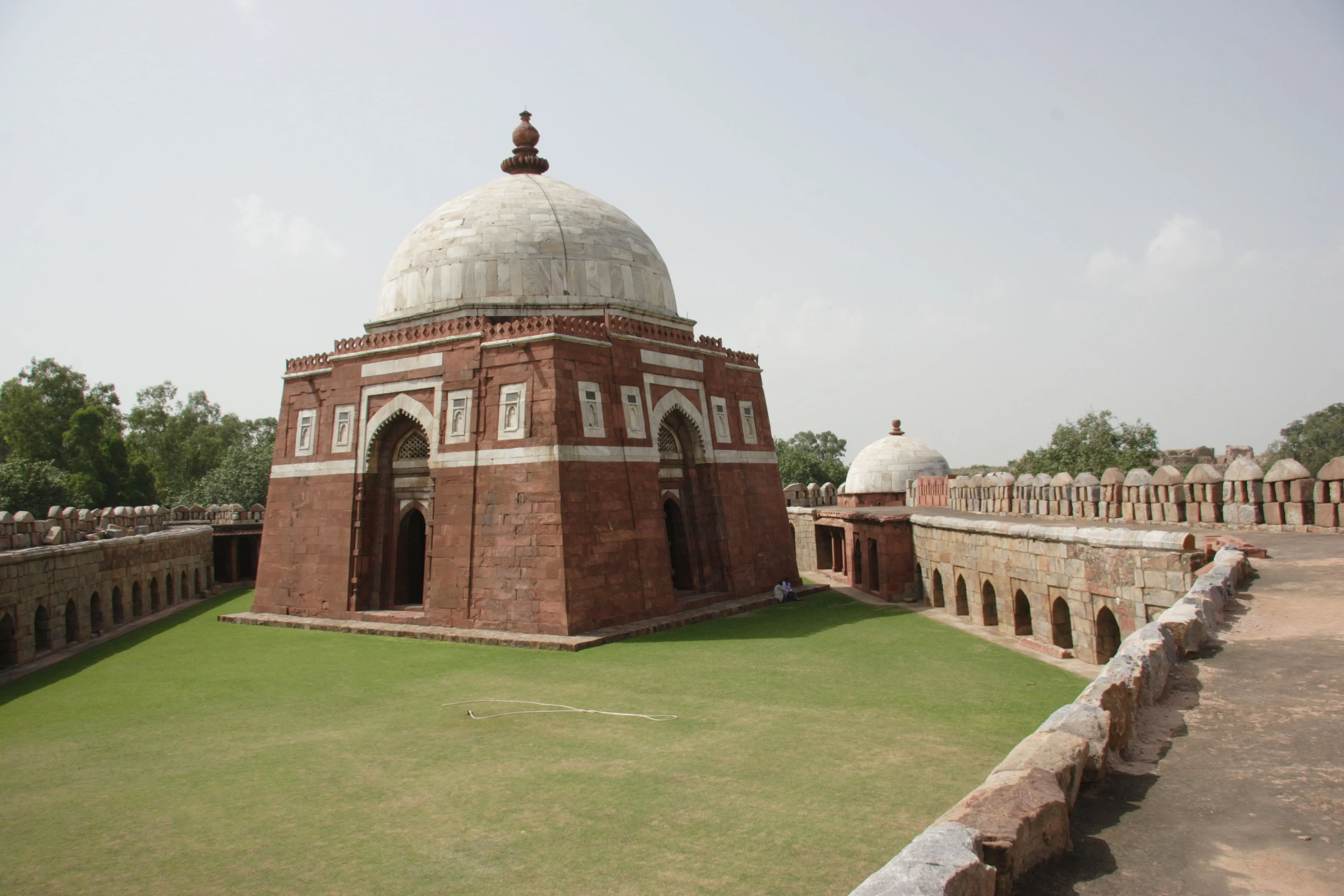
Ghiyath al-Din Tughluq Shah, known before his accession as Ghazi Malik, ruled the Delhi Sultanate from September 1320 until February 1325 and founded the third of its ruling dynasties. He came to the throne as a frontier soldier of obscure birth who had spent his career holding the northwest against Mongol incursion, and he took power in the aftermath of the collapse of the Khalji house, at a moment when the sultanate's political order had broken down entirely.
His reign lasted a little under four and a half years, which is short enough that he is usually treated as a preface to the far more consequential and controversial reign of his son Muhammad bin Tughluq. That treatment understates him. In those years he restored a functioning administration after four years of coups and murders, reversed the harshest features of the fiscal system built by Alauddin Khalji, recovered Warangal and asserted authority over Bengal, and built the fortress-city of Tughluqabad. The dynasty he founded governed from Delhi for most of the following century.
He is also the subject of one of the more persistent unresolved questions in the history of the sultanate. He died when a wooden pavilion collapsed on him at Afghanpur, and the traveller Ibn Battuta, writing some years afterwards, recorded a claim that his son had engineered it. Whether that claim is true cannot be established, and the article sets out below what the sources actually support.
Origins and Obscurity
Almost nothing about Ghiyath al-Din's early life is securely known, and the little the sources offer was recorded by men who had opinions about his fitness to rule.
The account transmitted by Ziya al-Din Barani, the principal narrative historian of the period, gives him a father who had come to India as a slave in the service of the sultan Ghiyath al-Din Balban, and who belonged to the Qarauna — a Turco-Mongol population of the Ghazni and Sind borderlands, of mixed descent and low standing in the eyes of the Delhi élite. His mother is described as a Jat woman of the Punjab. Neither his date of birth nor his place of birth is recorded.
This information has to be handled carefully in both directions. Barani was a member of the Delhi aristocracy with strong convictions about the social order, and he uses the humble origins of the Tughluqs as a recurring theme; low birth is, in his hands, an explanation for what he considers misgovernment. At the same time there is no reason to reject the substance, because the sultanate's own political history makes it entirely plausible. The Delhi Sultanate had been founded by a slave commander and its first dynasty was composed of military slaves and their descendants; men of servile origin reaching the highest offices was the system working as designed rather than an anomaly. Sunil Kumar's work on the sultanate's formation examines how thoroughly slave and client origins were built into its political structure.
What the obscurity does establish is that Ghazi Malik owed nothing to inheritance. His career was made entirely on the frontier.
The Mongol Frontier and the Command at Dipalpur
Ghazi Malik's reputation was made on the northwestern frontier, and the character of that warfare explains both his standing in 1320 and the kind of ruler he became.
From the 1290s the Chaghatai Mongols of Central Asia mounted a series of invasions of northern India through the passes of the northwest. These were not raids in the ordinary sense. Several were large armies with the apparent object of conquest: forces reached the neighbourhood of Delhi in 1299 and again in 1303, when the sultan was besieged in his own new fortress at Siri, and further invasions followed in 1305 and 1306–07. Had any of them succeeded, the Delhi Sultanate would have ended within a century of its foundation.
Alauddin Khalji's response, described in the article on his reign, was the most thorough military reorganisation the sultanate ever undertook: a large standing army paid in cash, the rebuilding and garrisoning of the frontier fortresses at Samana, Dipalpur and Multan, the fortification of Delhi itself, and the fiscal apparatus — including the notorious market controls — required to pay for it all. The system worked. After 1306–07 the great invasions ceased, though raiding continued into the 1320s.
Dipalpur, which Ghazi Malik held, was one of the two or three critical commands in that structure. Its governor was expected to meet incursions in the field rather than wait behind walls, to maintain a standing force at readiness, and to operate independently, since Delhi was too distant for orders to be useful in a fast-moving campaign. The tradition credits him with a long series of successful actions — the figure of twenty-nine appears, and should be read as meaning "very many" rather than as a count — and it is from this record that the title Ghazi attached to him.
Three things followed from that career and shaped his reign. He commanded the personal loyalty of a body of frontier troops who had fought under him for years, which is what made the march on Delhi in 1320 possible. He had spent his life in a command where administrative competence and military competence were the same thing, since an unpaid or unprovisioned garrison could not hold a frontier — which is consistent with the fiscal seriousness of his reign. And he understood the Khalji system from the inside, as the man at the receiving end of its revenues, which is relevant to his willingness to moderate its extraction without dismantling its military core.
His own origins add a complication worth noting. The Qarauna, to whom his father is said to have belonged, were Turco-Mongol groups of the Ghazni and Sind borderlands, some of whom entered Indian service. A frontier commander of partly Mongol descent defending India against Mongol invasion was not anomalous in the sultanate — the state's élite was substantially composed of men whose families had arrived from the northwest within living memory — but it is a reminder that the frontier was a zone of movement and recruitment as much as of conflict.
The Collapse of the Khaljis, 1316–1320
The four years before Ghazi Malik's accession were among the most disordered in the sultanate's history, and the disorder explains both how he came to power and what he did with it.
Alauddin Khalji died in January 1316 after a reign that had centralised authority to an extraordinary degree and left no mechanism for transferring it. His death was followed by the manipulation of the succession by the general Malik Kafur, the elimination of several of Alauddin's sons, and the eventual accession of Qutb al-Din Mubarak Shah. Mubarak Shah's reign, from 1316 to 1320, dismantled much of his father's system: the price controls and the fiscal apparatus were relaxed, confiscated grants restored, and the political discipline that had held the nobility in check abandoned.
In 1320 Mubarak Shah was murdered by his own favourite, Khusrau Khan, a commander of Baradu origin from Gujarat who had been captured as a youth and converted to Islam. Khusrau Khan took the throne as Nasir al-Din, and his brief rule alienated almost every constituency in the capital. The Turkish military nobility regarded him as an upstart of the wrong origin who had killed his master; the religious establishment objected to his elevation of his own kinsmen and to reports of their conduct; and the treasury was emptied in distributions intended to buy support.
Whatever the merits of the individual accusations — and the sources reporting them belong to the party that overthrew him — the political fact is clear. Within months Khusrau Khan had no reliable base, and the frontier armies were not under his control.
The Seizure of Power
Ghazi Malik moved from Dipalpur with his son Jauna and the frontier troops, and he did so with a stated justification: that the murder of the sultan and the conduct of the new regime required correction. Whether this was conviction or the necessary language of rebellion is not recoverable, but it mattered, because it gave him the support of the religious establishment and of nobles reluctant to appear as simple mutineers.
Khusrau Khan's forces met him near Delhi and were defeated in two engagements in September 1320, the second decisive. Khusrau Khan was captured and put to death.
The sources then describe an episode that has the shape of a legitimation ritual and is reported consistently enough to be worth recording. Ghazi Malik, according to Barani, assembled the nobles and asked whether any surviving member of the Khalji house remained who might take the throne, and accepted it himself only when none was produced. Modern historians generally read this as a formal proceeding designed to establish that the succession was necessary rather than usurped — which does not make it insincere, but does mean it should be understood as a political act rather than as evidence of reluctance.
He was enthroned as Ghiyath al-Din Tughluq Shah in September 1320, taking the regnal name of the sultan Balban whom his father had served. Sources differ by a few days on the exact date.
Revenue, the Village, and the Intermediary Classes
The fiscal policy of the reign is its most substantial civil achievement, and it can only be understood against what Alauddin Khalji had done, because it was a deliberate correction of it.
Alauddin's agrarian system had three features. The revenue demand in the core territories was set at a very high proportion of the produce — half is the figure the sources give for the Ganges–Yamuna Doab. Assessment was made by measurement of the sown area rather than by estimate or by a share of the actual harvest, which transferred the risk of a bad season entirely to the cultivator. And it was collected so far as possible directly from the peasantry, bypassing and deliberately impoverishing the rural intermediaries — the village headmen and district notables whom the sources call khuts, muqaddams and chaudhuris — whose perquisites were abolished and whose independent standing Alauddin regarded, correctly, as a political threat.
The system financed the defeat of the Mongols and the conquest of the Deccan. It also required constant supervision, generated deep resentment among exactly the classes whose cooperation rural administration depended on, and left no margin in a bad year. Barani, who admired Alauddin's firmness, is explicit about the impoverishment it produced.
Ghiyath al-Din's corrections, as Barani reports them, addressed each point. The demand was reduced from the Khalji level to a moderate assessment. The rigid reliance on measurement was relaxed in favour of methods that took account of the actual harvest, so that a failed season did not destroy the cultivator. The intermediary classes recovered a recognised position, with their perquisites restored — a political as much as a fiscal decision, since it bought the goodwill of the men who actually ran the countryside. And officials were forbidden to collect beyond the assessment, with severe penalties for extortion.
The most striking instruction Barani records is the rule on increases: that the demand should not be raised by more than a small fraction — a tenth or an eleventh — in any single year. This is a genuinely sophisticated piece of fiscal thinking. It accepts that revenue should grow with cultivation while capping the rate at which the state may take more, which is precisely the discipline Alauddin's system lacked and which his own grandson would abandon catastrophically in the Doab a decade later.
Two further measures belong here. Revenue officials were to be adequately remunerated, on the reasoning that underpaid collectors extort; and cultivation was to be actively encouraged, with irrigation works undertaken and the digging of wells and canals promoted. The tradition credits the reign with canal construction, and the claim should be kept in proportion: the great canal-building of the dynasty was the work of Firuz Shah Tughluq later in the century.
The general shape of the policy is a state trying to make its extraction sustainable. Irfan Habib's analysis of the medieval Indian agrarian economy treats the Tughluq settlement as an attempt to find a level of demand that the countryside could bear year after year, in place of a maximum that could be sustained only under continuous coercion.
Court, Nobility, and the Machinery of the Sultanate
The political settlement Ghiyath al-Din built inside Delhi is less documented than his fiscal policy and can be described in outline.
The nobility of the sultanate in 1320 was a mixed body: Turkish amirs of the older establishment, Khalji families, converts, Indian Muslims, and the frontier officers of the northwest. Its cohesion had been destroyed by the four years of coups, and the new sultan's task was to reconstitute a governing class that would obey him without becoming powerful enough to replace him.
His method combined his own following with reconciliation. The frontier officers who had marched with him from Dipalpur received commands and assignments; his sons and close kin took senior positions, with his eldest son Jauna Khan holding the principal military role; and men of the Khalji establishment who had not compromised themselves under Khusrau Khan were retained. Assignments of revenue — the iqta system, by which a noble received the income of a district in return for maintaining troops — were restored to a degree, after Alauddin's resumptions, which gave the nobility a material stake in the regime.
Alongside this ran a policy of conciliating the religious classes. Grants and endowments that Alauddin had confiscated were returned to scholars and to families claiming descent from the Prophet, and the ulama were treated with a public deference that Alauddin had not shown. Since the overthrow of Khusrau Khan had been justified in religious terms, this was both consistent and necessary.
The administrative machinery was that of the Khalji state, retained and repaired rather than redesigned: the wazir heading the revenue department, the departments of the army and of correspondence, provincial governors holding assignments, and judges appointed from the capital. The one system the sources single out for improvement is the postal and intelligence network, the dak, reorganised so that information moved reliably between the provinces and Delhi — an unglamorous measure and an indispensable one for a state whose territory stretched from Sindh to Bengal.
Barani's theoretical writing gives a sense of how a member of this élite understood the arrangement. In his treatise on statecraft he argues that social rank is divinely ordained, that the well-born should govern and the low-born be excluded, and that a sultan's duty includes maintaining these distinctions. He applies the theory to the Tughluqs with visible discomfort, since the dynasty's founder was on his own account the son of a slave. The tension in his account between approval of the policies and disdain for the man's origins is one of the more revealing features of the source.
Campaigns: The Deccan and Bengal
Ghiyath al-Din's military policy was directed at recovering what the Khalji collapse had lost rather than at new conquest.
The Kakatiya kingdom of Telangana, with its capital at Warangal, had been reduced to tributary status by Alauddin's campaigns and had ceased paying after 1316. In 1321 the sultan sent Jauna Khan south to bring it back. The first expedition failed: the sources describe a siege abandoned amid rumours that the sultan had died at Delhi, a breakdown of discipline in the camp, and a retreat that cost the army heavily. Jauna Khan returned and was sent again in 1323, and the second attempt succeeded. Warangal was taken, the Kakatiya ruler Prataparudra was captured, the kingdom was annexed rather than left tributary, and the city was renamed Sultanpur. A raid into Jajnagar in Orissa followed.
The annexation of Telangana was a significant change of policy. Alauddin had preferred tribute to administration in the south, on the reasonable view that governing the Deccan from Delhi was impractical. Bringing it under direct rule committed the sultanate to holding territory a very long way from its capital, and the difficulty of doing so is the direct background to the most criticised decision of the next reign — the attempt to govern from Daulatabad.
In Bengal the sultan intervened in 1324 in a succession dispute among the sons of the late ruler of Lakhnauti. He marched east, supported one claimant against another, and installed a dependent ruler, bringing western Bengal under the sultanate's authority and carrying the defeated claimant back toward Delhi. Bengal's distance and its river geography made any such settlement provisional, and it did not hold for long.
Tughluqabad
Ghiyath al-Din built a new fortified capital southeast of the existing settlements of Delhi, and it is the most substantial physical survival of his reign.
Tughluqabad was laid out on and around a rocky outcrop, with massive rubble-and-stone walls on a pronounced batter — sloping inward as they rise — punctuated by bastions and gates. The character of the architecture is unmistakably that of a soldier who had spent his career on the Mongol frontier: austere, thick-walled, sited for defence, and almost without ornament. It enclosed a citadel, a palace area, and a city quarter, with a reservoir formed by damming the ground to the south.
Within a walled enclosure connected to the fortress by a causeway across the water stands his tomb, a square structure of red sandstone and marble under a dome, with the same inward-sloping walls as the fortifications. It is one of the earliest surviving royal mausolea of the sultanate and it established a formal vocabulary — the sloping wall, the sturdy dome, the fortified enclosure — that later Tughluq building developed.
Tughluqabad was not occupied for long. The reasons are not fully established; water supply is the explanation usually offered, and the shifting of the court under his successor did the rest. It stands today as a ruin.
The Chishti Question
The reign coincided with the last years of Nizam al-Din Auliya, the Chishti Sufi shaykh whose following in Delhi was very large and whose spiritual authority was, in practical terms, a rival centre of allegiance to the court.
The sources describe friction between sultan and shaykh. Several strands are reported: that Khusrau Khan had made large gifts to the shaykh's establishment, which the new regime resented and sought to recover; that the sultan objected to the Chishti practice of sama, the use of music in devotional assemblies, which the stricter jurists condemned; and that the shaykh's independence and popularity were politically uncomfortable.
Around this friction a body of tradition later accumulated, and it must be identified as tradition. The best known element is the phrase attributed to Nizam al-Din when told that the sultan was returning from Bengal intending to deal with him — hunuz Dilli dur ast, "Delhi is yet far off" — understood as a prediction that the sultan would never arrive. Since Ghiyath al-Din in fact died at Afghanpur before entering the city, the phrase became one of the most famous sayings in the hagiographical literature of the Indian Chishtis and passed into proverb.
This material comes from devotional literature composed to demonstrate the shaykh's sanctity, and it is not evidence of what was said or intended. Nizam al-Din died in April 1325, a few weeks after the sultan. The friction between the court and the Chishti establishment is well attested in outline; the prophecy is hagiography, and presenting it as history would misrepresent both the sultan and the saint.
Death at Afghanpur
In February 1325 Ghiyath al-Din was returning to Delhi from the Bengal campaign. At Afghanpur, a village near the capital, a wooden reception pavilion had been erected for a ceremony of welcome. It collapsed on him, and he was killed, together with his son Mahmud Khan.
His eldest son Jauna Khan succeeded within days as Muhammad bin Tughluq.
The nature of the collapse is the disputed point, and the state of the evidence deserves a plain statement.
Ibn Battuta, who reached India in 1334 — nine years after the event — and wrote his account later still, records a detailed allegation: that Jauna Khan had the pavilion constructed so that it would fall when elephants were driven against it, and that the collapse was therefore murder. He presents it as what he was told, and his account is circumstantial.
Isami, writing his verse history in 1350, also points toward foul play. Barani, whose Tarikh-i Firuz Shahi was completed around 1357 and who is the most detailed narrative source for the period, treats the death as a calamity without endorsing the charge of parricide — a reticence that is itself difficult to interpret, since Barani was writing under Muhammad's successor and was in general willing to criticise Muhammad severely.
Modern historians are divided and no consensus exists. The considerations usually weighed are that Ibn Battuta was not present and was repeating court gossip a decade old; that he is elsewhere both a valuable witness and an uncritical transmitter of rumour; that Muhammad had motive and opportunity in the abstract; that structural collapse of a hastily built ceremonial pavilion during the monsoon-damaged season requires no conspiracy; and that the death of Muhammad's own brother in the same collapse cuts against a carefully controlled plot.
The honest position is that the allegation is recorded, that it cannot be verified, and that it should not be repeated as established fact. It is reported here as a claim made by a later source, which is what it is.
Legitimacy and the Founding of a Dynasty
A frontier soldier of servile descent who seized the throne by force needed to explain why he should hold it, and the means available to him are worth setting out, because they show what legitimacy consisted of in the Delhi Sultanate.
Four resources were available and Ghiyath al-Din used all of them.
The first was the necessity argument. The assembly at which he asked whether any Khalji survivor remained, and accepted the throne only when none was produced, was a formal proceeding designed to establish that the succession was unavoidable rather than usurped. It converted a military coup into the filling of a vacancy, with the nobility as witnesses. Whether the enquiry was sincere is beside the point; it was a legal-political act.
The second was the religious justification. Khusrau Khan's rule had been characterised — by the party that overthrew it, and in the sources that party produced — as a violation of the proper order: the murder of a sultan by his favourite, the elevation of his own kinsmen, and conduct offensive to Muslim opinion. Presenting the march from Dipalpur as a correction of this gave the new regime the endorsement of the ulama, and the restoration of confiscated religious endowments confirmed it. This was the cheapest and most effective legitimation available, and it explains the emphasis the tradition places on Khusrau Khan's alleged offences.
The third was the record of frontier service. The title Ghazi, earned against the Mongols, carried real weight in a state whose principal claim on its subjects was protection from invasion. A ruler who had personally held the northwest for a generation could argue that he was the man best placed to keep holding it, and the argument was true.
The fourth was performance in office. The moderation of the revenue demand, the restoration of the intermediaries' position, the endowments returned to scholars, the recovery of Warangal and the intervention in Bengal all functioned as demonstrations that the new dynasty governed better than the old — which is the form legitimacy takes when descent is unavailable.
What he could not do was claim high birth, and Barani's persistent hostility on exactly that point shows the limit. The theory of divinely ordained rank held by the Delhi élite had no place for a sultan whose father had been a slave and whose mother was a Jat woman of the Punjab, and no amount of competence closed the gap. The dynasty's answer over time was simply duration: by the reign of Firuz Shah Tughluq the Tughluqs were the established house, and the question of origins had become a literary complaint rather than a political problem.
The Tughluq Dynasty After Him
The dynasty Ghiyath al-Din founded in 1320 governed from Delhi for most of the following century, and its trajectory is the measure of what he began.
His son Muhammad bin Tughluq reigned from 1325 to 1351 over the largest territory the sultanate ever held, and left it fragmented: Bengal, Ma'bar in the far south and the Deccan all broke away, and the Bahmani Sultanate and the kingdom of Vijayanagara were established in provinces the dynasty had governed.
His nephew Firuz Shah Tughluq, who reigned from 1351 to 1388, took the opposite course and made a settlement of the diminished empire. He abandoned the attempt to recover the Deccan and the south, conciliated the nobility and the religious establishment, made grants where his predecessors had confiscated, and concentrated on administration, building and irrigation within the territory he could actually govern. His canal systems in the Punjab and the Jumna region were the most extensive public works of the sultanate, and his reign is remembered as prosperous and stable — an implicit vindication of his uncle's judgement that a sustainable demand on a smaller base was preferable to a maximum on an overextended one.
After Firuz Shah's death the sultanate declined through contested successions and the progressive independence of provincial governors. In 1398 Timur invaded northern India, stormed Delhi, and sacked it with great loss of life, destroying what remained of the sultanate's power and prestige. The Tughluq line ended shortly afterwards, in the second decade of the fifteenth century, and the Sayyid and Lodi dynasties that followed governed a much reduced territory around Delhi until Babur's victory in 1526 brought the Mughals.
The relevance to Ghiyath al-Din is a matter of proportion. The state he repaired in under five years survived nearly a century, produced the sultanate's greatest territorial extent and its most successful administrative reign, and was destroyed in the end by an external invasion rather than by the structural weaknesses he had inherited. For a ruler who came to power in the fourth year of a succession crisis, with no dynastic claim and a coalition of former enemies, that is not a small result.
Historiographical Note
The sources for this reign are relatively good by the standards of the Delhi Sultanate, and they are also strongly interested.
Barani's Tarikh-i Firuz Shahi is the central narrative. Barani was a Delhi aristocrat writing in the 1350s under Firuz Shah Tughluq, with a developed political theory in which social hierarchy was divinely ordered and the low-born were unfit for authority. His hostility to the Tughluqs' origins colours his account, and his history is also a work of advice to rulers, in which episodes are shaped to carry lessons. He nonetheless had access to court knowledge and administrative detail available nowhere else, and his description of the fiscal policy of this reign is the foundation of everything written about it since.
Isami's Futuh al-Salatin, a verse history completed in 1350 at the Bahmani court in the Deccan — that is, in a state that had broken away from Delhi — is hostile to Muhammad bin Tughluq and correspondingly favourable to his father. Ibn Battuta's Rihla offers an outsider's testimony of great value for social observation and of uneven value for political events he did not witness. Yahya bin Ahmad Sirhindi's Tarikh-i Mubarak Shahi, from the fifteenth century, transmits the tradition at a further remove.
The consequence is that the outline of the reign is secure — the rise at Dipalpur, the overthrow of Khusrau Khan, the moderation of the revenue demand, the two Warangal expeditions and the annexation of Telangana, the Bengal intervention, the building of Tughluqabad, and the death at Afghanpur — while three areas remain genuinely uncertain. His origins are described only by a hostile witness. The extent and precise terms of the fiscal reforms rest on Barani alone. And the cause of his death is contested, with the conspiracy allegation resting on a source who was not present.
Peter Jackson's political and military history of the sultanate is the standard modern account and is careful about these distinctions; Sunil Kumar's work re-examines the political sociology within which men of servile and frontier origin rose to power.
Assessment
Ghiyath al-Din Tughluq was a competent restorer of a broken state, and that is a more considerable thing than the brevity of his reign suggests.
He inherited a sultanate that had lost three rulers in four years, exhausted its treasury, and abandoned both the Khalji fiscal system and the political discipline that had sustained it. In under five years he re-established a working revenue administration on terms moderate enough to be sustainable, restored relations with the religious establishment that his predecessors had damaged, recovered the Deccan and asserted authority in Bengal, secured the frontier he had spent his career defending, and built a fortified capital. The dynasty he founded held Delhi for the better part of a century, and it did so on foundations he laid.
His fiscal moderation deserves particular notice because it reflects a genuine understanding of the problem. Alauddin Khalji's system had extracted the maximum the countryside could yield and had required the sultan's personal attention to function; it collapsed the moment that attention was withdrawn. Ghiyath al-Din's instruction that the demand should rise only gradually, and his insistence that officials not exceed the assessment, address exactly the failure mode of the earlier model. Barani, no admirer of the man's birth, records the policy approvingly.
The limits are equally clear. His reign was too short to test whether the settlement would hold, and the evidence suggests it would have been strained: annexing Telangana outright committed the sultanate to administering territory it could not easily reach, and the Bengal arrangement was inherently unstable. Tughluqabad was abandoned within a generation. The friction with the Chishti establishment was left unresolved. And the succession, however it came about, transferred power to a son whose reign would take the sultanate to its greatest nominal extent and then break it apart.
The unresolved question of his death has probably distorted his reputation more than any of this. A ruler chiefly remembered for the manner of his dying, and for a Sufi saying attached to it, is remembered for the least substantial part of his record. The durable part is the administrative repair of a state in collapse — unglamorous, well attested, and the reason the Tughluq dynasty existed at all.
References and Further Reading
Primary Islamic Sources
- Quran, Surah Al-Imran (3:26) — on the granting and withdrawal of sovereignty, invoked in the sultanate chronicles at every change of dynasty
- Quran, Surah al-Nisa (4:58–59) — on rendering trusts, judging justly, and obedience to those in authority; the scriptural basis of the sultanate's theory of legitimate rule
- Quran, Surah al-Hadid (57:25) — on the balance and the establishment of justice, the text underlying the Persianate ideal of the just ruler that Barani applies to this reign
- Sahih al-Bukhari, Kitab al-Ahkam (Book of Judgements), and Sahih Muslim, Kitab al-Imarah (Book of Leadership) — the prophetic material on the responsibilities of rulers toward the governed, and on oppression in taxation
- Fawaid al-Fuad, the recorded discourses of Nizam al-Din Auliya compiled by Amir Hasan Sijzi — the primary Chishti source for the religious life of Delhi in these years
Classical Islamic Sources
- Barani, Ziya al-Din. Tarikh-i Firuz Shahi. [c. 1357] — the central narrative source, and the only detailed account of the fiscal reforms
- Isami, Abd al-Malik. Futuh al-Salatin. [1350] — a verse history written at the Bahmani court
- Ibn Battuta. Rihla (Travels). [c. 1355] — the source of the allegation concerning the death at Afghanpur
- Sirhindi, Yahya bin Ahmad. Tarikh-i Mubarak Shahi. [15th century]
- Barani, Ziya al-Din. Fatawa-i Jahandari. [14th century] — Barani's treatise on kingship, which sets out the political theory behind his historical judgements
- Amir Khusrau. Tughluq Nama. [14th century] — a contemporary Persian verse account of Ghazi Malik's victory over Khusrau Khan
- Firishta, Muhammad Qasim. Tarikh-i Firishta. [c. 1606] — a later compilation preserving the tradition
Academic and Scholarly Sources
- Jackson, Peter. The Delhi Sultanate: A Political and Military History. Cambridge: Cambridge University Press, 1999. — the standard modern political narrative
- Kumar, Sunil. The Emergence of the Delhi Sultanate, 1192–1286. New Delhi: Permanent Black, 2007. — on the political sociology of slave and frontier origins
- Habib, Mohammad and Nizami, Khaliq Ahmad, eds. A Comprehensive History of India, Vol. V: The Delhi Sultanate. New Delhi: People's Publishing House, 1970.
- Habib, Irfan. Economic History of Medieval India, 1200–1500. New Delhi: Pearson Longman, 2011. — on the revenue systems of the Khalji and Tughluq periods
- Nizami, Khaliq Ahmad. The Life and Times of Shaikh Nizam-u'd-din Auliya. Delhi: Idarah-i Adabiyat-i Delli, 1991.
- Digby, Simon. "The Tomb of Ghiyath al-Din Tughluq." In studies on sultanate architecture and political culture.
- Auer, Blain. Symbols of Authority in Medieval Islam: History, Religion and Muslim Legitimacy in the Delhi Sultanate. London: I.B. Tauris, 2012.
- Kumar, Sunil, ed. Demolishing Myths or Mosques and Temples? Gurgaon: Three Essays Collective, 2008.
Further Reading
- Eaton, Richard M. India in the Persianate Age, 1000–1765. London: Allen Lane, 2019.
- Asher, Catherine B. and Talbot, Cynthia. India Before Europe. Cambridge: Cambridge University Press, 2006.
- Welch, Anthony and Crane, Howard. "The Tughluqs: Master Builders of the Delhi Sultanate." Muqarnas 1 (1983).
- Rizvi, Saiyid Athar Abbas. A History of Sufism in India. 2 vols. New Delhi: Munshiram Manoharlal, 1978.
- Nizami, Khaliq Ahmad. Studies in Medieval Indian History and Culture. Allahabad: Kitab Mahal, 1966.
Mentioned In
4 articles reference this topic
More from South Asian Islam
Delhi Sultanate: Islamic Rule in Medieval India
The Delhi Sultanate (1206-1526 CE) was a series of five successive Islamic dynasties that ruled northern India for over three centuries, establishing Muslim political power in the subcontinent, creating a unique Indo-Islamic culture, and leaving an enduring architectural and administrative legacy.
Ahmed Raza Khan Barelvi and the Barelvi Movement
Ahmed Raza Khan of Bareilly (1856-1921) was an Indian Hanafi jurist, Sufi of the Qadiri order and prolific writer whose defence of the veneration due to the Prophet and the saints gave rise to the movement known as Barelvi, whose adherents call themselves the ulama of the Ahl-i Sunnat wa Jamaat.
Darul Uloom Deoband: The Seminary and the School of Thought
Darul Uloom Deoband is an Islamic seminary founded in northern India in 1866 or 1867 and the origin of the Deobandi school of thought. Its innovation was institutional: it carried the traditional religious sciences in the form of a modern school funded by public subscription.
The Ahl-i Hadis Movement
A nineteenth-century Indian Sunni movement that set aside the authority of the historic schools of law in favour of direct recourse to the Qur'an and hadith. Led by scholars at Delhi and Bhopal, it was marked by its manner of prayer and an austere standard of interpretation.