Darul Uloom Deoband: The Seminary and the School of Thought
Darul Uloom Deoband is an Islamic seminary founded in northern India in 1866 or 1867 and the origin of the Deobandi school of thought. Its innovation was institutional: it carried the traditional religious sciences in the form of a modern school funded by public subscription.
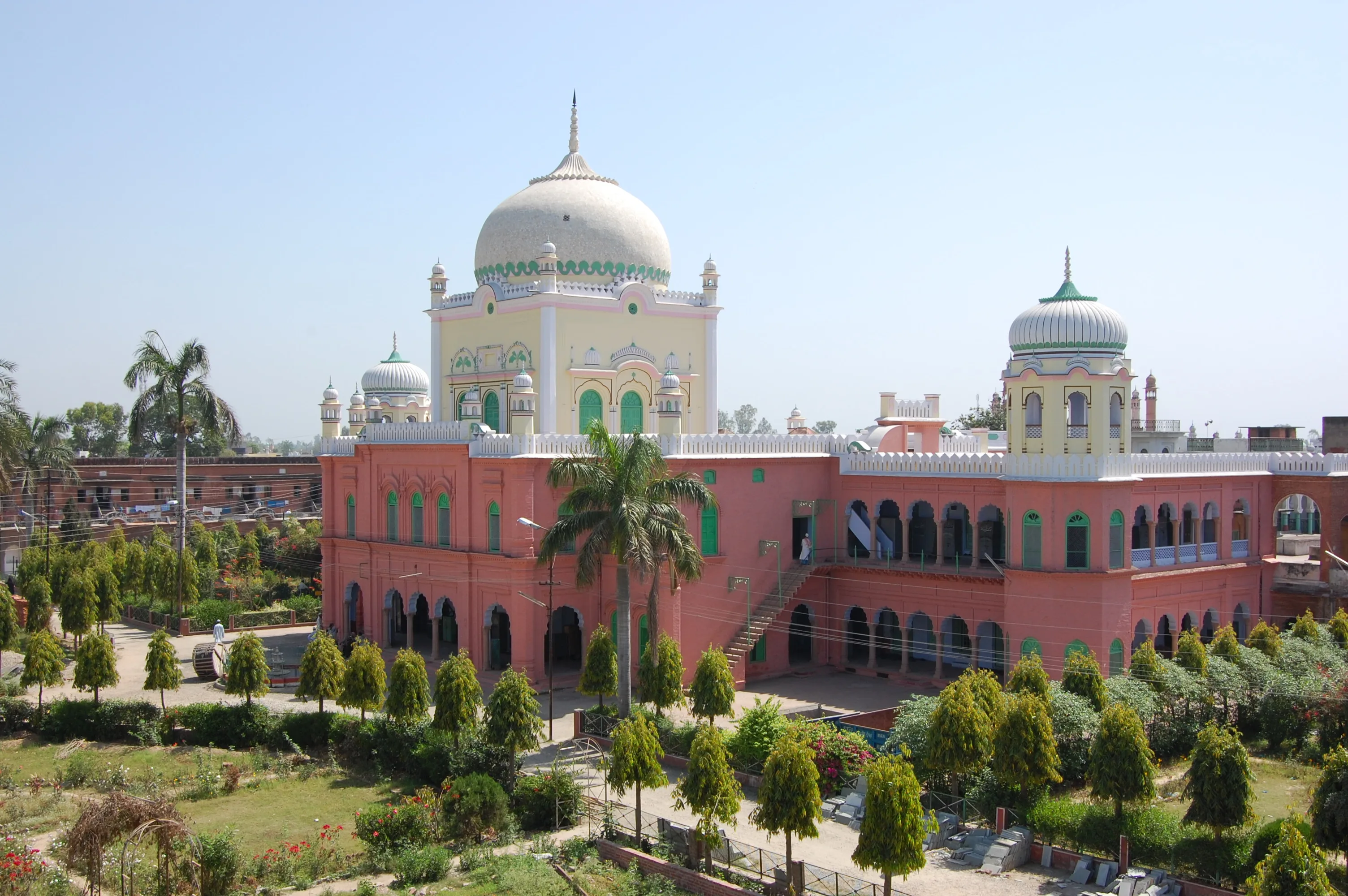
Darul Uloom Deoband is an Islamic seminary in the town of Deoband, in the Saharanpur district of Uttar Pradesh, India. It is the original institution of the Deobandi school of thought, which became one of the principal orientations of Sunni Islam in South Asia and, through migration, in Britain, South Africa and elsewhere.
Its historical significance is easy to state and easy to get wrong. Deoband is often described as a conservative reaction against colonial modernity, and in the content of its teaching that description holds: the curriculum was the traditional one, English and the modern sciences were not taught, and the school set itself against practices it judged to be innovations. But in its form Deoband was something new. As Barbara Metcalf established in the study that remains the standard work on the subject, the madrasa as a formal institution — organised into classes, teaching a sequential curriculum, staffed by salaried faculty, and supported by public charitable subscription — was a product of the colonial period and reflected familiarity with European educational institutions. Deoband's founders took the organisational apparatus of the colonial school and used it to carry a body of learning that the colonial school had no interest in carrying. That combination is what made the institution reproducible, and it is why a seminary in a country town became the model for hundreds of others.
Origins
The Situation After 1857
Deoband was founded within a decade of the revolt of 1857, and the connection is direct. The revolt's suppression fell very hard on the Muslim service and scholarly classes of northern India; Delhi, the centre of Muslim learning in the subcontinent, was devastated, and the Mughal monarchy was abolished. The forms of patronage on which religious learning had depended — court appointments, princely stipends, revenue-free land grants — were disrupted or destroyed.
The scholars who founded Deoband drew on the intellectual tradition of Delhi, and behind it on the eighteenth-century reform associated with Shah Waliullah and his successors, with its characteristic emphasis on returning to the Qur'an and the hadith as the measure of practice. What was new was not the doctrine but the recognition that its transmission now needed an institution capable of surviving without political patronage.
Foundation: 1866 or 1867
The date of the foundation is not agreed, and the disagreement should be reported rather than resolved. The seminary's own tradition places its beginning on 15 Muharram 1283 AH, corresponding to 30 or 31 May 1866, in the Chhatta Masjid at Deoband; this is the date generally given in South Asian accounts and by the institution itself. The major academic reference works give 1867 — Metcalf, the Encyclopaedia Britannica and the Encyclopaedia Iranica all use that year. Both dates are in serious use and this article gives neither as settled.
The beginning was modest to the point of being emblematic: a single teacher, a single student, and a pomegranate tree in a mosque courtyard. The first teacher was Mulla Mahmud. The first student was Mahmud Hasan, later known as Shaykh al-Hind, who would become the seminary's most senior figure and, in 1920, lay the foundation stone of Jamia Millia Islamia.
The Founders
Attribution of the founding to a single person is unsafe, and the sources differ on whom to credit. Muhammad Qasim Nanautavi (1833–1877) is the principal intellectual figure and the one most associated with the institution's design and doctrine. Rashid Ahmad Gangohi (1829–1905) was the other major founding scholar, and the leading authority in law and Sufi guidance in the school's first generation. Haji Muhammad Abid initiated the subscription that raised the funds and served as its first rector (muhtamim); Britannica credits him as founder on that basis. Others in the founding circle included Fazlur Rahman Usmani, Zulfiqar Ali, Mahtab Ali and Nehal Ahmad. The plural character of the founding is itself characteristic: Deoband was constituted as an institution with officers and a governing council rather than as the circle of a single master.
The Institution
What Was New
Before the colonial period, a student seeking advanced training in the Arabic religious sciences would attach himself to one or more teachers, travelling from place to place, and would receive not a degree but a certificate recording the completion of particular books. The madrasa as a standing corporate institution was not, on Metcalf's account, a major feature of the pre-colonial landscape.
Deoband's apparatus was different in several specific respects, and the list is worth setting out because each item was a departure:
The school was organised into graded classes following a fixed sequential curriculum, with examinations and a formal completion. It employed salaried teachers, making teaching a profession rather than a service rendered alongside another occupation. It had an administrative structure — a rector, a governing council, accounts — that outlived any individual. It maintained a central library. By the end of the nineteenth century it had formalised the office of chief mufti, giving the issuing of legal opinions an institutional rather than a personal basis. And it was financed by small charitable contributions gathered from a wide public.
That last point carried the most weight. Deoband's founders deliberately turned away from princely patronage — increasingly constrained in any case — toward popular subscription, and they used the new infrastructure of the colonial economy to collect it: the printing press, the postal system and the railways. An institution funded by many small donors is answerable to no ruler and cannot be closed by withdrawing a grant. It was this financial design, more than any doctrine, that allowed Deoband to survive the collapse of Muslim political power that had produced it, and to be copied. By the end of the nineteenth century it had spun off some two dozen further seminaries across the subcontinent.
Curriculum and Life
The course of study was a reformed version of the Dars-i Nizami, the curriculum long established in South Asian madrasas, adjusted to place the study of hadith at its summit — the final year, devoted to the reading of the canonical collections, is known as the dawra-e-hadith. Alongside it students read Qur'anic exegesis, Hanafi jurisprudence and legal method, theology, logic, rhetoric and Arabic grammar.
The founders were, above all, specialists in prophetic hadith, and this determined the character of the school. Hadith supplied both the standard against which existing practice was measured and the material of devotion to the Prophet.
English and the modern sciences were not taught. Urdu served as the common language, which had an effect the founders may not have anticipated: it linked students from Bengal to Central Asia in a single scholarly network. Students were provided with their basic necessities, lived austerely, and were held to a demanding schedule.
The Founding Principles
The seminary's own tradition preserves a set of administrative maxims attributed to Nanautavi, usually referred to as the eight principles (usul-e-hasht-gana), which were understood as guidance on how the institution should be kept alive. Their substance, rather than their exact wording, is what matters here, and it is consistent with the design described above: that the school should depend on many small contributions and not on a single large benefactor or a fixed permanent endowment, since dependence on one source creates a single point of failure and a patron with leverage; that it should not seek government support; that those running it should not be motivated by salary; and that a degree of insecurity in its finances was actually desirable, because it kept those responsible attentive and dependent on God rather than on an income stream.
Whatever one makes of the reasoning, the practical result is not in doubt. An institution constructed on these lines was very hard to suppress and very easy to imitate, and both facts shaped the following century.
The Scholarly Generation
Deoband's influence was carried by the scholars it produced, and several are consequential enough to name.
Mahmud Hasan (1851–1920), Shaykh al-Hind, was its first student and became its principal teacher of hadith and its most prominent public figure; he began an Urdu translation of the Qur'an, completed by his student Shabbir Ahmad Usmani.
Ashraf Ali Thanawi (1863–1943), titled Hakim al-Ummat, is arguably the most widely read of them. His Bahishti Zewar ("Heavenly Ornaments"), written in Urdu in the first years of the twentieth century as a complete religious and practical education for Muslim women, became one of the most influential Muslim publications of the century in South Asia — a standard gift to brides, of whom it was said that they entered their husband's house with the Qur'an in one hand and the Bahishti Zewar in the other. Metcalf's annotated partial translation, Perfecting Women, made it accessible to scholarship outside Urdu. Thanawi was also a Sufi guide with a very large following, which bears directly on the point made in the next section.
Anwar Shah Kashmiri (1875–1933) was the seminary's leading hadith scholar of the following generation. Husain Ahmad Madani held the chair of hadith and led the Jamiat Ulama-e-Hind through the Partition debates. Shabbir Ahmad Usmani took the opposite political course and led the scholars who supported the demand for Pakistan.
The sister seminary Mazahir al-Ulum at Saharanpur, founded in the same period and closely connected in personnel, should be mentioned alongside Deoband, since much of what is described as Deobandi in the twentieth century — including the origins of the Tablighi Jamaat — runs through it as much as through Deoband itself.
Sufism at Deoband
One correction matters more than any other for understanding this institution, because the common assumption is precisely wrong. Deoband was not an anti-Sufi movement. Its founding scholars were themselves initiated Sufis and Sufi guides; many of the teachers shared bonds of discipleship, and many students sought initiation. Nanautavi and Gangohi were both shaykhs as well as jurists.
Metcalf describes the resulting arrangement as a composite form of religious leadership, in which the same men were scholars of hadith and law and also spiritual directors, and she notes the wider consequence: because Muslims in South Asia were not required to choose between Sufism and reformist learning, both retained a vitality they lost in some other parts of the Muslim world. What Deoband opposed was not Sufism but specific practices — what its scholars judged to be excesses at the tombs of saints, elaborate life-cycle ceremonies, and observances they attributed to Shia influence.
The focus on hadith was itself connected to this. Studying the Prophet's reported words and practice was not only a means of testing existing custom against a textual standard; it was also a devotional discipline, a way of cultivating attachment to the Prophet, and it linked the student through chains of Sufi initiation to those understood as his spiritual heirs. Ashraf Ali Thanawi, the most widely read Deobandi author, was also one of the most sought-after Sufi guides of his generation. Any account of Deoband as a movement of dry legalism has to explain him away.
On the "Wahhabi" Label
Deoband is sometimes described as Wahhabi or as derived from Wahhabism, including in older reference works. The description is inaccurate and its history is worth knowing. Deoband is Hanafi in law and Sufi in spiritual practice, both of which distinguish it from the Arabian movement associated with Muhammad ibn Abd al-Wahhab. The label was applied in colonial India as a term of accusation, and Metcalf records that from colonial times to the present it has been used to discredit any reformist or politically active Islamic group. Among the South Asian orientations it was the Barelvis who applied it to the Deobandis. The related nineteenth-century Indian movement to which the label was attached by the colonial administration — that of Sayyid Ahmad Barelvi — is a distinct phenomenon and identifying Deoband with it is a further error.
Deoband and Its Rivals
Deoband was one of several reformist currents competing over the same question of correct practice, and the divisions between them have proved remarkably durable.
The Ahl-i Hadith rejected the authority of the established legal schools in favour of direct recourse to hadith, and went further than Deoband in opposing practices such as visiting graves. The movement known as Barelvi, after Ahmad Riza Khan of Bareilly (1856–1921) — whose adherents call themselves Ahl al-Sunnat wa'l-Jama'at, asserting that they are not a sect — engaged in the same exercise of measuring practice against hadith but reached considerably more accommodating conclusions about customary devotion, particularly regarding the Prophet and the saints. The polemics between Deobandi and Barelvi scholars were extensive, sharp, and conducted largely through printed pamphlets and fatawa.
These three orientations came to define much of the internal division among Sunni Muslims of South Asian background, and they were carried by migration: mosques, seminaries and organisations in Britain, South Africa and elsewhere are still identified by these labels. This encyclopaedia records the divisions and does not adjudicate them.
It is worth adding a point Metcalf makes about the fatawa themselves, since it cuts against the impression that a seminary of this kind produces fixed rulings. A fatwa is an attempt to fit accepted precedent to present circumstances, it was well understood that opinions could legitimately differ, and Islamic law at its core is contextual rather than rigid.
Politics
From Quietism to the Freedom Movement
In the decades after 1857 the Deobandi scholars adopted a stance of political quietism, which was a reasonable response to the severity of the reprisals. That changed after the First World War, when the Indian nationalist movement became a mass movement. Organised as the Jamiat Ulama-e-Hind — the Association of the Ulama of India, founded in 1919 — the Deobandi leadership aligned itself with Gandhi and the Indian National Congress against British rule. They never constituted a political party.
Mahmud Hasan's own trajectory illustrates the shift. He was interned by the British at Malta from 1917 to 1920 for his part in the anti-colonial activity known as the Silk Letter conspiracy, returned to lay the foundation stone of Jamia Millia Islamia in October 1920, and died the following month.
Metcalf notes a historiographical consequence of this reorientation that is instructive about institutional memory generally: Deobandi histories written before 1920 insisted that the ulama had not taken part in the rebellion of 1857, while those written afterwards give freedom-fighters pride of place. The same institution's account of its own origins changed as its politics changed.
Partition
Most Deobandi scholars opposed the creation of Pakistan. Their objection was not to Muslim political interests but to the specific proposition of a separate state for Muslims led by a westernised and secular leadership; they judged that they would do better in an officially secular India where they could pursue their own aims independently of government. Husain Ahmad Madani, Deoband's principal hadith scholar and the leading figure of the Jamiat Ulama-e-Hind, argued the case at length, and his exchange on composite nationhood with Muhammad Iqbal is among the significant intellectual confrontations of the period.
Deoband was not unanimous. A minority of its scholars dissented, organised as the Jamiat Ulama-e-Islam, and supported the Muslim League and the demand for Pakistan; after 1947 that body became a political party in Pakistan and a participant in the long argument over the character of the Pakistani state.
Tablighi Jamaat
The largest movement to emerge from the Deobandi milieu began in the late 1920s and took a deliberately different form. Maulana Muhammad Ilyas Kandhlawi (d. 1944), whose family had long associations with Deoband and with its sister seminary Mazahir al-Ulum at Saharanpur, sought a way to reach nominally Muslim peasants in Mewat, south of Delhi, and founded what became the Tablighi Jamaat.
Its distinguishing move was to shift the work of teaching out of the seminary. Ordinary Muslims, however little formal learning they had, were to go out in groups to remind other Muslims of their basic ritual obligations. The movement developed a characteristic pattern of commitment — an evening a week, a weekend a month, forty days a year, and a hundred and twenty days at least once in a lifetime — while maintaining no formal bureaucracy, no membership records and no paid staff. It also avoided the doctrinal polemics that occupied the seminaries.
It became, by the end of the twentieth century, a genuinely global movement, with annual gatherings drawing very large numbers at Raiwind in Pakistan and Tongi in Bangladesh, regional gatherings in India, and convocations in Europe and North America.
The Seminary in the Twentieth and Twenty-First Centuries
Deoband experienced a serious internal dispute over control of the institution in the early 1980s, which produced a lasting institutional division in the town. The seminary continued to operate and to grow, and published enrolment figures differ by source: Metcalf gave over three thousand students at the turn of the century, while Britannica's estimate is around five thousand. Its library holds a very large collection of printed books and manuscripts in Arabic, Persian, Urdu and other languages. In the mid-1990s the Government of India ended the visa arrangements that had allowed foreign students to enrol, which altered the composition of the student body.
Within India the seminary's ulama maintained the pattern set before independence: no political party of their own, and cooperation with non-Muslim parties justified as the means of protecting Muslim interests. Visitors have consistently reported a marked continuity in what is taught and how.
Partition also divided the network rather than the institution. Deoband itself remained in India, while the Deobandi seminaries of what became Pakistan and later Bangladesh developed separately and in very different political conditions — a distinction that matters for the section below, since conclusions drawn about seminaries in one of these countries are frequently attributed to the school in another. Migration extended the network further, and seminaries founded on the Deobandi model now operate in Britain, South Africa and elsewhere, training imams for South Asian diaspora communities.
The Question of the Taliban
Because the Afghan Taliban identified themselves with the Deobandi school of thought, Deoband received a great deal of international attention from 2001 onwards, much of it imprecise. The relationship needs to be stated carefully, and the most authoritative treatment is Metcalf's own, written directly in response to that coverage.
The facts are these. The Taliban placed themselves within a Sunni school of thought named after Deoband, and many of their members had studied in seminaries of the Deobandi network. That network is very large and has no central authority. The schools in question were on the Pakistan–Afghan frontier and in southern Afghanistan, above all the Madrasa Haqqaniyya at Akora Khattak near Peshawar, which trained a number of the Taliban leadership. Those seminaries multiplied in Pakistan from the 1980s, encouraged under the government of Zia-ul-Haq, at a period when some three million Afghan refugees had arrived and frontier madrasas were often the only schooling available to their sons.
Several distinctions follow. Ahmed Rashid, whose history of the movement is the standard account, characterised the Taliban's position as an extreme form of Deobandism preached in the Afghan refugee camps in Pakistan rather than as Deobandi teaching as such. Metcalf records that the Taliban's severity, particularly regarding women, was criticised even by leading ulama of the Jamiat Ulama-e-Islam — the Pakistani Deobandi party. And she observes that the Deobandi movements have no theoretical position on political life at all: politics functions as an empty category filled pragmatically according to circumstance, which is why the same school of thought produced quietists in nineteenth-century India, Congress allies in the twentieth, an apolitical missionary movement in the Tablighi Jamaat, and a governing movement in Afghanistan.
Darul Uloom Deoband in India is a distinct institution from the frontier seminaries, and its own ulama have continued the political practice described above. The general point Metcalf presses is that "Deobandi" names a broad orientation with a genealogy, not an organisation with a command structure, and that treating the label as though it did the latter produces conclusions the evidence will not support.
Assessment
Deoband's importance rests on an institutional innovation whose significance is easy to underestimate because it looks administrative. Faced with the destruction of the patronage that had sustained religious learning, its founders did not simply continue teaching in reduced circumstances; they redesigned the vehicle. A graded curriculum, salaried teachers, a governing council, an office of chief mufti, a library, and funding from many small donors together produced an institution that could reproduce itself indefinitely and could be copied anywhere. Hundreds of seminaries on the Deobandi model followed, and the class of professional religious scholars they produced — itself a modern formation, as Metcalf notes, rather than a survival from Mughal times — has shaped Sunni Islam in South Asia and its diaspora ever since.
Set beside the other institutional answers Indian Muslims gave to the same crisis, the contrast is instructive rather than simply oppositional. Aligarh took the colonial curriculum and the colonial state's patronage; Jamia took the curriculum and refused the patronage; Deoband refused both, and financed itself from the community directly. It is worth noting which of the three found the arrangement that proved most portable: the Aligarh model required a state, and Jamia's required a political movement, while Deoband's required only donors and a building. And it is worth noting, finally, that the man who laid Jamia's foundation stone was Deoband's first student — which is a reminder that these were arguments within a single community about method, not a division into separate worlds.
References and Further Reading
Primary Islamic Sources
- Quran, Surah Al-Zumar (39:9) — "Are those who know equal to those who do not know?"
- Quran, Surah Ta-Ha (20:114) — "My Lord, increase me in knowledge"
- Quran, Surah Al-Alaq (96:1-5) — the first revelation, on reading and the pen
- Quran, Surah Al-Tawbah (9:122) — the injunction that a portion of the community devote itself to acquiring understanding of the religion in order to instruct the rest; the verse most directly relevant to the seminary as an institution
- Sahih al-Bukhari 71, Kitab al-Ilm — "If God wants to do good to a person, He makes him comprehend the religion" (Mu'awiya)
- The six canonical hadith collections — Sahih al-Bukhari, Sahih Muslim, Sunan Abu Dawud, Jami' at-Tirmidhi, Sunan an-Nasa'i, Sunan Ibn Majah — read in the concluding year of the Deoband course, the dawra-e-hadith, which is the structural feature that defines the curriculum.
- The Dars-i Nizami syllabus, in the reformed form adopted at Deoband. The curricular framework inherited from earlier South Asian madrasa teaching.
Classical Islamic Sources
- Shah Waliullah of Delhi. Hujjat Allah al-Baligha and Al-Fawz al-Kabir. [18th century CE]. The intellectual background to which the Deobandi scholars traced their own tradition; see Shah Waliullah.
- Al-Nasafi and the standard Hanafi and Maturidi texts of the Dars-i Nizami. The works of law and theology read in the middle years of the course.
- Al-Zarnuji, Burhan al-Din. Ta'lim al-Muta'allim Tariq al-Ta'allum. [13th century CE]. The manual on the conduct of study long used in South Asian madrasas.
- Al-Ghazali, Abu Hamid. Ihya Ulum al-Din, Kitab al-Ilm. [c. 1100 CE]. The classical account of the classification of the sciences and of the purposes of religious learning.
- Husain Ahmad Madani. Muttahida Qaumiyat aur Islam (Composite Nationalism and Islam). 1938. Deoband's principal statement of the case against a separate Muslim state.
Academic and Scholarly Sources
- Metcalf, Barbara D. Islamic Revival in British India: Deoband, 1860–1900. Princeton: Princeton University Press, 1982. The standard study of the seminary's institutional and intellectual formation, and the source of the account of the modern madrasa as a colonial-period innovation.
- Metcalf, Barbara D. "Traditionalist Islamic Activism: Deoband, Tablighis, and Talibs." Social Science Research Council, 2002. Her direct treatment of the Deobandi network, the Tablighi Jamaat and the Taliban, including her criticism of imprecise use of the term "Deobandi" and her account of the label "Wahhabi" as a term of accusation.
- Zaman, Muhammad Qasim. The Ulama in Contemporary Islam: Custodians of Change. Princeton: Princeton University Press, 2002. On the Deobandi ulama in the twentieth century and on the madrasa in British India and Pakistan.
- Sanyal, Usha. Devotional Islam and Politics in British India: Ahmad Riza Khan Barelwi and His Movement, 1870–1920. Delhi: Oxford University Press, 1996. The standard study of the Barelvi movement, necessary for understanding the Deobandi–Barelvi division from both sides.
- Rashid, Ahmed. Taliban: Militant Islam, Oil, and Fundamentalism in Central Asia. New Haven: Yale University Press, 2000. The standard history of the Taliban, and the source of the characterisation of their position as an extreme form of Deobandism preached in the refugee camps.
- Friedmann, Yohanan. "The Attitude of the Jam'iyyat-i 'Ulama'-i Hind to the Indian National Movement and the Establishment of Pakistan." In Gabriel Baer, ed., The Ulama in Modern History. Jerusalem, 1971. On Deoband's political alignment and its opposition to Partition.
- Encyclopaedia Britannica, entry on the "Deoband school," and Encyclopaedia Iranica, entry on "Deoband." Reference treatments, both giving 1867 as the year of foundation.
Further Reading
- Hefner, Robert W., and Muhammad Qasim Zaman, eds. Schooling Islam: The Culture and Politics of Modern Muslim Education. Princeton: Princeton University Press, 2007. Comparative treatment placing Deoband alongside Aligarh and the reformed madrasa elsewhere in the Muslim world.
- Lelyveld, David. Aligarh's First Generation: Muslim Solidarity in British India. Princeton: Princeton University Press, 1978. The counterpart study of the alternative response to the same crisis.
- Malik, Jamal. Colonization of Islam: Dissolution of Traditional Institutions in Pakistan. New Delhi: Manohar, 1996. On the fate of religious educational institutions in Pakistan after 1947.
- Metcalf, Barbara D. "Living Hadith in the Tablighi Jama'at." The Journal of Asian Studies 52, no. 3 (1993). On the Tablighi movement's use of hadith and its relation to Deobandi learning.
- Metcalf, Barbara D. Perfecting Women: Maulana Ashraf 'Ali Thanawi's Bihishti Zewar. A Partial Translation with Commentary. Berkeley: University of California Press, 1990. Annotated translation of the most widely circulated Deobandi work, with an extended introduction on reformist thought about God, the person, society and gender.
- Ashraf Ali Thanawi. Bahishti Zewar. c. 1905. The complete religious and practical manual for Muslim women that became a standard gift to brides across South Asia.
Mentioned In
21 articles reference this topic
and 9 more articles
More from South Asian Islam
Anwar Shah Kashmiri
A Kashmiri scholar of hadith who rose to be chief teacher and shaykh al-hadith at Darul Uloom Deoband, and led it after 1915. His lectures became the Arabic commentaries Fayd al-Bari on Sahih al-Bukhari and al-Arf al-Shadhi on Jami al-Tirmidhi.
Mahmud Hasan Deobandi
The first student of Darul Uloom Deoband, afterwards its chief teacher and rector, known by the title Shaykh al-Hind. He organised the Silken Letters scheme of 1916 against British rule, was interned at Malta for three years, and opened Jamia Millia Islamia on his return.
Mufti Kifayatullah Dehlawi
An Indian Hanafi jurist widely titled Mufti-e-Azam, or Grand Mufti of India. He led Madrasa Aminia in Delhi for nearly half a century, was a founder and twice president of the Jamiat Ulama-i-Hind, and left some four and a half thousand legal rulings collected as Kifayat al-Mufti.
Mufti Muhammad Shafi
A Hanafi jurist who served as head mufti of Darul Uloom Deoband and founded Darul Uloom Karachi in 1951. His Urdu commentary Ma'arif al-Qur'an, which began as a radio programme, became one of the most widely read Qur'anic commentaries in South Asia.