Nizamuddin Auliya: The Chishti Master of Delhi
Nizam al-Din Awliya (1239-1325 CE) was the Chishti master whose hospice outside Delhi became the centre of Sufi life in the subcontinent. He outlived a dozen sultans, defended the practice of sama before the court, and admitted Hindus to his assemblies without requiring conversion.
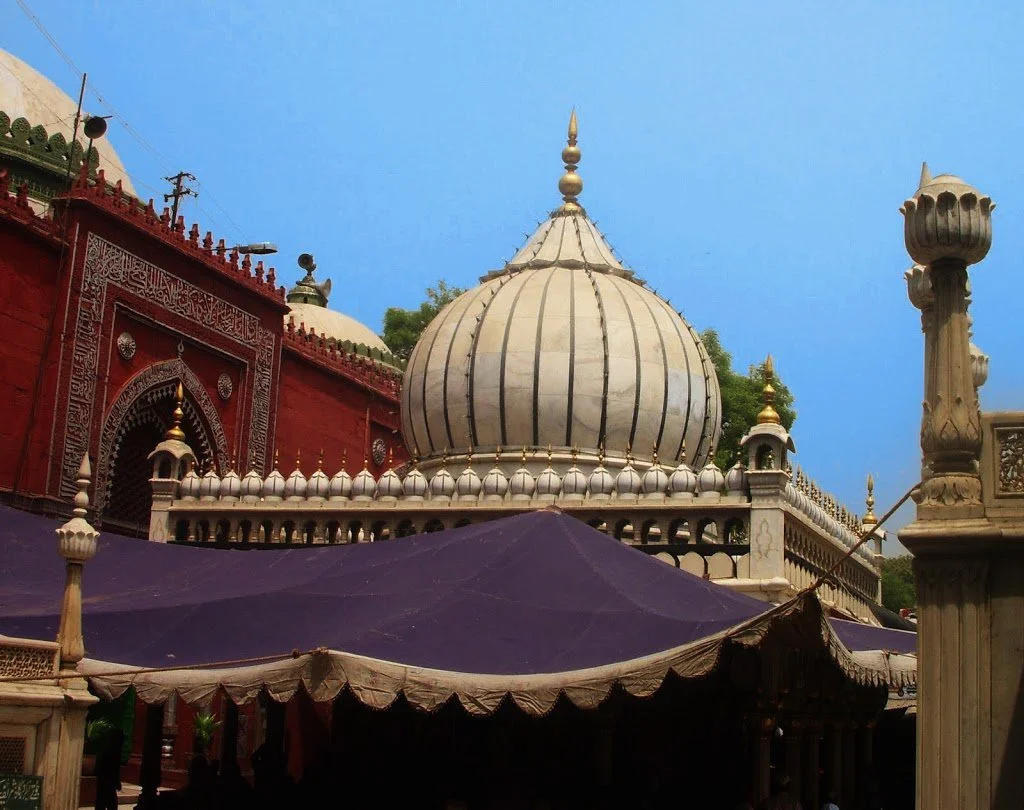
Muhammad ibn Ahmad ibn Ali Bada'uni (636–725 AH / 1239–1325 CE), known as Nizam al-Din Awliya and titled Sultan al-Mashaikh, was the Chishti master whose hospice at Ghiyaspur outside Delhi became the principal centre of Sufi life in the Indian subcontinent. Of all the early Chishtis he is the one about whom most can actually be established, because two of his disciples were writers of the first rank and one of them kept a record of his conversation over fourteen years. He held no office, accepted no regular stipend, never married, and outlived a dozen rulers of the Delhi Sultanate — and under him the order that Mu'in al-Din Chishti is credited with founding in India grew from a scattering of hospices into the dominant religious institution of Muslim north India.
Badaun and the Move from Bukhara
Family and birth
His family were not Indians of long standing. Gerhard Böwering, writing on the Chishtiyya in the Encyclopaedia Iranica, records that his Turkish forebears had migrated from Bukhara to Badaun, in what is now western Uttar Pradesh, and that he was born there in 636 AH / 1239 CE. The migration is the ordinary story of the period: the Mongol campaigns in Transoxiana and Khorasan from 1219 onwards displaced a large population of scholars, artisans and religious men eastward, and the Delhi sultanate under Iltutmish and his successors received them.
Badaun was a substantial provincial town and a seat of Muslim learning within a generation of the conquest, and it produced a notable number of scholars — including, later, the historian Abd al-Qadir Bada'uni, whose surname records the same place. Nizam al-Din's own name in the sources carries it too.
Education at Delhi
He went to Delhi as a young man and spent years there in formal study before any attachment to a Sufi master. This order of events is worth noting, because the picture of the Sufi as an alternative to the scholar does not fit him: he was trained in the disciplines of the madrasa first, and the authority he later exercised in argument with the jurists of Delhi rested partly on the fact that he had been educated as one of them. The essay on the Sufis of the subcontinent by Nazeer Ahmed on historyofislam.com describes him as a scholar of hadith and a formidable debater, and the record of the confrontation of 1320, treated below, bears that out.
Discipleship under Baba Farid
Ajodhan
In 655 AH / 1257 CE he became the disciple of Farid al-Din Mas'ud Ganj-i Shakar — Baba Farid — at Ajodhan on the Sutlej, now Pakpattan in the Pakistani Punjab. Baba Farid was one of the three principal successors of Mu'in al-Din, and his hospice at Ajodhan stood on the trunk road between Multan and Delhi, which is to say on the artery of the sultanate's western frontier.
Böwering describes the discipline of that house. Novices shaved their hair on entering and completed their initiation, bay'a, by clasping hands with the master. The Chishti hospice was known also as a jama'at-khana, a community hall, because the group slept, worked and lived in one large room. Baba Farid himself kept long prayer vigils, including the chilla-i ma'kusa, praying suspended by the feet through a forty-day retreat, and fasted on alternate days in the manner called sawm-i Dawudi. He trained his disciples using the Awarif al-Ma'arif of Abu Hafs Umar Suhrawardi as the manual of instruction, and Muslims and Hindus alike came to his door, where sama — the listening to sung poetry as a means of inducing mystical states — was practised.
This is the formation Nizam al-Din received: communal poverty, severe personal discipline, a standard Sufi textbook from a rival order, and an open door.
The succession and its document
Böwering records that Nizam al-Din was appointed Baba Farid's khalifa, his authorised successor, in 663 AH / 1265 CE, the year of his master's death — and that the khilafat-nama, the written authorisation on which the appointment rests, is dubious.
That qualification deserves to be reported rather than passed over. The written succession document was the instrument by which a Chishti master's authority was transmitted and, in disputed cases, by which one claimant's authority was established against another's. A questioned khilafat-nama in the case of the most celebrated master of the order is therefore not an incidental textual problem: it means that the formal basis of the authority Nizam al-Din exercised for sixty years cannot be verified from the document that was supposed to establish it. What is not in doubt is that the authority was in fact exercised, and recognised.
The Khanqah at Ghiyaspur
The place
Some time after Baba Farid's death he returned to Delhi and established his hospice at Ghiyaspur, a village outside the city. Böwering locates it near the new palace that Sultan Mu'izz al-Din Kayqubad, who reigned from 686 to 689 AH / 1287 to 1290 CE, had built at Kilokhri on the bank of the Jumna.
The siting is significant in a way the sources do not comment on but the geography makes plain. Ghiyaspur was outside Delhi and yet beside a royal palace: near enough to the seat of power for the court to come to him, far enough out that he was not of it. For the next four decades the traffic between the two would define much of his public life. The settlement that grew around the hospice took his name, and the quarter of Delhi called Nizamuddin still does.
The discipline of the house
Böwering preserves the marks by which his disciples were recognised: they carried leather pouches, wore four-cornered conical caps, and attached a toothbrush, the miswak, to their turbans. Small details of this kind matter more than they appear to, because a Sufi order in this period was identified in the street by exactly such things, and the adoption of a distinctive habit was a claim to a distinct identity.
The scale of the establishment is harder to fix. The essay on historyofislam.com states that at any given time over three thousand students and two hundred qawwals — professional singers — attended the hospice. The figure is round and comes from an uncited source, and it should be read as an indication that the establishment was very large rather than as a count.
The circle
What separates Nizam al-Din from the other early Chishtis is the company he kept. Böwering names the members of the Ghiyaspur circle, and the list is remarkable for a hospice on the edge of a provincial capital.
Amir Khusraw (651–725 AH / 1253–1325 CE) was the most celebrated Muslim poet of his time in India, and he was buried next to his master's tomb. He and a second poet had left the court of Multan after 683 AH / 1284 CE and taken the patronage of Alauddin Khalji at Delhi — which means that the two most accomplished literary men at the sultan's court were also disciples at Ghiyaspur.
Amir Hasan ibn Ala Sijzi Dihlavi (655–737 AH / 1275–1336 CE) was the second of those poets, and it is to him that the historical record of Nizam al-Din is chiefly owed. Between 707 AH / 1307 CE and 721 AH / 1321 CE he kept a record of his master's sayings and conversation, the Fawa'id al-Fu'ad. Böwering calls it the first genuine malfuz — the first authentic example of the recorded-conversation genre that became the Chishtis' distinctive literary form. Almost everything that can be said with confidence about what Nizam al-Din actually thought comes from this book.
Zia al-Din Barani (684–758 AH / 1285–1357 CE) was a disciple, and he is the historian on whose Tarikh-i Firuz Shahi the modern account of Alauddin Khalji's reign principally rests. That the fullest chronicler of the Khalji sultanate was a member of Nizam al-Din's circle is a fact of some consequence for reading both.
Fakhr al-Din Zarradi (d. 748 AH / 1347 CE) was a disciple who wrote the Usul al-Sama, an Arabic treatise on the principles of listening to music — the technical defence of the practice that was to be the order's most contested.
A hospice containing the age's leading poet, its leading historian and a jurist writing in Arabic on the disputed question of the day was not a retreat from the intellectual life of Delhi. It was one of its centres.
Teaching
Walaya and wilaya
Nizam al-Din's most precise recorded teaching concerns the nature of a saint's authority, and it takes the form of a distinction between two words written almost identically in Arabic.
The doctrine he inherited had a long history. Hujwiri's Kashf al-Mahjub, the channel through which it reached the Indian Chishtis, drew on the teaching of Hakim Tirmidhi, who died between 295 and 310 AH / 907 and 922 CE. In Tirmidhi's scheme, Böwering explains, the Prophet is the seal of the prophets because he is divinely protected against error and sin rather than merely because he is the last in time; prophets who are sent with a revealed law are distinguished from those who summon people to a law already revealed; and the latter are assisted in the world by a spiritual hierarchy of God's friends, the awliya, who receive divine friendship by grace and are the Prophet's true successors — his family by spiritual rather than genealogical descent. Hujwiri himself treated walaya as the very principle of Sufism, and distinguished the walaya of divine lordship from the walaya of divine love.
Following Hujwiri, and as recorded in the Fawa'id al-Fu'ad, Nizam al-Din distinguished walaya — the shaikh's work of educating and guiding disciples — from wilaya, the mystic's own relationship to God, understood in terms of divine love. The consequence he drew is the interesting part. When a shaikh dies, Böwering summarises, he takes his wilaya with him but leaves his walaya behind, and bestows it upon one of his disciples. Each shaikh accordingly holds a spiritual walaya over a body of disciples in a particular geographical region.
This is a doctrine with an institutional edge. It makes a master's relation to God his own and non-transferable, while making his authority over people an office that passes on and has territorial extent. It explains why the Chishtis assigned regions to successors rather than merely training pupils, and it is the theoretical basis of the pattern by which the order colonised the subcontinent hospice by hospice.
Sama and its rules
The hospice at Ghiyaspur became known for night-long assemblies of sama, including dancing, led by skilled qawwals who recited Persian poetry — the most popular medium — to the accompaniment of percussion: drums, timbrels and tambourines, but not flutes or pipes.
Nizam al-Din laid down conditions, and the specificity of them is evidence that he was answering objections rather than indulging an enthusiasm. Böwering lists them: the singer must be an adult, not a boy or a woman; the verses recited must be neither lewd nor trivial; the listener must be a true participant in the sama and not a spectator; and the instruments must not include the chang, the harp, or the rabab, the short-necked lute. He discouraged string and wind instruments on the ground that they obviated the mystic's experience of dhawq, taste, and dard, pain — the two states the practice existed to produce. Singing and dancing, raqs, he encouraged, holding them equal to dhikr, the recollection of God, as means of inducing mystical union.
Admission without conversion
One further practice is recorded and is unusual enough to state plainly. Böwering notes that Nizam al-Din permitted Hindus to take part in sama, and initiated them into the Chishtiyya without requiring formal conversion to Islam. Later Chishtis did the same.
The article reports this as a documented practice of the order and does not extend it into a general position on religion, which the sources do not supply. What it does indicate is that the hospice functioned as a place of resort for people who had not become Muslims, and that its master saw no necessity in changing that before admitting them to its central discipline.
The Shaikh and the Sultans
Nizam al-Din's sixty years at Ghiyaspur spanned the reigns of a dozen rulers, and the relationship varied with each. The Chishti reputation for standing clear of the state is only partly borne out in his case, and the departures from it are as well attested as the conformities.
Alauddin Khalji and Khizr Khan
He enjoyed the favour of Sultan Alauddin Khalji, who reigned from 696 to 716 AH / 1296 to 1316 CE, and counted the sultan's son and heir-apparent Khizr Khan among his disciples. The heir to the most powerful throne in the subcontinent was thus a murid at Ghiyaspur.
The best-known story of the relationship, however, is one of refusal. The essay on historyofislam.com records that Alauddin sent word of his wish to meet the shaikh and received the reply: "My hut has two doors. If the Emperor enters it through one door, I go out the other." The saying is not traceable to a contemporary record, and it should be read as the tradition's compression of a real posture into a memorable line. The posture itself is genuine: Nizam al-Din held no office and took no salary, and that was the substance of the distance he kept.
Khusraw Khan and the sum of 720 AH
The distance was not absolute, and Böwering records the instance that shows its limit. When Khusraw Khan usurped the throne of the sultanate in 720 AH / 1320 CE, Nizam al-Din accepted a large sum of money from him.
This sits awkwardly with the picture of a saint who refused a sultan's gold, and it is reported here because it is documented and because the awkwardness is instructive. The Chishti rule as it was actually practised barred stipends and office, not gifts; unsolicited gifts, futuh, were accepted. Böwering treats the whole conventional contrast between Chishti aloofness and Suhrawardi engagement as a questionable though often repeated assertion, and this episode is among his grounds.
The mahzar before Ghiyath al-Din Tughluq
The most consequential public episode of his life was the trial of sama before the throne.
The jurists of Delhi opposed the practice and sought an official edict against it. Böwering records that they attempted this at a notorious mahzar — a formal assembly or hearing — held with the shaikh in the presence of Sultan Tughluq, and that the attempt failed; Amir Khurd's Siyar al-Awliya preserves the account. The essay on historyofislam.com supplies the fuller narrative and dates it to 1320, in the reign of Ghiyath al-Din Tughluq, who ruled from 720 to 725 AH / 1320 to 1325 CE.
In that account the sultan convened the leading jurists, judges and philosophers of Delhi, and Nizam al-Din was summoned. Qadi Jalal al-Din, the chief judge of Delhi, argued against sama; Nizam al-Din defended it from hadith; the opposition replied that the hadith relied on were weak. The sultan then turned to Shaikh Ilm al-Din, a philosopher who had travelled widely in Persia, Iraq, Syria and Egypt, and who answered that sama was lawful for those who listened to it with their hearts and unlawful for those who heard it with their lower selves — before nonetheless siding with the chief judge and asking for a prohibition. The sultan's ruling divided the question: he permitted sama to the Chishti order and forbade it to the Qalandari and Haidari orders.
The outcome is more interesting than a simple victory would have been. A ruler faced with a demand to suppress a devotional practice licensed it for the order that had the following and the argument, and banned it for two orders with little presence in India — which cost him nothing and satisfied the jurists formally without conceding to them substantively. Half a century later, Böwering notes, Sultan Firuz Shah Tughluq would order the Chishtis to perform sama in seclusion after a report that participants had prostrated themselves before a shaikh. The question was managed rather than settled.
Death and Succession
Nizam al-Din remained unmarried to the end of his life and died in 725 AH / 1325 CE; the Encyclopaedia Iranica elsewhere gives 726 AH, and the small discrepancy is noted here rather than resolved. The year of his death was also the year in which Muhammad ibn Tughluq came to the throne.
Chiragh-i Dihli and the khirqa
His successor was Nasir al-Din Mahmud ibn Yahya Yazdi Awadhi (d. 757 AH / 1356 CE), born at Ajodhya and known as Chiragh-i Dihli, the Lamp of Delhi. Böwering records that he became Nizam al-Din's disciple at Delhi at the age of forty-three and remained celibate as his master had, and that in 724 AH / 1324 CE the master designated him successor by passing on the khirqa, the Sufi mantle, that he had himself received from Baba Farid.
The physical transmission is the point. Where Nizam al-Din's own appointment rested on a document whose authenticity is doubted, his successor's rested on the handing over of an object with a traceable history — the same mantle, from Baba Farid to Nizam al-Din to Nasir al-Din. Chiragh-i Dihli died without naming a successor of his own, and the insignia he had received from his shaikh — the mantle, a staff, a prayer rug and a begging bowl — were buried with him. Böwering treats that burial as the symbolic end of the classical phase of the great Chishtis of India.
The dispersal to the provinces
The order's expansion from Delhi into the provinces was carried by Nizam al-Din's disciples, and it was accelerated by a change of policy at court. Böwering records that the policy of Sultan Muhammad ibn Tughluq, who reigned from 725 to 752 AH / 1325 to 1351 CE, diverted Sufi influence away from Delhi and induced or compelled many Chishtis to settle in other parts of the country — and that their arrival in provincial towns coincided with the rise of provincial kingdoms.
The map that resulted was drawn largely by men trained at Ghiyaspur. Burhan al-Din Gharib (d. 741 AH / 1340 CE) appears to have been the first to bring the order to the Deccan, settling at Daulatabad, the former Deogiri; his own disciple Zayn al-Din became spiritual guide to Ala al-Din Hasan Shah, founder of the Bahmani kingdom. In Malwa the order spread through Wajih al-Din Yusuf (d. 729 AH / 1328–29 CE) at Chanderi and Kamal al-Din at Mandu. Siraj al-Din Akhi Siraj (d. 759 AH / 1357–58 CE) carried it to Bengal, from where it reached Bihar. In Gujarat, Husam al-Din Multani (d. 755 AH / 1354 CE) established it at Nahrwala, deriving his Chishti lineage directly from Nizam al-Din.
Within two generations of his death the order was present from the Punjab to the Bay of Bengal and from the Gangetic plain to the Deccan plateau, and in several of those places it was supplying the religious sanction for a new dynasty.
Legacy
The branch of the Chishtiyya named for him, the Nizamiyya, became one of the two lines of the order current in the subcontinent, the other being the Sabiriyya. Metcalf's study of the Deoband movement records both as still current in nineteenth-century India, and notes that Hajji Imdadullah initiated his disciples in Chishti Sabiri and Chishti Nizami together with the Qadiri, Naqshbandi and other lines — the practice of multiple initiation that by then had blurred the distinctions between the orders. The Nizamiyya was reformed and centralised at Delhi three centuries after its founder's death by Shah Kalimullah Jahanabadi (d. 1142 AH / 1729 CE), and through his successors it spread into Bareilly, Multan and the Punjab.
The literary consequences were as durable as the institutional ones. The Fawa'id al-Fu'ad established the malfuzat form, and Böwering lists the collections of recorded conversation that followed it across the order — Hamid Qalandar's record of Chiragh-i Dihli's assemblies in the Khayr al-Majalis, the Surur al-Sudur of Hamid al-Din Nagauri's sayings, and later compilations for Burhan al-Din Gharib, Gisu Daraz and Abd al-Quddus Gangohi. Amir Khusraw's poetry became, and remains, the core of the qawwali repertoire.
The devotional practice itself changed shape as the shrines came into their own. With the establishment of dargahs at the tombs of the venerated Chishtis, devotion transferred from living masters to dead ones; hereditary custodianship by a saint's patrilineal descendants, the office of sajjada-nishin, grew up beside the older office of appointed khalifa; and family control turned Chishti sama into a ceremony performed on the anniversary of a saint's death, eventually called qawwali. Rizvi's history of the Dar al-Ulum, written from inside the tradition, records the Chishtiyya and the Naqshbandiyya as the two most current orders in India and draws a contrast between their manner — a contrast that goes back, on the Chishti side, to the assemblies at Ghiyaspur.
Historiographical Note
Nizam al-Din is the best-documented of the early Chishtis, and the reason is a single book.
The Fawa'id al-Fu'ad of Amir Hasan Sijzi Dihlavi is a record of the master's conversation kept by a disciple who was present, dated by its compiler between 707 and 721 AH / 1307 and 1321 CE, and composed within his subject's lifetime. Böwering calls it the first genuine malfuz of the tradition. That combination — contemporaneity, a named recorder, and a dated period of compilation — is rare in the sources for medieval Indian Sufism, and it is why statements about what Nizam al-Din taught can be made here with more confidence than in the case of his order's founder, for whom nothing comparable exists.
The second layer is hagiographical. Amir Khurd's Siyar al-Awliya, compiled in the fourteenth century by another member of the circle, preserves the account of the mahzar before Sultan Tughluq and the detailed rules of sama. It was written to celebrate a chain of masters, and its purposes should be held in view; but it is close to the events and its compiler had access to people who had witnessed them.
Three specific cautions are recorded in the article above rather than smoothed over. The khilafat-nama by which Nizam al-Din was appointed Baba Farid's successor is described in the critical literature as dubious. The date of his death is given as 725 AH in one place in the Encyclopaedia Iranica and as 726 AH in another. And the figure of three thousand students and two hundred singers at the hospice comes from an uncited source and is reported as an order of magnitude rather than a count.
A fourth caution concerns a claim so widely repeated that its absence here will be noticed. It is often said that the early Chishtis, Nizam al-Din among them, built their teaching on Ibn Arabi's doctrine of the unity of being, wahdat al-wujud. Böwering shows that this cannot be sustained: the works of Ibn Arabi, who died in 638 AH / 1240 CE, were hardly circulating in India during the early Chishtis' lifetimes; neither the Fawa'id al-Fu'ad nor the Khayr al-Majalis mentions him at all; Chishti commentary on his Fusus al-Hikam begins only with Gisu Daraz in the fifteenth century, and even that commentary is reported to have been critical of him. Nor is Rumi's Masnavi quoted in Chishti sources before the assemblies of Chiragh-i Dihli. The doctrinal affiliation ordinarily assigned to Nizam al-Din is therefore an anachronism, and the article does not assert it.
On sourcing: the project's approved library carries the Chishti order but not its founders. A search of the extracted texts returned Metcalf on the Sabiri and Nizami branches and on multiple initiation, Rizvi on the standing of the Chishtiyya as described from within the tradition, and the Tabaqat-i Nasiri for the setting of thirteenth-century Delhi — but no biographical treatment of Nizam al-Din in any book in the library; the "Nizam al-Din" of Rizvi's index is Mulla Nizam al-Din Sahalvi of Farangi Mahal, an eighteenth-century figure and a different person. Of the approved websites, historyofislam.com carries a substantial essay by Nazeer Ahmed which supplies the narrative of the 1320 hearing and the exchange with Alauddin Khalji; it gives no citations and is internally inconsistent on several dates, and is used here for narrative and not for chronology. The critical framework, the dates, and the account of the teaching are taken from Gerhard Böwering's article on the Chishtiyya in the Encyclopaedia Iranica, an external source consulted under the owner's standing instruction that external material may be used where the approved base is insufficient, and recorded here so that the reliance remains auditable.
Conclusion
Nizam al-Din Awliya spent some sixty years in a village outside Delhi, holding no office and drawing no salary, while eleven or twelve sultans came and went a few miles away. In that time the Chishti order became the largest religious institution of Muslim north India, the recorded-conversation book became its characteristic literature, and the assembly of sung Persian poetry became the devotional practice by which it is still recognised.
What is most worth noticing about him is how much of that was achieved through argument rather than withdrawal. He was educated as a scholar before he was a Sufi; he defended the disputed practice of his order from hadith before the chief judge of Delhi and the sultan's assembled jurists, and did not lose; he set out rules for that practice precise enough to answer the objections against it; and he admitted to it people who had not become Muslims. The distance he kept from the court was a refusal of office and stipend, not of the world — and the record shows him accepting a usurper's money in the same decade that he was defying the jurists. Both belong to the same man, and an account that keeps only one of them is not the better for it.
References and Further Reading
Primary Islamic Sources
- Qur'an 10:62 — the phrase awliya Allah, the friends of God, the scriptural root of the Sufi vocabulary of sainthood and of the distinction between walaya and wilaya discussed above.
- Amir Hasan Sijzi Dihlavi. Fawa'id al-Fu'ad, compiled between 707 and 721 AH / 1307 and 1321 CE — the record of Nizam al-Din's conversation kept by a disciple during his lifetime; the earliest genuine malfuz of the Chishti tradition and the principal source for his teaching.
- Amir Khurd, Muhammad ibn Mubarak Kirmani. Siyar al-Awliya, 8th century AH / 14th century CE — the hagiography of the Chishti masters, preserving the account of the hearing before Sultan Tughluq and the rules laid down for sama.
- Suhrawardi, Abu Hafs Umar. Awarif al-Ma'arif — the manual of instruction used in Baba Farid's hospice, where Nizam al-Din was trained.
- Hujwiri, Abu al-Hasan. Kashf al-Mahjub — the source from which the Indian Chishtis took the doctrine of walaya that Nizam al-Din refined.
- Fakhr al-Din Zarradi. Usul al-Sama — the Arabic treatise on the principles of sama written by one of his disciples.
Classical Islamic Sources
- Barani, Zia al-Din. Tarikh-i Firuz Shahi, c. 1357 CE — the chronicle of the Delhi sultanate written by a disciple of Nizam al-Din, and the fullest source for the reign of Alauddin Khalji.
- Jami, Abd al-Rahman. Nafahat al-Uns, 881 AH / 1476 CE — the biographical compendium of Sufis that carries the Chishti chain of succession.
- Hamid Qalandar. Khayr al-Majalis — the recorded conversations of Nasir al-Din Chiragh-i Dihli, Nizam al-Din's successor.
- Juzjani, Minhaj al-Siraj. Tabaqat-i Nasiri, translated by H. G. Raverty. [approved PDF library:
sources/study/] — the chronicle of the sultanate to c. 1260, used here for the political setting of thirteenth-century Delhi into which Nizam al-Din's family migrated. - Amir Khusraw. Persian diwan and narrative poems — the work of the disciple buried beside his master, and the foundation of the qawwali repertoire.
Academic and Scholarly Sources
- Böwering, Gerhard. "Češtīya." Encyclopaedia Iranica. [external source, used under the owner's standing instruction that external sources may be consulted where the approved base is insufficient; recorded per §4A.6] — the source for the dates, the circle at Ghiyaspur, the walaya/wilaya distinction, the rules of sama, the admission of Hindus without conversion, the sum accepted from Khusraw Khan, the succession by khirqa, and the correction of the wahdat al-wujud claim.
- Metcalf, Barbara Daly. Islamic Revival in British India: Deoband, 1860–1900. [approved PDF library:
sources/study/] — for the Nizami branch as one of the two Chishti lines current in nineteenth-century India, and for multiple initiation. - Rizvi, Sayyid Mahboob. History of the Dar al-Ulum Deoband, Volume 1. [approved PDF library:
sources/study/] — for the standing and manner of the Chishtiyya as described from inside the later tradition. - Ahmed, Nazeer. "The Sufis of India and Pakistan." historyofislam.com. https://historyofislam.com/contents/the-post-mongol-period/the-sufis-of-india-and-pakistan/ [approved external web source, §4A.1a] — used for the narrative of the 1320 hearing, the exchange with Alauddin Khalji, and the scale of the hospice; it carries no citations of its own and is not relied on here for chronology.
Further Reading
- Nizami, K. A. "Chishtiyya," in the Encyclopaedia of Islam, second edition.
- Lawrence, Bruce B. Translation of the Fawa'id al-Fu'ad as Nizam ad-din Awliya: Morals for the Heart — the recorded conversations in English.
- Schimmel, Annemarie. Islam in the Indian Subcontinent. Leiden: Brill, 1980 — for the institutional form of the Chishti jama'at-khana.
- Qureshi, Regula Burckhardt. Studies of the mahfil-i sama and the performance practice of qawwali.
- Mu'in al-Din Chishti — the master to whom the Chishti order in India traces its foundation.
- The Sufi Orders in South Asian Islam — the four orders as institutions in the eighteenth and nineteenth centuries.
- Alauddin Khalji — the sultan whose reign coincided with the height of Nizam al-Din's influence, and whose historian was one of his disciples.
Mentioned In
9 articles reference this topic
More from South Asian Islam
Delhi Sultanate: Islamic Rule in Medieval India
The Delhi Sultanate (1206-1526 CE) was a series of five successive Islamic dynasties that ruled northern India for over three centuries, establishing Muslim political power in the subcontinent, creating a unique Indo-Islamic culture, and leaving an enduring architectural and administrative legacy.
The Ahl-i Hadis Movement
A nineteenth-century Indian Sunni movement that set aside the authority of the historic schools of law in favour of direct recourse to the Qur'an and hadith. Led by scholars at Delhi and Bhopal, it was marked by its manner of prayer and an austere standard of interpretation.
The Sufi Orders in South Asian Islam
Four Sufi orders shaped religious life in the Indian subcontinent: the Chishti, Naqshbandi, Qadiri and Suhrawardi. This article traces how they functioned there in the eighteenth and nineteenth centuries, and how initiation into several orders at once weakened the identity of each.
The Tablighi Jamaat
A movement of lay religious preaching founded by Muhammad Ilyas Kandhlawi in the Mewat region of northern India in the 1920s. Built on short preaching tours undertaken by ordinary Muslims, it grew from one rural district into a presence across much of the Muslim world.