Ashfaqulla Khan: Poet and Revolutionary of the Kakori Conspiracy
Ashfaqulla Khan (1900-1927) was an Indian Muslim revolutionary and poet who co-organized the 1925 Kakori train robbery with Ram Prasad Bismil to fund the anti-colonial Hindustan Republican Association, and was executed by the British for his role in it.
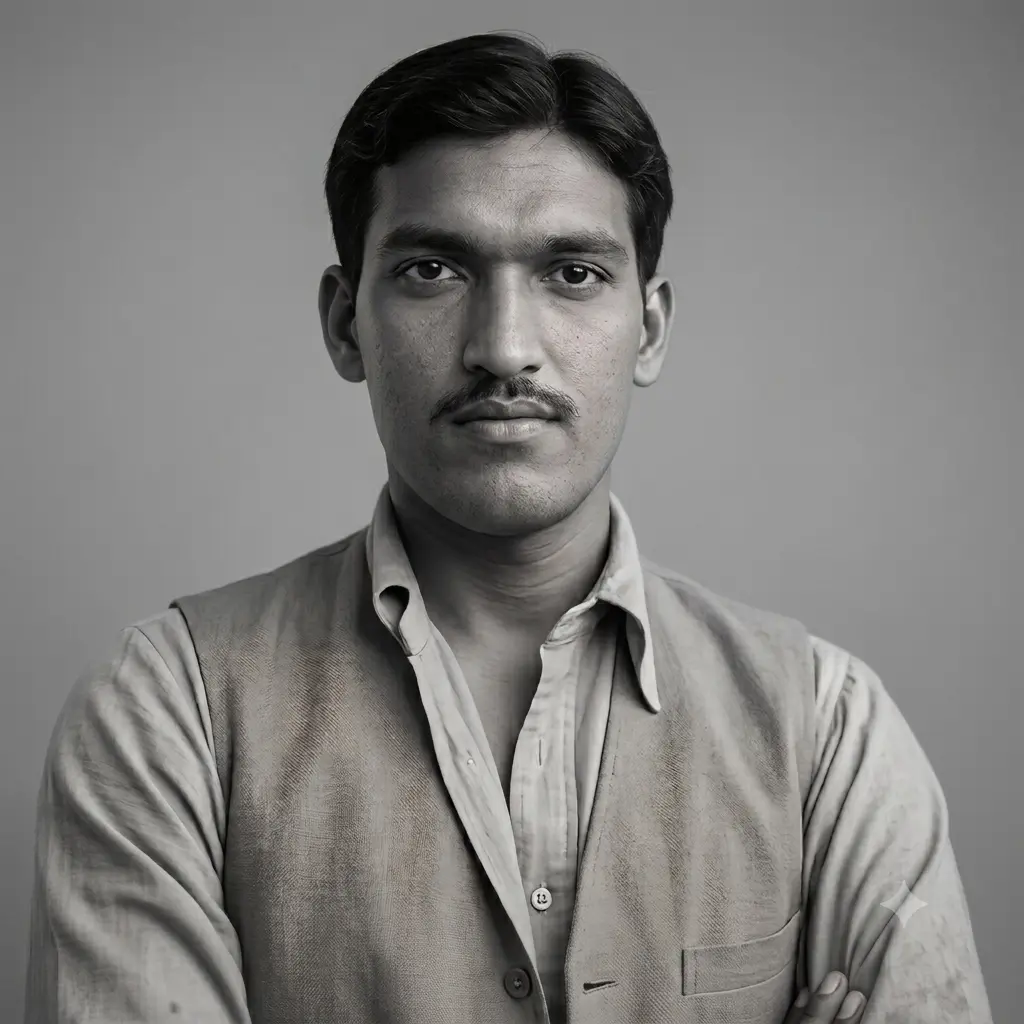
Ashfaqulla Khan (22 October 1900 – 19 December 1927) was an Indian Muslim revolutionary of the Hindustan Republican Association (HRA) whose brief and intense life became one of the most celebrated episodes of the armed wing of the Indian independence movement. Executed at the age of twenty-seven for his role in the 1925 Kakori train robbery, Khan is remembered both for the daring of his revolutionary activity and for the depth of his friendship with his Hindu comrade Ram Prasad Bismil — a bond that came to symbolize, for later generations of Indian nationalists, the possibility of Hindu-Muslim unity in the struggle against British colonial rule.
Khan's life intersected with a pivotal and turbulent decade in the Indian independence movement, a period when Mahatma Gandhi's non-cooperation movement, launched in 1920, had raised expectations of imminent freedom, only for these hopes to be dashed by Gandhi's abrupt suspension of the movement following the Chauri Chaura incident of February 1922. For a younger generation of Indians who had committed themselves to the cause of independence, Gandhi's decision to call off mass civil disobedience seemed to leave the movement without a clear path forward. Some of this generation turned to armed revolutionary action as an alternative or supplement to Gandhian non-violence, organizing themselves into secret societies dedicated to overthrowing British rule through direct action, including armed robbery to fund the purchase of weapons, assassination of colonial officials, and eventually insurrection. Ashfaqulla Khan was among the most prominent Muslim figures within this revolutionary current, and his participation demonstrated that the appeal of armed anti-colonial resistance in early twentieth-century India crossed religious lines.
The broader historical context in which Khan came of age was shaped by decades of accumulating political grievance against British colonial rule in India. The partition of Bengal in 1905 had already generated a wave of nationalist agitation and, in its wake, the emergence of revolutionary secret societies such as the Anushilan Samiti and Jugantar, which pioneered many of the tactics — clandestine cells, revolutionary expropriation of government funds, and the veneration of martyrdom — that the Hindustan Republican Association would later adopt in the United Provinces. The First World War, in which hundreds of thousands of Indian soldiers served the British Empire on the expectation of political reward, ended instead with the repressive Rowlatt Act of 1919 and the Jallianwala Bagh massacre in Amritsar, in which British troops under General Reginald Dyer killed hundreds of unarmed civilians. These events radicalized a generation of young Indians, including many still in school, and it was against this backdrop of accumulating disillusionment with the promises of colonial reform that Khan's own political consciousness took shape during his childhood and adolescence in Shahjahanpur.
Shahjahanpur itself, a district town in the United Provinces founded in the seventeenth century and named for the Mughal emperor Shah Jahan, was not among the major metropolitan centers of Indian nationalist politics such as Calcutta, Bombay, or Delhi, but it possessed a small and committed circle of politically engaged residents, including teachers, lawyers, and students, who maintained connections to the wider currents of nationalist and revolutionary thought circulating through the vernacular and English-language press of the period. It was within this provincial but politically alert milieu that both Ashfaqulla Khan and Ram Prasad Bismil grew to political maturity, and the town's relatively small size meant that the networks of trust and acquaintance connecting the eventual Kakori conspirators were often rooted in childhood friendships and family connections rather than the more anonymous political networks of a large city.
Early Life and Family Background
Ashfaqulla Khan was born on 22 October 1900 in Shahjahanpur, a town in the United Provinces (present-day Uttar Pradesh) of British India, into a family of Pathan (Pashtun) descent that had long been settled in the region. He was the youngest of five siblings in a household that, by the standards of colonial India, was reasonably comfortable, allowing him access to formal schooling at a time when literacy remained the privilege of a minority of the Indian population. Details of his childhood are sparse in the historical record, as is common for revolutionaries whose fame derived from a single dramatic episode late in short lives, but the sources agree that Khan showed early literary inclination, developing a facility for Urdu poetry that he would later put to use under the pen name "Hasrat" (Longing) — a pseudonym that should not be confused with the unrelated poet-politician Hasrat Mohani, active in the same period.
The political awakening that would define Khan's adult life began during his school years, against the backdrop of the mass political mobilization that swept British India following the First World War. In 1918, while Khan was still a student in the seventh standard, British colonial police raided his school in connection with the Mainpuri Conspiracy, an underground effort by young revolutionaries in the region to organize armed resistance and fund anti-colonial publications through robbery. A fellow student, Rajaram Bhartiya, was arrested in the raid — an event that appears to have crystallized Khan's own political consciousness and drawn his attention toward the currents of revolutionary nationalism circulating among educated youth in the United Provinces. The Mainpuri Conspiracy itself was suppressed by the colonial authorities, but its ideological legacy passed to a new generation of activists who would soon organize the Hindustan Republican Association.
Khan's formal schooling, though interrupted and ultimately curtailed by his growing political commitments, had given him a solid grounding in Urdu literature and, by several accounts, at least a working familiarity with Persian, the language in which much of the classical poetic tradition that shaped Urdu verse had originally been composed. This literary education proved significant not merely as a personal accomplishment but as a channel through which Khan and Bismil expressed their political convictions: both men wrote revolutionary verse under pen names, following the well-established Persian and Urdu literary convention of the takhallus, and their poetry circulated among sympathizers as a form of morale-building and political communication that could pass, on the surface, as conventional romantic or mystical verse while carrying an unmistakable subtext of revolutionary defiance for those attuned to its coded language. This use of poetry as a vehicle for political mobilization situated Khan within a long tradition of Indo-Persian and Urdu literary culture in which verse served simultaneously as personal expression and public commentary, a tradition that had already produced politically engaged poets such as Muhammad Iqbal in the same period, albeit toward different political ends.
Friendship with Ram Prasad Bismil and the Hindustan Republican Association
The defining relationship of Ashfaqulla Khan's life was his friendship with Ram Prasad Bismil, a Hindu revolutionary from Shahjahanpur who had been closely involved in the Mainpuri Conspiracy and who, by the early 1920s, had emerged as one of the most committed and capable organizers of armed resistance in the United Provinces. Khan met Bismil through a mutual acquaintance and quickly became one of his closest associates, drawn to Bismil's revolutionary conviction and his own literary sensibility — Bismil, like Khan, was a poet, and the two men shared both political commitment and artistic temperament. Their friendship transcended the religious divide that colonial administrators frequently sought to exploit in India, and it became, in the retelling by later nationalist historians, an emblem of the possibility of a shared Hindu-Muslim struggle against British rule, uncomplicated by the communal tensions that would tragically culminate in the Partition two decades later.
Through his association with Bismil, Khan became involved first in the Non-Cooperation Movement of 1919-1922 and subsequently in the Swaraj Party before joining the Hindustan Republican Association (HRA), a secret revolutionary organization founded in October 1924 in Kanpur with the explicit goal of overthrowing British rule in India through armed insurrection, to be achieved in the near term through the accumulation of funds and weapons via revolutionary action, including robbery of government treasuries. The HRA drew inspiration from the Bolshevik Revolution in Russia and from the broader current of anti-colonial revolutionary nationalism that had also produced organizations such as the Anushilan Samiti and Jugantar in Bengal. Khan, like several of his HRA comrades, expressed sympathy for the Bolshevik model of revolutionary transformation, articulating beliefs in the liberation of the poor from both colonial and capitalist exploitation.
Ashfaqulla Khan was also notable among his HRA comrades for his explicit rejection of religious communalism, which he identified as a tool deliberately employed by the British colonial administration to divide the Indian population and forestall united resistance to colonial rule. This position placed him within a broader current of secular Indian nationalism that sought to transcend religious identity in favor of a shared anti-colonial struggle — a stance that, in the context of a revolutionary organization whose membership was overwhelmingly Hindu, gave Khan's own Muslim identity and his prominent role within the HRA particular symbolic significance for later generations of nationalist historians seeking to emphasize the plural, cross-communal character of the independence movement.
The Hindustan Republican Association itself had been formally established in October 1924 at a meeting in Kanpur, with its early leadership including figures such as Sachindra Nath Sanyal, a veteran revolutionary who had already been implicated in earlier conspiracies and deported to the Andaman Islands penal colony before his return to active organizing. The HRA's founding manifesto and subsequent publications, including a pamphlet titled The Revolutionary, articulated a vision of an independent India organized along broadly socialist and republican lines, explicitly rejecting both continued British rule and the prospect of a return to indigenous monarchical or aristocratic governance. Membership in the organization required a formal oath of commitment to the cause of complete Indian independence through revolutionary means, and the HRA operated through a cell structure designed to protect the organization's wider membership from exposure in the event that any individual cell was compromised by colonial intelligence — though this structure, as the aftermath of the Kakori robbery would demonstrate, proved only partially effective against the resources of the colonial state's investigative apparatus.
Khan's role within the HRA extended beyond mere participation in its operations to encompass a degree of organizational responsibility reflecting the trust his comrades placed in him. Contemporary and near-contemporary accounts describe him as a capable and physically imposing figure — described in some sources as approximately six feet tall — whose personal courage and reliability made him one of Bismil's most trusted lieutenants within the Shahjahanpur cell of the organization. His religious identity as a Muslim, in an organization whose membership and leadership were drawn overwhelmingly from Hindu communities of the United Provinces and Bihar, never appears to have been treated by his comrades as a barrier to full participation or trust, a fact that later Indian nationalist historiography would repeatedly invoke as evidence of the revolutionary movement's capacity to transcend the communal divisions that British colonial administrators frequently sought to exploit or, at minimum, to leave unaddressed in the service of maintaining colonial control.
The Kakori Train Robbery
By August 1925, the Hindustan Republican Association faced an acute shortage of funds needed to purchase arms for the insurrection its members envisioned. The organization had already carried out smaller acts of robbery to raise money, following a pattern of "revolutionary expropriation" inspired by similar tactics used by Russian revolutionaries before 1917. On 8 August 1925, HRA members convened a meeting in Shahjahanpur to determine how to raise the necessary funds, and the group settled on a plan to rob a train carrying government treasury cash traveling through the village of Kakori, near Lucknow.
Ashfaqulla Khan was, according to the historical accounts, initially opposed to the plan to rob the Kakori train, reportedly harboring reservations about the wisdom or morality of the action. He was eventually persuaded to participate when the majority of his HRA comrades expressed support for the operation, a decision that would ultimately cost him his life. On 9 August 1925, Khan and a group of fellow revolutionaries — including Ram Prasad Bismil, Rajendra Lahiri, Sachindra Bakshi, Chandrashekhar Azad, Keshab Chakravarty, Banwari Lal, Murari Lal Gupta, Mukundi Lal, and Manmathnath Gupta — boarded the train and, in a coordinated action, halted it, overpowered the guard, and made off with the government cash being transported aboard it. The Kakori train robbery of 1925 became one of the most famous single episodes of the armed revolutionary movement in colonial India, both for its audacity and for the extensive manhunt and trial that followed.
The British colonial administration responded to the robbery with an intensive investigation aimed at identifying and apprehending the perpetrators. On the morning of 26 October 1925, Ram Prasad Bismil was captured by the police. Ashfaqulla Khan, evading arrest, fled first to Nepal and subsequently traveled through Kanpur to Daltonganj, where he found employment as a clerk at an engineering firm under an assumed identity, remaining at large for more than a year while many of his HRA comrades were captured, tried, and in several cases sentenced to imprisonment.
The scale of the colonial investigation into the Kakori robbery reflected the seriousness with which British authorities regarded the challenge posed by organized revolutionary violence, even when, as in the Kakori case, the amount of money actually seized by the robbers was relatively modest in absolute terms. The colonial police mounted a sweeping campaign of arrests across the United Provinces, ultimately taking into custody several dozen individuals suspected of association with the HRA, of whom a much smaller number were eventually formally charged and brought to trial. The investigation drew on informants, surveillance of known nationalist sympathizers, and the interception of correspondence, and it succeeded in capturing most of the immediate participants in the robbery within its first year, with the notable exception of Chandrashekhar Azad, who evaded capture throughout the investigation and the subsequent trial and would remain at large as a revolutionary organizer until his own death in a shootout with police in Allahabad's Alfred Park in February 1931.
Khan's period as a fugitive, lasting from October 1925 until his eventual arrest in December 1926, illustrates the precariousness of the underground existence to which revolutionary activity condemned its participants. Living under an assumed identity in Daltonganj, in the region that is now part of the state of Jharkhand, Khan supported himself through ordinary clerical employment while presumably maintaining at least intermittent contact with the wider revolutionary network, though the exact nature and extent of his activities during this period of concealment remain imperfectly documented in the available sources. His eventual decision to travel to Delhi, which set in motion the chain of events leading to his capture, may have reflected either a desire to reestablish more active involvement in revolutionary organizing or simply the practical difficulties of maintaining indefinite concealment in a provincial town where a Pathan clerk of his description might eventually attract unwanted attention.
Capture, Trial, and Imprisonment
Khan's eventual capture came about, according to the historical accounts, through a betrayal rather than through the direct efforts of colonial detective work. Having traveled to Delhi to continue his revolutionary activities, Khan encountered a Pathan acquaintance from his native Shahjahanpur — a man he had known and trusted — who covertly informed the police of Khan's whereabouts. On the morning of 7 December 1926, Khan was arrested by the Delhi Police and subsequently transported to the District Jail at Faizabad, where formal charges were filed against him in connection with the Kakori robbery.
The trial of the Kakori conspirators, held over the course of more than a year in Lucknow, attracted substantial public attention and became a significant event in the broader narrative of the Indian independence movement, dramatizing both the reach of British colonial repression and the willingness of a new generation of Indians to risk their lives in pursuit of national freedom. The HRA itself had issued a public statement in 1925 explicitly rejecting the characterization of its members as terrorists, framing their actions instead as a legitimate response to the structural violence of colonial rule. While imprisoned and awaiting trial, Khan wrote a letter expressing a similar sentiment, affirming that his aims had never included indiscriminate violence but only the achievement of India's independence from foreign rule.
The Lucknow trial proceedings, which extended from 1926 into 1927, involved a substantial body of prosecution evidence, including testimony from witnesses to the robbery itself, from colonial detectives who had tracked and apprehended the various defendants, and — controversially, from the perspective of the defendants and their sympathizers — from several individuals who had themselves been implicated in the conspiracy but who agreed to testify for the prosecution in exchange for leniency. The trial received extensive coverage in the Indian press, both English-language and vernacular, and contributed to a broader public discourse in colonial India regarding the legitimacy and efficacy of revolutionary violence as a strategy for achieving independence, in implicit or explicit contrast with the non-violent methods associated with Gandhi and the Indian National Congress. Prominent Indian lawyers, including some sympathetic to the nationalist cause, participated in the defense of the accused, though the ultimate verdicts reflected the determination of the colonial judiciary to impose exemplary punishment on the leadership of an organization that had demonstrated the capacity to strike directly at the fiscal apparatus of colonial administration.
Notably, the specific attempt by colonial authorities to exploit the religious identity of Khan and Bismil during their imprisonment — the reported effort, mentioned in some historical accounts, to use a Muslim soldier of the British Indian Army to persuade Khan to testify against Bismil by appealing to communal solidarity, and a parallel effort directed at Bismil — if accurately reported, illustrates the deliberate strategy of colonial authorities to fracture revolutionary solidarity along religious lines wherever such divisions might be exploited. The reported failure of this strategy, with both men reportedly remaining loyal to one another and to their shared cause despite these efforts, has been cited by subsequent historians as further evidence of the genuine strength of the bond between the two revolutionaries, transcending the very communal categories that colonial administrators sought to weaponize against them.
The court ultimately imposed the death sentence on four of the accused — Ashfaqulla Khan, Ram Prasad Bismil, Rajendra Lahiri, and Thakur Roshan Singh — while the remaining defendants received sentences of transportation for life or lesser terms of imprisonment. During their joint imprisonment, Khan and Bismil, according to accounts that have become part of the popular memory of the Kakori case, were reportedly kept in separate cells specifically to prevent them from singing revolutionary verses to one another across the prison, a measure said to reflect the discomfort their camaraderie caused their British captors — though, as with much of the oral tradition surrounding the two men, this specific detail lacks direct documentary confirmation and should be treated as part of the popular legend that grew around their friendship rather than as an established historical fact.
Execution and Final Words
Ashfaqulla Khan was executed by hanging at the Faizabad Jail on 19 December 1927, two days after his comrade Rajendra Lahiri was hanged at Gonda Jail and shortly before Bismil and Roshan Singh were executed the same day at Naini Central Prison and Allahabad, respectively. According to the accounts preserved by his contemporaries, when asked about his last wish before his execution, Khan responded by reciting Urdu verses of his own composition — poetry that expressed both his longing for his homeland's freedom and his acceptance of death as a price willingly paid for that cause. He is reported to have approached the gallows with composure, stating, "My hands are not soiled with the murder of man. The charge against me is false. God will give me justice," before reciting the Islamic declaration of faith, the shahada — "La ilaha illallah, Muhammadur Rasoolullah" (There is no god but God, and Muhammad is the messenger of God) — as his final words.
The executions of Khan, Bismil, Lahiri, and Roshan Singh on 17 and 19 December 1927 sent a wave of shock and renewed nationalist sentiment through the Indian independence movement, and the Hindustan Republican Association itself was reorganized in the aftermath of the executions into the Hindustan Socialist Republican Association, reflecting a more explicit turn toward socialist and Marxist ideology among the surviving revolutionaries, several of whom — including Chandrashekhar Azad, who had evaded capture in the Kakori case — would go on to mentor a subsequent generation of revolutionaries, most famously Bhagat Singh.
The connection between the Kakori conspirators and the subsequent generation of revolutionaries associated with Bhagat Singh represents an important thread in the broader history of the armed anti-colonial movement in northern India. Chandrashekhar Azad, who had participated in the Kakori robbery but escaped the colonial dragnet that captured his comrades, became a central organizing figure for the reconstituted Hindustan Socialist Republican Association through the late 1920s, providing continuity between the Kakori generation and the subsequent wave of revolutionary activity that would culminate in Bhagat Singh's assassination of the police officer John Saunders in 1928 (in retaliation for the death of the nationalist leader Lala Lajpat Rai, who had been fatally injured during a police charge), and the 1929 bombing carried out by Singh and Batukeshwar Dutt in the Central Legislative Assembly in Delhi, an action undertaken with the explicit intention of courting arrest and using the ensuing trial as a public platform, in an escalation of the same revolutionary logic of dramatic direct action that had animated the Kakori robbery four years earlier. Bhagat Singh's own execution in 1931, alongside Rajguru and Sukhdev, would in turn cement the martyrological narrative already established by Khan, Bismil, Lahiri, and Roshan Singh, creating a continuous lineage of revolutionary martyrdom that Indian nationalist memory would come to treat as a unified narrative arc spanning the Kakori case through the early 1930s.
The specific historical and geographical setting of the Kakori robbery — a stretch of railway line in the United Provinces connecting Shahjahanpur to Lucknow, running through territory that had witnessed major engagements during the Indian Rebellion of 1857 — carried a resonance for contemporary observers that linked the 1925 action, in the nationalist imagination, to the earlier armed resistance to British rule in the same region seven decades before. The railway itself, as an infrastructure of British colonial administration and commercial extraction, made a fitting target for a movement that understood colonial rule in explicitly economic as well as political terms, and the choice to target government treasury funds being transported by rail reflected both the practical necessity of raising money for the movement and the symbolic value of striking directly at the fiscal machinery of the colonial state.
Literary Legacy and Poetic Voice
Beyond his role as a revolutionary organizer and participant in the Kakori robbery, Ashfaqulla Khan is remembered within the literary history of Urdu poetry for his verse composed under the pen name "Hasrat," a body of work that, while modest in volume compared to the output of professional poets of the period, occupies a distinctive place in the tradition of Urdu revolutionary poetry that flourished in the early twentieth century alongside the broader currents of Indian nationalist literature in Hindi, Bengali, and other regional languages. Khan's poetry, like that of his close friend Bismil, drew on the conventions of the classical Urdu ghazal — with its themes of longing, separation, and devotion — while redirecting these conventions toward an explicitly political object: the beloved homeland, whose freedom the poet-revolutionary was willing to purchase with his own life.
The verses that Khan is reported to have recited before his execution, preserved in multiple historical accounts of the Kakori martyrs, exemplify this fusion of classical poetic form and revolutionary content. The poem expresses a longing not for a human beloved but for the freedom of India, a desire to be buried in even a small piece of the soil of the homeland, and an appeal to divine protection for the honor and safety of the nation — themes that transpose the traditional vocabulary of Urdu romantic and mystical poetry onto an explicitly nationalist register. This kind of literary transformation, in which the emotional intensity and formal sophistication of classical ghazal poetry were redeployed in service of anti-colonial political sentiment, represented a significant development within early twentieth-century Urdu literature, paralleling similar developments in the work of poets such as Muhammad Iqbal, whose own verse, though animated by different political and philosophical commitments, likewise drew on classical forms to articulate a modern political vision for Indian and, in Iqbal's case, specifically Muslim political life.
The joint literary and revolutionary legacy of Khan and Bismil has also been commemorated in scholarly and popular publications examining their poetry as a specific genre within the broader corpus of Indian revolutionary literature, with Irfan Habib and other historians of the Indian left noting the significance of the collection of their verse published under titles referencing them jointly as "two revolutionary poets" (Do Sarfarosh Shaa'ir). This body of work, though composed under conditions of extreme personal risk and often literally in the shadow of the gallows, has been preserved and studied as a significant, if specialized, contribution to the broader tradition of politically engaged Urdu literature produced during the Indian independence struggle.
Comparative Context: Muslim Participation in the Independence Movement
Ashfaqulla Khan's involvement in an avowedly secular, socialist-inflected revolutionary organization such as the HRA stands in instructive contrast to the range of other political trajectories available to and pursued by Indian Muslims during the same decades. The Khilafat Movement of 1919-1924, led by figures such as Mohammad Ali Jauhar and Shaukat Ali Khan, mobilized Indian Muslim political sentiment around the defense of the Ottoman Caliphate and combined explicitly religious appeals with anti-colonial nationalism in alliance with Gandhi's non-cooperation campaign. Hasrat Mohani, a contemporary of Khan and a fellow Urdu poet, pursued yet another path, combining Congress and Muslim League membership with communist sympathies and an early demand for complete independence that anticipated the Congress's own eventual position by more than a decade. Maulana Abul Kalam Azad represented still another current, that of the nationalist Muslim scholar-politician who remained within the Congress fold throughout his career and rose to become the organization's president. Against this backdrop, Khan's choice to pursue armed revolutionary action within a predominantly Hindu-led secular organization represents a further, distinct current within the spectrum of Muslim political engagement with the anti-colonial struggle — one less concerned with the specifically religious or communal dimensions of Muslim politics than with a shared class-based and nationalist vision of India's future that placed the removal of British rule above all other political considerations.
This diversity of trajectories among Indian Muslim political figures of the same generation underscores a point increasingly emphasized by historians of colonial India: that Muslim political identity and behavior in the late colonial period was neither monolithic nor predetermined, and that the eventual dominance of the Muslim League's demand for a separate state represented the outcome of a protracted and contested political process rather than an inevitable unfolding of some essential communal logic. Khan's brief life, cut short at twenty-seven, does not allow for speculation as to how his own political trajectory might have evolved had he survived into the 1930s and 1940s, when the communal question came to dominate Indian politics with an intensity it had not possessed in the mid-1920s; but the historical record of his actual political commitments, so far as they can be reconstructed, situates him firmly within the secular, class-conscious, and explicitly anti-communal current of the independence movement.
Legacy and Historical Significance
Ashfaqulla Khan's legacy in the historical memory of the Indian independence movement rests on two related but distinct foundations: his personal courage and sacrifice in the cause of Indian freedom, and the symbolic weight of his friendship with Ram Prasad Bismil as an emblem of Hindu-Muslim unity in the anti-colonial struggle. In an era when communal identity would come to dominate and ultimately fracture Indian political life, culminating in the Partition of 1947, the story of Khan and Bismil — a Muslim and a Hindu, bound together by shared revolutionary conviction and willing to die alongside one another for a common cause — has retained particular resonance in Indian nationalist historiography and popular memory as a counter-narrative to communal division.
Khan's explicit rejection of religious communalism, and his identification of it as a tool of colonial control designed to prevent Indian unity, reflected a broader current within the secular wing of the independence movement that sought to build a shared national identity transcending religious affiliation. This aspect of his political thought has made him a figure of particular interest to historians examining the relationship between religious identity and anti-colonial nationalism in early twentieth-century India, and to those seeking historical examples of Muslim participation in currents of the independence movement not organized around explicitly Islamic or communal political frameworks, in contrast to movements such as the Khilafat Movement that mobilized Muslim religious sentiment directly in service of anti-colonial politics.
In recognition of his sacrifice, Ashfaqulla Khan has been commemorated in postage stamps, in popular films such as Rang De Basanti (2006), in television dramatizations, and in the naming of streets, schools, and public institutions across India, particularly in his native Uttar Pradesh. His life and execution alongside Bismil, Lahiri, and Roshan Singh remain, over a century later, one of the most frequently invoked episodes of the armed revolutionary current within the Indian independence movement, remembered not only for the daring of the Kakori action itself but for what the friendship between Khan and Bismil came to represent in the broader narrative of India's struggle for freedom.
The historical assessment of Khan and his HRA comrades has, inevitably, been shaped by the broader debate among historians of the Indian independence movement regarding the relative significance and efficacy of armed revolutionary action as against the mass non-violent civil disobedience associated with Gandhi and the Indian National Congress. Some historians have emphasized that the revolutionary movement, despite its dramatic episodes and the genuine heroism of its participants, never developed the organizational capacity or popular base necessary to pose a serious military threat to British colonial rule, and that its principal historical significance lies less in its direct contribution to the achievement of Indian independence in 1947 than in its symbolic and inspirational impact on younger generations of nationalists, and in its contribution to a broader climate of anti-colonial sentiment that complemented, rather than substituted for, the mass mobilization achieved through Gandhian methods. Other historians have argued for a more substantial reassessment of the revolutionary movement's importance, noting that the psychological impact of episodes such as the Kakori case and the subsequent revolutionary activities associated with Bhagat Singh and the Hindustan Socialist Republican Association contributed meaningfully to eroding the confidence of the colonial administration and to sustaining nationalist morale during periods when the Congress-led mass movement was in abeyance, as it was for much of the mid-1920s following the suspension of non-cooperation.
Within this broader historiographical debate, Ashfaqulla Khan's specific significance as a Muslim participant in a predominantly Hindu revolutionary organization has attracted particular scholarly attention in the context of the later history of Hindu-Muslim relations in colonial and post-colonial South Asia. Historians examining the trajectory of communal politics in India during the late 1920s, 1930s, and 1940s — a period that saw the gradual hardening of communal identities and the eventual demand for a separate Muslim state that would culminate in the Partition of British India in 1947 — have frequently invoked the example of Khan's participation in the HRA, and his explicit rejection of communalism, as evidence that alternative, non-communal trajectories of Muslim political engagement with Indian nationalism remained available and were actively pursued by at least some Muslims in the decades before Partition, even as the dominant current of Muslim political organization moved in a different direction under the leadership of the All-India Muslim League. Khan's life, understood in this context, offers historians a case study in the plurality of political options available to Indian Muslims in the interwar period, complicating any simple narrative of an inevitable trajectory toward communal separation.
Commemoration and Continuing Recognition
The Indian state's formal recognition of Ashfaqulla Khan as a martyr of the independence struggle has taken several forms in the decades since 1947, reflecting the broader effort by the post-independence Indian government to construct a national pantheon of freedom fighters spanning the full range of ideological and religious backgrounds represented within the historical independence movement. India Post issued a commemorative stamp jointly honoring Khan and Ram Prasad Bismil, and various government buildings, roads, and educational institutions in Uttar Pradesh — including in Shahjahanpur itself — bear his name. The Uttar Pradesh state government has periodically organized commemorative events marking the anniversary of the Kakori robbery and of Khan's execution, and his story continues to be included in school curricula addressing the independence movement, typically presented alongside Bismil's as a joint narrative emphasizing their friendship as much as their individual revolutionary careers.
The cinematic and television treatments of Khan's life, including his portrayal by the actor Kunal Kapoor in the 2006 film Rang De Basanti — a film that used the historical Kakori case as a frame narrative for a contemporary story about political disillusionment and civic action among Indian youth — and his depiction in various television historical dramas, have introduced his story to generations of Indians born long after independence, ensuring that the specific details of the Kakori case, and Khan's own role within it, remain part of the popular historical consciousness surrounding the armed revolutionary wing of the independence movement, alongside the more extensively commemorated legacy of Bhagat Singh and his associates in the Hindustan Socialist Republican Association.
References and Further Reading
Primary Islamic Sources
- The shahada (declaration of faith) recited by Ashfaqulla Khan before his execution, as preserved in contemporary and later biographical accounts of the Kakori martyrs
- Letters written by Ashfaqulla Khan from Faizabad Jail expressing his rejection of indiscriminate violence and his commitment to India's independence, cited in S. Waris, Unsung Heroes
- Urdu poetry composed by Ashfaqulla Khan under the pen name "Hasrat," recited before his execution
Classical Islamic Sources
- No classical Islamic sources apply to this twentieth-century historical figure; his life is documented primarily through colonial-era judicial records, contemporary press accounts, and modern historical scholarship
Academic and Scholarly Sources
- Gupta, Amit Kumar. "Defying Death: Nationalist Revolutionism in India, 1897-1938." Social Scientist 25, no. 9/10 (1997): 3-27.
- Chandra, Bipan. India's Struggle for Independence. New Delhi: Penguin Books, 1988.
- Hasan, Mushirul. Nationalism and Communal Politics in India, 1885-1930. New Delhi: Manohar, 1991.
- Kumar, Sunny. "'Terrorism' or the Illegitimacy of Politics in Colonial India." Social Scientist 44, no. 3/4 (2016): 41-55.
- S. Waris, Farukh. Unsung Heroes, Volume II. New Delhi: Indus Sourcebooks, 2003.
Further Reading
- Sanyal, Shukla. Revolutionary Pamphlets, Propaganda and Political Culture in Colonial Bengal. Cambridge University Press, 2014.
- Gordon, Leonard A. Bengal: The Nationalist Movement, 1876-1940. Columbia University Press, 1974.
- Falk, Bertil. Feroze: The Forgotten Gandhi. Roli Books, 2016.
Mentioned In
1 article references this topic
More from Modern Era
Aligarh Muslim University: From the Muhammadan Anglo-Oriental College to a Central University
Aligarh Muslim University grew out of the school founded by Syed Ahmad Khan in 1875, which became the Muhammadan Anglo-Oriental College in 1877 and a university by Act of the Indian legislature in 1920. It was the central institution of the Aligarh Movement.
Hamdard Laboratories (India): From Unani Clinic to National Institution
Hamdard Laboratories (India) is a Unani pharmaceutical company and welfare institution founded in Old Delhi in 1906 by Hakeem Hafiz Abdul Majeed. Converted into a waqf in 1948 under his son Hakeem Abdul Hameed, it produces Rooh Afza and established Jamia Hamdard university in Delhi.
Jamia Millia Islamia: The National Muslim University
Jamia Millia Islamia was founded at Aligarh on 29 October 1920 by nationalist Muslim leaders and students who left the Muhammadan Anglo-Oriental College during the Non-Cooperation movement. It moved to Delhi in 1925, to Okhla in 1935, and became a central university by Act of Parliament in 1988.
Growth of Islamic Finance
Banking and financial services conducted according to Islamic law, which forbids interest and requires risk to be shared. From institutional beginnings in the 1960s the sector has grown into a multi-trillion-dollar industry serving Muslim and non-Muslim customers alike.