Hasrat Mohani: The Revolutionary Poet of Indian Independence
Hasrat Mohani (1875-1951) was an Indian Muslim poet, journalist, and freedom fighter who coined the slogan 'Inquilab Zindabad' and was the first to demand complete independence for India, combining Urdu literary mastery with radical anti-colonial politics.
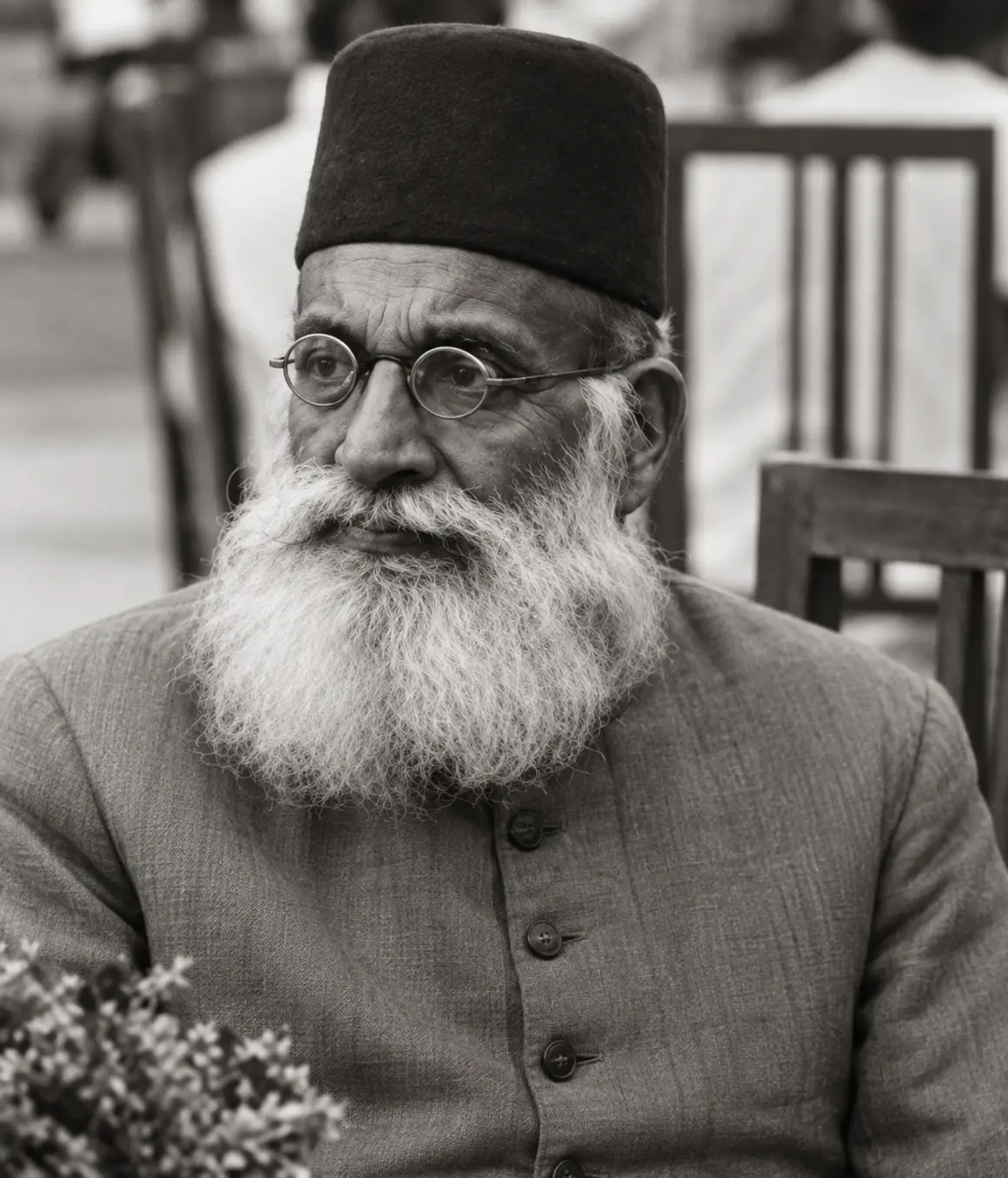
Maulana Hasrat Mohani (1 January 1875 – 13 May 1951), born Syed Fazl-ul-Hasan, was an Indian Muslim poet, journalist, and political activist who combined Urdu ghazal poetry with anti-colonial politics. He coined the slogan "Inquilab Zindabad" (Long Live Revolution) and is generally credited as among the first Indian political figures to call for complete independence (Azadi-e-Kaamil) from British rule, at a time when the Indian National Congress was still seeking dominion status.
Hasrat Mohani held together several commitments that his contemporaries and later historians have found difficult to classify: he was a practising Muslim, a communist sympathizer, a participant in the Congress and in the Muslim League, and a proponent of radical anti-colonial politics. His poetry moved from romantic themes (ishq) to political ones; he combined traditional Muslim learning with an interest in socialism; and he argued for both Hindu-Muslim cooperation and the protection of Muslim rights. He spent several periods in British prisons over the course of his career.
His life (1875-1951) spanned much of the Indian independence movement, from the constitutionalism of the early period through the mass movements of the 1920s to independence and partition in 1947. He was consistent in his call for complete, unconditional independence from British rule, which he first advanced in 1921.
Early Life and Education
Family Background
Hasrat Mohani was born on 1 January 1875 in the small town of Mohan (in Unnao district, United Provinces of British India — modern Uttar Pradesh) into a family of Syed descent — claiming lineage from the Prophet Muhammad (peace be upon him) through the line of Imam Husayn. His family belonged to the Muslim service gentry (ashraf) of northern India — educated, religiously observant, and connected to the broader networks of Muslim intellectual and cultural life in the region.
His birth name was Syed Fazl-ul-Hasan, but he adopted the takhallus (pen name) Hasrat early in his literary career — a word meaning "longing" or "unfulfilled desire" that captured both the romantic sensibility of his poetry and the political yearning for freedom that would define his life. "Mohani" indicated his association with his hometown of Mohan.
The family's circumstances were modest but culturally rich. The qasba (small town) environment of Mohan — characteristic of Muslim intellectual life in the United Provinces — combined religious learning, Urdu literary culture, and a sense of Muslim historical identity that would shape Hasrat Mohani's political consciousness. The qasbas of Awadh (Oudh) produced a considerable number of Indian Muslim intellectuals, poets, and political figures, and Hasrat Mohani came from this milieu.
Education at Aligarh
Hasrat Mohani received his higher education at the Muhammadan Anglo-Oriental College at Aligarh — the institution founded by Sir Syed Ahmad Khan that was the premier center of modern Muslim education in India. He entered Aligarh in 1894 and completed his B.A. in 1903 — a long period that reflected not academic difficulty but his growing involvement in political and literary activities that distracted from formal studies.
At Aligarh, Hasrat Mohani took in the institution's modernist Muslim outlook — the view that Muslims should master modern knowledge, engage with contemporary political questions, and treat Islam as compatible with modern education and political life. He also developed political views more radical than Sir Syed Ahmad Khan's loyalism: whereas Sir Syed had counselled cooperation with the British and the avoidance of agitation, Hasrat Mohani concluded, during his student years, that cooperation with the colonial regime was both ineffective and, in his view, wrong.
His years at Aligarh also saw the beginning of his literary work. He composed Urdu ghazals as a student and gained early notice for his verse, marked by romantic longing (ishq), classical form, and personal expression, which drew the attention of established literary figures before his formal education was complete.
The Influence of the Aligarh Environment
The Aligarh of the 1890s and early 1900s was an environment in which young Indian Muslims debated the questions of their time: the relationship between Islam and modernity, the political future of Indian Muslims under British rule, the merits of cooperation versus resistance, and the place of Muslim culture in a changing world. Hasrat Mohani took part in these debates, and the positions he developed there recur across his later career. He rejected the moderate, loyalist position that prevailed in Aligarh's official culture and argued for active resistance to British rule, while maintaining a personal commitment to Islamic observance that he did not separate from his politics. He treated poetry and journalism as instruments of political change rather than as entertainment alone, and he declined to subordinate his thinking to any single party, leader, or ideology, combining elements from different political traditions.
The Journalist: Urdu-e-Mualla
Founding and Purpose
In 1903, immediately after completing his education at Aligarh, Hasrat Mohani founded Urdu-e-Mualla — an Urdu-language monthly journal that combined literary criticism, political commentary, and cultural discussion. The journal's name (meaning "Exalted Urdu") signaled its dual commitment: to the Urdu language and literary tradition, and to the elevation of Muslim intellectual and political consciousness.
Urdu-e-Mualla was among the earlier Indian Muslim publications to combine literary content with political commentary, treating poetry, politics, and religion as connected concerns. Its contents ranged across literary criticism — reviews of Urdu poetry collections, discussions of literary technique, and assessments of contemporary poets — and political commentary, including criticism of British colonial policy, advocacy for Indian self-governance, and discussion of international developments. The journal also carried cultural articles on Muslim education, social reform, and religious thought, alongside original poetry, among it Hasrat Mohani's own ghazals, which drew readers and established the journal's literary reputation.
Suppression and Persistence
The British colonial government — alert to any publication that might stimulate anti-colonial sentiment among Indian Muslims — subjected Urdu-e-Mualla to repeated censorship, harassment, and suppression. The journal was banned multiple times; its press was seized; security deposits were demanded and forfeited; and Hasrat Mohani himself was prosecuted for seditious content.
The journal nonetheless reappeared after each suppression, despite the resulting costs to its editor. It continued, with interruptions, for several decades, making it one of the longer-running radical Muslim publications in colonial India.
Influence on Muslim Political Opinion
Urdu-e-Mualla's influence extended beyond its circulation figures (which were modest). It was read by the Muslim intelligentsia across northern India — by poets, scholars, journalists, and political activists who valued its combination of literary quality and political courage. Its arguments entered the broader discourse of Indian Muslim politics through quotation, discussion, and the influence of its editor's growing reputation.
The journal also provided a platform for younger Muslim writers and journalists, and offered an example of journalism that combined literary content with political commentary. It was read among writers and thinkers who were later active in Indian Muslim politics and culture.
The Poet: Master of the Urdu Ghazal
Literary Achievement
Hasrat Mohani is widely regarded as a leading Urdu ghazal poet of the twentieth century, working within the classical form while extending its range to include political themes. His poetry showed a command of the ghazal's formal requirements — meter (bahar), rhyme (qafiya), refrain (radif), and the conventions of the opening couplet (matla) and closing couplet (maqta). His love poetry (ishqiya shayari) is noted for its intensity of longing, expressed both through suggestion and through direct statement, and he expanded the ghazal to accommodate political subjects — the love of freedom, opposition to tyranny, the call to revolution — without abandoning the form's traditional romantic vocabulary. Critics have observed that, in contrast to poets who treated the ghazal as a purely literary exercise, his verse conveyed a marked personal directness of feeling.
The Famous Couplet
Perhaps Hasrat Mohani's most famous couplet — one that encapsulates his entire worldview — is:
"Chupke chupke raat din aansu bahana yaad hai" (Secretly, night and day, shedding tears — I remember)
This opening of one of his well-known ghazals shows the combination of emotional directness and apparent simplicity often noted in his work. The poem reads on its surface as an expression of romantic loss, but, as is common in the ghazal, its beloved can be read on more than one level — as a human beloved, as the Divine, or as freedom.
The Synthesis of Love and Revolution
A notable feature of Hasrat Mohani's poetry is his combining of romantic and political themes within the ghazal form. In his verse the conventional beloved (mahbub) can be read alongside freedom (azadi), revolution (inquilab), and the nation (watan): the lover's longing corresponds to the desire for liberation, the beloved's cruelty to the oppressor's tyranny, and the lover's readiness to sacrifice to the readiness to sacrifice for freedom.
This approach showed that the Urdu literary tradition could carry political content, and that traditional form and political theme could be held together within a single poem.
Literary Legacy and Influence
Hasrat Mohani's poetry influenced subsequent generations of Urdu poets — particularly those who sought to combine literary quality with political commitment. Poets like Faiz Ahmad Faiz, Josh Malihabadi, and others who developed the tradition of progressive Urdu poetry (taraqqi pasand shayari) in the 1930s and 1940s acknowledged Hasrat Mohani as a precursor — a poet who had demonstrated that political engagement need not compromise literary quality and that the ghazal form could accommodate revolutionary content.
His collected works (Kulliyat-e-Hasrat) remain in print and continue to be studied and recited. His ghazals are still performed at mushairas (poetry gatherings) across South Asia.
Hasrat Mohani as Literary Critic
Beyond his own poetry, Hasrat Mohani was active as a literary critic. Through Urdu-e-Mualla and in his other writing and comment, he assessed the work of both classical and contemporary poets, combining technical knowledge with direct judgement.
His critical work took in several areas. He wrote extensively on the poets of the Urdu tradition — Mir Taqi Mir, Mirza Ghalib, Momin Khan Momin, and others — offering close readings of their craft and assessments of their relative merits. In the long-running literary debate between the partisans of Mir and those of Ghalib, he advocated for Mir Taqi Mir, arguing that Mir's emotional depth, naturalness of expression, and command of the ghazal's essential spirit placed him above Ghalib despite Ghalib's intellectual range. He assessed his contemporaries with the same frankness he applied to classical poets, and he contributed to debates about the nature of poetry, the function of the ghazal, the relationship between form and content, and the standards by which literary quality should be judged.
The Mir-Ghalib Debate
Hasrat Mohani's ranking of Mir Taqi Mir above the more commonly celebrated Mirza Ghalib was among his notable literary positions. He argued that Mir's poetry embodied the essential spirit of the ghazal — romantic longing, emotional sincerity, the pain of separation — more fully than Ghalib's more intellectual and self-conscious work, and that Mir's simpler, less ornate language represented a higher achievement, the art that conceals art. He held that Mir's emotional range was the broader of the two, encompassing not only the wit that Ghalib mastered but also deeper registers of suffering and love, and that the apparent effortlessness of Mir's best couplets concealed a technical mastery that other practitioners were best placed to recognize.
This position, which he maintained throughout his life, contributed to a wider reassessment of Mir's standing in the Urdu canon at a time when Ghalib's more dramatic reputation had tended to overshadow it.
The Mushaira Tradition
Hasrat Mohani was one of the great mushaira performers of his generation — a poet whose recitation could hold audiences spellbound and whose presence at a gathering guaranteed its success. The mushaira (poetry recitation gathering) was the traditional venue for Urdu poetry's public life — and Hasrat Mohani's participation in mushairas across India made him a public figure in ways that publication alone could not.
Several features marked his mushaira performances. He delivered his ghazals with an intensity that matched their emotional content, using voice, gesture, pause, and timing rather than plain reading. The mushaira tradition involves active audience participation, with cries of "wah wah!" and "irshad!" at particularly admired couplets, and he was noted for his ability to elicit these responses. He frequently introduced new and previously unheard poems at these gatherings, so that they served as occasions for fresh composition as well as recitation of established favourites, and his performances often included ghazals with political and revolutionary themes — using the metaphorical language of poetry to convey meanings that prose would have stated more openly and at greater risk under British censorship.
Political Career: The Radical Path
Early Political Activism (1903-1919)
From the founding of Urdu-e-Mualla in 1903, Hasrat Mohani was an active participant in Indian political life, though his positions placed him at odds with the moderate current that dominated early twentieth-century Indian politics. He attended sessions of the Indian National Congress but consistently argued for more radical positions than its leadership was prepared to adopt. He criticized the moderate (or "Naram Dal") approach associated with leaders such as Gopal Krishna Gokhale, holding that petitions and constitutional agitation would not compel the British to grant freedom, and he aligned instead with the extremist (or "Garam Dal") faction led by Bal Gangadhar Tilak, which favoured more forceful methods such as boycotts and passive resistance. He was repeatedly prosecuted and imprisoned by the British for seditious writing and speaking.
His positions during this period were radical by the standards of the time. The Congress itself moved toward the mass action and non-cooperation associated with the extremist faction over the following two decades.
The Swadeshi Movement and the Boycott of British Goods
Hasrat Mohani was an early and enthusiastic supporter of the Swadeshi Movement — the campaign to boycott British-manufactured goods and to promote Indian-made alternatives. He advocated for swadeshi not merely as a political tactic but as an economic necessity — arguing that India's poverty was directly caused by the drain of wealth to Britain through the purchase of British goods, and that economic self-reliance was a prerequisite for political independence.
He was among those who called for extending the boycott (initially limited to Bengal in response to the 1905 Partition) to all of India — arguing that economic resistance to British imperialism should be a national rather than a regional campaign. This position — considered radical in 1905-1910 — would become mainstream Congress policy by 1920.
Imprisonment and Persecution
Between 1908 and 1947, Hasrat Mohani was imprisoned multiple times by the British colonial government — spending a total of several years in various jails across India. His offenses included seditious writing, seditious speaking, participation in banned political activities, and refusal to furnish security bonds that would have required him to moderate his journalism.
His first significant imprisonment came in 1908 — when he was sentenced to two years' rigorous imprisonment for publishing articles in Urdu-e-Mualla that the government considered seditious. The specific offense was an article criticizing British policy and calling for Indian self-governance — a position that was radical enough in 1908 to warrant criminal prosecution.
Further imprisonments followed. In 1915 he was arrested under the Defence of India Act for seditious activities during the First World War. Between 1921 and 1923 he was imprisoned for his role in the Non-Cooperation and Khilafat movements and for speeches calling for complete independence, and in 1930 he was arrested during the Civil Disobedience Movement for taking part in the salt satyagraha and related activities. Throughout the 1930s and 1940s he was repeatedly detained for shorter periods for speeches and writings that the colonial authorities found objectionable.
Prison as Political Education
Accounts of Hasrat Mohani's prison terms describe them as periods of reading and writing as well as hardship. Away from the demands of journalism and organizing, he composed poetry, read in political theory, and deepened his engagement with socialist and anti-colonial thought. He reflected on questions of strategy and the methods of resistance available against British rule, maintained his daily religious practice during confinement, and, where permitted, corresponded with other political prisoners and with supporters outside.
He returned to political activity after each release rather than withdrawing from it, and did not moderate his positions in response to imprisonment.
The Economic Cost of Radicalism
Hasrat Mohani's political career imposed severe economic costs on him and his family. His journal Urdu-e-Mualla — repeatedly suppressed, its press seized, its security deposits forfeited — was a constant financial drain rather than a source of income. His imprisonments meant years without any earnings. His refusal to accept government patronage or to moderate his positions for commercial advantage meant that he lived in genuine poverty for much of his life.
In the Indian political culture of the period, in which personal austerity was often read as a sign of sincerity, his straitened circumstances were taken as evidence that he was not motivated by office or income. He declined government patronage and did not moderate his positions for material advantage.
"Inquilab Zindabad" — The Birth of a Slogan
The Congress Session of 1921
At the Indian National Congress session at Ahmedabad in 1921, Hasrat Mohani introduced the slogan "Inquilab Zindabad" (Long Live Revolution), which subsequently became one of the widely used slogans of the Indian independence movement. It combines the Urdu and Persian word inquilab (revolution, transformation) with zindabad (long live), and expressed in brief the demand for fundamental change that he advocated across his career.
The slogan was revolutionary in its implications: it demanded not reform, not gradual change, not dominion status within the British Empire, but complete transformation — the overthrow of the existing colonial order and its replacement with something entirely new. It was a call not for improvement but for revolution.
The Demand for Complete Independence (Azadi-e-Kaamil)
At the same Congress session, Hasrat Mohani moved a resolution demanding Azadi-e-Kaamil (Complete Independence) — full and unconditional independence from British rule, with no compromise, no dominion status, no gradual self-government, and no constitutional arrangement that left India within the British Empire in any form.
The demand went beyond the Congress consensus of the time. In 1921 most Congress leaders, including Gandhi, called for swaraj (self-rule), a term left broad enough to cover arrangements ranging from dominion status to full independence, whereas Hasrat Mohani's resolution called explicitly for separation from the British Empire without qualification.
The Congress did not adopt his resolution in 1921, regarding it as too far-reaching. The Congress formally adopted the demand for Purna Swaraj (Complete Independence) eight years later, at the Lahore session of 1929 under Jawaharlal Nehru's presidency.
The Slogan's Afterlife
"Inquilab Zindabad" was taken up well beyond its origin and became a common slogan of revolutionary movements across South Asia. Bhagat Singh and the revolutionary nationalists of the late 1920s used it during their trials, and it became a standard slogan at political meetings, demonstrations, and protests throughout the 1930s and 1940s. After independence it continued in use in labour, student, and other political campaigns in both India and Pakistan, and it was translated and adopted by anti-colonial movements in other parts of Asia and Africa.
That a slogan coined by a Muslim poet and politician became a widely shared cry of Indian revolutionary nationalism has often been cited as an instance of its use across communal lines; it came to be associated with no single community.
Bhagat Singh and the Revolutionary Legacy
One channel through which the slogan spread was Bhagat Singh, the revolutionary who was executed by the British in 1931. Bhagat Singh used "Inquilab Zindabad" during his trial, and through his case the slogan reached a younger audience and became associated with revolutionary sacrifice.
That a phrase coined by a Muslim poet was taken up by a Sikh revolutionary and then used more widely within the national movement has often been cited as an example of the cross-communal character of Indian anti-colonial activity, the slogan coming to be associated with no single community.
Relationships with Contemporary Political Leaders
Hasrat Mohani and Gandhi
Hasrat Mohani's relationship with Mahatma Gandhi combined respect with disagreement. He acknowledged Gandhi's capacity for mass mobilization and his personal integrity, but differed with him on several points. He did not accept non-violence as an absolute principle, holding that resistance might require force and that ruling it out in advance was mistaken when facing an armed colonial state. His demand for complete independence went further than Gandhi's position, at least until 1929, and he criticized Gandhi's willingness to negotiate for partial measures. In common with other radicals, he regarded Gandhi's suspension of the Non-Cooperation Movement after the violence at Chauri Chaura in 1922 as a setback for those who had committed to it, and he considered Gandhi too willing to accept incremental progress.
Despite these disagreements, Hasrat Mohani acknowledged Gandhi's personal courage and his reach among ordinary Indians, while continuing to argue that Gandhi's methods were insufficient for the goal of complete independence.
Hasrat Mohani and the Ali Brothers
Hasrat Mohani worked alongside Mohammad Ali Jauhar and Shaukat Ali during the Khilafat Movement, sharing their concern for the Ottoman Caliphate and their commitment to Muslim political mobilization, though the collaboration coexisted with clear differences. His demands were more far-reaching than the Ali Brothers' more gradual approach, calling for complete independence, and he was more sympathetic to socialism and economic questions than they were, their orientation being primarily religious and political rather than economic. He also kept his distance from the organizational structures they built, taking part in the Khilafat Movement without placing himself under its leadership hierarchy.
Hasrat Mohani and Allama Iqbal
The relationship between Hasrat Mohani and Allama Iqbal — both prominent Urdu poets of their generation — combined mutual literary respect with political divergence. Both were committed Muslim intellectuals who combined literary achievement with political engagement; both sought to reconcile Islamic faith with modern political consciousness; and both influenced the development of Muslim political thought in South Asia.
However, they differed in emphasis: Iqbal developed a more elaborate philosophical system (the concept of khudi or self-realization) and eventually articulated the idea of a separate Muslim political entity; Hasrat Mohani remained more rooted in practical politics and in the revolutionary tradition that demanded immediate action rather than philosophical elaboration.
Hasrat Mohani and Maulana Azad
Maulana Abul Kalam Azad — the Muslim scholar and Congress leader — shared with Hasrat Mohani a commitment to Hindu-Muslim cooperation and to a form of Indian nationalism that did not require Muslims to abandon their religious identity. Both men remained in India after Partition; both participated in the Constituent Assembly; and both represented the tradition of Muslim Indian nationalism that the Pakistan movement challenged but did not destroy.
However, Azad was more firmly within the Congress mainstream (eventually serving as Congress president and as India's first Education Minister), while Hasrat Mohani maintained his characteristic independence — participating in Congress but also in the Muslim League, in communist organizations, and in literary circles that transcended party boundaries.
The Khilafat Movement and Muslim Politics
Participation in the Khilafat Movement
Hasrat Mohani was an active participant in the Khilafat Movement (1919-1924) — supporting the campaign to preserve the Ottoman Caliphate and participating in the broader Non-Cooperation Movement that the Khilafat-Congress alliance produced. However, his participation was characteristically independent: he supported the movement's goals while maintaining positions more radical than those of its official leadership (the Ali Brothers).
Specifically, while the Khilafat leadership and Gandhi called for non-cooperation with the British, Hasrat Mohani argued for civil disobedience — a more active and confrontational form of resistance that went beyond mere boycotts and non-participation. He believed that passive non-cooperation was insufficient; that Indians must actively challenge British authority rather than merely withdrawing from it.
His radicalism within the Khilafat Movement extended to his economic demands as well. While other Khilafat leaders focused exclusively on the religious/political issue of the Caliphate, Hasrat Mohani connected the movement to broader questions of economic justice — arguing that the struggle against British imperialism must also be a struggle against the economic exploitation that imperialism imposed. This connection between anti-imperialism and economic radicalism distinguished his position from that of more conservative Muslim leaders.
The Civil Disobedience Movement (1930-1934)
When Gandhi launched the Civil Disobedience Movement in 1930 — beginning with the famous Salt March — Hasrat Mohani participated with characteristic energy despite being in his mid-fifties. He supported the movement's defiance of unjust British laws and participated in activities that led to his arrest and imprisonment.
During this period, his wife Begum Nishat-un-Nisa also became politically active — participating in women's demonstrations, addressing meetings, and enduring the hardships of her husband's renewed imprisonment. Her activism reflected the broader pattern of Indian women's political participation during the Civil Disobedience era — when thousands of women across India came forward to join the national movement, breaking social conventions and risking arrest.
The Civil Disobedience Movement reinforced Hasrat Mohani's view that active defiance, rather than non-cooperation alone, was the more effective form of resistance.
The Quit India Movement (1942)
During the Quit India Movement of 1942 — the last of the large mass movements of the independence struggle — Hasrat Mohani supported the demand for immediate British withdrawal. Its slogan ("Quit India" / "Bharat Chhodo") aligned with the demand for complete independence that he had been making since 1921.
By 1942, Hasrat Mohani was sixty-seven years old. He continued to write and speak in support of independence during the war years, despite the wartime government's increased repression, restating the demand for immediate and complete British departure that he had put to the Ahmedabad Congress of 1921.
The Relationship with the Muslim League
Hasrat Mohani's relationship with the All-India Muslim League was complex and evolved over decades. He participated in League sessions and supported the League's demands for Muslim political rights — but he was never a conventional League politician. His radicalism, his sympathy for socialism, and his insistence on complete independence placed him outside the mainstream of League politics (which tended toward constitutionalism and negotiation rather than revolutionary demand).
In the crucial years of the 1940s — when the Muslim League under Jinnah was demanding Pakistan — Hasrat Mohani supported the general principle of Muslim self-determination while maintaining his own distinctive positions on the form that Muslim political sovereignty should take. He participated in the Constituent Assembly of India after independence (choosing to remain in India rather than migrating to Pakistan) — demonstrating that his commitment to Muslim rights did not require him to abandon the land of his birth.
The Communist Connection
A distinctive feature of Hasrat Mohani's political career was his sympathy for communism, which many contemporaries regarded as difficult to reconcile with his Islamic faith. He was among the founding members of the Communist Party of India (1925), reportedly attending the founding meeting at Kanpur, and he maintained connections with communist and socialist movements throughout his life.
His sympathies drew on several strands of thought. He attributed India's poverty to capitalist exploitation, both British imperial and domestic, and held that only fundamental economic restructuring could address it. He argued that Indian Muslims, like Indians generally, were divided by class as well as by religion, and that the interests of poor Muslims had more in common with those of poor Hindus than with those of wealthy Muslims. He saw the anti-colonial struggle as part of a broader movement against imperialism and exploitation, connecting Indian freedom to the struggles of other colonized peoples. Communist theory offered him a framework for the radical politics he had long practised, and he cited the Russian Revolution of 1917 as evidence that an apparently permanent imperial order could be overturned through organized action.
This combination of Islam and communism was not as contradictory as it appeared to many of his contemporaries. Hasrat Mohani argued that Islam's emphasis on social justice, charity (zakat), equality before God, and the condemnation of exploitation was compatible with socialism's economic program — that both traditions sought a just society in which wealth was not concentrated in the hands of the few while the many suffered in poverty.
A Unique Political Position
Hasrat Mohani's combination of commitments — Muslim, communist, revolutionary, and nationalist at once — sat awkwardly within the categories that his contemporaries and later historians applied to Indian politics. He was a Muslim who worked with Hindus toward common political goals; a communist who maintained Islamic faith and daily religious practice; a Muslim League participant who also attended Congress sessions; an advocate of both armed resistance and constitutional participation; and a supporter of Muslim rights who remained in India after Partition rather than migrating to Pakistan.
He treated this combination not as inconsistency but as a rejection of the idea that political identity had to be singular and exclusive, holding that these commitments could be maintained together even where others regarded them as contradictory.
The Constituent Assembly and Post-Independence Career
The Decision to Stay in India
After the Partition of India in 1947, Hasrat Mohani — despite his Muslim League connections and his advocacy for Muslim rights — chose to remain in India rather than migrating to Pakistan. Several reasons are attributed to the decision. He was attached to the land of his birth, the qasbas of Uttar Pradesh, and held that Indian Muslims had a right to remain in India and to take part in its political life as equal citizens, and that Partition did not require all Muslims to leave. He declined to follow the mass migration that Partition produced, reaching his own decision, and he took the view that independent India still had need of voices calling for social change in which Muslim citizens had a part. His attachment to the syncretic culture of Lucknow and Awadh, and to both Islamic and Hindu cultural traditions, also informed his refusal to treat religious identity as requiring geographic separation.
The decision was not without cost. Many Muslims who remained in India after Partition faced suspicion, discrimination, and marginalization — their loyalty questioned and their status as full citizens contested. Hasrat Mohani's stature and his decades of service to the independence movement provided some protection against such treatment, but the broader climate for Indian Muslims was difficult in the years immediately following Partition.
The Constituent Assembly Debates
Hasrat Mohani was elected to the Constituent Assembly of India, the body charged with drafting independent India's constitution. In its debates he advocated for protections for Muslim minority rights, including personal law autonomy, educational institutions, and cultural preservation, and for economic provisions along socialist lines aimed at the poverty of the Indian population. He opposed constitutional provisions that would limit popular sovereignty or entrench elite privilege, and supported the recognition of Urdu alongside Hindi, arguing that Urdu was not solely a "Muslim language" but a shared literary inheritance of northern India. He also favoured a federal structure with substantial state-level autonomy to protect regional and minority cultures.
His interventions in the Assembly did not always shape the final constitutional text, but they represented one Muslim voice in the drafting of independent India's founding document, informed both by his long record of imprisonment during the independence movement and by his standing as a poet.
The Urdu-Hindi Controversy
Among his interventions in post-independence Indian politics was his advocacy for Urdu. He argued that Urdu and Hindi were historically the same language (Hindustani) written in different scripts, and that the effort to separate them was artificial and politically driven. He maintained that Urdu was not a foreign or exclusively Muslim language but a product of Indian soil, developed over centuries of interaction between linguistic communities, and he characterized the removal of Urdu from government, education, and public signage as, in effect, discrimination against those — chiefly Muslims — who used the Nastaliq script. In his view a secular India should accommodate Urdu alongside Hindi rather than privilege one register over another on communal grounds.
He pursued this position through his journalism, his political speeches, and his Constituent Assembly interventions, linking his literary interest in the survival of the Urdu language to his political concern for the protection of Muslim minority rights in independent India.
Final Years and Continued Activism
Even in the final years of his life — in his mid-seventies, in poor health, in a new nation still finding its way — Hasrat Mohani continued his activism. He spoke at political meetings, wrote poetry, maintained his journal (Urdu-e-Mualla), and continued to advocate for the causes he had always championed: complete freedom, social justice, Muslim rights, and cultural preservation.
He remained a devotee of Lord Krishna in a cultural sense — he was famous for his annual pilgrimage to Mathura during the Krishna Janmashtami festival, combining this with his devout Islamic practice in a way that exemplified the syncretic cultural tradition of the United Provinces' Muslim gentry. This combination — Islamic devotion and appreciation for Hindu cultural traditions — was characteristic of the composite culture of Lucknow and Awadh from which he came, and it represented a vision of Indian Muslim identity that was inclusive rather than exclusive.
His attendance at Janmashtami celebrations was not religious syncretism (he did not worship Krishna) but cultural participation — an expression of the Indian Muslim tradition that could appreciate the beauty of Hindu devotional culture while maintaining its own theological commitments. This tradition — shared by many Muslim intellectuals and poets of the Indo-Gangetic plain — was under increasing pressure from both Hindu and Muslim communalism, and Hasrat Mohani's continued practice of it was itself a political statement: a refusal to accept that religious identity required cultural exclusion.
The Lucknow Literary Circle
In his final years, Hasrat Mohani remained an active member of Lucknow's literary community, attending mushairas, commenting on younger poets' work, and taking part in the literary culture in which he had long moved. Lucknow, with its tradition of Urdu literary refinement, its courtesy culture (tehzeeb), and its association with Urdu poetry, was a fitting setting for his work.
He used these literary gatherings not merely for aesthetic enjoyment but as occasions for political communication — embedding political messages within literary discussions, using poetry to comment on contemporary events, and maintaining his political relevance through his literary authority. In the Indian Muslim tradition, the poet's role was never purely aesthetic — poets were expected to be moral commentators, social critics, and voices of conscience. Hasrat Mohani fulfilled this role until the end of his life.
Personal Life and Character
Marriage and Family
Hasrat Mohani married Begum Nishat-un-Nisa (known as Begum Hasrat Mohani) — a woman of considerable intelligence and political awareness who supported his activism throughout their married life. Begum Hasrat Mohani was herself politically active — participating in the Non-Cooperation and Khilafat movements, enduring the hardships that her husband's repeated imprisonments imposed on the family, and maintaining the household during his long absences.
Their marriage was a genuine intellectual partnership — Begum Nishat-un-Nisa understood and shared her husband's political convictions, supported his refusal to compromise with the colonial government, and accepted the poverty and uncertainty that his activism imposed on their family. She managed the practical affairs of the household, provided emotional support during his imprisonments, and represented his views in his absence — functioning as both his domestic anchor and his political representative.
The couple's domestic life was characterized by intellectual partnership, shared political commitment, and the financial hardship that inevitably accompanied a life devoted to radical journalism and political activism rather than to income-generating professions. They had no children — a fact that meant Hasrat Mohani's legacy would be carried by his ideas and his art rather than by biological descendants.
Begum Hasrat Mohani's own involvement in the independence movement is less documented than her husband's. She was among the Indian Muslim women who entered public political life during the Khilafat and Non-Cooperation period, taking part in political activity that departed from prevailing purdah norms while retaining her religious and cultural identity.
Character and Temperament
Contemporaries described several traits. They noted his independence in holding to a position he considered right, a quality that drew respect but could also make him a difficult colleague, and his readiness to state his views plainly, whether before British judges, Congress leaders, or Muslim League politicians. Despite his Syed background, he lived simply, with modest material needs. The intensity that marked his poetry was also present in his politics, and he maintained his daily religious practice — the five prayers, Quran recitation, and Ramadan fasting — throughout his life, in prison, in political meetings, and in literary gatherings alike.
The Combination of Poet and Politician
Hasrat Mohani was both a poet and a politician at a time when a number of Indian public figures wrote verse, but he pursued both roles at length rather than treating either as secondary. His poetry was recognized within the Urdu literary establishment rather than being the occasional verse of a politician, and his political activity was sustained over decades, involving imprisonment and material hardship, rather than the occasional engagement of a writer. This combination gave him a footing in both worlds, and he addressed literary and political audiences alike.
Islamic Thought and Religious Life
A Devout Muslim Revolutionary
Hasrat Mohani maintained regular religious practice — daily prayers, Quran recitation, and fasting — throughout his life, in prison, in political meetings, in literary gatherings, and at home. His observance was personal and consistent rather than merely formal. He held that there was no contradiction between Islamic faith and radical politics, arguing that Islam's commitment to justice (adl) called for active resistance to oppression, and he did not confine himself to a single school of Islamic thought, combining traditional devotion with his political outlook. His practice of attending the Krishna Janmashtami celebrations in Mathura, while maintaining his Muslim identity, reflected a view of Muslim cultural life that could engage with Hindu traditions without altering its own religious commitments.
Islam and Social Justice
Hasrat Mohani consistently argued that Islam and socialism were compatible — that the Quranic emphasis on justice, the prophetic condemnation of exploitation, the institution of zakat (obligatory charity), and the Islamic ideal of equality before God all pointed toward the kind of just, egalitarian society that socialism also demanded. He saw his communist sympathies not as a departure from Islam but as an application of Islamic principles to modern economic conditions.
This argument — that Islam mandates social justice and economic equality — placed Hasrat Mohani within a broader tradition of Islamic socialism that would develop throughout the twentieth century in various Muslim-majority countries. He was among the earliest South Asian Muslim intellectuals to articulate this position — preceding by decades the more elaborate Islamic socialist theories that would emerge in Pakistan, Egypt, and Indonesia during the 1950s and 1960s.
The Hajj and Pan-Islamic Consciousness
Hasrat Mohani performed the Hajj (pilgrimage to Mecca) — fulfilling one of Islam's five pillars and deepening his connection to the global Muslim community (ummah). The experience of Hajj — standing with Muslims from across the world, regardless of race, nationality, or class, in the sacred precincts of Mecca — reinforced his pan-Islamic consciousness and his conviction that the Muslim community was a single spiritual body whose members were obligated to support one another.
His pan-Islamic consciousness — like that of many Indian Muslim leaders of his generation — extended beyond Indian borders to encompass the broader Islamic world, its struggles against European colonialism, and its aspirations for political and cultural renewal. He expressed solidarity with Muslim struggles in Palestine, Turkey, Egypt, and other regions — seeing these as different fronts in a single global struggle against Western imperialism.
However, his pan-Islamism was never exclusive — it coexisted with his Indian nationalism, his communist internationalism, and his cultural appreciation for Hindu traditions. He refused to accept that solidarity with Muslims worldwide required hostility toward non-Muslims or withdrawal from multi-religious national communities. For Hasrat Mohani, Islamic brotherhood and Indian patriotism were complementary rather than contradictory — both expressions of the same commitment to justice, freedom, and human dignity that animated his entire life.
Death and Legacy
Death in Lucknow (1951)
Hasrat Mohani died on 13 May 1951 in Lucknow, a centre of Urdu literary culture in northern India. He was seventy-six years old, having lived through the span of the Indian independence movement, from the nationalist activity of the 1890s through independence and Partition.
He remained in India until his death, holding to the positions he had maintained throughout his career. His death was noted by figures in both literary and political circles.
He was buried in Lucknow rather than in Pakistan, where a number of his political associates had migrated — consistent with his stated view that Indian Muslims belonged in India.
The Grave and Memory
Hasrat Mohani's grave in Lucknow remains a site of remembrance, visited by those who value his literary work, his political record, or both. Various institutions and public spaces across India bear his name, including streets, literary academies, and cultural organizations.
Literary Legacy
Hasrat Mohani is widely regarded as a significant Urdu ghazal poet of the twentieth century, and his work continues to circulate in several ways. His ghazals are recited at mushairas across South Asia, and his poetry is part of the Urdu literature curriculum in Indian and Pakistani universities. His revolutionary verse, together with the slogan "Inquilab Zindabad," is quoted in political contexts, and his collected works remain in print.
Political Legacy
His political legacy is harder to summarize, in part because he belonged to no single political tradition and the standard categories of Indian politics do not fit him neatly. Several elements are commonly noted. The slogan "Inquilab Zindabad" passed into wide use in Indian political life. He is often credited with being among the first to demand complete independence (Azadi-e-Kaamil), a position the Congress adopted some years later and which was realized in 1947. His career is cited as an example of maintaining radical positions over a long period at the cost of imprisonment, poverty, and political marginalization, and of holding together Islamic practice and radical politics in the person of one who was at once a devout Muslim, a communist sympathizer, and a nationalist. His life is also cited as a challenge to the communal categories of Indian politics, in that he combined Indian nationalism, radical politics, and the defence of Muslim rights.
The Question of Multiple Identities
A recurring theme in assessments of Hasrat Mohani is that he did not treat political identity as singular. At a time when Indian politics increasingly pressed individuals to choose between communal and national identities, and between religious commitment and secular politics, he held several of these commitments together. He participated in Muslim League politics while opposing the premise that Muslims and Hindus formed separate nations, and he took part in Congress politics while rejecting the view that religion should be excluded from public life.
Commentators have noted that this combination did not align neatly with any of the prevailing ideological positions, and have connected it to continuing debates in South Asia over religious identity, national belonging, and political commitment.
Historiographical Note
The Difficulty of Classification
Hasrat Mohani is difficult to place within a single category, and he appears across several bodies of scholarship. Histories of Urdu literature treat him as a major poet of the twentieth-century ghazal; histories of the Indian independence movement discuss him as a radical nationalist associated with "Inquilab Zindabad" and with an early demand for complete independence; and histories of Indian Muslim politics note him as a Muslim League participant who remained in India after Partition. He also figures in histories of the Indian left as a founding member of the Communist Party of India, in histories of Indian journalism as the editor who sustained Urdu-e-Mualla over several decades despite repeated government suppression, and in accounts of the Constituent Assembly as a member who argued for minority rights and for the standing of Urdu.
No single one of these accounts captures the whole, which is itself a reflection of the range of his activity.
National Recognition and Remembrance
Both India and Pakistan have recognized Hasrat Mohani, in somewhat different terms. In India he is remembered chiefly as a freedom fighter and poet associated with "Inquilab Zindabad," while in Pakistan he is remembered as a Muslim political leader and Urdu poet, though his decision to remain in India gives him a more ambiguous place in the Pakistani national narrative. Urdu literary institutions in both countries count him among the language's notable poets.
His portrait has appeared on Indian postage stamps, literary awards have been named after him, and his poetry continues to be published, studied, and recited across South Asia.
Comparative Context
Set against other figures of the Indian independence movement such as Bhagat Singh, Chandrashekhar Azad, and Subhas Chandra Bose, Hasrat Mohani is distinguished by the length of his active career rather than a brief prominence: he maintained his positions across nearly five decades, from 1903 to 1951, through repeated imprisonment, financial hardship, and political marginalization.
Among Muslim political leaders such as Jinnah, the Ali Brothers, and Maulana Azad, he is noted for combining sustained literary work with political activity, a combination less pronounced among his contemporaries in either field. And among Urdu poets of his generation such as Iqbal, Josh Malihabadi, and Jigar Moradabadi, he is distinguished by the extent of his direct political involvement, where Iqbal is generally read as a philosopher-poet and Josh chiefly as a romantic poet who also wrote political verse.
A Life of Principle
A recurring theme in accounts of Hasrat Mohani is the consistency of his positions over time. He called for complete independence at a stage when much of the mainstream sought constitutional reform, and he maintained his several political and literary commitments together rather than choosing among them, accepting the resulting imprisonment, poverty, and marginalization.
Whatever view is taken of his particular positions, he sustained his political engagement over roughly half a century, combining the roles of radical and traditionalist, Muslim and Indian nationalist, and poet and politician within a single career.
References and Further Reading
Primary Islamic Sources
- Quran, Surah An-Nisa (4:75) — "And what is [the matter] with you that you fight not in the cause of Allah and [for] the oppressed among men, women, and children" — cited by Hasrat Mohani to justify political activism as religious duty
- Quran, Surah Al-Ma'idah (5:8) — "O you who have believed, be persistently standing firm for Allah, witnesses in justice" — foundation for his synthesis of Islam and social justice
- Quran, Surah Al-Hashr (59:7) — "So that wealth does not circulate only among your rich" — used in his arguments for Islamic socialism
- Hadith on justice and oppression (Sahih Muslim, Book of Birr, various narrations) — "Help your brother, whether he is an oppressor or oppressed" — cited in the context of resistance to tyranny
Classical Islamic Sources
- Hasrat Mohani. Kulliyat-e-Hasrat (Collected Poetical Works). Various editions, Lucknow and Delhi.
- Hasrat Mohani. Urdu-e-Mualla (monthly journal, 1903-1951). Selected issues available at Aligarh Muslim University Library and National Archives of India.
- Hasrat Mohani. Speeches and statements at the Indian National Congress sessions (1921 and subsequent years). Published in Congress proceedings.
- Hasrat Mohani. Constituent Assembly debates (1947-1949). Published in the Constituent Assembly of India: Debates, Official Report.
- Hasrat Mohani. Nukat-e-Sukhan (literary criticism). Lucknow: various publishers, early 20th century.
Academic and Scholarly Sources
- Hasan, Mushirul. From Pluralism to Separatism: Qasbas in Colonial Awadh. New Delhi: Oxford University Press, 2004.
- Faruqi, Shamsur Rahman. Early Urdu Literary Culture and History. New Delhi: Oxford University Press, 2001.
- Hardy, Peter. The Muslims of British India. Cambridge: Cambridge University Press, 1972.
- Minault, Gail. The Khilafat Movement: Religious Symbolism and Political Mobilization in India. New York: Columbia University Press, 1982.
- Jalal, Ayesha. Self and Sovereignty: Individual and Community in South Asian Islam Since 1850. London: Routledge, 2000.
- Sadiq, Muhammad. A History of Urdu Literature. Delhi: Oxford University Press, 1984.
- Pritchett, Frances W. Nets of Awareness: Urdu Poetry and Its Critics. Berkeley: University of California Press, 1994.
Further Reading
- Russell, Ralph and Khurshidul Islam. Three Mughal Poets: Mir, Sauda, Mir Hasan. Delhi: Oxford University Press, 1968 (for context on the ghazal tradition).
- Hasan, Mushirul, ed. India's Partition: Process, Strategy and Mobilization. Delhi: Oxford University Press, 1993.
- Shaikh, Farzana. Community and Consensus in Islam: Muslim Representation in Colonial India, 1860-1947. Cambridge: Cambridge University Press, 1989.
- Ahmad, Aziz. Islamic Modernism in India and Pakistan, 1857-1964. London: Oxford University Press, 1967.
- Metcalf, Barbara D. Islamic Revival in British India: Deoband, 1860-1900. Princeton: Princeton University Press, 1982.
Mentioned In
4 articles reference this topic
More from Modern Era
Aligarh Muslim University: From the Muhammadan Anglo-Oriental College to a Central University
Aligarh Muslim University grew out of the school founded by Syed Ahmad Khan in 1875, which became the Muhammadan Anglo-Oriental College in 1877 and a university by Act of the Indian legislature in 1920. It was the central institution of the Aligarh Movement.
Hamdard Laboratories (India): From Unani Clinic to National Institution
Hamdard Laboratories (India) is a Unani pharmaceutical company and welfare institution founded in Old Delhi in 1906 by Hakeem Hafiz Abdul Majeed. Converted into a waqf in 1948 under his son Hakeem Abdul Hameed, it produces Rooh Afza and established Jamia Hamdard university in Delhi.
Jamia Millia Islamia: The National Muslim University
Jamia Millia Islamia was founded at Aligarh on 29 October 1920 by nationalist Muslim leaders and students who left the Muhammadan Anglo-Oriental College during the Non-Cooperation movement. It moved to Delhi in 1925, to Okhla in 1935, and became a central university by Act of Parliament in 1988.
Growth of Islamic Finance
Banking and financial services conducted according to Islamic law, which forbids interest and requires risk to be shared. From institutional beginnings in the 1960s the sector has grown into a multi-trillion-dollar industry serving Muslim and non-Muslim customers alike.