Battle of Yarmouk: The Decisive Victory that Opened the Levant
The Battle of Yarmouk (636 CE) was the decisive military engagement that secured Muslim conquest of the Levant, where Khalid ibn al-Walid's tactical genius led to a crushing defeat of the Byzantine Empire and opened Syria and Palestine to Islamic rule.
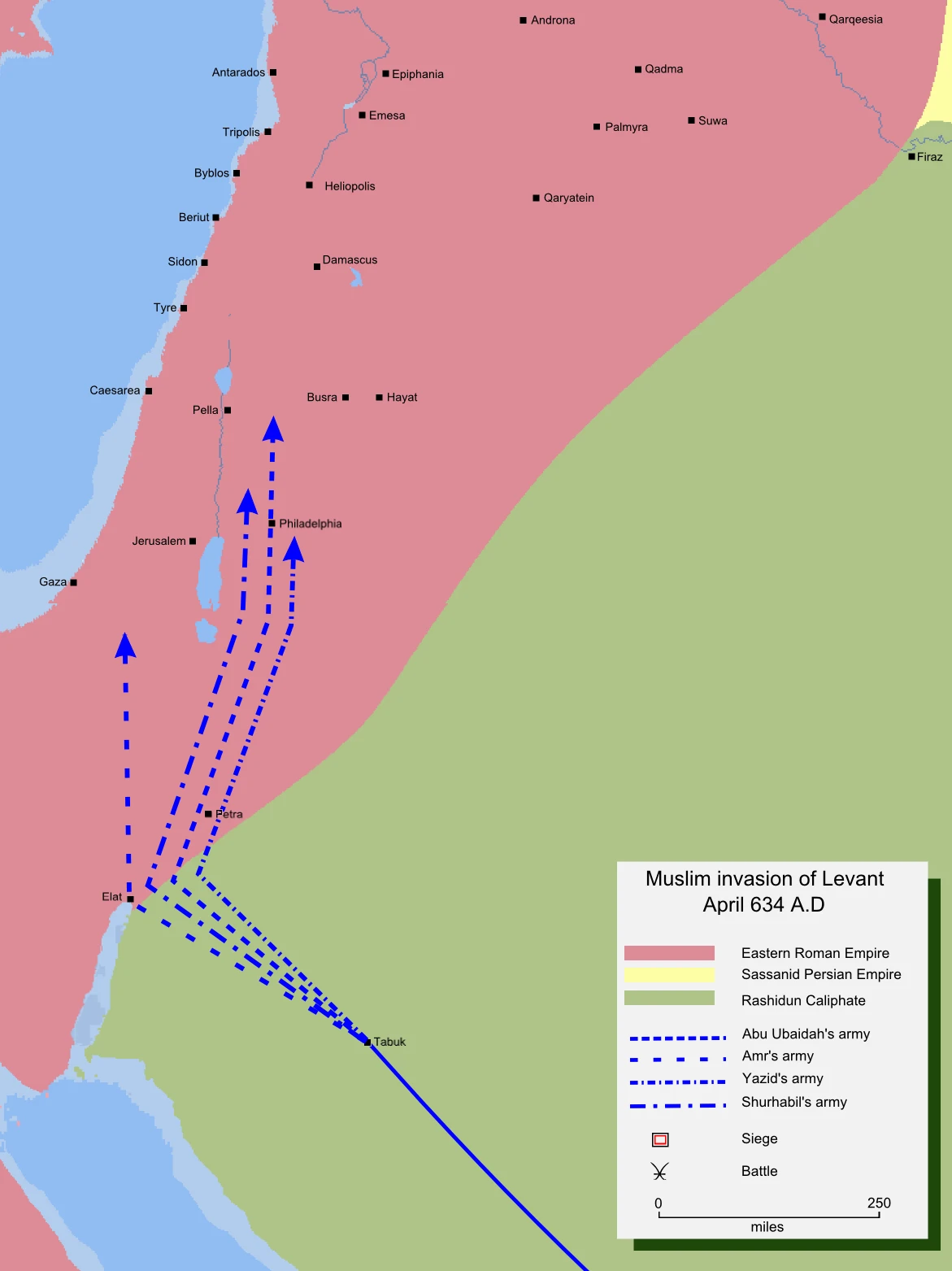
The Battle of Yarmouk, fought on August 20, 636 CE (15 AH), stands as one of the most decisive military engagements in world history. This crushing victory of the Rashidun Caliphate over the Byzantine Empire not only secured Muslim control over the Levant but also marked the beginning of the end of Byzantine dominance in the eastern Mediterranean. Under the brilliant tactical leadership of Khalid ibn al-Walid, known as "Sayf Allah al-Maslul" (The Drawn Sword of Allah), the Muslim forces achieved a victory so complete that it fundamentally altered the balance of power between the Islamic world and Byzantium for centuries to come.
Historical Context and Background
The Byzantine Empire's Strategic Position
By 636 CE, the Byzantine Empire under Emperor Heraclius had recently concluded a devastating war with the Sassanian Empire of Persia. This prolonged conflict, lasting from 602 to 628 CE, had exhausted both empires militarily and economically, leaving them vulnerable to the emerging Islamic expansion from the Arabian Peninsula.
The Levant (modern-day Syria, Palestine, Lebanon, and Jordan) represented one of the Byzantine Empire's most valuable provinces, serving as a crucial buffer zone against threats from the east and south. The region's strategic importance was enhanced by its role as a major trade route connecting Europe, Asia, and Africa, as well as its significance as the birthplace of Christianity.
Early Islamic Expansion into Syria
The Islamic expansion into Syria began during the caliphate of Abu Bakr (632-634 CE), who launched coordinated campaigns to bring the Levant under Islamic rule. The initial Muslim forces, led by commanders such as Abu Ubaidah ibn al-Jarrah, Amr ibn al-As, Yazid ibn Abi Sufyan, and Shurahbil ibn Hasana, achieved significant early successes against Byzantine forces.
The conquest of Damascus in 634 CE marked a major milestone in the Islamic expansion, providing the Muslims with a strategic base of operations in the heart of Syria. However, the Byzantine response under Emperor Heraclius threatened to reverse these gains and drive the Muslims back into the Arabian Peninsula.
Heraclius's Counter-Offensive
Emperor Heraclius, recognizing the existential threat posed by the Islamic expansion, assembled the largest Byzantine army in decades to reclaim Syria. This massive force, estimated at between 80,000 to 100,000 troops, included not only Byzantine regulars but also Armenian auxiliaries, Arab allies, and other allied contingents.
The Byzantine strategy aimed to use their numerical superiority and superior equipment to overwhelm the Muslim forces in a decisive battle. Heraclius personally oversaw the preparations for this campaign, understanding that failure would likely result in the permanent loss of the Levant to the Islamic state.
The Appointment of Khalid ibn al-Walid
The Strategic Decision
Recognizing the gravity of the Byzantine threat, Caliph Abu Bakr made the crucial decision to transfer Khalid ibn al-Walid from the Iraqi front to Syria. Khalid had already established himself as one of the greatest military tacticians of his era through his victories against the Sassanians and his role in the Ridda Wars.
The transfer of Khalid from Iraq to Syria required a dangerous march across the Syrian desert, a journey that would become legendary for its audacity and strategic brilliance. This movement demonstrated the Rashidun Caliphate's ability to coordinate military operations across vast distances and multiple fronts.
The Desert March
Khalid's march from Iraq to Syria in early 636 CE represents one of the most remarkable military movements in history. Leading a force of approximately 9,000 cavalry, Khalid crossed the seemingly impassable Syrian desert, using his knowledge of desert warfare and Bedouin guides to navigate the harsh terrain.
The march took Khalid's forces through areas considered impossible for large military units to traverse, allowing him to arrive in Syria completely unexpected by the Byzantine forces. This strategic surprise would prove crucial in the subsequent campaign and demonstrated Khalid's innovative approach to military logistics and movement.
Unification of Muslim Forces
Upon arriving in Syria, Khalid was appointed as the supreme commander of all Muslim forces in the region by Caliph Abu Bakr. This unified command structure was essential for coordinating the various Muslim armies that had been operating independently across different parts of Syria.
The unification of command under Khalid brought together approximately 36,000 Muslim troops, still significantly outnumbered by the Byzantine forces but now operating under a single, coherent strategy. This consolidation of forces would prove crucial in the upcoming decisive battle.
Prelude to Battle
The Strategic Situation
By the summer of 636 CE, the strategic situation in Syria had reached a critical juncture. The massive Byzantine army under the command of Vahan, an Armenian general, was advancing to reclaim Damascus and drive the Muslims from Syria entirely. The Muslim forces, despite their recent successes, faced the prospect of being overwhelmed by superior numbers.
Khalid ibn al-Walid recognized that a decisive battle was inevitable and began preparing for what would become the most important engagement of the Syrian campaign. His strategic genius lay in choosing the battlefield and the tactics that would maximize Muslim advantages while minimizing Byzantine strengths.
The Choice of Battlefield
The Yarmouk River valley, located in present-day Jordan near the borders with Syria and Israel, was chosen as the site for the decisive confrontation. This location offered several strategic advantages for the Muslim forces, including difficult terrain that would limit the effectiveness of Byzantine cavalry and the possibility of using the river and surrounding cliffs to channel enemy movements.
The battlefield's geography would prove crucial to the Muslim victory, as Khalid's tactical plan relied heavily on using the terrain to compensate for his numerical disadvantage. The narrow valley would prevent the Byzantines from fully deploying their superior numbers while creating opportunities for the Muslim forces to execute their tactical maneuvers.
Intelligence and Preparation
The Muslim forces conducted extensive reconnaissance of the battlefield and gathered detailed intelligence about Byzantine troop movements and dispositions. This intelligence gathering was crucial for Khalid's tactical planning and allowed him to anticipate Byzantine strategies and counter them effectively.
The preparation phase also involved careful positioning of Muslim forces to maximize their tactical advantages. Khalid arranged his troops to take full advantage of the terrain while maintaining the flexibility necessary for his planned tactical maneuvers.
The Battle Formation and Strategy
Muslim Army Disposition
Khalid ibn al-Walid arranged his forces in a formation that would become a model for Islamic military tactics. The Muslim army was organized into several distinct units, each with specific roles in the overall tactical plan:
The center was commanded by Abu Ubaidah ibn al-Jarrah, consisting of the most experienced infantry units. The right wing was led by Amr ibn al-As, while the left wing was commanded by Yazid ibn Abi Sufyan. The cavalry reserve, personally commanded by Khalid, was positioned to exploit opportunities as they developed during the battle.
The Pincer Movement Strategy
Khalid's tactical masterpiece involved a complex pincer movement designed to encircle and destroy the Byzantine army. The plan required precise timing and coordination between different units, as well as the ability to maintain formation discipline under extreme pressure.
The strategy called for the Muslim center to engage the Byzantine forces frontally while the wings gradually withdrew, drawing the enemy into an extended formation. At the crucial moment, the Muslim cavalry would strike the Byzantine flanks and rear, completing the encirclement and cutting off all routes of retreat.
Byzantine Army Formation
The Byzantine army, under the command of Vahan, was arranged in a traditional formation with heavy infantry in the center, cavalry on the flanks, and archers providing support. The Byzantines relied on their numerical superiority and superior equipment to overwhelm the Muslim forces through direct assault.
The Byzantine strategy was relatively straightforward, aiming to use their advantages in numbers and equipment to break through the Muslim lines and scatter their forces. However, this conventional approach would prove inadequate against Khalid's innovative tactics and the superior mobility of the Muslim forces.
The Course of the Battle
The Initial Engagement
The battle began at dawn on August 20, 636 CE, with both armies advancing toward each other across the Yarmouk valley. The initial engagement involved skirmishing between advance units and cavalry probes as both commanders sought to assess their opponent's dispositions and intentions.
The Muslim forces demonstrated remarkable discipline and coordination from the outset, maintaining their formation while engaging in tactical maneuvers that confused and disrupted Byzantine plans. The superior training and motivation of the Muslim troops became evident in these early exchanges.
The Feigned Retreat
As the battle intensified, Khalid implemented the crucial phase of his tactical plan - the feigned retreat of the Muslim wings. This maneuver required extraordinary discipline and trust between commanders and their troops, as it involved deliberately giving ground to the enemy while maintaining unit cohesion.
The Byzantine forces, believing they were achieving success, pressed forward aggressively, extending their formation and creating gaps in their lines. This aggressive pursuit played directly into Khalid's tactical plan, as it positioned the Byzantine army exactly where he wanted them for the decisive phase of the battle.
The Decisive Cavalry Charge
At the critical moment, when the Byzantine forces were fully committed to their advance and their formation was extended and vulnerable, Khalid launched his devastating cavalry charge. The Muslim cavalry, which had been held in reserve, struck the Byzantine flanks and rear with overwhelming force.
The timing and execution of this cavalry charge were perfect, catching the Byzantine forces completely off guard and unable to respond effectively. The psychological impact of the sudden appearance of Muslim cavalry in their rear was as devastating as the physical damage inflicted by the charge itself.
The Encirclement
The success of the cavalry charge enabled Khalid to complete his encirclement of the Byzantine army. The Muslim wings, which had been conducting their feigned retreat, now turned and advanced, trapping the Byzantine forces in a deadly pocket with no possibility of escape.
The encirclement was so complete that the Byzantine army found itself surrounded on all sides, with the Yarmouk River and its steep banks blocking any possibility of retreat. This tactical masterpiece demonstrated Khalid's genius for combining terrain, timing, and troop movements to achieve decisive results.
The Collapse of Byzantine Resistance
The Breakdown of Command
As the encirclement tightened, the Byzantine command structure began to collapse under the pressure. Communication between different units became impossible, and individual commanders found themselves unable to coordinate effective resistance or organize breakout attempts.
The psychological impact of being surrounded and cut off from retreat routes proved devastating to Byzantine morale. Many units began to surrender or flee individually, further accelerating the collapse of organized resistance.
The Slaughter
What followed was one of the most complete military disasters in Byzantine history. Trapped within the Muslim encirclement, the Byzantine army was systematically destroyed. Historical sources indicate that casualties among the Byzantine forces were catastrophic, with estimates suggesting that 70-80% of the army was killed or captured.
The completeness of the victory was unprecedented in the Islamic conquests up to that point. The destruction of the Byzantine army was so thorough that it effectively ended organized Byzantine resistance in the Levant for the foreseeable future.
The Death of Vahan
The Byzantine commander Vahan was killed during the final phase of the battle, along with most of his senior officers. The loss of the entire command structure meant that even surviving Byzantine units were unable to organize effective resistance or coordinate withdrawal to defensible positions.
The death of the Byzantine leadership had strategic implications far beyond the immediate battle, as it left the remaining Byzantine forces in Syria without experienced commanders capable of organizing continued resistance.
Immediate Aftermath and Consequences
The Strategic Impact
The victory at Yarmouk had immediate and far-reaching strategic consequences. The destruction of the main Byzantine army in the region left Syria and Palestine virtually defenseless, enabling the Muslims to complete their conquest of the Levant with minimal further resistance.
The psychological impact of the victory was equally important, as it demonstrated to both Muslims and their enemies that the Islamic expansion was unstoppable. The completeness of the victory at Yarmouk became a symbol of divine favor and military superiority that enhanced Muslim morale throughout the expanding Islamic empire.
The Completion of the Syrian Conquest
Following the victory at Yarmouk, the remaining Byzantine strongholds in Syria fell in rapid succession. Damascus, which had been temporarily reoccupied by Byzantine forces, was quickly retaken, while other major cities such as Aleppo, Antioch, and eventually Jerusalem surrendered or were conquered with minimal resistance.
The speed of these subsequent conquests demonstrated how completely the Battle of Yarmouk had broken Byzantine power in the region. Without a field army capable of relieving besieged cities, the remaining Byzantine garrisons were forced to surrender or face inevitable defeat.
Heraclius's Reaction
Emperor Heraclius, upon learning of the disaster at Yarmouk, reportedly bid farewell to Syria with the words "Peace be with you, Syria, what a beautiful land you are for your enemies!" This poignant farewell captured the finality of the Byzantine loss and Heraclius's recognition that the Levant was permanently lost to the Islamic empire.
The emperor's reaction also reflected the broader Byzantine understanding that the defeat at Yarmouk represented more than just a military setback - it marked the end of Byzantine dominance in the eastern Mediterranean and the beginning of a new era of Islamic expansion.
Military and Tactical Analysis
Khalid's Tactical Genius
The Battle of Yarmouk is widely regarded as one of the finest examples of tactical brilliance in military history. Khalid ibn al-Walid's ability to coordinate complex maneuvers involving multiple units while maintaining the element of surprise demonstrated his exceptional understanding of battlefield dynamics and human psychology.
The success of Khalid's tactics relied not only on careful planning but also on the superior training and discipline of his troops. The ability of Muslim forces to execute complex maneuvers under battle conditions while maintaining unit cohesion was crucial to the success of the encirclement strategy.
The Role of Mobility
The superior mobility of the Muslim forces, particularly their cavalry, proved decisive in the battle. While the Byzantine army was larger and better equipped, it was also less mobile and less capable of rapid tactical adjustments during the course of the battle.
The Muslim emphasis on mobility and flexibility allowed them to exploit opportunities as they developed and to maintain the initiative throughout the engagement. This tactical approach would become a hallmark of Islamic military success in subsequent conquests.
Psychological Warfare
The psychological aspects of Khalid's tactical plan were as important as the physical maneuvers. The feigned retreat created confusion and overconfidence among Byzantine forces, while the sudden appearance of Muslim cavalry in their rear created panic and demoralization.
The complete encirclement of the Byzantine army had a devastating psychological impact that accelerated the collapse of organized resistance. The realization that retreat was impossible broke the morale of many Byzantine units and contributed to the completeness of the Muslim victory.
Long-term Historical Impact
The End of Byzantine Power in the Levant
The Battle of Yarmouk marked the definitive end of Byzantine control over the Levant, a region that had been part of the Roman and Byzantine empires for over six centuries. The loss of this wealthy and strategically important region had profound implications for the future of the Byzantine Empire.
The permanent loss of the Levant deprived Byzantium of crucial tax revenues, military recruitment areas, and strategic depth. This loss would contribute to the empire's gradual decline and its eventual inability to resist subsequent Islamic expansion into Anatolia and other Byzantine territories.
The Establishment of Islamic Rule
The victory at Yarmouk established Islamic rule over the Levant on a permanent basis, creating the foundation for centuries of Islamic civilization in the region. The conquest brought new administrative systems, legal frameworks, and cultural influences that would profoundly shape the development of Syria and Palestine.
The Islamic conquest also brought religious tolerance and administrative efficiency that often compared favorably with previous Byzantine rule. Many local populations, particularly religious minorities who had faced persecution under Byzantine rule, welcomed the change in governance.
Impact on Islamic Expansion
The success at Yarmouk provided crucial momentum for subsequent Islamic conquests, demonstrating that even the most powerful enemies could be defeated through superior tactics, leadership, and faith. The victory encouraged further expansion into Egypt, North Africa, and eventually into Europe itself.
The tactical lessons learned at Yarmouk were applied in subsequent Islamic conquests, with the principles of mobility, encirclement, and psychological warfare becoming standard elements of Islamic military doctrine.
Religious and Cultural Significance
Divine Favor and Victory
For Muslims, the victory at Yarmouk was seen as clear evidence of divine favor and support for the Islamic cause. The completeness of the victory against overwhelming odds reinforced the belief that Allah was guiding and protecting the Muslim community in its expansion.
This religious interpretation of the victory provided powerful motivation for subsequent Islamic conquests and helped maintain the morale and unity of Muslim forces during the challenging campaigns that followed.
The Legacy of Khalid ibn al-Walid
The Battle of Yarmouk cemented Khalid ibn al-Walid's reputation as one of history's greatest military commanders. His tactical brilliance and undefeated record in battle made him a legendary figure in Islamic history and military tradition.
Khalid's success at Yarmouk demonstrated the importance of military leadership and tactical innovation in the Islamic conquests. His methods and principles continued to influence Islamic military thinking for centuries after his death.
Cultural Exchange and Transformation
The Islamic conquest of the Levant following Yarmouk initiated a period of cultural exchange and transformation that enriched both Islamic and local traditions. The region became a center of Islamic learning and culture while maintaining its role as a crossroads of civilizations.
The conquest also facilitated the spread of Arabic language and Islamic culture throughout the region, creating lasting changes in the demographic and cultural composition of Syria and Palestine.
Archaeological and Historical Evidence
Battlefield Archaeology
Archaeological investigations in the Yarmouk River valley have provided valuable insights into the battle and its aftermath. Excavations have uncovered weapons, coins, and other artifacts that help confirm historical accounts of the engagement.
The physical evidence supports the historical descriptions of the battle's scale and intensity, while also providing details about the equipment and tactics used by both sides during the engagement.
Historical Sources
The Battle of Yarmouk is well-documented in early Islamic historical sources, including the works of al-Tabari, al-Baladhuri, and other chroniclers. These sources provide detailed accounts of the battle's progression and its strategic significance.
The consistency of these accounts across different sources and their early dating provide historians with reliable information about the battle's events and consequences. The battle is also mentioned in Byzantine sources, though these accounts are often less detailed and sometimes contradictory.
Comparative Analysis
Modern military historians have analyzed the Battle of Yarmouk in comparison with other famous encirclement battles in history, such as Cannae and Stalingrad. These analyses highlight the exceptional nature of Khalid's tactical achievement and its place in military history.
The battle has been studied extensively in military academies around the world as an example of how superior tactics and leadership can overcome numerical disadvantage and achieve decisive victory.
Legacy and Historical Significance
The Battle of Yarmouk stands as one of the most decisive engagements in world history, fundamentally altering the balance of power between the Islamic world and Byzantium. Its consequences extended far beyond the immediate military results to shape the political, cultural, and religious development of the Middle East for centuries.
The Commanders: A Comparative Study
Khalid ibn al-Walid: The Sword of Allah
Khalid's path to military command was shaped first by his pre-Islamic career. He was born into the Banu Makhzum clan of Quraysh and initially fought against the Muslims at the Battle of Uhud in 625 CE, where he displayed considerable tactical skill as an opponent of Islam; his cavalry charge at Uhud came close to defeating the Muslim army. He converted to Islam in 629 CE, two years before the death of Prophet Muhammad, and his military talents were recognized soon afterward. Despite the lateness of his conversion, he was appointed to command positions and received from the Prophet the title "Sayf Allah al-Maslul" (The Drawn Sword of Allah). His approach to warfare emphasized mobility and speed, made extensive use of cavalry in desert conditions, took account of the psychological dimensions of combat, and combined tactical innovation with a broader strategic vision.
Vahan: The Byzantine Commander
Vahan represented the established Byzantine military tradition. An Armenian general in Byzantine service, he had experience in warfare against the Persians and commanded a diverse force that included Greeks, Armenians, and Arab allies, operating according to conventional Byzantine military doctrine. His strategic approach rested on numerical superiority and heavy equipment, traditional formation-based tactics, and adherence to established military procedures, an approach that afforded him less flexibility than his Muslim counterpart. At Yarmouk he faced particular difficulties: an enemy employing unfamiliar tactics, a diverse army with the potential for internal disunity, pressure from Emperor Heraclius to deliver a decisive result, and battlefield conditions that shifted more rapidly than his methods could readily accommodate.
The Role of Faith and Morale
Islamic Motivation
The motivation of the Muslim army is described in the sources as going beyond material concerns. It had a pronounced spiritual dimension: the belief that they were fighting for Allah's cause, the promise of paradise for those who died as martyrs (shahids), the recitation of Quranic verses before battle, and prayers and supplications offered throughout the engagement. This was accompanied by a unity of purpose that drew on a shared religious identity transcending older tribal divisions, a commitment to spreading Islam, trust in divine support and guidance, and a willingness to sacrifice for the faith.
Byzantine Morale Challenges
The Byzantine army, by contrast, contended with divided loyalties. Its Greek, Armenian, and Arab contingents held differing interests, and religious divisions between Orthodox and Monophysite Christians ran through its ranks; some of its troops were mercenaries fighting for pay rather than conviction, and the force as a whole lacked a unified ideological motivation. It was also affected by war weariness. Decades of war with Persia had left it exhausted, confidence in the imperial leadership was declining, economic hardship affected military readiness, and a growing sense of imperial decline weighed on morale.
Tactical Innovations at Yarmouk
The Mobile Reserve
One of Khalid's key innovations was his use of a mobile cavalry reserve. This body of cavalry was held back from the initial engagement and positioned to exploit opportunities as they arose, kept fresh and ready for the decisive moment and personally commanded by Khalid himself. Its value lay in its flexibility: it could reinforce threatened sectors, remain available for counterattacks, provide psychological reassurance to the other units, and ultimately execute the encirclement manoeuvre that decided the battle.
Coordinated Combined Arms
The Muslim army also demonstrated a high degree of coordination between its different arms. Its infantry held the line while the cavalry manoeuvred, and archers provided covering fire for the cavalry charges, allowing the force to shift between defensive and offensive postures with a fluency that depended on communication and coordination between units. This coordination was matched by careful timing and synchronization: the feigned retreat was executed at a precise moment, the cavalry charge was coordinated to fall at the critical point of the engagement, pressure was applied from several directions at once, and the resulting confusion and disorder in the enemy ranks were exploited without delay.
The Aftermath: Immediate Consequences
The Fall of Damascus
Damascus, which had been temporarily reoccupied by the Byzantines, fell quickly after Yarmouk. Muslim forces besieged the city immediately following the battle, and the demoralized Byzantine garrison offered little resistance, so that the city surrendered within weeks; it would later become the capital of the Umayyad Caliphate. The recovery of Damascus gave the Muslims control of Syria's most important city, access to the agricultural wealth of the surrounding region, a strategic position from which to pursue further conquests, and a visible sign of the extent of Islamic authority in the Levant.
The Conquest of Jerusalem
The fall of Jerusalem in 637-638 CE followed from the collapse of Byzantine power at Yarmouk. The surrender was negotiated: Patriarch Sophronius arranged the terms, and Caliph Umar personally came to accept the city's submission. The Christians of the city were guaranteed protection and religious freedom under the agreement, a settlement often contrasted with the violence that accompanied the later Crusader conquest. Jerusalem carried particular religious significance as the third holiest city in Islam after Mecca and Medina, the site associated with the Prophet's Night Journey (Isra and Mi'raj), and a sacred space shared with Judaism and Christianity, and its acquisition was understood by Muslims as a mark of Islamic expansion and divine favour.
The Byzantine Response and Adaptation
Heraclius's Strategic Withdrawal
After Yarmouk, Heraclius faced a series of difficult choices. His strategic reassessment led to the recognition that the Levant could not be held, and he decided to consolidate his defences in Anatolia, withdrawing the remaining Byzantine forces and concentrating on the protection of the empire's core territories. This was accompanied by a defensive reorganization that included the creation of the theme system of military administration, the fortification of the Taurus Mountains as a frontier, the development of new defensive strategies, and a broader adaptation to the reality of Islamic power on the empire's eastern edge.
Military Reforms
The Byzantines subsequently adapted their military system in the light of the defeat. At the tactical level, they placed greater emphasis on mobility and flexibility, developed lighter cavalry units, improved their intelligence and reconnaissance, and studied the tactics and strategies of the Muslim armies. At the strategic level, they accepted a defensive posture in the east, turned to naval power as a means of maintaining control of the Mediterranean, developed diplomatic strategies, and sought to create buffer zones and client states along their frontiers.
The Broader Islamic Conquests
The Pattern Established
Yarmouk established patterns that recurred in subsequent conquests. In military terms, these included the combination of mobility and tactical flexibility, the use of psychological warfare and deception, the exploitation of enemy weaknesses, and the rapid exploitation of victories once they had been won. In administrative terms, they included the quick establishment of Islamic governance, the protection of religious minorities, the introduction of efficient tax-collection systems, and the integration of local populations into the new order.
The Conquest of Egypt
The conquest of Egypt between 639 and 642 CE followed a similar pattern. Its strategic importance lay in Egypt's agricultural wealth, in control of the Nile Valley, in the access it gave to North Africa, and in the elimination of Byzantine naval bases. The methods used echoed those of the Syrian campaign: reliance on mobility and speed, the exploitation of local discontent with Byzantine rule, the combination of military pressure with diplomatic negotiation, and the rapid consolidation of control once resistance had been overcome.
Women and the Battle
Women in the Muslim Army
Women accompanied the Muslim army and filled a range of important roles, particularly in medical care. They treated wounded soldiers, provided water and supplies, offered encouragement and moral support, and in some cases took part in combat when circumstances required it. Among them was Khawlah bint al-Azwar, a warrior who fought in several battles, alongside many women who provided logistical support and the wives and family members of soldiers; their presence is described in the sources as boosting morale as well as providing practical assistance.
Byzantine Women
The aftermath of the battle affected women on both sides. Many Byzantine women fled before the advancing Muslim forces, and refugees sought safety in Anatolia and Constantinople. Families were separated by the conflict, and the movement of population contributed to longer-term demographic changes across the region.
Economic Consequences
The Wealth of the Levant
The conquest of Syria brought substantial economic benefits. Its agricultural wealth was considerable, comprising the fertile lands of the Jordan Valley and the coastal plains, the production of olive oil, wine, and grain, and control of the region's irrigation systems, all of which were now integrated into the Islamic economic system. The region also commanded major trade routes between Asia and Europe, gave access to Mediterranean ports and to the caravan routes through the desert, and generated significant revenue through customs duties and commercial taxes.
Byzantine Economic Impact
The loss of the Levant had a corresponding effect on Byzantine finances. The empire lost the tax revenues of wealthy provinces, its trade networks were disrupted, its military expenses for defence increased, and it entered a period of long-term economic decline. In response, it came to rely more heavily on Anatolian resources, developed alternative trade routes, undertook economic reforms to cope with reduced revenues, and placed greater emphasis on maritime commerce.
The Battle in Military Education
Modern Military Studies
Yarmouk continues to be studied in military academies, where its lessons are often examined across three levels. At the strategic level, it illustrates the importance of unified command, the value of strategic deception, the need for clear objectives, and the exploitation of enemy weaknesses. At the operational level, it is cited for the coordination of multiple forces, the sequencing of operations, the maintenance of the initiative, and flexibility and adaptation in the face of changing conditions. At the tactical level, it is studied for its use of terrain and environment, its combined-arms coordination, its timing and synchronization, and its use of psychological warfare.
Conclusion
The Battle of Yarmouk represents a pivotal moment in world history, marking the decisive victory that secured Islamic control over the Levant and fundamentally altered the balance of power in the eastern Mediterranean. Under the brilliant tactical leadership of Khalid ibn al-Walid, the Muslim forces achieved a victory so complete and devastating that it ended Byzantine hopes of retaining their eastern provinces and opened the way for continued Islamic expansion.
The battle's significance extends far beyond its immediate military consequences to encompass its impact on the development of Islamic civilization, the decline of Byzantine power, and the transformation of the Middle East. The tactical innovations demonstrated at Yarmouk, particularly the masterful use of encirclement and psychological warfare, established principles that would influence military thinking for centuries to come.
The victory at Yarmouk also demonstrated the power of unified leadership, superior tactics, and unwavering faith to overcome seemingly insurmountable odds. The Muslim forces, though significantly outnumbered, achieved total victory through careful planning, disciplined execution, and the tactical genius of their commander. The battle showcased the importance of mobility, flexibility, and psychological warfare in military operations, lessons that remain relevant to this day.
The human dimension of the battle - the courage of the soldiers, the suffering of the defeated, the role of women in supporting the armies, and the impact on civilian populations - reminds us that military history is ultimately about people, not just tactics and strategies. The battle's aftermath, including Saladin's treatment of defeated enemies and the establishment of Islamic governance in the Levant, demonstrated that military success could be combined with justice and religious tolerance.
For the Byzantine Empire, Yarmouk marked the beginning of a long decline, the loss of wealthy provinces, and the need to adapt to a new strategic reality. The empire would survive for another eight centuries, but it would never recover the territories lost in the wake of Yarmouk. The battle forced the Byzantines to develop new military and administrative systems, creating the theme system that would characterize Byzantine governance for centuries.
For the Islamic world, Yarmouk represented the fulfillment of the Prophet Muhammad's vision of spreading Islam beyond Arabia. The victory opened the way for the conquest of Jerusalem, Egypt, and North Africa, creating an Islamic empire that would become one of the world's great civilizations. The battle demonstrated that the early Islamic conquests were not merely the result of Byzantine and Persian weakness but reflected genuine military superiority and effective leadership.
Today, the Battle of Yarmouk continues to be studied and remembered as one of the greatest military achievements in history. Its lessons remain relevant for military strategists, while its historical significance continues to shape our understanding of the early Islamic conquests and their lasting impact on world civilization. The battle stands as a testament to the transformative power of military genius, the importance of faith and morale in warfare, and the profound consequences that can flow from a single decisive engagement.
The legacy of Yarmouk extends beyond military history to influence our understanding of the relationship between Islam and the West, the nature of religious warfare, and the factors that shape the rise and fall of civilizations. As we study this pivotal battle, we gain insights not only into medieval warfare but also into the broader forces that have shaped our world and continue to influence it today.
References and Further Reading
Primary Islamic Sources
- Quran, Surah Al-Anfal (8:45) — "O you who have believed, when you encounter a company, stand firm and remember Allah much that you may be successful" — cited in the context of the Muslim stand at Yarmouk
- Quran, Surah Al-Baqarah (2:286) — "Allah does not burden a soul beyond that it can bear" — relevant to the Muslim forces facing overwhelming Byzantine numbers
- Quran, Surah Al-Imran (3:160) — "If Allah should aid you, no one can overcome you" — invoked as religious framing of the Yarmouk victory
- Sahih al-Bukhari, Book of Military Expeditions (Maghazi), Hadith 4207 — on the Syrian campaigns and the companions who fought there
- Sahih al-Bukhari, Book of Companions (Fadail al-Sahaba), Hadith 3734 — on Abu Ubaidah ibn al-Jarrah as one of the trustees of the ummah
- Sahih Muslim, Book of the Merits of the Companions, Hadith 2419 — on the virtues of Abu Ubaidah ibn al-Jarrah
- Sahih al-Bukhari, Book of Fighting for the Cause of Allah, Hadith 2925 — on the conquest of Syria
- Abu Dawud, Book of Jihad, Hadith 2614 — on the rules of engagement in warfare, relevant to the Yarmouk campaign conduct
Classical Islamic Sources
- Al-Tabari, Muhammad ibn Jarir. Tarikh al-Rusul wa al-Muluk. Translated by Yohanan Friedmann as The Battle of al-Qadisiyyah and the Conquest of Syria and Palestine. SUNY Press, 1992. [Original c. 915 CE]
- Al-Baladhuri, Ahmad ibn Yahya. Futuh al-Buldan. Translated by Philip Hitti. Columbia University Press, 1916. [Original c. 892 CE]
- Ibn A'tham al-Kufi, Ahmad. Kitab al-Futuh. Edited by Muhammad Abd al-Mu'id Khan. Osmania Oriental Publications Bureau, Hyderabad, 1968. [Original c. 9th century CE]
- Ibn Kathir, Ismail ibn Umar. Al-Bidaya wa al-Nihaya. Dar al-Fikr, Beirut, 1986. [Original c. 1373 CE]
Academic and Scholarly Sources
- Kaegi, Walter E. Byzantium and the Early Islamic Conquests. Cambridge: Cambridge University Press, 1992.
- Kennedy, Hugh. The Great Arab Conquests: How the Spread of Islam Changed the World We Live In. London: Weidenfeld & Nicolson, 2007.
- Donner, Fred M. The Early Islamic Conquests. Princeton: Princeton University Press, 1981.
- Howard-Johnston, James. Witnesses to a World Crisis: Historians and Histories of the Middle East in the Seventh Century. Oxford: Oxford University Press, 2010.
- Haldon, John F. Byzantium in the Seventh Century: The Transformation of a Culture. Cambridge: Cambridge University Press, 1990.
Further Reading
- Nicolle, David. Yarmuk 636 AD: The Muslim Conquest of Syria. Oxford: Osprey Publishing, 1994.
- Blankinship, Khalid Yahya. The End of the Jihad State. Albany: SUNY Press, 1994.
- Akram, A.I. The Sword of Allah: Khalid bin al-Waleed, His Life and Campaigns. Karachi: National Publishing House, 1970.
- Foss, Clive. "The Persians in the Roman Near East (602–630 AD)." Journal of the Royal Asiatic Society 13, no. 2 (2003): 149–170.
Mentioned In
12 articles reference this topic
More from Rashidun Caliphate
Abu Bakr al-Siddiq
The first Rashidun Caliph (632-634 CE) and closest companion of Prophet Muhammad. Known as 'Al-Siddiq' (The Truthful), he preserved Islamic unity after the Prophet's death, defeated the Ridda rebellions, compiled the Quran, and initiated Islamic conquests beyond Arabia.
Jerusalem (Al-Quds)
The third holiest city in Islam, known as Al-Quds (The Holy). Site of the Al-Aqsa Mosque and Dome of the Rock, and the destination of Prophet Muhammad's Night Journey (Isra and Miraj). Conquered peacefully by Umar ibn al-Khattab in 637 CE.
Khawla bint al-Azwar: Warrior of the Muslim Conquest of the Levant
Khawla bint al-Azwar (d. 639 CE) was a Muslim woman warrior of the Banu Asad tribe who fought alongside her brother Dhiraar in the Rashidun conquest of the Levant, most famously at the Battle of Yarmouk in 636 CE, becoming one of the most celebrated women soldiers in Islamic history.
Muawiyah ibn Abi Sufyan: Founder of the Umayyad Caliphate
Founder and first caliph of the Umayyad Caliphate (602-680 CE), who served as governor of Syria for twenty years before establishing the first hereditary Islamic dynasty.