Muhammad ibn al-Qasim: The Conqueror of Sindh
Muhammad ibn al-Qasim (695-715 CE) was the teenage Umayyad general who conquered Sindh in 711 CE, establishing the first permanent Muslim political presence in the Indian subcontinent. His conquest opened the gateway through which Islam would eventually spread across South Asia.
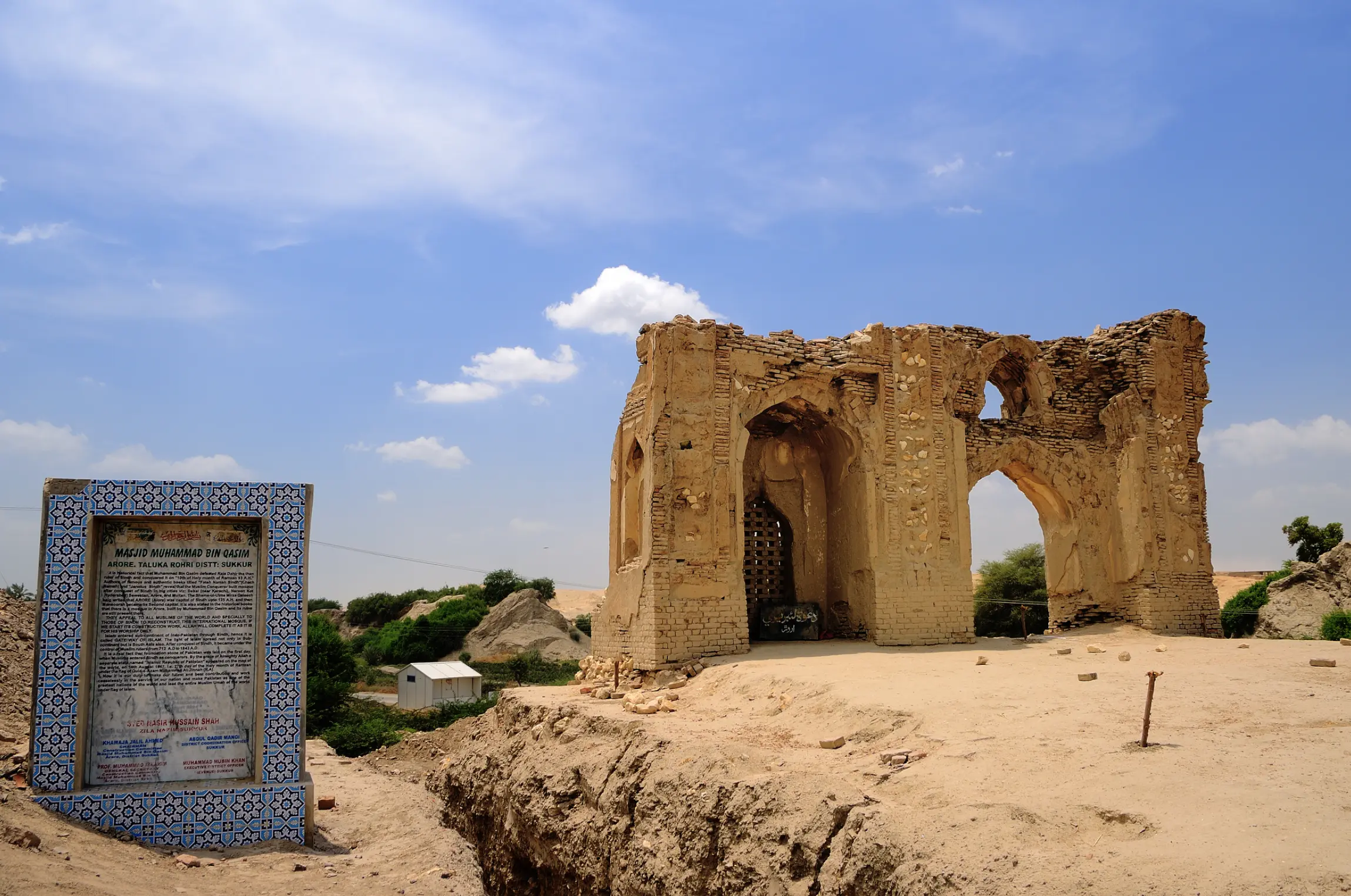
Muhammad ibn al-Qasim al-Thaqafi (695-715 CE / 76-97 AH) was the Umayyad general who, at the remarkable age of approximately seventeen, led the Arab conquest of Sindh (the lower Indus River valley, in modern Pakistan) in 711-712 CE — establishing the first permanent Muslim political presence in the Indian subcontinent. His campaign, authorized by the powerful Iraqi governor al-Hajjaj ibn Yusuf and undertaken during the reign of caliph al-Walid ibn Abd al-Malik, conquered the major cities of Sindh (including Debal, Nerun, Sehwan, and Multan) and established Muslim governance over a large, wealthy, and culturally diverse region.
The conquest of Sindh was one of three simultaneous Umayyad military operations in 711 CE — occurring in the same year as Tariq ibn Ziyad's crossing into Spain and Qutayba ibn Muslim's campaigns in Central Asia. Together, these three campaigns represented the Umayyad Caliphate at the height of its expansionist energy, pushing the boundaries of the Muslim world simultaneously in three directions.
Muhammad ibn al-Qasim's youth at the time of the conquest — he was between fifteen and twenty years old, depending on the source — has made him a celebrated figure in Islamic and particularly Pakistani historical memory: the teenager who conquered a kingdom. His subsequent fate — recalled, imprisoned, and killed after a change of caliph — adds a tragic dimension to his story that parallels the fates of other successful Umayyad commanders who fell victim to court politics.
Background and the Causes of the Campaign
Muhammad ibn al-Qasim's Origins
Muhammad ibn al-Qasim belonged to the Banu Thaqif — the tribe of Ta'if, near Mecca, that had been among the last Arabian tribes to embrace Islam but that subsequently produced many of the Umayyad state's most capable administrators and military commanders. Most significantly, his uncle (or father-in-law, in some accounts) was al-Hajjaj ibn Yusuf al-Thaqafi — the iron-fisted governor of Iraq and the eastern provinces, one of the most powerful and feared men in the Umayyad state.
Al-Hajjaj's patronage was the key to Muhammad ibn al-Qasim's appointment. Despite his extreme youth, he was given command of the Sindh expedition because of his family connection to al-Hajjaj, his demonstrated military ability in previous campaigns (he had reportedly served in Persia under al-Hajjaj's authority), and the governor's confidence in his ability. The appointment of a teenager to command a major expeditionary force was unusual but not unprecedented in an era when military command was often based on family connection and demonstrated merit rather than age.
The Immediate Causes
The immediate cause of the Sindh campaign was a series of incidents involving Muslim shipping in the Indian Ocean. Arab Muslim traders had been active in the Indian Ocean trade for decades, and their ships frequently passed through waters near the Sindhi coast. When Sindhi pirates (or, in some accounts, forces loyal to Raja Dahir, the Hindu ruler of Sindh) attacked Muslim merchant vessels and captured Muslim women and children, al-Hajjaj demanded their return. When Raja Dahir refused (or claimed inability to control the pirates), al-Hajjaj used the incident as a casus belli for a full military expedition.
Two earlier expeditions against Sindh had failed — their commanders defeated and killed. Al-Hajjaj then appointed his young kinsman Muhammad ibn al-Qasim, providing him with a well-equipped army of approximately 6,000-15,000 men (sources vary), including cavalry, infantry, and a siege train with catapults (manjaniqs).
The Conquest of Sindh (711-712 CE)
The March Through Makran
Muhammad ibn al-Qasim's army marched overland from Iraq through the barren coastal region of Makran (modern Balochistan) — a punishing route through desert terrain that had defeated previous expeditions. The army was supplied partly by land and partly by sea (a supporting fleet carried heavy equipment and supplies along the coast). The march through Makran was itself a significant logistical achievement for a force of this size.
The Capture of Debal (711 CE)
The first major engagement was the siege of Debal (a port city near modern Karachi), which was defended by a Buddhist temple-fortress with a garrison loyal to Raja Dahir. After a siege in which Muhammad ibn al-Qasim employed his catapults to break the defenses (reportedly targeting the temple's flagpole, whose fall demoralized the defenders), the city was captured. The fall of Debal gave the Muslim force a port through which supplies and reinforcements could be received by sea.
The Advance Up the Indus
From Debal, Muhammad ibn al-Qasim advanced northward up the Indus River, capturing cities and forts along the way. Nerun, near modern Hyderabad, surrendered without resistance, and Sehwan, a major fortified city, submitted after negotiation. The crossing of the Indus was achieved at a point where Raja Dahir attempted to defend the river crossing, leading to a major battle.
The Battle of Aror and the Death of Raja Dahir
The decisive engagement came at Aror (near modern Nawabshah/Rohri) in 712 CE, where Raja Dahir personally led his army — including war elephants — against the Muslim force. The battle was fierce, but Muhammad ibn al-Qasim's tactics (including the use of fire arrows against the elephants and naphtha-soaked cotton to panic them) proved effective. Raja Dahir was killed in the fighting — either by an arrow or when his elephant was brought down — and with his death, organized resistance to the Muslim advance largely collapsed.
The Capture of Multan
Following Dahir's death, Muhammad ibn al-Qasim continued his advance northward, capturing additional cities including Multan — one of the great cities of the upper Indus, famous for its wealthy temple (the Sun Temple, whose treasures funded the campaign). The capture of Multan in 713 CE marked the effective completion of the conquest: Muslim authority now extended over the entire Indus Valley from the sea to the Punjab.
Governance of Sindh
Administrative Arrangements
Muhammad ibn al-Qasim's governance of the conquered territory demonstrated a sophisticated approach to ruling a diverse, non-Muslim population. In matters of religion, Hindu and Buddhist populations were granted dhimmi status — protection of their persons, property, and worship in exchange for the payment of jizya (poll tax) — and temples were not destroyed, with the exception of the initial battle at Debal, so that local religious practices were permitted to continue. Existing administrative structures were largely preserved: local officials who submitted were retained in their positions, and the day-to-day governance of towns and districts continued under their traditional leaders, now subject to Muslim oversight. A system of taxation was established that drew revenue from the conquered territory for the Umayyad state while leaving the local economy functional.
These arrangements followed the model established in other Umayyad conquests — the dhimmi system that allowed the empire to govern diverse populations without requiring conversion. The Chach Nama (the Persian-language account of the conquest) records Muhammad ibn al-Qasim's instructions in detail, showing a ruler concerned with justice, order, and the practical requirements of governing a large population.
The Letter from al-Hajjaj
The sources preserve correspondence between Muhammad ibn al-Qasim and al-Hajjaj in which the governor provided guidance on governance questions. When Muhammad asked how to treat the Hindu population, al-Hajjaj reportedly instructed him to grant them dhimmi status — comparing their position to that of the Zoroastrians in Persia, who had been granted protection under similar terms. This guidance established the legal framework for Muslim governance of Hindu populations that would be developed further under subsequent Muslim rulers in India.
The Tragic End
The Death of al-Hajjaj and the Change of Caliph
Muhammad ibn al-Qasim's fall was as swift as his rise. In 714 CE, his patron al-Hajjaj ibn Yusuf died. Shortly afterward, the caliph al-Walid also died, and power passed to his brother Sulayman ibn Abd al-Malik (r. 715-717 CE). Sulayman bore grudges against those who had served al-Walid and al-Hajjaj loyally, and he moved quickly to punish them.
Muhammad ibn al-Qasim was recalled from Sindh, arrested, and imprisoned. The sources record that he was sent to Iraq (or possibly to Damascus), where he was tortured and killed — at approximately twenty years of age. The young man who had conquered a kingdom at seventeen was dead at twenty, destroyed by the court politics of a system that rewarded loyalty to one caliph with punishment under the next.
The Parallels
Muhammad ibn al-Qasim's fate paralleled that of other successful commanders under Sulayman. Musa ibn Nusayr, the conqueror of Spain, was also recalled, disgraced, and stripped of wealth; Qutayba ibn Muslim, the conqueror of Central Asia, attempted to rebel against Sulayman and was killed by his own troops; and Tariq ibn Ziyad disappeared into obscurity after his recall.
The pattern demonstrates the structural instability of the Umayyad system: a caliph could appoint capable commanders and achieve extraordinary conquests, but the next caliph could destroy those same commanders out of personal resentment or political calculation.
Legacy
The Opening of the Subcontinent
Muhammad ibn al-Qasim's conquest of Sindh is regarded as the opening of the Indian subcontinent to Islam — the first establishment of permanent Muslim political authority in a region that would eventually become home to the world's largest Muslim populations. While Arab merchants and Sufi travelers had brought Islam to the subcontinent's coasts before 711 CE, it was Muhammad ibn al-Qasim's military conquest that created the political framework within which Islam could spread as a governing religion.
The subsequent history of Islam in South Asia — the Delhi Sultanate, the Mughal Empire, the development of Indo-Islamic civilization, and the eventual creation of Pakistan and Bangladesh as Muslim-majority states — all trace their distant origins to the gateway that Muhammad ibn al-Qasim opened at Debal in 711 CE.
A National Hero in Pakistan
In modern Pakistan, Muhammad ibn al-Qasim is celebrated as a national hero — the young Muslim general who first brought Islam to the land that would become Pakistan. Streets, institutions, and military facilities bear his name; school textbooks recount his conquest; and his image (or representations of his army) appear in popular culture as symbols of Islamic heroism and Pakistani national identity.
This celebration is not without controversy: historians have debated how much of modern Pakistani nationalism can legitimately be projected back onto an eighth-century Arab military commander, and post-colonial critics have questioned the narrative that presents conquest as liberation. Nevertheless, Muhammad ibn al-Qasim's symbolic importance in Pakistani identity — as the first Muslim ruler of the Indus Valley — remains powerful and shows no sign of diminishing.
The Chach Nama: The Primary Source
The Text and Its Significance
The primary source for Muhammad ibn al-Qasim's conquest is the Chach Nama (also called Fateh Nama Sindh or Tarikh-i Hind wa Sindh) — a text that exists in a thirteenth-century Persian translation by Ali ibn Hamid al-Kufi of an earlier Arabic original (attributed to a certain al-Mubaraki, writing in the eighth century). The text provides a detailed narrative of the conquest: the battles, the negotiations, the administrative arrangements, and the correspondence between Muhammad ibn al-Qasim and his patron al-Hajjaj.
The Chach Nama is remarkable for several features. It preserves letters exchanged between Muhammad ibn al-Qasim and al-Hajjaj, with detailed instructions on governance, the treatment of non-Muslim populations, and the disposition of captured territory; it provides accounts of negotiations between the Muslim commander and various local rulers who submitted without fighting; and it describes the treatment of Hindu and Buddhist populations under Muslim governance, establishing precedents for the dhimmi status of non-Abrahamic religions.
The text has been the subject of modern scholarly debate. Manan Ahmed Asif's A Book of Conquest (2016) has argued that the Chach Nama is primarily a thirteenth-century literary construction rather than a reliable eighth-century historical source — that it reflects the concerns of its Persian translator's era rather than the actual events of 711 CE. Other scholars (including Derryl MacLean and André Wink) treat the core narrative as substantially historical while acknowledging that the text has been shaped by transmission and translation across five centuries.
The Letters of al-Hajjaj
Among the most significant elements of the Chach Nama are the letters attributed to al-Hajjaj ibn Yusuf — the powerful governor of Iraq who directed the Sindh campaign from afar. These letters provide instructions on several matters. On the treatment of Hindus and Buddhists, al-Hajjaj reportedly instructed Muhammad ibn al-Qasim to grant them dhimmi status, comparing their position to that of the Zoroastrians of Persia and the pagans of Iraq, who had been granted protection under similar terms — establishing the crucial legal precedent that non-Abrahamic religions could receive dhimmi protection, a principle that would govern Muslim-Hindu relations in India for centuries. Other letters gave detailed instructions on the administration of revenue through taxation and tribute and the management of conquered territories, on military strategy including which cities to attack and which to bypass and how to deal with various forms of resistance, and on the treatment of captives — the disposition of prisoners of war and their families.
Whether these letters are genuine eighth-century documents or later literary constructions, they establish the framework within which the Islamic tradition understood the conquest: as a carefully directed operation, guided by a senior statesman (al-Hajjaj) and executed by a capable young commander (Muhammad ibn al-Qasim), with attention to both military objectives and administrative governance.
The Sindhi Context: What Muhammad ibn al-Qasim Conquered
The Kingdom of Raja Dahir
The Sindhi kingdom that Muhammad ibn al-Qasim conquered was a Hindu Brahmin dynasty that had replaced an earlier Buddhist ruling family (the Rai dynasty) through a coup approximately a generation before the Arab invasion. Raja Dahir, the last Hindu ruler of Sindh, was thus a relatively recent usurper — a fact that may have weakened his popular support and contributed to the rapid collapse of resistance after his death.
Sindh in 711 CE was ethnically diverse, inhabited by Sindhi-speaking populations with significant Buddhist, Hindu, and Jain communities, and economically prosperous, its Indus Valley fertile agricultural land and its port cities including Debal active in Indian Ocean trade. It was militarily significant, controlling the lower Indus — the gateway to the Indian subcontinent from the west — and religiously plural, with Buddhist monasteries, Hindu temples, and smaller religious communities coexisting under a Hindu ruling dynasty that had replaced a Buddhist one.
The Buddhist Population
A significant portion of Sindh's population was Buddhist at the time of the conquest — a fact reflected in the descriptions of Buddhist monasteries (viharas) that the sources mention. The Buddhist communities, who had been displaced from political power by the Brahmin dynasty of Raja Dahir, may have been relatively accommodating toward the Muslim conquerors — seeing in them a force that would at least treat all non-Muslim groups equally under the dhimmi system rather than privileging Hindus over Buddhists.
The subsequent decline of Buddhism in Sindh — which was already underway before the Muslim conquest but accelerated afterward — is one of the long-term consequences of the conquest. Within a few centuries of Muslim rule, Buddhism had effectively disappeared from Sindh, with its adherents either converting to Islam or being absorbed into Hindu communities. The Muslim conquest did not destroy Buddhism in Sindh through persecution (the dhimmi system protected Buddhist practice), but the changed political and social environment accelerated a process of decline that had already begun.
The Military Campaign: Detailed Analysis
Logistics and Supply
The overland march from Iraq to Sindh through Makran was one of the most challenging logistical operations of the early Islamic conquests. The route passed through the deserts of southern Persia, the coastal wasteland of Makran (modern Balochistan) — a region so barren that Alexander the Great's army had suffered catastrophic losses marching through it centuries earlier — and mountain passes and difficult terrain before reaching the Indus Valley.
Muhammad ibn al-Qasim addressed these logistical challenges through a combination of measures. A fleet sailing along the coast provided naval supply, carrying heavy equipment including siege engines and provisions that could not be transported overland. He established forward bases as supply points along the route, arranged local procurement with local chiefs — some of whom were already Muslim or willing to cooperate — for food and water, and moved with speed to minimize the time spent in the worst terrain.
The fact that previous expeditions had failed (their commanders killed in Makran or at the borders of Sindh) demonstrates how difficult the logistics were. Muhammad ibn al-Qasim's success in bringing his army intact to the battlefield was itself a significant achievement.
Siege Warfare and Technology
The conquest of Sindh's fortified cities required siege technology that Muhammad ibn al-Qasim had brought from Iraq — particularly the manjaniq (trebuchet/catapult) that could hurl heavy stones against walls and towers. These siege engines were transported by sea (too heavy and bulky for the overland march) and assembled at each siege site.
The most famous use of siege technology was at Debal, where a catapult reportedly brought down the temple's flagstaff (a tall pole from which a large banner flew). The defenders had prophesied that their city would not fall while the banner flew; when the catapult brought it down, their morale collapsed and the city was stormed. Whether this account is precisely historical or dramatized in retelling, it demonstrates the psychological as well as physical impact of siege technology on defenders unfamiliar with it.
The Role of Elephants
Raja Dahir's army relied heavily on war elephants — a technology unfamiliar to the Arab forces. The elephants provided height advantage, carried archers and javelin-throwers, and could charge through infantry formations. However, Muhammad ibn al-Qasim countered them with fire arrows and naphtha, burning material that panicked the animals; by targeting the mahouts, since killing the driver left the elephant uncontrolled; and with flank attacks that avoided the elephants' frontal charge and struck from the sides.
The successful counter-elephant tactics demonstrated Muhammad ibn al-Qasim's tactical adaptability — his ability to face an unfamiliar military technology and develop effective counters in the field.
The Long-Term Impact on South Asian Islam
The Gateway Function
Muhammad ibn al-Qasim's conquest of Sindh did not immediately lead to the Islamization of the entire Indian subcontinent — that process took centuries and involved multiple subsequent conquests (by Mahmud of Ghazni, Muhammad of Ghor, the Delhi Sultanate, and the Mughal Empire). But Sindh served as the gateway through which Islam entered South Asia as a governing religion, and the precedents Muhammad ibn al-Qasim established (the dhimmi status of Hindus, the preservation of local administrative structures, the collection of revenue through existing systems) shaped the approach of subsequent Muslim rulers in India.
The path from Muhammad ibn al-Qasim's conquest of Sindh in 711 CE to the establishment of Pakistan as a Muslim-majority state in 1947 is long and complex — spanning twelve centuries, multiple dynasties, and countless social transformations. But the chain of causation is real: without the Muslim political presence that Muhammad ibn al-Qasim established, the subsequent history of Islam in South Asia would have unfolded very differently, and the modern Muslim populations of Pakistan, India, and Bangladesh might not exist in their current form.
The Precedent for Hindu-Muslim Relations
The arrangements Muhammad ibn al-Qasim established for governing Sindh's Hindu and Buddhist populations — the extension of dhimmi status to non-Abrahamic religions, the preservation of temples, the appointment of local officials, the collection of jizya rather than the imposition of conversion — set precedents that influenced Hindu-Muslim relations across the subcontinent for centuries.
The principle that Hindus could be granted dhimmi protection (like Christians, Jews, and Zoroastrians) was not self-evident in Islamic law: the original dhimmi concept was developed for "People of the Book" (Abrahamic monotheists), and Hindus — as polytheists with a radically different theological framework — did not obviously fit this category. Al-Hajjaj's instruction to treat Hindus like Zoroastrians (who had received protection despite not being technically "People of the Book") established a practical solution that allowed Muslim governance of Hindu populations without requiring mass conversion or persecution.
This solution — however imperfect in practice and however much it was violated by individual rulers across the centuries — provided the legal framework within which Muslim-majority states governed Hindu-majority populations for over a millennium. Its origins trace directly to Muhammad ibn al-Qasim's governance of Sindh and to al-Hajjaj's instructions about how to treat the conquered population.
The Youth of the Commander
A Teenager Leading an Army
One of the most remarkable aspects of Muhammad ibn al-Qasim's story is his extreme youth at the time of the conquest. The sources place his age at between fifteen and twenty years old when he marched on Sindh — making him, if the lower estimates are correct, one of the youngest commanders to lead a major military campaign in world history. This youth has made him a particularly compelling figure in popular historical memory: the image of a teenage general conquering a kingdom resonates powerfully across cultures and centuries.
His youth was not unique in the context of early Islamic military history — young commanders were not unusual in a system where ability and family connection mattered more than age. But the scale of his responsibility (an independent campaign thousands of kilometers from the capital, against an unknown enemy in unfamiliar terrain) was exceptional for anyone, let alone a teenager. That he succeeded — defeating a king with war elephants, capturing fortified cities, and establishing a functioning administration — testifies either to extraordinary personal ability, to excellent training and guidance from al-Hajjaj, or (most likely) to both.
The Mentorship of al-Hajjaj
Muhammad ibn al-Qasim's success cannot be separated from the mentorship and guidance of al-Hajjaj ibn Yusuf — the powerful governor who selected him for the command, equipped his army, planned the campaign's logistics, and provided ongoing strategic direction through correspondence. The letters preserved in the Chach Nama show al-Hajjaj providing detailed guidance on everything from military tactics to the treatment of conquered populations — functioning as a remote mentor whose experience and judgment supplemented the young commander's own abilities.
This mentorship relationship — between an experienced statesman operating from a distance and a young commander operating in the field — was one of the distinctive features of the campaign. Muhammad ibn al-Qasim was not operating entirely independently; he had the wisdom of one of the Umayyad empire's most experienced administrators available to him through regular correspondence. Al-Hajjaj's guidance on the dhimmi status of Hindus, on taxation policy, on military strategy, and on administrative arrangements shaped the campaign's character as much as Muhammad ibn al-Qasim's own decisions on the battlefield.
The Tragedy of Youth Cut Short
Muhammad ibn al-Qasim's death at approximately twenty years of age — imprisoned and possibly tortured to death after the change of caliph — gives his story a tragic dimension that has resonated across Islamic historical memory. A young man who achieved extraordinary things, who demonstrated capability far beyond his years, and who seemed destined for a long and distinguished career was destroyed by political forces entirely beyond his control. He did nothing wrong; he simply served the wrong master at the wrong time.
This tragedy — talent destroyed by politics, youth extinguished by the arbitrary exercise of power — connects Muhammad ibn al-Qasim's story to a broader theme in Umayyad history and in human history generally: the precariousness of achievement that depends on political favor. His fate serves as a reminder that even the most brilliant military career can be ended not by the enemy on the battlefield but by the ally in the palace.
The Sindh After Muhammad ibn al-Qasim
Continuity of Muslim Rule
Despite Muhammad ibn al-Qasim's recall and death, the Muslim presence he established in Sindh survived and endured. His successors — appointed by the Umayyad and later Abbasid caliphs — maintained Muslim governance of the Indus Valley, though with varying effectiveness. The territory he conquered did not revert to Hindu rule after his removal; the administrative and military systems he established proved robust enough to function without him.
Over the following centuries, Muslim Sindh developed its own distinctive character — an Indo-Islamic civilization that blended Arab Islamic governance with local Sindhi cultural traditions. The cities Muhammad ibn al-Qasim had conquered (Debal, Multan, and others) became centers of Islamic learning and Sufi activity, attracting scholars and mystics from across the Muslim world and serving as way-stations for Islam's further spread into the subcontinent.
The Connection to Later Indian Islam
The path from Muhammad ibn al-Qasim's Sindh to the broader Islamization of the Indian subcontinent was neither direct nor immediate. For approximately three centuries after the conquest (711-1000 CE), Muslim political power in India remained confined largely to Sindh and the lower Indus. It was not until the campaigns of Mahmud of Ghazni (1000-1027 CE) and later Muhammad of Ghor (1175-1206 CE) that Muslim power expanded into northern India and eventually established the Delhi Sultanate.
Nevertheless, Muhammad ibn al-Qasim's conquest established the precedent and the gateway for all subsequent Muslim activity in India. The Arab presence in Sindh created the trade routes, the cultural contacts, and the demonstration of successful Muslim governance that later conquerers would build upon. And the legal framework he established (dhimmi status for Hindus, preservation of local administration, collection of revenue rather than imposition of conversion) set patterns that — with modifications — governed Muslim-Hindu relations for centuries.
Historiographical Controversies
The Chach Nama Debate
The primary source for Muhammad ibn al-Qasim's conquest — the Chach Nama — has been the subject of significant modern scholarly debate. Manan Ahmed Asif's A Book of Conquest (2016) argued that the text as we have it is primarily a thirteenth-century literary construction — that Ali Kufi (the Persian translator) was not merely translating an Arabic original but creating a narrative that served thirteenth-century political purposes (legitimizing the Muslim conquest of India at a time when the Delhi Sultanate was consolidating its power).
If Asif's argument is accepted, it means that much of what we "know" about Muhammad ibn al-Qasim's conquest — the specific dialogues, the letters from al-Hajjaj, the detailed accounts of battles and negotiations — may reflect thirteenth-century literary imagination rather than eighth-century historical reality. The basic facts (that an Arab army conquered Sindh around 711 CE under a commander named Muhammad ibn al-Qasim) are confirmed by other sources (particularly al-Baladhuri's Futuh al-Buldan), but the detailed narrative is more contested.
Other scholars (including André Wink and Derryl MacLean) have been more willing to treat the Chach Nama's core narrative as historical while acknowledging that its literary form reflects the conditions of its transmission. The debate remains open and illustrates the broader challenge of using medieval narrative sources for historical reconstruction.
The National Hero Debate
Muhammad ibn al-Qasim's status as a Pakistani national hero — celebrated in school textbooks, commemorated in place names, and invoked in national mythology — has generated its own scholarly debate. Critics argue that claiming an eighth-century Arab commander as a "founder" of Pakistan is anachronistic, since Pakistan was created in 1947 and Muhammad ibn al-Qasim knew nothing of it; that the conquest was an act of imperial aggression rather than "liberation," and presenting it as liberation imposes a modern ideology on a medieval event; and that the celebration of conquest reinforces the idea that Islam came to South Asia through the sword rather than through trade, Sufism, and voluntary conversion, which are historically more significant pathways.
Defenders argue that Muhammad ibn al-Qasim established the first Muslim political presence in the region that became Pakistan, making him the first link in a chain that eventually produced a Muslim-majority state; that his tolerant governance in preserving Hindu worship and maintaining local administration demonstrates that Muslim rule in India was not inherently oppressive; and that national myths serve social functions regardless of their precise historical accuracy, with Muhammad ibn al-Qasim providing a positive model of Islamic governance for Pakistani national identity.
This debate — between historical criticism and national mythology — shows no sign of resolution and reflects broader tensions about how Muslim-majority societies should relate to their pre-Islamic and early Islamic pasts.
The Cities of the Conquest
Debal: The Gateway Port
Debal (also written Daybul) — the port city where Muhammad ibn al-Qasim made his first landing and fought his first battle in Sindh — was one of the major trading ports of the northwestern Indian Ocean. Located near the mouth of the Indus River (its exact location is debated, but most scholars place it near modern Karachi or Banbhore), Debal served as a gateway for maritime trade between the Arabian Peninsula, East Africa, and the Indian subcontinent.
The city's significance was both commercial (it controlled Indian Ocean trade routes) and military (it was the natural point of entry for any seaborne invasion of Sindh). Its fortifications included a Buddhist temple-fortress whose high walls and prominent flagstaff served as both spiritual center and military strongpoint. Muhammad ibn al-Qasim's capture of Debal — using catapults transported by sea — demonstrated that the Muslim forces possessed siege technology capable of reducing even well-fortified positions, and it gave them a secure port through which supplies and reinforcements could flow.
Multan: The City of Gold
Multan — the great city of the upper Indus valley — was perhaps the most economically significant prize of the conquest. It was famous across the ancient world for its Sun Temple (Aditya Mandir), which housed accumulated offerings of gold, jewels, and precious objects worth an enormous fortune. The temple's wealth — accumulated over centuries of Hindu devotional offerings — reportedly funded a significant portion of Muhammad ibn al-Qasim's subsequent campaign and was sent to the caliphal treasury in Damascus.
The capture of Multan (713 CE) marked the northernmost extent of Muhammad ibn al-Qasim's advance and the effective completion of the Sindh conquest. Beyond Multan, the terrain rose toward the Punjab highlands, and the political landscape became more complex (the Punjab was divided among multiple Hindu and Buddhist kingdoms rather than being ruled by a single king like Dahir). Muhammad ibn al-Qasim did not advance further — whether because his orders did not authorize it, because his resources were insufficient, or because his recall came before further advance was possible.
The Network of Conquered Cities
Between Debal in the south and Multan in the north, Muhammad ibn al-Qasim captured a chain of cities along the Indus River and its tributaries. Nerun, near modern Hyderabad, surrendered without resistance, its Buddhist governor choosing submission over battle, and Sehwan, a major fortified city, submitted after negotiation. Brahmanabad, a large city, saw its Hindu population negotiate terms of surrender; Aror, near modern Sukkur/Rohri, was the site of the decisive battle against Raja Dahir; and Alor was another significant city of the middle Indus.
This chain of conquered cities — stretching approximately 800 kilometers from south to north along the Indus — constituted the core of Muslim Sindh. Each city was given a garrison, a governor (often a local official who had submitted), and instructions for the collection of revenue and the maintenance of order.
The Broader Context: Three Simultaneous Conquests
711 CE: The Year of Expansion
Muhammad ibn al-Qasim's conquest of Sindh occurred in 711 CE — the same year that Tariq ibn Ziyad crossed into Spain and Qutayba ibn Muslim was conquering Bukhara and Samarkand in Central Asia. This simultaneity was not coincidental: it reflected the Umayyad Caliphate under al-Walid ibn Abd al-Malik at the height of its expansionist energy, deliberately pushing on all frontiers at once.
The three campaigns shared common features. All were authorized by the same caliph, al-Walid I, and directed by his governors; all were commanded by young, aggressive commanders willing to take risks; and all faced enemies weakened by internal divisions — the Visigothic civil war, the Sindhi succession crisis, and Central Asian city-state rivalries. All resulted in permanent Islamic presence in the conquered territories, and all ended tragically for their commanders, who were recalled, disgraced, or killed under the next caliph.
The coincidence of three major conquests in a single year — expanding the Muslim world simultaneously westward into Europe, eastward into India, and northeastward into Central Asia — makes 711 CE one of the most consequential single years in the history of Islamic expansion.
The Umayyad System of Expansion
The system that produced these simultaneous conquests relied on several structural features. Decentralized command meant that distant governors like al-Hajjaj in Iraq were given authority to organize and direct campaigns without waiting for caliphal approval of every detail, while revenue reinvestment — spoils from earlier conquests funding subsequent campaigns — created a self-sustaining expansion cycle. Berber and Persian recruitment drew on newly converted populations, Berbers in the west and Persians in the east, to provide the manpower that Arab populations alone could not have generated, and a strategic vision from Damascus allowed the caliph and his immediate advisors to identify frontiers, appoint commanders, and allocate resources across the empire's multiple theaters of operation.
Muhammad ibn al-Qasim's Sindh campaign was one expression of this system — a carefully planned operation directed from Iraq (by al-Hajjaj), funded by Iraqi revenue, manned by a mix of Arab soldiers and Persian/Central Asian auxiliaries, and authorized within the broader framework of Umayyad expansionist strategy.
The Sufi Connection: Islam's Deeper Roots in Sindh
Beyond Military Conquest
While Muhammad ibn al-Qasim's military conquest established the political framework for Islam in Sindh, the deeper and more lasting Islamization of the region came through Sufi mystics — spiritual teachers who arrived in subsequent centuries and who converted Sindhi populations not through the sword but through preaching, example, and the attraction of their personal piety. The Sufi tradition in Sindh — one of the richest in the Islamic world — builds upon the foundation that Muhammad ibn al-Qasim laid but extends it through spiritual rather than military means.
Major Sufi figures of Sindh include Shah Abdul Latif Bhittai (18th century), whose poetry in Sindhi is considered among the finest mystical literature in any language, and numerous earlier Sufi masters who established khanqahs (Sufi lodges) that served as centers of Islamic learning and community life. These Sufi networks — spreading Islam through personal charisma, spiritual practice, and social service — ultimately converted far more people than any military campaign, and they did so by adapting Islamic spirituality to local cultural forms in ways that made it accessible and attractive to Sindhi populations.
The relationship between Muhammad ibn al-Qasim's military conquest and the subsequent Sufi Islamization is complex: the military conquest created the political conditions (Muslim governance, dhimmi protection, Islamic legal framework) within which Sufi activity could operate freely, while the Sufis provided the spiritual content that actually transformed individual hearts and communities. The two processes — political establishment and spiritual conversion — were complementary rather than alternative.
The Enduring Muslim Presence
The Muslim presence that Muhammad ibn al-Qasim established in Sindh in 711 CE has endured continuously for over thirteen centuries — making it one of the oldest continuous Muslim communities in South Asia. Modern Sindh (divided between Pakistan and India after the 1947 Partition) retains deep Islamic roots: its mosques, its shrines, its Sufi traditions, and its Muslim-majority population all trace their origins, however distantly, to the moment when a teenage Arab general landed at Debal with his army of six thousand men and changed the history of the Indian subcontinent.
The Indian Ocean Context
Sindh and Maritime Trade
Muhammad ibn al-Qasim's conquest of Sindh must be understood within the broader context of Indian Ocean trade — the vast maritime network that connected East Africa, Arabia, Persia, India, Southeast Asia, and China through trade routes that had operated for millennia before Islam. The port of Debal (and other Sindhi ports) was a node in this network — a point where goods from the Indian interior (textiles, spices, precious stones) were loaded onto ships bound for Arabian and Persian Gulf ports.
Muslim Arab merchants had been active in Indian Ocean trade since before Muhammad ibn al-Qasim's military campaign. Arab trading settlements existed along the Indian coast (particularly in Gujarat and Malabar), and Muslim commercial networks linked the Arabian Peninsula to Indian markets. The attack on Muslim shipping that provided the casus belli for the Sindh campaign reflected the intersection of commercial and military interests: protecting Muslim merchants was both a religious obligation (defending the community) and an economic imperative (safeguarding trade routes).
The conquest of Sindh gave the Umayyad state direct control over a major node in the Indian Ocean trading system. The port of Debal — now under Muslim governance — became a gateway through which not only trade goods but also ideas, scholars, and cultural influences could flow between the Islamic world and the Indian subcontinent. The commercial dimension of the conquest was at least as significant as the military dimension: control of Sindh meant access to Indian markets, Indian products, and Indian knowledge (including mathematics and astronomy that would later contribute to the Islamic Golden Age).
The Maritime Silk Road
Sindh's ports connected the Islamic world to what historians call the Maritime Silk Road — the sea route that linked China, Southeast Asia, India, the Persian Gulf, and the Red Sea in a continuous chain of commerce. By conquering Sindh, the Umayyad state gained access to this maritime trade network at one of its crucial junctures — the point where the northwestern Indian Ocean met the routes leading to the Indian interior.
This maritime access complemented the overland Silk Road connections that the simultaneous Central Asian conquests (under Qutayba ibn Muslim) were establishing. Together, the conquests of 711 CE gave the Umayyad state access to both the overland and maritime routes that connected China and India to the Mediterranean — a commercial dominance that would fuel the prosperity of the subsequent Abbasid Golden Age.
The Religious Landscape of Conquered Sindh
Buddhism in Decline
At the time of Muhammad ibn al-Qasim's conquest, Buddhism — once the dominant religion of Sindh and much of the Indian subcontinent — was already in a long, slow decline. The Buddhist monasteries (viharas) that the Arab sources describe were the remnants of what had once been a much more extensive Buddhist establishment. The rise of Hindu dynasties (like that of Raja Dahir's family, which had displaced a Buddhist ruling house) had already marginalized Buddhism politically, and the intellectual vitality of the tradition was waning.
The Muslim conquest accelerated Buddhism's decline in Sindh — not through systematic persecution (the dhimmi system protected Buddhist worship) but through the changed social dynamics of Muslim governance. Under the new dispensation, the old Buddhist institutions lost their royal patronage (the Muslim rulers had no reason to support Buddhist monasteries), their social prestige (Islam offered an alternative spiritual path that attracted converts), and their economic base (land reforms and taxation changes affected monastic revenues). Within a few centuries, Buddhism had effectively disappeared from Sindh — its adherents either converting to Islam or being absorbed into Hindu communities.
Hinduism Under Muslim Rule
The Hindu population of Sindh — the majority — adapted to Muslim rule in various ways. The Brahmin priestly class initially lost political power, having been the ruling caste under Dahir, but retained their religious functions and social prestige within Hindu communities. The merchant and trading classes found that the dhimmi system, while requiring jizya payment, actually facilitated their commercial activities, as the Muslim trading networks of the Indian Ocean were now accessible to them through Sindhi ports. Agricultural populations experienced relatively little change in their daily lives, paying taxes to new masters rather than old ones while their agricultural practices, village structures, and local customs continued largely unchanged. Temple worship continued, and the sources record that temples were maintained and Hindu festivals observed, though under the general framework of Muslim political authority.
This Hindu adaptation to Muslim rule set patterns that would characterize Hindu-Muslim relations across the subcontinent for the next millennium: a framework of political submission and fiscal obligation (jizya) combined with cultural and religious autonomy — a system that was neither equality nor persecution but something in between.
The Comparison with Alexander
Two Invasions of the Indus Valley
Historians have sometimes compared Muhammad ibn al-Qasim's invasion of Sindh with Alexander the Great's invasion of the Indus Valley (326 BCE) — approximately one thousand years earlier. The two campaigns share structural similarities: both were invasions by a western power into the Indian subcontinent through the Indus Valley, both were led by very young commanders (Alexander in his twenties, Muhammad ibn al-Qasim in his teens), both involved the defeat of an Indian king who relied on war elephants, and both resulted in the temporary establishment of western political authority over the Indus region.
But the differences are equally significant. Alexander's invasion left no permanent presence — his successors quickly lost control of India, and Greek influence in the subcontinent through the Indo-Greek kingdoms was culturally significant but politically marginal — whereas Muhammad ibn al-Qasim's conquest established a permanent Muslim presence that has endured for thirteen centuries. Alexander did not bring a new religion or a comprehensive system of governance, while Muhammad ibn al-Qasim brought Islam, Islamic law, and a framework of religious coexistence that permanently altered the subcontinent's religious demographics. And where Alexander's army returned west, the Muslim army stayed, through its garrisons and through the continuous flow of settlers, scholars, and merchants from the Islamic world.
The comparison thus ultimately favors Muhammad ibn al-Qasim in terms of lasting historical impact: Alexander's passage through the Indus Valley was a brilliant episode that left limited traces, while Muhammad ibn al-Qasim's conquest initiated a permanent transformation of the subcontinent's religious, political, and cultural landscape.
The Military Innovations of the Campaign
Combined Arms Warfare
Muhammad ibn al-Qasim's campaign demonstrated a sophisticated approach to combined arms warfare — the integration of different military capabilities into a unified operational plan. Naval power came from the fleet that carried siege equipment along the coast and provided the catapults at Debal, operating in coordination with the land forces and arriving at the right place at the right time to support the overland army. The siege engines, the manjaniqs (catapults/trebuchets) that reduced fortified positions like Debal, represented specialized military technology transported over enormous distances specifically for this campaign. Cavalry — Arab and Persian horsemen capable of rapid movement and shock combat — formed the core of the fighting force, supported by infantry who conducted sieges, manned garrisons, and held positions, while intelligence came from a network of informants, scouts, and local collaborators who provided information about enemy dispositions and terrain.
This coordination — between naval and land forces, between siege and field capabilities, between different types of troops — required planning, communication, and command ability that was remarkable for a seventeen-year-old commander (even one guided by al-Hajjaj's correspondence). The fact that the different elements worked together smoothly — that the fleet arrived when needed, that the siege engines were available for each fortified position, that intelligence reached the commander in time to be useful — testifies to the organizational sophistication of the Umayyad military system.
The Counter-Elephant Tactics
Muhammad ibn al-Qasim's development of effective counter-elephant tactics was one of the campaign's significant military innovations. The Arab armies had no prior experience fighting war elephants — these animals were unknown in Arabia and rare in the territories the Arabs had previously conquered (Persia had used some elephants, but not in the numbers and tactical role that Indian armies employed).
The counter-tactics Muhammad ibn al-Qasim developed included naphtha and fire arrows — inflammable materials hurled at the elephants to panic them, since elephants feared fire above all else and flaming projectiles could cause them to bolt, often trampling their own side in their panic. He targeted mahouts, since the elephant driver controlled the animal and, if killed by an arrow or javelin, left the elephant uncontrollable and a danger to its own army. Caltrops and obstacles — scattered iron spikes that injured the elephants' feet — may also have been used, though the sources for this specific tactic in the Sindh campaign are limited, and flanking maneuvers avoided the elephants' frontal charge, their strongest attack, striking from the sides or rear where the animals were more vulnerable and less able to defend themselves.
These tactics — developed in the field against an unfamiliar enemy — were subsequently transmitted to other Muslim armies operating in India. When Mahmud of Ghazni invaded northern India three centuries later, his armies (descended from the same Central Asian military tradition) employed similar anti-elephant tactics. Muhammad ibn al-Qasim's campaign thus contributed not only to the conquest of Sindh but to the broader Islamic military knowledge about fighting on the Indian subcontinent.
The Administration of Justice
The Chach Nama's Legal Episodes
The Chach Nama preserves several episodes in which Muhammad ibn al-Qasim is depicted as a just administrator — resolving disputes fairly, protecting the weak, and applying Islamic legal principles with wisdom. In one case, when a Hindu administrator who had served loyally under Muslim authority was accused by another Muslim of misconduct, Muhammad ibn al-Qasim reportedly investigated fairly and exonerated the Hindu, demonstrating that justice applied regardless of religious affiliation. Several episodes depict him ordering the protection of Hindu and Buddhist temples and preventing soldiers from looting them, treating religious sites as inviolable under the dhimmi agreement, and the sources describe him ordering the protection of women from harm and punishing soldiers who violated this principle.
Whether these episodes are historically accurate (they come from a thirteenth-century text with literary motivations) or whether they are idealized portrayals designed to legitimate Muslim rule in India, they establish the model of just governance that the Islamic tradition associated with Muhammad ibn al-Qasim. In Pakistani and Islamic historical memory, he is not merely a conqueror but a just ruler — one who brought law, order, and impartial justice to a territory that his conquest had destabilized.
The Question of Forced Conversion
The sources are clear that Muhammad ibn al-Qasim did not force conversion on the Hindu and Buddhist populations of Sindh. The dhimmi system he established allowed non-Muslims to retain their faith, their temples, and their internal governance in exchange for jizya payment. This approach — consistent with Quranic principles ("There is no compulsion in religion," 2:256) and with the practice of Muslim conquerors elsewhere — meant that the initial Islamization of Sindh was gradual rather than immediate, voluntary rather than coerced.
The subsequent spread of Islam in Sindh over the following centuries occurred through multiple channels: Sufi missionaries who attracted converts through spiritual charisma and social service; social mobility, as conversion offered escape from the Hindu caste system's restrictions and made Islam attractive to lower-caste populations; intermarriage between Muslim settlers and local populations over generations; and court culture, through the adoption of Islam by ambitious local elites who wished to participate in the new ruling class.
Muhammad ibn al-Qasim created the political framework within which these processes could operate, but the actual conversion of Sindh's population was the work of centuries rather than of his brief two-year governorship.
The Indus Valley: Geography and Its Significance
A Natural Corridor
The Indus River — one of the great rivers of Asia, flowing approximately 3,000 kilometers from the Tibetan plateau to the Arabian Sea — has served since prehistoric times as a natural corridor connecting the Indian subcontinent to Central and Western Asia. The civilizations that arose along its banks (the Indus Valley Civilization of 3000-1500 BCE, the Gandharan kingdoms, the Greek-influenced kingdoms of the post-Alexandrian era) all owed their character in part to the river's dual function: as an agricultural lifeline (providing water and fertile silt to the surrounding plains) and as a communication route (connecting the interior to the coast and thence to the wider world).
Muhammad ibn al-Qasim's conquest followed this natural corridor from south to north — from the sea (Debal) up the river valley to the Punjab (Multan). His campaign was, in geographical terms, a penetration of the corridor from its seaward end: a movement from the coast toward the interior, following the river as both a supply line and a route of advance. This geographic logic — entering from the sea and advancing up the river — would be repeated by subsequent invaders of Sindh (including the British in the nineteenth century).
The Agricultural Wealth of Sindh
The Indus floodplain — particularly the lower valley that constitutes Sindh — was among the most agriculturally productive regions of the medieval world. The annual flooding of the Indus (similar in function to the Nile floods in Egypt) deposited rich silt across the surrounding plains, creating conditions for intensive agriculture: wheat, rice, cotton, sugar cane, and various fruits and vegetables grew in abundance. This agricultural wealth was what made Sindh worth conquering — it could support a large population, generate significant tax revenue, and produce surplus goods for export.
The agricultural wealth of Sindh also explains why the Muslim presence that Muhammad ibn al-Qasim established proved permanent: unlike arid or marginal territories that could not sustain a settled population, the Indus Valley provided the economic base for a viable, self-sustaining Muslim polity. The garrisons he established could be fed from local production; the revenue system he created could fund itself from local taxes; and the cities he captured were already functional urban centers capable of supporting Muslim administrative and scholarly communities.
The Port Cities and the Indian Ocean
The coastal cities of Sindh — particularly Debal — connected the Indus Valley to the Indian Ocean trading system that linked East Africa, Arabia, Persia, India, Southeast Asia, and China. Control of these ports gave the Muslim state access to maritime trade routes carrying spices, textiles, precious stones, and other luxury goods; commercial connections to the wider Islamic world through Arabian Sea shipping lanes; naval capability for projecting power along the Indian coast; and revenue from customs duties collected on goods passing through the ports.
The combination of agricultural wealth (from the Indus floodplain) and commercial wealth (from the ports) made Sindh an economically attractive prize — one that could fund its own governance and contribute surplus revenue to the caliphal treasury in Damascus. Muhammad ibn al-Qasim's conquest thus served both strategic interests (establishing a Muslim presence on the Indian subcontinent) and economic interests (gaining access to the wealth of the Indus Valley and the Indian Ocean trade).
The Cultural Exchange: What Islam Brought and What It Found
What Islam Brought to India
Muhammad ibn al-Qasim's conquest introduced several things to the Indian subcontinent. It brought monotheistic theology, the Islamic doctrine of the oneness of God (tawhid), which contrasted with the Hindu polytheistic system, and egalitarian social principles — Islam's rejection of caste and its insistence on the equality of believers before God, principles that would later attract significant numbers of lower-caste Hindu converts. It brought a new legal system in Islamic law (sharia), administered by Muslim judges (qadis), which coexisted alongside Hindu customary law for the non-Muslim population, and it brought Arabic script and language, which became the language of administration, scholarship, and court culture in Muslim-ruled territories. It introduced new architectural forms — the mosque, the minaret, and other Islamic architectural elements that would eventually produce the magnificent Indo-Islamic architecture of the Mughal period — and a connection to the wider Islamic world through trade routes, scholarly networks, and political connections that linked India to the Mediterranean, Central Asia, and the broader community of Muslim nations.
What Islam Found in India
The Islamic conquerors encountered in India a civilization of extraordinary richness and antiquity — older than Islam itself by millennia. It possessed a sophisticated philosophical tradition in the Vedas, Upanishads, and various schools of Hindu and Buddhist thought, and advanced mathematics including the decimal system and the concept of zero, which would later be transmitted to the Islamic world and thence to Europe. It had a complex social system, the caste hierarchy, that organized human relations in ways entirely foreign to the Arab/Islamic framework; artistic and architectural traditions of great beauty and sophistication; and medical and scientific knowledge, such as Ayurvedic medicine and astronomical observations, that complemented and sometimes exceeded what the Islamic world already possessed.
The encounter between Islamic and Indian civilizations — initiated by Muhammad ibn al-Qasim's military campaign — would eventually produce one of the most fruitful cultural exchanges in world history: the transmission of Indian mathematics to the Islamic world (particularly the numerals we now call "Arabic" but which are actually Indian), the development of Indo-Islamic artistic and architectural traditions, the philosophical dialogues between Islamic and Hindu thought, and the literary cross-pollination between Arabic/Persian and the Indian languages.
Muhammad ibn al-Qasim himself — a teenage military commander focused on the immediate challenges of conquest and governance — could not have anticipated the depth and richness of the cultural exchange that his military campaign would initiate. But the gateway he opened remained open for thirteen centuries, and through it flowed not only armies and administrators but ideas, arts, sciences, and spiritual traditions that enriched both civilizations.
Conclusion: Achievement and Tragedy
Muhammad ibn al-Qasim's life compressed extraordinary achievement and tragic destruction into a span of approximately twenty years. He conquered a kingdom at seventeen, governed it wisely at eighteen, and was destroyed by court politics at twenty. His story contains within it all the themes that define the Umayyad era: the extraordinary energy of a young empire, the brilliance of its commanders, the reach of its ambitions, and the structural instability that destroyed its own servants.
His conquest opened the Indian subcontinent to Islam — a development whose consequences are still unfolding in the twenty-first century, in the politics of South Asia, in the religious demographics of the region, and in the cultural exchanges between Islamic and Indic civilizations. The teenage general who landed at Debal with a few thousand men set in motion processes whose full consequences he could never have imagined — and that continue to shape the world thirteen centuries after his brief, brilliant, and tragic life.
References and Further Reading
Primary Islamic Sources
- Quran, Surah al-Fath (48:20) — "Allah has promised you much spoils that you will take" — cited in the context of conquest
Classical Islamic Sources
- Chach Nama (also called Fateh Nama Sindh). [Originally Arabic, 8th century; Persian translation by Ali Kufi, 13th century] — the most detailed account of the conquest
- Al-Baladhuri, Ahmad ibn Yahya. Futuh al-Buldan. [c. 892 CE] — includes a chapter on the conquest of Sindh
- Al-Tabari, Muhammad ibn Jarir. Tarikh al-Rusul wa al-Muluk. [c. 915 CE]
- Ibn al-Athir. Al-Kamil fi al-Tarikh. [c. 1231 CE]
Academic and Scholarly Sources
- MacLean, Derryl N. Religion and Society in Arab Sind. Leiden: Brill, 1989.
- Wink, André. Al-Hind: The Making of the Indo-Islamic World, Vol. 1. Leiden: Brill, 1990.
- Kennedy, Hugh. The Great Arab Conquests. London: Weidenfeld and Nicolson, 2007.
- Friedmann, Yohanan. "The Temple of Multan: A Note on Early Muslim Attitudes to Idolatry." Israel Oriental Studies 2 (1972): 176-82.
Further Reading
- Asif, Manan Ahmed. A Book of Conquest: The Chachnama and Muslim Origins in South Asia. Cambridge: Harvard University Press, 2016.
- Patel, Alka. Building Communities in Gujarat: Architecture and Society during the Twelfth through Fourteenth Centuries. Leiden: Brill, 2004.
- Khan, Ansar Zahid. History of the Muslim Rule in Sindh. Hyderabad: Academic Publications, 1979.
Mentioned In
5 articles reference this topic
More from Umayyad Caliphate
The Battle of Tours - Turning Point in European History
The Battle of Tours (732 CE) between Charles Martel's Frankish forces and the Umayyad army halted Muslim expansion into Western Europe, marking a decisive turning point that shaped the continent's political and religious landscape for centuries.
Umayyad Caliphate
The Umayyad Caliphate (661-750 CE) was the first major Islamic dynasty, ruling from Damascus and expanding the Islamic empire from Spain to Central Asia through unprecedented territorial growth and administrative innovation.
Al-Aqsa Mosque: The Farthest Sanctuary
Al-Aqsa Mosque in Jerusalem is the third holiest site in Islam, central to the Night Journey (Isra and Miraj) of Prophet Muhammad, and a symbol of Islamic heritage and Palestinian identity for over 1,300 years.
Battle of Karbala
The Battle of Karbala (680 CE) was a confrontation in which Husayn ibn Ali, grandson of Prophet Muhammad, was killed with his companions by Umayyad forces near the Euphrates. It became one of the most consequential events in Islamic history, shaping the development of Shia Islam.