Bahauddin Zakariya: The Suhrawardi Shaikh of Multan
Baha al-Din Zakariya (d. 1262 or 1265 CE) was sent from Baghdad to Multan by his master Umar Suhrawardi and, with Jalal al-Din Tabrizi, established the Suhrawardi order in the Indian subcontinent. The record of his life is thin, and this article says what it carries.
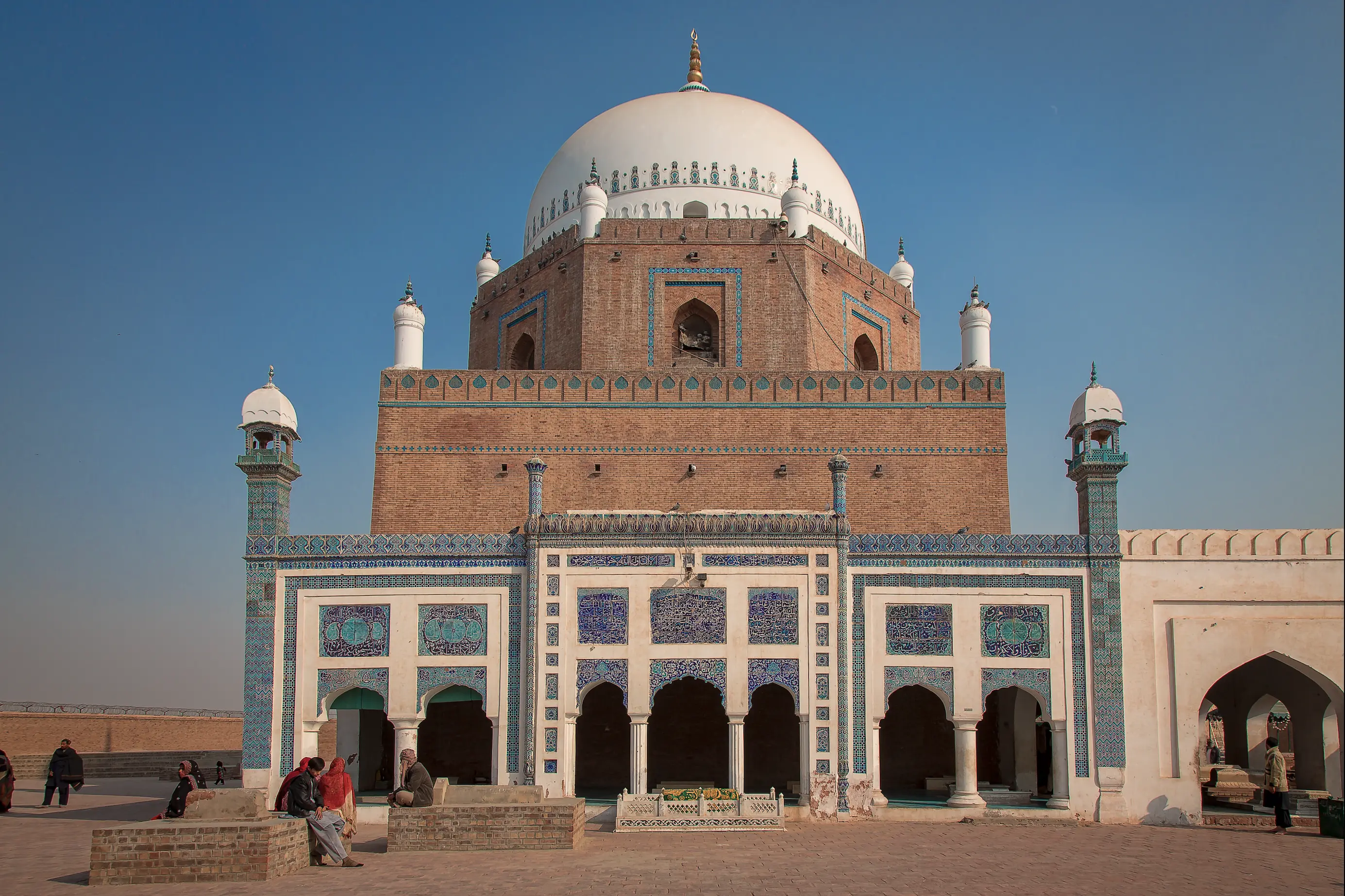
Baha al-Din Zakariya, known also as Baha al-Haqq, was the Sufi master who established the Suhrawardi order at Multan in the thirteenth century and made that city the first great centre of organised Sufism in what is now Pakistan. He was sent there from Baghdad by his own master, Abu Hafs Umar Suhrawardi, and he and Jalal al-Din Tabrizi are together regarded in the scholarly literature as the founders of the Suhrawardiyya in the Indian subcontinent. His shrine at Multan stands beside those of his son and grandson, and the city has been called the city of saints on the strength of them.
This article is shorter than the others in this group, and the reason should be given at the outset rather than left to be inferred. The sources available to this encyclopaedia establish very little about Baha al-Din Zakariya's life. They establish the shape of the world he worked in, the identity of his master, the commission that brought him to Multan, and the year of his death — on which they disagree. They do not establish his birth, his education, the course of his career at Multan, or the content of his teaching. Under the project's own standards a shorter article resting entirely on what can be traced is the correct outcome, and that is what follows.
Multan Before Him
The setting can be described with confidence, because the chronicle on which this encyclopaedia's account of the early Delhi sultanate rests was written by a man who lived and held office sixty miles away.
Multan is one of the oldest continuously inhabited cities of the Indus valley and it had been Muslim-ruled for five centuries before Baha al-Din's time, since the campaigns of Muhammad ibn Qasim in Sindh in 711 CE. The essay on the Sufis of the subcontinent by Nazeer Ahmed on historyofislam.com records that for nearly two hundred years before the Ghurid conquest, Multan and Sindh were controlled by chieftains who looked to the Ismaili Fatimid caliphate in Egypt rather than to Baghdad — which is why the reduction of Multan mattered to the Sunni sultans who followed, and why Mahmud of Ghazni and later Muhammad of Ghor both campaigned there.
In the decades in which Baha al-Din established himself, Multan was the seat of an independent Muslim power that briefly rivalled Delhi. Juzjani's Tabaqat-i Nasiri records that Sultan Nasir al-Din Qabacha, whom Raverty's translation calls Kaba-jah, ruled Uchch and Multan, and that he was destroyed by Sultan Shams al-Din Iltutmish of Delhi. Juzjani gives his own part in these events in unusual personal detail. He reached Uchch by boat in 624 AH, and in the following Dhu al-Hijja Qabacha placed him in charge of the Firuzi College there and appointed him qadi to the forces of his son Ala al-Din Bahram Shah. When Iltutmish appeared before Uchch, Juzjani left Qabacha's service and went over to him, and after the fall of the city accompanied Iltutmish to Delhi, arriving in Ramadan 625 AH.
Two things follow from this for the present subject. The first is that Multan in the 1220s was a city with a court, a college and a body of scholars, and not a frontier outpost — the sort of place in which a shaikh sent from Baghdad would find an educated audience. Gerhard Böwering, writing on the Chishtiyya in the Encyclopaedia Iranica, records that Baba Farid received his early education at Multan; that Qutb al-Din Bakhtiyar Kaki stopped there during Qabacha's rule on his way to Delhi; that Ahmad, the son of Qutb al-Din Mawdud Chishti, had died at Multan as early as 577 AH / 1181 CE; and that two of the poets who later joined Nizam al-Din Awliya's circle at Delhi had come from the court of Multan after 683 AH / 1284 CE. Multan was a place people were educated in and left from.
The second is more troubling for the biographer, and it is taken up in the Historiographical Note below: the chronicler who ran a college at Uchch in the very years when Baha al-Din was building his reputation at Multan never wrote an account of him.
The Commission from Baghdad
The one firmly established fact of his career is how he came to Multan, and it establishes his affiliation as well.
His master was Abu Hafs Umar Suhrawardi, who died in 632 AH / 1234 CE at Baghdad, the author of the Awarif al-Ma'arif — the manual of Sufi instruction that became standard across the Indian orders, and which Böwering records Baba Farid using to train his own disciples at Ajodhan. Umar Suhrawardi's order, the Suhrawardiyya, was thus already the source of the textbook used by the Chishtis before it had a hospice of its own in India.
Florian Sobieroj, writing in the Encyclopaedia Iranica on Jalal al-Din Abu al-Qasim Tabrizi, records the commission: Suhrawardi ordered Baha al-Din Zakariya to migrate to Multan, and permitted Jalal al-Din to travel with him. Sobieroj states, on the authority of S. A. A. Rizvi's history of Sufism in India, that Jalal al-Din and Baha al-Din are to be considered the founders of the Suhrawardi order in the subcontinent.
The manner of the founding is worth pausing on, because it distinguishes the Suhrawardis from the Chishtis at the outset. Mu'in al-Din Chishti reached India as a wandering dervish displaced by war, and the connection between him and the tradition he is held to have founded there rests, as Böwering shows, on a single tenuous link. Baha al-Din Zakariya was sent, by a named master, from the centre of the Islamic world, to a named city, with a companion assigned to him. The Suhrawardiyya in India began as a deliberate extension of an established Baghdad order, and the difference in origin is reflected in the difference in character that the sources afterwards describe.
The Order He Established
What the Suhrawardiyya became in the subcontinent can be described from the approved and scholarly literature even where its founder's own life cannot.
Its geography was distinctive. Böwering contrasts the two orders directly: where the Chishtiyya spread all over India, keeping pace with the Muslim advance, the Suhrawardiyya spread mainly in the Punjab and in Bengal, along the edges of the subcontinent. Multan and Uchch, on the Indus and its tributaries, were its heartland, and it remained a western and riverine order where the Chishtis became a continental one.
Its relation to the state is the point on which the two orders are conventionally opposed, and the opposition needs handling carefully. The received account holds that the Chishtis kept clear of government and refused its grants while the Suhrawardis entered its service. Böwering calls this a questionable, though often repeated, assertion, and his grounds concern the Chishti side of it: Mu'in al-Din's sons held large lands for which their father interceded at Delhi, Qutb al-Din Bakhtiyar came to Delhi at Iltutmish's request, Nizam al-Din Awliya accepted a large sum from a usurper in 720 AH / 1320 CE, and the oath of office was administered to Sultan Firuz Shah Tughluq by a Chishti shaikh. The contrast, in other words, has been overdrawn by understating Chishti involvement rather than by overstating Suhrawardi involvement — and a reader should treat the familiar characterisation of the Suhrawardis as courtly with the same caution.
That said, one Suhrawardi of the following century is documented in precisely that role. Böwering records that Makhdum-i Jahaniyan Jalal al-Din Bukhari, who died in 785 AH / 1384 CE, a Suhrawardi of Uchch, was a trusted adviser of Sultan Firuz Shah Tughluq — and, notably, that he also received a Chishti mantle from Nasir al-Din Chiragh-i Dihli. The two orders were not sealed against one another.
The Suhrawardiyya entered India as one of the four orders that would define Muslim religious life there, alongside the Chishtiyya, the Qadiriyya and the Firdausiyya. Barbara Metcalf's study of Deoband records those four as the major orders in which the sixteenth-century Chishti master Abd al-Quddus Gangohi received initiation, and lists the Suhrawardi among the lines in which Hajji Imdadullah initiated his own disciples in the nineteenth century — by which time, as Metcalf shows, multiple initiation from a single shaikh had blurred the distinctions between the orders and strengthened the individual master at their expense. The order Baha al-Din founded therefore survived as a line of transmission long after it had ceased to be a separate institution, and it is still one of the four named in the Sufi orders of South Asia.
Death
The year of his death is not settled, and the disagreement runs across the sources.
The Tabaqat-i Nasiri carries the earliest notice available here. In the chronological material assembled in Raverty's translation, under the events of 664 AH, appears the entry: "the Imam, Bahi-ud-Din, Zakariya, the Multani, died, leaving seven sons." That is 1265–66 CE. Raverty's index records him as "Baha-ud-Din Zakariya of Multan, Imam," and cross-refers the title Baha al-Haqq to the same person, confirming that the two names denote one man.
The date most often given in the wider literature is 661 AH / 1262 CE, and other accounts place his death as late as 1267 CE. The variance of some five years is reported here rather than resolved, since no source available to this article establishes one reading against the others. What the Tabaqat does add, and what no other source consulted here supplies, is the detail of the seven sons — which matters because hereditary custodianship of the shrine passed within his family, and because the shrines of his son Sadr al-Din Arif and his grandson Rukn al-Din stand beside his own at Multan.
His mausoleum at Multan remains one of the principal monuments of the city and one of the earliest surviving pieces of Islamic funerary architecture in the region.
Historiographical Note
The evidentiary position for Baha al-Din Zakariya is weaker than for any other figure in this group of articles, and the article above is short because of it rather than in spite of it.
What the approved base carries. The project's library was searched for this subject under Baha al-Din Zakariya, Bahauddin Zakariya, Baha-ud-din Zakariya, Zakariya of Multan, Baha al-Haqq, Suhrawardi and Suhrawardiyya, together with Multan and Uchch. The result is one notice: the entry in the chronological material of Raverty's Tabaqat-i Nasiri recording his death in 664 AH and his seven sons, with the supporting index entries. Nothing else in the library treats him. Metcalf's study of Deoband names the Suhrawardi order among the four and the Suhrawardi line among those in which nineteenth-century masters initiated their disciples, but it does not reach back to the order's Indian founding; the Suhrawardi it names as a figure of memory is Shihab al-Din Suhrawardi, not Baha al-Din Zakariya. Of the approved websites, historyofislam.com's essay on the Sufis of the subcontinent treats the Chishtiyya at length and the Suhrawardiyya only as a sister order, without a biographical notice of its Indian founder.
A silence worth recording. Minhaj al-Siraj Juzjani was a scholar and judge in Multan's own political orbit. By his own account in the Tabaqat-i Nasiri he headed the Firuzi College at Uchch and served as qadi to the forces of the ruler of Uchch and Multan, before transferring his allegiance to Iltutmish in 625 AH and going on to become qadi of Delhi. He was therefore in the region, in a senior religious office, in exactly the decades when Baha al-Din was establishing the Suhrawardiyya at Multan; he is demonstrably interested in the Sufi controversies of his day, since he gave the legal opinion in favour of sama in Iltutmish's reign; and he was still writing when Baha al-Din died. Yet his chronicle contains no notice of the shaikh beyond the bare record of his death in a list of the year's events. The same silence falls on Mu'in al-Din Chishti, whom the Tabaqat does not mention at all. Two of the three men now regarded as the founders of Sufism in the subcontinent are effectively absent from the one substantial chronicle written in their own generation. That is a fact about the standing these figures held at the time, as distinct from the standing the tradition later gave them, and it should be weighed before any statement that they dominated the religious life of thirteenth-century India.
What was taken from outside the approved base. Two articles in the Encyclopaedia Iranica were used: Gerhard Böwering on the Chishtiyya, for the comparative geography of the two orders, for the questionable status of the conventional contrast over state service, for Multan's place in the training of the early Chishtis, and for Makhdum-i Jahaniyan; and Florian Sobieroj on Jalal al-Din Tabrizi, for the commission from Umar Suhrawardi and for the statement, on Rizvi's authority, that Jalal al-Din and Baha al-Din are together to be considered the founders of the Suhrawardiyya in India. These were consulted under the owner's standing instruction that external sources may be used where the approved base is insufficient, and are recorded here so that the reliance remains auditable.
What has been left out. A considerable body of circumstantial detail circulates about this subject — a birth at Kot Karor near Multan around 1170, a descent traced to the Prophet's kin, thirty years of travel before settling at Multan in 1222, a college founded there, and a series of exchanges with Delhi. None of it could be traced to a source that meets this project's standard, the material in general circulation being unattributed devotional writing and web compilations of the kind the standards exclude from carrying a factual claim. It is therefore omitted rather than reported with a hedge. Their absence here is not a finding that any of these claims is false; it is a statement that the evidence for them lies outside what was available for this article. The specialist literature that would settle them — S. A. A. Rizvi's A History of Sufism in India above all, which Sobieroj cites, and the Encyclopaedia of Islam article on the Suhrawardiyya — is named in the Further Reading, and a reader who needs the full life should go there.
Conclusion
Baha al-Din Zakariya's importance rests on an institutional fact rather than a documented biography. The Suhrawardi order came to the Indian subcontinent because a master at Baghdad chose a disciple, gave him a companion, and named a city; and the order that resulted held the Punjab and the Indus valley for centuries, produced shaikhs who advised sultans, and remained one of the four lines of Sufi authority in South Asia into the modern period.
That is a substantial achievement, and it is recoverable. What is not recoverable, from anything available here, is the man who accomplished it. The chronicler who lived sixty miles away recorded only that he died and that he left seven sons. Six centuries of devotional writing then supplied everything else, and this article has declined to pass that on as history. A short entry that says what is known, names what is not, and points to where the answer might be found is more use to a reader than a long one that cannot be checked.
References and Further Reading
Primary Islamic Sources
- Suhrawardi, Abu Hafs Umar. Awarif al-Ma'arif — the manual of Sufi instruction by Baha al-Din's own master, which became the standard text of the Indian orders and was used by the Chishtis as well as the Suhrawardis.
- Qur'an 10:62 — the phrase awliya Allah, the friends of God, the scriptural root of the Sufi vocabulary of sainthood used throughout this literature.
- The silsilah of the Suhrawardiyya — the chain of transmission by which the order traced its practice from Umar Suhrawardi through Baha al-Din Zakariya to the masters of Multan and Uchch, and the basis of the authority claimed by every shaikh within it.
Classical Islamic Sources
- Juzjani, Minhaj al-Siraj. Tabaqat-i Nasiri, translated by H. G. Raverty. [approved PDF library:
sources/study/] — the only source in this project's library that mentions Baha al-Din Zakariya, recording his death in 664 AH and his seven sons; also the source for Nasir al-Din Qabacha's rule over Uchch and Multan, for Juzjani's own offices there, and for the fall of the city to Iltutmish. - Amir Khurd, Muhammad ibn Mubarak Kirmani. Siyar al-Awliya, 8th century AH / 14th century CE — the Chishti hagiography, which supplies much of what is known of the religious life of thirteenth-century Multan from the Chishti side.
- Jami, Abd al-Rahman. Nafahat al-Uns, 881 AH / 1476 CE — the biographical compendium of Sufis of the eastern Islamic world.
Academic and Scholarly Sources
- Böwering, Gerhard. "Češtīya." Encyclopaedia Iranica. [external source, used under the owner's standing instruction that external sources may be consulted where the approved base is insufficient; recorded per §4A.6] — for the comparative geography of the Chishtiyya and Suhrawardiyya, the questionable status of the contrast over state service, Multan's part in the training of the early Chishtis, and Makhdum-i Jahaniyan Jalal al-Din Bukhari.
- Sobieroj, Florian. "Jalāl-al-Dīn Abu'l-Qāsem Tabrīzī." Encyclopaedia Iranica. [external source, recorded per §4A.6 on the same basis] — for Umar Suhrawardi's order that Baha al-Din migrate to Multan, for Jalal al-Din's accompanying him, and for the two being regarded as the founders of the Suhrawardi order in India, on the authority of Rizvi.
- Metcalf, Barbara Daly. Islamic Revival in British India: Deoband, 1860–1900. [approved PDF library:
sources/study/] — for the Suhrawardi as one of the four major orders in India and for its place among the lines of multiple initiation in the nineteenth century. - Ahmed, Nazeer. "The Sufis of India and Pakistan." historyofislam.com. https://historyofislam.com/contents/the-post-mongol-period/the-sufis-of-india-and-pakistan/ [approved external web source, §4A.1a] — for the Fatimid-aligned rule of Multan and Sindh before the Ghurid conquest, and for the Suhrawardiyya's standing beside the Chishtiyya and Qadiriyya.
Further Reading
- Rizvi, Saiyid Athar Abbas. A History of Sufism in India, 2 volumes. New Delhi: Munshiram Manoharlal — the standard treatment of the subject, and the authority cited in the Encyclopaedia Iranica for Baha al-Din Zakariya's part in founding the Suhrawardiyya in India. Not consulted for this article.
- "Suhrawardiyya," in the Encyclopaedia of Islam, second edition — the reference account of the order and of Baha al-Din Zakariya's place in it. Not consulted for this article.
- Schimmel, Annemarie. Islam in the Indian Subcontinent. Leiden: Brill, 1980.
- Mu'in al-Din Chishti — his contemporary, and the founder of the order against which the Suhrawardis are conventionally contrasted.
- Nizamuddin Auliya — the Chishti master of the following generation, whose circle included men trained at Multan.
- The Sufi Orders in South Asian Islam — the four orders as institutions in the eighteenth and nineteenth centuries, including the later Suhrawardi line.
More from South Asian Islam
Delhi Sultanate: Islamic Rule in Medieval India
The Delhi Sultanate (1206-1526 CE) was a series of five successive Islamic dynasties that ruled northern India for over three centuries, establishing Muslim political power in the subcontinent, creating a unique Indo-Islamic culture, and leaving an enduring architectural and administrative legacy.
The Sufi Orders in South Asian Islam
Four Sufi orders shaped religious life in the Indian subcontinent: the Chishti, Naqshbandi, Qadiri and Suhrawardi. This article traces how they functioned there in the eighteenth and nineteenth centuries, and how initiation into several orders at once weakened the identity of each.
Ahmed Raza Khan Barelvi and the Barelvi Movement
Ahmed Raza Khan of Bareilly (1856-1921) was an Indian Hanafi jurist, Sufi of the Qadiri order and prolific writer whose defence of the veneration due to the Prophet and the saints gave rise to the movement known as Barelvi, whose adherents call themselves the ulama of the Ahl-i Sunnat wa Jamaat.
Darul Uloom Deoband: The Seminary and the School of Thought
Darul Uloom Deoband is an Islamic seminary founded in northern India in 1866 or 1867 and the origin of the Deobandi school of thought. Its innovation was institutional: it carried the traditional religious sciences in the form of a modern school funded by public subscription.