Musa al-Kazim
Musa ibn Ja'far al-Kazim (128–183 AH) was a son of Ja'far al-Sadiq and is the seventh Imam of the Twelver Shi'a. He lived in Medina until Harun al-Rashid had him arrested in 179 AH, and he died in custody in Baghdad in 183 AH.
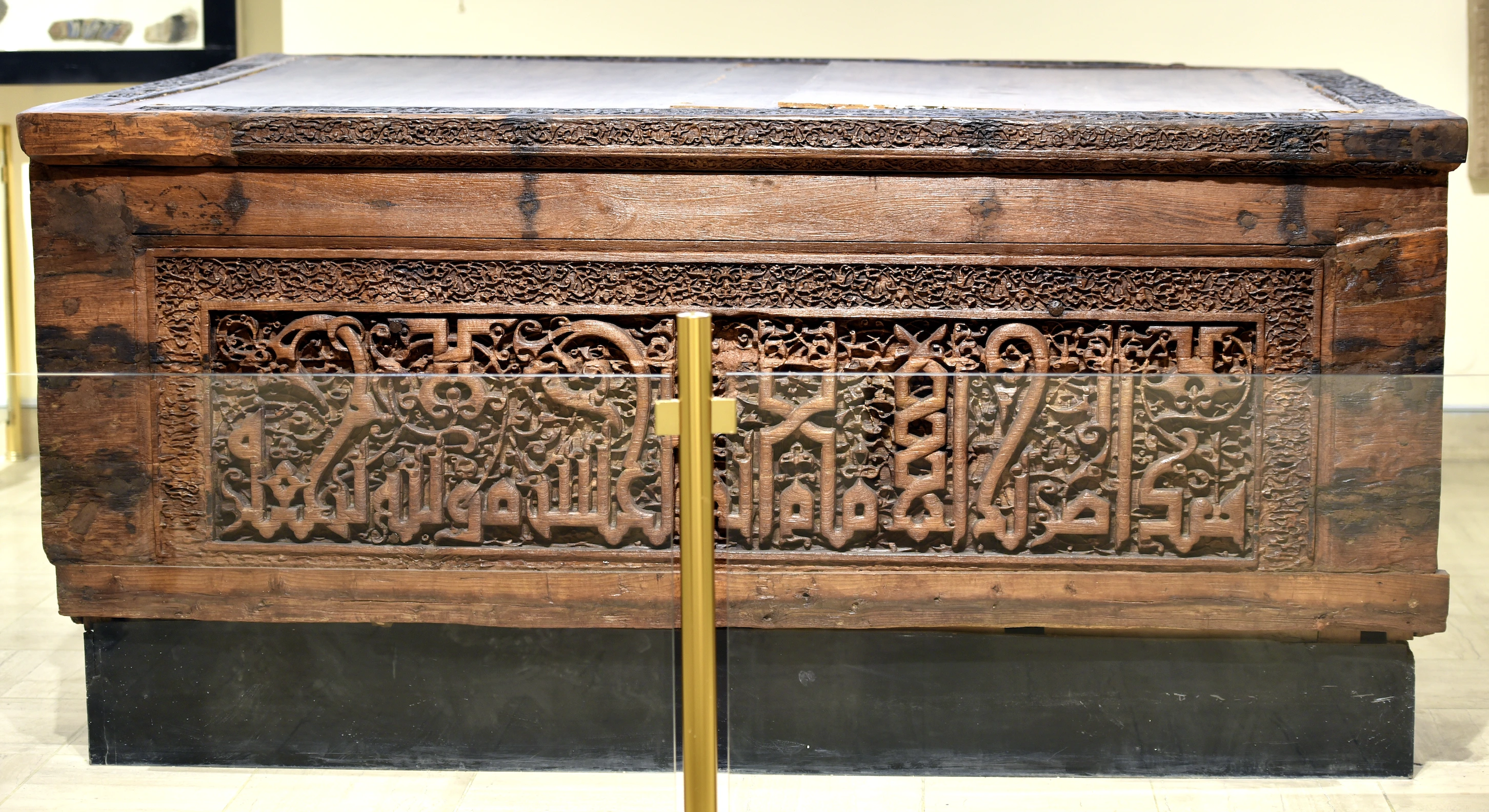
Musa ibn Ja'far (128–183 AH / 745–799 CE), called al-Kazim and known by the kunya Abu al-Hasan, was a son of Ja'far al-Sadiq, a grandson of Muhammad al-Baqir, and, through al-Husayn, a descendant of Ali ibn Abi Talib.123 The Twelver Shi'a count him as their seventh Imam. He was born at al-Abwa' or in Medina, spent his early life in Medina with his father, and remained there until the reign of Harun al-Rashid, apart from a detention in Baghdad under al-Mahdi.23
His father died in 148/765 and the question of who should succeed him divided his followers. The Twelver account is that Ja'far had already designated Musa, and most of the community came to follow him.23 The Encyclopaedia of Islam describes his policy as quietist, while the TDV İslâm Ansiklopedisi describes it as peaceful towards the Abbasids. Al-Mahdi had him brought to Baghdad and released him again, and in 179/795–6 Harun al-Rashid had him arrested at the time of a pilgrimage and taken to Baghdad, where he died in custody in Rajab 183 (August–September 799).234
He was buried in the cemetery of Maqabir Quraysh, at the Bab al-Tibn in north-west Baghdad, where the shrine and town of Kazimayn later grew up around his grave and that of his grandson Muhammad al-Jawad.256 Some of his followers held that he had not died and awaited his return, and most accepted that the imamate had passed to his son Ali al-Rida.73 The sources differ on the year and place of his birth, on the year and day of his death, on the route by which he was taken to Baghdad and on the number of his children; each version is given where the detail is told, and the Historiographical Note explains the differences that need it.2389
The sources
The fullest modern treatment is the entry on him in the Encyclopaedia of Islam by E. Kohlberg, a modern scholar, which draws on Imami works such as al-Kulayni's al-Kafi, Ibn Babawayh's Uyun akhbar al-Rida, al-Mufid's Kitab al-Irshad and al-Majlisi's Bihar al-anwar.23 The entry by Mustafa Öz, a modern scholar, in the TDV İslâm Ansiklopedisi covers the same ground from Imami and Sunni works, with its own choices among them.3 Shorter modern entries in the Encyclopaedia of Islam by W. Madelung (on Hisham ibn al-Hakam), H. Halm (on the Waqifa), B. Lewis (on Ali al-Rida) and M. Streck and A. A. Dixon (on Kazimayn), and Öz's own entry on Kazimayn, supply particular points.1071156
The earliest Sunni notice used here is that of al-Khatib al-Baghdadi (392–463 AH), the eleventh-century historian of Baghdad, in his Tarikh Baghdad. Al-Mizzi (654–742 AH), a scholar of the late thirteenth and early fourteenth century, copies al-Khatib's notice in full into his Tahdhib al-kamal, a biographical dictionary of transmitters, as the modern editor Bashshar Awwad Ma'ruf notes, and adds what the hadith critics said of him.1213 Al-Dhahabi (d. 748 AH), the fourteenth-century biographer, draws on al-Khatib in his Siyar a'lam al-nubala', and Ibn Khallikan (d. 681 AH), the thirteenth-century biographer, quotes al-Khatib in his Wafayat al-a'yan.814 Al-Tabari (839–923 CE), the historian, records the release under al-Mahdi among the events of 169 AH and notes his death in a single line among the events of 183 AH, and Hugh Kennedy and C. E. Bosworth, the translators of the two volumes, identify him in their notes.154 Akbar Shah Najeebabadi's History of Islam, a modern narrative history, gives a few lines on his last years.16
Both encyclopaedias take their accounts of his arrest, imprisonment and death from works named in their bibliographies, among them Abu al-Faraj al-Isfahani's Maqatil al-Talibiyyin, al-Mufid's Kitab al-Irshad and al-Majlisi's Bihar al-anwar, while the Sunni biographers give chiefly his lineage, his transmitters and the dates of his birth and death.23817
Name, family and birth
Name and epithets
His name was Musa ibn Ja'far. Kohlberg writes that he is known as Abu al-Hasan al-Awwal, as Abu Ibrahim and Abu Ali, and as al-Abd al-Salih, which renders literally as "the righteous servant".2 Kohlberg explains al-Kazim as "he who restrains himself" or "who keeps silent".2
Parents and family
His father was Ja'far al-Sadiq, the son of Muhammad al-Baqir, the son of Ali Zayn al-Abidin, the son of al-Husayn ibn Ali ibn Abi Talib.112 His mother, according to Kohlberg, was Hamida (or Humayda) bint Sa'id al-Barbariyya, or al-Andalusiyya, an umm walad (a slave-woman who bore her master a child) bought from a Berber slave-dealer; she is often called al-Musaffat, "the purified". Öz names her Hamida (Humayda) bint Sa'id al-Barbariyya.23
Birth
Kohlberg gives his birth as 7 Safar 128 (8 November 745), at al-Abwa', between Mecca and Medina, or in Medina, and lists Dhu al-Hijja 127 (September 745) and 129 (746–7) as other dates. Öz also gives 7 Safar 128 (8 November 745), at Ebva (al-Abwa'), near Medina.23 Ibn Khallikan gives a Tuesday before dawn in 129 and notes that al-Khatib gave 128, at Medina.9
Early life in Medina
He spent the first part of his life in Medina with his father. Kohlberg writes that little is known of his early life, and Öz that the information on his education is very limited.23
The succession after Ja'far al-Sadiq, 148/765
Kohlberg states that Musa first came into prominence when his father died in 148/765, and that the event split the Shi'i community over the succession. Ja'far's son and designated successor Isma'il had died before him, and another son, Abd Allah, died shortly after him without male offspring. Each had his followers, the proto-Isma'iliyya and the Fathiyya. A group called the Sumaytiyya held that the imamate should pass to another son, Muhammad, and the Nawusiyya held that Ja'far had not died and would return as the Mahdi.2 Öz adds that after the death of Abd Allah ibn Ja'far most of the Fathiyya, together with those who stayed outside the groups that formed the Isma'iliyya, came in time to accept Musa's imamate.3
According to Twelver belief, as Kohlberg gives it, Ja'far had designated Musa as a boy to be the next Imam. Some leading Shi'is supported him, among them Hisham ibn al-Hakam, and others withheld their recognition for a time.2 Madelung, in the Encyclopaedia of Islam, calls Hisham the most prominent representative of Imami theology in the time of Ja'far and Musa, and writes that he recognised Musa immediately after Ja'far's death, unlike many other Shi'i leaders.10 Öz writes that Musa rejected every claim to the imamate but his own and declared it with the support of a group from Ja'far's close circle, whom he names: Hisham ibn Salim al-Jawaliqi, Abu Ya'fur Abd Allah, Abu Ja'far al-Ahwal, Ubayd ibn Zurara ibn A'yan, Jamil ibn Darraj, Aban ibn Taghlib and Hisham ibn al-Hakam.3[a]
Kohlberg describes his policy as quietist: he devoted himself to prayer and contemplation and, like his father, spread Shi'i doctrine among his disciples, and this did not spare him harassment by the Abbasids.2 Öz likewise describes a peaceful policy towards the Abbasids and a life given chiefly to worship, and notes that the growth in the number of those who adopted his ideas, and the very large gifts and donations he made, made the caliph al-Mahdi suspicious of him.3
Detention under al-Mahdi
Kohlberg writes that the caliph al-Mansur's son and successor al-Mahdi (reigned 158–169/775–785) had Musa brought to Baghdad as a prisoner, and Öz that he was brought from Medina to Baghdad and imprisoned for a time.23 Al-Khatib records that al-Mahdi brought him to Baghdad and then sent him back to Medina, where he stayed until the days of Harun al-Rashid.1214
Al-Tabari gives an account of the release, which he places among the events of 169 and takes from Abu al-Ash'ath al-Kindi, on the authority of al-Rabi'. Musa ibn Ja'far was being held in the house of al-Rabi'. One moonlit night al-Rabi' saw al-Mahdi praying and heard him recite the verse "So would you perhaps, if you turned away, cause corruption on earth and sever your [ties of] relationship?" (Quran 47:22). When he had finished, al-Mahdi told al-Rabi' to bring him Musa, and al-Rabi' wondered whether he meant the caliph's own son Musa or Musa ibn Ja'far, and decided on the latter.15[b] Al-Mahdi then told Musa that he had been afraid he had broken the tie of kinship with him, and asked him to "confirm that you will not rise in rebellion against me". Musa answered yes, and al-Mahdi released him.15
Öz dates the release to 169 (785) and gives its terms as an oath not to rebel against the caliph or his children, a gift of 3,000 dinars and a return to Medina, citing al-Tabari and Abu al-Faraj al-Isfahani.3
The rising of al-Husayn ibn Ali at Fakhkh, 169/786
Öz writes that in the same year al-Husayn ibn Ali, called Sahib Fakhkh, rose against the Abbasid government. Musa did not join the rising; he warned al-Husayn that it would cost him his life and asked him to abandon it.3 Kohlberg likewise writes that Musa had refused to support the revolt and had warned al-Husayn that he would be killed, and dates its collapse to 169/786.2 Öz adds that Musa nonetheless remained a man of whom the Abbasid caliphs were suspicious.3
The arrest under Harun al-Rashid, 179/795–796
Musa stayed in Medina until Harun al-Rashid became caliph in 170/786. Kohlberg writes that nine years into his reign the caliph had him arrested, and Öz that he was summoned to Baghdad on various pretexts and spent the last four years of his life in prison.23 Najeebabadi records only that Harun obliged him to remain in Baghdad and did not allow him to leave it.16
The accounts of the background
Kohlberg notes that various accounts are given of what lay behind the arrest. In one, Harun took an interest in the views of Hisham ibn al-Hakam, found them dangerous, and ordered the arrest of the Imam. Öz gives the same account from some reports, and Madelung notes that some Shi'is accused Hisham of having been partly responsible for the arrest.2310
In a second account, which Kohlberg describes as an intrigue at the Abbasid court, Harun had placed his son Muhammad, the future al-Amin, in the care of Ja'far ibn Muhammad ibn al-Ash'ath, and the vizier Yahya ibn Khalid ibn Barmak feared that Ja'far would rise to prominence if al-Amin became caliph. Yahya planned to disgrace Ja'far by exposing his Alid connections, and for this he enlisted Musa's nephew and confidant Muhammad (or Ali) ibn Isma'il ibn Ja'far, who gave him information about the Alids' finances. Yahya then told Harun that Ja'far ibn Muhammad belonged to Musa's party and sent him the khums, that Musa received donations from all parts of the world, and that he had bought an estate called al-Yasir for 30,000 dinars.2 Öz gives a shorter version, in which Yahya ibn Khalid and other leading figures, fearing that Musa's standing would later harm them, presented him to the caliph as a dangerous man.3
In a third, the caliph was told that people believed in Musa's imamate or that he planned to rebel. Kohlberg observes that the denouncers are on occasion named as his brother Muhammad or the Zaydi Abu Abd Allah Ya'qub ibn Dawud, and judges the second name unlikely, since Ya'qub by then was blind and is known to have helped Alids escape from the authorities.2
The occasion
The arrest came during a pilgrimage of Harun's. Kohlberg gives the journey as an umra (the lesser pilgrimage) in Rajab 179 or Ramadan 179, or a hajj in Dhu al-Hijja 179, and Öz gives the same three occasions.23 Al-Khatib has Harun return from the umra of Ramadan 179 and carry Musa with him to Baghdad, where he imprisoned him until his death; al-Dhahabi, quoting al-Khatib, has him come to Baghdad in al-Rashid's company in 179.12148 The sources thus agree on 179 AH (795–796 CE) and differ on the month and the kind of pilgrimage.231214
Imprisonment at Basra and Baghdad
On the journey to Baghdad, Kohlberg writes that, according to some sources, Musa was sent directly to Baghdad, and that other reports, which he prefers, have him taken first to Basra and held for a year by its governor, Isa ibn Ja'far ibn al-Mansur.[c] Öz gives both versions as reports and says Musa was delivered to the same governor at Basra and kept there about a year; the Encyclopaedia of Islam article on Harun al-Rashid likewise has him sent to Basra and then to Baghdad.2318 Kohlberg states that Harun then ordered Musa killed, but that Isa, who had been impressed by Musa's piety, avoided it and had him brought to Baghdad; Öz writes that the governor, who was affected by Musa's worship and piety, did not carry out the caliph's wish, and wrote that he had found no evidence against him and that Musa should be handed to someone else or he would release him.23
In Baghdad Musa was handed to al-Fadl ibn al-Rabi', who had been appointed chamberlain (hajib) in 179/795, and placed under house arrest. He was later entrusted to al-Fadl ibn Yahya al-Barmaki, who also kept him under house arrest, and Kohlberg writes that al-Fadl treated him with respect; Öz gives the same on the authority of Abu al-Faraj.23 Ibn Khallikan records that his jailer for the length of his imprisonment was al-Sindi ibn Shahak, the grandfather of the poet Kushajim, and Öz names al-Sindi, an officer of the Baghdad security forces, as the man to whom Musa was handed over.93
Kohlberg reports that Musa could communicate with his followers, who now included local Shi'is. One of them, Ali ibn Yaqtin (d. 182/798), was asked by Musa to use his influence with the authorities to help the Shi'a, and acted as his financial agent, sending him gifts. Kohlberg adds that this agreed with Musa's view that working for an illegitimate government is permitted when it is done to further the Shi'i cause.2
Death and burial, 183/799
The date
Most sources give the year of his death as 183 AH and differ on the day. Al-Dhahabi gives Rajab 183 and writes that Musa lived fifty-five years.19 Al-Khatib gives 183 on the authority of Muhammad ibn Sadaqa al-Anbari, and adds, from another narrator, that he died five days before the end of Rajab; Ibn Khallikan also gives five days before the end of Rajab 183, and adds 186 in Baghdad as another year.209 Kohlberg gives the dates most commonly given as 6, 24 or 25 Rajab 183 (13 August, 31 August or 1 September 799), Öz gives Rajab 183 (August 799), and Najeebabadi gives Friday 25 Rajab 183.2316
Al-Tabari records the death in a single line among the events of 183: "In this year, there died at Baghdad Musa b. Ja'far b. Muhammad". Bosworth's note identifies him as the seventh Imam, whom al-Rashid had imprisoned in Baghdad "in spite of his apolitical stance".4 Öz writes that al-Tabari gives no details, and that other Sunni historians, Ibn al-Athir and Ibn Kathir among them, do the same.3 Kohlberg also lists 181/797–8, Rajab 182 (August–September 798), Rajab 184 (July–August 800), 186/802 and 188/804 among the dates given, and the Encyclopaedia of Islam article on Kazimayn gives 186/802; Kennedy's note on al-Tabari's account of the release gives 186/801; the two conversions of 186 AH differ by a year, as the Historiographical Note records.2515
The place, and the reports of how he died
Kohlberg states that he died in a prison (or mosque) near the Kufa Gate, known as al-Musayyab after al-Musayyab ibn Zuhayr; Ibn Khallikan, reporting al-Khatib, writes that he died in prison, and Najeebabadi that he died in Baghdad.2916 The Imami sources, as Kohlberg summarises them, hold that he was poisoned in custody.2
Al-Khatib preserves a report from Abd al-Salam, a son of al-Sindi ibn Shahak, that when Musa died in their custody they sent for a group of upright men (udul) of al-Karkh, brought them in to him and had them bear witness to his death; al-Dhahabi gives it and al-Mizzi repeats al-Khatib's notice in full.201921 Kohlberg writes that al-Sindi (or, in another account, al-Rashid) assembled representatives of the Hashimites, the Talibis and other notables of Baghdad, uncovered the Imam's face and had them acknowledge that there was "no sign of foul play", and that Musa was then washed, shrouded and buried.2
Burial
Kohlberg records that he was buried in the cemetery of the Arab aristocracy in north-west Baghdad (Maqabir Quraysh), at the Bab al-Tibn ("the straw gate"), in the area that became known as al-Kazimiyya. Öz places the burial in the Babüttibn quarter of the same cemetery, which was afterwards called Kazimiyya or Kazimayn, and writes that a tomb was built over it.23 Najeebabadi writes that he was buried in Baghdad and that his grave and that of his grandson lie under a dome known as Kazimiyya.16 Al-Dhahabi and Ibn Khallikan call the burial ground the Shunizi cemeteries. Al-Dhahabi writes that Musa has a well-known mashhad (shrine) at Baghdad, where his grandson al-Jawad was buried with him, and that his son Ali ibn Musa has one at Tus; Ibn Khallikan writes that his grave there is known and visited and that a mashhad stands over it.199
Teaching and transmission
As a transmitter of hadith
Öz names his father and Abd al-Malik ibn Qudama al-Jumahi as the men from whom he is known to have transmitted; al-Mizzi names his father, Abd Allah ibn Dinar and Abd al-Malik ibn Qudama among those from whom he transmitted.317 Al-Mizzi's editor quotes a remark of Ibn Hajar al-Asqalani, a later hadith critic, in his Tahdhib al-tahdhib: if Musa was born in 128, his transmission from Abd Allah ibn Dinar is interrupted, because Abd Allah ibn Dinar died in 127.21 Al-Dhahabi writes that Musa narrated a few hadith from his father and that his transmission is small because he died before the age at which transmission usually begins; he notes that two hadith of his are found in al-Tirmidhi and Ibn Majah.8 Kohlberg states that Sunni authors generally regard him as a trustworthy transmitter who passed on only a few traditions, and Öz calls him a reliable transmitter.23 The hadith critic Abu Hatim, whose verdict al-Dhahabi and al-Mizzi both quote, called him trustworthy and truthful, and one of the imams of the Muslims.817
Those who transmitted from him included his sons Ali (al-Rida), Ibrahim and Isma'il, his brothers Ali ibn Ja'far and Muhammad ibn Ja'far, and Muhammad ibn Sadaqa al-Anbari.817 Al-Mizzi's editor records that al-Uqayli, in his book of weak narrators, listed him with the remark that the fault in one report from his father lay with a narrator named Abu al-Salt; al-Dhahabi, in al-Mizan, asked what fault of Musa's that could be, and Ibn Hajar called him truthful and devout. The editor holds him trustworthy and writes that he knows of no one who impugned him.21
Works and the Imami tradition
Kohlberg records that a Musnad Musa al-Kazim compiled by Abu Bakr Muhammad ibn Abd Allah al-Shafi'i al-Bazzaz (d. 354/965) is extant, and that the Twelvers credit him with numerous supplications, with answers to legal questions, including questions from his brother Ali ibn Ja'far, and with a Wasiyya on reason (wasiyya fi al-aql) addressed to Hisham ibn al-Hakam, which exists in a shorter and a longer version, in al-Kulayni's al-Kafi and in Ibn Shu'ba's Tuhaf al-uqul.2 Öz names among the few works that survive a Musnad al-Imam Musa ibn Ja'far of fifty-nine hadith on principles and rulings, printed at Beirut in 1981, the same Wasiyya and a collection of his medical advice published at Beirut in 1993.3
Al-Khatib al-Baghdadi, al-Dhahabi and al-Mizzi relate stories of his generosity and of his prayer at night.122213 Kohlberg records that Imami tradition credits him with miracles.2 Kohlberg and Öz connect him with the Sufi tradition: the ascetic Shaqiq al-Balkhi, who saw him at al-Qadisiyya in 149 (766–767), judged him a friend of God (wali), and Ma'ruf al-Karkhi and Bishr al-Hafi are likewise associated with him.23
Wives and children
Öz states that the sons and daughters born to his wives and concubines number between thirty-seven and sixty in the reports, with eighteen to twenty-three sons and nineteen to thirty-seven daughters; Kohlberg gives between 33 and 60, and in some accounts eighteen (or nineteen) sons and twenty-three daughters.32 Al-Dhahabi writes that he left a number of children, all of them by slave-women, and names sixteen sons: Ali, al-Abbas, Isma'il, Ja'far, Harun, al-Hasan, Ahmad, Muhammad, Ubayd Allah, Hamza, Zayd, Ishaq, Abd Allah, al-Husayn, al-Fadl and Sulayman. He mentions daughters besides and writes that al-Zubayr named them all.19
After his death
Öz writes that most of his followers accepted that he had died in prison and that the imamate had passed to his son Ali al-Rida.3 Halm, in the Encyclopaedia of Islam, writes that the Waqifa were the Shi'is who held that Musa had not died but had been taken out of sight by God, and who awaited his return as the Mahdi; their Twelver opponents called them al-wakifa, "those who stop", because they let the line of Imams end with him and contested the transfer of the imamate to Ali al-Rida.72
Ali al-Rida is counted by the Twelver tradition as the eighth Imam. Lewis, in the Encyclopaedia of Islam, writes that he was born at Medina, in 148/765 by one account and in 151/768 or 153/770 by others, which Lewis judges probably better informed; that he related traditions from his father and gave legal opinions in the mosque of the Prophet Muhammad (Peace Be Upon Him) at Medina; and that in 201/816 the caliph al-Ma'mun summoned him to Marw and appointed him heir to the caliphate.11 Najeebabadi dates the appointment to Ramadan 201 and writes that al-Ma'mun gave him his daughter in marriage.16 The Encyclopaedia of Islam article on al-Ma'mun records two other sons: Zayd, who took part at Basra in the Alid risings of 199/815 and was arrested and sent to Marw, and Ibrahim, who took power in the Yemen from Safar 200 (September 815).23
The shrine at Kazimayn
Streck and Dixon give the history of the place in the Encyclopaedia of Islam. Before Baghdad was built by al-Mansur, the site was called al-Shunizi. When the city was founded, al-Mansur set aside the small cemetery of al-Shunizi as a private burial ground for his family and called it Maqabir Quraysh, or Maqabir Bab al-Tibn from its nearness to that gate, and his son Ja'far al-Akbar (d. 150/767) was the first to be buried there.5[d] Öz gives the same sequence, adding that Quraysh descended from the Abbasids and from the family of Ali were later buried there.6 Öz notes that the names Kazimiyya, al-Mashhad al-Kazimi and Mashhad Musa ibn Ja'far came into use after Musa's burial, and that Kazimayn, "the two Kazims", followed when his grandson, the ninth Imam, Muhammad al-Jawad, was buried beside him. Streck and Dixon write that the town was originally called al-Mashhad al-Kazimi and Mashhad Musa ibn Ja'far, and that Kazimiyya and Kazimayn have come into use only recently. They give al-Jawad's death as 219/834 and Öz gives 220/835.56
Both entries state that who first built the shrine is unknown. The first construction on record is that ordered in 336/947 by the Buyid Mu'izz al-Dawla: two wooden boxes over the graves, two wooden domes and a surrounding wall. The two entries record damage in the sectarian fighting of Baghdad in 443/1051 and again in 622/1225, and they differ on the Mongol conquest of the city in 656/1258: Streck and Dixon write that the sanctuary was again reduced to ashes, Öz that it was completely destroyed and afterwards rebuilt on Hulagu's order. The present building took its form under the Safavid shah Isma'il I, whose family claimed descent from Musa, and an inscription of 926/1519 refers to the transformation of the old building; the work that Isma'il left unfinished was completed by the Ottoman sultan Sulayman after he took Baghdad in 941/1534. Agha Muhammad Khan, the founder of the Qajar dynasty, had the domes covered with gold in 1211/1796, and Shah Nasir al-Din had the gilding renewed in 1870.56
Streck and Dixon record evidence of pilgrimage to the Alid tombs there from the 7th/13th century, citing Ibn Khallikan, and name Kazimayn as one of four Shi'i sanctuaries, with Samarra, Karbala and Najaf; Kohlberg adds that the shrine of Musa and al-Jawad became a centre of pilgrimage in Iraq.52
Historiographical Note
The sources differ on several details. Where the article tells such a detail it gives each version with its source; this note explains the differences that need it.
Birth. Ibn Khallikan gives 129 and records al-Khatib's 128, while in the printed text of al-Khatib, as al-Mizzi's editor notes, the year is 128 with 129 given as another view. Both encyclopaedias give 128, and the dates at the head of the article start from it.91323
Death. Most sources give 183. The other years come from Ibn Khallikan (186 in Baghdad), the Encyclopaedia of Islam article on Kazimayn (186/802), the translator's note in volume 29 of al-Tabari (186/801) and Kohlberg's list (181, Rajab 182, Rajab 184, 186 and 188).95152 The two conversions of 186 AH differ by a year, and the article does not choose between them. The day is given as 6, 24 or 25 Rajab (Kohlberg), as Friday 25 Rajab (Najeebabadi) and as five days before the end of Rajab (al-Khatib's second narrator, Ibn Khallikan); none of these sources equates the last with 25 Rajab, and the article does not either. Al-Dhahabi alone gives his age at death, fifty-five.21620919
The arrest. All the sources give 179 AH. Kohlberg and Öz leave the occasion open between an umra in Rajab or Ramadan and a hajj in Dhu al-Hijja, and they convert the months differently into Common Era dates: Kohlberg gives September–October and November–December 795 for the two months of the umra and February–March 796 for the hajj, and Öz gives October or December 795 for the umra and February–March 796 for the hajj. Al-Khatib has the umra of Ramadan.231214
His children. Kohlberg gives between 33 and 60 children and Öz between 37 and 60, and their figures for sons and daughters differ. Al-Dhahabi writes that all his children were born to slave-women, while Öz writes that they were born to his wives and concubines. The sixteen sons al-Dhahabi names do not include Ibrahim, who is named among the sons who transmitted from him and in the Encyclopaedia of Islam article on al-Ma'mun.2319823
The year 169. Kohlberg dates the collapse of the rising of Fakhkh to 169/786, and Öz dates the release by al-Mahdi to 169 (785) and places the rising in the same year; the article gives 169 AH.23
See also
- Ja'far al-Sadiq — his father, the sixth Imam of the Twelver Shi'a, and the division over the succession
- Muhammad al-Baqir — his grandfather, the fifth Imam
- Harun al-Rashid — the caliph under whom he was arrested
- Baghdad — the city where he was imprisoned and buried
- Al-Ma'mun — the caliph who named his son Ali al-Rida as heir
- Sunni and Shia: Historical Origins — the early divisions of the community
Notes
Explanatory notes
- a. Two men called Hisham appear among the followers of Ja'far and Musa. Hisham ibn al-Hakam, a client of the tribe of Kinda who was born at Wasit and later lived at Kufa, is the Imami theologian of whom Madelung writes in the Encyclopaedia of Islam. Hisham ibn Salim al-Jawaliqi is a different man, whom Öz lists separately and for whom the TDV İslâm Ansiklopedisi has an entry of its own. ↩
- b. The caliph al-Mahdi's own son, the future caliph al-Hadi, was also named Musa. Hugh Kennedy, the translator of this volume of al-Tabari, identifies the Musa of the report as Musa al-Kazim, the son of Ja'far al-Sadiq (notes 817 and 818). ↩
- c. This Isa is the governor of Basra, Isa ibn Ja'far ibn al-Mansur. He is a different man from Isa ibn Musa, who has an article of his own. ↩
- d. This Ja'far al-Akbar is a son of al-Mansur, as the Encyclopaedia of Islam and the TDV both say; he is not Ja'far al-Sadiq, Musa's father. ↩
References
Citations
Footnotes
-
Ibn Khallikan, Wafayat al-a'yan, ed. Ihsan Abbas (Beirut: Dar Sadir), v, 308 — his lineage; https://shamela.ws/book/1000/2306, register entry 4, shamela.ws. ↩ ↩2
-
E. Kohlberg, 'Musa al-Kazim', The Encyclopaedia of Islam, new edition, vol. 7 — the dedicated entry. ↩ ↩2 ↩3 ↩4 ↩5 ↩6 ↩7 ↩8 ↩9 ↩10 ↩11 ↩12 ↩13 ↩14 ↩15 ↩16 ↩17 ↩18 ↩19 ↩20 ↩21 ↩22 ↩23 ↩24 ↩25 ↩26 ↩27 ↩28 ↩29 ↩30 ↩31 ↩32 ↩33 ↩34 ↩35 ↩36 ↩37 ↩38 ↩39 ↩40 ↩41 ↩42 ↩43 ↩44 ↩45 ↩46 ↩47
-
Mustafa Öz, 'Mûsâ el-Kâzım', TDV İslâm Ansiklopedisi, vol. 31 (Ankara, 2020), pp. 219–221 — https://islamansiklopedisi.org.tr/musa-el-kazim, register entry 2, islamansiklopedisi.org.tr. ↩ ↩2 ↩3 ↩4 ↩5 ↩6 ↩7 ↩8 ↩9 ↩10 ↩11 ↩12 ↩13 ↩14 ↩15 ↩16 ↩17 ↩18 ↩19 ↩20 ↩21 ↩22 ↩23 ↩24 ↩25 ↩26 ↩27 ↩28 ↩29 ↩30 ↩31 ↩32 ↩33 ↩34 ↩35 ↩36 ↩37 ↩38 ↩39 ↩40 ↩41
-
Al-Tabari, The History of al-Tabari, vol. 30, The 'Abbasid Caliphate in Equilibrium, translated and annotated by C. E. Bosworth, p. 172 (Leiden iii 649), with note 626 — the notice of his death among the events of 183; https://archive.org/details/tabari-volume-30, register entry 12, archive.org. ↩ ↩2 ↩3
-
M. Streck and A. A. Dixon, 'Kazimayn', The Encyclopaedia of Islam, new edition, vol. 4 — the town and shrine, the cemetery of Maqabir Quraysh and the building of the sanctuary. ↩ ↩2 ↩3 ↩4 ↩5 ↩6 ↩7 ↩8
-
Mustafa Öz, 'Kâzımeyn', TDV İslâm Ansiklopedisi, vol. 25 (Ankara, 2022), pp. 152–153 — https://islamansiklopedisi.org.tr/kazimeyn, register entry 2, islamansiklopedisi.org.tr. ↩ ↩2 ↩3 ↩4 ↩5
-
H. Halm, 'al-Wakifa or al-Wakifiyya', The Encyclopaedia of Islam, new edition, vol. 11 — the Shi'i sect that held that Musa al-Kazim had not died. ↩ ↩2 ↩3
-
Al-Dhahabi, Siyar a'lam al-nubala' (Beirut: Mu'assasat al-Risala), vi, 270, no. 118 — his transmitters, the small number of his hadith, Abu Hatim's verdict, and al-Khatib's account of his coming to Baghdad in 179; https://shamela.ws/book/10906/4520, register entry 4, shamela.ws. ↩ ↩2 ↩3 ↩4 ↩5 ↩6 ↩7 ↩8
-
Ibn Khallikan, Wafayat al-a'yan, v, 310 — his birth, the date of death, al-Sindi ibn Shahak as his jailer, and the grave and shrine; https://shamela.ws/book/1000/2308, register entry 4, shamela.ws. ↩ ↩2 ↩3 ↩4 ↩5 ↩6 ↩7 ↩8 ↩9
-
W. Madelung, 'Hisham b. al-Hakam', The Encyclopaedia of Islam, new edition, vol. 3 — Hisham and his recognition of Musa after 148/765, and the accusation that he was partly responsible for the arrest. ↩ ↩2 ↩3
-
B. Lewis, 'Ali al-Rida', The Encyclopaedia of Islam, new edition, vol. 1 — Ali al-Rida's birth, his transmission from his father, and his appointment as heir in 201/816. ↩ ↩2
-
Al-Khatib al-Baghdadi, Tarikh Baghdad, ed. Bashshar Awwad Ma'ruf (Beirut: Dar al-Gharb al-Islami), xv, 14–19, no. 6939 — his birth, al-Mahdi's bringing him to Baghdad and sending him back, Harun's return from the umra of Ramadan 179 with Musa, and the stories of his generosity and night prayer; https://shamela.ws/book/736/8214, register entry 4, shamela.ws. ↩ ↩2 ↩3 ↩4 ↩5 ↩6 ↩7
-
Al-Mizzi, Tahdhib al-kamal, xxix, 44–50 — al-Khatib's notice quoted in full, with the editor's note on the printed text of al-Khatib and the stories of his generosity and night prayer; https://shamela.ws/book/3722/15616, register entry 4, shamela.ws. ↩ ↩2 ↩3
-
Ibn Khallikan, Wafayat al-a'yan, v, 309 — al-Khatib's account of the umra of Ramadan 179; https://shamela.ws/book/1000/2307, register entry 4, shamela.ws. ↩ ↩2 ↩3 ↩4 ↩5
-
Al-Tabari, The History of al-Tabari, vol. 29, Al-Mansur and al-Mahdi, translated by Hugh Kennedy, p. 253 (Leiden iii 533), with notes 817 and 818 — al-Mahdi's release of Musa ibn Ja'far, among the events of 169; https://archive.org/details/tabarivolume29, register entry 12, archive.org. ↩ ↩2 ↩3 ↩4 ↩5
-
Akbar Shah Najeebabadi, The History of Islam, vol. 2 (Riyadh: Darussalam) — Harun al-Rashid's requirement that Musa remain in Baghdad, the date of his death, and al-Ma'mun's appointment of Ali al-Rida. ↩ ↩2 ↩3 ↩4 ↩5 ↩6 ↩7
-
Al-Mizzi, Tahdhib al-kamal, ed. Bashshar Awwad Ma'ruf (Beirut: Mu'assasat al-Risala), xxix, 43, no. 6247 — his teachers, those who transmitted from him, and Abu Hatim's verdict; https://shamela.ws/book/3722/15615, register entry 4, shamela.ws. ↩ ↩2 ↩3 ↩4
-
'Harun al-Rashid', The Encyclopaedia of Islam, new edition, vol. 3 — the arrest of Musa al-Kazim and his removal to Basra and then to Baghdad. ↩
-
Al-Dhahabi, Siyar a'lam al-nubala', vi, 274 — the witnesses from al-Karkh, the burial and the shrine, the date of death and his age, and the list of his sons; https://shamela.ws/book/10906/4524, register entry 4, shamela.ws. ↩ ↩2 ↩3 ↩4 ↩5 ↩6
-
Al-Khatib al-Baghdadi, Tarikh Baghdad, xv, 19–20 — the witnesses from al-Karkh, the burial, and the dates of death; https://shamela.ws/book/736/8220, register entry 4, shamela.ws. ↩ ↩2 ↩3
-
Al-Mizzi, Tahdhib al-kamal, xxix, 51 — the witnesses from al-Karkh, the dates of death, and the editor's notes on al-Uqayli, al-Dhahabi and Ibn Hajar; https://shamela.ws/book/3722/15623, register entry 4, shamela.ws. ↩ ↩2 ↩3
-
Al-Dhahabi, Siyar a'lam al-nubala', vi, 271–273 — the stories of his generosity and night prayer; https://shamela.ws/book/10906/4521, register entry 4, shamela.ws. ↩
-
'al-Ma'mun b. Harun al-Rashid', The Encyclopaedia of Islam, new edition, vol. 6 — the sons Zayd and Ibrahim in the Alid risings of 199–200/815. ↩ ↩2
Sources
Works in the approved library. Cited by title and author, and by the entry used.
- Bearman, P. J., et al., eds. The Encyclopaedia of Islam, new (second) edition — E. Kohlberg, 'Musa al-Kazim' (vol. 7); M. Streck and A. A. Dixon, 'Kazimayn' (vol. 4); H. Halm, 'al-Wakifa or al-Wakifiyya' (vol. 11); W. Madelung, 'Hisham b. al-Hakam' (vol. 3); B. Lewis, 'Ali al-Rida' (vol. 1); 'al-Ma'mun b. Harun al-Rashid' (vol. 6); 'Harun al-Rashid' (vol. 3).
- Najeebabadi, Akbar Shah. The History of Islam, vol. 2. Riyadh: Darussalam.
Classical works read at Shamela (register entry 4, shamela.ws).
- Al-Khatib al-Baghdadi. Tarikh Baghdad, edited by Bashshar Awwad Ma'ruf, vol. 15. Beirut: Dar al-Gharb al-Islami, 2002.
- Al-Mizzi. Tahdhib al-kamal fi asma' al-rijal, edited by Bashshar Awwad Ma'ruf, vol. 29. Beirut: Mu'assasat al-Risala.
- Al-Dhahabi. Siyar a'lam al-nubala', edited by Shu'ayb al-Arna'ut et al., vol. 6. Beirut: Mu'assasat al-Risala.
- Ibn Khallikan. Wafayat al-a'yan, edited by Ihsan Abbas, vol. 5. Beirut: Dar Sadir.
Read at archive.org (register entry 12, archive.org).
- Al-Tabari. The History of al-Tabari, vol. 29: Al-Mansur and al-Mahdi, translated by Hugh Kennedy. Albany: State University of New York Press, 1990.
- Al-Tabari. The History of al-Tabari, vol. 30: The 'Abbasid Caliphate in Equilibrium, translated and annotated by C. E. Bosworth. Albany: State University of New York Press, 1989.
Encyclopaedia entries read at the TDV (register entry 2, islamansiklopedisi.org.tr).
- Öz, Mustafa. 'Mûsâ el-Kâzım'. TDV İslâm Ansiklopedisi, vol. 31. Ankara, 2020.
- Öz, Mustafa. 'Kâzımeyn'. TDV İslâm Ansiklopedisi, vol. 25. Ankara, 2022.
The Qur'an (register entry 8, quran.com) — the English rendering of the verse quoted is that of Sahih International as given at quran.com.
Further reading
Offered to the reader for further study. Nothing in this article rests on the works below beyond what the sources above record of them.
- Al-Mufid. Kitab al-Irshad, translated by I. K. A. Howard. London, 1981 — the Imami account of the Imams, whose chapter on Musa is cited in the bibliographies of the Encyclopaedia of Islam and the TDV.
- Abu al-Faraj al-Isfahani. Maqatil al-Talibiyyin, edited by Ahmad Sakr. Beirut — cited by both encyclopaedias for his arrest and imprisonment.
- Algar, Hamid. 'Imam Musa al-Kazim and Sufi Tradition'. Islamic Culture 64 (1990), 1–14 — cited by Kohlberg and Öz for his association with the Sufis.
- Madelung, W. 'A treatise of the Sharif al-Murtada on the legality of working for the government'. Bulletin of the School of Oriental and African Studies 43 (1980) — cited by Kohlberg for the view on service under an illegitimate government.
- Al Yasin, Muhammad Hasan. Ta'rikh al-mashhad al-Kazimi. Baghdad, 1967 — listed in Kohlberg's bibliography; a history of the shrine.
External links
Approved sources only, each with its number on the Register of Approved External Web Sources.
- Mûsâ el-Kâzım — the TDV İslâm Ansiklopedisi, register entry 2, islamansiklopedisi.org.tr: the dedicated entry, in Turkish
- Kâzımeyn — the TDV İslâm Ansiklopedisi, register entry 2, islamansiklopedisi.org.tr: the entry on the shrine town, in Turkish
- Al-Khatib al-Baghdadi, Tarikh Baghdad, the entry on Musa ibn Ja'far — register entry 4, shamela.ws: in Arabic
- Al-Dhahabi, Siyar a'lam al-nubala', the entry on Musa al-Kazim — register entry 4, shamela.ws: in Arabic
- Al-Tabari, The History of al-Tabari, vol. 29 — register entry 12, archive.org: in English
Mentioned In
2 articles reference this topic
More from Abbasid Caliphate
Abbasid Caliphate
The third major Islamic caliphate (750–1258 CE), centered in Baghdad. It presided over the Islamic Golden Age, with landmark advances in science, philosophy, literature, and the arts, forging a cosmopolitan empire that blended Greek, Persian, Indian, and Arab traditions.
Baghdad
Baghdad, founded in 762 CE by Caliph al-Mansur, served as the capital of the Abbasid Caliphate and became the intellectual, cultural, and economic center of the Islamic world during the Islamic Golden Age, reaching a population of over one million before its destruction by the Mongols in 1258 CE.
Islamic Urban Planning and City Development
How cities were laid out in the Islamic world from the eighth century onward, with the congregational mosque and market at the centre, streets graded from public to private, and courtyard houses built for seclusion. Baghdad, Cordoba, Cairo and Istanbul show the pattern at scale.
The Mihna
The Mihna (833–849 CE) was an inquisition begun by Caliph al-Ma'mun to enforce the Mu'tazilite doctrine that the Quran was created. Its failure, symbolized by Ahmad ibn Hanbal's resistance, established the independence of religious scholarship from political authority.