Sir Syed Ahmed Khan: Reformer, Educator, and Architect of Muslim Modernity in India
Sir Syed Ahmed Khan (1817-1898) was an Indian Muslim reformer and educator who founded the Muhammadan Anglo-Oriental College at Aligarh in 1875, which became Aligarh Muslim University. His Aligarh Movement sought to reconcile Islamic faith with Western scientific education.
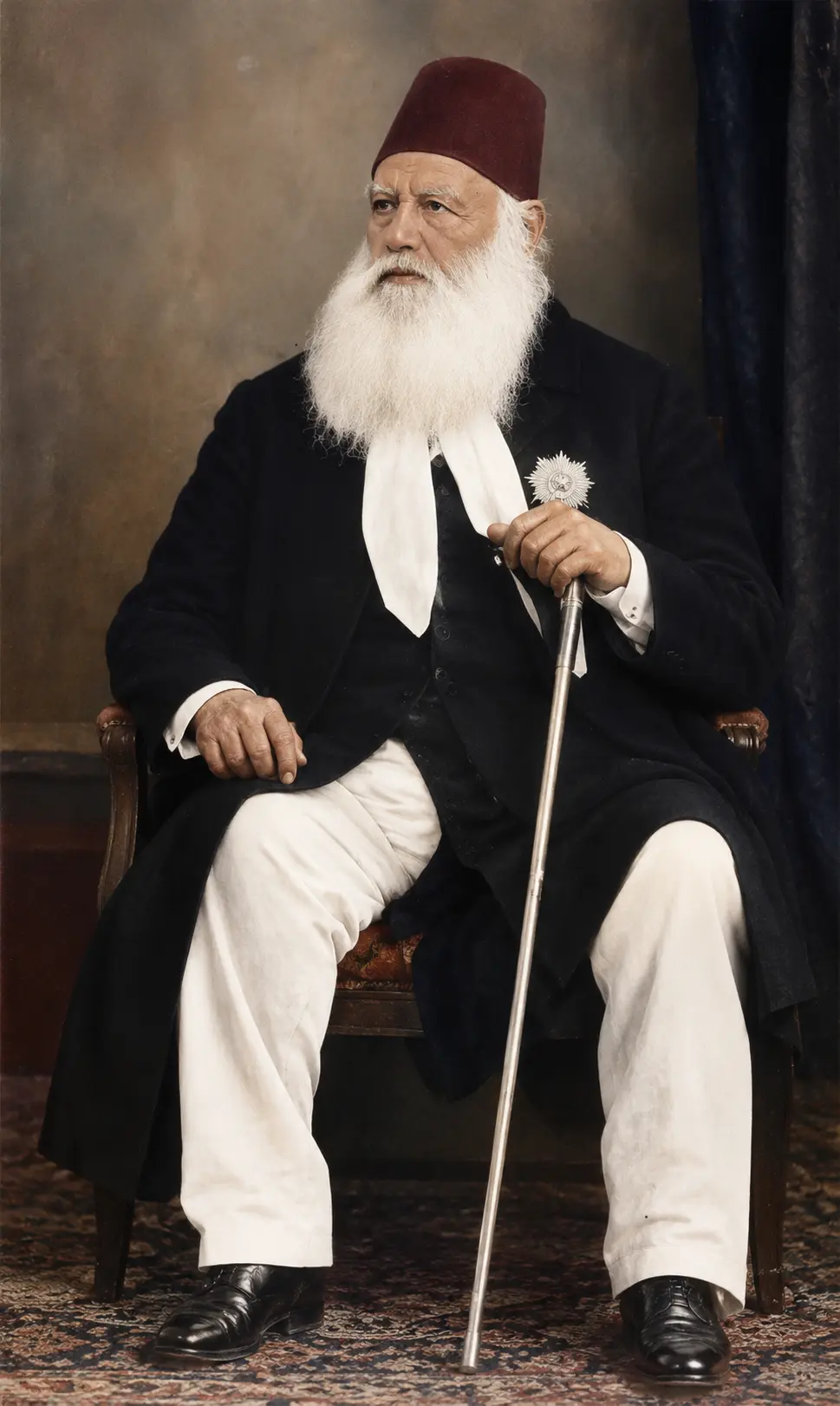
Sir Syed Ahmed Khan is among the most consequential Muslim figures of nineteenth-century India. His significance is threefold: as a reformer who argued that Indian Muslims must acquire Western education to survive as a community; as a founder of institutions — above all the Muhammadan Anglo-Oriental College at Aligarh — that translated that argument into practice; and as a political thinker whose evolving views on Hindu-Muslim relations set the terms for a debate that culminated, half a century after his death, in the partition of India.
He was born into the service elite of Mughal Delhi, educated in its traditions, and employed as a judicial officer under the East India Company. The rebellion of 1857 was the crisis that transformed him. Witnessing both the destruction of Muslim power and the British reprisals that followed, he concluded that Indian Muslims faced ruin unless they abandoned their hostility to the colonial state and acquired the education that would allow them to compete in its institutions. The rest of his career was the working-out of that conclusion.
The institution he built — the College at Aligarh, which began functioning on 24 May 1875 and became Aligarh Muslim University in 1920 — was the most influential Muslim educational institution in South Asian history. The movement associated with it reshaped Muslim attitudes to education, to the state, and to one another's communities across the subcontinent. His political legacy is more contested: though he initially argued that Hindus and Muslims constituted one nation, he later opposed the Indian National Congress and insisted on separate Muslim political representation — a position that many regard as laying the intellectual groundwork for the demand for Pakistan, though the relationship between his thought and the two-nation theory that emerged decades after his death remains debated in the scholarship.
Early Life and Formation
Birth and Family
Syed Ahmed Khan was born on 17 October 1817 in Delhi, then the seat of the diminished Mughal court. His family belonged to the Muslim service gentry of the city, maintaining connections to the Mughal establishment. Britannica describes him as born into a family with close ties to the Mughal court. His maternal grandfather, Khwaja Fariduddin, had been a minister in the court of Akbar Shah II.
The household was distinguished and educated — positioned within the intellectual and administrative life of late Mughal Delhi — but not wealthy in the manner of territorial magnates. The environment was one in which Persian, Arabic, Urdu, traditional Islamic learning, and service to the state were the markers of standing.
Education
His education followed the pattern of the Delhi Muslim elite: instruction in the Quran, Arabic, Persian, mathematics, and the traditional Islamic sciences. He did not receive a Western-style education — a fact that makes his later advocacy of it the more striking, since he came to it as a convert rather than as a product of the system he championed.
Service Under the East India Company
Khan entered the service of the East India Company in 1838 and pursued a career in the colonial judicial system. He rose through several grades — serving as a munsif (sub-judge) — and in 1867 became a judge at a Small Causes Court. He retired from judicial service in 1876, by which point he was already deeply engaged in the educational work that would define his legacy.
His postings took him to Bijnor, Muradabad, Ghazipur, and other towns of the North-Western Provinces. Each posting contributed to the network of local schools and societies he established before the main Aligarh project.
Early Writings: Asar-us-Sanadid
Before the rebellion of 1857 transformed him into a political figure, Sir Syed had already established himself as a scholar. In 1847, at the age of thirty, he published Asar-us-Sanadid ("Remains of the Past" or "Traces of the Great"), a historical and archaeological survey of the monuments of Delhi.
The work is treated in a peer-reviewed article in Modern Asian Studies (Cambridge University Press) as "a most impressive achievement" among his pre-revolt writings. It describes the principal buildings, monuments, and historical sites of the city, accompanied by illustrations. A revised edition appeared in 1854. The Times of India described it as showing "what the capital has lost," and in 2018 it was translated into English by the historian Rana Safvi, published by Columbia University Press.
Asar-us-Sanadid establishes that Sir Syed's intellectual life began not with politics or education but with history and heritage — a concern for the material past of Muslim Delhi that reflects the milieu of the late Mughal court. The Journal of the Royal Asiatic Society has published a scholarly note on the work.
The Rebellion of 1857 and Its Consequences
Sir Syed During the Revolt
The rebellion of 1857 was the turning point of his life. At Bijnor he was directly exposed to the violence and its aftermath. English Heritage's blue plaque for him in London records that he "saved thousands of British lives when he evacuated them out of the city of Bijnor, where he was based." Other accounts more modestly describe him as having saved several European lives.
He remained loyal to the British throughout the revolt. The Model Diplomat reference notes that he "declined the estate offered as reward" for his actions — a detail consistent with the character of a man who later repeatedly declined to profit personally from his public standing.
Asbab-e-Baghawat-e-Hind (The Causes of the Indian Revolt)
In 1858–59 Khan wrote Asbab-e-Baghawat-e-Hind, translated as The Causes of the Indian Revolt (or The Causes of the Indian Mutiny). The work was a critique — daring for its time — of British policies that he blamed for provoking the revolt. He rejected the widespread British assumption that the rebellion was a Muslim conspiracy, and argued instead that specific administrative errors, the disregard of Indian opinion in governance, and the exclusion of Indians from legislative processes had created the conditions for revolt.
The text is available in full in Columbia University's South Asian primary source collection, in the 1873 English translation. WarHistory.org describes it as "the first Indian account of the rebellion." It represents Sir Syed's earliest major work of political analysis and establishes several themes that recurred throughout his career: the importance of Indian participation in governance, the dangers of mutual ignorance between rulers and ruled, and the insistence that Indians — including Muslims — could be loyal subjects of the British Crown if treated with respect.
The Loyal Muhammadans of India
Following Asbab-e-Baghawat, Sir Syed published The Loyal Muhammadans of India (1860), a work that sought to rehabilitate the Muslim community in colonial eyes by documenting instances of Muslim loyalty during the revolt. The work served a practical purpose: after 1857, British suspicion fell disproportionately on Muslims, and Sir Syed's project of Muslim advancement required first dispelling the assumption that the community as a whole was disloyal.
The Lesson He Drew
The broader conclusion Sir Syed drew from 1857 was that Muslims, who bore the disproportionate weight of British suspicion and punishment after the revolt, faced collective ruin unless they changed their relationship to the colonial order. The old Mughal aristocratic culture, with its orientation toward Persian, Arabic, and the traditional Islamic sciences, could not survive in a world governed by English-educated administrators. Muslims must acquire English education and the sciences that accompanied it, or they would be displaced entirely from positions of influence by Hindus who had already begun to do so.
This was not a universally popular conclusion. It placed him in opposition to conservative religious opinion, which regarded Western education as a threat to Islamic faith and British service as collaboration with an occupying power. Much of his subsequent career was spent arguing against both objections.
The Aligarh Movement
The Scientific Society
Before the College, Sir Syed established a series of smaller institutions that built toward the larger project. In 1859 he set up the Gulshan School at Muradabad. In 1863 he founded the Victoria School at Ghazipur. In 1864 he established the Scientific Society at Ghazipur (later moved to Aligarh) — an institution dedicated to translating Western scientific and literary works into Urdu and making them accessible to an Indian audience regardless of religion. Britannica notes that the Scientific Society was intended to promote education for all citizens, not only Muslims.
The Scientific Society represents the non-sectarian phase of Sir Syed's thought: an institution aimed at bridging the knowledge gap between India and Europe, open to Hindus and Muslims alike.
Tahzib ul-Akhlaq (1870–1876)
In 1870 (some sources give 1871) Sir Syed launched the journal Tahzib ul-Akhlaq (Refinement of Morals), modelled in part on Addison and Steele's Spectator. The journal was published in plain Urdu and addressed social reform, the education of women, the criticism of superstition, widow remarriage, and the relationship between reason and revelation.
A McGill University thesis records that "as part of his reform movement, and in particular through his journal Tahzib-ul-Akhlaq, Sir Sayyid launched a severe attack on the ulama. He held the ulama directly responsible for leading the community to the verge of disintegration." This indicates the intensity of the opposition he faced from the religious establishment, and the directness with which he conducted the argument.
The journal provoked forceful replies, including Imdadul Ali's Imdad ul-Afaq ba-Javab-i Parcha-yi Tahzib ul-Akhlaq (1872), documented in a Cambridge University Press publication. Sir Syed's reform was not merely educational; it was an assault on the religious and social establishment that claimed authority over Muslim life.
The Visit to England, 1869–1870
In 1869 Sir Syed travelled to England, where he spent approximately seventeen months. He visited Cambridge and Oxford, studied their residential collegiate model, and resolved to build an institution on similar lines for Indian Muslims. The inspiration was explicit: multiple accounts describe his ambition as building a "Muslim Cambridge."
The visit also deepened his conviction that the reconciliation of Islamic faith with modern scientific thought was both possible and necessary.
The Muhammadan Anglo-Oriental College, 1875
The College was initially established as Madrasatul Uloom Musalmanan-e-Hind in 1875, and after two years became the Muhammadan Anglo-Oriental College. It began functioning on 24 May 1875 at Aligarh. The Cambridge International Journal of Middle East Studies describes it as "a higher education institution in the North Indian town of Aligarh modeled after Oxbridge."
The College was not merely an educational experiment. It was the institutional centre of what came to be called the Aligarh Movement: a broader social and intellectual programme aimed at transforming Muslim attitudes to education, to the colonial state, and to modernity. It attracted students from across northern India and, over time, from the wider Muslim world. Its graduates shaped the public life of Muslim India for generations.
The Cambridge Companion (Chapter 13, "A Living Legacy") notes that "in the Muhammadan Anglo-Oriental College, which became AMU in 1920, Sir Sayyid sought to cultivate Muslim men, who embodied these characteristics and were well prepared for public life."
The All-India Muhammadan Educational Conference (1886)
In 1886, Britannica records, Sir Syed organised the All-India Muhammadan Educational Conference to promote education among Muslims and to provide them with a unified platform for discussion of educational and social questions. Columbia University holds the text of his speech at the Lucknow meeting of this conference in 1887, and his Meerut speech of 1888 — both primary sources documenting his arguments for Muslim education and, increasingly, for separate Muslim political organisation.
Intellectual Position: Reconciling Islam and Modern Science
Sir Syed's intellectual project went beyond institution-building. He argued that the Quran was compatible with modern science and that apparent conflicts arose from misinterpretation of scripture rather than from inherent contradiction. He wrote extensively on Quranic exegesis (tafsir), attempting rational interpretations that would satisfy both religious commitment and the claims of modern knowledge.
The Quranic Commentary (Tafsir al-Quran)
Sir Syed's most ambitious intellectual work was his Quranic commentary, which remained unfinished at his death. An academic article from the Islamic Research Centre (ISAM, Necmettin Erbakan University) published under the title "Sir Syed Ahmad Khan's Rational Approach to the Qur'an in Colonial India: A Historical and Hermeneutical Analysis" treats this work in detail.
His approach to the Quran was characterised by the insistence that scripture and nature could not contradict one another, since both proceeded from the same divine source. Where an apparent conflict existed between a Quranic statement and an established finding of natural science, Sir Syed held that the Quranic statement required reinterpretation rather than that the scientific finding should be rejected.
A Brill journal article (Phenomenology and the Human Sciences, 2023) describes him as "exceptional for the ways in which he proposed that nature and observations of nature were central to Islam." The Cambridge Companion records that he engaged with Darwinian evolution, arguing that humans evolved over time from a common animal ancestor through a process guided by a divine creator, and that this was not antagonistic to Islamic beliefs. This was a bold position in the late nineteenth century and attracted considerable criticism from religious conservatives.
His hermeneutical method — seeking rational interpretations, questioning the methodology of hadith collectors where their reported narrations appeared to conflict with established knowledge, and insisting on the compatibility of faith and science — placed him at the liberal end of the spectrum of nineteenth-century Islamic reform. The Islamic modernism article in scholarly encyclopaedias describes him as seeking "to bridge the gap between science and religious truth by abandoning literal interpretations."
Opposition from the Ulama
Sir Syed's rationalist approach provoked sustained opposition from the traditional religious establishment. Some scholars issued fatwas declaring him outside the bounds of orthodoxy. The McGill thesis cited above records that "he held the ulama directly responsible for leading the community to the verge of disintegration" — a charge that naturally produced fierce resentment.
The Cambridge Companion (Chapter 3, "The Theological Foundations of Muslim Modernism and Traditionalism in South Asia") centres on "a subtle yet substantive disagreement between the pioneers of these schools: Sayyid Ahmad Khan (d. 1898) and Muhammad Qasim Nanautvi (d. 1877), one of the founders of the Deoband Madrasa." This indicates that the intellectual division between Aligarh (modernist) and Deoband (traditionalist) was structural from the beginning, rooted in a theological disagreement between their respective founders about the nature of revelation and its relationship to empirical knowledge.
Tahzib ul-Akhlaq as a Vehicle for Reform
Sir Syed's journal Tahzib ul-Akhlaq, launched in 1870/71, was the principal vehicle through which he addressed not only education but social custom. The journal attacked superstition, advocated the education of women, discussed widow remarriage, and argued for the abandonment of "rigid orthodoxy" in favour of pragmatism. It was among the most influential Urdu-language periodicals of its era, and the responses it provoked — including formal refutations — indicate the seriousness with which the religious establishment treated the challenge it represented.
Political Thought and Its Evolution
Early Position: Hindu-Muslim Unity
The Cambridge Companion, in its chapter on understanding Sir Sayyid's political thought, records that he "considered both Hindus and Muslims as one qaum (nation) — arguing that qaum should be used to describe the inhabitants of India even if they have individual characteristics." This is his earlier position, and it matters because it establishes that the later advocacy of Muslim separateness was a departure from his own starting point, not an invariant conviction.
In this earlier phase he argued for joint Hindu-Muslim co-operation in education and governance, and the Scientific Society was explicitly non-sectarian in its purposes. He is attributed with the statement that "the two nations are like two eyes of the beautiful bride, India" — a formulation of shared nationality that his later positions would abandon.
The Urdu-Hindi Controversy: The Turning Point
The accessible scholarship identifies the Urdu-Hindi controversy as the event that transformed Sir Syed's political views. In the 1860s and 1870s, a movement emerged among Hindi-speaking Hindus to replace Urdu (written in the Perso-Arabic script) with Hindi (written in Devanagari) as the language of administration and education in the North-Western Provinces.
Sir Syed, testifying before a British-appointed education commission, defended Urdu as the language of the educated and the administration. His remarks provoked hostile responses from Hindu advocates of Hindi. Scholarly accounts record that the Urdu-Hindi controversy "completely altered his point of view" on Hindu-Muslim relations — having previously been "a great advocate of Hindu-Muslim unity," the language conflict convinced him that the two communities' interests were structurally opposed in ways that education alone could not resolve.
The Punjab University academic paper (Pakistan Journal of History and Culture, Vol. 55) treats this evolution directly: it argues that while Sir Syed "opposed any development or proposal which went against the interests of the Indian Muslims, yet he never developed hatred against the Hindu community living in India" — and that even after turning against the Congress, "he encouraged Hindus to join hands with him in the establishment of United Indian Patriotic Association."
This complicates a simple narrative of conversion from unity to separatism. The evidence suggests that Sir Syed came to regard Hindu-Muslim political competition — particularly over language, jobs, and representation — as structural rather than occasional, and concluded that Muslims needed separate organisational vehicles to protect their interests. But it does not support the claim that he abandoned all interest in cross-communal co-operation.
Opposition to the Indian National Congress
After the founding of the Indian National Congress in 1885, Sir Syed's political position consolidated against it. He opposed Muslim participation in the Congress on the grounds that in a system of representative government based on numerical majority, Muslims — a permanent minority — would be subordinated to Hindu interests. He argued that competitive electoral politics would not protect Muslim interests and that Muslims should instead cultivate loyalty to the British Crown, which he regarded as a more reliable protector.
The most detailed surviving statement of his opposition is his speech at Lucknow on 28 September 1887 (actually delivered on 18 December 1887, according to the text's headnote), preserved in full at Columbia University. Delivered before "the intellect and the aristocracy, the brain and the muscle, of the Mahomedan community" — a gathering of taluqdars, government servants, lawyers, army officers, and religious scholars — the speech lasted an hour and a half and laid out his case against the Congress's demands in explicit detail.
His central argument was mathematical. On competitive examination: "Now, I ask you, have Mahomedans attained to such a position as regards higher English education, which is necessary for higher appointments, as to put them on a level with Hindus or not? Most certainly not." On elected councils: "It is certain the Hindu members will have four times as many [votes], because their population is four times as numerous. And now how can the Mahomedan guard his interests? It would be like a game of dice in which one man had four dice, and the other only one."
He explicitly rejected the premise that Indians constituted one nation for political purposes: "The first condition for the introduction of competitive examination into a country is that all people in that country, from the highest to the lowest, should belong to one nation... But this is not the case with our country, which is peopled with different nations."
The speech also reveals his attitude to British rule: "Whatever comfort we can experience under any Government, we have under the British Government." And his assessment of Muslim readiness: "In the whole nation there is no person who is equal to the Hindus in fitness for the work." His prescription was education first, political agitation later: "The only thing which can raise you to a high rank is high education. Until our nation can give birth to a highly-educated people, it will remain degraded."
Columbia's editorial note to the speech records a significant linguistic point: "In virtually every place where the Pioneer's translation says 'nation,' the Urdu word is actually 'qaum,' or 'community.'" This confirms that the term qaum — whose precise meaning was later debated between Husain Ahmad Madani and Iqbal — was already a contested category in Sir Syed's political vocabulary.
He founded the United Indian Patriotic Association in response to the Congress — an organisation that, despite its name, was intended to oppose the Congress's approach to representation. The Punjab University paper notes that he "encouraged Hindus to join hands with him" in this association, indicating that his opposition was to the Congress's method rather than to cross-communal co-operation as such.
The Two-Nation Theory: A Historiographical Note
Sir Syed is widely credited in popular accounts — and in Pakistani historiography — as the father of the two-nation theory. The scholarship is more careful.
The Cambridge Companion chapter on his political thought demonstrates that his positions evolved over time rather than being static, and that he used the term qaum in varying ways at different points in his career. The Oxford Research Encyclopedia of Asian History notes that he "helped establish an intellectual and institutional framework for contemporaries and future generations to debate and pursue collective goals based on religion, language, social status, or class interest" — a formulation that credits him with creating the framework for the debate without attributing to him the specific conclusions that later actors drew from it.
The Punjab University paper explicitly challenges the standard attribution: "This article is an attempt to challenge this assumption [that Sir Syed is the founder of the two-nation theory] on the basis of historical facts."
It is accurate to say that Sir Syed argued, in his later career, that Muslims constituted a distinct community whose interests required separate political expression. It is also accurate to say that the Pakistan movement of the 1930s and 1940s drew on his legacy. Whether this makes him the "father" of the two-nation theory or whether that retrospective attribution collapses a complex intellectual evolution into a single endpoint is a question on which serious scholars differ. This article presents his positions as they evolved, and does not flatten them into a single narrative.
Writings and Publications
Sir Syed's literary output was extensive and served multiple purposes: political analysis, religious reform, historical scholarship, and social criticism.
- Asbab-e-Baghawat-e-Hind (1859) — The Causes of the Indian Revolt. His most famous political work.
- Athar-us-Sanadid (1847, revised 1854) — A historical and archaeological survey of the monuments of Delhi, written before the revolt. It remains a valuable primary source for the history of the city.
- Tahzib ul-Akhlaq (1870–1876) — Refinement of Morals. His reformist journal, advocating social change, rational religion, and engagement with modern knowledge.
- Tafsir al-Quran — His Quranic commentary, applying rationalist principles to scriptural interpretation. It remained unfinished at his death.
- A Series of Essays on the Life of Mohammed — Biographical and apologetic writing on the Prophet, addressed in part to a Western audience.
- The Loyal Muhammadans of India — A work defending Muslim loyalty to the British Crown after 1857.
Honours and Later Life
Sir Syed received the KCSI (Knight Commander of the Star of India) in 1888. English Heritage records that he was "the first Muslim to be knighted." He was also made a Fellow of the Royal Asiatic Society (FRAS). He served as a member of the Imperial Legislative Council and of the Civil Service Commission.
The College became Aligarh Muslim University through an act of the Indian legislature in 1920 — twenty-two years after Sir Syed's death. It remains one of India's most significant universities.
He spent his final years at Aligarh, closely involved with the College until his death. He died on 27 March 1898 at Aligarh. He was buried within the grounds of the Muhammadan Anglo-Oriental College — the institution he had spent the last quarter-century of his life building. He was eighty years old.
Legacy and Assessment
Institutional
Aligarh Muslim University is Sir Syed's most tangible legacy. It continues to function and remains one of India's central universities. The Aligarh Movement he initiated — the broader project of Muslim engagement with Western education — reshaped the educational landscape of Muslim South Asia and produced generations of administrators, lawyers, writers, politicians, and scholars.
Intellectual
His intellectual legacy is contested from multiple directions. Liberal Muslims have claimed him as the father of progressive, rationalist Islam in India. Pakistani nationalists have claimed him as the pioneer of Muslim separatism and the intellectual ancestor of the state. Indian nationalists have criticised his opposition to the Congress and his advocacy of loyalty to the British. Conservative religious scholars have criticised his rationalist Quranic exegesis and his willingness to reinterpret Islamic sources in light of Western thought.
The Cambridge Companion characterises this multiplicity by noting that his writings include "religious texts; charters for Muslim 'separatism' and calls for Hindu-Muslim unity; demands for autonomy and political representation and opposition to it; bold critiques of British rulers; and proclamations of 'loyalty' to the colonial state." The richness of his legacy lies precisely in the fact that it supports more than one reading.
In This Encyclopaedia
Sir Syed appears in the intellectual genealogy of several other figures covered in this encyclopaedia. Allama Iqbal studied at Aligarh and drew on the tradition Sir Syed established, though he pushed it in directions Sir Syed might not have endorsed. Husain Ahmad Madani represented the opposite pole of Muslim political thought — composite nationalism against Sir Syed's separatist tendency — but worked within a landscape that Sir Syed had shaped. Mukhtar Ahmed Ansari, Hakim Ajmal Khan, and the founders of Jamia Millia Islamia established their institution explicitly as a nationalist alternative to Aligarh. The debate between these positions remains alive in Indian Muslim intellectual life.
Historiographical Note
The principal authoritative sources for this article are:
- Britannica (the standard reference entry, confirming dates, offices, and the founding of the College).
- The Cambridge Companion to Sayyid Ahmad Khan (Cambridge University Press, 2019), edited by Yasmin Saikia and M. Raisur Rahman. This is the current scholarly reference, with chapters by David Lelyveld and others. The characterisation of Sir Syed's evolving political thought and his views on qaum, and the passage on his engagement with evolution, rest on this source.
- Columbia University's South Asian primary source collection, which holds the 1873 English translation of Asbab-e-Baghawat-e-Hind in full.
- The Oxford Research Encyclopedia of Asian History (on the institutional framework Sir Syed created).
David Lelyveld's Aligarh's First Generation (Princeton University Press, 1978) is the standard monograph on the College's early decades and is listed in the references as authoritative literature. It was not consulted directly for this article.
The birth year presents a discrepancy. Britannica gives 17 October 1817. Some other sources give 1817 without specifying the month. The Wikiwand summary, derived from reference sources, also gives 17 October 1817. This article follows Britannica.
The characterisation of Sir Syed's relationship to the two-nation theory is treated here as a historiographical question rather than a settled fact, because the scholarship treats it that way. Popular accounts that reduce him to "the father of the two-nation theory" or, conversely, that emphasise only his earlier advocacy of Hindu-Muslim unity, each tell part of the story. The Cambridge Companion's approach — examining his thought in its complexity and evolution — is the one this article follows.
References and Further Reading
Primary Islamic Sources
- Quran, Surah Al-Alaq (96:1–5) — "Read in the name of your Lord who created... Taught man that which he knew not." (The injunction to seek knowledge; the foundational verse for Sir Syed's argument that Islam mandates the pursuit of all knowledge, including modern science)
- Quran, Surah Al-Baqarah (2:164) — "Indeed, in the creation of the heavens and earth, and the alternation of the night and the day... are signs for a people who reason." (The Quranic case for rational inquiry into natural phenomena, central to Sir Syed's intellectual project)
- Quran, Surah Al-Mujadila (58:11) — "Allah will raise those who have believed among you and those who were given knowledge, by degrees." (On the elevation of those who pursue knowledge)
- Quran, Surah Ar-Rahman (55:33) — "O company of jinn and mankind, if you are able to pass beyond the regions of the heavens and the earth, then pass." (Invoked in the tradition of Islamic engagement with the sciences)
- Sahih al-Bukhari, Book of Knowledge (Kitab al-Ilm) — narrations on the obligation to seek knowledge, the scriptural foundation on which Sir Syed built his educational argument.
Classical Islamic Sources
- Shah Waliullah Dehlawi. Hujjat Allah al-Balighah. [Original 18th century CE — the foundational text of the Indian Islamic reform tradition from which Sir Syed's generation descended]
- Al-Ghazali, Abu Hamid. Ihya Ulum al-Din. [Original 12th century CE — on the classification of knowledge and the obligation to pursue it; the classical reference point for arguments about the permissibility of secular learning]
- Ibn Khaldun, Abd al-Rahman. Al-Muqaddimah. [Original 14th century CE — on the rise and fall of civilisations and the role of education; relevant to Sir Syed's analysis of Muslim decline]
- Al-Biruni, Abu Rayhan. Kitab al-Hind. [Original 11th century CE — the earliest systematic Muslim scholarly engagement with Indian civilisation, providing a historical precedent for the intellectual exchange Sir Syed advocated]
Academic and Scholarly Sources
- Saikia, Yasmin, and M. Raisur Rahman, eds. The Cambridge Companion to Sayyid Ahmad Khan. Cambridge: Cambridge University Press, 2019. [The current authoritative multi-author academic volume; chapters on his political thought, religious reform, engagement with science, and legacy]
- Lelyveld, David. Aligarh's First Generation: Muslim Solidarity in British India. Princeton: Princeton University Press, 1978. [The standard monograph on the Muhammadan Anglo-Oriental College and its early graduates]
- Metcalf, Barbara D. Islamic Revival in British India: Deoband, 1860–1900. Princeton: Princeton University Press, 1982. [Provides the comparative context of the rival Deobandi reform movement]
- Hali, Altaf Husain. Hayat-i-Javed (Life of Sir Syed). [The classic Urdu biography by Sir Syed's associate, a primary source]
- Robinson, Francis. Separatism Among Indian Muslims: The Politics of the United Provinces' Muslims, 1860–1923. Cambridge: Cambridge University Press, 1974. [On the political movement Sir Syed initiated]
- Troll, Christian W. Sayyid Ahmad Khan: A Reinterpretation of Muslim Theology. New Delhi: Vikas Publishing House, 1978. [On his religious reform and Quranic exegesis]
Further Reading
- Encyclopaedia Britannica. "Sayyid Ahmad Khan." [Authoritative reference entry confirming dates, career, and institutional legacy]
- Oxford Research Encyclopedia of Asian History. "Sayyid Ahmad Khan." [Academic reference entry on his intellectual and institutional framework]
- Columbia University, South Asia Institute. The Causes of the Indian Revolt (1873 English translation of Asbab-e-Baghawat-e-Hind). [Full primary text available online]
- New World Encyclopedia. "Syed Ahmed Khan." [Reference entry providing a synoptic overview]
Mentioned In
22 articles reference this topic
and 10 more articles