Al-Tabari: Historian and Exegete of the Abbasid Age
Al-Tabari (839-923) was the most important historian and Quranic exegete of the early Islamic period. His annalistic History and his vast commentary on the Quran preserved earlier scholarship that would otherwise be lost, and both remain foundational sources.
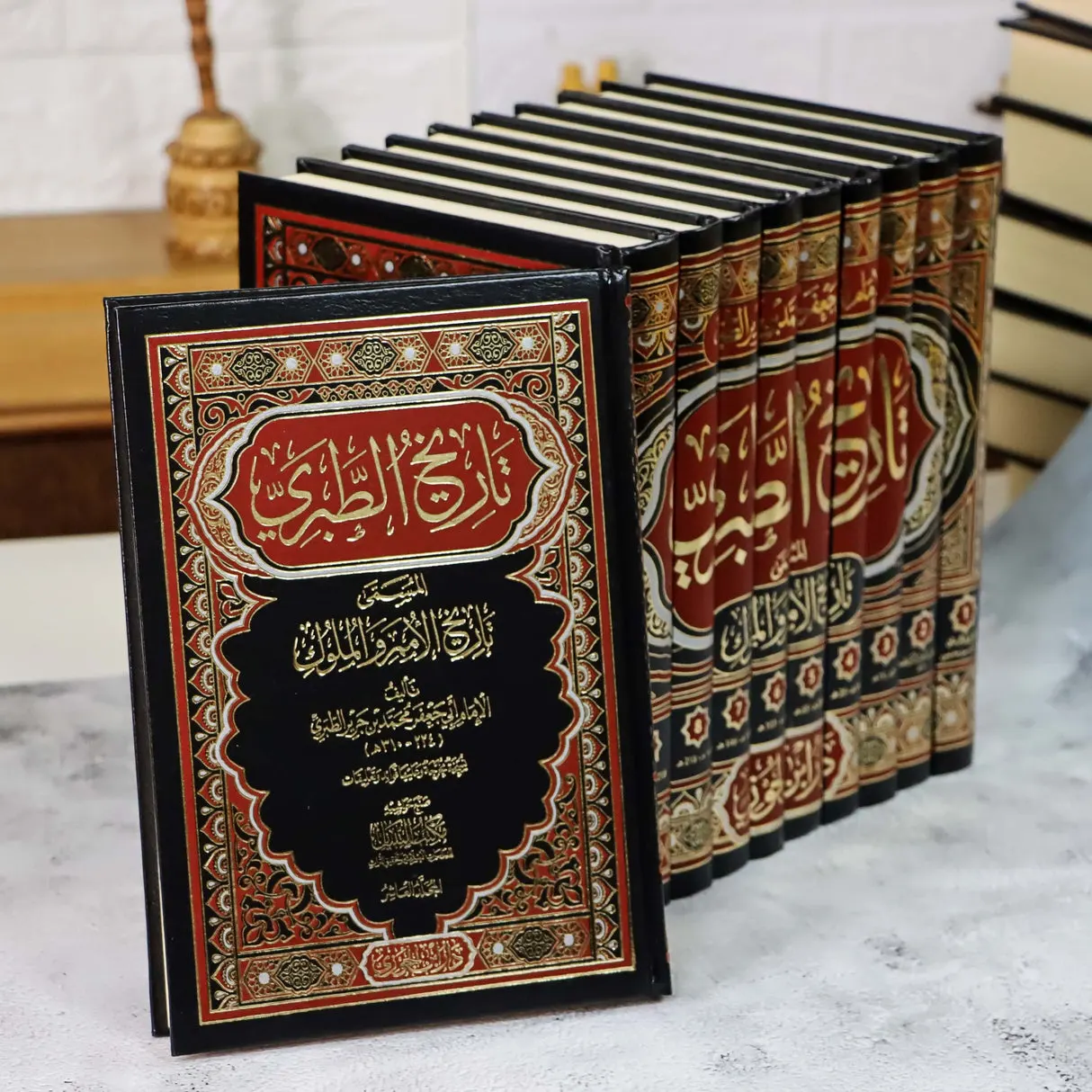
Abu Ja'far Muhammad ibn Jarir ibn Yazid al-Tabari, who lived from 839 to 923, produced two works that have shaped the study of Islam more than the writings of almost any other early scholar: a universal history from the creation of the world to his own lifetime, and a commentary on the Quran that gathered the interpretations of the first three Muslim generations into a single vast collection.
Both works were compilations rather than original treatises, and this is the source of their value. Al-Tabari wrote at the point when the oral and semi-oral transmission of the first two Islamic centuries was passing into books, and he set down what he had received with the chains of transmission attached, largely without smoothing the disagreements out. A great many of the authorities he quoted have not survived independently. The consequence is that modern knowledge of the life of the Prophet, the early caliphate, the civil wars, the Umayyad period and the Abbasid revolution depends on his Tarikh to a degree that depends on no other single text, and that Quranic exegesis of the formative period is known chiefly through his Jami al-Bayan.
He was also a jurist of standing who founded a school of law, an authority on the variant readings of the Quran, and a scholar who declined official appointment and lived on his family's income.
A note on identification is useful at the outset, because the name causes confusion. This al-Tabari — Muhammad ibn Jarir — is distinct from Ali ibn Sahl Rabban al-Tabari, a ninth-century physician, and from a later Shia scholar of similar name with whom medieval and modern writers have occasionally conflated him. The nisba simply means "of Tabaristan", the Caspian province from which all of them came.
Origins and Early Education
Al-Tabari was born at Amul in Tabaristan, the mountainous region south of the Caspian Sea, in 224 or 225 of the Hijra, corresponding to 838 or 839. His family was Persian and of modest landowning means, and the property they held in Tabaristan supported him financially for most of his life — a fact of some importance, since it allowed him to refuse the patronage and official employment that shaped many scholarly careers.
The biographical tradition describes a precocious childhood: memorisation of the Quran very young, leading prayers as a boy, and beginning the collection of hadith at nine. These details are the standard furniture of scholarly biography in Arabic literature, attached to many figures, and they should be read as an assertion of his stature by later admirers rather than as documented fact. What is not in doubt is that his father recognised his ability and supported his education, and that he left home in his early teens to study elsewhere — the beginning of the pattern of travel that defined his formation.
The Journeys in Search of Knowledge
Scholarship in the ninth century was acquired by travel. Authoritative transmission required hearing a text or a body of hadith directly from a recognised teacher, and the great teachers were scattered across the cities of the Islamic world. The institution the sources call al-rihla fi talab al-ilm — the journey in search of knowledge — was therefore a professional necessity, and al-Tabari's itinerary is characteristic of a scholar aiming at the highest rank.
He studied first at Rayy, near modern Tehran, where his teachers included Muhammad ibn Humayd al-Razi. This period was consequential in a specific way: it was through Ibn Humayd that al-Tabari received the recension of Ibn Ishaq's biography of the Prophet that he later used extensively, and much of what survives of Ibn Ishaq's material in a form independent of Ibn Hisham's edition comes through this channel.
He then went to Baghdad, the Abbasid capital and the centre of the scholarly world. The tradition records that he had hoped to study with Ahmad ibn Hanbal and arrived to find him already dead, which places the visit after 855. The article on Ahmad ibn Hanbal describes the movement he had founded.
From Baghdad he travelled through the Iraqi centres of Basra, Kufa and Wasit, collecting hadith and legal knowledge, and then westward into Syria, Palestine and Egypt. In Egypt he studied with the circle that transmitted the doctrine of al-Shafi'i, including al-Rabi ibn Sulayman, and this Shafi'i formation shaped his early legal identity; the school itself is described in the article on al-Shafi'i. He also gathered material on Quranic readings and on the traditions of the Egyptian and Syrian scholarly communities.
He returned to Baghdad and settled there for the remainder of his life, teaching, writing, and — by the consistent testimony of the sources — declining the offices he was offered. Reports that he refused a judgeship and the post of inspector of grievances are transmitted in the biographical literature; the underlying point, that he held no state appointment, is well attested and consistent with the independence of his work.
The Commentary on the Quran
Jami al-Bayan an Ta'wil Ay al-Qur'an — "The Comprehensive Exposition of the Interpretation of the Verses of the Quran" — is the earliest large-scale Quranic commentary to survive complete, and it became the reference point for the whole later tradition.
Its organising principle is transmission. For each verse, al-Tabari assembles the reported interpretations of the Prophet, the Companions and the Successors, each with its chain of transmitters, and sets them out in sequence. Where the authorities disagree, the disagreement is presented. This is the method later called tafsir bi'l-ma'thur, exegesis by transmitted report, and al-Tabari is its classic exponent.
The commentary is not only a collection of reports, however, and the range of what it does is easily underestimated. It treats the grammar and syntax of the Quranic text in technical detail, drawing on the Basran and Kufan grammatical traditions. It discusses lexicography, adducing pre-Islamic and early Arabic poetry as evidence for the meaning of words — a standard philological technique of the period, and one that gives the work incidental value as a repository of early verse. It records and evaluates the variant readings of the Quranic text, a field in which al-Tabari was an authority in his own right. And it addresses questions of law and theology as they arise from particular verses.
The feature that distinguishes it from a mere compilation is that al-Tabari adjudicates. Having laid out the transmitted views, he regularly states his own preference, in formulae of the kind "the correct view in our opinion is", and gives reasons — usually philological, sometimes based on the strength of transmission, sometimes on the coherence of the reading with the surrounding text. Claude Gilliot's study of the Jami al-Bayan examines this procedure closely and shows a scholar with a developed and consistent hermeneutic rather than an indiscriminate collector.
Two consequences follow for the history of exegesis. Because al-Tabari preserved the interpretations of the first generations with their chains of transmission, later scholars who wanted to know what the early community had understood a verse to mean went to him; the commentary became the principal channel through which formative-period exegesis reached the later tradition. And because he adjudicated, he established a model in which the exegete's task is to weigh transmitted authority rather than to generate meaning independently — a model that the more speculative and theological commentaries of later centuries departed from and had to justify departing from.
The History of the Prophets and Kings
Tarikh al-Rusul wa al-Muluk — also transmitted under the title Tarikh al-Umam wa al-Muluk — runs from the creation of the world to the year 302 of the Hijra, corresponding to 915, and is the single most important narrative source for the first three centuries of Islamic history.
Its structure changes as it proceeds. The early portions cover creation, the prophets, and the pre-Islamic empires of Iran, Israel and Arabia, drawing on Islamic prophetic narrative, Persian royal tradition and biblical material as transmitted in Arabic. With the career of the Prophet the narrative becomes fuller, and from the Hijra onwards it becomes strictly annalistic: events are recorded year by year, in Hijri reckoning, with the accounts for each year grouped under it.
The method within each year is the method of the hadith scholars applied to historical reporting. Al-Tabari gives the account of an event as he received it, prefaced by the chain of transmission through which it reached him, and where he has received differing accounts he gives them successively, frequently without choosing between them. He states in his introduction that he is transmitting what has been handed down and that responsibility for the content rests with the transmitters rather than with him — a disclaimer that modern historians have found both convenient and revealing.
The value of this procedure lies in what it preserved. Al-Tabari drew on a body of earlier historical writing that has very largely disappeared: the biography of the Prophet by Ibn Ishaq, the campaign narratives of al-Waqidi, the Iraqi traditions of Abu Mikhnaf on the civil wars and Karbala, the material of Sayf ibn Umar on the conquests and the first fitna, the work of al-Mada'ini, and the genealogical and tribal traditions of Ibn al-Kalbi. For many of these authorities, al-Tabari's quotations are the principal surviving witness. Chase Robinson's study of Islamic historiography treats the Tarikh as the great reservoir into which the earlier tradition drained.
A feature of the method follows from it. Because al-Tabari transmits the accounts he received, with their chains, and gives differing versions side by side, the Tarikh is read as a collection of transmitted reports to be studied with attention to the chains of transmission and the earlier authorities behind them. Much of the modern scholarship on early Islam consists of exactly this work of tracing the transmission, and the study of the early Islamic narrative tradition is in large part the study of how to read al-Tabari.
The work's later circulation is worth recording. In the tenth century the Samanid vizier Abu Ali al-Bal'ami produced a Persian version — an abridgement and adaptation rather than a translation — which became the form in which the Tarikh was known across the Persianate world and was itself translated into Turkish and other languages. The Arabic text was edited in Leiden between 1879 and 1901 by M. J. de Goeje and a team of European scholars, an edition still in use, and a complete English translation in forty volumes was published under the general editorship of Ehsan Yar-Shater between 1985 and 2007.
Law and the Jariri School
Al-Tabari was a jurist of the first rank whose legal legacy nonetheless disappeared, and the disappearance is instructive about how schools of law survived.
He was trained in the Shafi'i tradition in Egypt and was reckoned a Shafi'i in his earlier career. In maturity he developed independent positions and came to be regarded as the founder of his own school, known from his father's name as the Jariri. Its principal monument was Kitab Ikhtilaf al-Fuqaha, a comparative treatment of the disagreements among jurists, of which portions survive; his substantive legal compendium is lost, known only through citation.
The school attracted followers in Baghdad and elsewhere for perhaps two centuries and then died out, absorbed into the Shafi'i and other traditions. The reasons are structural rather than intellectual. A school of law in this period survived by acquiring the institutional apparatus that reproduced it — teaching posts, judgeships, endowed colleges, a body of textbooks and abridgements, and a lineage of scholars who identified with it. The four schools that endured in Sunni Islam, described in the articles on Abu Hanifa, Malik, al-Shafi'i and Ahmad ibn Hanbal, all acquired that apparatus. The Jariri school did not, and a legal tradition without institutions does not outlive the generations that remember its founder personally.
Al-Tabari's own reputation was unaffected. He continued to be read as an exegete and a historian by scholars of every school, and his legal writing was cited for its comparative material long after anyone identified as his follower.
The Last Years in Baghdad
Al-Tabari spent the final decades of his life in Baghdad, teaching and writing, and there are points of scholarly discussion in this period that bear on his work.
One concerns his relationship to the developing schools of law. In his comparative treatment of juristic disagreement he set out the positions of the recognised jurists; his own placing of Ahmad ibn Hanbal — whom he regarded principally as a master of hadith — was among the questions of classification discussed in his time. A second concerns a point of Quranic interpretation regarding the honoured station promised to the Prophet, a verse on which exegetes offered differing readings and on which al-Tabari set out his own. Both belong to the ordinary scholarly discussion of the age, in which questions of law and interpretation were argued among learned men.
He also composed a work on the merits of Ali ibn Abi Talib. Writing on the virtues of the members of the Prophet's family was an established and honoured activity across Sunni scholarship, and al-Tabari's work stands within that tradition.
He died at Baghdad in Shawwal 310 of the Hijra, corresponding to February 923, at about eighty-four years of age.
Historiographical Note
Al-Tabari presents an unusual situation: the works are abundantly available and the man is thinly documented, and the two present different problems.
For his life the sources are the Arabic biographical dictionaries — the entries in Yaqut's dictionary of learned men, in al-Khatib al-Baghdadi's history of Baghdad, in Ibn al-Nadim's catalogue, and in later compilations. These were written by scholars who admired him, they contain the conventional apparatus of prodigious memory and superhuman industry, and they preserve anecdotes whose function is to establish stature. The report that he offered to dictate tens of thousands of folios of commentary and history and was persuaded to reduce the plan is the best-known example and belongs to this genre. Franz Rosenthal's general introduction to the SUNY translation assembles and assesses this material carefully and is the standard treatment.
For the works themselves the difficulty is different and larger. The Tarikh is a compilation of earlier material, and the central scholarly question is what can be inferred from it about the events it describes rather than about the scholarship of the ninth century. Positions range widely. One tradition of scholarship treats the transmitted accounts as substantially reliable where they are early, multiply attested and internally coherent. A more sceptical tradition argues that the whole body of early Islamic narrative was shaped by the concerns of the second and third centuries — by legal disputes, dynastic legitimation and sectarian controversy — and that it cannot be used to reconstruct the first century with confidence. Between these positions lies most contemporary work, which proceeds by isolating individual transmission strands, dating them where possible, and asking whose interests a given version serves. The volume of essays edited by Hugh Kennedy on al-Tabari as a historian is a good entry point to the state of that argument.
Two practical points follow for any reader using him. Where the Tarikh gives several versions of an event, the existence of several versions is itself an important part of what the source records, and reading any one of them as al-Tabari's own settled account would mistake the nature of the work. And a detail carried by a single chain of transmission rests on that chain, which is part of what the source-critical reading of the Tarikh attends to.
Assessment
Al-Tabari's importance is of a kind that resists the usual categories, because his greatest achievement was not originality.
He was a compiler, and he compiled at the decisive moment. The first two Islamic centuries produced an enormous body of transmitted material — prophetic biography, conquest narrative, tribal tradition, exegesis, legal opinion — held in circles of teachers and students and recorded unevenly. By the late ninth century that material was being written down, edited and inevitably pruned, and much of it would have vanished in the process. Al-Tabari gathered it on a scale nobody attempted before or after, kept the chains of transmission, and preserved the variants. The result is that the modern study of early Islam has a documentary base at all.
His method is the second part of the achievement, and the two works show it applied differently. In the commentary he collects and then judges, giving reasons; in the history he collects and largely refrains from judging, disclaiming responsibility for what he transmits. This has been read as inconsistency, and it is better understood as a considered distinction between two kinds of enquiry: the meaning of a revealed text was a matter on which a qualified scholar was obliged to reach a conclusion, while the report of a past event was a trust to be passed on as received. Whether or not one accepts the distinction, it produced in the Tarikh something more useful to later historians than a confident synthesis would have been.
The character of the two works shapes how they are used. The Tarikh is annalistic, organised year by year, which sets events within a firm chronological frame; developments that unfolded across many years are therefore found distributed across the annals, and the later historian Ibn Khaldun would take up the study of the deeper causes of historical change as a distinct enterprise. Al-Tabari's own voice, by design, stands back from the narrative of the history, in keeping with his stated intention to transmit what he had received.
His works of law and of Quranic readings survive in part, and the very large Tahdhib al-Athar was left unfinished at his death. What remains is a commentary that defined a genre and a history that is among the indispensable sources for the first three Islamic centuries. Among the scholars of the Islamic Golden Age surveyed in the article on Muslim scholars who changed the world, al-Tabari is among the most widely drawn upon, for the reason that using al-Tabari is simply part of what studying early Islam consists of.
References and Further Reading
Primary Islamic Sources
- Quran — the text on which the Jami al-Bayan comments, and the primary object of al-Tabari's scholarly life
- Quran, Surah Al-Imran (3:7) — on the clear and the ambiguous verses, the text underlying the whole discipline of exegesis and discussed at length by al-Tabari
- Quran, Surah al-Isra (17:79) — on the honoured station, the verse at the centre of the Hanbali objection to his exegesis
- Quran, Surah al-Nahl (16:44) and Surah al-Qiyamah (75:19) — on the explanation of revelation, cited in the classical justification of tafsir
- Sahih al-Bukhari and Sahih Muslim, the books of Tafsir and of Ilm (Knowledge) — the hadith material on interpretation and on the transmission of learning, the framework within which al-Tabari worked
- Al-Tabari, Muhammad ibn Jarir. Jami al-Bayan an Ta'wil Ay al-Qur'an — his commentary, itself a primary source for formative-period exegesis
- Al-Tabari, Muhammad ibn Jarir. Tarikh al-Rusul wa al-Muluk — the History, and the principal narrative source for the first three Islamic centuries
Classical Islamic Sources
- Al-Tabari, Muhammad ibn Jarir. Kitab Ikhtilaf al-Fuqaha — his surviving comparative work on juristic disagreement
- Al-Bal'ami, Abu Ali. Tarikhnama [c. 963] — the Persian adaptation through which the History circulated in the eastern Islamic world
- Yaqut al-Hamawi. Mujam al-Udaba (Dictionary of Learned Men) [13th century] — a principal source for al-Tabari's life
- Al-Khatib al-Baghdadi. Tarikh Baghdad [11th century] — for his career and his years in Baghdad
- Ibn al-Nadim. Al-Fihrist [10th century] — the earliest catalogue of his works
- Al-Dhahabi. Siyar Alam al-Nubala [14th century] — the standard later biographical assessment
- Ibn Ishaq / Ibn Hisham. Sirat Rasul Allah — the prophetic biography whose independent recension al-Tabari preserves
Academic and Scholarly Sources
- Yar-Shater, Ehsan, ed. The History of al-Tabari. 40 vols. Albany: State University of New York Press, 1985–2007. — the complete annotated English translation
- Rosenthal, Franz. The History of al-Tabari, Volume I: General Introduction and From the Creation to the Flood. Albany: SUNY Press, 1989. — the standard scholarly account of his life and working method
- Gilliot, Claude. Exégèse, langue et théologie en Islam: l'exégèse coranique de Tabari. Paris: Vrin, 1990. — the major study of the commentary
- Kennedy, Hugh, ed. Al-Tabari: A Medieval Muslim Historian and His Work. Princeton: Darwin Press, 2008.
- Robinson, Chase F. Islamic Historiography. Cambridge: Cambridge University Press, 2003. — on the annalistic tradition and its assumptions
- Humphreys, R. Stephen. Islamic History: A Framework for Inquiry. Rev. ed. Princeton: Princeton University Press, 1991. — on the source-critical use of the Tarikh
- Donner, Fred M. Narratives of Islamic Origins: The Beginnings of Islamic Historical Writing. Princeton: Darwin Press, 1998.
- Shoshan, Boaz. Poetics of Islamic Historiography: Deconstructing Tabari's History. Leiden: Brill, 2004.
Further Reading
- Saleh, Walid A. The Formation of the Classical Tafsir Tradition. Leiden: Brill, 2004. — on the development of exegesis after al-Tabari
- Khalidi, Tarif. Arabic Historical Thought in the Classical Period. Cambridge: Cambridge University Press, 1994.
- Rippin, Andrew, ed. Approaches to the History of the Interpretation of the Qur'an. Oxford: Clarendon Press, 1988.
- Kennedy, Hugh. The Prophet and the Age of the Caliphates. 3rd ed. London: Routledge, 2016. — a modern narrative built substantially on the material al-Tabari preserved
- Melchert, Christopher. The Formation of the Sunni Schools of Law, 9th–10th Centuries C.E. Leiden: Brill, 1997. — for the context in which the Jariri school rose and failed
Mentioned In
40 articles reference this topic
and 28 more articles
More from Abbasid Caliphate
Abbasid Caliphate
The third major Islamic caliphate (750–1258 CE), centered in Baghdad. It presided over the Islamic Golden Age, with landmark advances in science, philosophy, literature, and the arts, forging a cosmopolitan empire that blended Greek, Persian, Indian, and Arab traditions.
Baghdad
Baghdad, founded in 762 CE by Caliph al-Mansur, served as the capital of the Abbasid Caliphate and became the intellectual, cultural, and economic center of the Islamic world during the Islamic Golden Age, reaching a population of over one million before its destruction by the Mongols in 1258 CE.
Islamic Urban Planning and City Development
How cities were laid out in the Islamic world from the eighth century onward, with the congregational mosque and market at the centre, streets graded from public to private, and courtyard houses built for seclusion. Baghdad, Cordoba, Cairo and Istanbul show the pattern at scale.
The Mihna
The Mihna (833–849 CE) was an inquisition begun by Caliph al-Ma'mun to enforce the Mu'tazilite doctrine that the Quran was created. Its failure, symbolized by Ahmad ibn Hanbal's resistance, established the independence of religious scholarship from political authority.