Mufti Muhammad Shafi
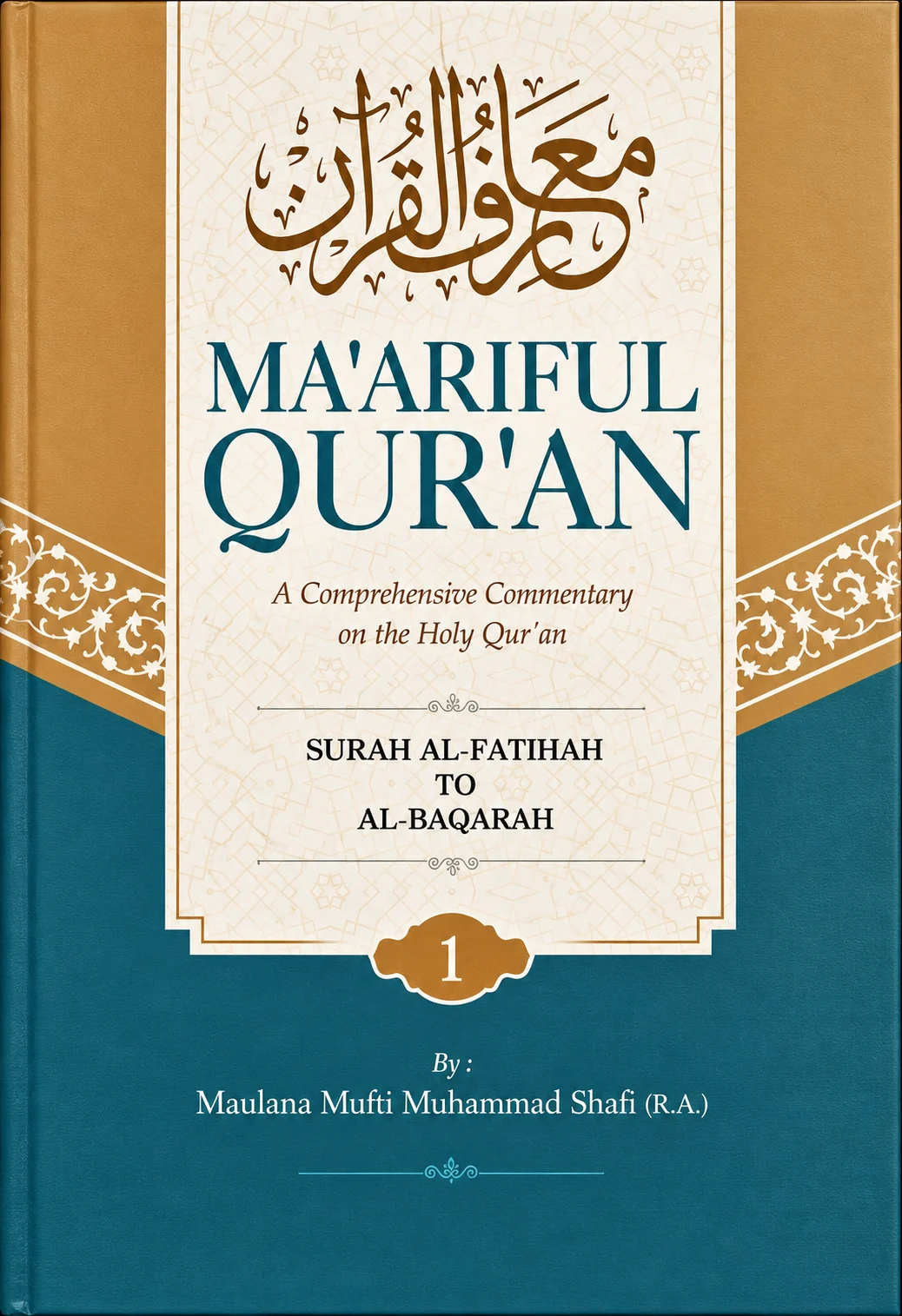
A Hanafi jurist who served as head mufti of Darul Uloom Deoband and founded Darul Uloom Karachi in 1951. His Urdu commentary Ma'arif al-Qur'an, which began as a radio programme, became one of the most widely read Qur'anic commentaries in South Asia.
Muhammad Shafi (24 January 1897 – 6 October 1976), generally known as Mufti Muhammad Shafi, was a Hanafi jurist who held the office of head mufti at Darul Uloom Deoband and, after moving to Pakistan, founded Darul Uloom Karachi in 1951. He is best known for Ma'arif al-Qur'an, an Urdu commentary on the Qur'an that became one of the most widely read works of its kind in South Asia.
Muhammad Qasim Zaman records a detail about that commentary which says a good deal about how religious authority reached ordinary Muslims in the twentieth century. Ma'arif al-Qur'an, he writes — "the influential and widely read Urdu Qur'an commentary... by Mufti Muhammad Shafi' of the Dar al-'Ulum of Karachi" — "originated in a radio program in which he regularly expounded the meaning of the Qur'an for ordinary believers." A work of classical exegesis in the seminary tradition thus began as broadcasting, addressed to listeners who had no training in the discipline.
He was the father of Muhammad Taqi Usmani and Muhammad Rafi Usmani, both of whom led the institution he founded.
Birth, Name and Childhood
Muhammad Shafi was born on 20 Sha'ban 1314 AH, corresponding to 24 January 1897, at Deoband, into a family of the Usmani lineage of the town. His father, Muhammad Yasin, was a teacher at the Darul Uloom.
His name has a small history of its own. His grandfather, Khalifah Tahsin Ali, had named him Muhammad Mubin; the name Muhammad Shafi was given instead by Rashid Ahmad Gangohi, one of the two principal founders of the Deobandi school and his father's Sufi guide. Barbara Metcalf's history describes Gangohi's standing in this period as resting on the combination of juristic authority with the role of a spiritual director, and the naming of a colleague's child belongs to that pattern of relationship.
He grew up inside the institution. As a child he played in the courtyard of Darul Uloom Deoband and sat in his father's company while he taught.
Education
At the age of five he began memorising the Qur'an at the Darul Uloom with Muhammad Azim and Namdar Khan. In 1325 AH, about 1907 or 1908, he began the study of Urdu, Persian and mathematics, completing this stage over the following five years under his father's supervision.
The range of that early instruction is worth noting. He read arithmetic and Euclid with his uncle, Munshi Manzur Ahmad, and studied Qur'anic recitation with Muhammad Yusuf Miruthi. His father took him through the Persian books and the elementary Arabic works of morphology, grammar and law, up to the Fusul-i Akbari, the Hidayat al-Nahw and the Munyat al-Musalli. Geometry and arithmetic sat alongside grammar and jurisprudence in the same course of study, which reflects the composition of the Dars-i Nizami curriculum as Metcalf describes it.
He was formally enrolled in the upper Arabic classes of the Darul Uloom in 1330 or 1331 AH — the sources differ, giving 1912 or 1913 — and completed the dawra of hadith in 1335 AH, about 1916 or 1917, under Anwar Shah Kashmiri, then the seminary's chief teacher of hadith. He finished his studies in 1336 AH, about 1917 or 1918.
His formal teachers included Anwar Shah Kashmiri, Shabbir Ahmad Usmani, Azizur Rahman Usmani, Mian Asghar Husain Deobandi, Izaz Ali Amrohi, Muhammad Rasul Khan, Muhammad Ibrahim Balyawi, Ghulam Rasul Hazarvi and Hafiz Muhammad Ahmad. He was also a disciple of Ashraf Ali Thanawi and of Mahmud Hasan Deobandi, the latter being the seminary's most senior figure of the preceding generation.
The books he read with Anwar Shah Kashmiri indicate the breadth of the final year: Sahih al-Bukhari, the Jami of al-Tirmidhi almost in full, al-Tirmidhi's Shama'il and his Ilal, a work on Arab philosophy, and the Sharh al-Nafisi on medicine. A curriculum that included philosophy and medicine alongside hadith was not unusual in the seminary tradition, and it formed jurists who were expected to rule on questions arising in fields well beyond ritual law.
In Sufism his affiliation was to the Chishti order in its Sabiri-Imdadi line, and in theology he followed the Maturidi position.
The Office of Mufti at Deoband
Muhammad Shafi taught at Darul Uloom Deoband after completing his studies, and came to hold the post of head mufti — the officer responsible for issuing the seminary's legal rulings. He held it twice: from about August 1931 to about November 1935, and again from about April 1940 to March 1943.
The work of a mufti at Deoband in this period was substantial and continuous. Metcalf's study of the institution describes the volume of correspondence the seminary attracted from across India and beyond, on questions ranging from ritual observance to inheritance, commerce and family law, and the dar al-ifta functioned as a standing court of reference for Muslims with no other recourse to expert opinion.
He also worked as an editor. Zaman records that Imdad al-fatawa, the collected legal rulings of Ashraf Ali Thanawi, was published in two volumes at Deoband under the editorship of Mufti Muhammad Shafi — a task that placed him in charge of organising and preparing for publication the fatwas of the scholar who had been his own spiritual guide.
He resigned his office in 1943 in order to give his time to the movement for Pakistan.
Migration and the Founding of Darul Uloom Karachi
Muhammad Shafi moved to Pakistan after the partition of the subcontinent, and in 1951 he established Darul Uloom Karachi, serving as its head from its foundation until his death in 1976, when he was succeeded by Abdul Hai Arifi.
The founding of the seminary at Karachi was among the most consequential institutional acts of the post-partition period for the Deobandi tradition. A network of seminaries had been built up over eight decades in northern India, and the creation of Pakistan left the Muslim populations of Sindh and Punjab without ready access to it. Zaman's study treats the Dar al-Ulum of Karachi as one of the principal centres of Deobandi learning in Pakistan in the later twentieth century, and its scholars — among them Muhammad Shafi's two sons — as figures of national standing whose writing on Islamic law reached well beyond the seminary.
The pattern of his own career, from Deoband to Karachi, was repeated across the tradition in these years. His teacher Shabbir Ahmad Usmani had gone to Pakistan before independence; Muhammad Idris Kandhlawi, his fellow student at Deoband, left India in 1949 for Bahawalpur and then Lahore.
Writings
Ma'arif al-Qur'an is his major work: a commentary on the whole Qur'an in Urdu, directed at general readers rather than at specialists, and originating in the radio talks in which he expounded the text week by week. Its subsequent translation into English and other languages carried it to Urdu-reading and non-Urdu-reading Muslims alike, and it remains among the most widely used Qur'anic commentaries produced in the subcontinent.
Sirat Khatam al-Anbiya is his account of the life of the Prophet Muhammad (Peace Be Upon Him).
His legal rulings, delivered over decades in the offices of two seminaries, and his editorial work on Thanawi's Imdad al-fatawa, form the other substantial part of his output.
Death
He died at Karachi on 6 October 1976, aged seventy-nine. His life spanned three citizenships without his ever having emigrated from the region of his birth in the ordinary sense: he was a British Indian subject from 1897, an Indian citizen from 1947, and a Pakistani citizen from 1948.
His sons Muhammad Rafi Usmani and Muhammad Taqi Usmani both became scholars of the Darul Uloom Karachi, the elder serving as its president and the younger as one of the most widely published writers on Islamic law of his generation. Among his students were Abul Hasan Jashori, Hafez Ahmadullah and Muhammad Abdullah Ghazi.
Historiographical Note
Two points of detail should be recorded.
The first concerns the title of his commentary. Ma'arif al-Qur'an is also the title of an eight-volume Urdu commentary by Muhammad Idris Kandhlawi, who was Muhammad Shafi's contemporary and fellow student at Deoband. The two works are distinct and by different authors, and readers meeting the title in a catalogue or bibliography should check which is meant.
The second concerns the year of his enrolment in the higher classes at Deoband, which the sources give as either 1330 AH (1912) or 1331 AH (1913). The discrepancy is of one year and does not affect the sequence of his education. Similarly, his completion of the hadith course is given as 1335 AH and his graduation as 1336 AH, which correspond to spans crossing 1916 to 1918 in the Common Era; precise Common Era years cannot be fixed from the Hijri figures alone.
References and Further Reading
Primary Islamic Sources
- The Qur'an — memorised by him from the age of five, and the subject of his commentary Ma'arif al-Qur'an
- Sahih al-Bukhari — read by him with Anwar Shah Kashmiri in the final year of his studies
- The Jami of al-Tirmidhi, together with al-Tirmidhi's Shama'il and Ilal — also read with Kashmiri
- Ma'arif al-Qur'an by Mufti Muhammad Shafi — his own commentary, the primary record of his exegetical work
- Sirat Khatam al-Anbiya by Mufti Muhammad Shafi — his life of the Prophet Muhammad (Peace Be Upon Him)
Classical Islamic Sources
- The Hanafi school of law, in which he ruled as mufti at two seminaries
- Imdad al-fatawa by Ashraf Ali Thanawi, which he edited for publication — a major modern collection of Hanafi rulings
- The Hidayat al-Nahw, Fusul-i Akbari and Munyat al-Musalli — the elementary texts of grammar, morphology and law he read with his father
- The Maturidi tradition in theology, and the Chishti order in its Sabiri-Imdadi line, to which he was affiliated
Academic and Scholarly Sources
- The Ulama in Contemporary Islam: Custodians of Change by Muhammad Qasim Zaman — for Ma'arif al-Qur'an and its origin in a radio programme, his editorship of Thanawi's Imdad al-fatawa, and the standing of the Dar al-Ulum of Karachi
- Islamic Revival in British India: Deoband, 1860-1900 by Barbara Daly Metcalf — for the seminary, the Dars-i Nizami curriculum, the working life of a mufti, and Rashid Ahmad Gangohi
- Wikipedia, "Muhammad Shafi Deobandi", https://en.wikipedia.org/wiki/Muhammad_Shafi_Deobandi — consulted with the owner's authorisation for his dates, family, education, offices at Deoband, and the founding of Darul Uloom Karachi
- Wikipedia, "Anwar Shah Kashmiri", https://en.wikipedia.org/wiki/Anwar_Shah_Kashmiri — consulted with the owner's authorisation for his teacher's tenure in the chair of hadith
Further Reading
- Muhammad Taqi Usmani — his son, and among the most widely published writers on Islamic law of the following generation
- Muhammad Rafi Usmani — his son, later president of Darul Uloom Karachi
- Anwar Shah Kashmiri — his teacher of hadith at Deoband
- Mahmud Hasan Deobandi — the senior scholar of the preceding generation whose disciple he was
- Darul Uloom Deoband — the seminary where he studied, taught and served as head mufti
- The Deobandi Movement — the tradition he carried from India into Pakistan
Mentioned In
9 articles reference this topic
More from South Asian Islam
Ahmed Raza Khan Barelvi and the Barelvi Movement
Ahmed Raza Khan of Bareilly (1856-1921) was an Indian Hanafi jurist, Sufi of the Qadiri order and prolific writer whose defence of the veneration due to the Prophet and the saints gave rise to the movement known as Barelvi, whose adherents call themselves the ulama of the Ahl-i Sunnat wa Jamaat.
Darul Uloom Deoband: The Seminary and the School of Thought
Darul Uloom Deoband is an Islamic seminary founded in northern India in 1866 or 1867 and the origin of the Deobandi school of thought. Its innovation was institutional: it carried the traditional religious sciences in the form of a modern school funded by public subscription.
The Deobandi Movement
A school of Sunni thought and practice that grew from the seminary founded at Deoband in northern India in 1866 or 1867. Its scholars combined the roles of jurist and Sufi guide, built a madrasa funded by public subscription, and made hadith the centre of religious education.
The Jamaat-e-Islami
An organisation founded by Abul A'la Maududi at Lahore in August 1941 to form a disciplined body of Muslims who would remake society according to Islamic norms. After the partition of India it divided into separate and independent organisations in Pakistan, India and later Bangladesh.