Bahadur Shah Zafar: The Last Mughal Emperor
Bahadur Shah Zafar (r. 1837-1857) was the last Mughal emperor, a calligrapher and celebrated Urdu poet reigning over a Delhi court stripped of real power. Reluctantly made figurehead of the 1857 Uprising, he was tried and exiled to Rangoon, where he died in 1862, ending the Mughal dynasty.
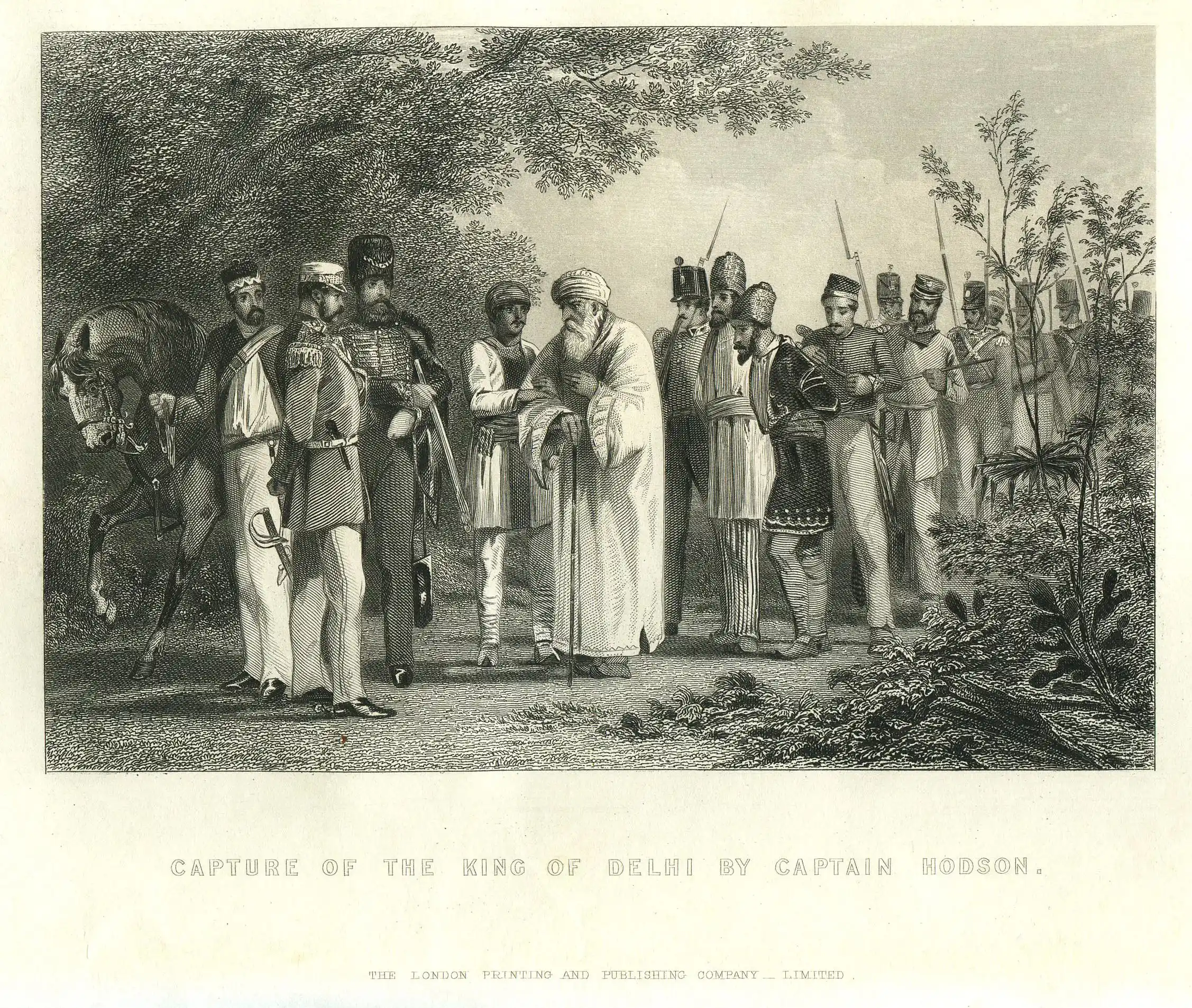
Bahadur Shah II — known throughout his life by his pen-name Zafar, "Victory" — was the last emperor of the Mughal dynasty, reigning at Delhi from 1837 until 1857 and living out his final years as a British prisoner in exile. Born in 1775, a direct descendant of Genghis Khan and Timur, and of Akbar, Jahangir and Shah Jahan, he came late to a throne that had already lost almost everything but its name, and he presided over Delhi at a moment of remarkable literary flowering even as the political substance of his dynasty dissolved around him. Reluctantly made the nominal leader of the 1857 Uprising against the East India Company, he was captured after the fall of Delhi, tried, and transported to Rangoon, where he died in 1862 at the age of eighty-seven, the last of the Great Mughals.
Accession to a Throne Without Power
Zafar was the eldest son of the emperor Akbar Shah II, but not his father's favourite; that place was held by a younger son, Mirza Jahangir, and Akbar Shah went so far as to write to the British Resident in 1807 declaring Zafar "wholly devoid of every qualification for occupying the throne." It was only the British insistence on the principle of primogeniture, over Akbar Shah's own wishes, that secured Zafar's eventual accession, in 1837, at the age of sixty-two.
By then the Mughal emperor's authority did not extend beyond the walls of the Red Fort itself. His grandfather Shah Alam II had been blinded by the Rohilla chief Ghulam Qadir in 1788, when Zafar was a boy of thirteen, and had spent his final years, in one contemporary's phrase, as "only a chessboard king." The East India Company had at first maintained the outward forms of vassalage — as late as 1832 its own seal still bore the inscription Fidvi Shah Alam, "Shah Alam's devoted dependant" — but Sir Charles Metcalfe, appointed Resident at Delhi, ended the practice of the ceremonial nazr in 1832 and declared that he had "renounced my former allegiance to the house of Timur." The following year the emperor's name disappeared from Company coinage. By 1852 Zafar retained nothing, in the judgement of his biographer, "but his palace and the lingering reputation of his dynasty." Even within the Red Fort his authority was circumscribed: no nobleman from outside Delhi could enter without the British Resident's permission, and Zafar had to apply to British courts to collect rent from his own lands.
Zafar's feelings on this confinement found their fullest expression in his poetry, in the recurring image of the caged bird longing for a garden it can see but never reach:
I want to shatter the bars of my cage, With the flutterings of my wings. But like a caged bird in a painting, There is no possibility of being free.
The Contest over the Succession
Zafar's own household reproduced, almost exactly, the succession dispute that had marked his father's reign. His eldest son, Mirza Dara Bakht, died of a fever in 1849, and the British assumed his next son, the talented poet, calligrapher and historian Mirza Fakhru, would become heir apparent in his place. Zafar, however, under the influence of his senior wife Zinat Mahal, tried instead to secure the succession for her own son, Mirza Jawan Bakht — a boy of eight, and the fifteenth of Zafar's sixteen sons — arguing to the Lieutenant-Governor that Jawan Bakht's mother was "of very high family" and that the boy remained always under his own supervision.
Mirza Fakhru, for his part, cultivated the British and in January 1852 reached a secret understanding with the Resident, Sir Thomas Metcalfe: recognition as heir apparent, in exchange for moving the court from the Red Fort to Mehrauli and abandoning the Mughals' traditional claim to superior status over the Governor-General. When Zafar learned of the terms, he was furious, and Mirza Fakhru was boycotted at court, his positions and revenues transferred to his ambitious younger brother Mirza Mughal. Zafar, in despair at his powerlessness to alter the succession, wrote to Metcalfe that he wished to abdicate and spend his last years on pilgrimage to Mecca, though he abandoned the plan and instead staged an immense and ruinously expensive wedding for Jawan Bakht in 1852, hoping its magnificence might yet persuade the British to recognise the boy — a hope Metcalfe deliberately disappointed by failing to attend any of the twelve days of celebration. Mirza Fakhru died in 1856, probably of cholera, though palace gossip suspected poison, leaving Mirza Mughal the eldest of Zafar's surviving legitimate sons on the eve of the Uprising.
Character, Sufism, and Patronage
Contemporaries and later historians alike have described Zafar as one of the most personally likeable and talented rulers of his dynasty: a skilled calligrapher, a discriminating patron of miniature painters, a creator of gardens, and, above all, a mystical poet of real accomplishment who composed in Urdu, Persian, Braj Bhasha and Punjabi. In his youth, before his accession, he deliberately lived and dressed as a poor scholar and dervish rather than in the manner of his fashionable younger brothers; an observer in 1828, when Zafar was fifty-three and still a decade from the throne, described him as "a man of spare figure and stature, plainly apparelled, almost approaching to meanness," with the appearance of "an indigent munshi, or teacher of languages."
Zafar was himself regarded by many of his subjects as a Sufi pir, and accepted disciples, or murids; the loyal Dihli Urdu Akhbar called him "one of the leading saints of the age, approved of by the divine court." His religious life combined the high literary Sufism of his poetry — in which the love of God and the love of a worldly beloved were deliberately left ambiguous, in the tradition of the Urdu and Persian ghazal — with an equally sincere attachment to the more popular and magical practices of Delhi's devotional culture: he gave generously to the keepers of the city's Sufi shrines, paid for flowers to be placed on saints' graves, wore charms and ta'wiz against illness and misfortune, and on one occasion attempted to cure a follower bitten by a snake by sending a bezoar stone and water over which he had breathed prayers. This eclectic and tolerant Sufism, aligned with the liberal Chishti tradition long favoured by the Mughal court, stood at the opposite end of the theological spectrum from the reform movement associated with Shah Waliullah and his descendants, whose followers regarded the veneration of saints as bordering on idolatry — a tension within Delhi's religious life that ran alongside, and sometimes crossed, the political tensions of the emperor's reign.
Zafar's court was, by common consent, the setting for one of the great literary flowerings of modern Indian history. He maintained as his own ustad, or poetic master, the poet Zauq, appointed Poet Laureate of Mughal Delhi, while his court also gave a stage to Zauq's rival Ghalib, generally regarded as India's greatest Urdu lyric poet of the age. Mushairas, or poetic symposia, were a constant feature of court life, alongside visits to Sufi shrines and pleasure gardens — pursuits that increasingly substituted, as the political sky darkened, for the exercise of power the Mughal throne no longer possessed.
Household and Family
Zafar's household reflected both the scale and the internal rivalries typical of a late Mughal court. His senior wife, Zinat Mahal, was the only one of his consorts to come from an aristocratic background; she married Zafar in 1840, when she was nineteen and he sixty-four, and displaced the previous favourite, Taj Mahal Begum — the daughter of a court musician, who had presided over the celebrations of Zafar's own accession in 1837 as head of his harem, and who by 1857 had fallen so far from favour that she had been imprisoned over a suspected affair with Zafar's nephew and remained bitterly estranged from both Zafar and Zinat Mahal. Zafar was widely regarded at court as entirely under Zinat Mahal's influence, though the events of 1857 would show that her power over him had real limits: when she opposed his decision to bless the Uprising, he answered her only with the words "Let what God wills happen," and did not alter his course.
Zafar's court also depended heavily on two men outside his immediate family. Hakim Ahsanullah Khan, an intelligent and cultured physician, served as both Zafar's prime minister and personal doctor and was, before 1857, on uneasy terms with Zinat Mahal; the two nonetheless made common cause during the Uprising, working together to open secret communication with the British, and when the hakim's letters were discovered by suspicious sepoys he was protected from violence by Zafar's personal intervention — protection he repaid, after the city's fall, by giving evidence against his own former master at the trial in exchange for a pardon. Mirza Ilahe Bakhsh, father-in-law of the deceased heir apparent Mirza Fakhru and grandfather of the unruly Mirza Abu Bakr, led the Palace's pro-British faction throughout the siege, maintained contact with the British officer William Hodson, and was instrumental in persuading Zafar to surrender once the city had fallen — afterward identifying which of his own relatives had sympathised with the rebels, at the cost of most of his family's lives including his own grandson's, and earning in consequence the lasting epithet "the Traitor of Delhi."
Delhi's Hybrid World and Its Erosion
The society over which Zafar presided at the Red Fort was, for much of his reign, considerably more intermixed with the British presence than the events of 1857 might suggest. In the early decades of the nineteenth century a number of British officials at Delhi — most notably Sir David Ochterlony, the Resident, and his assistant William Fraser — adopted Mughal dress, language, and domestic custom to a striking degree: Ochterlony kept a large household in the Mughal style and was said to have considered raising some of his own children as Muslims, while Fraser studied Persian and Arabic with the theologian Shah Abdul Aziz and became close enough to the poet Ghalib that Ghalib later wrote of feeling, on Fraser's assassination, "the grief of a father's death." Landed dynasties of mixed descent such as the Gardners of Khasgunge and the Skinners of Hansi, and the court of the Begum Sumru at Sardhana, formed a similar buffer between the Mughal elite and the British administration, professing Christianity while living in an almost entirely Mughal idiom. The Delhi ulama of this period were themselves divided but generally accommodating: most held that British rule, whatever its faults, was preferable to that of the Marathas who had preceded it, and a number entered Company service as teachers, scribes and legal advisers without difficulty.
This accommodation eroded steadily over the second quarter of the century, for reasons that had little to do with Zafar's own conduct. The gradual rise of Evangelical influence within the Company's administration, symbolised by the arrival in Delhi in 1852 of the aggressively confrontational chaplain the Reverend Jennings, coincided with a series of measures that Delhi's Muslims and Hindus alike read as a shift from tolerance to active pressure: the resumption of the tax-exempt endowments that had supported numerous mosques, temples and Sufi shrines in and around Delhi, an 1832 law permitting religious converts to inherit ancestral property in contravention of Islamic inheritance law, and the operation of missionary preaching within the confines of Company jails. The public conversion of two prominent Delhi Hindus in July 1852, arranged by Jennings in a deliberately public ceremony, caused what contemporaries described as sustained unrest in the city and prompted even moderate and previously pro-British figures among the ulama, such as Zafar's own friend Mufti Sadruddin Azurda, to begin quietly discouraging their students from missionary contact. It was against this steadily deteriorating backdrop, rather than through any initiative of Zafar's own court, that the reservoir of grievance later drawn on by the sepoys of 1857 was chiefly formed.
The Uprising of 1857
The morning of 11 May 1857 began, for Zafar, as an ordinary one. According to the account of his young attendant Zahir Dehlavi — a courtier who had served in the Fort since boyhood and whose own eyewitness narrative, the Dastan-i-Ghadr, records the day in more circumstantial detail than any other surviving source — Zafar had just finished his morning prayers when he noticed smoke rising beyond the Bridge of Boats across the Yamuna and dust clouding the far bank. He sent an express camel messenger to learn its cause, and summoned his prime minister Hakim Ahsanullah Khan and Captain Douglas, commandant of the Palace Guards. The messenger returned with the news that mutinous cavalrymen from Meerut, still in Company uniform, were crossing the bridge with drawn swords, having already burnt the toll house and killed the toll keeper and the manager of the city's telegraph office. Zafar at once ordered the gates of both city and Fort closed, and that the bridge itself be broken if it was not already too late.
Within minutes some twenty of the mutineers rode up along the strand beneath the Palace walls and halted under the Saman Burj, the latticed balcony where Mughal emperors had for centuries received petitioners, calling for the Emperor to appear. By Zafar's own later account of the exchange, they told him they had come from Meerut "after killing all the Englishmen there, because they asked us to bite bullets with our teeth that were coated with the fat of cows and pigs. This has corrupted the faith of Hindus and Muslims alike." Douglas offered to go down and address them himself, but Zafar refused to let him, judging the men dangerous and himself unarmed; Douglas instead spoke to them from a window, telling them their presence beneath the ladies' apartments was a disrespect to the king, and they withdrew toward the Rajghat Gate. Douglas then hurried off to see that the city's gates had been secured — and within minutes Zafar, from his terrace, could see fresh columns of smoke rising from within the walls themselves. Zahir Dehlavi's own passage across the city that same morning, buckling on a sword he said had lain unused for years to answer the Emperor's summons, describes mobs already looting shops and hunting down Christian residents street by street, and a crowd of convicts freed from the Meerut jail and villagers from the surrounding countryside who had followed the sepoys into the city.
By midday the mutineers had overrun Delhi and declared Zafar their leader and emperor. Zafar was no friend of the British, who had stripped him of his patrimony and subjected him to regular humiliation, but he was, in the judgement of historians of the episode, no natural insurgent either: he took up the role with severe misgivings, recognising from the outset that an unpaid, officerless peasant army was unlikely to prevail against the most powerful military force in the world, yet seeing in the Uprising the only remaining chance to preserve the House of Timur, a goal he had pursued by every other means since his accession twenty years before. He gave the rebellion his public blessing while working, so far as he was able, to restrain the sepoys' worst excesses — sheltering some fifty-two British men, women and children as prisoners within the Palace precincts for the duration of the siege.
His son Mirza Mughal, appointed commander-in-chief of the rebel forces, threw himself into the administration of the city with an energy his own contemporaries and many later historians underestimated, issuing thousands of orders on pay, food supply, entrenchment, and the discipline of the sepoy regiments, and establishing a mint to strike coin bearing Zafar's image. The Palace itself remained divided: Zinat Mahal and her faction — including the chief eunuch Mahbub Ali Khan and Zafar's own prime minister and physician, Hakim Ahsanullah Khan — worked quietly to keep her son Jawan Bakht clear of the rebel cause and to open communication with the British, calculating that the Uprising would fail and that loyalty might yet secure her son's succession; when their secret correspondence with the British was discovered by suspicious sepoys in May 1857, both narrowly escaped violence at the soldiers' hands. Zafar's court also received, though it did not originate, a widely circulated appeal for princely and popular support styled the Azamgarh Proclamation — a document later historians have sometimes mistakenly attributed to the King of Delhi, but which was in fact composed at Lucknow by another Mughal prince, Firoz Shah, who never came to the city during the Uprising at all.
The siege of Delhi ended on 14 September 1857, when British forces and their Sikh and Pathan levies stormed and sacked the city, killing large numbers of its inhabitants in the process. Zafar's family paid the heaviest price of the reprisal: most of his sixteen sons were captured, tried, and hanged, while three — Mirza Mughal among them — were shot without trial after surrendering their arms, an act for which the officer responsible, Captain William Hodson, wrote to his sister that he had "enjoyed the opportunity of ridding the earth of these wretches."
Flight, Capture, and Return to the Fort
As the city fell, Zafar withdrew with his household to Humayun's Tomb, some distance to the south, along with a large and unstable crowd of princes, courtiers, and fighters who had taken shelter within the garden enclosure. On the night of 20 September the rebel commander Bakht Khan, halting at the tomb himself, urged Zafar to come away with him to Lucknow and continue the resistance from there; it was again Hakim Ahsanullah Khan who dissuaded him, telling the Emperor to remember that he was king, that the mutinous army had fought its own masters and been utterly routed, and that he himself had no part in their cause and no reason to fear British justice if he stayed.
Captain William Hodson, who had obtained permission to negotiate Zafar's surrender in person, approached the tomb the following day with an escort of fifteen troopers and two intermediaries, Maulvi Rajab Ali and Mirza Ilahe Bakhsh, having warned them to tell the Emperor that if he came out quietly his safety would be guaranteed, but that if he tried to leave by any other way Hodson commanded the entrance and would shoot him and his attendants without mercy. After a wait of some two hours, word came that the King was coming: Zafar's palanquin appeared, followed by that of Zinat Mahal with her son Jawan Bakht and her father. Hodson rode up, placed his own men between the royal party and the pressing crowd of refugees behind it, and dismounted to give the visibly frightened King and Begum his personal word that Zafar's life would be spared provided no attempt was made to rescue him — a promise he repeated loudly enough for the crowd to hear, together with an order to his troopers to shoot the first man who moved. The palanquins were then escorted back across the no man's land toward the city, the crowd of stragglers thinning as they went, until by the Lahore Gate Hodson's small party found itself alone with its prisoners; asked by the gate guard who he had inside the palanquin, Hodson answered simply, "only the King of Delhi." Zafar passed back down Chandni Chowk and into the Fort he had ruled for twenty years, now a captive within his own palace. Command in Delhi was unimpressed rather than triumphant at the news: General Wilson, on hearing that the King had been taken alive, is reported to have said only "Well I am glad you have got him... I never expected to see either of you again," and by one account in the room at the time was privately displeased that Hodson had brought Zafar in alive rather than dead, contrary to Hodson's own later claim that Wilson had guaranteed the King's life in advance. Zafar was confined that afternoon in Zinat Mahal's own haveli under an openly hostile guard, Kendal Coghill, who wrote to his brother the next day that he had "the satisfaction of receiving the 'King of Hindoostan' as a prisoner" and admitted to calling him "a pig and other appropriate epithets" while ordering the sentries to shoot him if he so much as looked up.
Captivity and the Question of the Charge
Zafar himself was held and put on display for British visitors, among them the Times correspondent William Howard Russell, who described him as "a dim, wandering eyed, dreamy old man with a feeble hanging nether lip and toothless gums" and found him, on his first visit to the cell, "crouched on his haunches," being violently sick into a basin. Russell went on to make, in his own published account, an argument about the legal basis of the case against Zafar that several of his British contemporaries shared: the East India Company had never renounced its formal status as the Mughal's vassal — as recently as 1832 its own seal still carried the inscription acknowledging Shah Alam's suzerainty — and neither Shah Alam, nor Akbar Shah II, nor Zafar himself had ever renounced the throne's sovereignty over the Company in turn. On this reading Zafar could be tried as a defeated king, but not, properly speaking, as a rebel guilty of treason against a government to which he had never been a subject; Russell went further, suggesting that it was arguably the Company that stood in the position of a vassal in revolt against its feudal superior. "We crept in as humble barterers, whose existence depended on the bounty and favour of the lieutenants of the kings of Delhi," Russell wrote, "and the 'generosity' we have shown was but a small acknowledgement of the favours his ancestors had conferred to our race." He added that the old man could hardly be blamed for the crimes laid against him, given "the position of the King was one of the most intolerable misery long ere the revolt broke out."
Trial
In January 1858 Zafar was brought before a military commission convened in the Diwan-i-Khas of his own palace, on charges that included waging war against the British government, encouraging others to do the same, and being complicit in the killing of European residents of Delhi in May 1857. Zafar did not mount a vigorous legal defence and did not cross-examine the witnesses called against him, submitting instead a written statement asserting that the mutinous sepoys had made him a prisoner in all but name and used his position without his consent: "Seeing that these troops killed their own masters, men of high authority and power, how was I without an army, without treasure, to have resisted them?"
The prosecutor, Major Harriott, built his case on the theory that Zafar had been the guiding intelligence behind an international Muslim conspiracy reaching from Istanbul and Mecca to the walls of the Red Fort, and that the Uprising was in essence a religious war fomented by "Mahommedan" fanaticism with Zafar as its willing or unwitting figurehead. The theory sat awkwardly with the plain fact, acknowledged even by British officers present at Delhi, that a substantial majority of the mutinous sepoys were upper-caste Hindus, and officials close to the trial — among them Lieutenant Ommaney, who assisted the prosecution's own case-preparation — privately dismissed the conspiracy theory as showing no understanding of the actual grievances that had produced the revolt. A civilian spectator at the trial, Mrs Muter, recorded in her own account that the evidence instead showed an old man "eddied about in the whirlwind of the Mutiny with no energy to control," who had in fact intervened to protect the citizens of Delhi from the violence of both soldiery and looters, and who had condemned the massacre of British prisoners carried out elsewhere in the Uprising at Kanpur. Witnesses continued, even in the courtroom, to address the deposed emperor with the honorific "Ruler of the Universe," a mark of a personal deference the tribunal itself did not extend to him.
The trial ran for two months, repeatedly adjourned because of Zafar's failing health, and the military commission delivered its verdict on 9 March 1858: Zafar was found guilty on every charge. The president of the tribunal noted that such a verdict would ordinarily carry the death penalty, but that the guarantee of Zafar's life given by Captain Hodson at the time of his surrender in September 1857 made that sentence impossible. Zafar was instead sentenced to transportation for the remainder of his life.
Exile to Rangoon
Seven months of correspondence between Delhi, Calcutta, Rangoon and the Andaman Islands followed, as the colonial administration settled on a destination and satisfied itself that the security situation in eastern India permitted the move. At four o'clock in the morning on 7 October 1858 — three hundred and thirty-two years, almost to the day, after Babur had first taken the city — Zafar left Delhi by bullock cart, accompanied by his surviving wives, his two remaining children, and a household party of thirty-one persons in total, under military escort. He was given no advance warning of the date of his own departure. He was taken first toward Calcutta and then on to Rangoon in British Burma, where he lived out his final years as what the colonial administration termed a "State Prisoner," closely confined and largely disregarded by the government that held him.
He died at Rangoon on 7 November 1862, at the age of eighty-seven. His funeral was deliberately kept unmarked: quantities of lime were used to hasten the decay of the body, and the British Commissioner who reported the death to London noted that within a month the grave would be indistinguishable from the ground around it, so that "no vestige will remain to distinguish where the last of the Great Moghuls rests." The precise location of his grave, within the walled compound of the prison overlooking the Rangoon river, was rediscovered only in the twentieth century.
Legacy
With Zafar's deportation, the court culture he had sustained collapsed at once. Ghalib, one of the few of the old circle to survive the sack of Delhi, wrote that "all these things lasted only so long as the king reigned," and elsewhere lamented that Delhi itself had ceased, in any meaningful sense, to exist: "no Fort, no city, no bazaars, no watercourses." The male descendants of the deposed emperor who survived the reprisals were reduced to a state pension of five rupees a month.
The family Zafar left behind in Rangoon fared little better than those left in Delhi. His widow Zinat Mahal, their son Mirza Jawan Bakht, and Jawan Bakht's wife Nawab Shah Zamani Begum remained under British supervision after his death, eventually permitted to leave the prison enclosure for a house nearby, though on an allowance so meagre that by 1870 a British official described their home as "a mere hovel and much overcrowded." Shah Zamani Begum, married as a child to Jawan Bakht in a procession that had once crossed the whole of Mughal Delhi, went blind in her final years and was reduced, by the same official's report, to pawning her own clothes and ornaments to feed her children while her husband spent what little the family had on drink; she died in 1882, twenty years after Zafar, by which time the location of his own grave had already been forgotten, and she was buried nearby only approximately, near a tree remembered to have stood close to it. Jawan Bakht himself died two years later, aged forty-two.
The grave remained unmarked and its exact position uncertain for decades. A 1905 petition from the Muslims of Rangoon asking that it be marked and a monument permitted was initially refused by the Viceroy's government, which held that it would be "very inappropriate... to erect over his remains a tomb which might become a place of pilgrimage," though a simple railing and later a corrugated-iron roof were eventually allowed to stand over the traditionally remembered site. The actual grave was located only on 16 February 1991, when workmen digging a drain uncovered a brick-lined burial some three feet underground and about twenty-five feet from the shrine; Zafar's skeleton was found intact within it. The site, now enclosed in a small crypt beneath the shrine, remains a place of pilgrimage for Rangoon's Muslim community, who regard Zafar as a Sufi saint and visit to seek his blessing, and it continues to receive visits from politicians and dignitaries of India, Pakistan, and Bangladesh.
Zafar's importance to later memory rests less on any political achievement — his reign coincided with the final, irreversible eclipse of Mughal power — than on his personal character and his poetry, and on his position as the last, involuntary symbol of a six-hundred-year dynasty's end. His ghazals remain part of the Urdu literary canon, still read and set to music, and his tomb in Yangon (Rangoon) has become a site of pilgrimage and historical memory for visitors from South Asia.
Historiographical Note
The fullest connected modern account of Zafar's life and reign is William Dalrymple's The Last Mughal, which draws extensively on the Mutiny Papers held in the National Archives of India, the Delhi Palace diary kept by the British Resident's news-writers, and the private correspondence of the Delhi Residency, alongside the memoirs of participants such as the physician Hakim Ahsanullah Khan and the diarist Jiwan Lal. For the events of 11 May 1857 and the days that followed, this article follows in particular the eyewitness memoir of Zahir Dehlavi, a young attendant at Zafar's court whose Dastan-i-Ghadr Dalrymple identifies as the most detailed and best-informed surviving account of the Palace's own experience of the outbreak, even though, like many such memoirs, it reached its final written form some years after the events it describes; where other accounts of the same morning disagree on points of sequence, this article follows Zahir Dehlavi's version, as Dalrymple himself does. The capture at Humayun's Tomb is likewise reconstructed chiefly from Captain Hodson's own later account of the negotiation, corroborated by other witnesses present. Earlier English-language treatments include Percival Spear's Twilight of the Moghuls and the biography by Burke and Quraishi. Some details of Zafar's private and religious life — his belief in charms and the magical properties of his own blessing, for instance — are recorded in the Palace diary as contemporary report rather than independently verified fact, and are presented in this article as such: as an accurate record of what was believed and practised at court, not as an assessment of its efficacy. The precise authorship and degree of Palace involvement in the Uprising's various proclamations is likewise a matter on which historians continue to differ, and the Azamgarh Proclamation in particular is reported here, as the sources establish, as the work of Firoz Shah rather than of Zafar's own court.
References and Further Reading
Primary Islamic Sources
- Delhi Palace Diary (Court News-writer's Records) and the Mutiny Papers, National Archives of India, together with Zafar's own poetry and Ghalib's letters — as quoted and discussed at length in Dalrymple's The Last Mughal, cited below; not independently consulted for this article.
- Zahir Dehlavi. Dastan-i-Ghadr — an eyewitness memoir of the Uprising by a young attendant at Zafar's court, as quoted and discussed at length in Dalrymple's The Last Mughal, cited below; not independently consulted for this article.
Classical Islamic Sources
- Hakim Ahsanullah Khan's memoir and testimony, Munshi Jiwan Lal's diary of the siege, Captain William Hodson's own account of Zafar's capture, and William Howard Russell's and Mrs Muter's published accounts of the trial — as quoted and discussed in Dalrymple's The Last Mughal, cited below; not independently consulted for this article.
Academic and Scholarly Sources
- Dalrymple, William. The Last Mughal: The Fall of a Dynasty, Delhi, 1857. London: Bloomsbury, 2006. [approved PDF library:
sources/study/] — the principal source for this article. - Metcalf, Barbara Daly. Islamic Revival in British India: Deoband, 1860-1900. Princeton: Princeton University Press, 1982. [approved PDF library:
sources/study/] — on Shah Waliullah's reformist tradition and its opposition to Sufi practice at the Mughal court.
Further Reading
- Spear, Percival. Twilight of the Moghuls: Studies in Late Mughal Delhi. Cambridge: Cambridge University Press, 1951. — for the reader's further research; not consulted for this article.
- Burke, S.M., and Quraishi, Salim al-Din. Bahadur Shah: Last Mogul Emperor of India. Lahore: Oxford University Press, 1995. — for the reader's further research; not consulted for this article.
Mentioned In
2 articles reference this topic