Begum Hazrat Mahal: Regent of Awadh in the Revolt of 1857
Begum Hazrat Mahal (c. 1820-1879) was a consort of Nawab Wajid Ali Shah of Awadh who, after the British annexation of 1856, became regent for her son Birjis Qadr and led the resistance at Lucknow during the Revolt of 1857. She refused all terms and died in exile in Nepal.
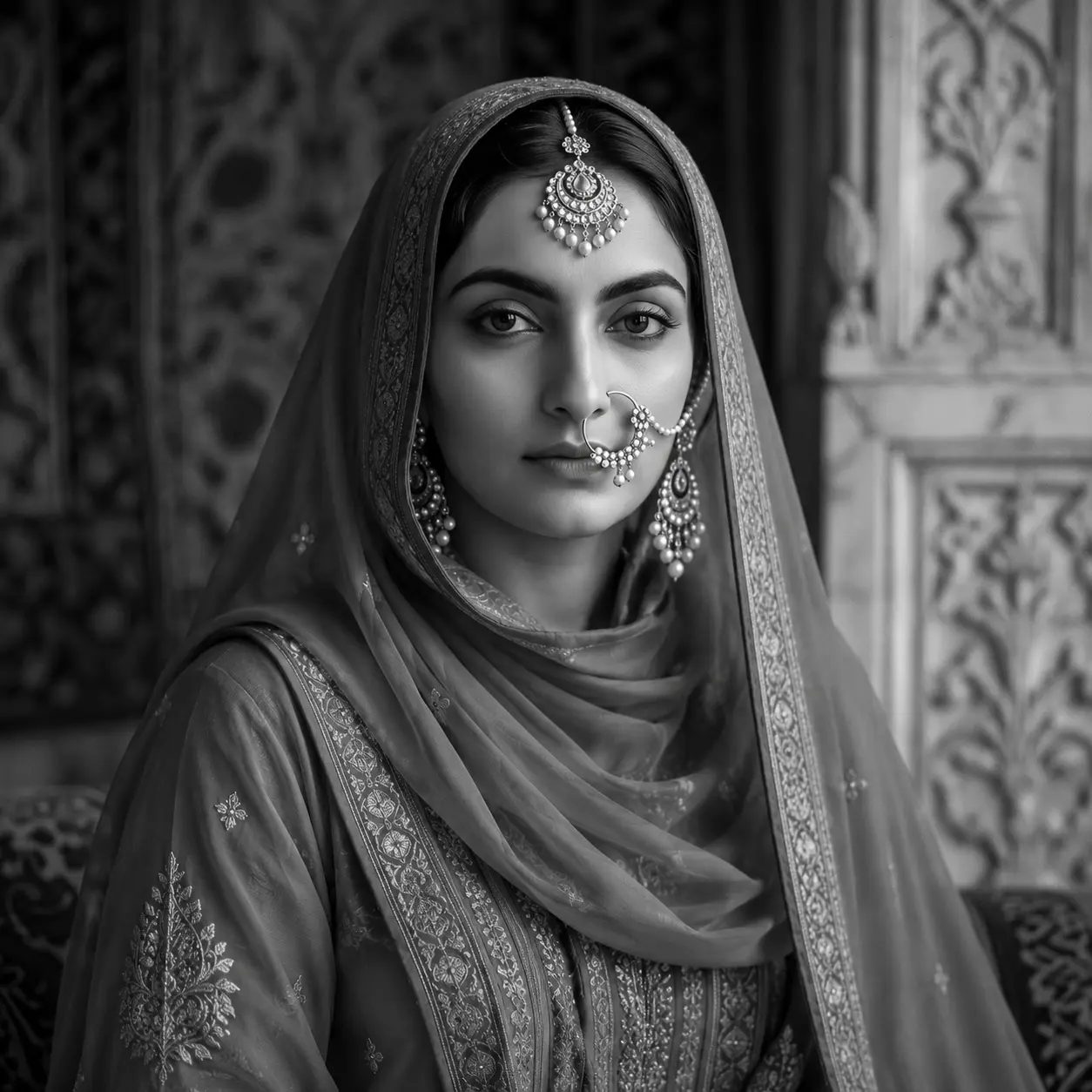
Begum Hazrat Mahal (c. 1820 – 7 April 1879), also called the Begum of Awadh, was a consort of Nawab Wajid Ali Shah, the last independent ruler of the kingdom of Awadh (Oudh) in northern India. After the British East India Company annexed Awadh in 1856 and removed her husband to Calcutta, she became regent for their young son Birjis Qadr and emerged as one of the principal leaders of the resistance at Lucknow during the Revolt of 1857. She is remembered in the history of the period as the leader who declined every British offer of terms and, alone among the major figures of the revolt in the region, went into a permanent exile rather than submit — living out her final two decades in Nepal, where she died in 1879.
Her career belongs to a specific and well-documented moment: the collapse of the last of the successor states that had emerged from the Mughal Empire, and the transition of India from Company rule to direct rule by the British Crown. Much about her early life is uncertain and is treated cautiously below; what is firmly established is her role in the events of 1856 to 1859, which is recorded in the administrative correspondence of the period, in the accounts of British participants, and in the modern scholarship on the revolt in Awadh.
The Kingdom of Awadh
Awadh, a fertile region of the Ganges plain centred on Lucknow and Faizabad, had emerged in the early eighteenth century as one of the most important successor states to Mughal authority. Its rulers, originally provincial governors (nawabs) appointed by the Mughal court, had made their position hereditary as central power in Delhi waned, while continuing to acknowledge the Mughal emperor as their nominal sovereign. By the mid-nineteenth century the Mughal emperor in Delhi, Bahadur Shah Zafar, retained little more than titular authority, and states such as Awadh were independent in all but name.
From 1801 Awadh existed under a subsidiary arrangement with the British East India Company. The Company guaranteed the ruler's security against external threat in exchange for territory, subsidies, and a controlling influence over the kingdom's affairs. Over the following half-century this relationship steadily tightened, and the Company came to treat the government of Awadh as answerable to it. Lucknow, the capital, was in this period one of the great centres of Indo-Muslim culture — celebrated for its poetry, music, architecture, and courtly refinement — even as the kingdom's political independence eroded.
The Court of Wajid Ali Shah
Wajid Ali Shah, who came to the throne in 1847, was the last ruler of independent Awadh. His reign is remembered for its extraordinary cultural patronage — of Urdu poetry, of the Kathak dance tradition, and of music and theatre — and, in the hostile assessment of the Company that removed him, for administrative neglect. Modern scholarship, in particular the work of Rosie Llewellyn-Jones, has re-examined the Company's characterisation of him and treated the charge of misrule as, in significant part, a justification constructed to serve annexation.
It was within the large royal household of Wajid Ali Shah that the woman later known as Hazrat Mahal rose to prominence. The biographical sources agree that she entered the royal establishment at Lucknow, that she became one of the king's consorts, and that she received the title Hazrat Mahal in connection with the birth of her son, Birjis Qadr. The details of her origins before this point are not securely established and are discussed in the Historiographical Note below.
The Annexation of Awadh, 1856
In late 1855 the governing Court of Directors of the East India Company concluded that the affairs of Awadh warranted direct intervention, and instructed its Resident at Lucknow, Sir James Outram, to proceed with annexation. On 7 February 1856 the Company assumed control of the kingdom; the formal instrument of annexation is dated shortly afterward, and the administration of Awadh passed to Company officers. Wajid Ali Shah, who refused to sign a treaty ceding his kingdom, left Lucknow for Calcutta on 13 March 1856 and was subsequently interned in Fort William, never to return.
The annexation was resented across Awadh society. It dispossessed the ruling family; it unsettled the taluqdars, the great landholders whose estates and revenue rights were now subject to a new settlement; it disbanded the kingdom's army, throwing large numbers of soldiers out of employment; and it disrupted the economy of a capital whose prosperity had depended on the court. The reference literature records that Hazrat Mahal was among those who opposed the annexation from the outset. The abruptness of the change, and the perceived breach of long-standing engagements with the ruling house, left a deep reservoir of grievance that would find expression in 1857.
The first Company administrators compounded the resentment. The reference accounts note that the officer placed in charge of Lucknow in the year after annexation, C. Coverley Jackson, alienated the former royal family and much of the political class of Awadh, and that his abler successor, Sir Henry Lawrence, had too little time to repair the damage before the wider revolt broke out.
The Revolt of 1857 and the Regency
The uprising that began at Meerut and Delhi in May 1857 spread rapidly across northern India, drawing together disaffected soldiers of the Company's army and a range of civilian and landed interests with grievances of their own. In Awadh, where annexation had so recently overturned the established order, the revolt found unusually broad support.
With Wajid Ali Shah held in Calcutta, the leadership of the resistance in Lucknow came to centre on his son. Birjis Qadr, then a boy of about eleven or twelve, was proclaimed Wali (ruler) of Awadh, and his mother assumed the regency and the exercise of authority in his name. The titular Mughal emperor, Bahadur Shah Zafar — himself proclaimed the figurehead of the revolt at Delhi — is recorded as having confirmed the boy's position. As P.J.O. Taylor's reference work notes of the arrangement, it was understood, though not formally stated, that Hazrat Mahal would rule in her son's name, and she did.
As regent she set about organising a government and a war effort. The reference accounts credit her with confiscating the property of officials she regarded as corrupt and using the proceeds to pay her troops, and with drawing respected Hindus into an administration that was largely Muslim in composition. Her principal military commander was Rajah Jai Lal Singh, whose adherence brought with it the support of many local Hindu soldiers. This cooperation across religious lines, in the service of restoring the deposed ruling house, was a notable feature of the revolt in Awadh and is emphasised in the scholarship on the period.
The Siege of the Lucknow Residency
The most closely documented episode of the revolt in Lucknow was the siege of the Residency, the fortified compound in which the British and their dependents took refuge. From the summer of 1857 the forces owing allegiance to Hazrat Mahal's government besieged the compound, subjecting it to bombardment and sniper fire. Sir Henry Lawrence, the senior British officer in the city, was mortally wounded early in the siege, on 2 July 1857.
The siege became one of the most widely reported events of the revolt in the British press, and its relief was pursued in stages. A first relieving force under Henry Havelock and James Outram fought its way into the Residency in late September 1857 but was too weak to evacuate it; a second, larger force under Sir Colin Campbell reached the compound in November and withdrew its occupants, leaving a British force stationed at the Alambagh on the edge of the city. Throughout this period the palace complex of Qaisar Bagh served as a stronghold of Hazrat Mahal's government.
The reference sources record that Hazrat Mahal was dissatisfied with the conduct of her commanders, whose divisions had prevented the capture of the Residency, and that as British reinforcement continued and some taluqdars began to accept British terms, she summoned a durbar (council) and rebuked her army for its inactivity. Repeated assaults on the British position at the Alambagh in the winter of 1857–1858 failed to dislodge it. On 16 March 1858 a large British army under Campbell recaptured Lucknow, and Hazrat Mahal and her forces were driven out of the city.
Resistance, the Proclamation, and Refusal of Terms
The loss of Lucknow did not end her resistance. Hazrat Mahal kept a force in the field through 1858, moving through the countryside of Awadh, but she was unable to re-establish her son's government in the capital. As British authority was restored, the Crown moved to formalise the new order: on 1 November 1858 the Government of India Act was proclaimed, transferring the Company's Indian possessions to the British Crown, and Queen Victoria's accompanying proclamation offered an amnesty and undertakings of non-interference in religion.
Hazrat Mahal responded, in December 1858, with a counter-proclamation issued in her son's name. It is one of the more remarkable documents to survive from the rebel side of the conflict, and it engaged the royal proclamation point by point rather than simply denouncing it.
The counter-proclamation disputed the credibility of the Crown's assurances by pointing to the Company's own record: the annexations of Awadh and of other Indian states, it argued, showed that British engagements with Indian rulers had repeatedly been broken, so that fresh promises carried little weight. It treated the pledge of religious non-interference with particular scepticism, contending that Company rule had in practice interfered with both Hindu and Muslim religious life — in its handling of temples and mosques and in its legal and administrative measures — and that a guarantee of non-interference from the same power was therefore not to be trusted. On the central question it turned the Crown's own logic against it: if the Queen had now assumed the government of India, the document asked, why did she not restore their country to its rightful rulers, as the people wished? These are the terms in which the archival and scholarly accounts summarise the proclamation, which is preserved in the records of the period and is treated in the historiography as a considered political rejection of the imposed settlement rather than a mere gesture of defiance.
By the end of 1859, with her military position collapsed and most of her adherents dispersed or reconciled to the British, Hazrat Mahal withdrew across the northern frontier into the Kingdom of Nepal. There she received asylum from Jung Bahadur Rana, the effective ruler and prime minister of Nepal, who had himself sent Nepali troops to assist the British in suppressing the revolt. She declined subsequent British offers, which reportedly included a pension conditional on her return to Awadh under British authority.
Exile and Death in Nepal
Hazrat Mahal spent the remaining two decades of her life in exile in Nepal, based in Kathmandu, together with her son and a body of followers who had accompanied her. Accounts of the period record that the exiled party and its retainers settled in the Bagbazar area of the city. The sources agree that she maintained her refusal of British terms to the end; the offers she declined are reported to have included a pension conditional on her return to Awadh under British authority, which she rejected.
She died on 7 April 1879. She was buried in Kathmandu, at the Jama Masjid in the centre of the city, where her grave remains; the inscription on the tomb records her arrival in Nepal in 1859 and her death in 1879.
Her steadfast refusal to submit distinguishes her in the historiography of 1857: reference works describe her as the only major leader of the revolt who never surrendered to the British and who died still resisting the settlement imposed after the rebellion's defeat.
Birjis Qadr and the Later Family
Birjis Qadr (20 August 1845 – 14 August 1893), the son in whose name Hazrat Mahal had exercised the regency, spent his youth and early adulthood in the exile in Nepal. After the death of his father, the deposed Wajid Ali Shah, in 1887, he was permitted to return to India. He settled at Metiabruz (Matiabruz), the enclave near Calcutta where his father had lived out his own exile on a British pension and had reconstituted a miniature court. Birjis Qadr married Mehtab Ara, a granddaughter of the last Mughal emperor Bahadur Shah Zafar, joining the fortunes of the two dispossessed royal houses whose figureheads the revolt of 1857 had briefly raised. He died in 1893; the accounts of his death report that he was poisoned by relatives, though the circumstances are not established with certainty.
The line continued through his descendants, several of whom remained associated with Calcutta and with the memory of the Awadh royal house into the twentieth century. The survival of the family, and its later custodianship of that memory, is part of the reason the events of 1856–1859 remained a living tradition rather than a purely archival one.
Historical Significance
Hazrat Mahal's importance rests on her role in the revolt in Awadh, one of the regions where the rebellion of 1857 was most broadly based and most tenacious. As regent she provided a focus of legitimate authority — the restoration of the dispossessed ruling house — around which soldiers, landholders, and townspeople could combine, and the cooperation between Muslim and Hindu adherents under her government has been noted by historians as a significant feature of the resistance in the region.
She belongs to a small number of women who exercised sovereign or regnal authority in the Islamic world in circumstances of crisis, a group that in earlier centuries had included figures such as Shajarat al-Durr in Egypt and Arwa al-Sulayhi in Yemen. In the specific setting of colonial India, her regency was exercised not to found a dynasty but to defend one against extinction.
Her life also marks a threshold in the history of Muslim northern India. The annexation of Awadh and the failure of the revolt ended the last substantial Muslim-ruled state of the Gangetic plain and confirmed the transition to direct British rule. The generation that followed — including reformers such as Sir Sayyid Ahmad Khan, who founded the college that became Aligarh Muslim University, and, later, public figures such as Abadi Bano Begum — grappled with the consequences of the collapse that Hazrat Mahal's resistance had failed to prevent.
In independent India she has been commemorated as a figure of the anti-colonial resistance. In Lucknow, the public garden in Hazratganj formerly known as Victoria Park was rededicated to her memory, and a marble memorial was established there — recorded as having been dedicated on 15 August 1962, the anniversary of Indian independence — incorporating a tablet with brass plaques bearing the coat of arms of the Awadh royal house. A commemorative postage stamp was later issued in her honour. This later commemoration is part of the modern memory of 1857 and should be distinguished from the contemporary record of her actions, which is the basis of the account given above.
Contemporary likenesses of Hazrat Mahal are almost entirely absent, which is itself characteristic of a woman of the royal household in this period. The one depiction generally accepted as contemporary appears in the Ishqnama, an illustrated autobiographical manuscript associated with Wajid Ali Shah now held in the Royal Collection; the figure is understood to have been based on a photograph, and it is the principal visual record of her that survives from her own lifetime.
Historiographical Note
The events of Hazrat Mahal's public career from 1856 to 1859 are comparatively well documented, through Company correspondence, the accounts of British participants in the siege of Lucknow, the proclamations issued in her son's name, and the modern scholarship on the revolt in Awadh. Her early life is not.
The reference literature is explicit that her origins are unclear. She is generally said to have been born around 1820 to an obscure family in Faizabad, in Awadh; her family name is reported in English-language sources as Iftikharun-nisa, which Rudrangshu Mukherjee notes may indicate Iranian descent, given the Persian origins of the Awadh ruling house. Her birth name is given differently in different accounts. A widely repeated tradition holds that she was trained as a singer or dancer and entered the royal household in a subordinate position before becoming a consort of the king; this account rests on local tradition and later report rather than on contemporary documentary evidence, and the details vary between tellings.
In keeping with the standard that authenticity takes priority over completeness, this article treats such details as reported rather than established, and does not attempt to resolve them. The date of her birth (c. 1820) is an approximation; the year of her death (1879) and the date of 7 April are consistent across sources, including the inscription on her tomb in Kathmandu.
A further point of caution concerns tone. Hazrat Mahal has been written about both in the hostile idiom of nineteenth-century British accounts of the "Mutiny" and in the celebratory idiom of later nationalist commemoration. This article follows the modern academic scholarship — Mukherjee, Pemble, Stokes, Taylor, and Llewellyn-Jones among others — in setting aside both framings and presenting the documented sequence of events.
References and Further Reading
Primary Islamic Sources
Begum Hazrat Mahal is a nineteenth-century political and historical figure rather than a subject of the religious sciences, and the sources bearing on her life are historical and archival rather than scriptural. No Qur'anic or hadith citations are made in this article, in keeping with the principle that references should reflect the evidence actually consulted and relevant to the subject.
- The proclamation issued in the name of Birjis Qadr (December 1858) in reply to Queen Victoria's Proclamation of 1 November 1858 — reproduced in the documentary collections and studies of the revolt cited below.
- Ishqnama of Wajid Ali Shah (illustrated manuscript, Royal Collection) — contains the one depiction of Hazrat Mahal generally accepted as contemporary.
Classical Islamic Sources
- Court chronicles and administrative records of the kingdom of Awadh under the Nawabs, preserved in Persian and Urdu and drawn upon by the modern historians of Awadh listed below.
- Contemporary Urdu accounts of the revolt at Lucknow (1857–1858), used critically by later scholars.
Academic and Scholarly Sources
- Mukherjee, Rudrangshu. Awadh in Revolt 1857–1858: A Study of Popular Resistance. Delhi: Oxford University Press, 1984.
- Pemble, John. The Raj, the Indian Mutiny, and the Kingdom of Oudh, 1801–1859. Rutherford: Fairleigh Dickinson University Press, 1976.
- Stokes, Eric. The Peasant Armed: The Indian Revolt of 1857. Edited by C.A. Bayly. Oxford: Clarendon Press, 1986.
- Taylor, P.J.O., ed. A Companion to the 'Indian Mutiny' of 1857. Delhi: Oxford University Press, 1996.
- Bhatnagar, G.D. Awadh Under Wajid Ali Shah. Varanasi: Bharatiya Vidya Prakashan, 1968.
- Llewellyn-Jones, Rosie. The Last King in India: Wajid Ali Shah, 1822–1887. London: Hurst, 2014.
- Royal Collection Trust. Eastern Encounters (catalogue and commentary on the Ishqnama of Wajid Ali Shah). — on the contemporary depiction of Hazrat Mahal and the December 1858 counter-proclamation.
Further Reading
- Llewellyn-Jones, Rosie. A Fatal Friendship: The Nawabs, the British and the City of Lucknow. Delhi: Oxford University Press, 1985.
- Llewellyn-Jones, Rosie. Hazrat Mahal: The Queen of Awadh. — a recent dedicated biography examining her life and the sources for it.
- Taylor, P.J.O. A Feeling of Quiet Power: The Siege of Lucknow, 1857. New Delhi: HarperCollins, 1994.
- Bayly, C.A. Rulers, Townsmen and Bazaars: North Indian Society in the Age of British Expansion, 1770–1870. Cambridge: Cambridge University Press, 1983.
- David, Saul. The Indian Mutiny: 1857. London: Viking, 2002.
Mentioned In
1 article references this topic
More from Modern Era
Aligarh Muslim University: From the Muhammadan Anglo-Oriental College to a Central University
Aligarh Muslim University grew out of the school founded by Syed Ahmad Khan in 1875, which became the Muhammadan Anglo-Oriental College in 1877 and a university by Act of the Indian legislature in 1920. It was the central institution of the Aligarh Movement.
Hamdard Laboratories (India): From Unani Clinic to National Institution
Hamdard Laboratories (India) is a Unani pharmaceutical company and welfare institution founded in Old Delhi in 1906 by Hakeem Hafiz Abdul Majeed. Converted into a waqf in 1948 under his son Hakeem Abdul Hameed, it produces Rooh Afza and established Jamia Hamdard university in Delhi.
Jamia Millia Islamia: The National Muslim University
Jamia Millia Islamia was founded at Aligarh on 29 October 1920 by nationalist Muslim leaders and students who left the Muhammadan Anglo-Oriental College during the Non-Cooperation movement. It moved to Delhi in 1925, to Okhla in 1935, and became a central university by Act of Parliament in 1988.
Growth of Islamic Finance
Banking and financial services conducted according to Islamic law, which forbids interest and requires risk to be shared. From institutional beginnings in the 1960s the sector has grown into a multi-trillion-dollar industry serving Muslim and non-Muslim customers alike.