Babur: The Tiger of Hindustan
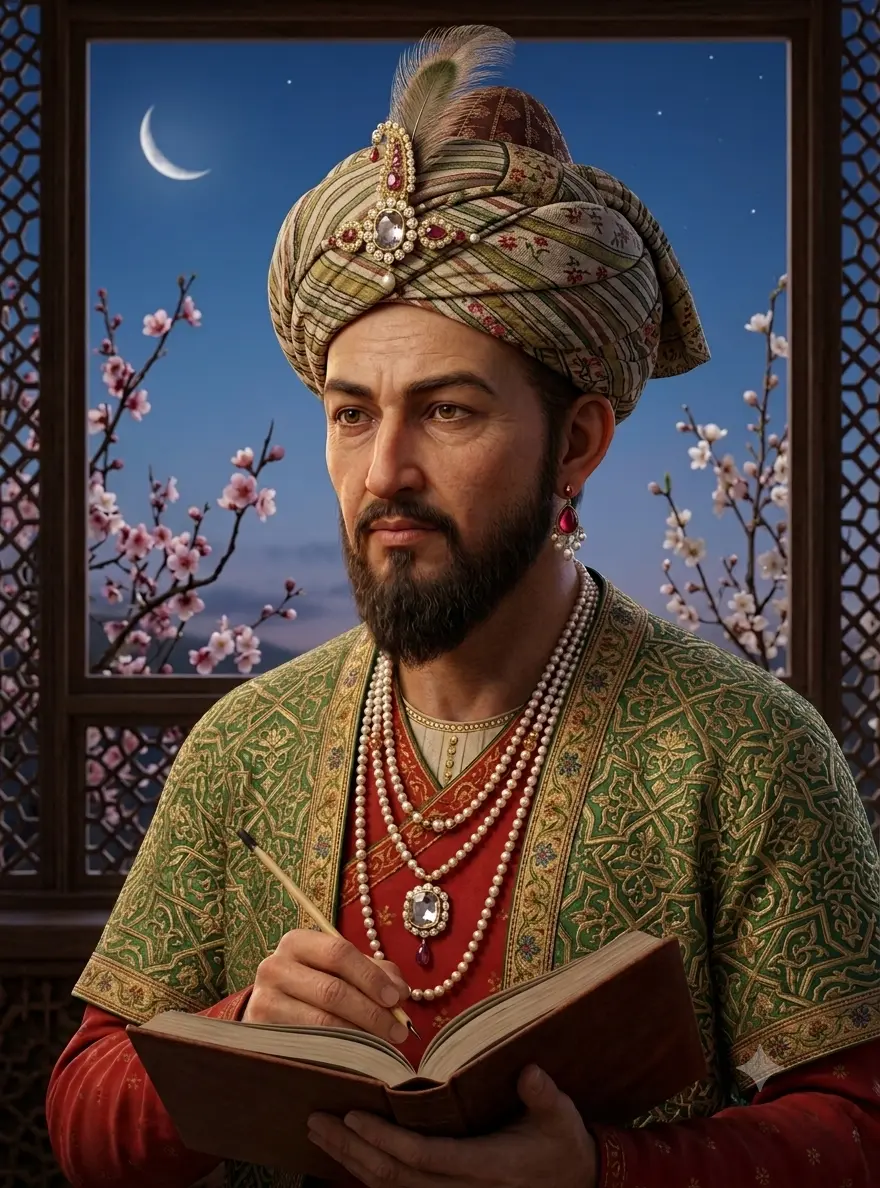
Babur (1483-1530), a Timurid prince who lost his Central Asian homeland, conquered Kabul, and founded the Mughal Empire in India after his victory at Panipat in 1526 — equally renowned as a warrior, poet, and memoirist whose Baburnama is a masterpiece of world literature.
Introduction
Zahir ud-Din Muhammad Babur (1483–1530 CE / 888–937 AH), known to history simply as Babur — "the Tiger" — stands as one of the most remarkable figures of the early modern Islamic world. A direct descendant of two of history's greatest conquerors, Timur (Tamerlane) on his father's side and Genghis Khan on his mother's, Babur united the martial traditions of the Turco-Mongol steppe with the refined literary culture of the Persian-speaking Timurid courts to forge a dynasty that would rule the Indian subcontinent for over three centuries. As the founder of the Mughal Empire, he initiated one of the most culturally brilliant and politically significant empires in world history — an empire that at its zenith would govern nearly a quarter of the world's population and produce architectural wonders, administrative innovations, and cultural achievements of enduring significance.
Yet Babur's historical importance extends far beyond his role as a dynastic founder. He was a man of extraordinary literary gifts whose autobiography, the Baburnama (also known as the Tuzuk-i-Baburi), is universally recognised as one of the finest memoirs ever composed in any language. Written in Chagatai Turkish — the literary language of the Central Asian Turkic peoples — the Baburnama reveals a personality of astonishing depth: a warrior who could describe the terror of battle with unflinching honesty, a naturalist who catalogued the flora and fauna of every region he traversed with scientific precision, a poet who composed verses of genuine beauty in both Turkish and Persian, and a man capable of profound emotional vulnerability in recording his griefs, failures, and longing for his lost homeland.
Babur's life trajectory reads as an epic of loss, perseverance, and ultimate triumph. Born a prince in the fertile Fergana Valley of Central Asia, he inherited a small kingdom at the age of eleven upon his father's sudden death. For nearly a decade thereafter, he struggled to claim the great prize of Samarkand — the legendary capital of his ancestor Timur — only to lose it repeatedly to the rising power of the Uzbek Shaybanids under Muhammad Shaybani Khan. By 1504, at the age of twenty-one, Babur had lost everything: his ancestral kingdom, his hopes of Central Asian dominion, and many of his closest companions. Yet rather than submit to obscurity, he turned southward, seized the strategic city of Kabul in Afghanistan, and began the patient construction of a new power base from which he would eventually launch his conquest of Hindustan.
The culmination of Babur's career came on 21 April 1526, when his small but disciplined army met and destroyed the vastly larger forces of Sultan Ibrahim Lodi at the First Battle of Panipat. This single engagement, decided in a few hours of concentrated violence, ended the Delhi Sultanate and established Mughal sovereignty over northern India. The following year, Babur consolidated his conquest by defeating the Rajput confederacy under Rana Sanga of Mewar at the Battle of Khanwa — a victory that extinguished the last serious indigenous challenge to Mughal rule. In barely four years of Indian campaigning, Babur had transformed himself from a dispossessed Central Asian prince into the master of one of the world's wealthiest regions.
Babur's significance in Islamic civilisational history is multifaceted. He represents the last flowering of the Timurid Empire tradition — that remarkable synthesis of Mongol military organisation, Turkic political authority, and Persian cultural refinement that had shaped Central Asia for over a century. He carried this tradition into India, where it would interact with indigenous Indian cultures to produce the distinctive Mughal civilisation. His gardens, laid out in the formal Persian chaharbagh (four-fold garden) style from Kabul to Agra, initiated a landscape tradition that would culminate in the Taj Mahal. His literary legacy, particularly the Baburnama, established a model of royal autobiography that his descendants would emulate. And his military innovations — particularly the effective combination of field artillery with cavalry tactics — transformed warfare across South Asia.
This article examines Babur's life comprehensively: his ancestry and the political world into which he was born; his turbulent youth in Central Asia; his establishment of power in Afghanistan; his conquest of India; his brief but consequential reign; his literary and cultural achievements; and his enduring legacy as the progenitor of one of history's greatest dynasties.
Ancestry and Early Life in Fergana
The Timurid-Chingizid Heritage
Babur's genealogy placed him at the intersection of two of the most powerful dynastic traditions in the history of Inner Asia. Through his father, Umar Shaikh Mirza II, the ruler of the Fergana Valley, Babur traced his descent through six generations to Amir Timur (1336–1405), the great Central Asian conqueror who had built an empire stretching from Anatolia to India. The Timurid lineage conferred upon Babur a claim to the vast territories once governed from Samarkand — a claim that, though politically contested, carried immense symbolic weight throughout the Persianate world. Timur's descendants, the Timurids, had transformed themselves from purely military conquerors into sophisticated patrons of Persian literature, Islamic architecture, miniature painting, and the sciences, creating one of the most culturally productive court traditions in Islamic history.
Through his mother, Qutlugh Nigar Khanum, Babur descended from Yunus Khan, the ruler of Moghulistan (the eastern Chagatai Khanate), and thereby traced his ancestry directly to Chagatai Khan, the second son of Genghis Khan (Chinggis Khan). This Chingizid lineage was of crucial political importance in the Central Asian context, where the tradition of legitimate sovereignty descending from Genghis Khan retained considerable force. The Chingizid connection gave Babur a dual legitimacy that few of his contemporaries could match — he was simultaneously a Timurid amir with a claim to imperial authority and a Chingizid prince with an ancestral right to rule. It was this dual heritage that later gave rise to the name "Mughal" (a corruption of "Mongol") applied to the dynasty Babur founded in India, even though Babur himself preferred to identify as a Timurid and wrote in Chagatai Turkish rather than Mongolian.
The Fergana Valley: Babur's Homeland
Babur was born on 14 February 1483 CE (6 Muharram 888 AH) in the city of Andijan, the principal city of the Fergana Valley in what is today eastern Uzbekistan. The Fergana Valley, nestled between the Tian Shan and Pamir-Alay mountain ranges in the heart of Central Asia, was one of the most fertile and strategically important regions along the ancient Silk Road. Irrigated by the Syr Darya (Jaxartes) river and its tributaries, the valley supported a prosperous agricultural population and served as a crossroads of trade between China, India, Persia, and the steppe.
In the Baburnama, Babur describes his homeland with evident affection: "Fergana is a small country, abounding in grain and fruits. It is girt round by mountains except on the west... It has seven separate townships." He catalogues its produce — grain, fruits, grapes, melons — with the detailed appreciation of a man who would spend much of his life far from home. The valley's modest size belied its importance; as a Timurid appanage, it represented one of the fractured pieces of Timur's once-vast empire, now divided among competing princes.
The Political Fragmentation of the Timurid World
The Central Asia into which Babur was born in 1483 bore little resemblance to the unified empire Timur had governed less than a century earlier. Following Timur's death in 1405, his vast domains had been progressively divided among his descendants in a pattern of fragmentation that was, in many respects, characteristic of Turco-Mongol political culture. By Babur's time, the Timurid realm had dissolved into numerous small and mutually hostile principalities, each ruled by a member of the extended Timurid family and each claiming varying degrees of legitimacy.
The most important of these fragments included: Samarkand, still regarded as the symbolic centre of Timurid power; Herat, which under Sultan Husayn Bayqara (r. 1469–1506) had become perhaps the most culturally brilliant city in the Islamic world; and numerous smaller appanages including Fergana, Tashkent, and others scattered across Transoxiana and Khorasan. This fragmentation created a political environment of endemic warfare, shifting alliances, and constant insecurity — an environment that would shape Babur's entire youth and young manhood.
Childhood and Early Education
Babur's early life was shaped by the twin imperatives of Timurid princely education and the harsh political realities of Central Asian power politics. As the eldest son of a ruling prince, he received training in the traditional arts expected of a Timurid nobleman: horsemanship, archery, swordsmanship, hunting, and the arts of war. Equally important was his literary and intellectual education. The Timurid courts were renowned centres of Persian literary culture, and Babur was schooled in Persian and Arabic, the literary and religious languages respectively of the Islamic world, as well as in his native Chagatai Turkish.
Babur's father, Umar Shaikh Mirza, was by his son's own account a man of moderate abilities — "short and stout, round-bearded and fleshy-faced," as Babur later described him with characteristic directness in the Baburnama. He was a restless and ambitious prince who spent much of his energy in unsuccessful attempts to expand his small domain, particularly toward Samarkand. Despite these limitations, Umar Shaikh maintained a court that exposed the young Babur to poetry, music, and the refined social culture of the Timurid elite.
Accession to the Throne (1494)
Babur's childhood ended abruptly on 8 June 1494 (5 Ramadan 899 AH), when his father died in a bizarre accident — the edge of his pigeon house, built on a cliff overlooking the ravine below his fortress in Akhsi, collapsed beneath him, and Umar Shaikh fell to his death along with his pigeons and their house. Babur, then only eleven years old, suddenly found himself the ruler of Fergana.
The young prince's position was immediately precarious. Timurid succession was not governed by primogeniture; rather, any male member of the dynasty might press a claim to any territory he could take by force. Babur's uncles — Sultan Ahmad Mirza of Samarkand and Mahmud Khan of Tashkent — both cast covetous eyes on Fergana. Within the valley itself, various amirs and courtiers had their own ambitions. As Babur later wrote with remarkable understatement: "At that date I had neither experience nor judgement; no plan of action, no power to execute."
Yet the young prince possessed qualities that would serve him well throughout a life of constant adversity: physical courage, personal charisma, and an instinctive understanding of the loyalties and self-interest of those around him. With the support of several key advisors and military commanders loyal to his father's memory, Babur weathered the immediate crisis of succession and established his rule over the Fergana Valley. He would hold it — with interruptions — for nearly a decade, though his attention was increasingly drawn toward the glittering prize of Samarkand to the west.
The political education Babur received in these early years was brutal but effective. He learned the transactional nature of loyalty in Timurid politics, where amirs shifted their allegiance based on calculations of advantage; the importance of personal presence and martial display in maintaining authority; and the constant necessity of vigilance against both external aggression and internal treachery. These lessons, painfully acquired, would prove essential in his later career.
The Struggle for Samarkand
The Lure of Timur's Capital
Samarkand — the city Timur had made the jewel of his empire, adorning it with the Registan, the Bibi-Khanum mosque, and the Gur-e Amir mausoleum — exercised an irresistible pull on every Timurid prince. For Babur, the city represented not merely territory but identity: to rule from Samarkand was to be the true heir of Timur, the rightful head of the Timurid house. This aspiration dominated the first decade of his independent rule and led him into three separate campaigns for the city, each ending in bitter disappointment.
The First Attempt (1497)
Babur's first opportunity came in 1497, when he was just fourteen years old. His uncle Sultan Ahmad Mirza had died in 1494, and Samarkand had passed to Sultan Ahmad's son, Sultan Mahmud Mirza, whose weak rule invited challenge. Babur gathered his forces — a modest army numbering perhaps a few thousand — and marched on the city. After a siege of seven months, during which his small force endured considerable hardship, Babur entered Samarkand in triumph. He was barely fifteen years old and had achieved what his father never could.
Yet triumph proved fleeting. Babur's soldiers, weary from the long siege and disappointed by the lack of plunder (the city's wealth had largely been dispersed), began to desert. Simultaneously, news reached him that his absence had encouraged rebellion in Fergana — his nobles had placed his younger brother Jahangir on the throne. Babur found himself in the classic dilemma of the Timurid prince: he could hold Samarkand or Fergana, but not both. Within a hundred days of his entry into Samarkand, he was forced to abandon the city and march back to recover his homeland. He arrived to find that he had lost Fergana as well. As he wrote in the Baburnama with painful honesty: "I went towards Khodjend, having lost both Samarkand and Fergana."
The young prince was now, at the age of fifteen, a ruler without a realm — a situation that would have broken many men but that only hardened Babur's determination. After months of desperate manoeuvring, he managed to recover Fergana with the help of loyal supporters, but the experience left deep marks. He had learned that the capture of a city was one thing; holding it quite another.
The Rise of Muhammad Shaybani Khan
The political landscape of Central Asia was being transformed during these years by the emergence of a formidable new power: the Uzbek confederation under Muhammad Shaybani Khan (1451–1510). The Uzbeks were a Turkic-Mongol people who had been consolidating their strength in the steppe regions north of the Syr Darya for generations. Under the dynamic and ruthless leadership of Shaybani Khan — himself a descendant of Genghis Khan through Jochi, the eldest son — the Uzbeks began a systematic campaign to seize the Timurid territories of Transoxiana.
Shaybani Khan was everything the fractious and increasingly effete Timurid princes were not: disciplined, strategically far-sighted, and commanding a large and fiercely loyal tribal army. He exploited the divisions among the Timurids with devastating effectiveness, playing one prince against another while steadily expanding his own domain. By the late 1490s, it was becoming clear that the age of Timurid dominion in Central Asia was drawing to a close, and that Shaybani Khan intended to replace it with Uzbek supremacy.
The Second Attempt (1500)
In 1500, Babur made his second attempt on Samarkand. This time, circumstances seemed more favourable: Shaybani Khan was temporarily distracted by campaigns elsewhere, and Babur had rebuilt his forces and his network of alliances. He took the city relatively easily and was received with enthusiasm by the population, who preferred a Timurid prince to Uzbek overlordship.
But Babur's resources remained painfully thin. He could not pay his troops adequately, his administration lacked the depth to control the surrounding countryside effectively, and Shaybani Khan was already turning his attention back toward Samarkand. The young Timurid prince held the city for barely a few months before Shaybani Khan's vastly superior forces closed in. By 1501, Babur was besieged within Samarkand, his supplies dwindling and his garrison melting away through desertion.
The end came in the spring of 1501. Babur was forced to evacuate the city, fighting his way out through Shaybani Khan's encircling forces. The retreat was desperate — Babur himself narrowly escaped capture on several occasions. He lost horses, equipment, and many followers. The account in the Baburnama is characteristically vivid: Babur describes hiding in gardens, going without food, and relying on the loyalty of a handful of companions to survive.
The Loss of Fergana and Years of Wandering (1501–1504)
The fall of Samarkand in 1501 was not merely a military setback; it marked the effective end of Timurid power in Transoxiana. Shaybani Khan proceeded to consolidate his control over the entire region, systematically eliminating the remaining Timurid principalities. Fergana itself fell to the Uzbeks, and Babur found himself not merely dispossessed of Samarkand but homeless entirely.
The period from 1501 to 1504 represents the nadir of Babur's fortunes. He wandered through the mountains and valleys of the borderlands between Transoxiana and Afghanistan, accompanied by a diminishing band of loyal followers, seeking allies and opportunities that rarely materialised. He was reduced to dependence on the charity of various rulers and tribal chiefs — a humiliation for a prince of his lineage. During this period, he made a brief and unsuccessful third attempt on Samarkand (1502), which ended in failure almost immediately.
The Baburnama records these years with extraordinary emotional honesty. Babur describes the shame of poverty, the cold of mountain winters without adequate shelter, the grief of watching companions die or drift away, and the constant temptation to abandon hope. Yet alongside these accounts of suffering, the memoir also reveals the qualities that would eventually bring Babur success: his refusal to accept permanent defeat, his ability to inspire loyalty in those who remained with him, and his capacity for clear strategic thinking even in the most desperate circumstances.
The Timurid Catastrophe
Babur's personal reverses were part of a much larger historical process: the definitive end of Timurid political power in Central Asia. By 1507, when Shaybani Khan conquered Herat — the last great Timurid capital, famous for its incomparable artistic and literary culture under Sultan Husayn Bayqara — the Timurid era in its homeland was effectively over. The cultural achievements of the Timurid courts — the miniature painting of Bihzad, the poetry of Jami and Navai, the architectural splendours of Herat and Samarkand — would continue to influence the Islamic world for centuries, but their political context had been destroyed.
Babur was among the few Timurid princes who survived this catastrophe with their ambitions intact. While many of his cousins and kinsmen submitted to Uzbek rule, retired into obscurity, or perished in the fighting, Babur alone found a way to rebuild his fortunes and, ultimately, to establish a new Timurid empire elsewhere. His success was not inevitable — it required a combination of strategic vision, personal resilience, and favourable circumstance — but it was rooted in the hard lessons of these years of loss and wandering.
The Conquest of Kabul (1504)
Seizing Opportunity
By 1504, Babur had reached a critical juncture. His prospects of recovering Samarkand or Fergana were effectively nil — Shaybani Khan's grip on Transoxiana was too firm to challenge with the meagre resources at Babur's disposal. Yet the ambitious prince was unwilling to accept the fate of a dependent exile. His attention turned southward, toward the mountainous territories of what is now Afghanistan, where political fragmentation offered opportunity.
Kabul, the principal city of eastern Afghanistan, was at this time in the hands of the infant Mukim Mirza, a minor Timurid prince whose regents governed poorly and whose position was contested by various Afghan tribal leaders. The city's strategic importance was considerable: it controlled the mountain passes leading both northward into Central Asia and southeastward through the Khyber Pass into the plains of Hindustan. It was also a prosperous trading centre, situated on the routes connecting Persia, Central Asia, and India.
In the autumn of 1504, Babur marched on Kabul with a force of perhaps two thousand men — a tiny army, but one hardened by years of campaigning and absolutely loyal to their prince. The city fell with surprisingly little resistance. Mukim Mirza's supporters proved unwilling to fight, and the population of Kabul accepted the change of regime with equanimity. At the age of twenty-one, Babur had found a new kingdom.
Building a Base
The conquest of Kabul transformed Babur's situation fundamentally. After years of homeless wandering, he now possessed a defensible territory, a revenue base, and a strategic position from which multiple future directions of expansion were possible. He devoted the next two decades to consolidating his hold on Afghanistan and its surrounding regions, building the administrative and military structures necessary for larger enterprises, and gradually extending his influence both westward toward Kandahar and eastward toward Hindustan.
Kabul itself became an object of deep affection for Babur. The Baburnama contains extended descriptions of the city and its surroundings that reveal genuine love for the place. Babur praised its climate ("in the whole habitable world there is no country so pleasant"), its fruits (he catalogued varieties of grapes, melons, and other produce with botanical precision), and its strategic position. He laid out gardens in the Persian chaharbagh style that would become his trademark — formal gardens with flowing water, geometric plantings, and elevated terraces from which to survey the landscape. The Bagh-e Babur (Babur's Garden) in Kabul survives to this day and eventually became his chosen burial place.
Raids into Hindustan
From Kabul, Babur could look southeastward toward the vast, wealthy plains of Hindustan — the Indian subcontinent — whose riches had drawn conquerors since the time of Alexander the Great. The region was accessible through the mountain passes of the Hindu Kush and the Sulaiman Range, particularly the historic Khyber Pass. Babur began launching raids across the frontier from an early date, testing the defences of the territories beyond and familiarising himself with the geography, peoples, and political conditions of northwestern India.
These early incursions into Hindustan were primarily plundering expeditions rather than attempts at conquest. They served to enrich Babur's treasury, reward his followers with booty, and maintain the morale of his army. But they also served a deeper strategic purpose: each raid added to Babur's knowledge of Indian conditions and his understanding of the military and political weaknesses of the ruling powers there. The Baburnama records careful observations about Indian roads, rivers, fortifications, armies, and political relationships — intelligence that would prove invaluable when Babur finally launched his full-scale invasion.
Consolidation and the Shaybani Khan Episode
Babur's position in Kabul was not without challenges. He faced periodic rebellions from Afghan tribal leaders resentful of his authority, threats from rivals both within his own family and from external powers, and the constant need to maintain a credible military force on limited revenues. In 1510, a dramatic change in the regional balance of power occurred when Shah Ismail I of Persia, the founder of the Safavid dynasty, defeated and killed Muhammad Shaybani Khan at the Battle of Merv. This momentarily opened the possibility of a return to Central Asia, and Babur briefly recovered Samarkand in 1511 with Safavid assistance.
However, this fourth occupation of Samarkand proved even more ephemeral than the previous ones. Babur's alliance with the Shi'a Safavids made him unpopular with the predominantly Sunni population of Transoxiana, and when the Uzbeks regrouped and counterattacked, Babur's support evaporated. He was defeated at the Battle of Ghijduvan in 1512 and forced to retreat permanently to Kabul. This final failure in Central Asia convinced Babur that his future lay not in recovering his ancestral homeland but in conquering new territories to the south. Hindustan would be his prize.
The Invasion of India and the Battle of Panipat (1526)
The Political Situation in Hindustan
By the early 1520s, northern India was governed by the Lodi dynasty of the Delhi Sultanate — Afghan in origin, based in Delhi and Agra, and ruling over a vast but politically fractured domain. Sultan Ibrahim Lodi (r. 1517–1526), the last of his line, was by most accounts an autocratic and unpopular ruler whose harsh treatment of his own nobles had created widespread disaffection. Several of the most powerful Afghan amirs of Hindustan were in open or covert revolt, and the once-formidable military machine of the Delhi Sultanate had deteriorated significantly.
Crucially, it was disaffected elements within Ibrahim Lodi's own nobility who provided Babur with both the pretext and the intelligence for invasion. Daulat Khan Lodi, the governor of the Punjab and one of the most powerful nobles in the sultanate, sent messages to Babur inviting him to intervene in Indian affairs — a calculated gamble aimed at replacing Ibrahim Lodi with a more compliant ruler, though Daulat Khan could scarcely have imagined that Babur intended to keep Hindustan for himself.
Rana Sanga of Mewar, the most powerful Rajput ruler in India, also apparently communicated with Babur, perhaps hoping that a Mughal invasion would weaken the Delhi Sultanate and allow Rajput expansion. This proved to be a catastrophic miscalculation: within a year of defeating Ibrahim Lodi, Babur would turn his forces against Rana Sanga himself.
The Five Expeditions
Babur's conquest of India was not achieved in a single dramatic campaign but developed through a series of increasingly ambitious expeditions launched from Kabul over a period of several years. Between 1519 and 1524, Babur led four preliminary incursions across the frontier, each probing deeper into Indian territory and each testing different aspects of the military and political landscape. These expeditions secured control over Bhira, Sialkot, and eventually Lahore — the great city of the Punjab — creating a forward base for the decisive invasion.
The first expedition of 1519 brought Babur across the Indus for the first time and secured the frontier town of Bhira. The second (1519–1520) extended control over the tribal areas. The third and fourth expeditions (1520–1524) progressively brought the Punjab under Babur's influence, though the cooperation of Daulat Khan Lodi proved unreliable. By 1525, Babur had decided on a full-scale invasion — not merely a raid or a frontier adjustment, but a campaign aimed at the destruction of the Lodi sultanate and the seizure of all northern India.
The March to Panipat
In November 1525, Babur crossed the Indus with his main army — a force that, by his own account in the Baburnama, numbered approximately 12,000 men. This was a remarkably small force for the enterprise it contemplated. Ibrahim Lodi could theoretically call upon 100,000 soldiers and 1,000 war elephants — numbers that, even allowing for considerable exaggeration, dwarfed Babur's army many times over. Babur was aware of the disparity and recorded his army's nervousness in the Baburnama: "All the soldiers and people who had gone with me were downhearted and spiritless... No one was in a condition to advance a useful opinion."
The march from Lahore to the vicinity of Delhi took several months, during which Babur carefully gathered intelligence about Ibrahim Lodi's dispositions and preparations. By early April 1526, the two armies were approaching each other in the region of Panipat, approximately 90 kilometres north of Delhi on the historic Grand Trunk Road. The ground was flat and open — ideal for the massed cavalry charges that were the standard tactical mode of Indian armies.
Babur's Tactical Preparations
Babur's genius as a military commander lay in his ability to combine different military traditions into a coherent tactical system that his opponents had never encountered. For the Battle of Panipat, he devised an innovative defensive-offensive plan that drew on Central Asian cavalry tactics, Ottoman siege technology, and his own hard-won battlefield experience.
The centrepiece of Babur's tactical plan was the creation of a fortified position linking together some 700 carts (arabas) with chains and ropes, behind which his matchlock men (tufangchiyan) and field guns (cannons, operated by the Ottoman expert Ustad Ali Quli) could fire on the enemy from protected positions. This technique — using chained wagons as a field fortification — may have been inspired by Ottoman practices, and its employment in India was entirely novel. Between every two carts, Babur placed breastworks (mantlets) behind which five or six men could shelter and fire.
On either flank, Babur deployed his cavalry in the traditional Mongol tulughma formation — a flanking tactic in which wings of mounted warriors swept around the enemy's flanks and rear while the centre held firm. This combination of static firepower in the centre with mobile striking power on the flanks created a tactical trap: an enemy attacking the centre would be channelled into a killing zone while simultaneously being enveloped from the sides and rear.
The Battle of Panipat (21 April 1526)
The battle was joined on the morning of 21 April 1526 (8 Rajab 932 AH). Ibrahim Lodi's army advanced toward Babur's position in a massive but poorly coordinated frontal attack, relying on sheer weight of numbers and the shock effect of war elephants. The Lodi forces expected to overwhelm the small Mughal army through a direct assault — the standard Indian tactical approach of the period.
What they encountered was something entirely different. As Ibrahim Lodi's vanguard pressed forward, it found itself channelled into the narrow gaps between Babur's chained carts. The concentrated matchlock and artillery fire from behind the cart fortification caused devastating casualties among the tightly packed attackers. The noise and smoke of the gunpowder weapons panicked the war elephants, which turned back into their own infantry, causing chaos and confusion.
Simultaneously, Babur's flanking cavalry swung into action on both wings, executing the tulughma with practised precision. The Lodi army, already disordered by the firepower from the centre, now found itself being attacked from three sides. The pressure from the flanks drove the Indian forces inward upon themselves, creating a crush in which men could barely move, let alone fight effectively. Ibrahim Lodi's numerical superiority became a liability as his own troops obstructed one another.
By midday, the battle was decided. Ibrahim Lodi himself was killed in the fighting — possibly in a final desperate charge toward the Mughal centre — along with thousands of his soldiers. The Lodi army disintegrated, its survivors fleeing in all directions. Babur recorded the outcome with characteristic precision: "By the grace and mercy of Almighty God, this difficult affair was made easy to us. In one half-day, that armed host was laid in the dust."
The Significance of Panipat
The First Battle of Panipat was one of the decisive engagements in Indian history. In a single morning, it destroyed the Delhi Sultanate, a political entity that had governed northern India in various forms for over three centuries. It established Mughal rule over the subcontinent — a rule that would endure, in progressively attenuated form, until 1857. And it demonstrated the revolutionary potential of gunpowder weapons in Indian warfare, inaugurating a military transformation that would reshape the subcontinent's political landscape over the following century.
For Babur personally, Panipat represented the vindication of decades of struggle. The dispossessed prince who had wandered the mountains of Central Asia with a handful of followers was now the master of one of the world's wealthiest empires. He immediately occupied Delhi and Agra, seizing the treasures of the Lodi sultans and distributing them with legendary generosity among his followers. The Baburnama records that "every man of the army, small and great, bondsman and free, received his share of the spoil."
Consolidation of Power and the Battle of Khanwa (1527)
The Mughal Position After Panipat
Victory at Panipat gave Babur control of Delhi and Agra — the political and symbolic centres of northern India — but it did not give him India. The subcontinent was home to numerous independent or semi-independent powers, many of whom viewed the Mughal newcomers as temporary raiders who would soon return to their Central Asian homeland, as previous invaders had done. The most serious challenge came from the Rajput kingdoms of western India, united under the formidable leadership of Rana Sanga (Sangram Singh) of Mewar.
Rana Sanga was perhaps the most powerful Hindu ruler in India at this time. He commanded a vast confederacy of Rajput chieftains — warriors from clans with centuries of martial tradition — and his forces significantly outnumbered Babur's. Rana Sanga had already demonstrated his military prowess in numerous campaigns against the Lodi sultans, and he had apparently anticipated that Babur's invasion would create an opportunity for Rajput expansion into the territories formerly controlled by Delhi.
The Crisis of Morale
The months following Panipat were difficult for Babur's army. The Indian climate — the searing heat of the north Indian summer — oppressed men accustomed to the cool highlands of Afghanistan and Central Asia. Many of Babur's soldiers and officers openly expressed their desire to return home, considering the conquest complete once the Lodi treasury had been distributed. The Baburnama records the depth of disaffection: "Everyone, from royal princes and amirs down to the lowest soldier, wished to return to Kabul."
The approach of Rana Sanga's enormous army — reportedly numbering over 100,000 men with 500 war elephants — intensified this crisis. Babur's officers reminded him that even the mighty Sultan Mahmud of Ghazni, who had raided India seventeen times, had always returned to Afghanistan rather than attempting permanent conquest. The implication was clear: Babur should take his treasure and withdraw while he still could.
Babur's Response: The Vow of Abstinence
Babur's response to this crisis of morale was one of the most dramatic episodes in his career. Recognising that his army needed spiritual as well as material motivation, he publicly vowed to abstain from wine — a sacrifice of real significance for a man who, by his own frank admission, was deeply attached to drinking. He ordered all wine vessels broken and all stocks of liquor poured out. He also declared the campaign against the Rajputs to be a jihad — a holy war in defence of Islam — thereby invoking religious duty as a motivation for his troops.
The effect was galvanic. Babur's public repentance and declaration of holy war transformed the mood of his army. Officers who had been counselling retreat now competed to declare their readiness to fight. The Baburnama preserves Babur's stirring address to his troops: "Let us with one heart and one determination raise this sword in the name of Islam against these infidels." Whether this was pure cynicism, genuine religious feeling, or a mixture of both has been debated by historians, but its political effectiveness was undeniable.
The Battle of Khanwa (16 March 1527)
The two armies met at Khanwa, about 60 kilometres west of Agra, on 16 March 1527 (5 Rajab 933 AH). Babur employed essentially the same tactical system that had proved so effective at Panipat: a central fortified position with chained carts, matchlocks, and artillery, flanked by mobile cavalry wings prepared to execute the tulughma envelopment.
Rana Sanga's forces launched repeated and ferocious attacks on the Mughal centre. The Rajput warriors, renowned for their individual courage and willingness to fight to the death, pressed their charges with desperate valour. Several assaults reached the cart line and there was heavy fighting at close quarters. Unlike the Lodi army at Panipat, the Rajput forces fought with sustained determination for hours, making Khanwa a far harder and bloodier engagement.
Yet the result was ultimately the same. The concentrated firepower of Babur's guns and matchlocks, combined with the enveloping movements of his cavalry, gradually ground down the Rajput attacks. By late afternoon, the Rajput forces began to waver. When Rana Sanga himself was wounded and carried from the field, resistance collapsed. The Rajput confederacy broke and fled, suffering enormous casualties in the pursuit.
The Significance of Khanwa
The Battle of Khanwa was arguably more important than Panipat for the establishment of Mughal rule in India. Panipat had destroyed the Delhi Sultanate — already a weakened and unpopular regime — but Khanwa broke the power of the Rajput confederacy, which represented the most formidable indigenous military force in northern India. After Khanwa, no Indian power possessed the strength to challenge Mughal supremacy in the Gangetic plain and its surrounding regions.
The battle also demonstrated that the Mughal tactical system was effective not merely against the poorly led and poorly motivated Lodi forces but against the best warriors India could field. The combination of gunpowder weapons with traditional cavalry tactics had proved its superiority over the older Indian mode of warfare, which relied primarily on massed cavalry charges, war elephants, and individual martial prowess. This military revolution would be consolidated and extended by Babur's successors, particularly his grandson Akbar.
Following Khanwa, Babur assumed the title of Ghazi (warrior for the faith), a title he valued highly and which appears on his coins and in official documents thereafter. Whatever the complex motivations behind his declaration of jihad, the victory at Khanwa provided the religious legitimation that reinforced his secular authority as conqueror.
Administration and Governance
The Challenges of a Short Reign
Babur's reign as emperor of Hindustan lasted barely four years — from the Battle of Panipat in April 1526 to his death in December 1530. This brevity, combined with the constant necessity of military campaigning to consolidate his conquest, severely limited the administrative achievements of his rule. Unlike his grandson Akbar, who would have nearly fifty years to develop sophisticated systems of governance, Babur had neither the time nor the stability to create lasting institutional structures. His governance was necessarily provisional, opportunistic, and focused primarily on maintaining military control.
Revenue and Fiscal Administration
The revenue system Babur inherited from the Lodi sultans was based on the iqta (assignment) system common throughout the medieval Islamic world, in which military officers received the right to collect revenue from designated territories in exchange for maintaining a specified number of troops. Babur largely maintained this system, lacking both the time and the administrative personnel to replace it with anything more centralised. He assigned territories to his principal amirs and officers, expecting them to maintain order, collect revenue, and provide military forces when called upon.
The distribution of the conquered territories revealed the fundamental tension in Babur's position: he needed to reward his followers generously enough to maintain their loyalty, but the revenues of northern India, though enormous by Central Asian standards, were not unlimited. Many of his Central Asian followers received assignments far from the centres of power and found the Indian climate, customs, and conditions deeply uncongenial. The Baburnama records frequent complaints from these men, who longed for the cooler highlands of Afghanistan and resented their posting to what they considered a barbarous land.
Babur himself was characteristically frank about the financial difficulties of his reign. He noted that the revenues of Hindustan, while vast in aggregate, were difficult to collect effectively given the limited administrative apparatus at his disposal and the uncertain loyalty of many Indian officials who had served the previous regime. He attempted to maintain some continuity by retaining experienced Indian administrators in subordinate positions, but the senior ranks of government were necessarily filled by his own Central Asian and Afghan followers.
Relations with Indian Society
Babur's relationship with the Indian society he now ruled was complex and often uncomfortable. As a Central Asian Timurid, he was profoundly a product of a different civilisation — one centred on the Persian literary tradition, Turco-Mongol political culture, and the physical landscape of mountains and highlands rather than the hot, flat plains of Hindustan. The Baburnama contains passages that reveal both his discomfort with Indian conditions and his genuine curiosity about Indian society and culture.
His famous assessment of India — often cited and sometimes taken out of context — reveals this ambivalence: "Hindustan is a country of few charms... The people are not handsome... There are no good horses, no good dogs, no grapes, muskmelons or first-rate fruits, no ice or cold water, no good bread or cooked food in the bazaars, no hot baths, no candles, torches or candlesticks." Yet he also acknowledged the wealth, productive capacity, and skilled craftsmanship of Indian civilisation, and he made genuine efforts to understand and accommodate his new subjects.
Governance Philosophy and Personal Rule
Babur's approach to governance was fundamentally personal rather than institutional. He ruled through direct relationships with his principal amirs and officers, relying on bonds of loyalty, shared history, and mutual obligation rather than on bureaucratic structures or formal administrative procedures. This mode of government was characteristic of the Timurid and Turco-Mongol political tradition from which he came — a tradition in which the ruler's personal qualities, his generosity, his martial prowess, and his ability to inspire devotion were the primary instruments of power.
The Baburnama reveals Babur as an attentive and often hands-on ruler who personally supervised military planning, directed construction projects, adjudicated disputes among his officers, and concerned himself with details of administration that a more settled monarch might have delegated. His famous generosity — the distribution of the entire Lodi treasury after Panipat without retaining any significant portion for himself — served both as an expression of personal character and as a calculated political act, binding his followers to him through gratitude and demonstrating the Timurid princely ideal of liberality.
Yet Babur also recognised the limitations of purely personal rule. He was aware that the administrative systems he inherited from the Lodi sultans were more developed in certain respects than what he could immediately replace them with, and he made pragmatic decisions to retain Indian officials and existing administrative practices where doing so served the stability of his new regime. This combination of personal authority with selective institutional continuity would become a characteristic feature of early Mughal governance, developed more fully under his successors.
Military Consolidation
The final years of Babur's reign were dominated by military campaigns to extend and consolidate Mughal control. After Khanwa, significant portions of northern India remained outside Mughal authority. The eastern regions — Bihar and Bengal — were controlled by the Afghan Lodi remnants under Mahmud Lodi, Ibrahim's brother, who represented a continuing threat. Various Rajput chieftains in Rajasthan and Malwa remained unconquered, and the sultanates of Gujarat and the Deccan viewed Mughal expansion with concern.
In 1528, Babur conducted a campaign against the fortress of Chanderi in central India, held by the Rajput chieftain Medini Rai. The siege demonstrated both the effectiveness of Mughal military technology — Babur's guns breached the walls — and the ferocious determination of Rajput resistance. According to the Baburnama, the defenders performed jauhar (mass self-immolation by the women) and fought to the last man rather than surrender. The fall of Chanderi extended Mughal influence into central India and sent a powerful message to other recalcitrant chieftains.
In 1529, Babur led his most ambitious campaign eastward, culminating in the Battle of Ghaghra, where the combined forces of the Afghans under Mahmud Lodi and the Sultan of Bengal, Nusrat Shah, were defeated on the banks of the river Ghaghra (Gogra) near its confluence with the Ganges. The battle involved a river crossing under fire — a difficult military operation that tested Babur's tactical ingenuity — and resulted in the dispersal of the last organised Afghan force in northern India.
This victory, though less celebrated than Panipat or Khanwa, was significant in extending Mughal authority into eastern India and eliminating the most dangerous remaining challenge to the new dynasty. It demonstrated that Babur's power was not confined to the Delhi-Agra region but could project force across the entire breadth of the Indo-Gangetic plain. The campaign also revealed the continued effectiveness of Babur's combined-arms tactical system against Indian forces. By the end of 1529, Babur's empire extended from Kabul in the west to the borders of Bengal in the east — a vast domain, though one still imperfectly controlled and dependent on military supremacy for its cohesion.
The Baburnama: A Literary Masterpiece
Origins and Nature of the Work
The Baburnama (Babur-nameh, literally "Book of Babur" or "Letters of Babur") is Babur's autobiography, written in Chagatai Turkish (also called Eastern or Central Asian Turkish), the literary language of the Turkic peoples of Central Asia. It is at once a personal diary, a military memoir, a geographical and natural-historical survey, and a work of considerable literary art. Composed intermittently over the last three decades of Babur's life, it covers the period from his accession to the throne of Fergana in 1494 to the final years of his Indian reign, though with significant gaps (most notably the years 1508–1519, for which the relevant sections have been lost).
The work belongs to a Central Asian literary tradition of royal and princely autobiography that included the memoirs of Timur himself (though these are of disputed authenticity). However, the Baburnama transcends this genre through the extraordinary frankness, self-awareness, and literary quality of its author. Where other royal memoirists tend toward self-glorification or propaganda, Babur writes with a candour that has no real parallel in medieval memoir literature. He records his own failures, doubts, and weaknesses alongside his triumphs; he admits to fear, grief, and indecision; and he judges others — including powerful allies and kinsmen — with an unsentimental precision that makes the Baburnama an unusually reliable historical source.
Literary Quality and Style
The literary quality of the Baburnama has been recognised by virtually every scholar who has studied it. The Orientalist Stanley Lane-Poole described it as "one of those priceless records which are for all time, and which can never be superseded by later writers." The historian Stephen Dale considers it "the most intimate and complete autobiography in Islamic literature." The work's prose style is direct, vigorous, and economical — qualities that reflect both Babur's personality and the literary traditions of Chagatai Turkish, which favoured clarity and concreteness over the elaborate ornamentation common in Persian literary prose.
Babur's descriptive powers are particularly notable. His accounts of landscapes, cities, gardens, animals, fruits, and people combine accuracy of observation with a vividness that brings his world to life across the centuries. When he describes the Fergana Valley, the mountains of Afghanistan, or the plains of India, the reader sees these places through the eyes of a man who observed them with scientific precision and responded to them with genuine aesthetic feeling. His descriptions of individuals — physical appearance, character, abilities, and failings — are equally acute, creating a gallery of portraits that illuminates the social and political world of fifteenth- and sixteenth-century Central and South Asia.
Observations of Nature and Geography
One of the most remarkable aspects of the Baburnama is the attention Babur pays to the natural world. He catalogues the flora and fauna of every region he passes through with the systematic interest of a naturalist, describing plants, animals, birds, fish, fruits, and geological formations in careful detail. His descriptions of Indian wildlife — rhinoceroses, elephants, parrots, monkeys — have the freshness of genuine first-hand observation, unmediated by literary convention.
Babur's geographical descriptions are equally valuable. He provides detailed accounts of the topography, climate, water sources, and agricultural potential of regions from the Fergana Valley to the plains of the Ganges. These descriptions served a practical military and administrative purpose — a conqueror needed to know the land he was conquering — but they also reflect a genuine intellectual curiosity about the physical world. Modern scholars have used the Baburnama as a historical ecological document, reconstructing the environmental conditions of sixteenth-century Central and South Asia from Babur's precise observations.
Historical Value
As a historical source, the Baburnama is invaluable. It provides an eyewitness account of a crucial period of transition in both Central Asian and South Asian history — the end of the Timurid era, the rise of Uzbek power, and the establishment of Mughal rule in India. Because Babur participated directly in the events he describes and wrote with remarkable honesty, the Baburnama is generally considered one of the most reliable sources for the political, military, and social history of the period.
The work also preserves information about topics that no other source records: the daily life of a Timurid prince, the mechanics of Central Asian politics, the experience of military campaigning in the early gunpowder era, the social customs of various peoples encountered during Babur's wanderings, and the physical geography of regions that would change significantly in subsequent centuries. For historians of the early Mughal Empire, the Baburnama is an indispensable primary source — the foundation upon which all subsequent scholarship must build.
Transmission and Translation
The Baburnama was widely copied and read in the Mughal world. Babur's grandson, the Emperor Akbar, commissioned a Persian translation by Abdul Rahim Khan-i-Khanan, which became the standard text through which most subsequent readers (including later Mughal emperors) encountered the work. The original Chagatai Turkish text survived in several manuscript copies, the most important being the so-called Haidarabad Codex and the Kehr manuscript.
European scholars became aware of the Baburnama in the nineteenth century, and several translations appeared: John Leyden and William Erskine produced an English translation from the Persian version in 1826, while Annette Beveridge published a direct translation from the Chagatai Turkish original in 1922. The most accessible modern English translation is that of Wheeler Thackston (1996, revised 2002), which combines scholarly rigour with readability.
Babur as Poet and Cultural Figure
The Chagatai Turkish Literary Tradition
Babur's literary achievements extended far beyond the Baburnama. He was a accomplished poet in the Chagatai Turkish literary tradition — a tradition that had reached its zenith under the great poet Ali-Shir Nava'i (1441–1501), whom Babur knew by reputation and admired deeply. Chagatai Turkish (also known as Old Uzbek or Eastern Turkic) was the primary literary language of the Turkic peoples of Central Asia, and its poetic tradition, while drawing heavily on Persian models and conventions, possessed distinctive qualities of directness, emotional intensity, and musicality.
Babur composed a substantial body of poetry in Chagatai Turkish, much of which survives in collected form (his divan or collected poems). His verses cover the conventional range of Turkic and Persian poetic themes — love, wine, nature, the transience of life, religious devotion — but are distinguished by the same qualities of directness and personal feeling that characterise the Baburnama. His ghazals (lyric poems) in particular have been praised for their musicality and emotional sincerity, qualities that set them apart from the more elaborate and conventional poetry of many of his contemporaries.
Persian Compositions
In addition to his Chagatai Turkish poetry, Babur composed verses in Persian — the prestige literary language of the Islamic world from Anatolia to India. His Persian poetry, while competent, is generally considered less distinguished than his Turkish verse — a judgement that reflects both the different character of Persian poetic convention and the fact that Persian was Babur's second literary language rather than his native tongue. Nevertheless, his facility in Persian reflects the bilingual literary culture of the Timurid courts, where both languages coexisted as vehicles of artistic expression.
Babur also composed a work on Turkic prosody (Mubayin) — a technical treatise on the rules of versification in Chagatai Turkish — which demonstrates his scholarly interest in the formal structures of poetry as well as his practical skill as a poet. Additionally, he wrote a versified summary of Islamic jurisprudence according to the Hanafi school, reflecting his religious education and piety.
Gardens and the Love of Nature
Perhaps the most visible expression of Babur's cultural sensibility was his passion for gardens. Wherever he established residence — in Kabul, in Agra, in other Indian cities — Babur created formal gardens in the Persian chaharbagh tradition: symmetrical designs divided by water channels into four quadrants, planted with trees, flowers, and fruit-bearing plants, and equipped with pavilions, terraces, and running water. These gardens were not merely aesthetic indulgences; in the Timurid tradition, they served as settings for courtly entertainment, political ceremony, and social gathering — the physical spaces in which the life of the court was conducted.
In India, Babur found the existing garden traditions inadequate to his standards and immediately set about creating new gardens according to his own principles. The Baburnama records his efforts in Agra: "I always thought that one of the chief defects of Hindustan was that there was no running water... Prompted by these considerations, I had the garden of the Hasht-Bihisht [Eight Paradises] made." These gardens — the Ram Bagh, the Zahra Bagh, and others — introduced the formal Persian garden to India and initiated a tradition that would culminate in the great Mughal gardens of the sixteenth and seventeenth centuries, including the gardens of the Taj Mahal.
The garden tradition established by Babur had profound cultural significance. It represented the transplantation of Central Asian aesthetic values to Indian soil — the creation of controlled, ordered, beautiful spaces that embodied the Timurid ideal of civilised life in contrast to the disordered natural landscape. For Babur, who so acutely felt the contrast between the cool, mountainous landscapes of his homeland and the hot plains of India, these gardens served as reminders of the world he had lost and as assertions of the cultural identity he refused to surrender.
The Mughal Cultural Legacy
Babur's cultural interests — his poetry, his love of nature, his garden design, his patronage of literature and the arts — established patterns that would be continued and elaborated by his descendants over the following two centuries. The Mughal Empire would become one of the most culturally productive dynasties in Islamic history, producing architectural masterpieces, sophisticated miniature painting traditions, literary works of enduring value, and a distinctive synthesis of Central Asian, Persian, and Indian cultural elements. While Babur himself did not live long enough to see this cultural flowering reach its full development, he planted the seeds — both literally and metaphorically — from which it grew.
Character and Personality
Honesty and Self-Awareness
The most striking quality of Babur's character, as revealed in the Baburnama, is his extraordinary honesty — both about himself and about others. In an age when royal chronicles were typically exercises in propaganda and self-glorification, Babur wrote with a candour that still surprises modern readers. He admits freely to his own failures, weaknesses, and mistakes. He records episodes of cowardice alongside acts of courage, moments of poor judgement alongside displays of strategic brilliance, and personal failings alongside personal virtues.
This honesty extended to his assessment of others. Babur's character sketches of the people he encountered — rulers, warriors, poets, servants, enemies — are noted for their precision and fairness. He could acknowledge the qualities of his enemies (praising Muhammad Shaybani Khan's abilities even while detesting him) and criticise the failings of his friends and allies without malice. This quality makes the Baburnama an unusually trustworthy source for the character and abilities of the numerous individuals who pass through its pages.
Physical Courage and Martial Spirit
Babur was a man of exceptional physical courage who repeatedly risked his life in combat and who seems to have genuinely enjoyed the challenge and danger of warfare. The Baburnama contains numerous accounts of personal combat, narrow escapes, and feats of physical endurance that, while they cannot all be independently verified, are consistent with the persona revealed throughout the text and corroborated by the general trajectory of his career.
He was also an outstanding athlete and swimmer. The Baburnama records with evident pride that he swam across every river he encountered — including the Ganges — and that he once swam the Ganges without stopping, "kicking along." His physical robustness is also attested by his capacity for sustained campaigning in extreme conditions — mountain warfare in the Afghan winter, cavalry operations in the Indian summer — that would have broken lesser constitutions.
The Love of Wine and the Vow of Abstinence
One of the most humanising aspects of Babur's self-portrait is his frank account of his drinking habits. He describes with evident relish the drinking parties (majlis) that were a central feature of Timurid court life — evenings of wine, poetry, music, and fellowship that could extend through the night and into the following day. He records the varieties of wine and spirits he consumed, the occasions on which he drank to excess, and the consequences of overindulgence.
Yet he also records his periodic attempts at self-reform, culminating in the famous vow of abstinence before the Battle of Khanwa in 1527. This renunciation — undertaken publicly, with the dramatic gesture of pouring out all his wine and breaking the vessels — was motivated by a combination of religious scruple, military necessity, and perhaps genuine self-disgust at the extent of his dependence. Babur appears to have maintained this vow for the remainder of his life, though the Baburnama suggests it was not without difficulty.
Loyalty, Friendship, and Emotion
The Baburnama reveals a man of deep emotional attachments who valued loyalty and friendship intensely. Babur repeatedly records his grief at the deaths of companions, his joy at reunions with old friends, and his outrage at betrayals of trust. These are not conventional rhetorical gestures but expressions of genuine feeling, recorded with the same directness that characterises all of Babur's self-portrayal.
His relationships with his family — his wives, his children, his sisters, his mother — are recorded with considerable tenderness. His devotion to his eldest son Humayun, his anxiety when Humayun fell ill, and his prayers for his children's welfare reveal a devoted father beneath the exterior of the conqueror. The famous story of Babur's death — that he offered his own life in exchange for the recovery of the critically ill Humayun, walking seven times around his son's sickbed in prayer, after which Humayun recovered and Babur sickened and died — while probably legendary in its details, reflects a genuine perception of Babur's character by those who knew him.
Nostalgia and Loss
A thread of melancholy runs through the Baburnama — the grief of a man perpetually separated from the places and people he loved. Babur's longing for the Fergana Valley and for Samarkand, cities he lost in his youth, is a recurring theme. Even after his triumph in India, he writes of his homeland with undiminished affection, contrasting the beauties of Central Asia with what he perceived as the deficiencies of India. This nostalgia was not merely personal but civilisational — a longing for the entire Timurid cultural world that had been destroyed by the Uzbek conquest.
The depth of this feeling is evident in Babur's expressed wish to be buried in Kabul rather than in India — a wish that was eventually fulfilled when his body was exhumed and transported to the Bagh-e Babur some years after his death. Even in death, Babur preferred the mountain city that had been his refuge during the darkest years of his life to the wealthy but uncongenial plains of Hindustan.
Death and Legacy
Final Illness and Death
In the autumn of 1530, Babur's health began to decline rapidly. He had been suffering from various ailments for some time — the accumulated toll of decades of campaigning, hard living, and the Indian climate he found so oppressive. The exact nature of his final illness is uncertain; various sources suggest fever, dysentery, or a combination of afflictions. He died on 26 December 1530 (5 Jumada al-Awwal 937 AH) in Agra, at the age of forty-seven. His reign as emperor of Hindustan had lasted just four years, seven months, and five days.
The tradition surrounding Babur's death is deeply embedded in Mughal historical memory. According to the most widely circulated account, Babur's beloved son Humayun fell gravely ill in late 1530, and Babur was told by his courtiers that only the sacrifice of the emperor's most precious possession could save the prince. While his advisors suggested that his most valuable possession was the Koh-i-Noor diamond (recently acquired from the Gwalior treasury), Babur declared that his own life was the most precious thing he possessed and offered it in exchange for his son's recovery. He is said to have circumambulated Humayun's sickbed several times in prayer, after which Humayun's condition began to improve while Babur's deteriorated.
Whether this account is historically accurate or represents a later embellishment, it captured something essential about Babur's character as perceived by his contemporaries and descendants: his capacity for self-sacrifice, his devotion to his family, and his willingness to act on deep personal conviction regardless of practical consequences.
Burial and Final Rest
Babur was initially buried in Agra, in one of the gardens he had created along the banks of the Yamuna River. However, in accordance with his expressed wish to be laid to rest in Kabul — the city he had loved best among all his conquests — his remains were later transferred to the Bagh-e Babur (Babur's Garden) in Kabul. The exact date of this transfer is debated by historians; it likely occurred during the 1540s, during the period when Babur's son Humayun was temporarily exiled from India and resident in Kabul.
The Bagh-e Babur remains one of Kabul's most important historical sites. Babur's grave, simple and open to the sky in accordance with his own preference for simplicity, sits on a terrace overlooking the garden he designed and the city he ruled. A marble mosque was added to the site by the Emperor Shah Jahan in 1640, and the garden has been restored multiple times, most recently in the early twenty-first century with the assistance of the Aga Khan Trust for Culture. The site embodies, in its combination of natural beauty, architectural restraint, and historical significance, something essential about Babur's own aesthetic and character.
Assessment as a Historical Figure
Babur's historical significance operates on multiple levels. As a military figure, he was one of the outstanding commanders of his age — a tactician capable of decisive innovation (the use of firearms and field fortifications at Panipat), a strategist who understood the importance of logistics, intelligence, and political preparation, and a leader who could inspire exceptional loyalty and effort from his followers. His military achievements, accomplished with consistently inferior numbers and limited resources, bear comparison with any in the early modern period.
As a political figure, Babur's legacy is inseparable from the dynasty he founded. The Mughal Empire that grew from his Indian conquest would become one of the largest, wealthiest, and most culturally productive states in world history. His successors — Humayun, Akbar, Jahangir, Shah Jahan, and Aurangzeb — would develop the political, administrative, and cultural structures of the empire to extraordinary heights. While Babur himself had neither the time nor the opportunity to create these structures, he provided the essential foundation: military control of northern India, the Timurid cultural tradition that would inform Mughal civilisation, and the dynastic legitimacy that his descendants would invoke for generations.
As a cultural figure, Babur represents the last great flowering of the Central Asian Timurid tradition and its successful transplantation to South Asian soil. His poetry, his gardens, his literary sensibility, and his personal refinement established models that his descendants would elaborate and transform. The cultural synthesis that defines the Mughal Empire — the fusion of Central Asian, Persian, and Indian elements into a distinctive civilisation — begins with Babur's own person, in which these diverse traditions were already combined.
The Dynasty After Babur
Babur's immediate successor, his son Humayun (r. 1530–1540, 1555–1556), struggled to maintain the conquests his father had won. Lacking Babur's military genius and political instinct, Humayun proved unable to hold together the fragile empire his father had bequeathed him. Driven from India by the Afghan Sher Shah Suri in 1540, Humayun spent fifteen years in exile — first in Sindh, then in Persia at the Safavid court — before recovering his throne with Safavid assistance in 1555, only to die from a fall down his library steps the following year. The parallels with Babur's own experience of dispossession and recovery were noted by contemporaries, though Humayun's exile was longer and his recovery less complete.
The true consolidation of Mughal power was achieved by Babur's grandson Akbar (r. 1556–1605), whose long and brilliant reign transformed the Mughal state from a military conquest into a stable, sophisticated, and culturally magnificent empire. Akbar developed the administrative structures — particularly the mansabdari system and the revenue reforms of his finance minister Todar Mal — that gave institutional substance to the personal rule Babur had exercised. He extended Mughal territory to encompass most of the Indian subcontinent and created a court culture that synthesised Central Asian, Persian, and Indian elements into a distinctive civilisational achievement.
Yet Akbar and all subsequent Mughal emperors looked back to Babur as the founder — the man whose courage, persistence, and vision had created the possibility of everything that followed. The Baburnama was read, copied, translated, and revered as the foundational text of the dynasty's self-understanding. Akbar commissioned its translation into Persian precisely because he wished to make his grandfather's voice accessible to a wider court audience. Babur's gardens were maintained and expanded by subsequent generations. His tomb in Kabul was honoured and embellished. And his example — of the warrior-poet, the cultured conqueror, the prince who combined martial prowess with literary refinement — remained the ideal to which Mughal rulers aspired across two centuries of imperial rule.
Historical Judgement
Modern historians have generally assessed Babur with considerable admiration, though perspectives differ regarding different aspects of his career. As a military commander, he is recognised as innovative and effective, particularly in his early adoption and skilful deployment of gunpowder weapons — a tactical revolution that transformed South Asian warfare. As an administrator, his record is necessarily incomplete given the brevity of his Indian reign, though he demonstrated pragmatism and awareness of the challenges facing his new state. As a cultural figure, he is universally acknowledged as exceptional — a genuine polymath whose literary gifts alone would have secured his historical reputation even without his military achievements.
The most debated aspect of Babur's legacy concerns his declaration of jihad before Khanwa and the extent to which religious motivation genuinely informed his Indian campaigns. Some historians have emphasised the pragmatic and political dimensions of this declaration, noting that Babur showed no particular religious hostility in his treatment of Hindu subjects or in his earlier career. Others have argued that Babur's religious identity was genuinely important to him and that his claim to ghazi status represented a sincere element of his self-understanding. The truth likely lies in the complexity of human motivation — religious and political impulses were not mutually exclusive in Babur's world, and his actions probably reflected elements of both sincere faith and calculated politics.
Conclusion
Zahir ud-Din Muhammad Babur stands among the most remarkable figures of the early modern Islamic world — a man whose life encompassed extraordinary extremes of fortune, from princely inheritance to homeless exile to imperial triumph, and whose personality combined martial courage with literary genius, political shrewdness with emotional depth, and worldly ambition with genuine religious feeling. His conquest of northern India in 1526 inaugurated one of history's greatest dynasties, while his autobiography, the Baburnama, remains one of the finest works of memoir literature in any language.
Babur's significance extends beyond his individual achievements to encompass his role as a cultural bridge between Central Asia and South Asia. He carried the refined Timurid tradition — with its poetry, its gardens, its architectural sensibility, and its emphasis on cultured kingship — from its dying homeland in Transoxiana to the vast stage of the Indian subcontinent, where it would interact with indigenous traditions to produce the magnificent synthesis of Mughal civilisation. In this sense, Babur was not merely a conqueror but a culture-bearer, transplanting an entire civilisational tradition to new soil where it would flourish for centuries.
The story of Babur's life also carries a universal human resonance that transcends its specific historical context. It is the story of a man who lost everything — homeland, heritage, companions, certainties — and rebuilt his life through persistence, adaptability, and an unbroken will. The dispossessed prince who wandered the mountains of Central Asia with a handful of followers, yet never abandoned his belief that he was destined for greatness, speaks to something enduring in the human experience. That he recorded this journey with such unflinching honesty — admitting his fears, failures, and doubts alongside his triumphs — makes his story not merely historically significant but genuinely moving.
Babur died at forty-seven, far from the homeland he loved, having spent barely four years in the Indian empire he had fought his entire life to win. Yet in those four years, and in the decades of struggle that preceded them, he laid the foundations for three centuries of Mughal rule and produced a literary masterpiece that ensures his voice — direct, vivid, honest, and unmistakably human — continues to speak across the five centuries that separate his world from ours.
References and Further Reading
Primary Islamic Sources
- Babur, Zahir ud-Din Muhammad. Baburnama (Memoirs of Babur), composed c. 1494–1529 in Chagatai Turkish — the primary source for Babur's life, campaigns, and personal observations
- Gulbadan Begum. Humayun-nama (History of Humayun), c. 1587 — memoir by Babur's daughter providing family context and details of Babur's final years
- Khwandamir, Ghiyath al-Din. Qanun-i-Humayuni (Laws of Humayun), c. 1534 — contains accounts of Babur's court and governance during the Indian period
- Mirza Haydar Dughlat. Tarikh-i-Rashidi, c. 1546 — Central Asian history with extensive material on Babur's early career and the political context of Timurid decline
- Abu'l-Fazl ibn Mubarak. Akbarnama, c. 1590 — contains retrospective accounts of Babur's reign as context for the history of his grandson Akbar's rule
Classical Islamic Sources
- Ibn Arabshah, Ahmad. Aja'ib al-Maqdur fi Nawa'ib Timur (Wonders of Destiny Concerning the Calamities of Timur), 15th century CE — essential context for Timurid dynastic history and Babur's ancestral legacy
- Nizam al-Din Ahmad. Tabaqat-i-Akbari, c. 1593 — comprehensive history of Muslim India including detailed account of Babur's conquest
- Abd al-Qadir Bada'uni. Muntakhab al-Tawarikh, c. 1595 — provides additional perspectives on early Mughal governance and Babur's legacy
- Firishta (Muhammad Qasim Hindu Shah). Tarikh-i-Firishta (Gulshan-i-Ibrahim), c. 1612 — major synthesis of Indo-Islamic history including Babur's campaigns
- Khwaja Ni'matullah Harawi. Tarikh-i-Khan Jahani, c. 1612 — Afghan perspective on the political landscape Babur encountered in India
Academic and Scholarly Sources
- Dale, Stephen F. The Garden of the Eight Paradises: Babur and the Culture of Empire in Central Asia, Afghanistan and India. Leiden: Brill, 2004.
- Richards, John F. The Mughal Empire. The New Cambridge History of India, vol. I.5. Cambridge: Cambridge University Press, 1993.
- Thackston, Wheeler M. The Baburnama: Memoirs of Babur, Prince and Emperor. New York: Modern Library, 2002.
- Beveridge, Annette S. The Babur-nama in English (Memoirs of Babur). London: Luzac & Co., 1922. Reprinted Delhi: Low Price Publications, 1989.
- Manz, Beatrice Forbes. The Rise and Rule of Tamerlane. Cambridge: Cambridge University Press, 1989.
- Streusand, Douglas E. The Formation of the Mughal Empire. Delhi: Oxford University Press, 1989.
- Lal, Ruby. Domesticity and Power in the Early Mughal World. Cambridge: Cambridge University Press, 2005.
- Schimmel, Annemarie. The Empire of the Great Mughals: History, Art and Culture. London: Reaktion Books, 2004.
- Eraly, Abraham. Emperors of the Peacock Throne: The Saga of the Great Mughals. London: Penguin, 2000.
Further Reading
- Foltz, Richard. Mughal India and Central Asia. Karachi: Oxford University Press, 1998.
- Moorcroft, William and Trebeck, George. Travels in the Himalayan Provinces of Hindustan and the Panjab. London, 1841 — contains early European observations of Mughal-era sites
- Wescoat, James L. and Wolschke-Bulmahn, Joachim (eds.). Mughal Gardens: Sources, Places, Representations, and Prospects. Washington, DC: Dumbarton Oaks, 1996.
- Anooshahr, Ali. The Ghazi Sultans and the Frontiers of Islam: A Comparative Study of the Late Medieval and Early Modern Periods. London: Routledge, 2009.
- Faruqui, Munis D. The Princes of the Mughal Empire, 1504–1719. Cambridge: Cambridge University Press, 2012.
Mentioned In
17 articles reference this topic
and 5 more articles
More from Mughal Empire
Taj Mahal - Monument to Eternal Love
The Taj Mahal (1632-1653 CE) is an ivory-white marble mausoleum built by Mughal Emperor Shah Jahan in memory of his wife Mumtaz Mahal. Located in Agra, India, this masterpiece blends Persian, Islamic, and Indian architectural traditions, representing the pinnacle of Mughal achievement.
The Mughal Empire: Three Centuries of Islamic Rule in the Indian Subcontinent
The Mughal Empire (1526-1857) ruled most of the Indian subcontinent for three centuries, from Babur's victory at Panipat to the deposition of Bahadur Shah Zafar. At its height it was among the wealthiest and most populous states in the world.
Humayun: The Emperor Who Lost and Regained an Empire
Humayun (1508-1556), the second Mughal emperor, inherited Babur's unconsolidated conquests in 1530, lost them to Sher Shah Suri by 1540, spent some fifteen years in exile including refuge with the Safavids, and recovered Delhi in 1555 months before his death.
Akbar Shah II: A Mughal Emperor Without an Empire
Akbar Shah II (r. 1806-1837) was the penultimate Mughal emperor, holding a Delhi court that kept its ceremonial and literary life while the East India Company reduced its standing and revenue. He tried for thirty years to make Mirza Jahangir his heir instead of the future Bahadur Shah Zafar.