Akbar: The Third Mughal Emperor
Akbar (r. 1556-1605) turned the Mughal foothold in India into an empire of fifteen provinces. He rebuilt the central government, created the mansabdari service and the dah-sala revenue settlement, abolished the jizya, and pursued a religious policy his contemporaries judged very differently.
Abu'l-Fath Jalal al-Din Muhammad Akbar was the third emperor of the Mughal Empire and reigned for forty-nine years, from 1556 to 1605. He inherited a claim rather than a state. The Encyclopaedia of Islam puts the position plainly: there was no Mughal empire before Akbar, only an attempt to create one. By the time he died the empire ran in fifteen provinces from Kabul to Bengal and from Kashmir to the northern Deccan, governed through an administrative system that outlasted him by a century and a half.
Three things occupied the reign. The first was conquest, carried out steadily over four decades and recorded province by province. The second was government: a reorganisation of the central offices in 1564, a ranked imperial service in which civil and military officers held the same grades, and a revenue settlement reached only after two failed experiments. The third, and the most argued over both at the time and since, was religion — the debates at the Ibadat Khana, the declaration of 1579 that made him the arbiter of religious questions in his realm, the abolition of the jizya, the doctrine of sulh-i kull, and the Din-i Ilahi.
His court produced two chroniclers who disagreed about almost everything. Abu'l-Fazl Allami wrote the official Akbarnama and the Ain-i Akbari, the administrative survey that remains the fullest description of any pre-modern Indian state. Abd al-Qadir Bada'uni, appointed an imam by Akbar himself and employed on the emperor's translation programme, wrote the Muntakhab al-Tawarikh in private and was severe about much of what he had seen. The reign is unusually well documented precisely because these two men were in the same rooms and drew opposite conclusions, and no account of Akbar can be written without weighing one against the other.
The Mughal Position in 1556
Babur had taken Delhi and Agra in 1526, but the conquest did not hold. His son Humayun lost northern India to Sher Shah Suri, whose administration and road-building the later Mughals inherited and built upon, and spent thirteen years in exile, much of it in Safavid Persia. Only as Sur power declined did he attempt the reconquest of Hindustan, and he had accomplished little of it before his death.
What Akbar received in 1556 was therefore a recent and partial recovery: Kabul, the Punjab, Delhi and Agra, with Sur claimants still in the field, Afghan commanders unsubdued, and the greater part of the subcontinent outside Mughal authority altogether.
Birth and Childhood
Akbar was born at Umarkot in Sind while his father was in flight towards Persia, having been driven out by Sher Shah. The Encyclopaedia of Islam gives the date as 15 October 1542; the TDV İslâm Ansiklopedisi gives 4 Rajab 949, which it converts to 14 October 1542. His mother was Hamida Banu, whom the Encyclopaedia of Islam describes as a Persian and the TDV entry as of Iranian origin. Through Babur he was, in the Encyclopaedia of Islam's description, both a Timurid Turk and a Chaghatay Mongol.
His childhood was shaped by his father's misfortunes. During Humayun's failed attempt to recover Kabul from his brother Kamran the infant passed into the hands of another brother, Askari. Humayun then went on to Persia, where Shah Tahmasp received him and gave military help; with that help he recovered Kabul, and when the successors of Sher Shah fell to quarrelling he returned to Agra.
Education
Akbar was taught by Mir Abdullatif, of a sayyid family of Qazvin. The TDV entry records that despite this instruction, and despite being highly intelligent, he took no interest whatever in reading and writing, and was drawn instead to the fine arts, to soldiering and to leadership; but that he distinguished himself as an intelligent and forceful personality in the assemblies of scholars, men of letters and Sufis. The Encyclopaedia of Islam likewise records that he was illiterate, and in the same sentence that he was genuinely interested in the study of religions.
His tutor left a mark of another kind. The TDV entry credits Mir Abdullatif with impressing on him the idea of friendship and coexistence in peace, resting on mutual forbearance between different religions, sects and races — that is, sulh-i kull.
In 1555, while Humayun was recovering lost territory, Akbar commanded in the field: sent against Sikandar Sur, who had attacked to retake the fort of Sirhind, the army under his command won a substantial victory. Once Afghan power in the Punjab and Agra was broken, Humayun appointed him governor of the Punjab with Bayram Khan as his atabeg.
Accession
Humayun's Death
Humayun died on 24 January 1556. Akbar was thirteen, and away in the field. The TDV entry records that on the advice of the Ottoman naval commander Seydi Ali Reis, who was then in Delhi, the death was concealed for a time; Akbar reached Delhi twenty days later and ascended the throne on 3 Rabi' II 963, 15 February 1556, as Jalal al-Din Akbar Shah.
His authority extended over Kabul, the Punjab, Delhi and Agra. Sikandar Sur was active on one side, and on the other a group of Afghan commanders together with the Hindu general Hemu.
The Second Battle of Panipat
Hemu, formerly minister to Muhammad Adil Sur, had assumed the title Raja Vikramaditya and was campaigning on his own account. In the first year of the reign he took Delhi. His forces were broken at Panipat on 5 November 1556, in the battle fought by Bayram Khan, and he lost the city again. The following year Sikandar Sur surrendered. The year after that the Sayyids of Bara entered Mughal service.
The Regency and Fall of Bayram Khan
Akbar's early survival owed much to Bayram Khan, whom the Encyclopaedia of Islam calls his able guardian and regent. In October 1560 Akbar removed him from his offices and sent him on the pilgrimage; the TDV entry records that Bayram Khan was killed by Afghans while passing through Patan in Gujarat.
The four years that followed were not years of personal rule. The Encyclopaedia of Islam records that authority was contested between the ladies of the household and a faction built around his foster relatives, whom the Muslim historians of the period call the atga khayl. Both that work and the TDV entry date his effective personal rule from 1564.
The Expansion of the Empire
The Position in 1561
The Encyclopaedia of Islam sets out what Akbar held and what he did not. His kingdom comprised the Punjab and Multan; the Ganges–Jumna basin between Panipat and Allahabad; the country between the Gumti and the Himalayan foothills; Gwalior in central India; and Ajmer in Rajputana. Kabul was held by his half-brother Muhammad Hakim, and Kandahar belonged to Persia.
Outside his dominions lay the Muslim states of Gujarat and Khandesh; the five Deccani sultanates of Berar, Bidar, Ahmadnagar, Bijapur and Golconda; south of the Tungabhadra the Hindu empire of Vijayanagar; Kashmir, Rajputana and Gondwana under independent chiefs and rajas; Bihar and Bengal acknowledging the Afghan ruler Sulayman Kararani; and the Portuguese established at points along the coast.
The Annexations
Between 1562 and 1576 he added Malwa (1562), the Gond kingdom of Garha-Katanga in Gondwana (1564), Chitor (1568), Ranthambhor (1569), Kalanjar in Bundelkhand (1569), and Gujarat (1573). The annexation of Bengal in 1576 made him master of the whole of northern India apart from lower Sind.
Later additions were Kashmir (1586), Sind (1591), part of Orissa (1592), Baluchistan and Makran (1594), and Kandahar (1595).
The eastern campaigns were not uninterrupted. The Encyclopaedia of Islam records a rebellion in which the Kakshals proclaimed Akbar's younger brother Muhammad Hakim, the ruler of Kabul, as their sovereign; Muhammad Hakim marched on Hindustan, was repulsed, and made his submission, after which the eastern rebels were put down gradually by Akbar's generals.
The Deccan
The Deccan campaigns brought Berar, Khandesh and part of Ahmadnagar under Mughal authority between 1595 and 1601. The TDV entry records that the Faruqi rulers of Berar and Khandesh, who had grown strong in the Deccan after the Tughluqs passed from the scene, first established friendly relations with Akbar and so reigned a while longer. The same entry judges that by subduing the neighbouring states Akbar became the first ruler to bring India under a single central administration.
The Empire at His Death
At his death in 1605 the empire comprised fifteen subas: Kabul, including Kashmir; Lahore; Multan, including Sind; Delhi; Oudh; Agra; Ajmer; Ahmadabad; Malwa; Allahabad; Bihar; Bengal; Khandesh; Berar; and Ahmadnagar, which the Encyclopaedia of Islam notes was not fully subjugated.
The Rajput Settlement
In 1562 Raja Bhar Mal of Amber submitted to Akbar and gave him his daughter in marriage. The TDV entry treats this as the point at which Rajput influence established itself at the Mughal court, and draws out two consequences: that it opened office in the Mughal state to non-Muslims, Rajputs above all, and that it led to Hindus being employed at court in greater numbers than men of Central Asian origin.
This was a structural change rather than a gesture. It gave the dynasty a body of service families with an interest in its survival, and it altered the composition of the ruling group for the rest of the empire's history.
Government
The Encyclopaedia of Islam records that Akbar was not merely a conqueror, and that the structure of both his central and his provincial government testifies to his administrative capacity. It also observes that his ideas can be traced back to his immediate predecessors, the Sur Afghans and the sultans of Delhi, and that the chief lesson he drew from their history was the danger of an unlimited wazirate.
The Reorganisation of 1564
In 1564 the central government was reorganised by transferring the financial functions of the wakil-i mutlaq to the diwan or wazir. From that point the power of the wakil was eclipsed by that of the diwan, and the office was further diminished by being left vacant for long periods.
The Great Offices
Three other offices stood at the centre.
The mir bakhshi was the administrative head of the military department. The Encyclopaedia of Islam notes the difficulty of defining the post — it has been rendered as Paymaster-General and as Adjutant-General, but the work suggests Quartermaster-General as the closer equivalent. He was responsible for transport arrangements on campaign and could be given command of an army in the field. Under Akbar's separation of functions he paid the troops only on active service; normally that was the diwan's work.
The mir saman had charge of the buyutat department and was responsible for the kar-khanas — the workshops, factories and stores the emperor maintained.
The sadr al-sudur was the chief spokesman of the ulama, chief qadi, and head of the judiciary. In the early part of the reign the office carried extraordinary powers: his reading of the khutba in a new sovereign's name legalised the accession, and he recommended deserving cases to the emperor for madad-i ma'ash grants. The Encyclopaedia of Islam corrects a common statement here, noting that it is incorrect to assert that Akbar abolished this office in 1581: six provincial sadrs were appointed, but the office of sadr al-sudur continued, shorn of its former exceptional powers.
The Mansabdari System
All important officials, civil and military alike, were graded as amirs or mansabdars on a military basis. They were divided into thirty-three classes, and rank and precedence were fixed by nominal commands of horse ranging from ten to five thousand. The Encyclopaedia of Islam records that there was evidently some connection between an officer's rank and the number of troops he kept, but that the exact meaning of the paired terms zat and sawar is controversial.
The TDV entry describes the same reform from its own angle and identifies two changes as decisive: that Akbar took the promotion and appointment of military officers into his own hands, and that he abolished the inherited distinction between military and civil service by giving civil officers the rank of mansabdar too, so that both held rank and authority in proportion to the cavalry assigned to them.
The Provinces
Provincial government mirrored the centre. The subas were divided into sarkars, and these into parganas or mahalls, the lowest fiscal unit in the empire.
The Encyclopaedia of Islam is explicit about the purpose of the arrangements: distance and poor communications required elaborate precautions against fraud and rebellion, and the provincial governor was kept a bureaucratic head and not allowed to develop into a feudal baron. His tenure was deliberately short, and important provincial officers — the diwan, and the faujdar who was executive head of a sarkar — were appointed by the central government rather than by him. An elaborate reporting system operated alongside, carried on by the waqi'a nuwis and other officials.
The TDV entry records the same design: beside the subadar Akbar placed a civil officer who checked the annual yield, prepared the accounts, and reported directly to the emperor; and to guard against abuse of that office he established a confidential intelligence service.
In 1583, according to the TDV entry, he set up departments to handle judicial penalties, the registration of marriages and births, religious affairs, the assignment of jagirs and of gifts, appointments and dismissals on crown lands, the development of agriculture, the organisation and allowances of the army, the management of camps and halting places, the regulation of prices, dealings in precious metals and stones, inheritance questions, and legal business.
The Branding of Horses
The TDV entry records that Akbar put the branding system on a sound footing, something earlier sultans had failed to do. By establishing the true number of horses each soldier was obliged to maintain he stopped the drawing of allowances for horses that did not exist, and so secured a substantial sum for the treasury.
Revenue
The Encyclopaedia of Islam records that Akbar's revenue policy was the outcome of three experiments. Each adopted a different set of assessment rules, but in all three the assessment rested on the area actually sown and varied with the crop. The first two failed. Not until the twenty-fourth regnal year, 1579–80, was a stable system introduced.
This was the dah-sala settlement, so called because the assessment was based on the average of the previous ten years. An attempt was made to deal directly with the peasants, who paid one-third of their gross produce to the state. The Encyclopaedia of Islam notes its limits: it was enforced only in the six central provinces that formed the original nucleus of the empire.
Religion and the State
This is the most argued-over part of the reign, and the sources do not speak with one voice. What follows separates what they agree on from what they do not; the disagreements themselves are set out in the Historiographical Note.
The Encyclopaedia of Islam states at the outset that Akbar's religious policy was chiefly dictated by political and dynastic considerations, that the measures described below were aimed at securing the loyalty of his non-Muslim subjects, who formed the bulk of the population, and that the policy was also bound up with his conception of sovereignty and asserted the supremacy of the state in political, economic and financial matters.
The Ibadat Khana
In 983 AH, 1575, Akbar built a house of debate at Fatehpur Sikri, the seat of his court. The Encyclopaedia of Islam's Supplement records that he brought Muslim theologians together there to discuss their differences with a view to resolving them, and that he was himself present at many of the sessions.
Bada'uni, who was there, gives the physical origin. Akbar had the cell of Shaykh Abdullah Niyazi Sirhindi repaired and built a spacious hall on all four sides of it, and finished the tank called Anuptalao; he named the cell the Ibadat-khana, the house of worship. He adds that the name degenerated in common speech into Iyadat-khana — the house of visiting the sick — and that Mulla Sheri composed a satirical verse on the building.
On Bada'uni's account the early sessions were a Muslim affair: after Friday prayers the emperor would come and hold a meeting in the building, and shaykhs, ulama, pious men and a few of his own companions and attendants were the only people invited, discussion ranging over instructive and useful topics.
The Widening of the Debate
Two things then happened. The Encyclopaedia of Islam's Supplement records that it emerged in the course of the discussions that Muslim orthodoxy was divided not merely on details but on principles; and that Akbar then enlarged the scope of the debate by inviting non-Muslim divines, so that Hindus, Christians and Parsis could set out the articles of their belief.
Bada'uni's account of the temper of the assemblies is that of a participant. He records that the ulama quarrelled so noisily that the emperor told him to report any who talked nonsense and could not behave, and that when he replied to Asaf Khan that carrying out the order would empty the hall of most of the ulama, Akbar was highly pleased and repeated the remark to those sitting near him. He also records that Akbar used to summon Makhdum al-Mulk Mawlana Abdullah Sultanpuri to the assembly in order to provoke him.
The Mahzar of 1579
The TDV entry gives the sequence. Those around Akbar pressed on him the argument that it was not fitting for a just imam such as he to follow the mujtahids, since the rank of the just imam stood above theirs. On 12 Rabi' I 987, 9 May 1579, at a mawlid ceremony, Akbar went up into the pulpit of the great mosque at Fatehpur Sikri and read a versified khutba composed by Faizi which raised him to a divine station. The TDV entry records that this provoked a reaction among Muslims, and that Shaykh Mubarak Nagawri then drew up the document presenting Akbar in the style sultan al-Islam, kahf al-anam, amir al-mu'minin, zillullah ala al-alamin.
This document is the mahzar, which the Encyclopaedia of Islam calls the so-called Infallibility Decree of 1579 and describes as the means by which Akbar curbed the powers of the ulama and was recognised as the chief authority in the realm on religious matters. The Supplement's assessment of its reception is blunt: the high claims the theologians set out for Akbar did not win much support among Muslims.
Shaykh Mubarak Nagawri was the father of both Abu'l-Fazl and Faizi. The Encyclopaedia of Islam describes him and his son Abu'l-Fazl as exponents at Akbar's court of a more liberal and eirenic view of the place of Islam in India than that held by the rigorist ulama who opposed Akbar's religious policies.
Sulh-i Kull
The Encyclopaedia of Islam devotes a separate entry to sulh-i kull and calls it the central principle in the religious thought of Akbar and of his counsellor Abu'l-Fazl, apparently developed under the influence of Ibn Arabi. The term is rendered as absolute or universal peace, and the entry explains it as a station that recognises diversity and calls on a man to be benevolent to all. By 989 AH, 1581, the doctrine was dominant at Akbar's court.
The entry cites the Akbarnama for the position Akbar reached in 1000 AH, 1591, when he declared it incumbent on sovereigns and administrators to keep sulh-i kull with all the world and its inhabitants. It also records that sulh-i kull is not heard of after the early years of Jahangir's reign.
Among the measures the Encyclopaedia of Islam places under the same policy are the abolition of the jizya and of the tax formerly levied on Hindu pilgrims.
The Din-i Ilahi
In 1582 Akbar promulgated the Din-i Ilahi. The Encyclopaedia of Islam describes it as a syncretistic faith and records that an Ilahi era was introduced two years later.
The TDV entry is the fullest account in the approved sources, and it both states what the Din-i Ilahi was and sets limits on its extent. It records that Akbar, probably with the intention of putting an end to conflict between Hindus and Muslims, founded a new religion under this name by combining principles that Islam, Christianity, Zoroastrianism, Hinduism and Buddhism each accepted as virtues; that it strictly forbade sins such as lust, slander and pride, and took as its basis virtues such as equality among people, magnanimity, prudence and piety; that Islam, Christianity and Hinduism predominated in it; that it developed as a cult centred on the person of Akbar, with those admitted chosen by the emperor himself; and that its adherents never exceeded twenty in number.
The same entry records the reaction. The use by those adherents of the phrase Allahu akbar in a sense that could be read as "Akbar is God" was condemned with revulsion by Muslim scholars and by Muslims generally.
Those whom the TDV entry names as having most influenced Akbar in this direction are Shaykh Mubarak Nagawri and his two sons Faizi and Abu'l-Fazl; it adds that Salim Chishti had a large part in his turn towards a mystical temper, and that Abu'l-Fazl ascribed to acts of the sultan's that might be called irrational or childish the character of nearness to God and of worship, praising him in his odes as a ruler who had come into the world to discharge a divine commission.
Refusal was possible and is recorded. The Encyclopaedia of Islam notes of Mirza Aziz Koka that rather than subscribe to the new faith he made a pretence of marching on Diu and in fact joined a pilgrim vessel for the Hajj with a large retinue including his six younger sons; he returned to India in early 1003 AH, 1594, accepted the Din-i Ilahi, became governor of Bihar, and the next year was appointed wakil of the empire. Makhdum al-Mulk, who opposed Akbar's religious innovations, was ordered to perform the pilgrimage to Mecca and Medina, set out in 987 AH, 1579, completed the enforced journey within two years, and died — or, the Encyclopaedia of Islam records, was poisoned — at Ahmadabad on his return in 990 AH, 1582. The poet Nazi'ri, in an ode addressed to Akbar's second son Murad, denounced as heretics the authors of the new religion and praised the prince for working against it.
The Ilahi Era
The Ilahi era was more than a declaration. It was used on the coinage, and the objects survive. The Khalili Collections hold Mughal silver rupis and half-rupis struck at Ahmadabad, Lahore and Kabul and dated by Ilahi regnal year together with a Persian solar month — year 38 with the month Mihr, years 40 and 44 with Khurdad, year 46 with Di at Lahore, and years 47 to 50 at Kabul. The Encyclopaedia of Islam's Supplement notes that the Ilahi calendar could not be followed properly without almanacs, and that a discrepancy between the actual vernal equinox and the opening day of the official solar year appeared in the course of time.
What the Sources Say About His Own Practice
Bada'uni's account of Akbar's personal religious position is severe, and it is set out here as his, because it is a contemporary record from a man who was present and because the sources that are friendly to Akbar corroborate part of it.
He records that the early history of Islam was read out to the emperor, and that he began to think less of the Companions; that soon afterwards the observance of the five prayers and of the fasts, and belief in matters connected with the Prophet, were set down as vain superstitions, and that man's reason rather than transmitted authority was acknowledged as the basis of religion; and that Portuguese priests came frequently, the emperor enquiring into the articles of their belief.
The partial corroboration comes from the official side. The Encyclopaedia of Islam's entry on sulh-i kull, citing Abu'l-Fazl's own Akbarnama, records that by 1591 Akbar held the Muslim prayers and fasts to be mere ritualistic exercises, and that he had moved away from Muslim orthodoxy. The Supplement's entry on the Ibadat Khana notes that Akbar's disenchantment with Muslim orthodoxy was ascribed by Bada'uni to the effects of the open and bitter theological disputes held there, and that after the mahzar Akbar himself began to hold larger religious views.
Bada'uni records one departure that he presents as a consequence. Shaykh Badr al-Din, son of Salim Chishti, had succeeded his father and lived as a recluse given to prayer and fasting; summoned to the Ibadat Khana, and no longer observing the court's customs of sitting, rising and speaking, he gave offence repeatedly, and after three or four years left the court without a word to anyone, going to Ajmer and then to Gujarat, where he took ship alone for the pilgrimage to Mecca.
The question of Akbar's own standing as a believer is not one this article answers. It was disputed in his lifetime and has been disputed since, and the Historiographical Note sets out the range of positions the approved sources record.
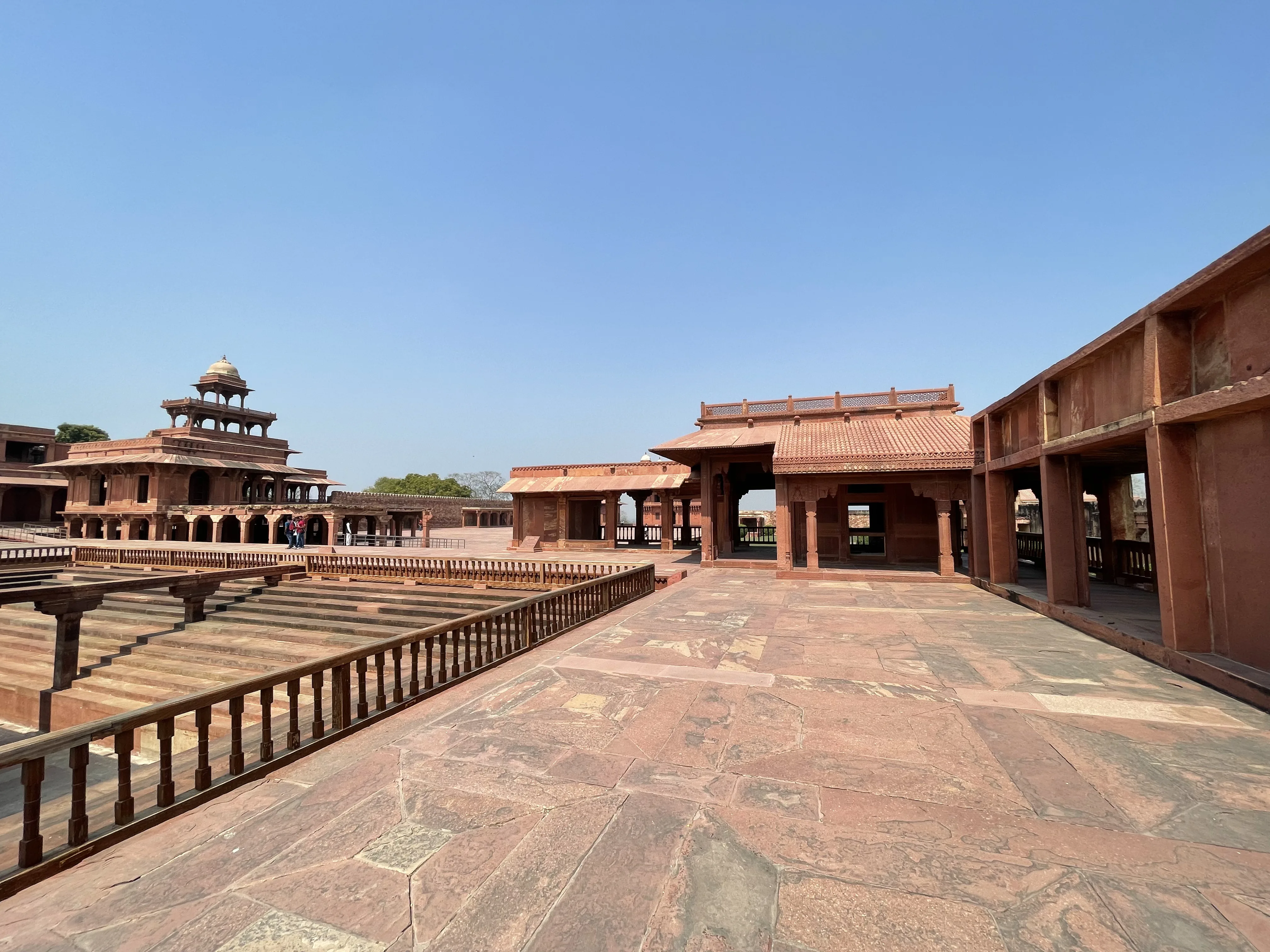
Fatehpur Sikri
Fatehpur Sikri was Akbar's own foundation, and the TDV entry records that it served as his capital for twelve years. The Encyclopaedia of Islam's Supplement notes that the actual building used as the Ibadat Khana has never been properly identified among the remains, and that Akbar left Fatehpur Sikri not long after 1579.
Akbar's building was not confined there. The TDV entry records that Agra, Allahabad, Ajmer, Lahore and Delhi were adorned with fine work in his reign, and the Encyclopaedia of Islam's treatment of the architecture of the period describes the synthesis visible in the surviving private apartments, noting in passing that the names attached to such buildings in India are unreliable guides.
Letters, Painting and the Translation Programme
The Akbarnama and the Ain-i Akbari
Abu'l-Fazl Allami's Akbarnama is the official history of the reign, and its third part, the Ain-i Akbari, is a survey of the empire's institutions, revenues, offices, provinces, usages and learning. Both were edited in the Bibliotheca Indica series and translated into English — the Akbarnama by H. Beveridge, the Ain-i Akbari by H. Blochmann and H. S. Jarrett.
Bada'uni's Muntakhab al-Tawarikh was written privately and is the indispensable counterweight. Nizam al-Din Ahmad's Tabaqat-i Akbari belongs to the same period; the Encyclopaedia of Islam warns that it must be used with caution because its author was a partisan, his father having been wazir to Akbar's uncle Askari.
Sanskrit into Persian
Akbar had Sanskrit works translated into Persian. The Mahabharata was rendered under the title Razm-nama, and the Ramayana and other works followed.
Bada'uni was employed on the Razm-nama, and his first-person account of one episode shows both the programme and the temper of the court. The emperor remarked of him that he was an unworldly man of Sufi leanings but seemed so rigid a lawyer that no sword could sever the vein of his rigidity, and cited the Razm-nama as his evidence, calling Naqib Khan to witness. Abu'l-Fazl acknowledged that there was a fault. Bada'uni was obliged to present himself and stated that he was a translator and nothing more, that he had rendered what the sages of India had set down without alteration, and that had he written it himself he would have been to blame. Abu'l-Fazl supported him, and the emperor said nothing further.
The passage at issue was the dying counsel of an Indian teacher: that a man should step beyond the limits of ignorance and negligence, come first of all to know the peerless Creator, pursue the path of knowledge, and not rest content with knowledge unaccompanied by practice, since that bears no fruit, but choose the path of virtue.
Painting and Scholarship
The TDV entry records the men Akbar drew to his court — Mir Fathullah Shirazi above all, with Hakim Ali Gilani, Molla Ahmad, Khwaja Nizamuddin, Faizi, Abd al-Rahim and Abu'l-Fazl Allami — and names Mir Sayyid Ali and Khwaja Abd al-Samad as the leading figures of the painting school of his reign. A substantial body of work was added to Mughal cultural life in this period, by composition and by translation.
Europeans at the Court
The TDV entry records that Akbar opened his court to Western travellers and clergy and so came to know of cultures and civilisations outside the Indian world. Jesuit missions came from Goa, and the commentary of Father Monserrate is among the sources for the reign; the Encyclopaedia of Islam cites his judgement of 1581 that Akbar cared little that in allowing everyone to follow his own religion he was in reality violating all religions.
The Last Years
The reign closed with the emperor outliving two of his three sons. Murad died in 1008 AH, 1599; Daniyal died a few years later. The eldest, Salim, had established himself at Allahabad and for a period conducted himself as a sovereign in his own right, an episode the Encyclopaedia of Islam describes as a short attempt at independence in his father's lifetime. To this period belongs the killing of Abu'l Fazl in 1011 AH, 1602, ambushed on his way from the Deccan to court at the prince's instigation, with his head sent to Salim at Allahabad.
Akbar died on 16 October 1605. A party at court had favoured his grandson Khusrau, but it did not prevail, and Salim succeeded as Jahangir. Akbar was buried at Sikandra, near Agra, where the Encyclopaedia of Islam records his tomb; it notes in another entry that in the reign of Aurangzeb, Jats under Raja Ram attempted to despoil the tomb and were resisted by the local commandant.
Historiographical Note
The two chroniclers. The reign is reported by two contemporaries who reached opposite conclusions, and the Encyclopaedia of Islam's account of their circumstances is what allows them to be weighed.
Abu'l-Fazl Allami was the son of Shaykh Mubarak Nagawri, and the Encyclopaedia of Islam describes father and son as exponents at court of a more liberal and eirenic view of Islam's place in India than the rigorist ulama held. He wrote the official history, and the TDV entry records that he ascribed to acts of the emperor's that might be judged irrational the character of nearness to God, and praised him as having come into the world to discharge a divine commission.
Bada'uni was not an outsider. He had studied under the same Shaykh Mubarak Nagawri who taught Abu'l-Fazl, and read Hanafi jurisprudence under Qadi Abu'l-Ma'ali. He was presented to Akbar in 981 AH, 1574, and the Encyclopaedia of Islam records that Akbar, impressed by his ability as a controversialist, appointed him an imam in 982 AH and enrolled him as a mansabdar of twenty. He sat in the Ibadat Khana and worked on the emperor's translation programme. The same entry records what then happened: he did not match Abu'l-Fazl's progress at court — the two had arrived at about the same time — and this embittered him, after which he accepted a madad-i ma'ash grant of a thousand bighas. Elsewhere the Encyclopaedia of Islam describes his comments on Akbar's religious borrowings as scathing.
So the position is not that one witness was present and the other absent. Both were insiders; one rose and wrote the official account, the other did not rise and wrote privately. Neither is disinterested, and a statement found in only one of them carries that qualification.
The characterisation of the Din-i Ilahi. The approved sources agree that Akbar promulgated it and differ in how they describe it. The TDV İslâm Ansiklopedisi calls it a new religion, and adds two qualifications that bear on its scale: that it took the form of a cult centred on Akbar's person, with members admitted at his choice, and that its adherents never exceeded twenty. The Encyclopaedia of Islam calls it a syncretistic or eclectic faith in its entries on Akbar and on the Mughals; its glossary volume calls it a heresy, and relates it to earlier alfi movements in sixteenth-century Indian Islam which held that faith needed reorientation at the close of the first Islamic millennium. This article does not adopt the word "heresy" in its own voice, since that is a theological judgement rather than a historical finding, and Section 6 of this project's standards bars the encyclopaedia from passing such verdicts on its subjects; the term is recorded here as that reference work's.
The date. The Encyclopaedia of Islam is inconsistent: its glossary volume gives 989 AH, 1581, and its entry on the Suris gives 990 AH, 1582. The date used in this article, on the owner's decision, is 1582. The separate statement that sulh-i kull was dominant at court by 1581 is not in conflict with it, since the two are different things.
How Akbar was judged. The spread of opinion is itself a documented fact. The account at historyofislam.com observes that Muslim historians are divided, some counting him among the greatest Muslim rulers and others regarding him as a renegade; and that the orthodox thought he had become a Hindu, Hindus were convinced he died a Muslim, some said he favoured the Shia while some Shia said he persecuted them, the Jesuits from Goa thought him a likely convert to Catholicism, and Jains and Parsis felt at home in his presence. That site is recorded in this project's source register as secondary narrative which is usually uncited, so the observation is reported as its characterisation of the historiography and not as a finding; it is included because the divergence it describes is real and is visible in the primary sources themselves.
What is not asserted here. Whether Akbar remained a Muslim is a theological question, and this article does not answer it. The approved sources are cited for what they record — his measures, his declarations, the testimony of those present, and the reactions of the scholars of his time — and not for a verdict on his faith. Several widely repeated particulars about his personal devotions could not be traced to an approved source and are accordingly absent.
A name to keep distinct. Akbar is not to be confused with Akbar Shah II, who reigned at Delhi from 1806 to 1837 and held, in the Encyclopaedia of Islam's phrase, a titular sovereignty. The Encyclopaedia of Islam also carries an entry on Sayyid Husayn Allahabadi, an Urdu poet of the nineteenth century who wrote under the pen-name Akbar, immediately after its entry on the emperor.
References and Further Reading
Primary Islamic Sources
- Abu'l-Fazl Allami, Akbarnama, the official history of the reign. Text in Bibliotheca Indica, Calcutta, 1873–87; English translation by H. Beveridge.
- Abu'l-Fazl Allami, Ain-i Akbari, the survey of the empire's institutions and administration. Text in Bibliotheca Indica, Calcutta, 1867–77; English translation by H. Blochmann and H. S. Jarrett.
- Abd al-Qadir Bada'uni, Muntakhab al-Tawarikh. Text in Bibliotheca Indica, Calcutta, 1864–9; English translation by Ranking, Lowe and Haig.
- Nizam al-Din Ahmad, Tabaqat-i Akbari. To be used with the caution the Encyclopaedia of Islam records.
- Nur al-Haqq, Zubdat al-Tawarikh.
- The mahzar of 987 AH, 1579, and the versified khutba read at the Fatehpur Sikri mosque on 9 May 1579, as recorded in the TDV İslâm Ansiklopedisi.
- Mughal coinage of the ilahi type, dated by Ilahi regnal year and Persian solar month, in the Khalili Collections, inventory nos. AR5673–AR5687.
Classical Islamic Sources
- Muhammad Qasim Hindu Shah Firishta, Tarikh-i Firishta.
- Abd al-Haqq Dihlawi, Akhbar al-Akhyar, for the shaykhs of Akbar's period.
- The anonymous Dabistan-i Madhahib, cited by the Encyclopaedia of Islam among the sources for the religious debates.
Academic and Scholarly Sources
- C. Collin Davies, 'Akbar, Abu'l-Fath Djalal al-Din Muhammad', The Encyclopaedia of Islam, vol. 1, pp. 316–317.
- 'Sulh-i kull', The Encyclopaedia of Islam, vol. 9.
- 'Ibadat Khana' and 'Ilahi Era', The Encyclopaedia of Islam, vol. 12 (Supplement).
- 'Bada'uni, Abd al-Kadir' and 'Mubarak Nagawri', The Encyclopaedia of Islam.
- 'Mughals', The Encyclopaedia of Islam, vol. 7.
- Enver Konukçu, 'Ekber Şah', TDV İslâm Ansiklopedisi.
- J. S. Hoyland (trans.), The Commentary of Father Monserrate, 1922.
Further Reading
- S. A. A. Rizvi, Religious and Intellectual History of the Muslims in Akbar's Reign. Delhi, 1975. Cited by the Encyclopaedia of Islam in both its Akbar-related entries.
- Aziz Ahmad, Studies in Islamic Culture in the Indian Environment. Oxford, 1964.
- Sri Ram Sharma, The Religious Policy of the Mughal Emperors. Bombay, 1962.
- M. Roychoudhuri, The Din-i-Ilahi. Calcutta, 1941; 2nd edition, Calcutta, 1952.
- V. A. Smith, Akbar the Great Moghul, 1919.
- W. H. Moreland, India at the Death of Akbar, 1920, and The Agrarian System of Moslem India, 1929.
- Ibn Hasan, The Central Structure of the Mughal Empire, 1936.
- P. Saran, The Provincial Government of the Mughals. Allahabad, 1941.
- E. W. Smith, Mughal Architecture of Fathpur Sikri, Archaeological Survey of India, 1896.
Note: the works in this Further Reading list are offered to the reader for further study. Nothing in the body of this article rests on them.
Mentioned In
13 articles reference this topic
and 1 more article