Humayun: The Emperor Who Lost and Regained an Empire
Humayun (1508-1556), the second Mughal emperor, inherited Babur's unconsolidated conquests in 1530, lost them to Sher Shah Suri by 1540, spent some fifteen years in exile including refuge with the Safavids, and recovered Delhi in 1555 months before his death.
Nasir al-Din Muhammad Humayun was the second ruler of the Mughal dynasty, and his reign divides into two unequal halves separated by an exile of some fifteen years. He succeeded his father Babur in 1530 as master of a recently conquered and barely governed territory in northern India; by 1540 he had lost all of it to Sher Shah Suri; in 1555 he recovered Delhi; and in January 1556 he died from an accidental fall, leaving a thirteen-year-old son to inherit.
That sequence has given him an uneven reputation. He is the Mughal emperor who lost the empire, and the contrast with his father's boldness and his son Akbar's consolidating genius has not favoured him. But the reign is more consequential than the summary suggests. The exile drew the Mughals into a close relationship with Safavid Persia whose cultural effects on Mughal painting, architecture, and court life were lasting, and the restoration of 1555, brief as it was, re-established the dynastic claim on which everything afterwards depended.
The fullest surviving account of these years is the memoir of Jauhar Aftabchi, Humayun's aftabchi — the officer responsible for his ewer and washing water — who attended him personally from his youth until his death and began writing his Tazkirat al-Waqi'at in 1587, on Akbar's court's continuing interest in the founding reigns. Jauhar's translator, Charles Stewart, judged the work's value to lie precisely in its lack of literary pretension: it was written, he said, "with the greatest sincerity and naivete, sometimes to the disparagement of its hero," which is why its account of Humayun's failures is not softened. The narrative that follows draws heavily on that memoir, on the official Akbarnama commissioned by Humayun's son, and on Khwandamir's Qanun-i Humayuni, a work composed at Humayun's own court and under his patronage.
Inheritance and Early Difficulties
Humayun was born at Kabul on 6 March 1508 (4 Dhu'l-Qa'da 913 AH), the same year his father Babur took the title of Padshah. His full brothers by different mothers were Kamran, Hindal, and Askari, each given the title Mirza; Jauhar's account notes that Askari's birth is not mentioned in Babur's own memoirs, which he takes as a sign that Askari may have been illegitimate.
Humayun's military apprenticeship began early. When Babur invaded Hindustan in 1526, he gave Humayun command of the army's right wing, and it was Humayun's force that first engaged the Afghans at the first Battle of Panipat. After the victory Humayun was sent to secure Agra and the treasure of the defeated Sultan Ibrahim Lodi, and he was rewarded by his father with a substantial cash grant and a palace at Agra with its contents. He went on to take Jaunpur and to fight in the battle against the confederated Rajput chiefs near Bayana before Babur's death.
Even the succession itself was not entirely secure. As Babur lay dying, his minister Mir Khalifa — on a suspicion he had formed about Humayun, whom the Akbarnama does not specify further — considered placing Babur's brother-in-law Mahdi Khwaja on the throne instead, and Mahdi Khwaja himself, "from his evil disposition and wickedness and folly," began appearing daily at court to press the matter. The scheme collapsed only when other officers persuaded Mir Khalifa to abandon it; he then barred Mahdi Khwaja from court altogether. Babur died on 6 Jumada al-Awwal 937 AH (26 December 1530) at the Charbagh on the bank of the Yamuna at Agra, and Humayun's accession went ahead as his father had wished.
He succeeded on Babur's death in December 1530, and the inheritance was more precarious than it appeared. Babur had won battles rather than built a state: the revenue system was unreformed, the Afghan nobility that had ruled north India before him remained largely intact in Bihar and Bengal, the Rajput states were unsubdued, and the Timurid convention of dividing patrimony among male kin meant the empire came encumbered with brothers holding independent power. Kamran Mirza held Kabul and Kandahar and later the Punjab; Askari and Hindal held further assignments. Humayun's authority over them was nominal, and their intermittent disloyalty shaped every crisis of his reign.
His first recorded campaigns as emperor were against the rebellions of Bayazid and Mahmud Lodi in the eastern provinces, which he suppressed after marching from Kalinjar to Jaunpur; he then besieged the fortress of Chunar, held by Jalal Khan, son of the Afghan chief who would soon be known as Sher Shah, and accepted its surrender after four months. In the west he confronted Bahadur Shah of Gujarat, taking Champaner and Ahmedabad in 1535 by an escalade — a small party climbing to a point that commanded the fortress under cover of night, then signalling the main assault with drums and a trumpet — but losing the province again once he withdrew. In the east, Sher Khan Sur was building a power base in Bihar and Bengal that Humayun repeatedly moved against and repeatedly failed to eliminate.
The Loss of India
The collapse came in two battles. At Chausa, near Buxar on the Ganges, on 26 June 1539, Sher Khan's forces broke the Mughal army after peace negotiations had lulled Humayun's camp into relaxing its guard. Jauhar Aftabchi, who was present, records that as Humayun's horse foundered while he tried to cross the Ganges, a water-carrier named Nizam offered him his inflated leather water-skin, and Humayun swam the river clinging to it. On reaching the far bank, Humayun asked the man his name, and on hearing it replied that he would make Nizam's name "as celebrated as that of Nizam-addyn-Aulia" — the revered Delhi saint Nizamuddin Auliya — and that Nizam should sit on his throne. A great number of the Mughal army drowned attempting the same crossing.
At Kannauj, also called Bilgram, on 17 May 1540, the defeat was decisive. Humayun's army disintegrated, and with his brothers unwilling to commit their resources to his recovery, he abandoned north India.
The reasons for the failure are not obscure. Sher Khan commanded a disciplined, centrally paid army and an administration that could supply it; Humayun commanded a coalition held together by personal loyalty and dynastic sentiment, undermined by his own brothers. The contrast between the two men as organisers of state power is the substance of the episode, and it is the point on which the sources — including the Akbarnama, written later under Mughal patronage — concur.
Exile
The years from 1540 to 1555 were spent as a fugitive and then as a guest. Humayun moved first through Sindh and the Rajput borderlands, seeking a base and finding none; it was during this period, at Umarkot in Sindh in 1542, that his son Akbar was born to Hamida Banu Begum. Denied support by Kamran in Kandahar and Kabul, he crossed into Persia in 1544 and was received by the Safavid Shah Tahmasp I.
Jauhar Aftabchi's account of the Safavid reception is considerably more detailed, and more fraught, than the bare fact of a generous welcome suggests. Shah Tahmasp's agent, Qazi Jahan, warned Humayun that some seven hundred Sunni companions shared his exposure and that circumstances required him to "temporise with your oppressors" — meaning to accept, under duress, papers that Tahmasp's court had prepared touching Humayun's religious observance. Humayun read two such papers and pushed them away, but on reading a third rose in anger before the Qazi persuaded him there was "no remedy," and he signed it. At the same time the relationship carried real warmth: Tahmasp took Humayun hunting at the ruins of Persepolis, exchanged gifts of jewels and honours, and — when Bahram Mirza, Tahmasp's brother, wept on being asked to consider Humayun's "destruction" and appealed through their sister, who interceded directly with the shah — Tahmasp relented and instead equipped Humayun with troops to recover Kandahar and Kabul. The precise substance of what Humayun was made to concede is not settled by the sources available; what is documented is that the pressure was real, that it was resisted so far as resistance was possible, and that the alliance nonetheless proceeded and delivered the military assistance Humayun needed. The relationship with the Safavid state and with the cultural world of Persia had consequences beyond the immediate campaign: Persian artists, architects, and men of letters entered Mughal service in this period and after, and the distinctive Mughal synthesis in painting and building owes much to that transfer.
The Kabul Years
Humayun took Kandahar and then Kabul in 1545 with Safavid assistance, and the nine years that followed are usually passed over as an interlude. They were in fact the period in which the Mughal restoration was made possible.
The immediate business was the contest with Kamran, who took Kabul back and lost it again more than once between 1546 and 1553 as the loyalties of the Afghan and Central Asian commanders shifted between the brothers. Jauhar's memoir records this period in close, almost day-by-day detail: Kamran's flight and recapture of Kabul by surprise, the pass fighting in the Hindu Kush passes, Humayun's illness at Keshan so severe that his chiefs began preparing to desert before his wife Hamida Banu Begum revived him by pressing pomegranate juice into his mouth, and the circumcision of the young Akbar celebrated at Kabul with the queen brought specially from Kandahar for the occasion. The city changed hands repeatedly, and the accounts of these years are a catalogue of sieges, defections and reconciliations, of which one, in 955 AH (1548), is described in unusual detail. Kamran approached Humayun's camp to submit after one of his defeats, and on stepping onto the carpet of the audience tent took a handkerchief and tied it around his own neck in token of his crimes; Humayun told him to throw it off, saying there was no need for it, and when Kamran had made his salutations Humayun embraced him and seated him at his right hand, declaring that the ceremony of submission was over and they should now meet only as brothers. The two drank a cup of sherbet between them, Hindal and Askari joined them on the same carpet, and all four brothers ate salt together and prayed for Humayun's prosperity, in a reconciliation feast that lasted two days. It did not hold: Kamran broke with Humayun again, and the contest for Kabul continued until his capture and blinding in 1553.
Two things were accomplished alongside the fighting. Humayun assembled and held together a body of commanders and administrators — Bairam Khan foremost among them — who would form the nucleus of the restored empire's leadership, and who had chosen him at a point when he had almost nothing to offer. And he retained Kabul itself: a defensible base with revenue, astride the route into India, and the ancestral Timurid seat from which his father had launched the original conquest. A claimant with Kabul was a claimant with prospects; his years in Sindh and Persia had shown what a claimant without a base amounted to.
His son Akbar spent much of his childhood in these years at Kabul and in the field — at one point falling into the custody of his uncle Askari during one of Humayun's hasty retreats from Afghanistan, and being raised there for a time with what the sources describe as genuine affection — and the practical military and political education this gave him is part of the explanation for the competence he showed on succeeding at thirteen.
From that base Humayun watched the Sur regime in India decay. Sher Shah had died in 1545 and his son Islam Shah in 1554; the succession that followed was disputed and the Sur domain fell apart.
Restoration and Death
In 1555 Humayun moved into the Punjab, and with the generalship of Bairam Khan defeated Sur forces at Machhiwara and then decisively at Sirhind, a campaign treated more fully below. He entered Delhi in July 1555, fifteen years after leaving it, and re-established Mughal rule over the northern plains.
The restoration lasted about six months. Jauhar Aftabchi's memoir, quoting the account given in Dow's History of Hindostan, describes Humayun walking out onto the terrace of his library at the Din-Panah citadel in Delhi to take the evening air; as he descended the stairs the call to prayer sounded, and, observing custom, he stopped and sat on a step to recite his creed. Rising again, he leaned on his staff, which slipped on the marble, and he fell headlong to the bottom of the stairway. He was carried to his bed insensible, recovered his speech briefly, and died as the sun set on 11 Rabi al-Awwal 963 AH — 21 or 24 January 1556 by different reckonings, the sources disagreeing on the exact equivalent date, and also on his precise age at death, which Jauhar's editor calculates as either fifty-one lunar years or forty-eight solar years depending on which calendar is applied to his 1508 birth.
The Akbarnama's own, independently narrated account of the accident agrees with Jauhar's in its essentials and adds particular detail. Humayun had been reducing his customary opium intake toward the end of his life, telling his attendants he would see how long two or three pellets a day could be made to last; he took his last dose, from a seven-day supply wrapped and divided in paper, in rosewater on the day of the fall itself. That evening he meant to descend from the library terrace to hold an assembly once the planet Venus had risen, but at the stair a reciter named Miskin gave an unscheduled call to prayer; out of respect Humayun tried to sit down where he stood, his foot caught in the skirt of his own robe, his staff slipped on the worn stone steps, and he fell and struck his head, blood issuing from his right ear. Even so injured, his first act was to send word of his condition to Akbar by the hand of Nazr Shaikh Quli. The officers present — among them Khizr Khwaja Khan, Ali Quli Khan, Qambar Ali Beg, and Tardi Beg Khan — concealed the emperor's death from the wider court for seventeen days while messages went out to summon the absent nobility and to the heir apparent in the Punjab, and only on 28 Rabi al-Awwal (11 February 1556) was the khutba publicly read in Akbar's name at Delhi.
His son Akbar, then thirteen and residing at Kalanaur in the Punjab, was enthroned there on hearing the news, under the regency of Bairam Khan. The Mughal empire as a durable institution was built in Akbar's reign, but it was built on a throne that Humayun had recovered months before his death.
Character, Learning, and Patronage
The sources present Humayun as a cultivated and personally courageous man whose weaknesses were of decision rather than of courage or intellect. Khwandamir's Qanun-i Humayuni — composed at Humayun's own request and read to him at court — shows an emperor who valued literary and historical scholarship highly enough to keep an aged and ailing historian at his side through a military campaign into Gujarat; Khwandamir, already advanced in years, died of dysentery contracted on that expedition in 1535, and was buried, at his own request, beside the graves of Nizamuddin Auliya and the poet Amir Khusrau in Delhi. Humayun had earlier given Khwandamir the title Amir al-Muwarrikh, chief chronicler, in recognition of his scholarship.
The most valuable eyewitness source for Humayun's life is Jauhar Aftabchi's own memoir, written from decades of personal attendance and preserved with what its English translator called unusual candour about its subject's failings. The official Mughal chronicle, Abu'l-Fazl's Akbarnama, composed under Akbar a generation later, treats Humayun's reign substantially as prologue to his son's, and its more schematic passages should be read with that purpose in mind.
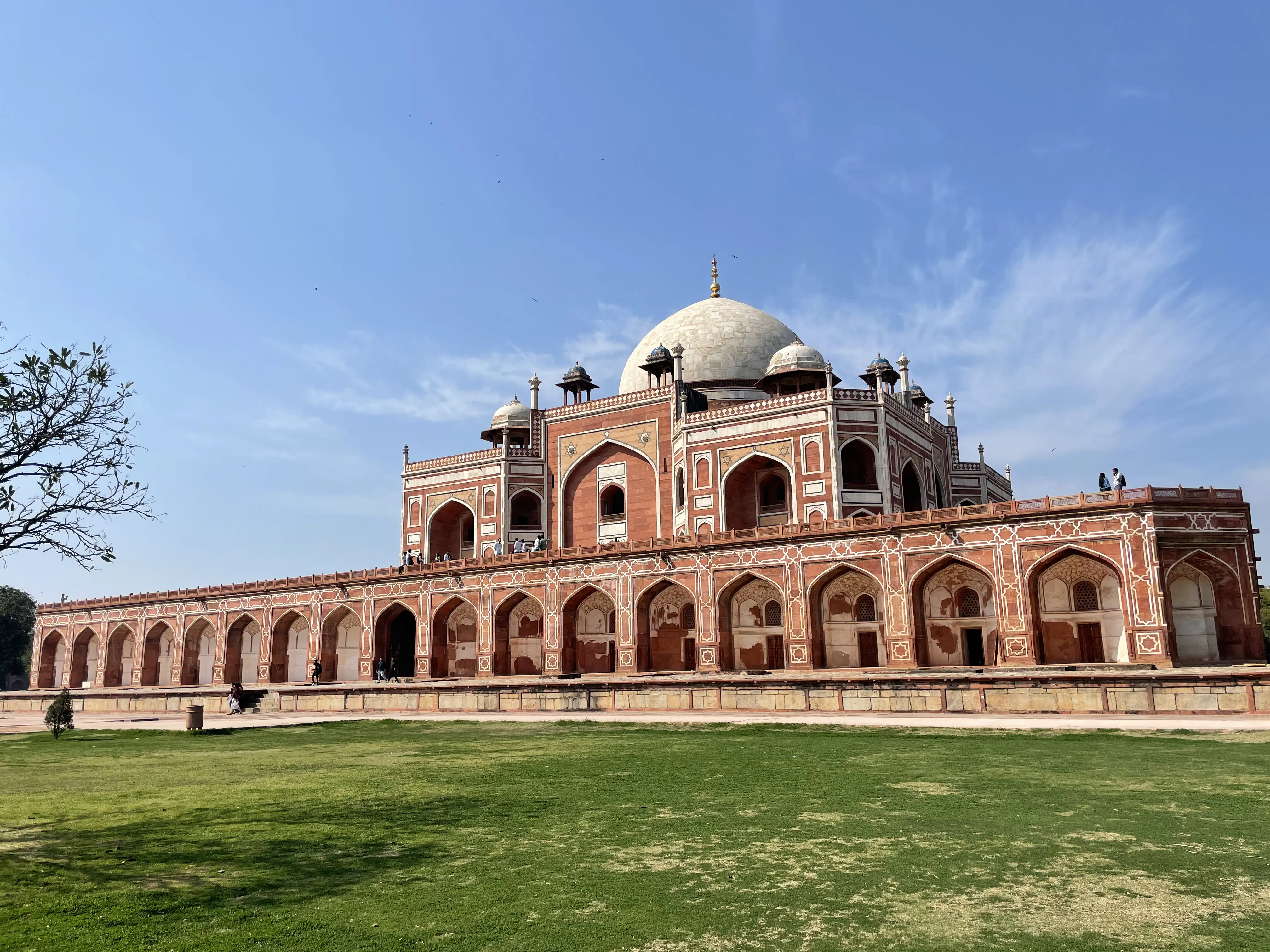
His most conspicuous architectural legacy was raised after his death. Humayun's Tomb in Delhi, commissioned by his widow and completed in the years following his death, is the first of the great Mughal garden tombs — a domed mausoleum of red sandstone and white marble set within a formal charbagh enclosure. It established the type that culminates in the Taj Mahal, and it was inscribed as a UNESCO World Heritage Site in 1993. Its place in the development of the Indo-Islamic architectural tradition is more securely established than any of his own political achievements.
The Problem of the Brothers
The single most persistent cause of Humayun's difficulties was the Timurid conception of sovereignty he inherited, and it is worth setting out because it explains failures usually attributed to his character alone.
In the Timurid tradition, as in much of the Turco-Mongol political world, rule was the collective property of the ruling house rather than the exclusive possession of one man. Territory was distributed among adult male kinsmen, who held it with their own troops and revenues and who possessed a legitimate claim to the whole. Babur had himself risen in this system, contending with cousins for the Fergana inheritance, and on his death he left the pattern intact.
Humayun accordingly began his reign with three brothers holding significant power. Kamran Mirza held Kabul and Kandahar and swiftly took the Punjab as well, giving him control of the routes between India and Central Asia and of the recruiting grounds from which Mughal armies were raised. Askari and Hindal held assignments in India. Their loyalty was conditional and intermittent: Hindal was in open revolt at the moment of greatest danger from Sher Khan — going so far, according to the Akbarnama, as to have the Friday sermon read in his own name at Agra during Humayun's absence in Bengal, and having the Shaikh Buhlul, a revered figure of Indian Sufism sent by Humayun to remonstrate with him, put to death when the Shaikh's presence threatened to unravel the officers' scheme — and Kamran declined to commit his forces to the defence of India and later refused Humayun refuge, fighting him for Kabul over nearly a decade.
Humayun's response was, for most of these years, to conciliate rather than to eliminate, and Jauhar's memoir preserves an episode that captures the family cost of this policy directly: on recovering Kabul, Humayun learned that Kamran had fed their father's widow, Rayke Begum, on beef during her widowhood in the fort, and reproached his absent brother aloud over her supper table before refusing to eat himself until the next day. The contrast with later Mughal practice is instructive: Akbar, Shah Jahan, and Aurangzeb each secured the throne by removing rival claimants within the family, and the empire they governed was correspondingly free of the divided sovereignty that crippled Humayun. Only late, and under extreme provocation, did Humayun have Kamran blinded and removed from contention.
The Gujarat and Bengal Campaigns
The military record of the first reign shows a commander capable of winning campaigns but unable to convert them into possession.
In Gujarat, Bahadur Shah's expansion provoked Mughal intervention, though not immediately. Jauhar's memoir records that when Humayun's army first approached the region in 1533, Bahadur Shah wrote asking that he not interfere while he completed the siege of the Rajput fortress of Chittor, and Humayun agreed and halted his own march until Chittor had fallen. Only afterward, when Bahadur Shah's own army confronted the Mughal advance near Burhanpur, did the two sides come into open conflict. Humayun campaigned from 1535, and the operation was, in military terms, a success: after a siege of some three months in which his cavalry cut off the Gujarati camp's supply until the defenders were reduced to eating horseflesh, Bahadur Shah's army broke and fled, and the seemingly impregnable fortress of Champaner was taken shortly after by the night escalade described above. Jauhar records the discovery of Bahadur Shah's treasury beneath a drained bath at Champaner, divided among the army "by filling the shield of each person with materials in proportion to his rank." When his own counsellors urged him to take the money, install Bahadur Shah as a tributary governor, and return to Agra — where trouble was brewing with the rebellious Muhammad Zaman Mirza — Humayun refused outright: "After having subdued this valuable province by the power of my sword, shall I give it up for nothing? No; I will keep it, and add it to the kingdom of Delhi."
He then withdrew to deal with the eastern threat, leaving his brother Askari in charge. The province reverted almost immediately: the Gujarati nobility rose, Askari's position collapsed, and the conquest evaporated without a battle. The pattern — successful assault, no administrative consolidation, rapid reversion — repeated in Bengal, where Humayun occupied Gaur in 1538 and found himself unable to hold or supply it. He shut himself in his harem there for months, according to Jauhar's account, while Sher Khan besieged Chunar, took Benares, seized the families of several Mughal officers, and cut off the road back to Agra; and the monsoon and disease reduced his army while Sher Khan cut his communications.
The two campaigns together consumed roughly four years, produced nothing permanent, and gave Sher Khan the time he needed to consolidate Bihar and Bengal. The judgement of both the contemporary and the modern accounts is the same: Humayun could win provinces and could not keep them, because winning required an army and keeping required an administration.
The underlying failure was administrative rather than tactical. Babur's conquests had not been converted into a revenue system capable of supporting sustained operations at a distance, and Humayun made no serious attempt to build one during his first reign. He fought with the resources of a conquest army — plunder, requisition, and the assignments of his nobility — against an opponent who had built a treasury and a supply system. Nehru's survey of the period, written independently of the Mughal chronicle tradition, likewise identifies the gap between Indian and Central Asian methods of state organisation and European or Sur-Afghan administrative practice as decisive in this era, and the same asymmetry operated between Humayun and Sher Shah within it.
The Persian Years and Their Cultural Consequence
The period of Safavid refuge, difficult as it was politically, proved to be the most culturally productive episode of Humayun's life, and its effects on the Mughal empire were lasting.
At the Safavid court Humayun encountered a mature Persianate imperial culture at the height of its refinement — in manuscript painting, in architecture, in garden design, in poetry, and in the ceremonial of kingship. When he recovered Kabul and later Delhi, he brought elements of that world with him. The painters Mir Sayyid Ali and Abd al-Samad, recruited from Persia, entered Mughal service and became the founding masters of the imperial painting workshop under Akbar; the Mughal atelier's characteristic synthesis of Persian technique with Indian subject and colour begins with them.
The architectural consequence is equally traceable. The formal charbagh garden enclosure, the high double-shelled dome, and the vocabulary of iwan and arcaded facade that define Mughal building were Persian and Central Asian in origin, and their systematic application in India dates from this period and its immediate aftermath. Humayun's own tomb is the first full statement of the resulting style.
There is a wider point here about the Islamic world of the sixteenth century. The three great Muslim empires of the period — Ottoman, Safavid, and Mughal — were connected by exactly this kind of movement of artists, scholars, soldiers, and exiled princes, and the shared Persianate high culture of the period was produced by it. Humayun's exile is a particularly clear instance of the mechanism at work.
The Restoration Campaign
The recovery of India in 1555 was made possible by the collapse of the Sur regime, but it still had to be executed, and the execution was competent.
Sher Shah had died in 1545 and his son Islam Shah in 1554, after which the Sur domain broke into contending fragments under rival claimants. Humayun, secure in Kabul since 1553, moved into the Punjab in late 1554. The campaign was directed in large part by Bairam Khan, the ablest of his commanders, who defeated Sur forces at Machhiwara and then decisively at Sirhind in 1555.
At Sirhind the two armies faced each other for nearly a month before Humayun, recalling the tactic he had used against Bahadur Shah of Gujarat, ordered his forces to cut off the Afghan army's supplies rather than force an immediate battle. When the fighting came, the Sur emperor Sikandar Sur threw his strongest attack against the division commanded by Bairam Khan, who held his ground behind a hastily thrown-up entrenchment while Humayun, occupied in prayer during the engagement, sent to confirm a false report of Bairam Khan's death before ordering a flanking attack on the Afghan rear that broke Sikandar Sur's line. Jauhar Aftabchi, who served through the campaign, records his own part in the pursuit that followed: tasked with gathering intelligence as far as Kandahar and Kabul, he learned that the fleeing Sikandar Sur was rallying fresh troops near the fortress of Mankot, and, judging the pursuing Mughal force too small to risk an open engagement, had timber intended for fort repairs sawn into carriages and bound with old chains and raw leather to encircle the camp against a cavalry charge — the same defensive method Humayun himself had used at Sirhind. Delhi and Agra followed.
Bairam Khan's role matters for what came next. When Humayun died months later, the regent held the empire together for the boy Akbar, defeated the Sur claimant Hemu at the second battle of Panipat in 1556, and governed until Akbar came of age. The continuity of Mughal rule across Humayun's sudden death was the work of the apparatus Humayun had assembled in exile rather than of any provision he made.
The Wilderness Years in Sindh
The period between Kannauj and the crossing into Persia is the least glamorous part of Humayun's life and among the most consequential.
Driven out of Hindustan, he moved through Sindh seeking a base from which to recover, negotiating with the local rulers and with the Rajput chiefs of the desert margins, and finding no one willing to commit to a defeated claimant. Jauhar Aftabchi, who was present throughout, describes months of considerable hardship, and his memoir preserves the human detail official chronicles omit — including his own role, on one occasion, in finding provisions for the King's household when supplies ran short.
Two things of importance happened in Sindh. Humayun married Hamida Banu Begum, and at Umarkot in October 1542 she bore him a son, Akbar — the future emperor was born to a father with no throne, no territory, and no reliable ally. And Humayun's calculation shifted: with India closed to him and Kabul held by a hostile brother, the only available patron was the Safavid shah, and he turned west.
The Fate of the Brothers
The resolution of the fraternal problem, when it finally came, was late and reluctant.
Hindal Mirza, who had been in revolt at the moment of greatest danger from Sher Khan, was reconciled to Humayun during the exile and died in 1551 fighting on his behalf against Kamran's forces — the one brother whose end the sources present without reproach.
Askari Mirza was captured and sent under restraint on pilgrimage to Mecca, where he died. The arrangement was a characteristic Timurid solution: removal from the political field without execution.
Kamran Mirza was the persistent adversary. He held Kabul and Kandahar, took the Punjab, refused Humayun refuge after Kannauj, and contested Kabul repeatedly through the decade after 1545, taking and losing the city more than once — on one occasion, according to Jauhar, blinding or killing the governors he found holding it against him. When he was finally captured in 1553, Humayun had him blinded — the standard means of disqualifying a Timurid prince from rule — and sent to Mecca, where he died in 1557. The Akbarnama and Jauhar's memoir both describe Humayun as reaching this decision under sustained pressure from his own commanders, who had had enough of a rival who could not be trusted and would not stay defeated.
Only after Kamran's removal was Humayun secure enough at Kabul to attempt India, and the sequence is not coincidental. The reconquest of 1555 was possible because the divided sovereignty that had wrecked the first reign had at last been ended, and the lesson was not lost on his successors: Akbar and every Mughal after him treated the elimination of rival claimants within the family as the first task of a new reign.
Humayun's Tomb
The mausoleum in Delhi is Humayun's most important legacy, and it was not his doing.
It was commissioned by his widow and built in the years following his death, under an architect of Persian origin. The design brings together elements that had existed separately and makes a single composition of them: a high double-shelled dome over a domed chamber, a symmetrical plan with chamfered corners and deep recessed arches on each face, red sandstone faced with white marble, the whole raised on a broad plinth and set at the centre of a walled charbagh — a garden quartered by water channels.
Its importance is that this configuration became the Mughal imperial tomb. Akbar's mausoleum at Sikandra, Jahangir's at Lahore, and above all the Taj Mahal — where the same elements appear in white marble and at greater refinement — descend from it. The building was inscribed as a UNESCO World Heritage Site in 1993 and has since undergone extensive conservation.
There is also a political reading. A monumental dynastic tomb in Delhi, placed near the shrine of a revered Sufi and among the burial places of earlier Muslim dynasties of India, asserted that the Mughals belonged in that succession — a claim worth making for a dynasty that had been expelled from the country fifteen years earlier and had only just returned. Shah Jahan made the same argument a century later when he founded his capital on the same ground.
Assessment
An assessment of Humayun has to hold two things together. As a ruler he failed at the central task of his reign: he inherited a conquest and did not convert it into a state, and he lost it to an administrator who could. The Timurid practice of shared patrimony, which he did not overcome until 1553, was a structural cause; his own hesitancy at decisive moments, on which the sources are consistent, was a personal one. He was, on the evidence of Chausa and Kannauj, a competent soldier who was not a competent organiser of war.
Against that, the dynasty survived because he survived. He kept the Timurid claim alive through fifteen years without territory, secured a base at Kabul, ended the fraternal challenge, and returned to Delhi when the opportunity came. Had he died in exile, there would have been no Mughal restoration in 1555 and no imperial inheritance for Akbar. The apparatus he assembled in those years — Bairam Khan above all — held the empire through his sudden death and his son's minority.
The exile also had a cultural yield that outlasted the political failure. The Mughal court's absorption of Safavid artistic and architectural practice, which shaped the visual culture of the empire for two centuries, dates substantially from his years in Persia and from the personnel he brought back with him. The painters who founded Akbar's workshop came by that route.
His tomb, built by his widow, became the model for Mughal funerary architecture and the ancestor of the Taj Mahal — a legacy that is genuinely his in subject if not in commission. It is a fitting summary of the reign that his most durable monument was raised in his name by someone else, out of materials he had brought back from the years when he had lost everything.
Historiographical Note
Humayun's life is unusually well documented for a sixteenth-century ruler because it was written about from inside his own household. Jauhar Aftabchi's memoir is the most valuable single source precisely because its author was not a court historian working to a brief: he wrote from decades of personal service, after both Humayun's and much of the next generation's deaths, and his English translator judged the narrative trustworthy in part because it does not flatter its subject. Where the memoir and the officially commissioned Akbarnama diverge in emphasis, this article has generally followed Jauhar for personal and narrative detail and the Akbarnama for the larger political and military framework, since each source's evident purpose explains the difference. Khwandamir's Qanun-i Humayuni, composed at Humayun's own court, is a contemporary rather than a retrospective source, though the surviving edition consulted here is heavily annotated by its modern editor and the original Persian text is not always separable from the editorial apparatus surrounding it; it has accordingly been used here chiefly for the biographical and institutional detail its editor's preface and notes make explicit, rather than for reconstructing the more elaborate schemes of court ceremonial sometimes attributed to Humayun in later secondary literature, which this article does not repeat because it could not independently verify them in this edition.
Some specific details remain genuinely unsettled in the sources consulted: the precise date of Humayun's death is given as either the 11th or the 20th of Rabi al-Awwal 963 AH depending on the account, and his age at death depends on whether a lunar or solar year is applied to his 1508 birth. The exact terms of the religious accommodation Humayun made with Shah Tahmasp in Persia are also not fully recoverable — Jauhar records that pressure was applied and that Humayun signed at least one document under duress, but does not specify its content, and this article accordingly reports the pressure and the outcome without asserting what was contained in the paper itself.
References and Further Reading
Primary Islamic Sources
- Quran, Surah Al-Imran (3:26) — "You give sovereignty to whom You will and You take sovereignty away from whom You will"; a verse repeatedly invoked in the Persian histories of his loss and recovery of the throne
- Quran, Surah al-Nisa (4:58) — on rendering trusts and judging with justice, the standard applied to rulers in the Indo-Persian literature of governance
- Quran, Surah al-Baqarah (2:155–157) — on patience under trial, the frame within which contemporary Muslim writers presented the years of exile
- Sahih al-Bukhari and Sahih Muslim, Books of Leadership (Kitab al-Imarah) — the prophetic material on the responsibilities of rulers, the framework of contemporary judgement on his reign
Classical Islamic Sources
- Jauhar Aftabchi. Tazkirat al-Waqi'at (Tezkereh al Vakiat), translated by Charles Stewart. London: Oriental Translation Fund, 1832. [Composed 1587] — the indispensable eyewitness memoir by Humayun's aftabchi (ewer-bearer), who attended him from youth to death
- Abu'l-Fazl ibn Mubarak. Akbarnama, translated by H. Beveridge. Calcutta: Asiatic Society (Bibliotheca Indica), 1907. [Compiled c. 1590s] — the official Mughal account, which treats Humayun's reign as prologue to Akbar's
- Khwandamir. Qanun-i Humayuni (also Humayun-nama), edited by M. Hidayat Hosain. Calcutta: Royal Asiatic Society of Bengal (Bibliotheca Indica), 1940. [Composed c. 1534] — a contemporary account written at Humayun's own court and under his patronage
- Bada'uni, Abd al-Qadir. Muntakhab al-Tawarikh, translated by George Ranking and W.H. Lowe. Calcutta: Asiatic Society, 1898. [Compiled c. 1595]
Academic and Scholarly Sources
- Nehru, Jawaharlal. The Discovery of India. [approved PDF library:
sources/study/] — on the administrative contrast between the Mughal conquest state and its rivals in this period - Rizvi, Sayyid Mahboob. History of the Dar al-Ulum Deoband, Volume 1. [approved PDF library:
sources/study/] — on the growth of madrasas under Humayun and Akbar - Ahmed, Nazeer. "Akbar, the Great Moghul." historyofislam.com. [approved external web source, §4A.1a] — for corroborating narrative detail on Humayun's exile and its bearing on Akbar's early life
Further Reading
- Beveridge, Annette S., trans. The History of Humayun by Gul-Badan Begam. London: Royal Asiatic Society, 1902. — Gulbadan Begum's memoir of the imperial household, not independently consulted for this article and listed here for the reader's further research
- Koch, Ebba. Mughal Architecture: An Outline of Its History and Development. Munich: Prestel, 1991.
- UNESCO World Heritage Centre, documentation on Humayun's Tomb, Delhi.
Mentioned In
10 articles reference this topic
More from Mughal Empire
The Mughal Empire: Three Centuries of Islamic Rule in the Indian Subcontinent
The Mughal Empire (1526-1857) ruled most of the Indian subcontinent for three centuries, from Babur's victory at Panipat to the deposition of Bahadur Shah Zafar. At its height it was among the wealthiest and most populous states in the world.
Taj Mahal - Monument to Eternal Love
The Taj Mahal (1632-1653 CE) is an ivory-white marble mausoleum built by Mughal Emperor Shah Jahan in memory of his wife Mumtaz Mahal. Located in Agra, India, this masterpiece blends Persian, Islamic, and Indian architectural traditions, representing the pinnacle of Mughal achievement.
Akbar: The Third Mughal Emperor
Akbar (r. 1556-1605) turned the Mughal foothold in India into an empire of fifteen provinces. He rebuilt the central government, created the mansabdari service and the dah-sala revenue settlement, abolished the jizya, and pursued a religious policy his contemporaries judged very differently.
Babur: The Tiger of Hindustan
Babur (1483-1530), a Timurid prince who lost his Central Asian homeland, conquered Kabul, and founded the Mughal Empire in India after his victory at Panipat in 1526 — equally renowned as a warrior, poet, and memoirist whose Baburnama is a masterpiece of world literature.