Abadi Bano Begum (Bi Amma): Mother of the Khilafat Movement
Abadi Bano Begum (1852-1924), known affectionately as Bi Amma, was the mother of the Ali Brothers and one of the first Muslim women to enter Indian nationalist politics, mobilizing women for the Khilafat and Non-Cooperation movements while observing purdah.
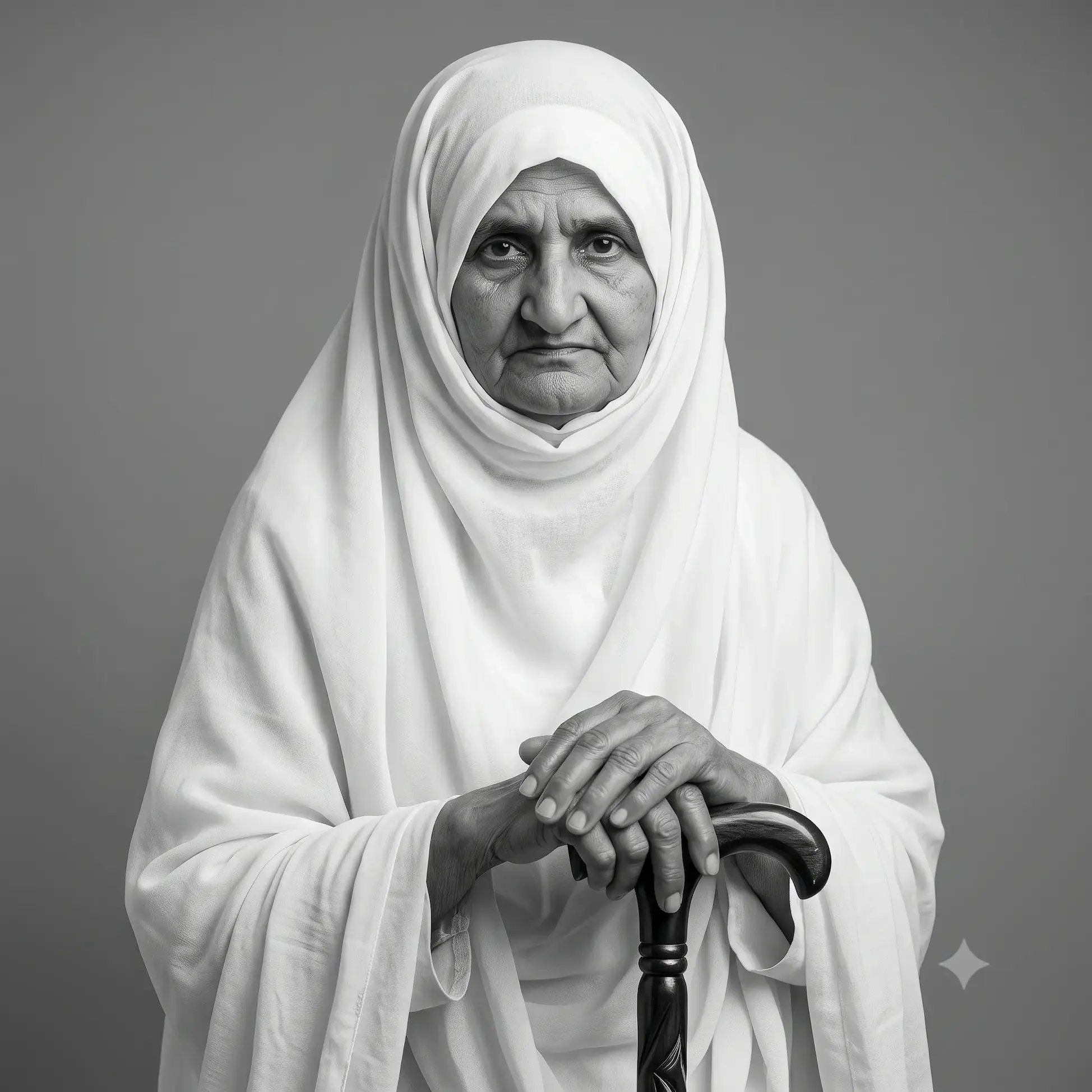
Abadi Bano Begum (1852 – 13 November 1924), universally known and revered as Bi Amma ("respected mother"), was one of the most remarkable women in the history of the Indian independence movement — the mother of the famous Ali Brothers, Mohammad Ali Jauhar and Shaukat Ali, and a pioneering figure who broke the conventions of her era to become one of the first Muslim women to participate openly in Indian nationalist politics.
At an age when most women of her generation and social class remained in the strict seclusion of purdah, Bi Amma emerged into public life in her sixties and seventies — addressing mass political gatherings, mobilizing Muslim women for the Khilafat and Non-Cooperation movements, contributing her own jewelry and possessions to the national cause, and providing the moral authority that transformed her sons' political activism into a family mission sanctified by maternal blessing. Her appearance on political platforms — a veiled elderly woman whose very presence testified to the depth of Muslim feeling — was among the most moving spectacles of the mass-movement era of 1919–1924.
Bi Amma's significance extends beyond her role as the mother of two famous sons. She represented, in her own person, the entry of Muslim women into the public sphere of anti-colonial politics — demonstrating that a woman could maintain her religious observance, her cultural identity, and her personal dignity while participating fully in the political struggle for freedom. Her willingness to sacrifice her sons to prison and her possessions to the movement, and her insistence that honor mattered more than safety, made her a symbol of the ethic of sacrifice that defined Indian Muslim politics in its most idealistic phase.
Early Life and Background
Birth and Family Origins
Abadi Bano Begum was born in 1852 in Rampur, a Muslim princely state in the United Provinces of British India (modern Uttar Pradesh). She belonged to a family of the Muslim service gentry — the class of educated, religiously observant Muslims who had served the various Muslim rulers of northern India and who maintained a strong sense of Islamic identity, cultural refinement, and social status even as the political power of Muslim states declined under British colonial expansion.
The year of her birth is significant: 1852 fell just five years before the great uprising of 1857 (the Indian Rebellion, or what the British termed the "Mutiny") — the cataclysmic event that ended the last vestiges of Mughal authority, brought India under direct British Crown rule, and traumatized the Muslim aristocracy of northern India whose fortunes were most closely tied to the old order. Bi Amma grew up in the aftermath of this catastrophe, in a community grappling with the loss of political power, cultural prestige, and economic security. This context — the wounded pride and anxious uncertainty of the post-1857 Muslim gentry — shaped the environment in which she was raised and the values she would later transmit to her sons.
Rampur: A Center of Muslim Culture
Rampur, the town of Bi Amma's birth, was itself significant to her formation. As a Muslim princely state ruled by a Nawab, Rampur was one of the centers of North Indian Muslim culture that survived the collapse of Mughal power. It was known for its patronage of Urdu and Persian literature, its distinguished library (the Raza Library, one of the great repositories of Islamic manuscripts in South Asia), its traditions of Islamic scholarship, and its cultivation of the refined courtly culture (tehzeeb) of the Indo-Muslim elite. Rampur attracted scholars, poets, and artists displaced from Delhi and other centers after 1857, becoming a refuge for the cultural traditions of the old Muslim order.
To be raised in Rampur was to be immersed in this atmosphere of Muslim cultural pride and religious learning. Even a woman confined to the domestic sphere absorbed, through the life of her family and community, the values of this culture: reverence for Islamic learning, pride in Muslim heritage, and a keen sense of the community's precarious position under colonial rule. This cultural environment shaped Bi Amma's sensibility and provided the foundation for the fierce Muslim identity that she would later transmit to her sons and project onto the national stage.
The World of the Ashraf Woman
As a woman of the ashraf (the respectable, upper-class Muslims who claimed foreign or noble descent), Abadi Bano Begum was raised within the strict conventions of purdah — the system of female seclusion that governed the lives of respectable Muslim women in northern India. Purdah involved physical seclusion (women remained within the private, female quarters of the home, the zenana), veiling when in the presence of unrelated men, and a general restriction of women's activities to the domestic sphere.
Within these constraints, however, the ashraf woman was not powerless. The zenana was a world of its own, with its own hierarchies, its own networks, and its own forms of authority. Senior women — mothers, mothers-in-law, grandmothers — wielded considerable influence over family affairs, marriages, finances, and the upbringing of children. A woman of strong character could exercise real power within the domestic realm even while observing the outward forms of seclusion. Bi Amma would prove to be exactly such a woman: her authority within her family was absolute, and it was this domestic authority that she would later project, remarkably, onto the public stage of national politics.
Education and Religious Formation
Like most women of her time and class, Abadi Bano Begum did not receive formal schooling in the modern sense — such institutions barely existed for Muslim girls in mid-nineteenth-century India. Her education was traditional and religious: she learned to recite the Quran, absorbed the fundamentals of Islamic belief and practice, and acquired the domestic and social skills expected of an ashraf woman. She was deeply religious, and her faith was not a matter of formal theology but of lived devotion — regular prayer, Quranic recitation, observance of the fasts and festivals, and an intense personal piety that infused every aspect of her life.
This religious formation was the bedrock of her character. Her later political activism was never a departure from her faith but an expression of it: she entered politics because she believed that the defense of Islam and the Muslim community was a religious duty, and she brought to that activism the same devotional intensity that governed her private worship. Her Islam was practical, emotional, and absolute — and it gave her a moral certainty that made her a formidable presence even in the unfamiliar world of political agitation.
Marriage and Early Widowhood
Abadi Bano Begum married Abdul Ali Khan, a man of the same ashraf background from Rampur. The marriage produced several children, including the two sons who would make the family famous — Shaukat Ali (born 1873) and Mohammad Ali (born 1878) — as well as other children.
The defining tragedy of Bi Amma's early adult life was the early death of her husband. Abdul Ali Khan died while the children were still young, leaving Abadi Bano Begum a widow responsible for raising her family in conditions of financial hardship. The death of the family's male provider was, in the social and economic structure of the time, a potentially catastrophic event — it could mean the collapse of a family's fortunes and its descent into poverty and dependence.
Bi Amma's response to this crisis revealed the strength of character that would later make her a national figure. Rather than allowing the family to sink into ruin or accepting a diminished future for her children, she took charge of the household with fierce determination. She managed the family's limited resources, made the critical decisions about her sons' upbringing and education, and imposed upon her children a discipline and a set of values that would shape their entire lives. She was, in the fullest sense, both mother and father to her children — the sole authority and the sole source of guidance in a fatherless household.
The Widowed Mother: Raising the Ali Brothers
The Decision to Educate Her Sons
The most consequential decisions of Abadi Bano Begum's life concerned the education of her sons. In the straitened circumstances of a widowed household, the education of children — particularly expensive modern education — was far from guaranteed. Many families in similar situations would have withdrawn their sons from school and put them to work to support the household. Bi Amma made the opposite choice: she resolved that her sons would receive the best education available, regardless of the cost and sacrifice this required.
This decision reflected both her values and her ambition for her children. She understood — as the more perceptive members of the post-1857 Muslim gentry had come to understand — that the future of Indian Muslims depended on their acquiring modern education. The old avenues of advancement through service to Muslim rulers had largely closed; the new paths to influence and prosperity ran through English education, professional qualifications, and engagement with the modern institutions the British had established. A mother who wanted her sons to rise in the world had to give them modern education, whatever the cost.
Bi Amma's determination to educate her sons meant real sacrifice. Family resources were stretched to their limits; she reportedly sold or pawned her own jewelry and possessions to fund their schooling. This willingness to sacrifice her material comfort for her sons' advancement — a pattern she would later repeat on the national stage, sacrificing her jewelry for the Khilafat cause — was characteristic of her entire life.
Aligarh and Oxford
Both sons attended the Muhammadan Anglo-Oriental College at Aligarh (later Aligarh Muslim University) — the premier institution of modern Muslim education in India, founded by Sir Syed Ahmad Khan to prepare Muslims for engagement with the modern world. At Aligarh, Shaukat Ali and Mohammad Ali absorbed the modernist Muslim ethos that would shape their careers: the conviction that Islam was compatible with modern knowledge, that Muslims must organize collectively to protect their interests, and that political engagement was a duty.
Mohammad Ali, the more academically gifted of the two, went on to win a scholarship to Lincoln College, Oxford, where he studied modern history. That a widow's son from Rampur — raised in financial hardship — could reach Oxford was an extraordinary achievement, and it testified to both Mohammad Ali's talent and his mother's determination. Bi Amma's investment in her sons' education had paid off spectacularly: she had produced two educated, articulate, ambitious young men equipped to take their place among the leaders of their community.
Instilling Values
Beyond formal education, Bi Amma instilled in her sons a set of values that would define their political careers:
- Islamic faith as the foundation of identity and action — the conviction that their first loyalty was to God and the Muslim community, and that political activism was a form of religious duty
- Family honor (izzat) — the sense that the family's reputation and dignity were paramount, and that dishonor was worse than death
- Courage and defiance — the willingness to stand against injustice regardless of the personal cost
- Sacrifice — the readiness to give up material comfort, personal safety, and even life itself for a righteous cause
- Loyalty to one another — the bond between the brothers that made them an inseparable political partnership
These values were not abstract precepts but the lived atmosphere of the household Bi Amma created. Her sons grew up understanding that their mother expected them to be brave, principled, and self-sacrificing — and that her approval depended on their living up to these standards. When they later chose the path of political resistance, enduring repeated imprisonment for their convictions, they were fulfilling the expectations their mother had instilled in them from childhood.
The Bond Between Mother and Sons
The relationship between Bi Amma and her sons was extraordinarily close, and it remained so throughout their lives. Even as adults — as famous political leaders addressing mass audiences and negotiating with British officials — Mohammad Ali and Shaukat Ali remained devoted sons who sought their mother's blessing and approval. This devotion was not mere sentiment but a genuine deference to her moral authority: they regarded her as the conscience of the family, the person whose judgment mattered most.
This bond became politically significant during the Khilafat Movement. When the British sought to pressure the Ali Brothers by threatening or imprisoning them, they discovered that the brothers' resolve was sustained by their mother's approval of their sacrifice. Bi Amma did not weep and beg her sons to compromise for their safety; on the contrary, she urged them to stand firm, declaring that she would rather see them in prison for a just cause than free and dishonored. This maternal endorsement of sacrifice was a crucial source of the brothers' political strength — and it was what eventually drew Bi Amma herself onto the public stage.
The Political Context: World War I and the Khilafat Crisis
The Internment of Her Sons (1915–1919)
The event that first drew Abadi Bano Begum toward political engagement was the internment of her sons during the First World War. When the war began in 1914 and the British Empire found itself at war with the Ottoman Empire — the seat of the Islamic Caliphate — the pro-Ottoman sympathies of Indian Muslim leaders like the Ali Brothers became intolerable to the colonial government. In 1915, both Shaukat Ali and Mohammad Ali were interned under the Defence of India Act — detained without trial for the duration of the war because of their potential to stir Muslim opposition to Britain's war against the Ottomans.
For four years (1915–1919), Bi Amma's sons were held in confinement, separated from their family and their political work. For a mother, this was an agonizing ordeal — but Bi Amma's response was not to plead for her sons' release on terms that would compromise their principles. Instead, she became an advocate for their cause, and her sons' imprisonment transformed her from a private matriarch into a public symbol of Muslim suffering under colonial rule.
During the years of internment, Bi Amma reportedly refused offers that would have secured her sons' release in exchange for their political submission. According to accounts of the period, when approached with the suggestion that she could obtain their freedom by persuading them to abandon their agitation, she refused — declaring that her sons were doing their religious and national duty and that she was proud of their sacrifice. This refusal — a mother choosing her sons' honor over their liberty — became part of the legend of Bi Amma and established her moral authority even before she appeared on a public platform.
The Khilafat Movement Emerges
When the war ended in 1918 and the victorious Allies (including Britain) moved to dismember the Ottoman Empire and threaten the Caliphate, Indian Muslims launched the Khilafat Movement (1919–1924) — a mass campaign to preserve the Ottoman Caliphate and to defend Muslim interests. The Ali Brothers, released from internment in 1919, became the movement's foremost leaders, and the Khilafat cause quickly merged with Mahatma Gandhi's broader Non-Cooperation Movement to create the largest anti-colonial mobilization British India had yet seen.
The Khilafat Movement was distinctive in its religious character. It framed political resistance as a religious duty, drew heavily on Islamic symbols and rhetoric, and mobilized not only the educated political elite but also the traditional religious scholars (ulama) and the Muslim masses. This religious framing created an opening for a woman like Bi Amma: if the defense of the Caliphate was a sacred duty binding on all Muslims, then women too had a role to play — and a pious elderly mother whose sons had already sacrificed their freedom for the cause was uniquely positioned to summon others to the same sacrifice.
The Opening for Women
The mass character of the Khilafat and Non-Cooperation movements created unprecedented opportunities for women's participation in Indian politics. Gandhi actively encouraged women to join the movement — to picket shops selling foreign cloth, to spin khadi, to donate their jewelry, and to support their menfolk's activism. For Hindu women, this participation, while still challenging, built on existing traditions of women's public religious activity. For Muslim women bound by purdah, the challenge was greater — but the religious framing of the Khilafat cause provided a justification that could override the ordinary constraints of seclusion.
It was in this context that Abadi Bano Begum made her extraordinary decision: to emerge from purdah, at least partially, and to lend her voice and presence to the movement. This decision — for a conservative, elderly, upper-class Muslim woman to appear before public gatherings — was genuinely revolutionary, and it required both personal courage and a compelling religious justification. Bi Amma had both.
Bi Amma Enters Public Life
Breaking Purdah for the Cause
Abadi Bano Begum's emergence into public political life, in her late sixties, was one of the most striking developments of the Khilafat era. For a woman of her age, class, and religious conservatism to appear before public gatherings — including gatherings attended by men — was a dramatic departure from the norms that had governed her entire life. It was made possible by a careful negotiation between the demands of the cause and the requirements of religious propriety.
Bi Amma did not abandon purdah entirely; rather, she adapted it. When she addressed public meetings, she typically did so while remaining veiled — speaking from behind a screen (chik or curtain) or fully covered by a burqa, so that she could be heard without being seen in a way that violated the norms of female modesty. On some occasions, particularly at women's gatherings, she spoke more openly. This adaptation — maintaining the substance of modesty while setting aside its most restrictive forms for the sake of a higher duty — allowed her to participate in public life without abandoning her religious identity. It was a model that other Muslim women would follow.
The symbolic power of her appearances was immense. When a veiled elderly woman — visibly pious, manifestly respectable, the mother of imprisoned leaders — rose to address a political gathering, the effect on the audience was electric. Her presence testified, more powerfully than any speech by a professional politician could, to the depth and sincerity of Muslim feeling about the Khilafat cause. If Bi Amma, a woman who had spent her life in seclusion, was willing to come forward, then the cause must be sacred indeed, and every Muslim — man or woman — was obligated to support it.
The Meaning of "Bi Amma"
It was during this period of public activism that Abadi Bano Begum became universally known as "Bi Amma" — an affectionate and respectful term meaning "respected mother" or "mother dear." The name reflected the role she came to play in the movement: she was not merely the mother of the Ali Brothers but the symbolic mother of the entire Khilafat struggle — a maternal figure whose blessing sanctified the sacrifice of the movement's activists and whose presence embodied the moral authority of the cause.
The title "Bi Amma" transformed her from an individual into an institution. She became "the mother" of the movement in a way that transcended her biological motherhood of two leaders. Young activists who had never met her regarded her as a mother figure; her appearances were greeted with the reverence due to a saintly matriarch; and her words carried a moral weight that no ordinary political speaker could command. This maternal authority was a genuine political force — one that the movement's male leaders, however eloquent, could not replicate.
Addressing the Masses
Bi Amma addressed numerous public gatherings across northern India during the peak years of the Khilafat and Non-Cooperation movements (1920–1922). Her speeches were not the polished orations of a trained politician — she was an elderly woman with a traditional religious education, not a public speaker by training — but they were powerful precisely because of their authenticity. She spoke from the heart, in the language of faith and family, calling upon her listeners to support the cause, to sacrifice for it, and to stand firm against injustice.
Her characteristic themes included:
- The religious duty to defend Islam and the Caliphate — framing the political struggle as a sacred obligation
- The call to sacrifice — urging Muslims to give their wealth, their comfort, and if necessary their freedom for the cause
- The mobilization of women — calling specifically on Muslim women to support the movement through donations, encouragement of their menfolk, and their own participation
- Hindu-Muslim unity — supporting the alliance with Gandhi and the Hindu community against the common colonial adversary
- Steadfastness in the face of repression — encouraging activists to endure imprisonment and hardship without wavering
Her presence at meetings alongside her sons, and sometimes alongside Gandhi himself, created some of the most memorable images of the era.
The Image with Gandhi
One of the most striking symbolic tableaux of the Non-Cooperation era was the appearance of Bi Amma alongside Mahatma Gandhi at public gatherings. The image of a veiled, elderly, conservative Muslim mother sharing a platform with the Hindu ascetic leader of the Indian National Congress communicated, at a single glance, the extraordinary Hindu-Muslim unity that the Khilafat–Non-Cooperation alliance had achieved. It was a visual argument for the possibility of communal cooperation — a demonstration that India's Hindus and Muslims, however different, could stand together against colonial rule.
Gandhi, for his part, held Bi Amma in high regard, recognizing both her personal courage and her symbolic value to the movement. Her participation lent the Non-Cooperation Movement a moral depth and an emotional resonance that reached beyond the political calculations of the male leadership. She embodied the movement's claim to be not merely a political campaign but a moral and spiritual awakening.
Mobilizing Women for the National Cause
The Appeal to Muslim Women
One of Bi Amma's most important contributions was her role in mobilizing Muslim women for the national movement. As a woman of impeccable religious and social credentials who had herself come forward for the cause, she was uniquely positioned to summon other women to participate. She addressed women's gatherings across northern India, calling upon Muslim women to play their part in the struggle.
Her appeal to women operated on several levels. First, she called upon women to support and encourage their menfolk — to strengthen the resolve of husbands, sons, and brothers who were making sacrifices for the cause, rather than pleading with them to prioritize family safety over principle. A wife or mother who urged her man to stand firm was, in Bi Amma's framing, herself a participant in the struggle.
Second, she called upon women to contribute materially to the movement — most famously by donating their jewelry. In the culture of the time, a woman's jewelry was her personal wealth, her security, and often her most treasured possession. The call to surrender jewelry for the national cause was thus a call for genuine sacrifice, and Bi Amma led by example, contributing her own ornaments. Her personal sacrifice gave moral force to her appeal: she was not asking other women to do what she was unwilling to do herself.
Third, she encouraged women's direct participation in movement activities — attending meetings, participating in the boycott of foreign goods, spinning and wearing khadi (hand-spun cloth), and generally treating the national struggle as their own concern rather than a matter for men alone.
The Jewelry Sacrifice
The donation of jewelry became one of the most powerful symbols of women's participation in the Khilafat and Non-Cooperation movements, and Bi Amma was central to this phenomenon. At meetings, women would come forward to surrender their bangles, earrings, necklaces, and other ornaments to the movement's funds. For women who had little other means of contributing — who did not earn incomes and did not control family finances — the donation of personal jewelry was a way of participating directly in the sacrifice the movement demanded.
Bi Amma's role in promoting this practice drew on the credibility of her own sacrifices. Her whole life had been marked by the willingness to give up material comfort for higher ends — she had sacrificed her jewelry to educate her sons, and now she called upon other women to sacrifice theirs for the freedom of the community. This continuity between her private sacrifices and her public appeals gave her words an authenticity that mere exhortation could never achieve.
Building Networks of Women's Activism
Beyond her individual appearances, Bi Amma contributed to the broader emergence of Muslim women's political activism in this period. The Khilafat era saw the beginnings of organized women's participation in Indian Muslim politics — the formation of women's committees, the holding of women's meetings, and the gradual acceptance of the idea that women had a legitimate role in public life. Bi Amma was both a pioneer and a symbol of this development: her example demonstrated that a Muslim woman could enter public life without abandoning her religious identity, and this example helped to legitimize the participation of other women.
The women's activism of the Khilafat era did not, by itself, transform the position of Muslim women in Indian society — purdah and female seclusion remained the norm for decades afterward. But it planted seeds. It established a precedent for women's public participation, created networks and organizations that would persist, and demonstrated that religious conservatism and political engagement were not necessarily incompatible. Later generations of Muslim women activists — in the Pakistan movement of the 1940s and beyond — built, consciously or unconsciously, on foundations that Bi Amma and her contemporaries had laid.
The Significance of a Conservative Pioneer
It is important to appreciate the specific character of Bi Amma's pioneering role. She was not a modernizer or a social reformer in the Western sense; she did not campaign against purdah, advocate for women's education on secular grounds, or challenge the traditional structure of Muslim family life. On the contrary, she was a deeply conservative woman who maintained her religious observances and her essential adherence to purdah throughout her public career.
Her significance lies precisely in this combination of conservatism and activism. She demonstrated that the entry of women into public life need not be a rejection of tradition — that a woman could remain pious, modest, and traditional while also being politically active and publicly influential. This model of activism-within-tradition was, for many Muslim women, far more accessible and less threatening than a model that required them to abandon their religious and cultural identity. Bi Amma showed that one could be both a good Muslim woman in the traditional sense and a participant in the national struggle — and this synthesis was her distinctive contribution.
Bi Amma and the Ulama
The Religious Endorsement of Women's Activism
One of the delicate questions raised by Bi Amma's public activism was its religious permissibility. For a Muslim woman of her background to appear before mixed gatherings, to travel for political purposes, and to address public meetings was, in the eyes of some conservative religious authorities, a departure from the norms of female propriety. The success of her activism depended, in part, on the willingness of the religious establishment to sanction — or at least tolerate — such participation.
The Khilafat Movement's close alliance with the traditional religious scholars (ulama) helped to resolve this tension. Many of the leading ulama of the period, including scholars associated with Deoband, Firangi Mahal, and other centers of Islamic learning, supported the Khilafat cause and endorsed the mobilization of the entire community — men and women alike — for its defense. The framing of the cause as a religious obligation (fard) provided a justification for women's participation: if the defense of the Caliphate was a duty binding on all Muslims, then the ordinary restrictions on women's public activity could be set aside for this higher purpose.
Bi Amma's own impeccable religious credentials were crucial here. Because she was manifestly pious, because she maintained her veiling and her essential modesty, and because she framed her activism entirely in religious terms, she gave the religious establishment little grounds for objection. She was not a Westernized reformer challenging Islamic norms but a devout Muslim mother fulfilling what she understood to be a religious duty. This positioning allowed her to expand the boundaries of women's public participation without triggering the resistance that a more confrontational approach would have provoked.
Reconciling Purdah and Public Life
The reconciliation of purdah and public life that Bi Amma achieved was a genuine intellectual and social accomplishment, even if she never articulated it in theoretical terms. She demonstrated, through her practice, that the essence of purdah — female modesty and the protection of women's honor — could be preserved even as its most restrictive forms were relaxed for a compelling purpose. By remaining veiled, by maintaining her dignity, and by framing her activism in religious terms, she showed that a woman could enter the public sphere without abandoning the values that purdah was meant to protect.
This practical reconciliation was more influential than any theoretical argument could have been. Other Muslim women, observing Bi Amma's example, could see that public participation did not require them to become immodest or irreligious — that they could follow her path while remaining faithful to their identity. In this way, Bi Amma's personal practice became a model that helped to reshape, gradually and without open confrontation, the possibilities for Muslim women's public life.
The Ethic of Sacrifice
"Better Dead Than Dishonored"
The defining principle of Bi Amma's public message — and of her personal conduct — was the primacy of honor over safety, of principle over survival. The saying most associated with her is the declaration that she would rather see her sons dead than living in dishonor. Whether or not she used these exact words on any particular occasion, the sentiment captured the essence of her ethic and became part of her legend.
This ethic had deep roots in the culture of the ashraf gentry, for whom izzat (honor) was the supreme value — but Bi Amma gave it a specifically religious and political inflection. To submit to colonial injustice, to abandon the defense of Islam and the Caliphate, to prioritize personal safety over the community's cause — these, in her view, constituted dishonor worse than death or imprisonment. Conversely, to suffer for a righteous cause — to endure prison, poverty, and hardship for the sake of God and the community — was the highest honor a Muslim could attain.
This message was powerful precisely because Bi Amma lived it. She had already sacrificed her sons to years of internment and imprisonment; she had given up her possessions for the cause; and she faced the prospect of her sons' continued suffering with equanimity, even pride. When she called upon others to sacrifice, she spoke as one who had sacrificed — and this gave her words an authority that no comfortable, unsacrificing politician could command.
Sustaining Her Sons' Resolve
Bi Amma's ethic of sacrifice had a direct and crucial political effect: it sustained the resolve of her sons and, through them, of the movement they led. The British strategy for dealing with troublesome nationalist leaders relied heavily on the threat and reality of imprisonment — the calculation that leaders would eventually moderate their opposition to avoid or end their confinement. This strategy depended on the leaders (and their families) valuing liberty and comfort above principle.
Bi Amma's ethic defeated this calculation. Because she valued honor above her sons' liberty — because she would rather see them in prison for a just cause than free through compromise — the British had no leverage over the Ali Brothers through her. A mother who wept and begged her sons to submit might have broken their resolve; a mother who urged them to stand firm and be proud of their suffering only strengthened it. In this sense, Bi Amma was not merely a symbol but an active political force: her moral stance was one of the factors that made the Ali Brothers such determined and uncompromising opponents of colonial rule.
The Model of the Sacrificing Mother
Bi Amma established a powerful model — the figure of the sacrificing mother who gives her sons to the national cause. This figure resonated deeply in a culture that revered motherhood and filial devotion. The image of a mother willingly surrendering her sons to prison and hardship for the sake of freedom and faith was profoundly moving, and it inspired others to similar sacrifices.
This model was not unique to Bi Amma — the broader independence movement produced other examples of mothers, wives, and families who sacrificed for the cause — but Bi Amma was its most prominent Muslim exemplar. Her example helped to define the ethic of the Khilafat era: an ethic in which sacrifice was not a regrettable necessity but a positive good, a source of honor and spiritual merit. This ethic, at its height, gave the movement an extraordinary moral energy — though, as events would show, it was difficult to sustain once the specific cause of the Caliphate collapsed.
The Non-Cooperation Movement and Its Peak
The Height of the Movement (1920–1922)
The years 1920 to 1922 marked the peak of the combined Khilafat–Non-Cooperation Movement, and it was during this period that Bi Amma's public activism reached its greatest intensity. The movement mobilized millions of Indians across religious lines in a program of non-cooperation with the colonial government: the boycott of British goods, the withdrawal from government schools and courts, the surrender of titles and honors, and the promotion of indigenous alternatives.
Bi Amma participated fully in this mobilization. She traveled to address gatherings, lent her presence to major events, promoted the boycott of foreign goods and the wearing of khadi, and continued her appeals to women. Her sons were at the height of their political power and fame during these years, and Bi Amma shared in this prominence as the revered mother of the movement's foremost Muslim leaders.
The Bombay and Other Gatherings
Bi Amma appeared at major political gatherings in Bombay, Delhi, and other centers of the movement. These were not small meetings but mass assemblies, sometimes numbering in the tens of thousands, and her appearances at them were significant events. The willingness of an elderly, purdah-observing woman to travel across the country and address such gatherings was itself a testament to the extraordinary mobilizing power of the movement — and Bi Amma's presence, in turn, amplified that power.
At these gatherings, Bi Amma's role was partly symbolic and partly substantive. Symbolically, her presence embodied the movement's moral seriousness and its capacity to draw in even the most traditionally secluded members of society. Substantively, her appeals for sacrifice, unity, and steadfastness contributed to the emotional and moral atmosphere that sustained the movement through the hardships of the boycott and the repression of the colonial authorities.
The Strain of Public Life
It should not be forgotten that Bi Amma undertook this public activism as an elderly woman — she was approaching seventy during the peak years of the movement — and that the demands of travel, public appearances, and political engagement must have been physically taxing. That she persisted despite her age and the unfamiliarity of public life testifies to the depth of her commitment. This was not a woman seeking personal fame or political power; it was a mother and a believer who had concluded that the cause demanded her participation, and who gave that participation despite its costs to her comfort and her health.
Fundraising and Material Support
Beyond her symbolic and inspirational role, Bi Amma contributed materially to the movement through her involvement in fundraising. The Khilafat Movement required substantial financial resources — to run its organizational infrastructure, support the families of imprisoned activists, fund its publications, and finance its campaigns. Women's contributions, channeled significantly through appeals like those Bi Amma made, formed an important part of the movement's resources.
Bi Amma's fundraising appeals were particularly effective among women, who might not attend general political meetings but who would respond to a direct appeal from a revered mother figure. She could reach into the zenana — the female domestic world that male politicians could not access — and mobilize the resources and support of women who would otherwise have remained outside the movement's reach. This access to the female sphere was a distinctive and valuable contribution: it extended the movement's reach into a segment of society that its male leaders could not directly touch, and it mobilized resources — particularly women's jewelry and savings — that would otherwise have remained beyond the movement's grasp.
The Collapse of the Movement and Final Years
The Suspension of Non-Cooperation (1922)
The combined Khilafat–Non-Cooperation Movement began to unravel in early 1922. In February 1922, following the Chauri Chaura incident — in which a mob of protesters killed twenty-two policemen in the United Provinces — Gandhi unilaterally suspended the Non-Cooperation Movement, believing that the violence demonstrated the people's unreadiness for disciplined non-violent struggle. This suspension caused deep frustration among the Khilafat leadership, who felt that the movement had been abandoned at the height of its strength.
For Bi Amma, as for her sons, the suspension was a bitter disappointment. The movement into which she had poured her energy and her moral authority was faltering, and the unity of purpose that had characterized its peak years began to dissolve. The suspension marked the beginning of the end of the era of mass mobilization in which Bi Amma had played so prominent a part.
The Abolition of the Caliphate (1924)
The final blow to the cause Bi Amma had championed came in March 1924, when Mustafa Kemal Atatürk and the new Turkish Republic abolished the Ottoman Caliphate itself. The institution that Indian Muslims had mobilized to defend was eliminated not by the British but by the Turks — the very people the Khilafat Movement had sought to protect. This abolition rendered the movement's central goal moot and left its supporters without a cause.
For Bi Amma, who had given so much to the defense of the Caliphate, the abolition must have been a profound disappointment — the collapse of the sacred cause for which she had emerged from seclusion and sacrificed her comfort. She had championed the preservation of an institution that its own guardians had chosen to abolish.
Death in 1924
Abadi Bano Begum died on 13 November 1924 — the same year that the Caliphate was abolished and the movement she had served collapsed. She was approximately seventy-two years old. Her death, coming at the end of the Khilafat era, marked the passing of one of the movement's most beloved figures and the end of a remarkable life that had spanned the transformation of Indian Muslim society from the aftermath of 1857 to the age of mass politics.
The coincidence of her death with the collapse of the Khilafat cause gave her passing a symbolic resonance. She had entered public life for the sake of the Caliphate, and she died just as that cause was extinguished — as though her public mission had ended with the cause that had summoned her forth. For her sons, particularly, her death was a devastating personal and political blow: they lost not only their beloved mother but the moral anchor of their public lives.
Her death was widely mourned across the Muslim community and the broader nationalist movement. Tributes recognized her not merely as the mother of the Ali Brothers but as a figure of the movement in her own right — a woman whose courage and sacrifice had inspired countless others and whose presence had lent the Khilafat struggle much of its moral depth. The mourning for Bi Amma was, in a sense, also mourning for the idealistic era of mass mobilization that was drawing to a close, an era of which she had been one of the most beloved and representative figures.
The Impact on Her Sons
The death of Bi Amma in 1924 removed the moral foundation of the Ali Brothers' political careers. She had been their conscience, their source of strength, and their connection to the traditional Muslim values that gave their modernist politics its legitimacy. Without her, both brothers entered a more difficult and less certain phase of their careers.
Mohammad Ali would go on to break with Gandhi and the Congress, move toward a more explicitly communal politics, and ultimately die in London in 1931 while attending the Round Table Conference — buried, at his own request, in Jerusalem. Shaukat Ali would continue in Muslim politics until his death in 1938. But neither brother, after 1924, recaptured the moral clarity and political power they had possessed during the Khilafat era — an era inseparable, in their own minds and in the public imagination, from the presence and blessing of their mother.
Bi Amma Among Her Contemporaries
Women of the Independence Movement
Bi Amma was part of a broader emergence of women into the Indian independence movement during the Non-Cooperation era. Across religious communities, women came forward in unprecedented numbers to participate in the national struggle — picketing shops, spinning khadi, donating jewelry, courting arrest, and lending their moral authority to the cause. Figures such as Sarojini Naidu, Kasturba Gandhi, Basanti Devi, and numerous others became prominent in this period, and the movement as a whole marked a watershed in Indian women's public participation.
Within this broader phenomenon, Bi Amma occupied a specific and distinctive place. She was among the most prominent Muslim women in the movement, and she represented a particular model of participation — that of the traditional, religiously conservative woman who entered public life not by adopting modern or Westernized modes of behavior but by extending her traditional maternal and religious roles onto the public stage. Where some women of the movement embodied a more modern, educated, and emancipated model of womanhood, Bi Amma embodied the mobilization of tradition itself for the national cause.
Comparison with Muslim Women Contemporaries
Bi Amma can be compared with other Muslim women who became active in public life in this period, such as her own daughter-in-law Amjadi Bano Begum (wife of Mohammad Ali), Begum Hasrat Mohani (wife of the poet-politician Hasrat Mohani), and later figures in the Muslim women's movement. What distinguished Bi Amma was her age and her generational position: she was not a young, educated woman of the new generation but an elderly matriarch of the old order, and her participation therefore carried a different kind of significance. When a woman of the younger, more educated generation entered public life, it could be attributed to the influence of modern education and changing times; when Bi Amma, an elderly traditional woman, did the same, it demonstrated that the appeal of the cause reached even the most traditional segments of society.
Her role also differed from that of the younger women in its character. The younger, educated women often took on organizational and leadership roles, founding and running women's associations and committees. Bi Amma's role was more symbolic and inspirational — she was less an organizer than a moral presence, less an administrator than a summoner of sacrifice. Both roles were necessary, and together they represented the range of ways in which women contributed to the movement.
The Family as a Political Unit
One striking feature of Bi Amma's story is the way it illustrates the family as a unit of political action. The Ali family — the widowed mother and her two sons — functioned as a collective political force, with each member contributing according to their capacity and role. Mohammad Ali provided the intellectual leadership and the eloquence; Shaukat Ali provided the organizational drive; and Bi Amma provided the moral foundation and the emotional authority. Together, they were more than the sum of their parts.
This model of the family as a political unit was characteristic of the period, and it drew on the deep cultural importance of family bonds in Indian society. The involvement of an entire family — including its revered matriarch — in the national struggle gave that struggle a moral depth and an emotional resonance that purely individual or organizational politics could not achieve. The Ali family's collective commitment, sanctified by the mother's blessing and sacrifice, became a model of what the movement asked of every family: total dedication to the cause.
Character and Personality
A Woman of Formidable Will
Every account of Abadi Bano Begum emphasizes the strength of her character. She was a woman of formidable will — decisive, determined, and unyielding in matters of principle. This strength was evident throughout her life: in her management of a widowed household, in her determination to educate her sons against the odds, in her refusal to compromise her sons' principles for their safety, and in her extraordinary decision to enter public life in her old age.
Her will was not mere stubbornness but a principled steadfastness rooted in her faith and her values. She knew what she believed and what she considered right, and she acted on those convictions regardless of convention, comfort, or personal cost. This quality — the alignment of belief and action, the willingness to live by one's principles whatever the consequences — was what made her a moral force rather than merely a political symbol.
Piety and Devotion
Bi Amma's character was fundamentally shaped by her religious devotion. Her faith was not a matter of intellectual conviction or theological sophistication but of lived, intense, personal piety. She prayed regularly, observed the fasts and religious obligations, and infused her daily life with religious consciousness. Her political activism was an extension of this piety: she entered public life because she believed it was God's will that Muslims defend their faith and their community, and she brought to that activism the same devotional intensity that governed her private worship.
This piety gave her a moral authority that transcended politics. People revered Bi Amma not merely as the mother of famous leaders or as a political symbol but as a genuinely holy woman — a figure of religious as well as political significance. Her blessings were sought, her presence was treasured, and her words carried the weight of religious as well as maternal authority.
Maternal Authority
The core of Bi Amma's public persona was maternal authority — the moral power of the mother. In the culture of Indian Muslim society, the mother occupied a position of extraordinary reverence; the famous saying that "Paradise lies beneath the feet of mothers" captured the religious veneration accorded to motherhood. Bi Amma embodied this ideal of the revered mother, and she projected it onto the national stage.
Her authority was not the authority of office or wealth or learning but the authority of the mother — the moral power of the woman who has given life, who has sacrificed for her children, and who speaks with the disinterested love and wisdom of the maternal role. This form of authority was uniquely suited to her position: she could summon others to sacrifice because she spoke as the mother who had herself sacrificed; she could sanctify the movement because she blessed it with a mother's blessing. No male politician could command this particular form of moral authority, and it was Bi Amma's distinctive contribution to the movement.
Warmth and Accessibility
Alongside her formidable will and her moral authority, contemporaries recalled Bi Amma's warmth and accessibility. She was not a distant or forbidding figure but a genuinely maternal presence who extended her care and affection to the young activists of the movement as though they were her own children. This warmth was an essential part of her appeal: people were drawn to her not merely out of respect for her position but out of genuine love for a woman who embodied the nurturing, protective, self-sacrificing ideal of motherhood.
This combination of strength and warmth — of unyielding principle and tender care — was the essence of her character. She could be absolutely firm in matters of principle while remaining gentle and loving in her personal relations. She could urge sacrifice and steadfastness while also comforting and encouraging those who struggled. This balance made her not merely respected but beloved, and it explains the depth of affection that the term "Bi Amma" — mother dear — conveyed. She was not simply a leader or a symbol; she was, to the movement and to the community, a mother in the fullest sense.
Legacy and Historical Significance
Pioneer of Muslim Women's Public Participation
Abadi Bano Begum's most enduring significance lies in her role as a pioneer of Muslim women's participation in Indian public life. She was among the first Muslim women to enter the arena of nationalist politics openly, and she did so in a manner that demonstrated the compatibility of religious tradition and political engagement. Her example — the pious, purdah-observing woman who nonetheless participated fully in the national struggle — opened a path that other Muslim women could follow.
This pioneering role should be understood in its historical context. Bi Amma did not launch a movement for women's rights or challenge the fundamental structures of Muslim family life. Her contribution was more subtle but no less significant: she demonstrated, by her own example, that a Muslim woman could have a public voice and a public role while remaining faithful to her religious and cultural identity. This demonstration expanded the horizon of possibility for Muslim women and contributed to the gradual, uneven, but real expansion of women's public participation in South Asian Muslim society over the following decades.
The Symbol of Maternal Sacrifice
Bi Amma became, and remains, a symbol of maternal sacrifice for the national and religious cause. Her image — the veiled mother who gave her sons to the struggle and urged others to similar sacrifice — captured something essential about the moral spirit of the Khilafat era. In the collective memory of South Asian Muslims, she stands as the archetype of the mother who places faith and honor above personal attachment, who sacrifices her own for the greater good.
This symbolic status has ensured her a lasting place in the historical memory of the independence movement. She is remembered not merely as the mother of the Ali Brothers but as a figure in her own right — "Bi Amma," the mother of the Khilafat Movement, whose name evokes the idealism, the sacrifice, and the moral energy of that remarkable period.
Remembrance in India and Pakistan
Abadi Bano Begum is remembered in both India and Pakistan as a significant figure of the independence movement. In the historical narratives of both nations, she features as an example of women's contribution to the anti-colonial struggle and as a symbol of the Khilafat era's moral idealism. Her name is invoked in accounts of the period, in discussions of women's participation in Indian politics, and in the broader story of the Ali Brothers and the Khilafat Movement.
Her memory is also preserved through her association with her sons, whose fame ensured that the mother who shaped them would not be forgotten. In the story of the Ali Brothers — one of the great political partnerships of the independence movement — Bi Amma is an essential character: the widowed mother who raised them, instilled their values, sustained their resolve, and finally joined them on the public stage as a fellow participant in the struggle.
Historiographical Assessment
Historians of the Khilafat Movement and of Muslim women's history have recognized Bi Amma's significance, particularly as scholarship on women's participation in the independence movement has developed. Scholars such as Gail Minault, in her work on the Khilafat Movement and on Muslim women's social reform, have highlighted the importance of figures like Bi Amma in mobilizing women and in demonstrating the possibilities for women's participation within a framework of religious traditionalism.
The historiographical assessment of Bi Amma situates her within several important developments: the emergence of mass politics in colonial India, the mobilization of religious sentiment for political ends, the beginnings of Muslim women's public participation, and the distinctive ethic of sacrifice that characterized the Khilafat era. In each of these contexts, she appears as a significant and revealing figure — a woman whose life illuminates the transformations that Indian Muslim society underwent in the early twentieth century.
The Broader Significance
Beyond her specific historical role, Bi Amma's life carries a broader significance. It demonstrates how individuals of apparently limited scope — a widowed, uneducated (in the formal sense), purdah-observing woman from a provincial town — can, under the right circumstances, play significant historical roles. Bi Amma was not born to prominence; she achieved it through the strength of her character, the depth of her convictions, and her willingness to act on those convictions when the moment demanded.
Her life also illuminates the complex relationship between tradition and change in colonial Muslim society. Bi Amma was neither a simple traditionalist nor a Westernized modernizer; she was a woman who drew on the deepest resources of her traditional Islamic identity to engage with the modern political world. In doing so, she demonstrated that tradition and modernity need not be simple opposites — that traditional values and identities could be sources of strength and even of innovation in the face of modern challenges. This synthesis — engagement with the modern world from within a framework of traditional faith and identity — was characteristic of the best of the Indian Muslim response to colonialism, and Bi Amma embodied it in her own remarkable life.
Historical Memory and Commemoration
In the Narrative of the Independence Movement
In the collective memory of the Indian independence movement, Bi Amma occupies a secure and honored place. Accounts of the Khilafat and Non-Cooperation movements consistently note her participation, and she features in histories of the period as one of the pioneering women of the struggle. Her name is invariably linked with those of her sons — "the Ali Brothers and their mother Bi Amma" — but she is remembered as a figure of significance in her own right, not merely as an appendage to her sons' fame.
The image of Bi Amma that has been preserved in historical memory is a powerful and consistent one: the elderly, veiled mother who came forward from a lifetime of seclusion to serve the cause, who sacrificed her sons and her possessions without complaint, and who embodied the moral idealism of the Khilafat era. This image has proved durable precisely because it captures something genuine and moving about her life and about the spirit of the movement she served.
In Women's History
As the field of women's history has developed in South Asia, Bi Amma has received renewed attention as an early example of Muslim women's political participation. Scholars examining the history of women in the independence movement, the emergence of Muslim women into public life, and the intersection of gender, religion, and politics in colonial India have found in Bi Amma a revealing and significant case study.
Her importance to women's history lies in the specific model of participation she represented — the mobilization of traditional womanhood, rather than its rejection, for public and political ends. This model challenges simplistic narratives that equate women's empowerment solely with Westernization or with the abandonment of tradition. Bi Amma demonstrated an alternative path: the assertion of a public role from within, and on the basis of, traditional religious and cultural identity. This alternative model remains relevant to discussions of women's agency in traditional and religious societies.
A Lasting Example
Bi Amma's life continues to offer an example of principled courage and self-sacrifice. In a period of great moral and political ferment, she chose the harder path — the path of sacrifice, defiance, and public commitment — over the easier path of comfort, safety, and seclusion. She did so not for personal gain or fame but out of conviction, and she persisted despite the costs to her comfort and her health.
The values she embodied — faith, family honor, courage, sacrifice, and steadfastness in the face of injustice — transcend the specific historical circumstances of the Khilafat Movement and speak to enduring questions about how individuals should respond to injustice and how they should balance personal safety against principle. In this sense, Bi Amma's life retains a significance that outlasts the particular cause she served: she remains an example of what it means to live by one's deepest convictions, whatever the cost.
References and Further Reading
Primary Islamic Sources
- Quran, Surah Al-Isra (17:23–24) — "And your Lord has decreed that you worship none but Him, and that you be dutiful to your parents... and lower unto them the wing of submission and humility through mercy" — the Quranic foundation of the reverence for parents, particularly mothers, that underlay Bi Amma's moral authority
- Quran, Surah Luqman (31:14) — "And We have enjoined upon man [care] for his parents. His mother carried him, [increasing her] in weakness upon weakness" — Quranic recognition of maternal sacrifice
- Hadith on the status of mothers (Sahih al-Bukhari, Book of Good Manners, and Sahih Muslim) — "Paradise lies at the feet of mothers" and related traditions on the reverence due to mothers, central to Bi Amma's cultural authority
- Quran, Surah Al-Imran (3:103) — "And hold firmly to the rope of Allah all together and do not become divided" — the call to Muslim unity that animated the Khilafat cause Bi Amma championed
Classical Islamic Sources
- Proceedings of the All India Khilafat Conference, various sessions (1919–1924). Central Khilafat Committee, Bombay.
- Comrade and Hamdard newspapers (edited by Mohammad Ali Jauhar) — contemporary reporting on the Khilafat and Non-Cooperation movements and the activities of the Ali family
- Contemporary Urdu accounts and memoirs of the Khilafat Movement recording Bi Amma's public appearances and speeches
Academic and Scholarly Sources
- Minault, Gail. The Khilafat Movement: Religious Symbolism and Political Mobilization in India. New York: Columbia University Press, 1982.
- Minault, Gail. Secluded Scholars: Women's Education and Muslim Social Reform in Colonial India. Delhi: Oxford University Press, 1998.
- Hasan, Mushirul. Mohamed Ali: Ideology and Politics. New Delhi: Manohar, 1981.
- Hardy, Peter. The Muslims of British India. Cambridge: Cambridge University Press, 1972.
- Robinson, Francis. Separatism Among Indian Muslims: The Politics of the United Provinces' Muslims, 1860–1923. Cambridge: Cambridge University Press, 1974.
- Forbes, Geraldine. Women in Modern India. Cambridge: Cambridge University Press, 1996.
Further Reading
- Jalal, Ayesha. Self and Sovereignty: Individual and Community in South Asian Islam Since 1850. London: Routledge, 2000.
- Minault, Gail. Gender, Language, and Learning: Essays in Indo-Muslim Cultural History. Delhi: Permanent Black, 2009.
- Hasan, Mushirul, ed. India's Partition: Process, Strategy and Mobilization. Delhi: Oxford University Press, 1993.
- Özcan, Azmi. Pan-Islamism: Indian Muslims, the Ottomans and Britain, 1877–1924. Leiden: Brill, 1997.
Mentioned In
5 articles reference this topic
More from Modern Era
Aligarh Muslim University: From the Muhammadan Anglo-Oriental College to a Central University
Aligarh Muslim University grew out of the school founded by Syed Ahmad Khan in 1875, which became the Muhammadan Anglo-Oriental College in 1877 and a university by Act of the Indian legislature in 1920. It was the central institution of the Aligarh Movement.
Hamdard Laboratories (India): From Unani Clinic to National Institution
Hamdard Laboratories (India) is a Unani pharmaceutical company and welfare institution founded in Old Delhi in 1906 by Hakeem Hafiz Abdul Majeed. Converted into a waqf in 1948 under his son Hakeem Abdul Hameed, it produces Rooh Afza and established Jamia Hamdard university in Delhi.
Jamia Millia Islamia: The National Muslim University
Jamia Millia Islamia was founded at Aligarh on 29 October 1920 by nationalist Muslim leaders and students who left the Muhammadan Anglo-Oriental College during the Non-Cooperation movement. It moved to Delhi in 1925, to Okhla in 1935, and became a central university by Act of Parliament in 1988.
Growth of Islamic Finance
Banking and financial services conducted according to Islamic law, which forbids interest and requires risk to be shared. From institutional beginnings in the 1960s the sector has grown into a multi-trillion-dollar industry serving Muslim and non-Muslim customers alike.