Prophet Sulayman عَلَيْهِ ٱلسَّلَامُ (Solomon)
Prophet Sulaiman (Solomon), son of Dawud, was granted a kingdom unmatched in human history — commanding jinn, winds, and animals while ruling with legendary wisdom. His encounter with the Queen of Sheba and his hidden death reveal the depths of divine sovereignty.
Prophet Sulaiman (Arabic: سليمان, Sulaymān), known in the Judeo-Christian tradition as Solomon, was the son and successor of Prophet Dawud (David) and the ruler of the most extraordinary kingdom ever granted to a human being. The Quran describes a dominion without parallel in history — one that encompassed not merely human subjects and territorial sovereignty but extended to the jinn (invisible beings), the winds (which carried his throne across vast distances at his command), and the animal kingdom (whose languages he understood and whose services he directed). He was granted wisdom so profound that it became proverbial (hikmat Sulaiman), wealth so vast that it has never been equalled, and a kingdom so comprehensive that the Quran records his own prayer: "My Lord, forgive me and grant me a kingdom such as will not belong to anyone after me" (Quran 38:35).
Sulaiman is mentioned by name seventeen times in the Quran across seven surahs, with his most extensive narratives appearing in Surah an-Naml (27, "The Ants"), Surah Saba (34, "Sheba"), and Surah Sad (38). His story encompasses themes unique in prophetic literature: the righteous use of absolute power, the subjugation of supernatural forces to divine purpose, the encounter with a foreign queen who converts to monotheism, and a death so hidden that it was revealed only by the most humble of creatures — a worm eating through the staff upon which his corpse leaned.
In Islamic theology, Sulaiman represents the possibility of power combined with piety — the demonstration that vast wealth, political authority, and supernatural abilities need not corrupt the soul if they are wielded in gratitude and submission to God. His story is both a promise (God can grant believers extraordinary gifts) and a warning (such gifts are tests, and their proper response is gratitude rather than arrogance).
The Inheritance from Dawud
The Prophetic Succession
The Quran opens Sulaiman's narrative with a statement of inheritance:
"And Sulaiman inherited Dawud. He said, 'O people, we have been taught the language of birds (mantiq al-tayr), and we have been given from all things. Indeed, this is the evident bounty.'" (Quran 27:16)
This "inheritance" was not merely material (the kingdom, the treasury, the army) but spiritual and supernatural: Sulaiman inherited Dawud's prophethood, his wisdom, his kingdom, and his special relationship with God — then was granted additional gifts that exceeded even his father's extraordinary endowments. Where Dawud's miracles were primarily related to worship (the mountains and birds praising, iron softening), Sulaiman's miracles were primarily related to authority — command over beings and forces that no other human has ever controlled.
The Early Demonstration of Wisdom
Even before inheriting the kingdom, Sulaiman demonstrated exceptional judicial wisdom. The Quran narrates an episode where both Dawud and Sulaiman judged a case involving sheep that had strayed into a cultivated field:
"And [mention] Dawud and Sulaiman, when they judged concerning the field — when the sheep of a people overflowed into it [at night], and We were witness to their judgment. And We gave understanding of the case to Sulaiman, and to each [of them] We gave judgment and knowledge." (Quran 21:78–79)
Islamic commentators explain that Dawud ruled that the sheep (whose value equalled the damage to the crops) should be given to the field's owner as compensation. Sulaiman suggested a subtler solution: the field's owner should take the sheep temporarily (benefiting from their milk and wool) while the sheep's owner cultivated the field until it was restored — after which both properties would be returned to their original owners. This judgment — preserving both parties' assets while ensuring full restitution — demonstrated the nuanced wisdom that would characterise Sulaiman's entire reign.
The Extraordinary Gifts
The Language of Birds and Animals
Sulaiman's first announced gift was understanding the language of birds (mantiq al-tayr):
"He said, 'O people, we have been taught the language of birds, and we have been given from all things.'" (Quran 27:16)
This ability extended beyond birds to the entire animal kingdom. The Quran narrates Sulaiman's encounter with ants:
"Until, when they came upon the valley of the ants, an ant said, 'O ants, enter your dwellings that you not be crushed by Sulaiman and his soldiers while they perceive not.' So [Sulaiman] smiled, amused at her speech." (Quran 27:18–19)
Sulaiman's smile — and his subsequent prayer of gratitude — reveal several things: he heard and understood the ant's speech; he was amused by its concern (the ant warned about being crushed unknowingly, implying that Sulaiman would never intentionally harm them); and his response was not pride in his ability but gratitude to God for the gift:
"My Lord, enable me to be grateful for Your favour which You have bestowed upon me and upon my parents and to do righteousness of which You approve. And admit me by Your mercy into [the ranks of] Your righteous servants." (Quran 27:19)
This prayer — seeking gratitude, righteousness, and divine mercy despite possessing the greatest kingdom on earth — demonstrates the spiritual posture that distinguished Sulaiman from ordinary kings: the consciousness that even the vastest power is a divine gift requiring thankfulness rather than arrogance.
The Command Over Jinn
Sulaiman was granted authority over the jinn — invisible beings created from smokeless fire who possess intelligence, free will, and physical capabilities beyond human power:
"And gathered for Sulaiman were his soldiers of the jinn and men and birds, and they were [marching] in rows." (Quran 27:17)
"And among the jinn were those who worked for him by the permission of his Lord." (Quran 34:12)
"And [We subjected] the devils [shayatin], every builder and diver, and others bound together in shackles." (Quran 38:37–38)
The jinn under Sulaiman's command performed various services:
- Construction: Building structures of extraordinary scale and beauty — "They made for him what he willed of elevated chambers (maharib), images (tamathil), bowls like reservoirs (jifan), and stationary kettles (qudur)" (34:13)
- Diving: Retrieving treasures from the sea (38:37)
- General labour: Various tasks assigned by Sulaiman
- Restraint of rebellious jinn: Those who disobeyed were bound in shackles (38:38)
The theological significance of this subjugation is profound: beings who normally operate beyond human perception and control were made obedient to a human prophet — demonstrating that God's authority, when delegated to His chosen servant, extends even to the unseen world. This establishes a hierarchy: God → Prophet → Jinn — with the prophet serving as the intermediary through whom divine authority governs even supernatural beings.
The Command Over Wind
"And to Sulaiman [We subjected] the wind — its morning [journey was that of] a month, and its afternoon [journey was that of] a month." (Quran 34:12)
"So We subjected to him the wind blowing by his command, gently, wherever he directed." (Quran 38:36)
The wind served as Sulaiman's means of transportation — carrying his throne (or his army, according to different interpretations) vast distances in short periods. A journey that would take a month by conventional means was accomplished in a morning or an afternoon. This gift — essentially supernatural air travel — enabled Sulaiman to administer a vast kingdom with a speed and reach impossible for any other ancient ruler.
The Flowing of Copper
"And We caused a fountain of [liquid] copper to flow for him." (Quran 34:12)
This miracle — molten copper flowing like water at Sulaiman's command — provided the raw material for the extraordinary constructions that the jinn and human craftsmen produced under his direction. Copper (and its alloys, bronze and brass) was one of the most important metals of the ancient world, used for tools, weapons, vessels, and architectural decoration. Having a miraculous, inexhaustible supply gave Sulaiman's building programmes resources beyond any normal kingdom's capacity.
The Queen of Sheba (Bilqis)
The Hoopoe's Report
The encounter between Sulaiman and the Queen of Sheba (Bilqis in Islamic tradition) constitutes the longest and most dramatically detailed narrative in the Quranic account of Sulaiman's life. It occupies Quran 27:20–44 — twenty-five consecutive verses — and presents a masterfully constructed story of diplomacy, power, monotheism, and conversion that has captivated Islamic scholars, storytellers, and theologians for fourteen centuries. The narrative is set within Surah an-Naml (The Ants), the twenty-seventh chapter of the Quran, which takes its name from another Sulaiman episode — the encounter with the ants — and which collectively presents the most comprehensive single portrait of Sulaiman's kingdom and its operations. The surah's literary architecture moves from Sulaiman's domestic administration (reviewing his forces) through intelligence-gathering (the hoopoe) to international diplomacy (the letter and gift) to the theological climax (the glass floor and conversion) — a progression that mirrors the movement from local governance to universal truth.
The narrative begins with an absence. Sulaiman, reviewing his assembled hosts of jinn, humans, and birds, notices that the hoopoe (hudhud) is missing from its appointed place:
"And he inspected the birds and said, 'Why do I not see the hoopoe — or is he among the absent? I will surely punish him with a severe punishment or slaughter him unless he brings me a clear authorization [for his absence].'" (Quran 27:20–21)
This opening establishes several important elements: Sulaiman's authority was comprehensive enough that the absence of a single bird from an army of thousands was immediately noticed; his administration operated with military precision; and even his animal subjects were held to standards of duty and accountability. The threat of punishment — severe or capital — was not cruelty but the maintenance of order in a kingdom whose subjects included beings of vastly different natures.
The hoopoe's return brought not excuses but intelligence of extraordinary value:
"But he [the hoopoe] stayed not long and said, 'I have encompassed [in knowledge] that which you have not encompassed, and I have come to you from Sheba with certain news. Indeed, I found [there] a woman ruling them, and she has been given of all things, and she has a great throne. I found her and her people prostrating to the sun instead of Allah, and Satan has made their deeds pleasing to them and averted them from [His] way, so they are not guided.'" (Quran 27:22–24)
The hoopoe's report is remarkable in its analytical completeness. The bird identified: the political structure (a queen ruling), the economic condition (given "of all things" — prosperity), the material symbol of power (a great throne), the religious error (sun-worship rather than worship of the one God), and the spiritual diagnosis (Satanic deception averting them from guidance). This was not mere observation but theological intelligence — the kind a prophet would need to determine his response.
Islamic historians identify the Queen of Sheba with the ancient kingdom of Saba (Sheba), located in what is now Yemen, in the southwestern Arabian Peninsula. The kingdom of Saba was renowned in the ancient world for its wealth — derived from the incense trade, agriculture supported by the famous Marib Dam (whose collapse is referenced in Quran 34:15–17 in the same surah that discusses Sulaiman's gifts), and control of trade routes connecting the Indian Ocean world to the Mediterranean. Archaeological evidence from Ma'rib (the Sabaean capital) confirms the existence of a prosperous civilisation in this region during the early first millennium BCE, with monumental architecture, sophisticated irrigation systems, and extensive trade networks reaching as far as India and East Africa.
The "great throne" (arsh 'azim) mentioned by the hoopoe corresponds to what classical sources describe as an elaborately jewelled seat of power befitting one of the ancient world's wealthiest monarchies. Al-Tabari describes this throne in detail drawn from exegetical traditions: it was said to be eighty cubits in length, forty in width, and thirty in height, made of gold and silver and studded with precious stones, with legs of rubies, emeralds, and pearls. While such descriptions clearly carry symbolic weight (expressing magnitude rather than precise measurement), they indicate the Islamic tradition's understanding of Saba as a civilisation of extraordinary material splendour — making Bilqis's eventual recognition that Sulaiman's kingdom surpassed her own all the more significant.
The hoopoe's theological analysis is also noteworthy. It did not merely report facts but offered a spiritual diagnosis: the Sabaeans worshipped the sun because "Satan has made their deeds pleasing to them" (27:24). This implies that idolatry is not simply ignorance but active spiritual deception — a theme that resonates throughout the Quran and that gives the subsequent conversion narrative its urgency: Bilqis needed not merely information but liberation from a deception she did not know she was under.
Sulaiman's Letter
Sulaiman's response to the hoopoe's intelligence was not an invasion or military campaign but a letter — the instrument of diplomacy:
"[Sulaiman] said, 'We will see whether you were truthful or were of the liars. Take this letter of mine and deliver it to them. Then leave them and see what [answer] they will return.'" (Quran 27:27–28)
The content of the letter is revealed when Bilqis shares it with her advisors:
"She said, 'O eminent ones, indeed, to me has been delivered a noble letter. Indeed, it is from Sulaiman, and indeed, it reads: In the name of Allah, the Entirely Merciful, the Especially Merciful. Be not haughty with me but come to me in submission [as Muslims].'" (Quran 27:29–31)
Several features of this letter merit scholarly attention. First, it opens with the basmalah — "In the name of Allah, the Most Merciful, the Most Compassionate" — establishing it as a divinely-oriented communication, not merely a political demand. Second, it is extraordinarily concise: the entire substantive content is a single sentence combining a prohibition (do not be arrogant) with a command (come in submission). Third, Sulaiman identifies himself by name without titles or elaboration — his reputation, it is implied, requires no introduction. Fourth, the demand is religious before it is political: "come to me in submission" (muslimin) frames the encounter as a call to monotheism rather than merely an assertion of political dominance.
Classical commentators including al-Tabari, Ibn Kathir, and al-Qurtubi note that this letter exemplifies prophetic communication: brief, clear, authoritative, and centred on the divine message rather than personal aggrandisement. Al-Razi observes that the basmalah at the letter's opening served as both a theological declaration and a diplomatic protocol — informing Bilqis immediately that this was not an ordinary political communication but an invitation to a different worldview entirely.
The Queen's Consultation
Bilqis's response reveals her as an intelligent, consultative ruler — qualities the Quran presents without criticism despite her being a woman in authority and a polytheist:
"She said, 'O eminent ones, advise me in my affair. I would not decide a matter until you are [present] witnessing.'" (Quran 27:32)
Her council offered military readiness:
"They said, 'We are men of strength and of great military might, but the command is yours, so see what you will command.'" (Quran 27:33)
But Bilqis rejected the military option, displaying political wisdom:
"She said, 'Indeed kings, when they enter a city, ruin it and render the honoured of its people humbled. And thus do they do. But I will send to him a gift and see with what [reply] the messengers will return.'" (Quran 27:34–35)
This response demonstrates several qualities: awareness of the consequences of war (destruction and humiliation), preference for diplomacy over force, and the practical intelligence to test Sulaiman's character through a gift. If he accepted the gift, he was a king who could be bought or appeased; if he rejected it, he was a prophet whose demands were spiritual and non-negotiable.
The Rejection of the Gift
Sulaiman's response to the gift was immediate and decisive:
"So when [the envoy] came to Sulaiman, [Sulaiman] said, 'Do you provide me with wealth? But what Allah has given me is better than what He has given you. Rather, it is you who rejoice in your gift. Return to them, for we will surely come to them with soldiers that they will be powerless to encounter, and we will surely expel them therefrom in humiliation, and they will be debased.'" (Quran 27:36–37)
The rejection confirmed Bilqis's test: Sulaiman was not a king motivated by material gain. His response indicated that he possessed wealth beyond anything she could offer (what Allah has given me is better than what He has given you) and that his demand was non-negotiable: submission to the one God, not political tribute. The threat of military force was stated plainly — but significantly, it was conditional. The door to peaceful submission remained open; force was the consequence of refusal, not the first resort.
Ibn Kathir notes that Sulaiman's rejection of the gift was itself a form of da'wah (invitation to God): by demonstrating indifference to material wealth, he showed that his motivation was purely spiritual, thereby lending credibility to his religious message. A prophet who could be bought would be no prophet at all. Al-Tabari adds that the gift itself was magnificent — according to various traditions, it included gold, precious gems, rare fabrics, and servants — making Sulaiman's dismissal all the more striking to the Sabaean envoys who had never encountered a ruler indifferent to such treasures.
The diplomatic exchange between Sulaiman and Bilqis illustrates what Islamic scholars have termed al-da'wah qabl al-qital (invitation before fighting) — the prophetic principle that military force is permissible only after peaceful alternatives have been exhausted. Sulaiman's sequence — letter first, then gift-rejection and warning, then the display of supernatural power — models a graduated escalation in which force is the final resort, preceded by communication, demonstration, and the opportunity for voluntary acceptance. This same principle would later be codified in Islamic international law (siyar) as a requirement before military engagement: the enemy must first be offered Islam, then offered peace with tribute, before force becomes permissible.
The Throne Test
Upon learning that Bilqis was indeed coming to him, Sulaiman devised a test that demonstrated his supernatural resources while simultaneously testing her intelligence:
"[Sulaiman] said, 'O assembly [of jinn], which of you will bring me her throne before they come to me in submission?' A powerful one (ifrit) from among the jinn said, 'I will bring it to you before you rise from your place. And indeed, I am for this [task] strong and trustworthy.' Said one who had knowledge of the Scripture, 'I will bring it to you before your glance returns to you.'" (Quran 27:38–40)
The identity of the one "who had knowledge of the Scripture" (alladhi 'indahu 'ilmun min al-kitab) has been the subject of extensive commentary. Al-Tabari records multiple opinions: some said it was Asaf ibn Barkhiya, Sulaiman's chief minister and a man of exceptional piety whose prayers were answered; others suggested it was Sulaiman himself; still others identified him as Khidr or even the angel Jibril. The majority scholarly opinion, as reported by Ibn Kathir, favours Asaf ibn Barkhiya — a human whose spiritual knowledge and closeness to God enabled him to accomplish what even the powerful ifrit could not match in speed.
The instantaneous transportation of the throne — from Yemen to Jerusalem in the blink of an eye — demonstrated that spiritual knowledge ('ilm) exceeded raw physical power. The ifrit offered strength; Asaf offered knowledge. Knowledge won. This hierarchy — knowledge above power — is a recurring Quranic theme and one of the theological lessons embedded within the Sulaiman narrative.
"And when [Sulaiman] saw it placed before him, he said, 'This is from the favour of my Lord to test me whether I will be grateful or ungrateful. And whoever is grateful — his gratitude is only for [the benefit of] himself. And whoever is ungrateful — then indeed, my Lord is Free of need and Generous.'" (Quran 27:40)
Once again, Sulaiman's response to a miraculous display of power was not pride but the recognition that power is a test (ibtila') — and the proper response to every divine gift is gratitude. This reflexive attribution of all blessings to God — even in the moment of their most spectacular manifestation — is the defining characteristic of Sulaiman's spirituality as presented in the Quran.
Sulaiman then ordered the throne to be altered:
"He said, 'Disguise for her her throne; we will see whether she will be guided [to truth] or will be of those who are not guided.'" (Quran 27:41)
This was a test of recognition — could Bilqis identify her own throne despite its alteration? — but also, on a deeper level, a test of openness to truth. The throne, familiar yet changed, served as a metaphor: would she recognise the truth of monotheism beneath the unfamiliar form in which it was being presented to her?
The Glass Floor and Conversion
When Bilqis arrived, she was asked about the throne:
"So when she came, it was said [to her], 'Is your throne like this?' She said, 'It is as though it were it.'" (Quran 27:42)
Her answer was masterfully diplomatic: she neither confirmed nor denied, preserving her dignity while acknowledging the resemblance. Al-Qurtubi notes that this demonstrated intelligence — a foolish person would have either denied it entirely or confirmed it without qualification. Her measured response showed the same political acumen she had displayed throughout the narrative.
The Quran then records:
"And she was already averted [from monotheism] by that which she used to worship instead of Allah. Indeed, she was from a disbelieving people." (Quran 27:43)
This verse contextualises her prior polytheism as environmental rather than inherently blameworthy: she was from a disbelieving people — her error was inherited, cultural, a product of her context. This framing prepares the reader for her conversion, showing it as a liberation from inherited error rather than a capitulation to force.
The climactic moment came with the glass floor:
"She was told, 'Enter the palace.' But when she saw it, she thought it was a body of water and uncovered her shins [to wade through it]. He said, 'Indeed, it is a palace [whose floor was] made smooth with glass.' She said, 'My Lord, indeed I have wronged myself, and I submit with Sulaiman to Allah, Lord of the worlds.'" (Quran 27:44)
The glass floor — a surface so perfectly transparent that it was indistinguishable from water — served multiple purposes in the narrative. On the most literal level, it was a display of Sulaiman's architectural capabilities: technology so advanced that it deceived the senses. On a symbolic level, it represented the deceptiveness of appearances: what seemed to be water was glass; what seemed to be multiple gods was in fact one God. The physical deception of the floor mirrored the theological deception of polytheism — things are not always what they appear.
Al-Razi develops this symbolism extensively in his Mafatih al-Ghayb: the glass floor was an object lesson in epistemology. Bilqis, relying on her senses alone, misjudged the nature of reality — just as she had previously misjudged the nature of divinity by following the evidence of her eyes (the sun being the most visible and powerful object in the sky) rather than the evidence of reason (which points to an invisible Creator behind all visible things). The floor taught her that appearances deceive and that reality lies beneath the surface — a lesson that prepared her, in that very moment, to abandon the surface-level theology of sun-worship for the deeper truth of monotheism.
Some scholars also note the element of vulnerability in the scene: Bilqis, thinking she was about to wade through water, lifted her garments — a moment of physical exposure that paralleled the spiritual exposure of her theological error. The glass floor stripped away pretence, just as monotheism strips away the illusions of polytheism. This reading, while sensitive, is handled by classical commentators with characteristic discretion — the emphasis falls on the intellectual awakening rather than the physical moment.
Bilqis's response was immediate, total, and self-directed: "My Lord, indeed I have wronged myself." She did not blame her people, her upbringing, or her advisors. She acknowledged personal responsibility for her error. And her submission was not to Sulaiman the king but with Sulaiman to Allah — she submitted to God alongside the prophet, not beneath the king. The preposition "with" (ma'a) is theologically significant: it establishes that Bilqis and Sulaiman were equals before God, fellow servants, regardless of the vast difference in their worldly power.
Theological Dimensions of the Bilqis Narrative
The story of Bilqis carries several layers of theological significance that Islamic scholars have explored extensively:
The legitimacy of female rule: The Quran presents Bilqis as an effective, intelligent, consultative ruler without any criticism of her gender in leadership. She consulted her advisors, weighed options carefully, preferred diplomacy to war, and ultimately made the most important decision of her life — accepting monotheism — independently. While scholars have debated the permissibility of female political leadership in Islamic law, the Quranic narrative itself presents no criticism of Bilqis as a ruling queen; its criticism is reserved solely for her polytheism.
The superiority of knowledge over power: The entire narrative arc demonstrates that Sulaiman's superiority over Bilqis lay not in his military might (though he possessed it) but in his knowledge of God. The gift-test, the throne-transport, and the glass floor all demonstrated knowledge and wisdom rather than brute force. Bilqis was not conquered; she was convinced.
Conversion through evidence, not coercion: Bilqis's path to monotheism was gradual and evidence-based. She received the letter, tested its sender with a gift, was confronted with the transported throne, and finally experienced the glass floor. At each stage, evidence accumulated. Her conversion was rational, deliberate, and uncoerced — a model of da'wah through demonstration rather than compulsion, consistent with the Quranic principle "there is no compulsion in religion" (Quran 2:256).
The accountability of perception: The glass floor taught that human perception can be deceived and that reality must be sought beyond appearances. This applies equally to theology: the apparent multiplicity of creation conceals the unity of the Creator. Polytheism, like the glass floor, deceives the senses; monotheism, like the solid ground beneath the glass, is the underlying reality.
Al-Tha'labi in his Qisas al-Anbiya (Stories of the Prophets) expands considerably on the Bilqis narrative, incorporating traditions about her lineage (some trace her ancestry to jinn through her mother), the splendour of her court in Ma'rib, and her ultimate marriage to Sulaiman. While these expanded narratives are not Quranic, they reflect the centrality of the Bilqis story in the Islamic imagination and its capacity to generate reflection on gender, power, faith, and the nature of leadership across centuries of Muslim thought.
The Prayer for an Unmatched Kingdom
Among the most distinctive features of Sulaiman's prophethood is his prayer for a kingdom that would be unequalled in all of human history:
"He said, 'My Lord, forgive me and grant me a kingdom such as will not belong to anyone after me. Indeed, You are the Bestower.'" (Quran 38:35)
This prayer — unique among prophetic requests in the Quran — raises important theological questions. Why would a prophet ask for something unprecedented and unrepeatable? Was this a request born of ambition or divine instruction? Classical scholars offer several interpretations.
Al-Razi argues that Sulaiman's prayer was not motivated by worldly desire but by the wish to have a clear, unmistakable sign (ayah) of his prophethood. A kingdom so extraordinary that it could never be replicated would serve as permanent proof that its possessor was divinely appointed — since no human effort alone could produce such results. The uniqueness of the kingdom was thus a function of its role as evidence for God's existence and power.
Ibn Kathir notes that the prayer begins with a request for forgiveness (ighfir li) before the request for power — establishing that Sulaiman sought spiritual purification before worldly authority. This ordering reflects proper spiritual priorities: the soul's relationship with God precedes and governs the soul's relationship with the world.
Al-Tabari records a tradition that Sulaiman made this prayer after the trial that is mentioned earlier in the same surah (the "body on his throne" incident, discussed below), during which he temporarily lost his authority. Having been restored to his kingdom after a period of testing, Sulaiman sought both God's forgiveness and a confirmation of his authority that would be permanent and unassailable.
God's response was immediate and comprehensive:
"So We subjected to him the wind blowing by his command, gently, wherever he directed, and the devils [of jinn] — every builder and diver — and others bound together in shackles." (Quran 38:36–38)
God then added:
"This is Our gift, so grant or withhold without account." (Quran 38:39)
This final verse is remarkable: God not only granted the kingdom but gave Sulaiman unconditional discretion in its exercise — "grant or withhold without account" (fa-mnun aw amsik bi-ghayri hisab). This represents the maximum degree of delegated authority ever given to a human being: not merely the power but the unrestricted right to exercise it. No human before or after received such a blank divine mandate. Yet this very freedom was itself the ultimate test: given unlimited authority with no conditions, would Sulaiman still choose justice, gratitude, and worship? The Quranic narrative demonstrates that he did — making his example all the more powerful precisely because his obedience was genuinely unconstrained.
The granting of this prayer confirmed that Sulaiman's kingdom was unique by divine decree: no subsequent ruler — whether prophet, king, emperor, or conqueror — would ever command jinn, wind, and animals simultaneously. This specificity is significant for Islamic theology: it establishes that certain prophetic gifts were unique to their recipients and should not be expected to recur. Prophet Muhammad, while the greatest of prophets in Islamic belief, was not given command over jinn or wind in the same manner — his miracles were of a different order (primarily the Quran itself), confirming the distinctiveness of each prophet's endowment.
The prayer also carries an implicit lesson about the relationship between prayer and divine will. Sulaiman did not seize his kingdom; he asked for it. The extraordinary nature of what he received was a function of what he requested — but the request itself was only possible because God had already decreed its fulfilment. Islamic theology sees this as an illustration of the harmony between human supplication and divine predestination: Sulaiman prayed for what God had already willed to give him, and his prayer was the means through which the divine will was actualised in human experience.
The Trial of the Throne
The Quran alludes to a mysterious trial that tested Sulaiman's prophethood:
"And We certainly tried Sulaiman and placed on his throne a body; then he returned [to God in repentance]. He said, 'My Lord, forgive me and grant me a kingdom such as will not belong to anyone after me. Indeed, You are the Bestower.'" (Quran 38:34–35)
The phrase "placed on his throne a body" (jasadan) has generated extensive scholarly discussion. The verse is deliberately concise, and its interpretation relies heavily on exegetical traditions. Several explanations have been proposed by classical commentators:
Al-Tabari's account: The most widely cited interpretation, transmitted through multiple chains of narration, relates that Sulaiman once made a statement (or vow) without saying "insha'Allah" (if God wills). As a consequence, he was temporarily deprived of his authority. A jasad (body) — interpreted as a shapeless form or a jinn who assumed his appearance — was placed on his throne, while Sulaiman himself was removed from power for a period of days. This trial taught him that his kingdom was entirely dependent on divine permission and could be withdrawn at any moment.
Ibn Kathir's synthesis: Ibn Kathir, while recording the various traditions, emphasises that many of the detailed stories surrounding this trial are Isra'iliyyat (traditions derived from Jewish sources) and should be treated with caution. He notes that the Quran's own brevity on the subject is deliberate and that scholars should not build elaborate narratives on uncertain foundations. The essential lesson — that Sulaiman was tested, was humbled, repented, and was restored — is clear from the text itself.
Al-Razi's philosophical interpretation: Al-Razi suggests that the "body on the throne" may refer to a child born to Sulaiman who was sickly or lifeless — a "body without spirit" — representing a trial in Sulaiman's personal life rather than a political one. This interpretation avoids the theological difficulties of suggesting that a jinn could impersonate a prophet (which would undermine the reliability of prophethood as an institution).
Al-Qurtubi's position: Al-Qurtubi discusses multiple interpretations but emphasises the moral lesson: that even the most powerful prophet is subject to divine testing, and that the proper response to any trial is repentance (tawbah) and return to God (inabah). The details of the trial matter less than its theological function: demonstrating that power without submission is meaningless, and that even prophets must continuously renew their dependence on God.
The narrative sequence is significant: the trial (38:34) immediately precedes the prayer for an unmatched kingdom (38:35) and its granting (38:36–38). This juxtaposition suggests that Sulaiman's humbling was a precondition for the bestowal of ultimate authority — that God granted him the unmatched kingdom precisely because the trial had purified his relationship with power, ensuring that he would hold it with gratitude rather than presumption.
The Test of the Horses
Another episode of testing appears in the same surah, involving thoroughbred horses:
"[Mention] when there were exhibited before him in the afternoon the [standing] horses of the finest breed. And he said, 'Indeed, I gave precedence to the love of good [things] over the remembrance of my Lord until the sun disappeared [behind] the curtain [of night]. Return them to me,' and set about striking [their] legs and necks." (Quran 38:31–33)
This passage has been interpreted in two principal ways by classical scholars:
The first interpretation (held by many early exegetes including Ibn Abbas, as reported by al-Tabari): Sulaiman was reviewing fine horses — thoroughbreds bred for war or display — and became so absorbed in their beauty that he missed the 'Asr (afternoon) prayer. When he realised what had happened, he was filled with remorse. The "striking of legs and necks" is understood literally as his ordering the horses slaughtered — sacrificing what had distracted him from God as an act of repentance and a demonstration that nothing in creation was more important to him than his Lord's remembrance. This interpretation portrays Sulaiman as a man of such spiritual intensity that he would destroy valuable property rather than allow any worldly attachment to compete with his devotion to God.
The second interpretation (preferred by some later scholars and by modern commentators): The "striking of legs and necks" refers not to slaughter but to stroking or wiping — Sulaiman passed his hand over the horses' legs and necks in a gesture of affection before sending them back. The word masaha (to wipe/stroke) supports this reading. Under this interpretation, the "love of good things" (hubb al-khayr) was not sinful but simply a momentary prioritisation that Sulaiman himself judged insufficient. His "return them to me" was a request to bring the horses back so he could properly appreciate them after completing his worship — restoring the correct hierarchy of devotion above worldly pleasure.
Both interpretations convey the same essential lesson: the hierarchy of values in a believer's life must place God above all worldly goods, however beautiful or valuable. Sulaiman's self-criticism — "I gave precedence to the love of good things over the remembrance of my Lord" — is remarkable precisely because it comes from the man who possessed more "good things" than any human in history. If the king of the greatest kingdom ever given could critique himself for momentary distraction, the standard for ordinary believers is clear.
Al-Razi notes the educational function of this passage: it teaches that even prophets must guard their hearts against the seduction of worldly beauty, and that the proper response when one recognises a spiritual lapse is immediate corrective action — not gradual reform but decisive reorientation toward God.
The horse episode also carries implications for Islamic aesthetics and the permissibility of enjoying beauty. Sulaiman's "love of good things" (hubb al-khayr) is not condemned as sinful in itself — the Quran does not say he was wrong to love beautiful horses. What was problematic was the prioritisation: allowing the love of beauty to displace the remembrance of God. This nuance has informed Islamic discussions of art, architecture, and material beauty throughout history: beauty is permissible and even praiseworthy when it exists within the framework of divine remembrance, but becomes spiritually dangerous when it displaces that remembrance. The mosques of the Islamic world — combining extraordinary aesthetic beauty with a primary function of worship — represent the resolution of this tension: beauty placed in the service of divine remembrance rather than in competition with it.
The chronological placement of this episode in Surah Sad is significant. It immediately precedes the trial of the throne (38:34) and the prayer for an unmatched kingdom (38:35), suggesting a narrative sequence: the horse episode reveals Sulaiman's vulnerability to distraction → the throne trial demonstrates divine correction → the prayer and its granting represent restoration and confirmation. This arc — temptation, correction, restoration — mirrors the universal spiritual journey and makes Sulaiman's story accessible to every believer who has experienced moments of distraction followed by repentance and divine mercy.
The Building of the Temple
The Great Construction Projects
Sulaiman's building programme was among the most ambitious in the ancient world, and the Quran explicitly credits both human and jinn labour in its execution:
"They made for him what he willed of elevated chambers (maharib), images (tamathil), bowls like reservoirs (jifan), and stationary kettles (qudur). [We said], 'Work, O family of Dawud, in gratitude.' And few of My servants are grateful." (Quran 34:13)
The maharib (singular: mihrab) referred to here are elevated chambers, prayer niches, or sanctuaries — structures associated with worship and royal audience. The term mihrab would later become the standard Arabic word for the prayer niche in mosques that indicates the direction of Makkah (qiblah), suggesting a continuity between Sulaiman's sacred architecture and the mosque architecture of subsequent Islamic civilisation. The tamathil (images or statues) have generated scholarly discussion: while later Islamic law generally prohibited representational imagery, the majority view is that this prohibition was not part of Sulaiman's shari'ah (legal dispensation), and that these were permissible decorative elements under his prophetic law. Al-Tabari records that these included images of angels, trees, and other figures used as architectural decoration in Sulaiman's temple and palace complexes. This point illustrates the Islamic legal principle that the shari'ah of earlier prophets may differ from that of Prophet Muhammad in specific rulings while maintaining unity in fundamental theology.
The "bowls like reservoirs" and "stationary kettles" suggest monumental vessels — possibly ceremonial basins, ritual purification pools, or massive cooking implements for feeding Sulaiman's enormous household and army. The scale implied is extraordinary: bowls compared to reservoirs and kettles so large they were permanent fixtures rather than portable utensils.
The Temple in Jerusalem
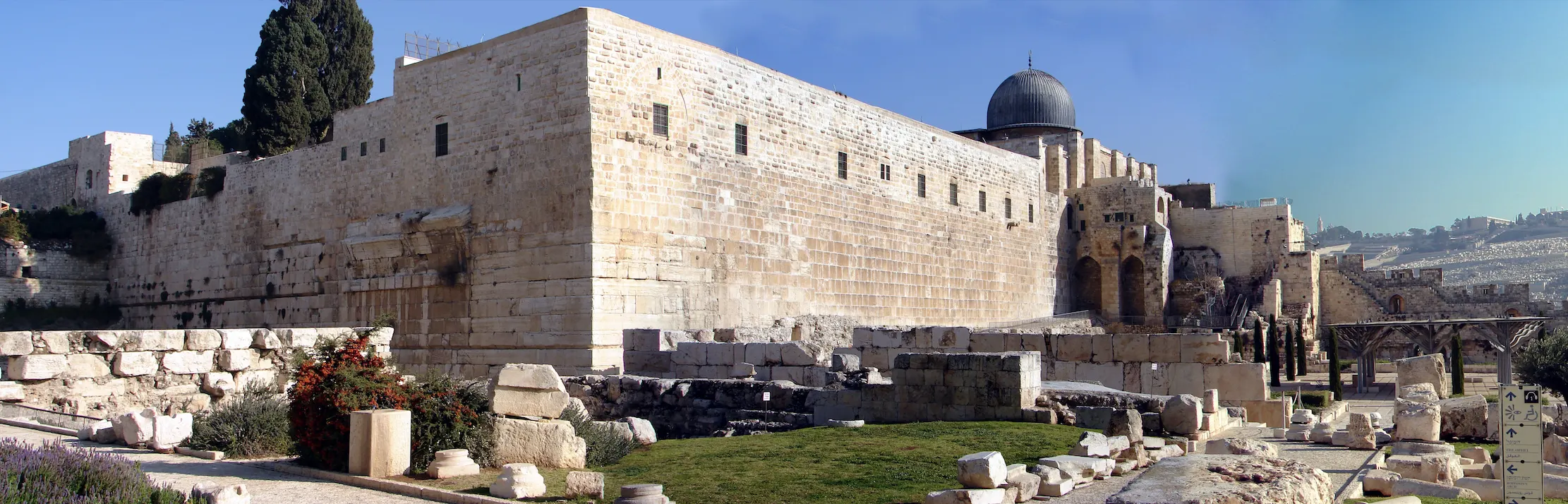
The most significant of Sulaiman's constructions was the great temple in Jerusalem — known in Islamic tradition as Bayt al-Maqdis (the Sacred House) or the precursor to what would become Al-Aqsa Mosque. Islamic sources place the construction of this temple as the continuation and completion of a sacred site originally established by Ibrahim (Abraham) and his descendants. The temple represented the culmination of a prophetic building tradition: just as Ibrahim had raised the foundations of the Ka'bah in Makkah (Quran 2:127), Sulaiman raised the sanctuary in Jerusalem — the second of the two earliest mosques established on earth.
A hadith in Sahih al-Bukhari (Book of the Prophets, Hadith 3366) records Abu Dharr asking the Prophet Muhammad (peace be upon him) which mosque was first established on earth. He replied, "Al-Masjid al-Haram" (the Sacred Mosque in Makkah). Abu Dharr asked, "Then which?" He replied, "Al-Masjid al-Aqsa." Abu Dharr asked, "How long was between them?" He replied, "Forty years." This hadith establishes the antiquity of the Jerusalem sanctuary and connects it to the earliest period of prophetic history.
Another hadith in Sahih al-Bukhari (Book of the Prophets, Hadith 3366) records that the Prophet Muhammad (peace be upon him) stated that Sulaiman ibn Dawud, upon completing the construction of Bayt al-Maqdis, asked God for three things: judgment that would accord with God's own judgment, a kingdom that would belong to no one after him, and that no one should come to this mosque (al-Masjid al-Aqsa) intending only prayer except that they would leave it cleansed of sins as the day their mother bore them. The Prophet stated that the first two were granted, and expressed hope that the third was also granted.
This hadith connects Sulaiman's construction directly to the site that would later become the third holiest mosque in Islam — the place to which Prophet Muhammad would journey in the Night Journey (Isra') and from which he would ascend to the heavens (Mi'raj). The continuity of sacred geography — from Ibrahim through Dawud and Sulaiman to Muhammad — is a fundamental element of Islamic sacred history. The temple that Sulaiman built was not merely a political monument but a house of worship — a place consecrated to the remembrance of God and carrying divine promise for all who would pray there until the end of time.
Al-Tabari records traditions about the scale of the construction: the temple complex reportedly took years to complete, employed thousands of jinn and human workers, and incorporated the miraculous fountain of molten copper (34:12) alongside conventional building materials. The structures included spaces for prayer, judicial proceedings, royal audiences, and public assembly — reflecting the Islamic understanding of Sulaiman's kingdom as one in which governance and worship were inseparable activities conducted in integrated architectural spaces.
The Jinn as Builders
The Quran specifically identifies the jinn as the primary labour force for Sulaiman's construction projects:
"And [We subjected] among the jinn those who worked for him by the permission of his Lord. And whoever deviated among them from Our command — We will make him taste of the punishment of the Blaze. They made for him what he willed..." (Quran 34:12–13)
"And among the devils were those who dived for him and did work other than that. And We were of them a guardian." (Quran 21:82)
The jinn's capabilities — superhuman strength, the ability to work with materials beyond human manipulation, speed and endurance exceeding human limits — enabled construction on a scale impossible for human labour alone. Islamic tradition describes the jinn cutting stone from quarries, transporting massive blocks, working with molten metals (the "fountain of copper" mentioned in 34:12), and executing architectural designs of extraordinary complexity and beauty.
The division of labour between jinn and humans in Sulaiman's kingdom reflects an important theological principle: the subjugation of the jinn to human prophetic authority demonstrated that the natural hierarchy (God → Prophet → Jinn → Humans in terms of power) was subordinated to the spiritual hierarchy (God → Prophet → Believers, regardless of species). The jinn, though more powerful than humans in raw capability, served under human prophetic direction — establishing that spiritual authority transcends physical power.
Al-Tha'labi records traditions about specific categories of jinn labour: some were assigned to quarrying and stone-cutting, working with precision and speed beyond human capability; others specialised in underwater work, diving for pearls and coral used in decoration; still others were tasked with metalwork, shaping the miraculous flowing copper into architectural elements of surpassing beauty. The rebellious among the jinn — those who resisted or attempted escape — were "bound in shackles" (38:38), demonstrating that Sulaiman's authority included both the direction of willing labour and the restraint of unwilling subjects. This combination of productive employment and punitive restraint mirrors the functions of any comprehensive governance system — suggesting that Sulaiman's kingdom was not a fantasy but a fully-functioning polity with institutions for both utilisation and correction.
The divine command concluding this passage — "Work, O family of Dawud, in gratitude" (34:13) — frames all of Sulaiman's construction as an act of worship. The buildings were not monuments to royal ego but expressions of thankfulness to God. The immediately following observation — "And few of My servants are grateful" — implies that most people blessed with wealth and power fail to channel them into gratitude; Sulaiman's construction programme was the exception, not the rule.
The Death of Sulaiman
The Hidden Death
The death of Sulaiman is one of the most remarkable narratives in the Quran — a story in which the mightiest king in human history died without anyone knowing, his corpse propped upright on his staff while the jinn continued their labours in ignorance:
"And when We decreed for [Sulaiman] death, nothing indicated to them [the jinn] his death except a creature of the earth eating his staff. And when he collapsed, it became clear to the jinn that if they had known the unseen, they would not have remained in humiliating punishment." (Quran 34:14)
The scene is vivid and theologically loaded: Sulaiman died while standing (or leaning) on his staff — perhaps in a posture of prayer, perhaps overseeing the jinn's work. His body remained upright, supported only by the wooden staff, and the jinn — unable to perceive his death — continued their heavy labour under the assumption that he was still watching and commanding them. Only when a dabbat al-ard (creature of the earth, universally interpreted as a termite or worm) ate through the staff did the body collapse, revealing that their master had been dead for what some traditions specify as a year or more.
Al-Tabari records multiple traditions regarding the duration: some say the jinn laboured unknowingly for a full year after Sulaiman's death; others say longer or shorter periods. The significance lies not in the precise duration but in the principle it demonstrates: even prolonged proximity to the dead prophet did not give the jinn access to information about his condition. Their sensory capabilities — however superior to humans in other respects — were entirely limited when it came to the knowledge of the unseen.
Ibn Kathir adds a poignant detail from exegetical traditions: Sulaiman had been engaged in worship at the time of his death — leaning on his staff while standing in prayer or contemplation within the mihrab (prayer niche) he had built. This detail, if accepted, means that Sulaiman died in the posture of devotion — the most fitting end for a prophet whose entire kingdom was an expression of worship. His death in prayer mirrors his life in prayer: the king who ruled standing before his Creator died standing before his Creator.
The Theological Significance
The Quranic narrative explicitly draws the theological conclusion: "it became clear to the jinn that if they had known the unseen (al-ghayb), they would not have remained in humiliating punishment." This verse establishes a fundamental principle in Islamic theology: the jinn do not possess knowledge of the unseen. Despite their superhuman powers — their ability to fly, to build, to dive, to move with extraordinary speed — the jinn cannot perceive what is hidden from them. They did not know that Sulaiman was dead even though his corpse was in their presence.
This has several important implications:
Refutation of fortune-telling: In pre-Islamic Arabia and many other cultures, the jinn were believed to possess knowledge of the future and the unseen, and human fortune-tellers (kahin, plural kuhhan) claimed to derive their predictions from jinn informants. The death of Sulaiman definitively refutes this claim: if the jinn could not perceive the death of a man standing before them, they certainly cannot know the future or the hidden dimensions of reality. Any claim to such knowledge is false.
The exclusivity of divine knowledge: Knowledge of the unseen belongs to God alone. This is stated repeatedly in the Quran (6:59, 27:65, 72:26–27), and the death of Sulaiman provides the most dramatic demonstration of this principle in prophetic history. The Quran states elsewhere: "Say: None in the heavens and the earth knows the unseen except Allah" (27:65) — and the death of Sulaiman is the narrative proof of this theological assertion. If the jinn who served the greatest prophet could not perceive his death, then no created being — however powerful — possesses knowledge of the unseen.
The hierarchy of creation: The death narrative establishes a clear hierarchy: God (who knows all) → the Prophet (who received divine knowledge) → the jinn (who, despite their powers, are ignorant of the unseen) → the worm (which, despite being the lowliest creature, was the instrument of truth's revelation). This hierarchy inverts worldly expectations: the mighty jinn were deceived, while the humble worm fulfilled a divine function. This inversion is characteristic of Quranic theology, which consistently challenges human assumptions about greatness and insignificance.
The humility of power: The most powerful king in history was brought down by the humblest of creatures — a worm. This dramatic irony carries a profound lesson: all human power, however vast, is ultimately subject to the same mortality that governs the smallest creature. The worm knew nothing of Sulaiman's greatness; it simply did what worms do — ate wood. And in doing so, it accomplished what armies could not: it brought the greatest king's rule to its visible end.
The mercy in concealment: Some scholars note that God concealed Sulaiman's death as a mercy — both to Sulaiman (whose final project could be completed) and to the jinn (whose freedom from service was delayed, preventing them from causing harm during the transition period). Al-Qurtubi suggests that the hidden death ensured the completion of the temple and other construction projects, which served humanity's religious needs for generations.
The Creature of the Earth
The dabbat al-ard (creature of the earth) — the humble termite or wood-boring worm that ate through Sulaiman's staff — holds a unique place in Islamic narrative. It is perhaps the smallest creature to play a pivotal role in a prophetic story, yet its action revealed a truth of cosmic significance: that the jinn are ignorant of the unseen. Al-Tha'labi records traditions that this creature was later honoured among its kind, and that its role demonstrates God's ability to use the most insignificant of His creatures to reveal the most significant of truths.
Sulaiman in Islamic Theology
His Place Among the Prophets
Sulaiman is one of the prophets explicitly named and affirmed in the Quran. He appears in the list of prophets who received divine revelation:
"Indeed, We have revealed to you, [O Muhammad], as We revealed to Nuh and the prophets after him. And We revealed to Ibrahim, Isma'il, Ishaq, Ya'qub, the Descendants, 'Isa, Ayyub, Yunus, Harun, and Sulaiman, and to Dawud We gave the Zabur." (Quran 4:163)
His theological status is clear: he was both a prophet (nabi) and a king (malik), one of the few figures in Islamic prophetology to hold both offices simultaneously. This dual role places him alongside his father Dawud as a prophet-king — a category distinct from prophets who held no political authority (like Yahya/John the Baptist) and from those whose political authority was contested or limited (like Musa/Moses in the wilderness years).
The Quran explicitly affirms Sulaiman's spiritual station at the end of his narrative in Surah Sad:
"And indeed, he had nearness to Us and a good return." (Quran 38:40)
This verse — using the phrase zulfa (nearness) and husn ma'ab (good return/destination) — places Sulaiman among those closest to God in the afterlife. It serves as the divine seal on his prophethood: whatever trials he faced, whatever momentary lapses occurred (the horses, the throne trial), his ultimate standing with God was one of intimacy and blessing. This is consistent with the broader Quranic principle that prophets, while they may experience moments of human weakness, are ultimately ma'sum (protected) in their prophetic mission and their final destiny.
The Refutation of Sorcery
One of the most important theological functions of the Sulaiman narrative in the Quran is the explicit refutation of the charge that Sulaiman practiced magic or sorcery:
"And they followed [instead] what the devils had recited during the reign of Sulaiman. It was not Sulaiman who disbelieved, but the devils disbelieved, teaching people magic and that which was revealed to the two angels at Babylon, Harut and Marut." (Quran 2:102)
This verse addresses a specific historical claim: that Sulaiman's extraordinary powers derived from sorcery rather than divine grant. According to Islamic exegesis, during and after Sulaiman's reign, devils (shayatin) authored texts of magic and attributed them to Sulaiman, claiming that his power over jinn and nature came from sorcerous arts rather than prophetic authority. The Quran categorically rejects this: "It was not Sulaiman who disbelieved" — sorcery being a form of disbelief (kufr) in Islamic law.
This refutation serves several purposes:
First, it protects Sulaiman's prophetic integrity. A prophet who practiced sorcery would be a contradiction in terms, since sorcery requires alliance with evil forces while prophethood requires absolute devotion to God alone.
Second, it distinguishes between divine miracle (mu'jizah) and sorcery (sihr). Sulaiman's powers were miracles — divinely granted, divinely directed, and divinely limited. Sorcery, by contrast, involves human manipulation of spiritual forces through forbidden means. The distinction is not in the effects (both may appear supernatural) but in the source: miracles come from God through a prophet; sorcery comes from devils through a sorcerer.
Third, it establishes a general principle applicable beyond Sulaiman: that extraordinary phenomena should not automatically be attributed to magic, and that the charge of sorcery has historically been used to discredit genuine prophets — as it was used against Prophet Muhammad by the Quraysh (Quran 10:2, 38:4). The pattern repeats across prophetic history: the powerful and the established dismiss divine messengers by attributing their miracles to sorcery or madness, thereby avoiding the more challenging conclusion that God has truly spoken through them.
Furthermore, the Quran 2:102 passage introduces a broader discussion about the nature of magic itself — distinguishing between the sihr (sorcery) that the devils taught humanity and the divinely-granted mu'jizat (miracles) of the prophets. This distinction has been foundational for Islamic jurisprudence regarding magic: sorcery is categorically forbidden (haram) precisely because it operates through disobedience to God, while prophetic miracles are signs of divine favour and obedience. Sulaiman's command over the jinn was not manipulation of dark forces but delegated divine authority — a fundamental difference in mechanism, purpose, and moral character.
The Concept of Tested Power
Sulaiman's story introduces a distinctive theological concept: that extraordinary worldly power can be a test (fitnah) rather than a reward. While the Quran presents his kingdom as a divine gift, it simultaneously emphasises that the gift carried the weight of accountability:
"This is from the favour of my Lord to test me whether I will be grateful or ungrateful." (Quran 27:40)
This verse — spoken by Sulaiman upon receiving Bilqis's transported throne — frames even miraculous power as a moral examination. The test has only two possible outcomes: gratitude (shukr) or ingratitude (kufr). There is no neutral ground; receiving divine gifts without responding with thankfulness is itself a form of ingratitude.
This theological framework has profound implications for Islamic ethics of power: every position of authority, every material blessing, every talent or ability is simultaneously a divine trust (amanah) and a divine test. The powerful are not more favoured than the powerless; they are more tested. And the test is passed not by renouncing power (which would be to reject God's gift) but by wielding it with justice, gratitude, and consciousness that it could be withdrawn at any moment — as Sulaiman himself experienced during the trial of the throne.
The Mu'tazili theologians particularly emphasised this aspect of Sulaiman's story, arguing that divine gifts are always tied to divine accountability — a principle they applied to their broader discussions of divine justice ('adl) and human responsibility. If God grants extraordinary power, He does so knowing that the recipient will be tested proportionally to their gifts. Sulaiman's tests — the horses, the throne trial, the temptation to attribute his power to himself rather than God — were the necessary correlates of his extraordinary endowments.
The Ash'ari school, while differing from the Mu'tazilites on questions of divine justice, agreed that Sulaiman's narrative demonstrates the hikmah (wisdom) of God's distribution of gifts: He gives to whom He wills, when He wills, and tests each recipient according to what they have received. The verse "And few of My servants are grateful" (34:13) serves as a warning: the default human response to power is ingratitude; Sulaiman's response of gratitude was exceptional, achieved only through prophetic guidance and constant spiritual vigilance.
Gratitude as Response to Gifts
The theme of gratitude (shukr) is the theological backbone of the Sulaiman narrative. It appears at every crucial juncture:
- Upon hearing the ant's speech: "My Lord, enable me to be grateful for Your favour" (27:19)
- Upon receiving the throne of Bilqis: "This is from the favour of my Lord to test me whether I will be grateful or ungrateful" (27:40)
- The divine command to his family: "Work, O family of Dawud, in gratitude" (34:13)
- The divine observation: "And few of My servants are grateful" (34:13)
Sulaiman's gratitude was not passive thankfulness but active service — his entire kingdom was organised as an expression of thanks. His construction projects, his governance, his judgments, his prayers — all were forms of shukr. This model of gratitude-as-active-service rather than mere verbal acknowledgment is one of the most important ethical contributions of the Sulaiman narrative to Islamic spiritual thought.
The concept of shukr in Sulaiman's example operates on three levels recognised by Islamic scholars: gratitude of the heart (shukr al-qalb) — the inner recognition that all blessings come from God; gratitude of the tongue (shukr al-lisan) — verbal praise and acknowledgment of God's gifts; and gratitude of the limbs (shukr al-jawarih) — using the gifts in God's service. Sulaiman demonstrated all three simultaneously: his heart recognised divine agency ("this is from the favour of my Lord"), his tongue expressed thanks (his prayers recorded throughout the narrative), and his limbs acted in service (his governance, construction, and justice). This three-dimensional gratitude is what the Quran means by the command "Work, O family of Dawud, in gratitude" — it is gratitude expressed through the totality of one's being and actions, not merely a feeling or a phrase.
Sulaiman's Character
Gratitude and Humility
Despite commanding the greatest kingdom in human history, Sulaiman is consistently portrayed in the Quran as a man of profound humility before God. His prayers — consistently beginning with praise and requests for forgiveness — reveal a soul that understood itself as a servant ('abd) regardless of its worldly station. The Arabic phrase ni'ma al-'abd (how excellent a servant) used for his father Dawud (Quran 38:30) applies equally to Sulaiman: he was God's servant first and a king second.
His humility was not the false modesty of someone who pretends not to possess what they clearly have. Sulaiman acknowledged his gifts openly: "O people, we have been taught the language of birds, and we have been given from all things" (27:16). But this acknowledgment was immediately followed by attribution: "Indeed, this is the evident bounty" — meaning it was God's bounty, not Sulaiman's achievement. Acknowledging gifts while attributing them to the Giver is the Islamic model of humble excellence: neither false denial of one's capabilities nor arrogant self-attribution.
Wisdom in Judgment
Sulaiman's wisdom (hikmah) is presented in the Quran as divinely endowed rather than merely the product of experience or intelligence:
"And We gave understanding of the case to Sulaiman, and to each [of them] We gave judgment and knowledge." (Quran 21:79)
His judicial wisdom — demonstrated in the case of the sheep and the field — was characterised by a concern for equity, creative problem-solving, and outcomes that preserved the rights of all parties. Unlike merely punitive judgment, Sulaiman's rulings sought restoration: the field would be restored, the sheep preserved, both owners made whole. This restorative approach to justice — seeking the underlying interest rather than mechanical application of rules — has been cited by Islamic legal theorists as exemplifying the maqasid al-shari'ah (objectives of Islamic law): the protection of life, property, and social harmony.
Justice and Governance
Sulaiman's governance encompassed beings of radically different natures — humans, jinn, and animals — yet maintained justice across all categories. The rebellious jinn were "bound in shackles" (38:38) — punished for disobedience — while the obedient were assigned work appropriate to their capabilities. Animals were treated with consideration: Sulaiman smiled at the ant rather than crushing it, suggesting that his rule over animals was benevolent rather than exploitative.
The hadith literature expands on Sulaiman's justice. A famous hadith in Sahih al-Bukhari (Book of the Prophets) recounts the story of two women who disputed over a child, each claiming to be its mother. Sulaiman proposed cutting the child in half, whereupon the true mother offered to give up her claim rather than see her child harmed — revealing her identity through her maternal instinct. This story (shared with the Jewish tradition) illustrates Sulaiman's use of psychological insight rather than mere evidence-gathering in judicial proceedings.
Worship and Devotion
Despite the demands of governing the most complex kingdom in history, Sulaiman maintained intense personal worship. The horse episode (38:31–33) reveals a man who was distressed by even momentary neglect of prayer — suggesting that worship was his primary orientation, with governance serving as its expression rather than its replacement.
A hadith in Sahih al-Bukhari records the Prophet Muhammad saying: "Sulaiman ibn Dawud said, 'Tonight I will go around to seventy women [his wives], and each will give birth to a horseman who will fight in the cause of Allah.' His companion said, 'Say insha'Allah (if God wills),' but he did not say it. So none of them gave birth except one, who gave birth to a half-formed child." The Prophet then said, "Had he said insha'Allah, it would have served as an affirmation for his intention, and they would have fought as horsemen in the cause of Allah" (Sahih al-Bukhari, Book of Oaths, Hadith 6639). This hadith reinforces the lesson that even a prophet of Sulaiman's stature must maintain constant awareness of divine sovereignty over all outcomes.
The Combination of Power and Submission
What makes Sulaiman's character distinctive in prophetic history is the combination of absolute worldly power with complete spiritual submission. He possessed everything the human heart could desire — wealth, authority, knowledge, supernatural abilities, a vast kingdom — yet his Quranic portrayal shows a man whose primary concern was his standing before God, not his standing among men.
This combination is exceedingly rare in human history. Power, as the famous observation goes, tends to corrupt. Yet Sulaiman demonstrates that corruption is not inevitable — that power wielded as a trust, held with gratitude, and directed toward divine service can ennoble rather than debase. His example answers the question: "Is it possible to be both the most powerful person in the world and a sincere servant of God?" The Quran's answer, through Sulaiman, is yes — but only through constant vigilance, perpetual gratitude, immediate repentance when one errs, and the unwavering consciousness that all power belongs ultimately to God and is merely lent to human hands.
Sulaiman in Comparative Religion
The Jewish Tradition
In Judaism, Solomon (Shelomoh) is presented in the Hebrew Bible primarily in 1 Kings 1–11 and 2 Chronicles 1–9. The biblical account shares several elements with the Islamic narrative: his wisdom, his wealth, his building of the Temple in Jerusalem, and his command over spirits (in later Jewish tradition, particularly in the Testament of Solomon, a pseudepigraphical work from the 1st–5th centuries CE).
However, significant differences exist between the biblical and Islamic portrayals. The Hebrew Bible describes Solomon's later years as a period of religious decline: influenced by his foreign wives, he is said to have turned to the worship of other gods (1 Kings 11:1–13). This narrative of apostasy is categorically rejected in Islamic theology. The Quran explicitly defends Sulaiman's monotheistic integrity: "It was not Sulaiman who disbelieved" (2:102). In the Islamic view, a prophet — protected by divine ismah (infallibility in matters of faith and morality) — cannot commit shirk (polytheism) or major sins that would compromise the prophetic mission. The biblical account of Solomon's idolatry is therefore regarded in Islamic scholarship as a corruption (tahrif) of the original narrative, possibly reflecting later political or theological agendas within Israelite history — perhaps the need to explain the division of the kingdom after Solomon's death by attributing it to divine punishment for idolatry.
This difference illustrates a broader methodological distinction between Islamic and biblical approaches to prophethood. The Hebrew Bible frequently portrays prophets with significant moral failings (David's adultery, Noah's drunkenness, Solomon's idolatry), while the Islamic tradition maintains prophetic ismah — the protection of prophets from major sins, particularly those that would undermine their credibility as divine messengers. For Islamic theology, a prophet who commits idolatry is a contradiction: how could God command people to follow someone who himself violates the most fundamental divine commandment?
The Jewish tradition also attributes to Solomon the authorship of several biblical books: Proverbs (Mishlei), Ecclesiastes (Qohelet), and the Song of Songs (Shir ha-Shirim). While Islam does not confirm these specific attributions, it acknowledges that Sulaiman was given hikmah (wisdom) and 'ilm (knowledge), which may have included written works not preserved in their original form. The attribution of wisdom literature to Solomon/Sulaiman in both traditions reflects the shared recognition of his extraordinary intellectual gifts.
The Christian Tradition
In Christianity, Solomon appears primarily as an ancestor of Jesus (Matthew 1:6–7) and as a figure of wisdom referenced by Jesus himself: "The Queen of the South will rise at the judgment with this generation and condemn it; for she came from the ends of the earth to listen to Solomon's wisdom, and now something greater than Solomon is here" (Matthew 12:42). This reference is significant for Islamic-Christian dialogue: Jesus's acknowledgment of Solomon's wisdom — while claiming to surpass it — mirrors the Islamic understanding of prophetic succession in which each prophet affirms those who came before while carrying a unique mission of his own.
The Christian tradition generally follows the Hebrew Bible's portrayal, including the narrative of Solomon's later apostasy — though some Church Fathers, including Origen and Gregory of Nazianzus, debated whether Solomon ultimately repented. The Eastern Orthodox tradition tends toward a more sympathetic reading of Solomon, with some traditions including him among the righteous of the Old Testament, while the Western Catholic tradition has historically been more critical. The figure of Solomon in Christian mystical literature — particularly in commentaries on the Song of Songs — emphasises the allegorical and spiritual dimensions of his kingship, reading his marriage to Pharaoh's daughter and the Shulammite woman as symbols of Christ's relationship with the Church.
The Islamic Distinctive
The Islamic portrayal of Sulaiman is distinctive in several ways:
First, his prophetic integrity is absolute — there is no narrative of spiritual decline or apostasy. He remains a faithful servant of God from beginning to end.
Second, his supernatural powers are presented as divinely granted miracles rather than magical acquisitions — the sorcery charge is explicitly and categorically refuted.
Third, his kingdom is presented as unique by divine decree — it was not merely historically unmatched but theologically unrepeatable, granted in response to a specific prayer that God chose to answer.
Fourth, his death narrative — entirely absent from the Bible — carries profound theological import about the nature of the unseen and the limitations of the jinn.
Fifth, the Bilqis narrative in the Quran is far more developed than its biblical counterpart (1 Kings 10:1–13), which mentions the Queen of Sheba's visit but says nothing about conversion to monotheism, the hoopoe's intelligence mission, or the glass floor. The Islamic version transforms what the Bible presents as a diplomatic visit into a conversion story of cosmic significance.
Sulaiman in Islamic Intellectual History
In Sufi Literature
Sulaiman has occupied a distinctive place in Sufi (tasawwuf) literature, where his story is read as an allegory of the spiritual journey. The Sufis were particularly drawn to several elements of his narrative:
The paradox of the powerful servant: Sulaiman possessed everything, yet his primary self-identification was as a servant ('abd) of God. For Sufi writers, this represented the highest spiritual station — fana' fi'l-mulk (annihilation within sovereignty), where one possesses the world without being possessed by it. Jalal al-Din al-Rumi (d. 1273 CE) in his Masnavi references Sulaiman repeatedly as the model of the soul that commands the "jinn" of the lower self (nafs) while remaining in submission to the divine.
The ring of authority: Islamic folk tradition (expanded upon in Sufi texts) describes a ring given to Sulaiman that bore the "Greatest Name of God" (ism Allah al-a'zam) and was the source of his authority over jinn. While this ring does not appear in the Quran, it became a powerful symbol in Sufi literature of the spiritual authority that comes from knowledge of God's names — the idea that true power flows from intimacy with the divine, not from worldly force.
The language of birds: The mantiq al-tayr — Sulaiman's ability to understand the language of birds — gave its name to one of the most famous works of Sufi literature: Farid al-Din Attar's (d. c. 1221 CE) Mantiq al-Tayr (The Conference of the Birds), an allegorical poem in which birds journey toward their king, the Simurgh. While the poem does not directly retell Sulaiman's story, its title acknowledges his narrative as the archetypal framework for the mystical journey: the idea that a deeper language exists beneath surface appearances, accessible only to those whom God has chosen to hear it.
The throne and the kingdom as inner states: Later Sufi writers, particularly those in the school of Ibn 'Arabi (d. 1240 CE), interpreted Sulaiman's kingdom allegorically: the "jinn" representing the hidden forces of the soul that must be brought under the command of the spirit; the "wind" representing the breath (nafas) that carries the seeker toward God; the "throne" representing the heart (qalb) that must be purified and claimed by the divine. In this reading, every human being is potentially a "Sulaiman" who must establish sovereignty over the inner kingdom before seeking authority in the outer world. Ibn 'Arabi's Fusus al-Hikam (Bezels of Wisdom) devotes a chapter to Sulaiman, exploring the relationship between mercy (rahmah) and sovereignty (mulk) in his prophetic archetype.
Detachment within engagement: The Sufi tradition particularly valued Sulaiman as a model of zuhd fi'l-mulk — detachment within worldly engagement, as opposed to detachment from the world (which is easier and less heroic). A hermit who renounces wealth has accomplished something; a king who possesses everything yet remains inwardly free has accomplished far more. This principle influenced generations of Sufi thinkers who argued that true spirituality must be tested in the crucible of worldly responsibility, not merely cultivated in isolation.
In Islamic Political Thought
Sulaiman's dual status as prophet-king made him a natural reference point in Islamic political philosophy. The concept of a ruler who combined spiritual authority with temporal power — governing by divine mandate while remaining accountable to divine law — was central to classical Islamic theories of the caliphate and governance.
Abu Nasr al-Farabi (d. 950 CE), in his Al-Madinah al-Fadilah (The Virtuous City), described the ideal ruler as one who combined philosophical wisdom with prophetic inspiration — a figure not unlike Sulaiman. Al-Mawardi (d. 1058 CE), in his Al-Ahkam al-Sultaniyyah (The Ordinances of Government), drew on prophetic models including Dawud and Sulaiman to articulate the qualifications and responsibilities of the caliph.
The Ottoman sultans, in particular, invoked Solomonic imagery in their self-presentation. Sultan Suleiman I (r. 1520–1566 CE), whose very name echoed Sulaiman, was known in Europe as "Suleiman the Magnificent" and in the Islamic world as al-Qanuni (the Lawgiver) — a title that deliberately evoked the wisdom and justice of his prophetic namesake. The Süleymaniye Mosque in Istanbul, completed in 1557 by the architect Mimar Sinan, was consciously conceived as a rival to Sulaiman's Temple — a statement that Ottoman sovereignty continued the Solomonic tradition of combining piety with architectural magnificence. The mosque complex (külliye) included madrasas, a hospital, a bath, a caravanserai, and a soup kitchen — reflecting the comprehensive social vision that the Islamic tradition associated with Solomonic governance: not merely prayer but the total welfare of the community.
The Mughal emperors of India similarly drew on Solomonic symbolism. The takht (throne) terminology in Mughal court language echoed the Quranic 'arsh of Sulaiman, and Mughal architectural programmes — particularly under Shah Jahan (r. 1628–1658 CE) — consciously evoked the magnificence that Islamic tradition associated with Sulaiman's constructions. The Peacock Throne (Takht-i Tawus), commissioned by Shah Jahan, was explicitly compared to Sulaiman's legendary throne in court panegyrics.
In Popular Culture and Literature
In popular Islamic literature, Sulaiman became one of the most frequently narrated prophets. The Qisas al-Anbiya (Stories of the Prophets) genre — from al-Tha'labi (d. 1035 CE) to al-Kisa'i (11th century CE) — devoted extensive chapters to Sulaiman, often incorporating Isra'iliyyat and folk traditions that expanded the Quranic narrative with colourful detail. These popular accounts describe his flying carpet (an expansion of the Quranic wind), his conversations with specific animals, the details of his palace and throne, and the adventures of his ministers and servants.
In Persian literature, Sulaiman appears as a literary archetype of the just king. The Shahnameh tradition and subsequent Persian poetry frequently invoke "the throne of Sulaiman" (takht-i Sulayman) as a symbol of legitimate, divinely-sanctioned authority. A specific geographic site in Iran — Takht-i Sulayman (Throne of Solomon) — became associated with royal legitimacy, serving as a Zoroastrian fire temple and later an Ilkhanid palace complex, its very name invoking the Solomonic model of sacred kingship.
In the One Thousand and One Nights (Alf Layla wa-Layla), jinn are frequently described as having been imprisoned by "Sulaiman ibn Dawud" in copper vessels sealed with his ring — a motif that became one of the most recognizable elements of Islamic popular culture worldwide, eventually entering European literature through the translations of Antoine Galland (1704–1717) and subsequent adaptations. The "genie in the bottle" — perhaps the most famous image from the Nights in Western popular culture — is ultimately derived from the Quranic account of Sulaiman's authority over the jinn, filtered through centuries of storytelling, elaboration, and cultural transmission.
In modern Arabic literature, Sulaiman continues to serve as a reference point. Tawfiq al-Hakim (d. 1987 CE), the Egyptian playwright, drew on Solomonic themes in exploring questions of power and wisdom. The Palestinian poet Mahmoud Darwish (d. 2008 CE) invoked Jerusalem's Solomonic heritage in poetry addressing the city's contested status. Contemporary Islamic children's literature frequently features Sulaiman's story — particularly the ant episode and the hoopoe — as a means of teaching environmental awareness, the importance of gratitude, and the reality of divine gifts.
Conclusion
Prophet Sulaiman stands in the Islamic tradition as a figure of unique and unrepeatable grandeur — a prophet whose kingdom encompassed dimensions of reality that no other human has ever governed, yet whose heart remained oriented toward the God who granted it all. His story, as told across seven surahs of the Quran, addresses some of the most fundamental questions of human existence: Can power be held without corruption? Can wealth coexist with piety? Can the extraordinary be received with humility? Can a creature given dominion over other creatures remain a servant of the Creator?
The Quranic answer to each of these questions, through the narrative of Sulaiman, is affirmative — but conditional. Power held in gratitude, exercised in justice, and returned to God in prayer does not corrupt; it serves. Wealth channelled into construction for worship, governance of diverse beings with equity, and the demonstration of divine truth becomes itself an act of devotion. The extraordinary, when met with the perpetual acknowledgment that "this is from the favour of my Lord to test me," becomes not a source of pride but a deepened awareness of one's dependence on God.
The narrative arc of Sulaiman's life — from the youthful wisdom that surpassed his father's judgment, through the accumulation of unprecedented gifts (jinn, wind, animals, copper, wisdom), the great encounters (the ants, the hoopoe, Bilqis), the tests (the horses, the throne trial), the constructions (the temple, the palaces), to the hidden death and its revelation by a worm — traces a complete theology of power. At every point, the narrative returns to the same principle: all power is from God, all power is a test, and the only appropriate response to power is gratitude expressed through service.
Sulaiman's legacy endures in the sacred geography of Jerusalem, in the theological principles his story established (the jinn's ignorance of the unseen, the distinction between miracle and sorcery, the accountability of power), in the literary and intellectual traditions he inspired (from Attar's Conference of the Birds to the Ottoman architectural programme), and in the ethical frameworks his example continues to generate for Muslim thinkers addressing contemporary challenges of power, ecology, and interfaith engagement.
His final image — a king so devoted to his work that he died standing, his departure unnoticed until the humblest creature revealed what the mightiest could not perceive — remains one of the most powerful images in Islamic prophetic literature: a testament to the hiddenness of death, the limitations of all creation before God's knowledge, and the ultimate equality of all beings — from the king of the jinn to the worm in the wood — before the Lord of the worlds.
The Quran concludes its treatment of Sulaiman with an affirmation of his spiritual station: "And indeed, he had nearness to Us and a good return" (38:40). This brief verse — affirming Sulaiman's closeness to God and his blessed afterlife — serves as the divine verdict on a life that balanced unprecedented power with unwavering faith.
References and Further Reading
Primary Islamic Sources
- Quran, Surah al-Baqarah (2:102) — the refutation of the charge that Sulaiman practiced sorcery; distinction between prophetic miracle and devils' magic
- Quran, Surah an-Nisa (4:163) — Sulaiman listed among prophets who received divine revelation
- Quran, Surah al-Anbiya (21:78–82) — the judgment of Dawud and Sulaiman concerning the field; subjection of wind and devils to Sulaiman's service
- Quran, Surah an-Naml (27:15–44) — the inheritance from Dawud, the language of birds, the ants, the hoopoe, the Queen of Sheba narrative, the glass floor, Bilqis's conversion
- Quran, Surah Saba (34:10–14) — the gifts granted to Dawud and Sulaiman, the jinn's labour, the fountain of copper, the death of Sulaiman and the worm
- Quran, Surah Sad (38:30–40) — the excellent servant, the test of the horses, the trial of the throne, the prayer for an unmatched kingdom, the subjection of wind and jinn
- Sahih al-Bukhari, Book of the Prophets (Kitab al-Anbiya), Hadith 3427 — the story of the two women and the child; Sulaiman's judicial wisdom
- Sahih al-Bukhari, Book of Oaths and Vows, Hadith 6639 — Sulaiman's statement about seventy wives and the importance of saying insha'Allah
- Sahih al-Bukhari, Book of the Prophets, Hadith 3366 — Sulaiman's three requests upon completing Bayt al-Maqdis
- Sahih Muslim, Book of Mosques (Kitab al-Masajid), Hadith 520 — the virtue of prayer in al-Masjid al-Aqsa and its connection to Sulaiman's construction
Classical Islamic Sources
- Ibn Kathir, Isma'il ibn 'Umar. Qisas al-Anbiya (Stories of the Prophets). 14th century CE. The most widely-read collection of prophetic narratives in Sunni Islam; includes extensive treatment of Sulaiman's kingdom, the Bilqis narrative, and his death.
- Ibn Kathir, Isma'il ibn 'Umar. Tafsir al-Quran al-'Azim. 14th century CE. Comprehensive Quranic exegesis with detailed commentary on all Sulaiman-related passages.
- Al-Tabari, Muhammad ibn Jarir. Tarikh al-Rusul wa al-Muluk (History of Prophets and Kings). 10th century CE. The foundational Islamic universal history; includes extensive narratives about Sulaiman's reign, construction projects, and the circumstances of his death.
- Al-Tabari, Muhammad ibn Jarir. Jami' al-Bayan 'an Ta'wil Ay al-Quran. 10th century CE. The earliest comprehensive Quranic commentary; records multiple chains of interpretation for all Sulaiman passages.
- Al-Tha'labi, Ahmad ibn Muhammad. Qisas al-Anbiya (also known as 'Ara'is al-Majalis). 11th century CE. Elaborate retelling of prophetic stories with extensive folk and literary material on Sulaiman and Bilqis.
- Al-Qurtubi, Muhammad ibn Ahmad. Al-Jami' li-Ahkam al-Quran. 13th century CE. Legal and theological exegesis with detailed treatment of Sulaiman-related verses and their jurisprudential implications.
- Fakhr al-Din al-Razi. Mafatih al-Ghayb (Keys to the Unseen). 12th century CE. Philosophical and theological commentary with sophisticated analysis of the Sulaiman narratives' theological dimensions.
- Al-Kisa'i, Muhammad ibn 'Abd Allah. Qisas al-Anbiya. 11th century CE. Popular prophetic narratives with extensive Sulaiman material drawn from diverse traditions.
Academic and Scholarly Sources
- Brinner, William M. (trans.). 'Ara'is al-Majalis fi Qisas al-Anbiya, or Lives of the Prophets as Recounted by Abu Ishaq Ahmad ibn Muhammad ibn Ibrahim al-Tha'labi. Leiden: Brill, 2002. Critical English translation of al-Tha'labi's prophetic narratives.
- Lassner, Jacob. Demonizing the Queen of Sheba: Boundaries of Gender and Culture in Postbiblical Judaism and Medieval Islam. Chicago: University of Chicago Press, 1993. Comparative study of the Queen of Sheba in Jewish and Islamic traditions.
- Wheeler, Brannon M. Prophets in the Quran: An Introduction to the Quran and Muslim Exegesis. London: Continuum, 2002. Academic analysis of Quranic prophetic narratives including detailed treatment of the Sulaiman cycle.
- Tottoli, Roberto. Biblical Prophets in the Quran and Muslim Literature. London: Routledge, 2002. Scholarly examination of the relationship between biblical and Quranic prophetic narratives.
- El-Hibri, Tayeb. Parable and Politics in Early Islamic History: The Rashidun Caliphs. New York: Columbia University Press, 2010. Discusses how prophetic models (including Solomonic kingship) influenced early Islamic political thought.
- Klar, Marianna. Interpreting al-Tha'labi's Tales of the Prophets: Temptation, Responsibility and Loss. London: Routledge, 2009. Critical literary analysis of al-Tha'labi's narrative techniques in his retelling of prophetic stories.
- Noegel, Scott B. and Brannon M. Wheeler. The A to Z of Prophets in Islam and Judaism. Lanham: Scarecrow Press, 2010. Comparative encyclopaedia of prophetic figures across Islamic and Jewish traditions.
Further Reading
- Firestone, Reuven. Journeys in Holy Lands: The Evolution of the Abraham-Ishmael Legends in Islamic Exegesis. Albany: SUNY Press, 1990. Provides methodological context for understanding how prophetic narratives develop in Islamic exegetical tradition.
- Milstein, Rachel, Karin Rührdanz, and Barbara Schmitz. Stories of the Prophets: Illustrated Manuscripts of Qisas al-Anbiya. Costa Mesa: Mazda Publishers, 1999. Study of illustrated prophetic narrative manuscripts including Sulaiman imagery.
- Sells, Michael. Approaching the Qur'an: The Early Revelations. Ashland: White Cloud Press, 1999. Introduction to Quranic literary features relevant to understanding prophetic narratives.
- Nasr, Seyyed Hossein. The Study Quran: A New Translation and Commentary. New York: HarperOne, 2015. Contemporary scholarly Quranic commentary with extensive annotations on all Sulaiman-related passages.
- Aslan, Reza. No god but God: The Origins, Evolution, and Future of Islam. New York: Random House, 2005. Accessible introduction to Islamic history and theology with treatment of prophetic narratives.
- Renard, John. Friends of God: Islamic Images of Piety, Commitment, and Servanthood. Berkeley: University of California Press, 2008. Explores how prophetic models including Sulaiman influenced Islamic understandings of piety and authority.
Mentioned In
8 articles reference this topic
More from Age of the Prophets
Maryam bint Imran (Mary, Mother of Jesus)
Maryam bint Imran (Mary), mother of Prophet Isa (Jesus), holds a uniquely exalted place in Islam as the only woman named in the Quran. Revered for her purity, devotion, and the miraculous virgin birth of Jesus, she is regarded as one of the greatest women and a model of faith.
Prophet Adam عَلَيْهِ ٱلسَّلَامُ
The first human being and the first Prophet in Islam, created by Allah as His khalifah (vicegerent) on Earth. Father of humanity, Adam's story encompasses creation, paradise, the fall, repentance, and the beginning of human civilization.
Prophet al-Yasa عَلَيْهِ ٱلسَّلَامُ (Elisha)
Known as Al-Yasa in Arabic, Elisha was the successor of Prophet Elijah, blessed with a double portion of his spirit and known for numerous miracles of healing, provision, and resurrection during his ministry to Israel.
Prophet Ayyub عَلَيْهِ ٱلسَّلَامُ (Job)
Ayyub, the Job of the Bible, is named in four passages of the Qur'an and is the Islamic tradition's standing example of patience under trial. The Qur'an records his loss of wealth, family and health, his supplication, and his restoration, while naming no specific illness.