Shah Ahmad Shafi
A Bangladeshi scholar of hadith who led the seminary at Hathazari in Chittagong for more than three decades and chaired the country's Qawmi madrasa education board. Trained at Hathazari and Darul Uloom Deoband, he wrote a commentary on Sahih al-Bukhari.
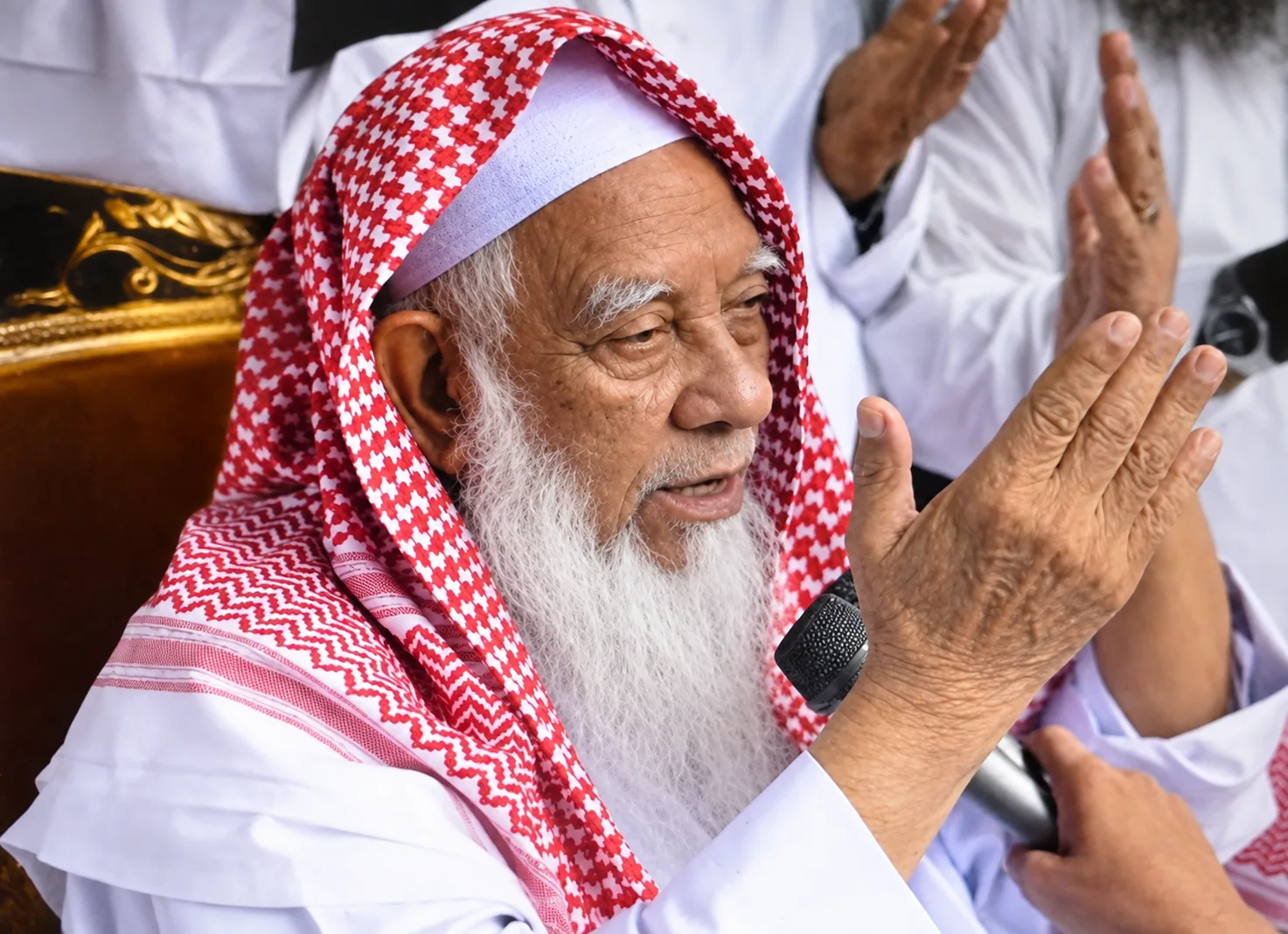
Shah Ahmad Shafi (5 April 1930 – 18 September 2020) was a Bangladeshi scholar of hadith and an educational administrator who led Al-Jamiatul Ahlia Darul Ulum Moinul Islam at Hathazari, near Chittagong, for more than three decades. Commonly known as the Hathazari madrasa, the institution is among the oldest and largest of the Qawmi seminaries of Bengal, and Shafi's tenure as its rector made him one of the most widely recognised religious figures in the country. He also served as chairman of the Bangladesh Qawmi Madrasah Education Board, the body coordinating the independent seminaries, and from 2010 he was the first amir of Hefazat-e-Islam Bangladesh, an organisation of Qawmi madrasa scholars and teachers.
His life spanned three states. He was born a subject of British India, lived from 1947 as a citizen of Pakistan, and from 1971 as a citizen of Bangladesh, without leaving the district in which he was born. That sequence is a useful reminder that the institutions of religious learning in Bengal long predate the political boundaries drawn around them, and that the scholarly networks running between Chittagong, Deoband, and the seminaries of what became Pakistan were older than any of the three sovereignties.
Birth and Early Education
Shafi was born on 5 April 1930 at Rangunia, in the Chittagong region. He received his first education within his family, and then entered Al-Jamiatul Arabiatul Islamiah at Ziri.
In 1941, corresponding to 1344–45 AH, at the age of about ten, he was admitted to Al-Jamiatul Ahlia Darul Ulum Moinul Islam at Hathazari. He studied there for ten years. The seminary would remain the institutional centre of his life: he returned to it as a teacher, rose to its headship, and died while still its rector, having been associated with it for close to eight decades.
He then travelled to Darul Uloom Deoband in India for advanced study in hadith and Qur'anic commentary, where he spent four years. Barbara Metcalf's history of the seminary describes a curriculum in which the hadith collections occupied the culminating position, read through in a final intensive year under the most senior teachers; this was the training Shafi went to Deoband to complete. During his time there he became closely attached to Husain Ahmad Madani, the seminary's principal teacher of hadith and the president of the Jamiat Ulama-i-Hind, and he is described in the biographical literature as among the youngest of Madani's authorised successors from the subcontinent.
The journey from Chittagong to Deoband was a well-worn one. Muhammad Qasim Zaman's study of the modern ulama traces how Deobandi scholarly networks extended across South Asia and beyond it, sustained by teacher-to-student transmission and by the authorisations that passed between them. Hathazari's own standing within that network is indicated by the fact that in 1949 the seminary was able to offer the post of Shaykh al-Hadith to Muhammad Idris Kandhlawi, one of the senior hadith scholars of Deoband, who declined it only because he had decided to settle in West Pakistan.
Teaching and Leadership at Hathazari
Shafi began his career as a teacher at the Hathazari madrasa. In 1986 or 1987, corresponding to 1407 AH, he was elected its rector, the head of the institution, and he held that position for the rest of his life. The seminary's majlis-e-shura, its consultative council, determined that he would continue as director general, and no acting rector was to be appointed during his lifetime.
The Qawmi madrasas of Bangladesh are privately funded and self-governing, supported by public subscription and charitable donation rather than by the state, and they set their own curricula and examinations. Zaman's account of the madrasa emphasises precisely this insistence on constituting a distinct sphere, managed by its own councils and protected against outside encroachment. Shafi's chairmanship of the Bangladesh Qawmi Madrasah Education Board placed him at the head of the coordinating structure for that sector, giving him a role in the examination and certification arrangements shared across a large number of independent institutions.
In 2010 he became the first amir of Hefazat-e-Islam Bangladesh, an organisation drawn from the teachers and graduates of the Qawmi seminaries. He held the office until his death, when he was succeeded by Junaid Babunagari.
Sufi Affiliations
Shafi held initiation in four Sufi orders — the Qadiri, Chishti, Suhrawardi and Naqshbandi — and in law he followed the Hanafi school, with the Maturidi position in theology.
Multiple tariqa affiliations of this kind are characteristic rather than unusual among scholars of the Deobandi tradition. Metcalf's study of the movement's founding generation describes its leading figures as combining the roles of jurist and Sufi guide, holding authorisation in several lineages at once, and treating the two forms of authority as complementary rather than competing. Shafi's fourfold affiliation places him within that inherited pattern, and connects a twentieth-century Bengali seminary directly to orders that had been established in the subcontinent for many centuries.
Public Statement Against Militancy
In 2009, corresponding to 1430 AH, Shafi joined Azizul Haque and a number of other Bangladeshi religious scholars in a joint statement addressed to the Prime Minister, Sheikh Hasina Wazed, condemning terrorism and militancy carried out in the name of Islam. The statement was made on behalf of the Qawmi madrasa leadership and offered the sector's cooperation with the government in countering militancy.
Writings
Shafi wrote in Arabic, Urdu and Bengali. His works include:
- Faiz al-Jari, a commentary on Sahih al-Bukhari, the collection at the centre of the curriculum he had studied and taught
- al-Khayr al-Kathir fi Usul al-Tafsir, on the principles of Qur'anic exegesis
- al-Bayan al-Fasil, al-Hujaj al-Qati'a and Izhar-e-Haqiqat, works of theology and doctrinal exposition
- Islam o Siyasat, on Islam and public life
- Bengali works of religious instruction, including Quran o Sunnat er Alokey Apnar Namaj, a guide to prayer, Sunnat o Bid'ater Sothik Porichoy, and Islami Ortho Bebostha on economic questions
The mixture of languages is itself informative. Arabic served for technical commentary addressed to scholars, while the Bengali works were written for ordinary readers. Zaman describes this double address as a general feature of the modern ulama's output: they continued to write demanding works for a specialist audience while also producing accessible material for a wide readership, and the ability to speak at both levels was part of how their authority was sustained.
Death
Shafi had for some years been affected by conditions of age, including diabetes and heart disease. Late on 17 September 2020 his condition deteriorated and he was brought by ambulance from the Hathazari madrasa to Chittagong Medical College Hospital, where he was admitted to intensive care after his blood pressure and pulse rate fell.
On the morning of 18 September a medical board recommended that he be moved to Dhaka. On the doctors' advice his family took him by air ambulance that afternoon to Asgar Ali Hospital in Dhaka, where he died at six o'clock in the evening, at the age of ninety. His funeral prayer was held at Chittagong, and he was buried in the madrasa cemetery at Hathazari.
His son, Anas Madani, is also a religious scholar. Among those who studied with him were Nurul Islam Olipuri, Jamir Uddin Nanupuri, Sultan Zauq Nadvi, Yahya Alampuri, and Junaid Babunagari, who succeeded him as amir of Hefazat-e-Islam.
References and Further Reading
Primary Islamic Sources
- The Qur'an — the foundation of the curriculum he studied at Hathazari and Deoband and taught for six decades
- Sahih al-Bukhari — the collection on which he wrote his commentary Faiz al-Jari
- Sahih Muslim — a second canonical collection of the dawra-i hadith, the culminating year of the seminary curriculum
- Faiz al-Jari by Shah Ahmad Shafi — his own commentary on al-Bukhari, the principal record of his hadith teaching
Classical Islamic Sources
- The Hanafi school of law, which he followed and taught
- The Maturidi tradition in theology, the doctrinal position of the Deobandi seminaries
- The Qadiri, Chishti, Suhrawardi and Naqshbandi orders, in each of which he held initiation
- The classical usul al-tafsir literature, the field of his al-Khayr al-Kathir fi Usul al-Tafsir
Academic and Scholarly Sources
- The Ulama in Contemporary Islam: Custodians of Change by Muhammad Qasim Zaman — for the madrasa as a self-governing sphere, the Deobandi networks extending across and beyond South Asia, and the ulama's writing for both specialist and general audiences
- Islamic Revival in British India: Deoband, 1860-1900 by Barbara Daly Metcalf — for Darul Uloom Deoband, its hadith-centred curriculum, and the combination of juristic and Sufi authority among its scholars
- Wikipedia, "Shah Ahmad Shafi", https://en.wikipedia.org/wiki/Shah_Ahmad_Shafi — consulted with the owner's authorisation for the biographical framework, dates, offices, affiliations and works
- Wikipedia, "Idris Kandhlavi", https://en.wikipedia.org/wiki/Idris_Kandhlawi — consulted with the owner's authorisation, for Hathazari's standing as a seminary recruiting senior hadith teachers in 1949
- Ashraf Ali Nijampuri, The Hundred: 100 Great Scholars from Bangladesh (Salman Publication, Hathazari, 2013) — a biographical compendium carrying a notice of his life; cited in the source consulted rather than read directly for this article
Further Reading
- Darul Uloom Deoband — the seminary where he completed his advanced training in hadith
- Husain Ahmad Madani — his teacher at Deoband
- The Deobandi Movement — the tradition to which the Hathazari seminary belongs
- Muhammad Idris Kandhlawi — the Deoband hadith scholar invited to Hathazari in 1949
- Sufi Orders in South Asia — for the four orders in which he held initiation
Mentioned In
2 articles reference this topic
More from South Asian Islam
Darul Uloom Deoband: The Seminary and the School of Thought
Darul Uloom Deoband is an Islamic seminary founded in northern India in 1866 or 1867 and the origin of the Deobandi school of thought. Its innovation was institutional: it carried the traditional religious sciences in the form of a modern school funded by public subscription.
The Ahl-i Hadis Movement
A nineteenth-century Indian Sunni movement that set aside the authority of the historic schools of law in favour of direct recourse to the Qur'an and hadith. Led by scholars at Delhi and Bhopal, it was marked by its manner of prayer and an austere standard of interpretation.
The Deobandi Movement
A school of Sunni thought and practice that grew from the seminary founded at Deoband in northern India in 1866 or 1867. Its scholars combined the roles of jurist and Sufi guide, built a madrasa funded by public subscription, and made hadith the centre of religious education.
The Jamaat-e-Islami
An organisation founded by Abul A'la Maududi at Lahore in August 1941 to form a disciplined body of Muslims who would remake society according to Islamic norms. After the partition of India it divided into separate and independent organisations in Pakistan, India and later Bangladesh.