Mufti Kifayatullah Dehlawi
An Indian Hanafi jurist widely titled Mufti-e-Azam, or Grand Mufti of India. He led Madrasa Aminia in Delhi for nearly half a century, was a founder and twice president of the Jamiat Ulama-i-Hind, and left some four and a half thousand legal rulings collected as Kifayat al-Mufti.
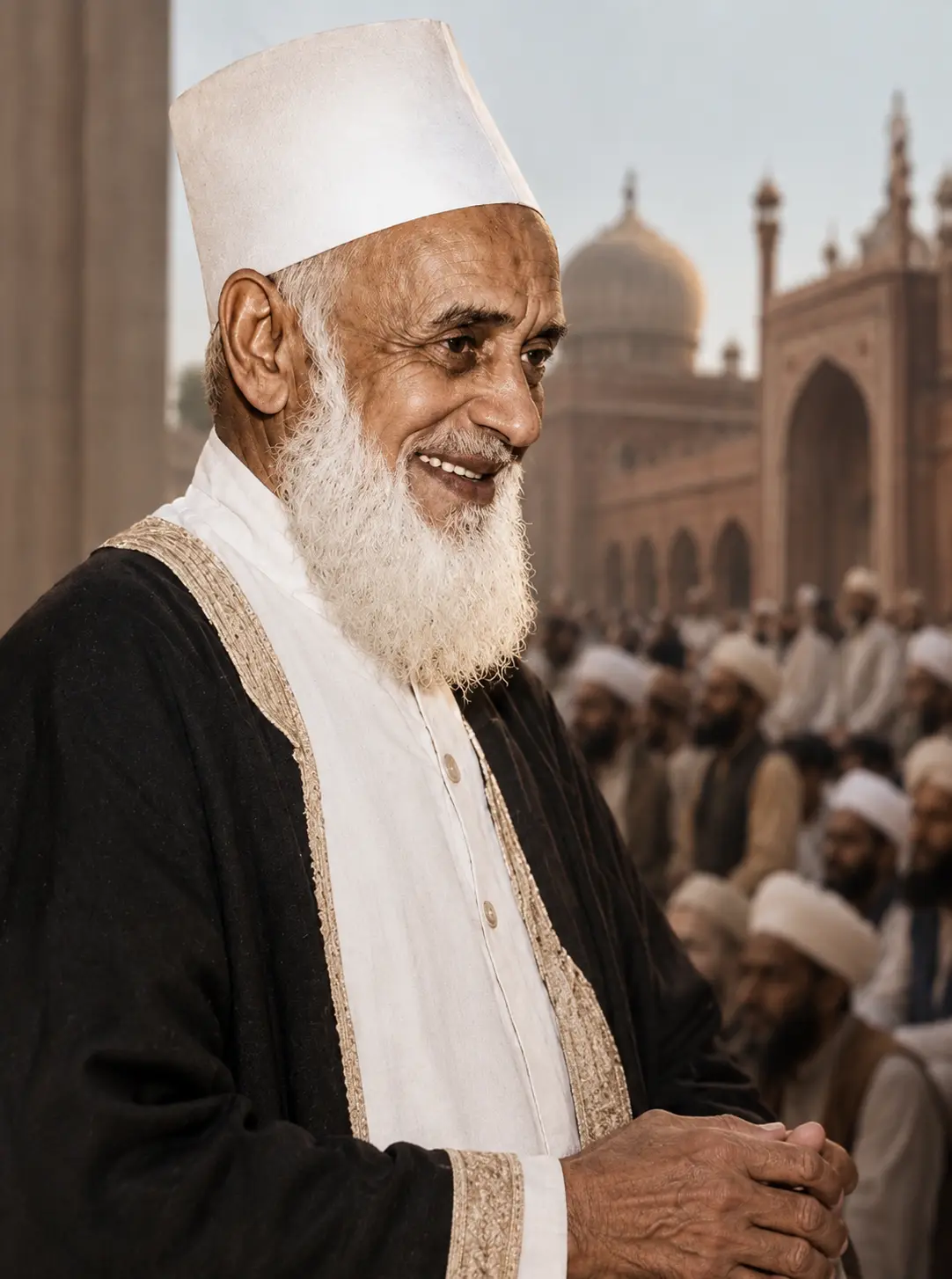
Muhammad Kifayatullah Dehlawi (1875 – 31 December 1952) was an Indian Hanafi jurist, teacher and political leader, widely titled Mufti-e-Azam or Grand Mufti of India. Muhammad Khalid Masud's entry on him in the TDV İslâm Ansiklopedisi gives his full name as Muhammad Kifayatullah b. Inayatullah b. Fayzullah Dihlawi, and records that although he was a successful teacher, a political leader, a poet and a thinker, he became known above all for his fatwas, and was famous for the strength of his memory, the sharpness of his intelligence and the depth of his reflection.1
He was born at Shahjahanpur in the United Provinces to a poor family, and paid for his own education out of handicrafts. After primary study in his home town and a period at the Madrasa-i Shahi in Moradabad he entered Darul Uloom Deoband, graduating in 1898, and taught for five years at Shahjahanpur before moving to Delhi in 1903 to join the newly founded Madrasa Aminia. He remained attached to that school for the rest of his life, as its mufti and teacher of hadith, then as its principal, and from 1920 as its rector. From Delhi he built a practice of legal rulings that reached him from across India and from countries in Asia and Europe, and that made his name in the city's courts; some four and a half thousand of those rulings survive in the collection Kifayat al-Mufti, assembled after his death by his son.
He was also, in Sayyid Mahboob Rizvi's phrase, a crusader as well as a jurist, and he was unusual among the Deoband muftis in taking an active part in politics.2 He criticised the Lucknow Pact in 1917 and called for self-rule; he was a founder of the Jamiat Ulama-i-Hind in 1919 and twice its president; he moved the resolution that led to the boycott of the British Victory Celebration; he was imprisoned twice in the civil disobedience years; and he led the organisation's delegations to the Mecca conference of 1926 and the Cairo conference on Palestine in 1938. After independence, finding his political companions pursuing office, he withdrew from politics altogether and returned to teaching and to the fatwa. This article draws chiefly on Masud's encyclopaedia entry and on Rizvi's institutional history of Darul Uloom Deoband, which survives in two separate printings used here as independent witnesses, together with Barbara Metcalf's study of the Deobandi revival and a further history of the seminary. The sources differ on several dates, and those differences, with the editorial decisions taken on them, are set out in the Historiographical Note.
Family and early years
Masud records that Kifayatullah was born at Shahjahanpur in 1875, and that he first received lessons in the Qur'an and in Urdu.3 Rizvi's memoir, which is among the notices of the seminary's graduates in the second volume of his history, gives the year as 1292 AH and the place as Shahjahanpur, and records that he received instruction in the Qur'an and his primary education at his native place from a number of different teachers.4
Both sources make his family's poverty a fact of his education rather than a detail of his background. Masud records that because the family was poor he met the cost of his studies from what he earned by handicrafts — tailoring, thread-spinning and carving.5 Rizvi gives one of those crafts specifically and adds the manner in which he carried his circumstances: despite his poverty, Mufti Sahib passed his student career at Moradabad and at the Dar al-Ulum with great self-respect, making crochet skull-caps and meeting his expenses from the income earned by selling them.6
Nothing in the approved sources consulted here establishes the origins of the family beyond its residence at Shahjahanpur, and the question is accordingly left where the evidence leaves it.
Education
Shahjahanpur and the Izazia madrasa
After his primary instruction, Masud records, Kifayatullah completed two years of elementary education at the I'zaziyya Madrasa in his home town.7 Rizvi's account agrees in substance and is more guarded about the extent of the study, saying that he read some books at the Madrasa-e Izazia at Shahjahanpur before moving on.8
Moradabad
From Shahjahanpur he went to the Madrasa-i Shahi at Moradabad. Masud records that he read Arabic language and literature there, together with fiqh.9 Rizvi names his principal teacher at Moradabad: he studied under Maulana Abd al-Ali, a disciple of Muhammad Qasim Nanautavi, and under other teachers of the school.10 The connection matters for the tradition in which he was formed, since it placed him under a pupil of one of Deoband's founders before he reached Deoband itself.
Darul Uloom Deoband
Masud dates his arrival at Deoband to 1312 AH, 1894, and describes the Dar al-Ulum as having made its name through its advocacy of independence.11 He graduated, on Masud's reckoning, in 1315 AH, 1898.12 Rizvi records only that in the end he took admission in the Dar al-Ulum and graduated from it in 1313 AH.13 The year given in this article is 1898, on the owner's editorial decision; the divergence is set out in the Historiographical Note.
At Deoband he became the student of Mahmud Hasan Deobandi, the seminary's chief teacher and afterwards known as Shaykh al-Hind. Rizvi makes that relationship the origin of his political life: cherishing a great faith in his teacher, he had begun to take an interest in politics from the very beginning of his career.14 The debt ran the other way as well: in 1918, while Mahmud Hasan was interned at Malta, Kifayatullah wrote a treatise about him, the Risala-i Shaykh al-Hind, and the TDV İslâm Ansiklopedisi records the two men's entries as linked by exactly that fact.15
Teaching and the beginnings of the fatwa
Ayn al-Ilm, Shahjahanpur
After graduating he returned to his home town as a teacher at the Madrasa Ayn al-Ilm. Masud records that he taught there for five years, and that during the same period he began to answer the legal questions put to him.16 Rizvi gives the same sequence: appointed a teacher at Madrasah Ayn al-Ilm, Shahjahanpur, he began fatwa-writing during this period.17
It is from these years that Masud dates the reputation that would define the rest of his career. His fatwas, being plain and concise, became well known in the courts of Delhi; questions were put to him from every part of India and from some countries of Asia and Europe.18 Rizvi identifies the same quality as the salient characteristic of the rulings: their brevity, and their clear and explicit language.19
Al-Burhan and the Qadiani controversy
Also in these years he founded a journal. Rizvi records that he started the monthly Al-Burhan in 1321 AH in order to refute Qadianism.20 Masud sets the journal in a wider frame of religious disputation: Kifayatullah took part in the debates conducted with Christian, Hindu and Ahmadi — Qadiani — missionaries, and published his refutations of the last of these in al-Burhan, the journal he brought out himself.21 Masud also records that he established a publishing house in Delhi, the Kitabkhana-i Rahimiyya, together with Mawlawi Hafiz Abd al-Ghani.22
Madrasa Aminia
The school he joined
Madrasa Aminia had been founded a few years before he came to it, and Rizvi's history describes its beginnings in the memoir of its founder that immediately precedes Kifayatullah's own. Amin al-Din Dehlawi was born about 1283 AH at Aurangabad in the Deccan, entered the Dar al-Ulum at Deoband in 1304 AH, read the rational sciences at Shahjahanpur from 1307 AH under Maulana Nadir al-Din, returned to Deoband in 1309 AH and graduated in 1319 AH; and in 1315 AH he started the Madrasa-e Aminiya in the Sunehri Masjid in Chandni Chowk, Delhi.23 Rizvi describes him as widely known in Delhi for his abstinence and piety, as showing no partiality in religious matters or in the management of the school, as loving his students like his own children, and as having always remained aloof from political frays — a temperament the opposite of his successor's.24
Metcalf's study treats the school's foundation as an instance of something more general, the cooperation among Deoband's graduates that accounts for the spread of Deobandi schools in the two decades either side of 1900. The founder, she records, was able to enlist the services of many of his fellow students both in joining the staff and in soliciting support: Anwar Shah Kashmiri, later the principal of Deoband itself, left a government post in Bijnor to serve as the first principal of the new school; Kifayatullah resigned his teaching post at the Madrasa Ayn al-Ilm in Shahjahanpur to become the school's mufti and teacher of hadith; and Maulana Ziya al-Haqq, another Deoband graduate, joined as second teacher and stayed some fifty-eight years until his death. The staffs of Deoband, of the Mazahir-i Ulum and of the Madrasa Aliyah at Fatehpur all helped the school in its early years, and Maulana Manfa'at Ali, then teaching at Deoband, used his influence to win the support of the traders of Delhi, who provided both funds and administrative help.25
Rizvi's footnote on the school agrees with Metcalf on the order of its principals and adds what became of it: it is a famous madrasah of Delhi; Anwar Shah Kashmiri was its first principal, and after him Kifayat Allah graced the masnad of principalship; it had first been established in the Sunehri Masjid, but as it grew it was moved to the Masjid-e Panipatian at Kashmiri Gate; it progressed much under Kifayatullah, students coming to it not only from distant parts of India but from foreign countries; a three-storeyed building was put up for it around the mosque; and it has always held a distinguished position among the madrasahs of Delhi by virtue of its academic standing and its centrality.26 The move to Kashmiri Gate is dated here to 1917, on the owner's instruction; the year printed in the history cannot be right, and the Historiographical Note sets the matter out.27
Principal and rector
Rizvi dates the move to Delhi to the end of 1321 AH and gives the reason for it: at the insistence of Maulana Amin al-Din Dehlawi he went to grace the principal's seat at the Madrasa-e Aminiya, Delhi, to which he remained attached until his last breath.28 Masud dates his teaching at the school from 1903 and likewise carries it to his death, and adds the later step: on the death of the school's founder, Shaykh Aminuddin, in 1338 AH, 1920, Kifayatullah took over the directorship and led the institution's development.29 Rizvi's memoir of Amin al-Din gives that death precisely, as the nineteenth of Ramadan 1338, which the independent printing of the history converts to 6 June 1920, and records his burial at Mehndiyan near the grave of Shah Waliullah.30
On the owner's instruction the sequence is given here as follows: that he declined an invitation to join the seminary at its foundation in 1897, being then engaged in teaching at Shahjahanpur; that he came to Delhi and took up the principalship in 1903; and that on the founder's death he was appointed the school's second rector, an office he held until his own death in 1952.31
Whichever office he held at a given moment, both sources agree about the result. Rizvi's assessment is unqualified: Mufti Sahib's greatest achievement is the Madrasa-e Aminiya, Delhi, which made unusual progress through his efforts and came to be counted among the famous seminaries of India.32 One measure of what the school became under him is that students came to it to learn his own craft: Rizvi's notice of another graduate records that, living at the Madrasa-e Aminia, he practised the art of fatwa-writing under Kifayatullah's guidance before returning to Deoband in 1336 AH to complete the daura-e hadith.33
Reform of the madrasas
Kifayatullah's interest in the schools was not confined to his own. Masud records that alongside the unification of the madrasa's administration he worked for the reform of its educational programme and its methods, and that his proposals for reform were partly accepted at the joint meeting of the Deoband madrasas in 1910.34 Metcalf's note supplies the initiative behind that meeting and dates it earlier: in 1904 Kifayatullah began a Movement for the Union of Madrasahs, and he arranged for his students to receive their turbans at the great dastarbandi ceremony held at Deoband in 1328 AH, 1909–10. The same note records that the school remained a centre for fostering close links among the schools, that its teachers were active in political movements, and that the first office of the Jamiat Ulama-i-Hind was at Madrasa Aminia.35
Students
Masud records that he trained hundreds of students, and names four among them: Mawlana I'zaz Ali, one of Deoband's teachers of Arabic literature; Mahdi Hasan, mufti of Deoband; Mawlana Ahmad Sa'id, president of the Jamiat Ulama-i-Hind; and Mawlana Muhammad Taqi Amini, a writer on Islamic legal theory.36
The mufti
The scale and the manner of the rulings
The office for which he is remembered was never a single appointment. Masud records that he issued fatwas in the capacity of chief mufti in the column headed "Hawadis u Ahkam" in al-Jam'iyyat, the organ of the Jamiat Ulama-i-Hind, so that his rulings reached a readership well beyond the people who had asked for them.37 The collection assembled after his death describes itself as the fatwas he gave between 1898 and 1952, and particularly those given as the official mufti of the Madrasa Aminia and of the Jamiat Ulama-i-Hind.38
Masud identifies what distinguished him from his colleagues, and it bears on everything in the next section: unlike the other Deoband muftis, who did not concern themselves with active politics, Kifayatullah gave rulings on a very wide range of subjects by virtue of his grasp of the questions actually facing the Muslims of India, and on most of the important questions he sought a way through while preserving his impartiality.39 Masud also sets out the conditions that produced the questions: the problem of Muslim identity, Hindu–Muslim conflicts that reached the point of violent risings, events in the Islamic world and above all in Turkey, and the general state of the world, all of them generating highly complicated political problems that sometimes provoked extreme and emotional reactions.40
Rulings on the Ottoman question
Masud records a ruling of 1912 in which Kifayatullah supported the Ottomans in the Balkan wars, and called on the Muslims of India to give that year's sacrifice money in aid of the victims of the war.41
Rulings on worship, and the controversy of 1916
Not all of the rulings that made a noise were political. In 1916 Kifayatullah gave a fatwa against the practice of performing tasbih collectively and aloud after congregational prayers, and Masud records that it led to debates in India in which well-known scholars took sides; the fatwas given for and against are collected in Kifayatullah's own Nafa'is-i Marghuba.42 That work, as Masud describes it, contains the author's fatwa on the ruling concerning supplication after the obligatory prayers together with the fatwas that other scholars gave against it — a book, that is, which prints the case against its own author's position.43
Relations with non-Muslims
Masud records a fatwa given in answer to a question about the attitude Muslims should take in their relations with Hindus and Christians, in which Kifayatullah emphasised that Islam does not forbid relations with non-Muslims.44
He also records a step taken in 1924. At a conference arranged in that year for the purpose of establishing Hindu–Muslim unity, Kifayatullah was among the scholars who signed a motion calling on Muslims to abide by the principle that no one may be compelled to change his religion and that no one who changes it may be punished.45 Masud's entry goes on to characterise that motion, and the characterisation is not carried into this article: what is recorded here is the motion, its content, and the fact that he signed it.
Rulings of political consequence
Masud names four matters on which Kifayatullah's fatwas had a large political effect: Shahid Ganj; the shariat bill; tark-i muwalat, the withdrawal of cooperation, that is civil disobedience; and madh-i sahaba, the praise of the Companions.46
Politics
Before the Jamiat
The history of the seminary published as Darul Uloom Deoband places his first recorded political intervention in 1917, when he criticised the Lucknow Pact between the Congress and the Muslim League and put forward the demand for self-rule — a statement which, that history notes, coincided with the arrival of Lord Montagu as Secretary of State for India.47 Masud records that in 1918 he attended the Delhi session of the All-India Muslim League at which the protection of the holy places was discussed.48
The founding of the Jamiat Ulama-i-Hind, 1919
Darul Uloom Deoband sets the founding of the Jamiat in a longer sequence: the Indian National Congress was formed in 1885; more than three hundred ulama issued a decree that was repeatedly published in the newspaper Nusratul-Abrar; Abul Kalam Azad launched the weekly Al-Hilal; and the same ulama, in March 1919, set up an organisation called the Jamiat Ulama-e-Hind, of which Mufti Kifayatullah was elected the first president.49
Rizvi's memoir gives the same year and the same role in more general terms: in 1919, with the collaboration of other divines, he established the Jamiat al-Ulama-e Hind and acted as its president for a long time; and he was always to be found in the forefront of all the movements of the Jamiat and of the Congress.50 Masud records him among the founders of the body that secured the political solidarity of the Indian ulama.51 As noted above, Metcalf's study records that the Jamiat's first office was at Madrasa Aminia.35
The Khilafat movement and the Victory Celebration
Masud records that Kifayatullah played an effective part in both the Khilafat and the Congress movements and served on various boards of the Khilafat Movement Committee and of the Jamiat.52 Darul Uloom Deoband gives the episode in which that part is most visible. The Khilafat Conference was held at Delhi on 13 November 1919 under the presidency of Maulana Fazle Haq. Kifayatullah moved a resolution at the conference to boycott the Victory Celebration of the British government, and the resolution had the support of Seth Chutani and of Mahatma Gandhi. He then issued a fatwa, signed and endorsed by twenty ulama, declaring participation in the Victory Celebration impermissible for Muslims so long as the settlement with the rulers of the defeated Ottoman empire was not in accordance with Islamic law and with the feelings of the Muslims.53
The same history records that the first conference of the Jamiat was held at Amritsar on 28 December 1919 under the presidency of Maulana Abdul Bari of Firangi Mahal, and that it protested at the continued detention of Shaykh al-Hind and of Maulana Azad.54
The presidency
On the owner's instruction, his leadership of the Jamiat Ulama-i-Hind is given here as two distinct terms spanning some two decades in all. He was appointed the organisation's first interim president on its foundation, holding that office from November 1919 until November 1920, when he stepped aside on Mahmud Hasan Deobandi being made permanent president. On Mahmud Hasan's death, Kifayatullah served first as vice-president and interim president, and was then permanently elected the organisation's second president, holding the office from 6 September 1921 to 7 June 1940 — nearly nineteen years — before being succeeded by Husain Ahmad Madani.55
The surrounding facts are established in the approved sources. The Jamiat was founded in 1919 with Kifayatullah as its first president, as Darul Uloom Deoband records;49 and the article on Mahmud Hasan Deobandi records from Masud's colleague Abdülhamit Birışık that Mahmud Hasan addressed the Jamiat's second meeting, held from 19 to 21 November 1920, and died nine days later on 30 November 1920 — which is the vacancy Kifayatullah's second term filled. Masud's own entry gives the term differently, as running to 1942, and the Historiographical Note sets that out.
Civil disobedience and imprisonment
Rizvi records in general terms that in connection with his political activities he often had to face imprisonment, and that his academic occupations continued there as well: Maulana Ahmad Sa'eed Dehlawi read the Divan-e Himasa and other books under his guidance in the Multan jail, and a well-known Indian leader, Lala Desh Bandhu, studied Persian under his instruction.56
The dates are in the other two sources. Darul Uloom Deoband records that during the Civil Disobedience Movement of 1930 the president of the Jamiat, Mufti Kifayatullah, and its general secretary, Maulana Ahmad Saeed Dehlavi, were arrested; and that at the time of the second Civil Disobedience Movement in 1932 the Jamiat, like the Congress, appointed an organisational arbitrator, an Idara Harabia being set up under the charge of Maulana Abul Mahasin Sajjad, with Mufti Kifayatullah Dehlavi appointed the Jamiat's first arbitrator.57 Masud gives the sentences: accused of being the leader of the civil disobedience movement against the English, Kifayatullah was sentenced on 11 October 1930 to six months' imprisonment, and in March 1932 to eighteen months.58
Delegate abroad
Rizvi records that at gatherings once in the Hejaz and once in Egypt he discharged the duties of delegate of the Indian Muslims.59 Masud identifies both: Kifayatullah headed the organisation's delegations to the Mecca Islamic Conference of Dhu al-Qa'da 1344, May 1926, and to the Cairo conference on Palestine of Sha'ban 1357, September 1938.60
The tabligh movement of 1924
Masud records that in 1924 Kifayatullah began a tabligh — propagation — movement at Delhi.61
Mediation at Deoband, 1346 AH
Kifayatullah's standing among the Deoband men was such that he was called on to settle a quarrel within the seminary itself. The first volume of Rizvi's history describes the dissension that ran through the Dar al-Ulum from about 1344 AH to 1347 AH, subsiding at intervals and then breaking out again. In Dhu al-Qa'da 1346 Anwar Shah Kashmiri went on leave to Kashmir and sent in his resignation from there in Safar; he returned to Deoband on 2 Rabi al-Awwal but, having resigned, did not resume teaching. The estrangement of the dean was certain to affect the students, and on the second day after his return the Lujnat al-Ittihad launched an educational strike which lasted ten days — the first instance of an educational boycott at the Dar al-Ulum. Through the effort and endeavour of Maulana Mufti Kifayat Allah and Maulana Ahmad Sa'eed Dehlawi a compromise was reached, and the strike was called off.62
Quit India, and the question of Pakistan
Masud records that Kifayatullah generally supported the Indian National Congress.63 Darul Uloom Deoband records the clearest instance: the working committee of the Jamiat, on 5 August 1942, adopted a resolution calling on the British to quit India, the signatories being Mufti Kifayatullah, Maulana Ahmad Saeed, Maulana Hifzur Rahman and Maulana Abdul Haleem Siddiqui; and it was after the Jamiat's resolution that the Bombay session of the Congress passed the famous Quit India resolution on 9 August. The same history records that the Jamiat Ulama resolutely opposed the idea of Pakistan.64
Jamia Millia Islamia
The TDV İslâm Ansiklopedisi records Jamia Millia Islamia, the Indian Muslim university founded at Aligarh in 1920, as an institution among whose founders Kifayatullah was one.65 The university was opened by his own teacher Mahmud Hasan Deobandi on 29 October 1920, a month before Mahmud Hasan's death.
Writings
Kifayat al-Mufti
The work by which he is chiefly known was not published in his lifetime. Rizvi, writing while the compilation was still in progress, records that the bulk of his fatwas is very large, that his son Maulana Hafizur Rahman Wasif was compiling and publishing them under the title Kifayat al-Mufti, and that six volumes had so far appeared.66
Masud describes the finished work and the record behind it. It is a compilation of the fatwas Kifayatullah gave between 1898 and 1952, particularly in his capacity as the official mufti of the Madrasa Aminia and of the Jamiat Ulama-i-Hind. The fatwas he answered while at the Madrasa Aminia were preserved systematically from 1933 onwards: these number 2,814 in all and were gathered in five registers, the last entry in the fifth belonging to 1944. The fatwas of the periods from 1898 to 1933 and from 1944 to 1952 were collected from other sources, among them those he had published in al-Jam'iyyat as mufti of the Jamiat. After his death his son Hafizurrahman Wasif compiled them according to the arrangement of the fatwa registers and numbered them consecutively; Urdu translations were supplied for the Arabic and Persian expressions in the rulings so that ordinary readers could follow them, and a glossary of technical terms was added. The work as published contains 4,502 fatwas, and appeared from 1969 in seven-volume and nine-volume forms, with further printings of uncertain date.67
The nine-volume form is the one most widely available: archive.org holds volumes one to nine complete, each attributed to Shaykh Mufti Muhammad Kifayatullah.68 On the owner's instruction it is recorded that modern revised editions, among them one supervised by Maulana Saleemullah Khan of Jamia Farooqia, standardise the work into a fourteen-volume set carrying modern commentary, source-tracing (takhrij) and textual annotation (ta'liq).69
Ta'lim al-Islam
His second well-known book was written for children. Rizvi records that Talim al-Islam is very famous, that he wrote it in four parts and in very easy Urdu in the form of questions and answers — a catechism — for the children of Islamic schools, and that it became so popular that it was translated into English and Hindi, ran into several editions and was current both in and outside India. Rizvi adds a measure of its reach that he had from Qari Muhammad Tayyib: that when Tayyib reached Zanzibar he found Talim al-Islam in the syllabus of the madrasahs there.70
Masud judges that the book must have been written in the course of the reform work at the Madrasa Aminia, records that it was taught as a textbook in the madrasas and went through many printings, and names the English translation specifically: that of Khurshid Ahmad and Aftab Ahmad, published as Talim-ul-Islam: Lessons in Islam at Quebec in 1991.71 An English edition is among the copies held at archive.org under his name.72
Other works
Masud's entry lists four further works.73
- Rawd al-Rayahin (Delhi, 1909), an Arabic qasida, which Kifayatullah translated into Urdu and provided with a gloss.
- Musalmanon ke Mazhabi aur Qaumi Aghraz ki Hifazat (Delhi, 1917), on the protection of the religious and communal interests of the Muslims.
- Risala-i Shaykh al-Hind (Delhi, 1918), on Mahmud Hasan Deobandi, written while his teacher was interned at Malta.
- Nafa'is-i Marghuba fi hukm al-du'a ba'd al-maktuba (Karachi, undated, Maktaba-i Sanawi), containing his own fatwa on the ruling concerning supplication after the obligatory prayers together with the contrary fatwas of other scholars.
Later years and death
Masud records the manner of his withdrawal from public life. After India gained its independence and a national government was formed, Kifayatullah saw his companions in the cause pursuing political advancement; he drew away from politics and gave himself to learning and to the issuing of fatwas, serving for a period as director of the Madrasa Aminia.74 Rizvi records the same period in a sentence about his state of mind rather than his movements: in the end the ruinous conditions in the country saddened him very much.75 Rizvi also records that he served as a member of the Majlis-e Shura, the consultative council of the Dar al-Ulum at Deoband.76
He died after a long illness of several months. Masud gives the date as 13 Rabi al-Akhir 1372, which he converts to 31 December 1952, and records that he was buried at Delhi near the grave of the Sufi Qutbuddin Bakhtiar Kaki.77 Rizvi gives the same day and month — the night of the thirteenth of Rabi al-Sani — with a different year, and the Historiographical Note sets the divergence out.78 On the owner's editorial decision the date is given here as 31 December 1952, and his age at death as seventy-seven.79
Assessments
Rizvi's own summary of him lists the capacities in which he worked rather than praising them: Mufti Sahib was a traditionist, a jurisprudent, a mufti, a crusader, and one of the judicious ulema.2
The members of the Majlis-e Shura of the Dar al-Ulum at Deoband published their impressions on his death, and they are reproduced here as the judgement of a named body of his contemporaries rather than as a description of the subject:80
In respect of his knowledge and learning, peity and purification, morals and accomplishments, Hazrat Mufti Sahib was a peerless personality among the class of the ulema. He was a distinguished graduate of the Dar al-Ulum and a very intelligent and sagacious member of its Majlis-e Shura. His death has caused such a vacuum in the Islamic community as well as in the Dar al-Ulum that apparently it is not to be filled up soon. He was one of those rare and select ulema of the time who was simultaneously a religious divine and scholar, jurisconsult and traditionist, litteratteur and poet, versifier and prose-writer, pious and pure, high-minded (ghayyur) and a defender of the faith, and, moreover, incomparable in perspicacity and wisdom.
Masud's assessment turns on the gap between the range of his work and the ground of his reputation: although Kifayatullah was a successful teacher, a political leader, a poet and a thinker, he came to be known chiefly for his fatwas. He was famous for a powerful memory, a sharp intelligence and a deep capacity for reflection, and he lived simply.81
Historiographical Note
The two fullest sources on Kifayatullah disagree on four dates, and on one of them the printed text of the library history cannot be right. The readings of each source are set out here, with the editorial decisions taken on them.
The year of his graduation
| Source | Reading |
|---|---|
| Muhammad Khalid Masud, TDV İslâm Ansiklopedisi | Went to Deoband in 1312 (1894); graduated 1315 (1898) |
| Sayyid Mahboob Rizvi, History of the Dar al-Ulum Deoband | Graduated 1313 AH |
The article gives 1898, on the owner's editorial decision of 18 October 2026. Two things favour that reading beyond the decision itself. Masud gives both ends of the period and converts them, where Rizvi gives one year and no span; and Masud's chain is internally consistent, since a graduation in 1898 followed by the five years he records at the Madrasa Ayn al-Ilm brings Kifayatullah to Delhi in 1903, which is exactly where both sources place him. Rizvi's 1313 AH is recorded here so that a reader meeting it elsewhere can see where it comes from.
The date of his death
| Source | Reading |
|---|---|
| Masud, TDV İslâm Ansiklopedisi | 13 Rabi al-Akhir 1372, converted there to 31 December 1952; the entry is headed "1875-1952" |
| Rizvi, History of the Dar al-Ulum Deoband, vol. 2 | The night of 13 Rabi al-Sani, 1379 AH |
| The History of Deoband, vol. 2 (independent printing) | The same: 13 Rabi al-Sani, 1379 AH |
The article gives 31 December 1952, on the owner's editorial decision, and his age at death as seventy-seven. The disagreement is narrower than it appears: Rabi al-Sani and Rabi al-Akhir are two names for the same month, and all three sources give the thirteenth day of it, so only the year differs. A year of 1379 AH would place the death in 1959 and does not sit with Rizvi's own statement that Kifayatullah joined the Majlis-e Shura of the Dar al-Ulum in 1372 AH. Masud performs the conversion himself and heads his entry with the dates 1875–1952.
The presidency of the Jamiat Ulama-i-Hind
| Source | Reading |
|---|---|
| Darul Uloom Deoband | The Jamiat was set up in March 1919 and Mufti Kifayatullah was elected its first president |
| Rizvi, History of the Dar al-Ulum Deoband, vol. 2 | He established it in 1919 with others and was its president "for a long time"; no years given |
| Masud, TDV İslâm Ansiklopedisi | Among its founders in 1919; president until 1942 |
| Owner's instruction, 18 October 2026 | Interim president November 1919 to November 1920; second president 6 September 1921 to 7 June 1940 |
The article follows the owner's instruction, which distinguishes two terms where the sources speak of one. The approved sources establish the frame within which those terms sit: the founding in 1919 with Kifayatullah as first president, Mahmud Hasan Deobandi's address to the Jamiat's second meeting of 19 to 21 November 1920 and his death on 30 November 1920, and the first Jamiat conference at Amritsar in December 1919 presided over by Maulana Abdul Bari of Firangi Mahal rather than by Kifayatullah — which shows that the organisation's presidency and the chairmanship of its conferences were distinct offices.
Masud's "until 1942" is recorded rather than resolved. One possible origin of it is visible in the approved base: Darul Uloom Deoband records Kifayatullah signing the Jamiat's Quit India resolution of 5 August 1942 as a member of its working committee, which is a role he could hold after ceasing to be president.
His post at Madrasa Aminia
| Source | Reading |
|---|---|
| Barbara Metcalf, Islamic Revival in British India | He resigned his post at the Madrasa Ayn al-Ilm to become the school's mufti and teacher of hadith; Anwar Shah Kashmiri was its first principal |
| Rizvi, vol. 2, memoir | In late 1321 AH he went, at Amin al-Din Dehlawi's insistence, to "grace the principal's masnad" |
| Rizvi, vol. 2, footnote on the school | Kashmiri was first principal, "after him Maulana Kifayat Allah graced the masnad of principalship" |
| Masud, TDV İslâm Ansiklopedisi | Taught there from 1903 until his death; took the directorship on the founder's death in 1338/1920 |
These are not as far apart as the first two rows suggest, and Rizvi's own footnote reconciles them: Kashmiri held the principalship first and Kifayatullah succeeded him in it, so Metcalf's account of what he came to the school as in 1903 and Rizvi's account of the office he later held are compatible. The article follows the owner's instruction in giving the sequence as an invitation declined at the school's foundation in 1897, the principalship taken up in 1903, and the rectorship from the founder's death.
One point in that sequence is contradicted by the approved base and is given here as the sources have it. The owner's instruction places the founder's death in 1919. Rizvi's memoir of Amin al-Din Dehlawi gives it as the nineteenth of Ramadan 1338, which the independent printing of that history converts to 6 June 1920, and Masud independently gives 1338/1920. The article accordingly dates the rectorship from 1920.
The move to Kashmiri Gate
Rizvi's footnote records that the school was first established at the Sunehri Masjid and was moved, as it grew, to the Masjid-e Panipatian at Kashmiri Gate, and both printings of the history give the year of that move as 1393 AH. That cannot be right: 1393 AH falls in 1973, more than twenty years after Kifayatullah's death, whereas the same footnote says the school progressed greatly under him after the move. The article gives 1917, on the owner's instruction, which is consistent with the footnote's own sequence; the printed year is recorded here as an error in the source rather than silently corrected.
The founding of the school, and the family's origin
Two further points are recorded because the article's silence on them is deliberate.
Rizvi's memoir of Amin al-Din Dehlawi dates the founding of the Madrasa Aminia to 1315 AH, which falls in 1897–98, and places it at the Sunehri Masjid in Chandni Chowk; Metcalf dates it only to "the end of the century". The article gives 1897, which both readings support.
On the origin of Kifayatullah's family, Masud's entry states that he was born into a family of Berber descent. The owner's instruction of 18 October 2026 is that this is incorrect. No source in the approved base establishes the family's origin, and under the rule against carrying an unestablished claim the article therefore says nothing about it, rather than reporting the question as an open one.
See also
- Darul Uloom Deoband — the seminary he graduated from, and whose consultative council he sat on
- The Deobandi movement — the tradition and the organisations in which he worked
- Mahmud Hasan Deobandi — his teacher, the subject of his Risala-i Shaykh al-Hind, and the man he stood aside for as president of the Jamiat in 1920
- Anwar Shah Kashmiri — the first principal of Madrasa Aminia, whom he succeeded in that office, and whose resignation from Deoband he helped to mediate in 1346 AH
- Husain Ahmad Madani — who succeeded him as president of the Jamiat Ulama-i-Hind
- Jamia Millia Islamia — the university the TDV entry numbers him among the founders of
- Sharia — the law his four and a half thousand rulings applied
- Qutbuddin Bakhtiar Kaki — near whose grave in Delhi he is buried
References
Citations
Footnotes
-
Masud, "Kifâyetullah Dihlevî", TDV İslâm Ansiklopedisi, vol. 25, pp. 566–567 — his full name as Muhammad Kifayatullah b. Inayatullah b. Fayzullah Dihlawi, and the assessment that he was best known for his fatwas despite being also a teacher, political leader, poet and thinker. ↩
-
Rizvi, History of the Dar al-Ulum Deoband, vol. 2 — his description as a traditionist, jurisprudent, mufti, crusader and one of the judicious ulema. ↩ ↩2
-
Masud, "Kifâyetullah Dihlevî" — his birth at Shahjahanpur, and his first lessons in the Qur'an and Urdu. ↩
-
Rizvi, History of the Dar al-Ulum Deoband, vol. 2 — his birth in 1292 AH at Shahjahanpur, and his primary education there under several teachers. ↩
-
Masud, "Kifâyetullah Dihlevî" — the family's poverty, and the tailoring, thread-spinning and carving by which he paid for his studies. ↩
-
Rizvi, History of the Dar al-Ulum Deoband, vol. 2 — the self-respect with which he carried his poverty at Moradabad and Deoband, and the crochet skull-caps he made and sold to meet his expenses. ↩
-
Masud, "Kifâyetullah Dihlevî" — the two years of elementary education completed at the I'zaziyya Madrasa in his home town. ↩
-
Rizvi, History of the Dar al-Ulum Deoband, vol. 2 — the books he read at the Madrasa-e Izazia, Shahjahanpur. ↩
-
Masud, "Kifâyetullah Dihlevî" — Arabic language and literature, and fiqh, read at the Madrasa-i Shahi at Moradabad. ↩
-
Rizvi, History of the Dar al-Ulum Deoband, vol. 2 — his study at the Madrasa-e Shahi, Moradabad, under Maulana Abd al-Ali, a disciple of Muhammad Qasim Nanautavi, and under other teachers there. ↩
-
Masud, "Kifâyetullah Dihlevî" — his going to Deoband in 1312 (1894), and the Dar al-Ulum's reputation for advocacy of independence. ↩
-
Masud, "Kifâyetullah Dihlevî" — his graduation in 1315 (1898). ↩
-
Rizvi, History of the Dar al-Ulum Deoband, vol. 2 — his admission to the Dar al-Ulum and graduation in 1313 AH. The year given in the article is the owner's editorial decision; see the Historiographical Note. ↩
-
Rizvi, History of the Dar al-Ulum Deoband, vol. 2 — his faith in his teacher Shaykh al-Hind, and his interest in politics from the beginning of his career. ↩
-
Masud, "Kifâyetullah Dihlevî", and the related-entry record of the TDV İslâm Ansiklopedisi, which links the two men as the scholar about whom he wrote a treatise — the Risala-i Shaykh al-Hind, Delhi, 1918. ↩
-
Masud, "Kifâyetullah Dihlevî" — the five years taught at the Ayn al-Ilm Madrasa at Shahjahanpur after graduation, and the fatwas he began to give in the same period. ↩
-
Rizvi, History of the Dar al-Ulum Deoband, vol. 2 — his appointment as a teacher at Madrasah Ayn al-Ilm, Shahjahanpur, and the beginning of his fatwa-writing there. ↩
-
Masud, "Kifâyetullah Dihlevî" — the plainness and concision of his fatwas, their standing in the Delhi courts, and the questions put to him from across India and from countries in Asia and Europe. ↩
-
Rizvi, History of the Dar al-Ulum Deoband, vol. 2 — the brevity and the clear and explicit language he identifies as the salient characteristic of the fatwas. ↩
-
Rizvi, History of the Dar al-Ulum Deoband, vol. 2 — the founding of the monthly Al-Burhan in 1321 AH to refute Qadianism. The year is taken from the independent printing, The History of Deoband, vol. 2; the other printing garbles it. ↩
-
Masud, "Kifâyetullah Dihlevî" — his part in the religious debates with Christian, Hindu and Ahmadi (Qadiani) missionaries, and the publication of his refutations of the last in al-Burhan. ↩
-
Masud, "Kifâyetullah Dihlevî" — the founding of the Kitabkhana-i Rahimiyya publishing house at Delhi with Mawlawi Hafiz Abd al-Ghani. ↩
-
Rizvi, History of the Dar al-Ulum Deoband, vol. 2, the memoir of Amin al-Din Dehlawi — his birth about 1283 AH at Aurangabad, his studies at Deoband and Shahjahanpur, his graduation in 1319 AH, and his founding of the Madrasa-e Aminiya in 1315 AH at the Sunehri Masjid in Chandni Chowk, Delhi. ↩
-
Rizvi, History of the Dar al-Ulum Deoband, vol. 2 — Amin al-Din's reputation for abstinence and piety, his impartiality in the school's affairs, his affection for his students, and his aloofness from political frays. ↩
-
Metcalf, Islamic Revival in British India: Deoband, 1860–1900 — the founding of the Madrasa Aminia through the cooperation of Deoband graduates, Anwar Shah Kashmiri as its first principal, Kifayatullah's resignation from the Madrasa Ayn al-Ilm to become its mufti and teacher of hadith, Ziya al-Haqq as second teacher, the help of other Deobandi staffs, and Manfa'at Ali's winning of the Delhi traders' support. ↩
-
Rizvi, History of the Dar al-Ulum Deoband, vol. 2, the footnote on the school — Kashmiri as first principal and Kifayatullah as his successor in the office, the move from the Sunehri Masjid to the Masjid-e Panipatian at Kashmiri Gate, the school's growth under Kifayatullah, its students from India and abroad, the three-storeyed building, and its standing among the madrasahs of Delhi. ↩
-
The move to Kashmiri Gate is dated to 1917 on the owner's instruction of 18 October 2026. Both printings of Rizvi's history give 1393 AH, which falls in 1973 and cannot be reconciled with the same footnote's account of the school's growth under Kifayatullah, who died in 1952; see the Historiographical Note. ↩
-
Rizvi, History of the Dar al-Ulum Deoband, vol. 2 — his going to the principal's seat at the Madrasa-e Aminiya in late 1321 AH at Amin al-Din Dehlawi's insistence, and his remaining attached to the school until his last breath. ↩
-
Masud, "Kifâyetullah Dihlevî" — his teaching at the Aminiyya Madrasa from 1903 until his death, and his taking the directorship on the founder Shaykh Aminuddin's death in 1338 (1920). ↩
-
The History of Deoband, vol. 2 — Amin al-Din Dehlawi's death on 19 Ramadan 1338, converted there to 6 June 1920, and his burial at Mehndiyan near the grave of Shah Waliullah. The parallel printing in Rizvi's history garbles the Common Era year. ↩
-
The sequence of his offices at Madrasa Aminia — an invitation declined at the school's foundation in 1897 while he was teaching at Shahjahanpur, the principalship taken up in 1903, and the rectorship held until his death — is given on the owner's instruction of 18 October 2026. The rectorship is dated here from 1920 rather than 1919, since two approved sources give the founder's death in that year; see the Historiographical Note. ↩
-
Rizvi, History of the Dar al-Ulum Deoband, vol. 2 — his judgement that the Madrasa-e Aminiya was Kifayatullah's greatest achievement, and that it progressed unusually through his efforts to be counted among the famous seminaries of India. ↩
-
Rizvi, History of the Dar al-Ulum Deoband, vol. 2 — the notice of a graduate who practised fatwa-writing under Kifayatullah's guidance while living at the Madrasa-e Aminia before returning to Deoband in 1336 AH for the daura-e hadith. ↩
-
Masud, "Kifâyetullah Dihlevî" — his work for the unification of the madrasa's administration and for the reform of its educational programme and methods, and the partial acceptance of his proposals at the joint meeting of the Deoband madrasas in 1910. ↩
-
Metcalf, Islamic Revival in British India, the note on the Madrasa Aminia — the Movement for the Union of Madrasahs that Kifayatullah began in 1904, the turbans his students received at the dastarbandi held at Deoband in 1328 AH (1909–10), the school's continuing role in linking the madrasahs, the political activity of its teachers, and the Jamiat Ulama-i-Hind's first office being at the school. ↩ ↩2
-
Masud, "Kifâyetullah Dihlevî" — the hundreds of students he trained, among them I'zaz Ali, Mahdi Hasan, Ahmad Sa'id and Muhammad Taqi Amini. ↩
-
Masud, "Kifâyetullah Dihlevî" — the fatwas he published as chief mufti in the "Hawadis u Ahkam" column of al-Jam'iyyat, the organ of the Jamiat Ulama-i-Hind. ↩
-
Masud, "Kifâyetullah Dihlevî" — Kifayat al-Mufti as the fatwas of 1898 to 1952, given particularly as official mufti of the Madrasa Aminia and of the Jamiat Ulama-i-Hind. ↩
-
Masud, "Kifâyetullah Dihlevî" — his difference from the other Deoband muftis, who did not engage in active politics, and the range of his rulings and his search for a way through while keeping his impartiality. ↩
-
Masud, "Kifâyetullah Dihlevî" — the conditions that generated the questions put to him: the problem of Muslim identity, Hindu–Muslim conflict reaching the point of violent risings, events in the Islamic world and especially in Turkey, and the general state of the world. ↩
-
Masud, "Kifâyetullah Dihlevî" — the fatwa of 1912 supporting the Ottomans in the Balkan wars, and the call on Indian Muslims to give that year's sacrifice money to the victims of the war. ↩
-
Masud, "Kifâyetullah Dihlevî" — the fatwa of 1916 against performing tasbih collectively and aloud after congregational prayers, and the debates among well-known Indian scholars that followed it. ↩
-
Masud, "Kifâyetullah Dihlevî" — Nafa'is-i Marghuba fi hukm al-du'a ba'd al-maktuba, containing his own fatwa on supplication after the obligatory prayers together with the contrary fatwas of other scholars. ↩
-
Masud, "Kifâyetullah Dihlevî" — the fatwa on the attitude Muslims should take towards Hindus and Christians, in which he emphasised that Islam does not forbid relations with non-Muslims. ↩
-
Masud, "Kifâyetullah Dihlevî" — the conference arranged in 1924 to establish Hindu–Muslim unity, and the motion he signed with other scholars on compulsion in religion and the punishment of those who change it. That entry's characterisation of the motion is not followed here, on the owner's instruction of 18 October 2026. ↩
-
Masud, "Kifâyetullah Dihlevî" — the four matters on which he records that Kifayatullah's fatwas had great political effect: Shahid Ganj, the shariat bill, tark-i muwalat, and madh-i sahaba. ↩
-
Darul Uloom Deoband — his criticism of the Lucknow Pact in 1917 and his demand for self-rule, and the coincidence of that statement with Lord Montagu's arrival as Secretary of State for India. ↩
-
Masud, "Kifâyetullah Dihlevî" — his attendance at the Delhi session of the All-India Muslim League in 1918 at which the protection of the holy places was discussed. ↩
-
Darul Uloom Deoband — the sequence from the Congress's formation in 1885, through the decree of more than three hundred ulama and Azad's Al-Hilal, to the establishment of the Jamiat Ulama-e-Hind in March 1919 and Kifayatullah's election as its first president. ↩ ↩2
-
Rizvi, History of the Dar al-Ulum Deoband, vol. 2 — his establishment of the Jamiat in 1919 with other scholars, his long tenure as its president, and his place in the forefront of the movements of the Jamiat and the Congress. ↩
-
Masud, "Kifâyetullah Dihlevî" — his place among the founders in 1919 of the body that secured the political solidarity of the Indian ulama. ↩
-
Masud, "Kifâyetullah Dihlevî" — his effective part in the Khilafat and Congress movements, and his service on various boards of the Khilafat Movement Committee and of the Jamiat. ↩
-
Darul Uloom Deoband — the Khilafat Conference at Delhi on 13 November 1919 under Maulana Fazle Haq, Kifayatullah's resolution to boycott the Victory Celebration and its support by Seth Chutani and Gandhi, and the fatwa endorsed by twenty ulama declaring participation impermissible so long as the settlement with the defeated Ottoman rulers was not in accordance with Islamic law and Muslim feeling. ↩
-
Darul Uloom Deoband — the first Jamiat conference at Amritsar on 28 December 1919 under Maulana Abdul Bari of Firangi Mahal, and its protest at the continued detention of Shaykh al-Hind and Maulana Azad. ↩
-
The two terms of his presidency of the Jamiat Ulama-i-Hind — interim president from November 1919 to November 1920, and second president from 6 September 1921 to 7 June 1940, succeeded by Husain Ahmad Madani — are given on the owner's instruction of 18 October 2026. Masud's entry gives the tenure as running to 1942; see the Historiographical Note. ↩
-
Rizvi, History of the Dar al-Ulum Deoband, vol. 2 — the imprisonments his political activity brought him, and the teaching he continued there: Ahmad Sa'eed Dehlawi reading the Divan-e Himasa under his guidance in the Multan jail, and Lala Desh Bandhu studying Persian under his instruction. ↩
-
Darul Uloom Deoband — the arrest of Kifayatullah and of the general secretary Ahmad Saeed Dehlavi during the Civil Disobedience Movement of 1930, and his appointment as the Jamiat's first arbitrator in 1932 when the Idara Harabia was set up under Abul Mahasin Sajjad. ↩
-
Masud, "Kifâyetullah Dihlevî" — the sentence of six months passed on 11 October 1930 and the sentence of eighteen months passed in March 1932, on the accusation that he led the civil disobedience movement against the English. ↩
-
Rizvi, History of the Dar al-Ulum Deoband, vol. 2 — his service as delegate of the Indian Muslims at gatherings once in the Hejaz and once in Egypt. ↩
-
Masud, "Kifâyetullah Dihlevî" — his heading of the organisation's delegations to the Mecca Islamic Conference of Dhu al-Qa'da 1344 (May 1926) and the Cairo conference on Palestine of Sha'ban 1357 (September 1938). ↩
-
Masud, "Kifâyetullah Dihlevî" — the tabligh movement he began at Delhi in 1924. ↩
-
Rizvi, History of the Dar al-Ulum Deoband, vol. 1 — the dissension at the Dar al-Ulum from about 1344 to 1347 AH, Anwar Shah Kashmiri's leave and resignation in 1346 AH, the ten-day educational strike that followed his return, and the compromise reached through the efforts of Kifayatullah and Ahmad Sa'eed Dehlawi that ended it. ↩
-
Masud, "Kifâyetullah Dihlevî" — his general support for the Indian National Congress. ↩
-
Darul Uloom Deoband — the Jamiat working committee's Quit India resolution of 5 August 1942 and its four signatories, the Congress's Bombay resolution of 9 August that followed it, and the Jamiat Ulama's resolute opposition to the idea of Pakistan. ↩
-
The related-entry record of the TDV İslâm Ansiklopedisi accompanying Masud's entry, which names Jamia Millia Islamia — the Indian Muslim university founded at Aligarh in 1920 — as an institution among whose founders Kifayatullah was one. ↩
-
Rizvi, History of the Dar al-Ulum Deoband, vol. 2 — the great bulk of his fatwas, his son Hafizur Rahman Wasif's work of compiling and publishing them as Kifayat al-Mufti, and the six volumes that had appeared when that history was written. ↩
-
Masud, "Kifâyetullah Dihlevî" — the composition of Kifayat al-Mufti: the systematic preservation of the Aminia fatwas from 1933, the 2,814 in five registers with the last entry of 1944, the gathering of the fatwas of 1898–1933 and 1944–1952 from other sources including al-Jam'iyyat, his son's compilation and consecutive numbering after his death, the Urdu renderings of Arabic and Persian expressions, the glossary, the total of 4,502 fatwas, and the seven- and nine-volume forms published from 1969. ↩
-
archive.org, register entry 12 — copies of Kifayat al-Mufti volumes 1 to 9, each attributed to Shaykh Mufti Muhammad Kifayatullah, consulted to confirm the work's volume numbering and attribution. ↩
-
The modern revised editions of Kifayat al-Mufti, among them the fourteen-volume set supervised by Maulana Saleemullah Khan of Jamia Farooqia with its commentary, takhrij and ta'liq, are recorded on the owner's instruction of 18 October 2026. No source in the approved base carries them: archive.org holds the nine-volume form, and idara.com, the register's bibliographic entry, returns nothing for the work. ↩
-
Rizvi, History of the Dar al-Ulum Deoband, vol. 2 — Talim al-Islam in four parts, written in very easy Urdu as a catechism for the children of Islamic schools, its translation into English and Hindi, its several editions, and Qari Muhammad Tayyib's report of finding it in the madrasah syllabus at Zanzibar. ↩
-
Masud, "Kifâyetullah Dihlevî" — his judgement that Ta'lim al-Islam must have been written during the reform work at the Madrasa Aminia, its use as a madrasa textbook, its many printings, and the English translation of Khurshid Ahmad and Aftab Ahmad published at Quebec in 1991. ↩
-
archive.org, register entry 12 — an English edition of Ta'lim al-Islam held under his name. ↩
-
Masud, "Kifâyetullah Dihlevî" — the four further works with their places and dates of publication: Rawd al-Rayahin, Musalmanon ke Mazhabi aur Qaumi Aghraz ki Hifazat, Risala-i Shaykh al-Hind and Nafa'is-i Marghuba. ↩
-
Masud, "Kifâyetullah Dihlevî" — his withdrawal from politics after independence on seeing his companions pursue political advancement, his return to learning and the fatwa, and his service for a period as director of the Madrasa Aminia. ↩
-
Rizvi, History of the Dar al-Ulum Deoband, vol. 2 — that the ruinous conditions in the country saddened him greatly at the end of his life, and that he died after a long illness of several months. ↩
-
Rizvi, History of the Dar al-Ulum Deoband, vol. 2 — his membership of the Majlis-e Shura, the consultative council of the Dar al-Ulum, which that history dates from 1372 AH. ↩
-
Masud, "Kifâyetullah Dihlevî" — his death on 13 Rabi al-Akhir 1372, converted there to 31 December 1952, and his burial at Delhi near the grave of the Sufi Qutbuddin Bakhtiyar. ↩
-
Rizvi, History of the Dar al-Ulum Deoband, vol. 2, and the independent printing — the death on the night of 13 Rabi al-Sani, with a year the article does not follow; see the Historiographical Note. ↩
-
The death date of 31 December 1952, and his age at death of seventy-seven, are given on the owner's editorial decision of 18 October 2026, taken on the sources as they stand; see the Historiographical Note. ↩
-
Rizvi, History of the Dar al-Ulum Deoband, vol. 2 — the impressions published by the members of the Majlis-e Shura of the Dar al-Ulum on his death, quoted here as that history gives them. ↩
-
Masud, "Kifâyetullah Dihlevî" — his assessment that Kifayatullah was best known for his fatwas although he was also a teacher, political leader, poet and thinker, that he was famous for his memory, intelligence and reflection, and that he lived simply. ↩
Sources
Primary sources. His own works.
- Mufti Kifayatullah Dehlawi, Kifayat al-Mufti, compiled by Hafizur Rahman Wasif — 4,502 fatwas given between 1898 and 1952; published from 1969 in seven- and nine-volume forms.
- Mufti Kifayatullah Dehlawi, Ta'lim al-Islam, in four parts; English translation by Khurshid Ahmad and Aftab Ahmad as Talim-ul-Islam: Lessons in Islam. Quebec, 1991.
- Mufti Kifayatullah Dehlawi, Rawd al-Rayahin. Delhi, 1909.
- Mufti Kifayatullah Dehlawi, Musalmanon ke Mazhabi aur Qaumi Aghraz ki Hifazat. Delhi, 1917.
- Mufti Kifayatullah Dehlawi, Risala-i Shaykh al-Hind. Delhi, 1918.
- Mufti Kifayatullah Dehlawi, Nafa'is-i Marghuba fi hukm al-du'a ba'd al-maktuba. Karachi: Maktaba-i Sanawi, undated.
Academic and scholarly sources.
- Muhammad Khalid Masud, "Kifâyetullah Dihlevî", TDV İslâm Ansiklopedisi, volume 25. Ankara, 2022, pp. 566–567.
- Sayyid Mahboob Rizvi, History of the Dar al-Ulum Deoband, Volumes 1 and 2, translated by Murtaz Husain F. Quraishi.
- The History of Deoband, Volume 2 — an independent printing of the same text, used here as a second witness; it settles two readings the other printing garbles.
- Darul Uloom Deoband — a further history of the seminary, carrying the fullest chronology of the Jamiat Ulama-i-Hind consulted here.
- Barbara Daly Metcalf, Islamic Revival in British India: Deoband, 1860–1900.
Editorial decisions. Five dates and one point of detail in this article rest on the owner's instruction of 18 October 2026 rather than on a source in the approved base, and each is identified as such in its citation and set out in the Historiographical Note: the death date, the graduation year, the invitation declined in 1897, the move to Kashmiri Gate in 1917, the two terms of the Jamiat presidency, and the fourteen-volume revised edition of Kifayat al-Mufti.
Works named by the sources but not consulted. The following are the authorities Masud's entry rests on. None was consulted directly, and they are listed so that the chain of attribution can be followed.
- Abd al-Hayy al-Hasani, Nuzhat al-Khawatir, volume 8, pp. 374–377.
- Fuyuzurrahman, Mashahir-i Ulama. Lahore, 1976, volume 1, pp. 412–415.
- Muslims in India: A Biographical Dictionary, edited by Naresh Kumar Jain. New Delhi, 1983, volume 2, pp. 25–26.
- Abd al-Rashid Arshad, Bis Barey Musalman. Lahore, 1986, pp. 414–458.
- M. Akbar Shah Bukhari, Akabir-i Ulama-i Deoband. Lahore: Idara-i Islamiyat, pp. 116–119.
- M. Khalid Masud, "Kifāyatu'llah (Muftī)", in Dictionnaire biographique des savants et grandes figures du monde musulman périphérique du XIXe siècle à nos jours, edited by M. Gaborieau and others. Paris, 1992, volume 1, pp. 14–15.
- al-Balagh — the history of Madrasa Aminia on which Metcalf's account of the school rests.
Further reading
Offered to the reader for further study. Nothing in this article rests on the works below.
- Muhammad Qasim Zaman, The Ulama in Contemporary Islam: Custodians of Change — for the wider setting of the Indian ulama, the fatwa as a genre, and the politics of the Jamiat Ulama-i-Hind. It carries no account of Kifayatullah himself, and is named here for the context rather than for the subject.
- Abd al-Rashid Arshad, Bis Barey Musalman. Lahore, 1986 — the longest of the biographical notices Masud cites, at some forty-four pages.
External links
Approved sources only, each with its number on the Register of Approved External Web Sources.
- Kifâyetullah Dihlevî — the TDV İslâm Ansiklopedisi, register entry 2: Muhammad Khalid Masud's entry, on which most of this article rests
- Kifayat al-Mufti, volumes 1 to 9 and Ta'lim al-Islam in English — archive.org, register entry 12
Mentioned In
5 articles reference this topic
More from South Asian Islam
Ahmed Raza Khan Barelvi and the Barelvi Movement
Ahmed Raza Khan of Bareilly (1856-1921) was an Indian Hanafi jurist, Sufi of the Qadiri order and prolific writer whose defence of the veneration due to the Prophet and the saints gave rise to the movement known as Barelvi, whose adherents call themselves the ulama of the Ahl-i Sunnat wa Jamaat.
Darul Uloom Deoband: The Seminary and the School of Thought
Darul Uloom Deoband is an Islamic seminary founded in northern India in 1866 or 1867 and the origin of the Deobandi school of thought. Its innovation was institutional: it carried the traditional religious sciences in the form of a modern school funded by public subscription.
Delhi Sultanate: Islamic Rule in Medieval India
The Delhi Sultanate (1206-1526 CE) was a series of five successive Islamic dynasties that ruled northern India for over three centuries, establishing Muslim political power in the subcontinent, creating a unique Indo-Islamic culture, and leaving an enduring architectural and administrative legacy.
The Ahl-i Hadis Movement
A nineteenth-century Indian Sunni movement that set aside the authority of the historic schools of law in favour of direct recourse to the Qur'an and hadith. Led by scholars at Delhi and Bhopal, it was marked by its manner of prayer and an austere standard of interpretation.