The Deobandi Movement
A school of Sunni thought and practice that grew from the seminary founded at Deoband in northern India in 1866 or 1867. Its scholars combined the roles of jurist and Sufi guide, built a madrasa funded by public subscription, and made hadith the centre of religious education.
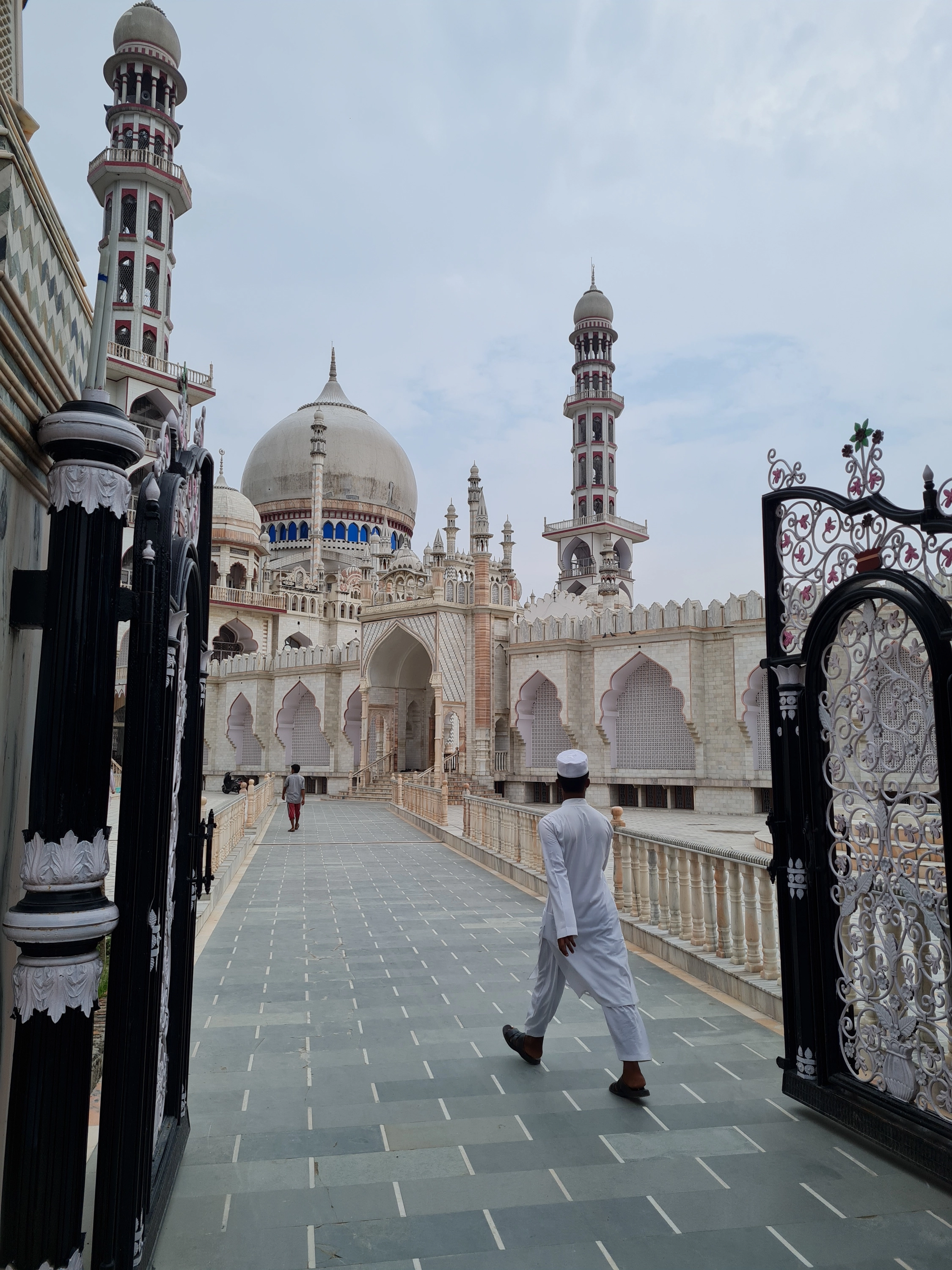
The Deobandi movement is a school of Sunni Islamic thought and practice that takes its name from the small town of Deoband in northern India, where a seminary was founded in 1866 or 1867. Within a generation the name of that school had come to stand for a distinctive approach to religious learning and religious leadership, and by the end of the nineteenth century, as Barbara Metcalf records, the name of Deoband had come to represent a distinct maslak, or style, of Indian Islam.
The movement's founders were scholars, not rulers or officials. Their aim was to train ulama who could preserve religious learning and teach correct practice and belief in a society where Muslim political power had ended, and they pursued that aim by building an institution of a kind India had not seen before. The seminary they created — treated in detail in the article on Darul Uloom Deoband — combined a fixed curriculum, examinations, a salaried professional staff and funding by small public subscription, and it became the model for hundreds of schools across the subcontinent and beyond.
Two things about the movement are easily misunderstood, and Metcalf is at pains to correct both. The Deobandi ulama were not survivors of an unchanging past: their organisational forms and their means of communication were new, and so was the broad audience they addressed. Nor were they opponents of Sufism. They were among the leading Sufis of their day, and they never sought to eliminate Sufism but rather to integrate it into an obedient religious life.
The Setting: Northern India after 1857
The movement cannot be understood apart from the political collapse that preceded it. The uprising of 1857 ended what remained of Mughal authority, and the reprisals that followed fell heavily on Delhi and on the towns of the surrounding country. William Dalrymple's account of the city in those years describes the dispersal of a scholarly and literary culture that had been concentrated there for generations, and the town of Deoband itself did not escape: thirty-four of its men were hanged, three neighbouring villages were burned, and the holdings of many landed families were confiscated.
Metcalf's assessment of the mood among religious scholars afterwards is blunt. The ulama, she writes, shared in the general political quietude that followed the cataclysm of the Mutiny. They were sobered by what they had seen and persuaded that the British were invincible, and many entered government service. It was in this atmosphere, not in one of confidence, that the founders of Deoband set about their work.
Their response was to turn inward. In this period, Metcalf argues, the ulama chose a strategy of turning within, and their sole concern was to preserve the religious heritage and to disseminate instruction in authentic religious practice and belief. That formula — the preservation of religious learning rather than the pursuit of political power — describes the movement's character for its first half-century.
The question of the founders and the uprising
Later accounts came to hold that the founders of the school had themselves fought in 1857, and the claim requires care because the evidence for it is late. Metcalf notes that Deobandis caught up in the nationalist movement after the First World War came to believe that the founders of their school, particularly Muhammad Qasim, Rashid Ahmad and Imdadullah, had joined the rebels. But she observes that the detailed version of events at Thanah Bhawan, identifying the posts held by each man and the course of the uprising, appears only in secondary sources written after about 1920.
Earlier biographies took the opposite view, treating the accusations as the work of enemies and pointing to Gangohi's release after six months of confinement and to the fact that Muhammad Qasim was never arrested. There was certainly fighting at Thanah Bhawan, and a leading scholar of the town was killed in it. Metcalf's conclusion is that who led the fighting, and on which side he fought, all remains obscure, and that the overall role of the ulama in the revolt was at best fragmentary and divided. The article follows her in leaving the question open.
The accusation had a long afterlife as a weapon. When opponents of the school circulated a paper addressed to the government in 1895 alleging that Deoband educated students for religious warfare, both a Hindu investigator and the British district collector examined the charge and cleared the school.
Foundation
The date of the foundation is not agreed, and the disagreement is reported here rather than resolved. Metcalf gives 1867, and hers is the account this article follows for the movement's analytical history; she gives the year but no month or day, and no more precise founding date should be attributed to her. The seminary's own tradition places the beginning slightly earlier, in 1866, and that is the date generally given in South Asian accounts and by the institution itself.
Within that earlier tradition the day is itself given variously. Sayyid Mahboob Rizvi's History of the Dar al-Ulum Deoband, the institution's own history, dates the inauguration to a Thursday, 14 Muharram 1283, in May 1866; the corresponding day of the Gregorian month is illegible in the copy consulted here, so no Gregorian day is asserted from it. Other South Asian accounts give 15 Muharram 1283, corresponding to 30 or 31 May 1866. All of these are in serious use, and the fuller discussion is set out in the article on Darul Uloom Deoband.
Metcalf's own sentence names the founders in an order worth preserving: the school was founded by Rashid Ahmad, Muhammad Qasim, and others in a town called Deoband.
Deoband was a qasbah of the upper Doab, some ninety miles north-east of Delhi on the old royal road, with a population of about twenty thousand, somewhat over half of it Muslim. It was dominated by Usmani and Siddiqi shaikh families whose standing dated from Mughal times and who preserved their landholdings by marrying among themselves. It had become a tahsil headquarters in 1834 and a municipality in 1868, and the year after the founding brought the completion of the Northwest Railway, which linked the town to cities across northern India. The movement's finances and its reach would depend directly on that new infrastructure of rail, post and money order.
Teaching began in the open courtyard of the old Chattah Masjid under a pomegranate tree. The first teacher and the first pupil were both named Mahmud — Mulla Mahmud the teacher, and Mahmud Hasan the pupil, who was later to become the school's most famous teacher. Rizvi records the practical arrangements behind the scene: Mulla Mahmud Deobandi, already teaching elsewhere, was appointed by Nanautawi at fifteen rupees a month and sent to Deoband, and Nanautawi wrote to Haji Muhammad Abid telling him to begin the madrasa without waiting for him. In Rizvi's account the school opened with one teacher and one student and no building, and he too remarks on the coincidence that teacher and pupil bore the same name.
Metcalf reproduces the same scene and then immediately punctures the sentiment attaching to it: despite the timeless atmosphere surrounding this cherished vignette of its inauguration, she writes, the school from its inception was unlike earlier madrasas. The two accounts are not in conflict on the facts; they differ in what they take the scene to show, and both readings are given here.
As to why Deoband was chosen, she distinguishes what the founders said from what the historian can observe. Kinship ties, the cultural atmosphere of the town and its earlier receptivity to reformist preaching all made it a plausible site. But in choosing Deoband, she notes, the founders did not cite these considerations or the amenities of the town as motives; to them the decision had had divine sanction. Reports spoke of an "odour of learning" rising from the ground, and of dreams. Metcalf reads these accounts functionally, as having given the founders a self-fulfilling confidence in their mission.
The Founding Generation
Three men educated at Delhi in the 1840s stand at the head of the movement, and Metcalf treats them together. All three came from qasbahs of the upper Doab: Nanautah, Gangoh and Thanah Bhawan.
Muhammad Qasim Nanautawi
Muhammad Qasim Nanautawi, born in 1833, was of Siddiqi shaikh stock and from a family relatively well off. He was sent to Deoband as a child for his safety after a killing in the family, and the town was afterwards called "his Medina." At thirteen his uncle Mamluk Ali took him to Delhi, where he stayed five years, studying hadith under Abdul Ghani Naqshbandi and Ahmad Ali Saharanpuri. In 1850 he entered the Matba Ahmadi printing house.
He held the senior post of sarparast, or rector, but avoided an active administrative role for fear of tainting the school's reputation because of his participation in the events of 1857, and for the first three years did not come to Deoband at all, remaining at his printing plant in Meerut. He affected the school, Metcalf writes, not through direct control but by personal influence. He composed the eight fundamental principles on which its constitution rested, set out below, was the ablest preacher and debater of the early group, and was the Deobandi party to the exchange of letters with Sayyid Ahmad Khan published as the Tasfiyatul-Aqaid.
Metcalf's text gives his death year inconsistently, as 1877 in one place and 1879 in another. Rizvi's history gives his dates as 1248/1833 to 1297/1879, and on that authority this article gives 1879, while recording that Metcalf's own text is not consistent on the point.
Rashid Ahmad Gangohi
Rashid Ahmad Gangohi, born in 1829, came from a family already inside the reformist current: his father had studied with the family of Shah Waliullah and had taken spiritual training from Shah Ghulam Ali Mujaddidi Naqshbandi. His father died when he was seven. He spent four years in Delhi under Mamluk Ali alongside Muhammad Qasim. In his whole life he held only one regular salaried post — six months tutoring a notable of Saharanpur — and thereafter depended on whatever contributions of income happened to arrive.
He was descended in twelve generations from the Chishti shaikh Abdul Quddus Gangohi, and he revived his ancestor's khanaqah, which had lain deserted for three hundred years. At the outset he held no formal position at the school, being occupied at Gangoh as a Sufi guide, a teacher of hadith and a jurist; yet he was so revered, Metcalf writes, that his opinions on organising and shaping the school were followed. After Muhammad Qasim's death he became sarparast of both Deoband and the Mazahir-i Ulum at Saharanpur, and he was particularly distinguished as an administrator. His teaching of hadith drew students from Bengal, Madras and the Punjab, and his memory was such that he could cite the page of a relevant hadith in the sahih collections. He died in 1905.
Hajji Imdadullah
Hajji Imdadullah occupies a distinctive place: he was the spiritual guide of the movement's leaders but was not a scholar. Metcalf's formulation is that learned men shared bai'at from him, and he was known as the shaikh of the ulama, though Imdadullah himself was not an alim. Muhammad Qasim made a pun of it, saying that he was not an alim but alamgir, possessor of the world.
He had studied little as a child and went to Delhi at sixteen; his real interest was in mysticism. He was initiated in the Naqshbandi order by Nasiruddin Dihlawi, and after Nasiruddin's death took another guide, Miyanji Nur Muhammad Jhanjhanawi. He made over his entire inherited wealth to his brother and lived in a mosque. Around 1857 he migrated to Mecca and remained there for the rest of his life, dying in 1899; Metcalf's text gives his birth year as both 1817 and 1815, so it is left unstated here.
Metcalf describes Rashid Ahmad and Muhammad Qasim as sharing a common allegiance to Imdadullah as their Sufi preceptor, and as their guide in every decision — and notes that they were only the first of some seven or eight hundred learned men who took bai'at from him. His importance for the movement's internal cohesion was considerable: a special bond existed among many of the school's personnel because of common allegiance to a Sufi order, particularly among the many who were his disciples.
The second generation
Muhammad Yaqub Nanautawi, son of Mamluk Ali and cousin of Muhammad Qasim, served as the school's first principal from 1867 to 1886. He was known as a jurist and, in the phrase applied to him, as a majzub, so absorbed in spiritual matters that he could appear to blaspheme. Metcalf uses him to illustrate the friction between the new institutional forms and older habits: even one of the school's own teachers, the saintly Muhammad Yaqub, did not see the point of the examinations, and though he recorded scores he did so on the basis of his own intuition.
Mahmud Hasan, later titled Shaikh al-Hind, was the school's first pupil, and had sought out Muhammad Qasim in the printing houses of Meerut and Delhi in order to be one of the few to undergo his demanding teaching of hadith. When he completed his education in 1873 he joined the staff, and for the next forty years was a dominating influence. He taught ten lessons a day and refused invitations to leave. His biographer records that he taught over a thousand students, drawn from Kabul, Qandahar, Balkh, Bukhara, Mecca, Medina and Yemen, among them Anwar Shah Kashmiri and Shabbir Ahmad Usmani. In a dispute of 1892, when a proposal was made to dismiss most of the teaching staff, Mahmud Hasan — by then clearly the school's best teacher — simply insisted that if anyone went it would be he. He accepted a salary only under compulsion from Rashid Ahmad.
Ashraf Ali Thanawi, a graduate of Deoband and a khalifah of Rashid Ahmad, became in Metcalf's words the man widely considered the pre-eminent Sufi of modern India. He was among the Deobandis who translated the Qur'an into Urdu and among those who edited hadith, and his manual Bihishti Zewar is described as an attempt to bring the shariah, its doctrines and laws, within reach of the common man's intelligence.
Khalil Ahmad, whom Metcalf calls Ambahtawi, was a disciple of Rashid Ahmad and a student of both Deoband and the Mazahir who left his post at Deoband at Gangohi's direction to become principal at the Mazahir. When a faction of the Mazahir council voted to expel him, he followed the direction of his shaikh and resolutely stayed on; vindicated by an arbitration committee, he remained at the school some thirty-one years, a pillar of its administration and teaching.
Anwar Shah Kashmiri, Shabbir Ahmad Usmani and Hafiz Muhammad Ahmad are named by Metcalf as the leaders of the third generation.
What Was New: The Institutional Model
Metcalf's central historical argument is that the significance of Deoband lies less in what it taught than in how it was organised. She states the thesis before demonstrating it: the new madrasas, she writes, were distinctive in their basis of support, their organisational style, and their goals. And of the founders: emulating the British bureaucratic style for educational institutions, they in fact eschewed the informal pattern of education that the scene under the pomegranate tree suggests.
The concrete innovations were these. The school was conceived of as a distinct institution, not relegated to a wing of a mosque or home and dependent on a parent institution. It acquired classrooms and a central library. It was run by a professional staff, and its students were admitted for a fixed course of study and required to take examinations for which prizes were awarded at a yearly convocation. Gradually an informal system of affiliated colleges emerged, many staffed by its own graduates and examined by visiting Deobandis.
The contrast Metcalf draws is with the older family-based schools, and she names the most famous of them. In older schools, like the celebrated Farangi Mahall in Lucknow, family members taught students in their own homes or in a corner of a mosque. There was no central library, no course required of each student, no series of examinations. A student sought out a teacher, received a certificate listing the books he had read, and moved on.
Behind this lay a change in the material basis of religious learning. The old ulama had depended on revenue from endowments and on the largesse of princes whose courts they graced; they were part of the larger structure of a Muslim state. The Deobandi ulama, in contrast, could not depend on a court to provide a framework of patronage or to take responsibility for Muslim law and education. Metcalf stresses that the founders knew the institutions they were emulating from the inside: several had been government servants, three of them Deputy Inspectors in the Education Department, some had attended the Delhi College, and all had encountered the missionary societies. In dealing with these institutions, she writes, they learned their methods and chose to compete with them on equivalent terms.
Funding by subscription
The school was wholly dependent on public contributions, and not on fixed holdings of waqf or endowments contributed by noble patrons. Metcalf singles out two features as decisive: the participation of people with no kin ties, and the system of popular financing. So unusual was the arrangement that the annual printed report — itself an innovation — made continuing efforts to explain it.
Government grants-in-aid were refused. Such help was precarious and carried the taint of its non-Muslim source; instead the founders created a network of donors, which served as a base for disseminating their ideas as well as for paying the bills. The mechanics depended on record-keeping, the postal service, money orders and the printing press. Donors were listed by the size of their gift in the published proceedings, but even the humblest contributor was included. Hides from the Eid sacrifice were collected and sold, and contributions were designated as zakat. The scale of the operation was modest: by 1890 an average of only forty-two rupees a year had been spent on each student.
Metcalf notes drily that in practice many wealthy people were among the donors, and many expected recognition for it. Her verdict on the model's durability is comparative: other schools, like Farangi Mahall, which clung to support from landed wealth, have in part for this reason disappeared.
Rizvi's history preserves an account of the first collection, taken from Haji Fazl Haq's narrative in Nanautawi's Sawanih-e Makhtutah. In that telling Haji Sayyid Muhammad Abid made a wallet out of a handkerchief, put in three rupees of his own, and went out alone from the Chhatta Mosque to call on the notables of the town. Maulavi Mehtab Ali gave six rupees, Maulavi Fazl al-Rahman twelve, the narrator himself six, and Maulavi Sayyid Zulfiqar Ali twelve, with a further twelve on behalf of Sayyid Zulfiqar Ali Sani, who happened to be present. Two hundred rupees had been gathered by the time he reached the quarter of Abul Barakat, and three hundred by dusk. Fazl Haq dates the day to Friday, 2 Zi-qa'da 1282. The detail is worth having because it shows the funding model beginning as a literal walk around a small town, before it became the postal and money-order network Metcalf describes.
The eight principles
The doctrine behind the funding model was set down by Nanautawi in the constitution he proposed for the school, in eight fundamental principles. Metcalf paraphrases two of them; Rizvi's history gives all eight, and they are summarised here in his order, since together they explain both the finance and the internal governance of the institution. The wording is paraphrased rather than quoted, because the copy consulted is an optical scan whose text is corrupt in places.
- Those running the madrasa should always attend to increasing the donations, making the effort themselves and urging others to do the same.
- Its well-wishers should work to keep the students supplied with food, and to increase their number.
- The counsellors should keep the school's welfare in view and hold no opinion stubbornly. If they come to resent opposition to their own views, the foundation of the school will be shaken. They should not hesitate to speak, and should hear one another in good faith, accepting a convincing argument even against their own position. The muhtamim must seek their advice on all important matters, though he may act on the counsel of a proper quorum rather than of every member.
- The teachers should be of one temper, neither presumptuous nor given to insulting one another; were that to happen, the school would be imperilled.
- The prescribed syllabus should always be completed, or the school will lack strength, and such strength as it has will be of no use.
- So long as the madrasa has no regular income it will continue by reliance on God. Should assured income arrive — a fief, a commercial undertaking, the promise of a wealthy patron — the condition of fear and hope that drives the appeal to God will slip away, divine help will cease and disputes will follow among the functionaries. A measure of destitution should always be kept in view.
- The participation of the government, and of the wealthy, appears very harmful.
- Donations from those who give what they can without seeking fame bring more blessing; the donor's good faith is the provision for the school's endurance.
Rizvi observes that five of the eight — the first, second, sixth, seventh and eighth — bear directly on substituting public donation for endowment, and that the insistence on avoiding assured income is deliberate rather than incidental. He also records that when Muhammad Ali Jauhar visited the school during the Khilafat Movement and read the eight principles, he was moved to tears, remarking that what his own generation had reached after a century of stumbling these men had arrived at long before.
Read against Metcalf's analysis, the principles show something her external account cannot quite supply: that the refusal of state and elite money was not merely a tactical judgement about the taint of British grants, but a settled conviction that institutional poverty was itself a spiritual safeguard.
Offices and consultation
The administration was deliberately bureaucratic. A dozen teachers were ranked by learning, with the Arabic faculty above the Persian in pay and standing. Three officers ran the school: the sarparast or rector, the muhtamim or chancellor, who was the chief administrative officer, and the sadr mudarris or principal, responsible for instruction. A fourth office, that of mufti, was added in 1892 to supervise the issuing of legal opinions. A consultative council comprised the administrators and seven others.
That the council's authority was real, and was understood to override personal standing, is caught in a remark of the muhtamim Rafiuddin in 1887: all decisions, he said, are made by the consultative council, and even he, though muhtamim and present in the school for twenty years, would be removed if they saw fit.
The model was tested by two internal crises, in 1876 and 1895, and Metcalf records that both were resolved in general in favour of those who supported the original bureaucratic conception of the institution. The 1876 quarrel concerned the erection of a separate building, which she reads as more than a practical matter: separate madrasas had not previously been characteristic of Muslim architecture in India, and schools like Deoband now began to serve that function and to symbolise Muslim culture. The 1895 crisis set the council against townsmen, several of whom held office in the British-created municipality; Gangohi answered them by consistently explaining that he was answerable only to the contributors, an assertion of the school's non-local character. Her summary is that the dispute had been more ideological than personal.
Curriculum
The goal of the school was to train well-educated ulama dedicated to reformed Islam, who would serve as prayer leaders, writers, preachers and teachers. Students of Arabic, about three-quarters of the whole, had to have studied Persian to the level of the Gulistan, to have completed the Qur'an, and to pass an entrance examination; only half of those examined were admitted. The course was originally scheduled for ten years and later reduced to six.
The claim made for the school was one of comprehensiveness: in this one place students would be trained in the specialties of all three great intellectual centres of northern India — the transmitted sciences of Qur'an and hadith, the specialty of Delhi, and the rational sciences of law, logic and philosophy, the specialty of Lucknow and Khairabad.
The textual basis was inherited. The school taught basically the Dars-i Nizami, the curriculum evolved at Farangi Mahall in the eighteenth century. What Deoband changed was the balance within it. The Deobandis, Metcalf writes, reversed the emphasis on rational studies in favour of an emphasis on hadith, which was to be the basis of their popular teaching. Where the older curriculum had required only one text of hadith selections, they included in their entirety the six classical collections of the precedents of the Prophet. They deemed hadith, the basis of correct practice and belief, the crowning subject, and the most influential teacher at the school was the shaikh al-hadith. Their second specialty was fiqh, of similar importance for popular teaching, since they stressed correct performance of ritual and ceremonial duties rather than the study of jurisprudence.
The place of the rational sciences was contested from within. There was actual opposition, led by Rashid Ahmad, to teaching logic, philosophy and jurisprudence at all; he held them trivial beside the basic texts, their only merit being preparation for refutation. Muhammad Qasim, in sympathy, thought students should rather study the more threatening new philosophy of the West. The staff and council, however, wanted the logic and philosophy books retained so that graduates could find employment, and despite Gangohi's retort — would you clean latrines to get a job? — the books that had initially been eliminated from the curriculum did gradually creep back.
On English there was no advocacy at all: there were no spokesmen for including English or Western subjects. But the position was not one of prohibition. Muhammad Qasim insisted that the school was not opposed to such study, but simply wanted to avoid duplication of government efforts, and students were free to continue in government schools afterwards, though few did.
Metcalf's overall judgement on the content is deflationary, and it is important for an accurate picture: with no new subjects and with philosophy gradually restored, the curriculum was not dramatically innovative, though it was to become famous for its emphasis on hadith. It was primarily the core religious sciences, unchanged in substance, that the school taught.
What was genuinely new was method and medium. Arabic was taught by the British technique of translation into and out of Urdu, with monthly Arabic compositions added later. More consequentially, the school continued the use of Urdu, not Persian, as the medium of instruction, so that students from Afghanistan, Chittagong, Patna and Madras all returned home with a common language. Metcalf's comparison is pointed: like the Westernising college at Aligarh, Deoband was instrumental in establishing Urdu as a language of communication among the Muslims of India.
Two vocational subjects took root. A calligrapher joined the staff in 1873 to train students for the lithographic presses, and tibb, the Greek-derived medicine, entered the curriculum at the end of the century over Gangohi's objection. Attempts to teach crafts and trades came to naught because the students deemed such work beneath their dignity as religious scholars.
Examinations were an innovation in Arabic madrasas, and hence extensively described in the school's annual reports. The first two years were examined orally and the following four in writing, with five required questions on each book and twenty points for each answer; candidates were supervised against cheating and identified by number only, for objectivity. The school was not organised by classes but by books, so a failed book was repeated alone. At the annual convocation certificates were distributed describing the books completed and commenting on the student's character and capacity.
The library was built by soliciting gifts and loans of manuscripts and by asking the new presses to donate a copy of everything they published; the Hindu publisher Newal Kishore of Lucknow assisted, having an interest in preserving Arabic and Persian and in encouraging Urdu. The result was a carefully kept library of thousands of volumes.
Almost all the leading teachers were offered posts in princely states or in government service, and stayed in return for small salaries of ten or fifteen rupees a month. In the lean year of 1872 they reduced their own salaries, and advanced students helped with the teaching.
Scholars and Sufis
The most persistent misunderstanding of the movement concerns Sufism, and Metcalf addresses it directly: the Deobandis, she writes, were among the leading Sufis of the day. The senior office of sarparast was held in succession by revered and influential Sufis — Muhammad Qasim, Rashid Ahmad, Mahmud Hasan and Ashraf Ali Thanawi.
Their model was the combination of shariah and tariqah, Law and Path, understood as complementary rather than opposed, in a line the Deobandis traced back to al-Ghazali. Muhammad Qasim's much-quoted complaint captures the cost of occupying that middle ground: among the ulama, he said, he had a bad name, and among the Sufis he bore the stain of scholarliness.
They were not shaikhs of a single order. Their own history described them as Chishti in suluk, the method of training, but as uniting all the silsilahs. The mechanism was multiple initiation: Imdadullah initiated his disciples in all the major orders then current in India — Chishti Sabiri and Chishti Nizami, Qadiri, Naqshbandi and Naqshbandi Mujaddidi, Suhrawardi and Quddusi. In general, allegiance to the Chishti order predominated at the school, and Imdadullah's disciples represented the leadership of the Chishti Sabiri order in the late nineteenth century. The Deobandis especially valued the reputation of the Chishtis for being aloof from the state and for basing their influence on individual spirituality alone.
Their practice, however, was coloured by the Naqshbandi tradition. They preferred silent to spoken dhikr; Gangohi's relation to his disciples was described as Naqshbandi in style, emphasising the concentrated attention of tawajjuh between master and individual disciple; and the whole orientation of the Deobandis toward reform and obedience to the sunnah was one pre-eminently associated with the Naqshbandis. Above all they placed themselves in the primarily Naqshbandi tradition of the family of Shah Waliullah. Asked to teach the Naqshbandi path, Gangohi replied that he taught the final instruction in which all the silsilahs merge.
An institutional innovation followed from all this. Students at the school often became disciples of their teachers — a practice Metcalf calls remarkable, because previously many of the ulama had sought initiation only from their own relatives. Among the Deobandis the functions of both pir and mufti were often united in a single person, and the insistence that a disciple follow one guide was the deliberate counterpart of the juristic position that in matters of law one should turn only to one mufti for guidance.
What they opposed, and what they did not
Their reform was directed at particular customs rather than at Sufism itself. Deobandi opposition to certain Sufi customs, notably the death-anniversary festival of urs and pilgrimage to graves, directly challenged the centrality of the tombs and the networks of support attached to them. They offered an alternative spiritual leadership, geared to individual instruction rather than to mediation and stripped of what they deemed to be deviant custom, and they represented a Sufi leadership separate from the most characteristic institution of later Sufism, the guardianship of the tombs of the medieval saints.
The practices they objected to are named in their legal opinions: musical sessions to induce ecstasy, recitation of the Fatiha for the dead, urs, pilgrimage to graves, meditation on the image of the shaikh, vocal dhikr, the celebration of the Prophet's birthday, and elaborate weddings and funerals — several of them on the ground of resemblance to Hindu festivals.
The limit of their programme is the point Metcalf is most concerned to establish. Unlike the contemporary Arabian reformers and the Faraizi movement in Bengal, the Deobandis never sought to eliminate Sufism, but rather to integrate it into an obedient religious life.
Nor were they uniform among themselves. There was scope for disagreement on custom: Muhammad Qasim sanctioned participation in birthday celebrations by the educated, and Imdadullah himself took part in the elaborate celebration held in Mecca while approving Gangohi's refusal to join in. Gangohi, for his part, trusted Imdadullah utterly despite his guide's apparent commitment to practices the Deobandis disapproved of. Their success in changing popular practice was in any case limited: even at Gangoh, Metcalf records, Rashid Ahmad was unable to his great anguish to stop the celebration of his own ancestor's urs.
They also differed on the underlying question of whether the dead can hear. Rashid Ahmad held that praying to a saint was shirk and himself doubted that the saints could hear prayers at all; Muhammad Yaqub believed that the dead could hear and so intercede, but only if the believer were present at the grave; Muhammad Qasim also believed the dead could hear, but directed his followers merely to visit a grave, read a portion of the Qur'an, and offer its merit to the deceased.
The Fatwa, the Press and the Debate
The Deobandis thought of their fundamental role as that of mufti, giving advisory opinions on the Law. In jurisprudence they were Hanafi and stood for taqlid, conformity to an established school, and they emphasised taqlid-i shakhsi, the principle that each Muslim should follow a single scholar as a definitive guide.
The work grew to institutional scale. In 1893, when the burden of dealing with legal questions arriving from all over Hindustan had become very heavy, the school established a separate dar al-ifta. From 1911 a register of all opinions was kept and volumes were published regularly, the aim being a collection as definitive as the Fatawa-yi Alamgiri of Aurangzeb's reign. At the close of its first century the school counted a total of 269,215 opinions issued, and prided itself on answering most questions the day they arrived.
Metcalf's judgement on the significance of this is unambiguous: through the issuance of fatawa, more than through any other single means, the ulama of the school gained currency for their reformist beliefs. Part of the motive was to provide an alternative to the British courts and the hybrid Anglo-Muhammadan law they administered; around Deoband itself the ulama went further and established a separate court under Muhammad Qasim's supervision, the townsmen agreeing to bring their disputes to the Chattah Masjid. This succeeded only partly, since many Muslims preferred the British courts, and officials at Saharanpur pressed for the quasi-governmental proceedings to be suspended.
The content of Gangohi's collected opinions, the Fatawa-yi Rashidiyyah, indicates where the movement's attention lay. On Metcalf's own count of more than three hundred opinions in the first volume, approximately one-third dealt with issues related to Sufism, and a full one-fifth were devoted to the correct performance of the canonical prayer; smaller numbers concerned fasting, the pilgrimage and Qur'an recitation, and most of the remainder dealt with relations to other groups. She reads the collections as evidence of expansion rather than narrowing: they treated issues earlier opinions had not even considered.
That extends to technology. Later Deobandi opinions on the camera, the telegraph, the toothbrush and the phonograph show a consistent approach, in which British inventions were never condemned unless some sinful item or practice was intrinsic to them. Metcalf notes that they are not antimodern in the sense of being antitechnological in their concerns.
The Deobandis enthusiastically embraced two means of communication that their predecessors had used only somewhat: the lithographic press and public debate. Metcalf's account of missionary influence is worth registering, because it inverts the obvious expectation: the main effect of the missionaries was not the message they disseminated but the challenge of their methods, and cheap printing and preaching were welcomed not as a source of a new world-view but as a way of spreading the Deobandis' own formulations of identity.
The presses came first to Muslim-dominated towns — Bareilly, Moradabad, Agra, Meerut, Delhi — and the reformers were pre-eminent among those using them. Ahmad Ali Saharanpuri, who taught many of the Deobandis, published the first Indian editions of Tirmidhi and Bukhari as early as 1850, Muhammad Qasim assisting with the notes to Bukhari. Books reached far beyond the literate, since a single copy would be passed from hand to hand and read aloud to those unable to read for themselves. A government catalogue for the North-Western Provinces in 1878 recorded that some seventy per cent of all titles classified as religious were Muslim.
Contemporary observers noticed. The Director of Public Instruction wrote in 1872 that unusual energy had been shown by Muslims in providing for their educational wants in their own way, and five years later noted a marked tendency to religious revival. A missionary in 1902 observed that Muslims were certainly learning the power of the press. Metcalf's summary is that publication of the religious classics was clearly key to the effectiveness of the reformist movement, and that the creation of Urdu as a language of Muslim religious literature was an enormous undertaking, highly influential in disseminating religious instruction.
Debate
Public disputation was the other instrument, and Metcalf is unsentimental about its intellectual value: these debates, she writes, most emphatically did not provide an occasion for serious intellectual exchange. Arguments were stereotyped and repetitious, and she quotes a contemporary complaint that not a single new argument had been advanced on any side.
Her explanation of why the practice flourished nonetheless is functional. Debate defined the boundaries of a community, allowed rivals within a tradition to bid for leadership, and served psychological ends for people who were powerless in many political areas. Each side invariably claimed to have won, and in a real sense always did, since participation raised a man's standing among his own coreligionists. Deoband went so far as to establish a separate department of munazara to train students in its art. Debate was important, Metcalf concludes, for if it did not influence other participants, it clearly did influence those who were the followers of those participants.
Notably, the movement's leaders imposed limits on the conduct of controversy. They forbade their followers to mock their opponents, and Metcalf records that Rashid Ahmad silenced those who delighted in the illness of his principal antagonist, Ahmad Riza Khan.
Relations with Other Movements
Aligarh
The college at Aligarh, opened as a private institution in 1875 under Sayyid Ahmad Khan, was designed to provide English education and to inculcate a European style of behaviour in the sons of well-born Muslim families. Metcalf characterises it as a movement committed to collaboration between the more privileged classes of Indian Muslim society and the imperial regime.
The two movements shared origins: Sayyid Ahmad Khan had been among Mamluk Ali's associates in pre-1857 Delhi, alongside the men who founded Deoband, and both institutions promoted Urdu. Their quarrel was doctrinal, and was conducted in the exchange of letters published as Tasfiyatul-Aqaid, the Cleansing of Beliefs. Muhammad Qasim set out the classical case for taqlid, premised on the claim that the world had declined dramatically since the time of the Prophet and that no living scholar matched the classical imams; consulting the learned of the present, he said, would be like consulting a quack instead of a skilled doctor. He objected that Sayyid Ahmad's exercise of independent judgement was not grounded in the four accepted sources, and closed on a reformist note of his own: shirk, he wrote, is committed not by following the ulama but by following false custom. Metcalf's structural reading is that implicit in Sayyid Ahmad's position was a diminution of the authority of such ulama.
The separation was not absolute in practice. Families connected to Deoband sent sons to Aligarh; a scholar of the Kandhlah family became the first director of religious studies there, and at least five members of that family studied at the college. Attendance at Aligarh, Metcalf observes, did not mean that a person necessarily embraced the ideology of its founder, least of all his religious thought.
The Nadwatul Ulama
The Nadwatul Ulama was an association of ulama based at Lucknow whose object was to consolidate a single leadership for all Muslims and to mediate between them and the government. It planned to become a university affiliating all Muslim schools, Aligarh included, and it opposed the educational institutions of both Aligarh and the popular ulama. Its political goal was not achieved, and it operated as a Sunni religious academy distinguished by Arabic scholarship and by a sense of the wider Muslim world. Metcalf's text gives its founding date in more than one way, and this article therefore does not fix the year.
The relationship with Deoband was competitive. Metcalf quotes a newspaper correspondent of 1891 asking why, when there already existed a good Arabic school at Deoband, the Nadwah should take it into its head to establish a separate one in its own name. The two also differed over language: Nadwah men deplored what they saw as the vulgarisation of religious learning brought about by the spread of Urdu, the very medium on which Deoband's reach depended.
Metcalf sets the three movements in a common frame. Aligarh and Nadwah were notable in seeking an active political role in relation to the colonial government, a role most ulama of the period either shunned or ignored. But all three, she insists, belonged to one body of change: all contributed to the substantial religious self-consciousness of the period, all reflected and encouraged the growing sense that Muslims in British India were tied together in a separate community, and all fostered the use of Urdu.
The Ahl-i Hadis and the Barelvis
Two other Sunni tendencies took shape in the same decades, and both are treated in their own articles. The Ahl-i Hadis shared the Deobandi commitment to reform of custom but rejected the authority of the medieval law schools. Deobandi opinions were more critical of them than of other ulama, Metcalf suggests, perhaps because they came so close to the Deobandis in their common commitment to reform; Gangohi treated them as Shafi'i, which simultaneously denied their claim to be the followers of hadith and conceded their legitimacy as Muslims.
The Barelvis, who called themselves the ulama of the ahl-i sunnat wa jamaat, upheld a more custom-laden practice and a more intercessory style of religious leadership. The polemic between them and Deoband was severe, and is described in the article on that movement. What matters here is that the Deobandis did not exclude either group from common prayer: they were judged to deviate only in practice, not in belief. With the Shi'a the Deobandis drew the line, directing Sunnis to keep clear of Muharram observances.
Metcalf also records what the Deobandis did not claim for themselves. They did not think of themselves as a sect, but as a leaven that could reach others; they tolerated differences among themselves; and while they criticised the practices of others they did not on that account deny that they were Muslims.
The British administration
The movement's political posture combined moral distance with practical accommodation. On one side, the fatawa encouraged an attitude of moral and spiritual self-confidence towards the rulers that Metcalf contrasts with the desire of many English-educated Muslims to win official approval on the rulers' own terms. Gangohi remarked that it was not surprising that the government had established laws contrary to the shariah, condemned British financial institutions, discouraged the use of government courts, and urged his followers not to dress like Englishmen. Muhammad Qasim wrote of how foreigners had taken a rich country and drawn money from it.
On the other side, the Deobandis had no option but to accept the worldly rulers they had, and they coupled disapproval with realism in their relations with them. Gangohi sanctioned appealing to the government in disputes with Hindus, advising his followers not to fight and die over a disputed mosque site but to turn to the government. The school used officials' help in its own affairs: the district collector was invited in 1895 to confirm its integrity and spoke in its praise in Urdu. They made sure to conform in every way to a posture of loyalty — Gangohi refused a grant of five thousand rupees a year from the Shah of Afghanistan for fear that a political link might be suspected — and the school marked royal occasions with appropriate ceremony.
Metcalf reads this stance as coherent rather than merely prudent, and offers a psychological explanation: such a practical position was possible because the core of Deobandi teaching encouraged a sense of moral superiority over the politically superior British.
Who the Deobandis Were
Chapter by chapter Metcalf builds a case against a received picture of the ulama as socially marginal. The ulama, she notes, have sometimes been thought to be an underworld who influenced only the lower classes, cut off from a collaborating class of officials and large landholders. In fact, she concludes, almost the opposite appears to have been the case: they themselves were ashraf, and they primarily influenced their counterparts.
Like other ashraf they claimed extra-Indian descent — sayyids as descendants of the Prophet, shaikhs of his Companions, Mughals and Pathans of the medieval immigrant rulers — and guarded that status by marrying not only within the community but within the family. The claim to foreign descent bolstered their religious authority, since it implied proximity to the Prophet.
They were not, however, an occupational caste. Their families engaged in landholding, government service and trade as well as religious leadership, and Metcalf's examples make the point sharply. The Kandhlah family was reformist from the eighteenth century onwards and supplied both supporters and teachers of the Deobandis, yet many of its members were in government service as revenue officers, sub-judges or education department staff; all of them had taken bai'at from Rashid Ahmad or from one of his disciples. Muhammad Ahsan Nanautawi, a member of the school's council, was at once a scholar, a government servant, a writer, a newspaper editor, a book publisher and a businessman. Her conclusion is that an attempt to distinguish government servants from those involved in religious activities is misleading, since work in the two areas enhanced one another.
The donor lists show both the movement's geographical base and the limits of its early reach. Before 1892, about three-quarters of annual donors came from the United Provinces, with Saharanpur and Muzaffarnagar districts alone accounting for over half; roughly an eighth came from Deoband town and a dozen neighbouring villages, and the remainder were spread across the Punjab, Bihar, the princely states and the major cities. Metcalf reads the distribution as substantiating Deoband's claim to be, even in this early period, more than a local school, and as making it one of the first institutions to make effective use of modern improvements in communication such as mail and money-order services and cheap printing. Around two thousand people attended the convocation of 1883, invited by letter and poster on a date chosen to coincide with a government holiday.
Of some 2,658 donors named over the first thirty years, about half were identified by occupations usually associated with the ashraf: government or princely service accounted for a little over a quarter, religious titles for a fifth, traders for seven per cent and landholders for five. Roughly eighty per cent of donors were urban. Support of the school, Metcalf observes, spread along pre-existing social lines of family, occupation and religious order, and the school deliberately sought people with influence over others.
For students who were not recognised as ashraf, a religious education offered a route to standing. The school gave such students the opportunity to make a new claim to respectability, teaching not only a profession but the aristocratic qualities of hospitality, refined taste and cultured language. Muhammad Qasim insisted that the ashraf must acquire learning not merely for glory but for their livelihood as well, and the school's proceedings protested that its people were not, as was often thought, concerned only with religion and not with earning a living. Graduates were prepared for careers as teachers, prayer leaders, shrine guardians, doctors, writers and publishers.
Growth
There were seventy-eight students in the first year, rising rapidly to a constant two or three hundred for the rest of the century. They came from as far as Afghanistan, Chittagong, Patna and Madras within the first years, and Metcalf notes that most striking were the numbers from distant Bengal, fully as many as from the United Provinces itself.
The institutional network grew with them. By roughly 1880 there were over a dozen schools that identified themselves as Deobandi, and by the end of the century at least three times that many, some in places as distant as Chittagong, Madras and Peshawar. The largest of the linked schools was the Mazahir-i Ulum at Saharanpur, founded only six months after Deoband and twenty miles away, which explicitly modelled itself on it and became in size and influence second only to Deoband itself in the entire subcontinent.
For the school's centenary in 1967 its administrators published a summary of the first hundred years, which Metcalf reproduces as the institution's own account of itself. It records 7,417 graduates — 3,795 in India, 3,191 in Pakistan and 431 from abroad, the latter including Burma, Afghanistan, Russia, China, Malaysia, South Africa and Iran — together with 269,215 legal opinions issued, a library of 82,350 books, and 8,934 schools started by graduates. Among the services its graduates were recorded as having rendered were work as teachers, preachers, muftis, debaters, writers, journalists, spiritual guides and physicians.
Assessment
Metcalf's concluding argument bears directly on how the movement should be understood. Religious change in this period, she writes, primarily entailed a self-conscious reassessment of what was deemed authentic religion: it was not syncretism, not acculturation to Western patterns, not conversion. The chief actors in her study were men who remained integrated in their society, not alienated or marginal. And she warns against a particular error of interpretation — that of being misled into seeing modernity where the participants would see Islam. They looked back, she says, not West.
Her judgement on the consequences of the sectarian controversies of the period is also worth recording, because it runs against the obvious reading. The result of religious change, for all the bitterness of the conflict among the groups, was not that a previously united community was divided but that there was now substantial homogeneity among Muslims. She cites the census of 1901 for the North-Western Provinces and Oudh as concluding, correctly in her view, that there had been a genuine deepening of religious life among the Muslims of the area.
The movement's inward strategy had a long consequence. The Jamiat Ulama-i Hind was founded in 1919 and worked with the Congress for independence, but most of its members, Metcalf writes, still thought in terms of a self-regulating community. Her final assessment of the strategy is that one can argue that the very success of the inward-looking approach developed in the nineteenth century was a hindrance in the twentieth.
Historiographical Note
The evidence for this movement comes from two kinds of writing that do not sit at the same distance from it, and most of the disagreements recorded above follow from that difference rather than from any gap in the record.
On one side is the academic history, represented here by Barbara Metcalf's Islamic Revival in British India, which reads the movement from outside and is concerned with what was organisationally new about it. On the other is the movement's own institutional history, represented here by Sayyid Mahboob Rizvi's History of the Dar al-Ulum Deoband, which preserves material no external account holds — the full text of Nanautawi's eight principles, the names and sums of the first collection of donations, the terms of the first teacher's appointment. The two are not in competition on the facts. They differ in what they take those facts to demonstrate, and the article has drawn on each for what it is best placed to supply: Rizvi for the documentary record the institution kept of itself, Metcalf for the comparative analysis of why that record looks as it does.
Four specific points are left unresolved above, and it is worth saying why in each case.
The year of foundation is given as 1867 by Metcalf and as 1866 by the seminary's own tradition. Both are in wide use, and neither is a mistake for the other: they appear to reflect different judgements about what counts as the founding — the first teaching, or the constitution of the school as an institution. Within the earlier tradition the day also varies, Rizvi giving Thursday 14 Muharram 1283 where other South Asian accounts give 15 Muharram. Rizvi's copy in the approved library is an optical scan, and the corresponding day of the Gregorian month is illegible in it, so no Gregorian day has been asserted from that source.
Nanautawi's death year appears in Metcalf's text as both 1877 and 1879. Rizvi gives 1297 AH / 1879, and the article follows Rizvi, since an institutional history is the stronger authority for the dates of its own founder and it is internally consistent where Metcalf is not.
Imdadullah's birth year appears in Metcalf as both 1817 and 1815, and no approved source consulted here resolves it. It is therefore left unstated rather than settled by preference. That is the correct outcome under the project's sourcing rules, not an omission.
The founders' part in the uprising of 1857 is the one point where the difficulty is not a discrepancy between sources but the date of the evidence itself. Metcalf observes that the detailed account of events at Thanah Bhawan, assigning a post to each man, appears only in secondary works written from about 1920, when Deobandis active in the nationalist movement had reason to claim a rebel lineage for their school; earlier biographies treated the same charge as an accusation by enemies. There was fighting at Thanah Bhawan and a leading scholar of the town died in it, but who led it, and on which side, cannot be established from the material available. The article reports the claim, its late appearance, and the contrary earlier tradition, and does not decide between them.
References and Further Reading
Primary Islamic Sources
- The Qur'an — the text at the centre of the Deobandi curriculum, and translated into Urdu by several of the movement's scholars, among them Ashraf Ali Thanawi and Mahmud Hasan
- The six classical collections of hadith — included in their entirety in the Deoband curriculum, in place of the single volume of selections required by the older Dars-i Nizami
- Rashid Ahmad Gangohi, Fatawa-yi Rashidiyyah — the collected legal opinions of one of the movement's founders, the source for its positions on Sufi custom, ritual practice and relations with other communities
- Muhammad Qasim Nanautawi, Tasfiyatul-Aqaid — the exchange of letters with Sayyid Ahmad Khan on taqlid and independent judgement
- Muhammad Qasim Nanautawi, the constitution proposed for the madrasa and its eight fundamental principles — the movement's own foundational statement on funding, governance and the avoidance of state and elite patronage, preserved in Rizvi's history
- Haji Fazl Haq, account of the first collection of donations in Nanautawi's Sawanih-e Makhtutah — the named donors, the sums given and the date of Friday 2 Zi-qa'da 1282, preserved in Rizvi's history
- Ashraf Ali Thanawi, Bihishti Zewar — the manual of religious instruction described as an attempt to bring the shariah within reach of ordinary readers
Classical Islamic Sources
- The Dars-i Nizami — the curriculum developed at Farangi Mahall in the eighteenth century, which Deoband inherited and rebalanced towards hadith
- Al-Ghazali — the authority to whom the Deobandis traced their understanding of Law and Sufi Path as complementary rather than opposed
- The tradition of Shah Waliullah and his family — the primarily Naqshbandi lineage in which the Deobandis placed themselves
- Fatawa-yi Alamgiri — the collection compiled under Aurangzeb, which the Deoband dar al-ifta took as its model of a definitive body of legal opinion
Academic and Scholarly Sources
- Metcalf, Barbara Daly. Islamic Revival in British India: Deoband, 1860-1900. Princeton: Princeton University Press. The principal source for this article throughout: for the founding and the founders, the institutional model and its finance, the curriculum and examinations, the Sufi affiliations of the Deobandi ulama, the fatawa and the press, relations with Aligarh and the Nadwatul Ulama, the social composition of the movement, and the assessment of its character and consequences.
- Rizvi, Sayyid Mahboob. History of the Dar al-Ulum Deoband, translated by Murtaz Husain F. Quraishi. The institution's own history, and the source here for the eight fundamental principles of Nanautawi's constitution in full; for the first collection of donations as preserved from Haji Fazl Haq's account in Nanautawi's Sawanih-e Makhtutah, with the named donors and the date of Friday 2 Zi-qa'da 1282; for the inauguration dated to Thursday 14 Muharram 1283 in May 1866; for the appointment of Mulla Mahmud Deobandi at fifteen rupees a month; and for Nanautawi's dates of 1248/1833 to 1297/1879, which resolve an inconsistency in Metcalf's text.
- Dalrymple, William. The Last Mughal. Consulted for the condition of Delhi and the dispersal of its scholarly culture in and after 1857, the setting in which the movement was founded.
Further Reading
- Zaman, Muhammad Qasim. The Ulama in Contemporary Islam: Custodians of Change. Princeton: Princeton University Press, 2002 — for the movement's development in the twentieth century, beyond the period covered here.
- Metcalf, Barbara D. "Traditionalist Islamic Activism: Deoband, Tablighis, and Talibs." Social Science Research Council, 2002.
- The article on Darul Uloom Deoband — the seminary itself, its buildings, administration and later history.
- Shabbir Ahmad Usmani — a leading scholar of the movement and its most prominent voice for Pakistan
- Shah Ahmad Shafi — the Bangladeshi scholar of the Hathazari seminary
Mentioned In
22 articles reference this topic
and 10 more articles
More from South Asian Islam
Anwar Shah Kashmiri
A Kashmiri scholar of hadith who rose to be chief teacher and shaykh al-hadith at Darul Uloom Deoband, and led it after 1915. His lectures became the Arabic commentaries Fayd al-Bari on Sahih al-Bukhari and al-Arf al-Shadhi on Jami al-Tirmidhi.
Darul Uloom Deoband: The Seminary and the School of Thought
Darul Uloom Deoband is an Islamic seminary founded in northern India in 1866 or 1867 and the origin of the Deobandi school of thought. Its innovation was institutional: it carried the traditional religious sciences in the form of a modern school funded by public subscription.
Mahmud Hasan Deobandi
The first student of Darul Uloom Deoband, afterwards its chief teacher and rector, known by the title Shaykh al-Hind. He organised the Silken Letters scheme of 1916 against British rule, was interned at Malta for three years, and opened Jamia Millia Islamia on his return.
Mufti Kifayatullah Dehlawi
An Indian Hanafi jurist widely titled Mufti-e-Azam, or Grand Mufti of India. He led Madrasa Aminia in Delhi for nearly half a century, was a founder and twice president of the Jamiat Ulama-i-Hind, and left some four and a half thousand legal rulings collected as Kifayat al-Mufti.