Major General Shah Nawaz Khan: From the Indian National Army to the Indian Republic
Major General Shah Nawaz Khan (1914-1983) joined the Indian National Army after his capture at Singapore in 1942 and led its forces into north-eastern India. Tried for treason at the Red Fort in 1945 and reprieved, he later served four terms as a Congress Member of Parliament.
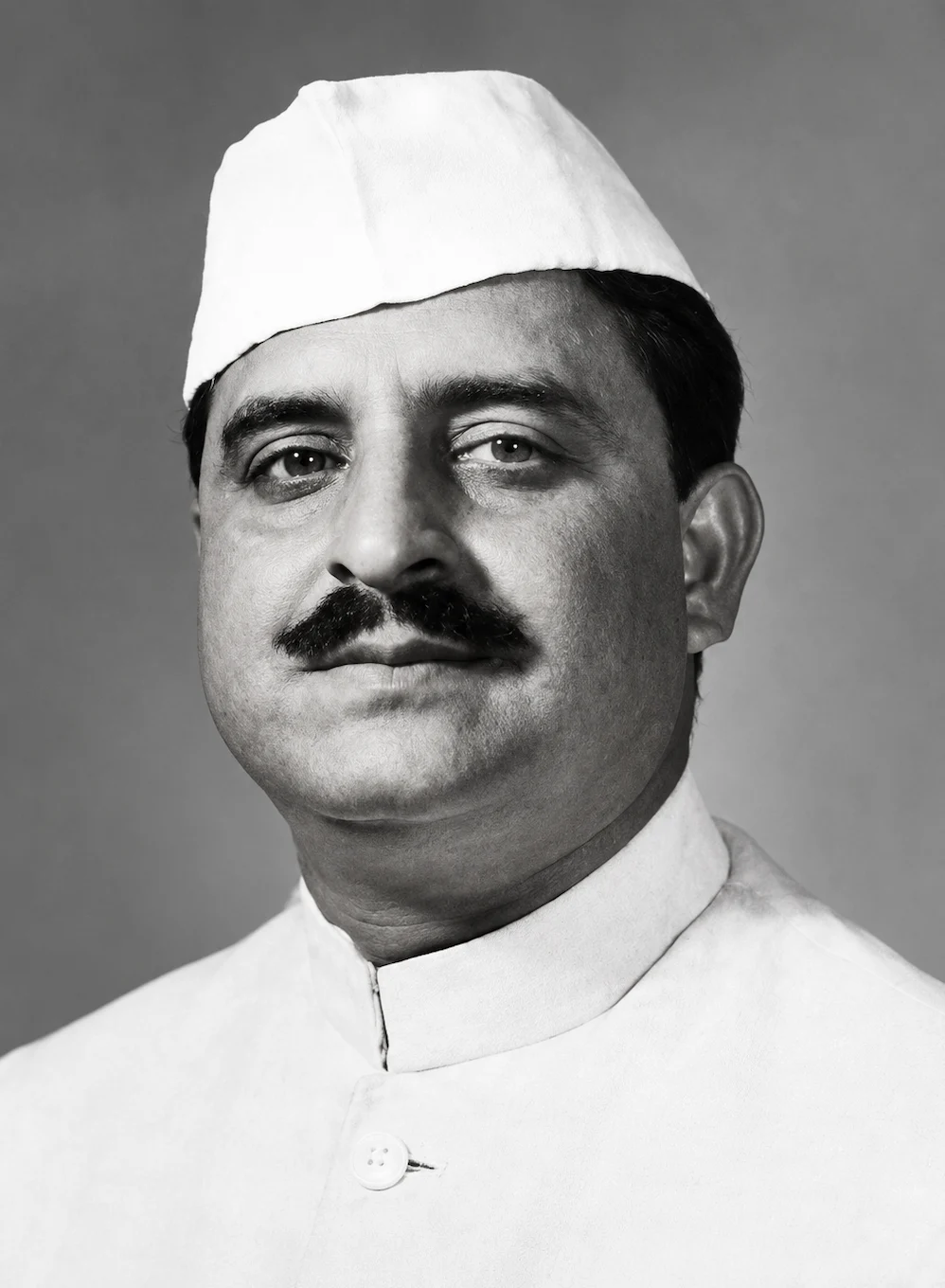
Shah Nawaz Khan's life falls into two halves so sharply divided that they are sometimes treated as belonging to different men. In the first he was a professional soldier: commissioned into the 14th Punjab Regiment from the Prince of Wales Royal Indian Military College, captured at Singapore, and drawn by Subhas Chandra Bose into the Indian National Army, which he led into battle at Kohima and Imphal. In the second he was a Congress politician: tried for treason at the Red Fort, reprieved, and thereafter elected four times to the Lok Sabha from Meerut, holding ministerial office in railways, agriculture, steel and mines, and petroleum across successive governments. The connection between the two halves is not merely biographical. The INA trial itself — in which a Hindu, a Muslim, and a Sikh officer were tried together and defended together by a united political and legal establishment — became one of the catalytic events of 1945–46 that hastened the British departure.
Early Life and Military Family
Birth and Family
Khan was born on 24 January 1914 in Matore, a village in the Rawalpindi District of Punjab in British India (now in Pakistan). He states in his autobiography, published in 1946 as part of The INA Heroes, that he was born into a Janjua Rajput family. Sugata Bose's A Hundred Horizons (Harvard University Press, 2006) confirms that he was "born to a family of Janjua Rajputs in Rawalpindi" and that his father "had been the leader of the Janjua clan and served in the Indian Army for thirty years." Khan himself wrote that his father, Lieutenant Tikka Khan, served with the 58th Vaughan's Rifles (Frontier Force) for some thirty years, and that other relatives had also served in the armed forces, making his family perhaps "the most militarized" in India.
The military character of the household is the most important fact about his upbringing: he was born into a tradition of service in the British Indian Army, trained within its institutions, and commissioned into one of its regiments. His later decision to join the INA was therefore a rupture of personal and family loyalty as well as a political act — a point that became central to the prosecution's case at the Red Fort.
Education and Commission
Khan received his military education at the Prince of Wales Royal Indian Military College. He was subsequently commissioned into the 14th Punjab Regiment. By the time of the fall of Singapore he had risen to the rank of captain.
The Second World War and the Indian National Army
Capture at Singapore
The fall of Singapore to the Japanese in February 1942 was the largest surrender of British-led forces in history, delivering roughly 80,000 to 100,000 troops into Japanese captivity. Among the prisoners were a substantial number of Indian soldiers, including Khan. The Japanese and their Indian collaborators, including initially Mohan Singh and later Subhas Chandra Bose, saw in these prisoners a potential army that could be turned against the British and marched into India.
Joining the INA
Khan's own account of his decision to join the INA, recorded in the INA Heroes autobiography and cited in the academic literature, centres on the influence of Bose's speeches to the prisoners of war. He stated: "It will not be wrong to say that I was hypnotized by his personality and his speeches. He placed the true picture of India before us and for the first time in my life I saw India, through the eyes of an Indian."
He joined the INA in 1943. Bose included him in the cabinet of the Provisional Government of Free India (Azad Hind). He was appointed to command the Subhas Brigade, which Bose selected as the force to spearhead the advance into India.
The Imphal Campaign
Khan led the INA into north-eastern India as part of the Japanese Operation U-Go in 1944. The INA, operating under Japanese authority, participated in the advance on Kohima and Imphal. These positions were held briefly before the operation's failure. In December 1944 Khan was appointed Commander of the 1st Division at Mandalay.
The Imphal campaign failed, and with it the military possibility that the INA represented. The advance into India was repulsed; the Japanese offensive collapsed; and the retreat through Burma in 1944–45 destroyed the INA as a fighting force. Khan survived the retreat.
Khan's Testimony on Discrimination
During the trial Khan provided testimony that the academic literature records as significant. He testified that in the British Indian Army no Indian officer was given the command of a division, and only one was permitted to command a brigade. This testimony — cited in Cohen's 1963 Pacific Affairs article and in the trial literature — served the defence's argument that the INA officers had turned to Bose not merely from nationalism but from a justified grievance about the racial structure of the army they had served.
The Red Fort Trial
The Court-Martial
After the war Khan was tried at the Red Fort in Delhi, alongside Colonel Prem Kumar Sahgal (a Hindu) and Colonel Gurbaksh Singh Dhillon (a Sikh), in the first and most celebrated of the INA trials. The proceedings took place between November 1945 and May 1946. The three were charged with "waging war against the King-Emperor" — the Indian Army Act of 1911 did not provide a separate charge of treason, so this was the nearest equivalent. They were also charged with murder and abetment of murder relating to the execution of INA personnel who had refused to fight.
The Defence
The defence was assembled by the Congress Working Committee and constituted the most eminent legal and political team available in India. It included Jawaharlal Nehru, Bhulabhai Desai (who served as chief defence counsel), Asaf Ali, Sir Tej Bahadur Sapru, and Kailash Nath Katju. The Cambridge Leiden Journal of International Law article on the trial notes that "at the heart of the case was the question of allegiance" and that Bhulabhai Desai's task was to present "a legitimate — i.e., non-treasonable — exception to the duty of allegiance to a state during a war."
The defence argued that the accused should be treated as prisoners of war of a legitimate belligerent government — the Provisional Government of Free India — and that they were not paid mercenaries but bona fide soldiers of a government which they recognised as sovereign. In essence the argument was that allegiance to the British Crown could be lawfully transferred to a competing Indian sovereignty, and that the accused had acted from patriotic duty, "however misinformed or otherwise they had been in their notion of patriotic duty towards their country."
The Verdict and Its Commutation
Khan was convicted and sentenced to death. The sentence was subsequently commuted by the Commander-in-Chief of the Indian Army. L.C. Green's 1948 article in the Modern Law Review treats the legal aspects of the trial and the commutation in detail. The commutation followed widespread unrest and protest across India — the trial had become a national cause, and the spectacle of three officers from the three major communities being tried together for fighting to free India from colonial rule had produced a political effect far beyond its legal merits.
The Trial's Political Significance
The trial is treated in the academic literature as one of the events that hastened the British decision to quit India. The Association for Asian Studies, in its Education About Asia publication, carries an article arguing that "the impact of the INA court-martial of 1945–1946 significantly helped hasten the British exit from India in 1947." The deliberate selection of a Hindu, a Muslim, and a Sikh for the first trial was intended by the British to demonstrate that treason transcended community, but its political effect was the opposite: it demonstrated national unity in the demand for independence, and it turned three convicted officers into symbols of a shared struggle.
Post-Independence Political Career
Joining the Congress
After the trial Khan declared that he would follow the path of non-violence espoused by Gandhi and joined the Indian National Congress. In 1946 he accompanied Gandhi and Abdul Ghaffar Khan to provide relief to the victims of the Noakhali riots — a journey that placed him alongside two of the leading figures of the nationalist movement in one of the most traumatic episodes of communal violence in pre-Partition Bengal.
Parliamentary Career
Khan contested the first Lok Sabha election in 1952 from the Meerut constituency in Uttar Pradesh and won. He was elected from Meerut four times: in 1952, 1957, 1962, and 1971. He lost the seat in 1967 and again in 1977.
His ministerial career spanned several portfolios across successive Congress governments:
- Parliamentary Secretary and Deputy Minister of Railway and Transport (1952–1956 and 1957–1964)
- Minister of Food and Agriculture (1965)
- Minister of Labour, Employment and Rehabilitation (1966)
- Minister of Steel and Mines and Minister of Petroleum and Chemical Industries (1971–1973)
- Minister of Agriculture and Irrigation (1974–1977)
He also held the chairmanship of the National Seeds Corporation and the Food Corporation of India.
The 1965 War and the Question of His Son
During the 1965 Indo-Pakistani War, Khan's son Mahmud was serving as an officer in the Pakistan Army. Khan's entire family, apart from himself and one son, had remained in Pakistan at Partition, his birthplace being in the territory that became West Pakistan. The opposition demanded that he be removed from the government. Prime Minister Lal Bahadur Shastri refused, pointing to Khan's record of service to India as an INA officer.
The episode is worth recording because it illustrates the peculiar position Partition created for families divided by the border, and because Shastri's response constituted a public affirmation that Khan's loyalty to India was beyond question — a significant statement given that his career had begun with a charge of treason against the previous sovereign. It also demonstrates, concretely, that a father and son fought on opposite sides of the same war — a situation that was not unique to the Khan family but is rarely so well documented at the ministerial level.
Political Views
Khan's political orientation was leftist. He supported land reforms and public distribution. He also supported permanent separate personal laws for religious communities — a position that contributed to his defeat in the 1967 election against a Jan Sangh candidate. This defeat indicates that by the late 1960s the political environment in Meerut had shifted sufficiently that a candidate associated with minority religious law could be defeated on precisely that issue.
After the Congress split of 1969 he sided with Indira Gandhi. The 1971 "Garibi Hatao" (Remove Poverty) campaign returned him to Parliament from Meerut. The Janata Party wave of 1977 ended his parliamentary career. His four terms in Parliament (1952, 1957, 1962, 1971) and two defeats (1967, 1977) trace the arc of Congress dominance, its internal fracture, and its recovery and subsequent collapse with considerable precision.
The Shahnawaz Committee
In 1956 the Government of India constituted a committee to investigate the circumstances of Subhas Chandra Bose's death, with Khan as its chairman. The committee included Bose's elder brother Suresh Chandra Bose as a member. The committee's report, declassified by the Government of India from December 2015 and released into the public domain, concluded (on the vote of two of the three members, Suresh Chandra Bose dissenting) that Bose had died in an aeroplane crash at Taihoku (Taipei), Formosa (Taiwan), on 18 August 1945, and that his ashes were kept at the Renkoji Temple in Japan and should be repatriated to India.
The committee's finding has been contested ever since — it is one of the most enduring controversies of modern Indian history — but the report itself is a primary government document and Khan's chairmanship of it a matter of public record.
Death and Burial
Khan died on 9 December 1983 in Delhi. He was sixty-nine years old. He was buried with full state honours in a garden near the Red Fort and the Jama Masjid — the physical proximity to the Red Fort carrying an obvious historical resonance, given that it was there that he had been sentenced to death thirty-eight years earlier.
He remained as head of the Congress Seva Dal until his death. The Films Division of India produced a short documentary on his life in 1987.
Legacy and Assessment
In the History of the Independence Movement
Khan's significance in the independence movement rests not on the INA's military success — the Imphal campaign failed and the INA was destroyed — but on the political consequences of its failure. The Red Fort trial, by making a public spectacle of three officers who had fought for Indian independence, produced a reaction that demonstrated to the British how far political opinion had moved. The academic consensus, as expressed in the Education About Asia article and in the broader literature on 1945–46, is that the trial was among the events that made continued British rule untenable.
The Partition Choice
Khan's decision to remain in India at Partition, when his family and his birthplace were both in Pakistan, was a personal enactment of the composite nationalism argument. Like Husain Ahmad Madani, like Abul Kalam Azad, and like millions of Indian Muslims who made the same choice, he determined that India was his country despite the creation of a Muslim-majority state that claimed to represent him. His subsequent parliamentary career — four terms, multiple ministries, state honours at death — constitutes the working-out of that choice across three decades.
In Parliament
His ministerial record is substantial and largely unremarked in the popular memory, which tends to remember him exclusively as an INA figure. Over twenty-five years in Parliament he held portfolios in transport, agriculture, food, labour, steel, mines, petroleum, and chemical industries. Whether that career was effective is a question this article cannot answer from the available sources, but its extent is documented.
Cultural Memory
Khan was portrayed in the 2005 film Netaji Subhas Chandra Bose: The Forgotten Hero and in the 2017 film Raagdesh, which dramatised the Red Fort trials. His connection to the Bollywood actor Shah Rukh Khan — Khan was the cousin of Shah Rukh Khan's father — has brought his name to a wider audience, though the precise family relationship has been reported variously and some details have been disputed.
Historiographical Note
The primary source for Khan's early life and his decision to join the INA is his own published autobiography, The INA Heroes (1946). His testimony at the Red Fort trial is documented in the trial proceedings and in subsequent academic treatments, principally Cohen (1963), Green (1948), and the Cambridge Leiden Journal of International Law article on the meanings of treason in a colonial context.
His parliamentary career is documented in Lok Sabha records and in journalism of the period, but no scholarly biography or monograph exists. The account given here of his ministerial portfolios and electoral record derives from reference sources whose content is consistent across multiple independent entries. The 1965 episode with his son is recorded in journalism.
The Shah Nawaz Committee report is a primary government document, declassified and available in the public domain from Wikimedia Commons. Its finding is contested, but the document's existence and content are not.
One area of genuine uncertainty is the family's ethnic identity. Khan described himself as Janjua Rajput, and Sugata Bose's Harvard University Press monograph confirms this. However, reporting on the family connection to Shah Rukh Khan has produced conflicting claims about whether the wider family is Rajput, Pashtun, or Hindko-speaking Kashmiri in origin, and cousins resident in Peshawar have disputed the Pashtun identification. This article follows Khan's own account and the academic confirmation, and notes the dispute without resolving it.
References and Further Reading
Primary Islamic Sources
- Quran, Surah An-Nisa (4:75) — "And what is [the matter] with you that you fight not in the cause of Allah and [for] the oppressed among men, women, and children." (Invoked in the broader discourse of Muslim participation in armed resistance to colonial rule)
- Quran, Surah Al-Anfal (8:60) — "And prepare against them whatever you are able of power and of steeds of war." (The verse on military preparedness most frequently cited in the context of Muslim soldiers' duty)
- Quran, Surah Al-Baqarah (2:190) — "Fight in the way of Allah those who fight you but do not transgress." (Principles of defensive and just warfare)
- Quran, Surah At-Tawbah (9:20) — "Those who believed and emigrated and fought in the cause of Allah with their wealth and their lives are greater in rank in the sight of Allah." (The Quranic valuation of sacrifice in a just cause)
- Sahih al-Bukhari, Book of Jihad (Kitab al-Jihad wa al-Siyar), Hadith 2785 — "Guarding the frontier for a day in the cause of Allah is better than the world and what is in it." (The classical reference point for military service as a form of devotion)
Classical Islamic Sources
- Al-Sarakhsi, Shams al-Din. Sharh al-Siyar al-Kabir. [Original 11th century CE — the foundational Hanafi text on the Islamic law of war, relevant to the legal and ethical framework within which Muslim soldiers of the period understood their obligations]
- Al-Mawardi, Abu al-Hasan. Al-Ahkam al-Sultaniyyah. [Original 11th century CE — classical Islamic political theory on military command, obedience, and the legitimacy of authority]
- Ibn Qudamah, Muwaffaq al-Din. Al-Mughni, Kitab al-Jihad. [Original 12th century CE — Hanbali jurisprudence on the ethics of combat and the obligations of a soldier]
- Shah Waliullah Dehlawi. Hujjat Allah al-Balighah. [Original 18th century CE — Indian Islamic reform tradition; the intellectual heritage shared by Muslim nationalists of Khan's generation]
Academic and Scholarly Sources
- Cohen, Stephen P. "Subhas Chandra Bose and the Indian National Army." Pacific Affairs 36, no. 4 (Winter 1963): 411–429. doi:10.2307/2754686. [Peer-reviewed article treating the INA's formation, command structure, and Khan's role within it]
- Green, L.C. "The Indian National Army Trials." The Modern Law Review 11, no. 4 (January 1948): 47–69. doi:10.1111/j.1468-2230.1948.tb00071.x. [Academic legal analysis of the trial's proceedings and the commutation]
- Bose, Sugata. A Hundred Horizons: The Indian Ocean in the Age of Global Empire. Cambridge, MA: Harvard University Press, 2006. [Confirms Khan's birth, family, and place within the INA's history]
- Tarique, Mohammad. Modern Indian History. New Delhi: Tata McGraw-Hill Education. [Textbook treatment of the INA and the Red Fort trial]
- Singh, Harkirat. The INA Trial and the Raj. New Delhi: Atlantic Publishers, 2003. [Monograph on the trial's political context and consequences]
- Leiden Journal of International Law (Cambridge University Press). "Meanings of Treason in a Colonial Context: Indian Challenges to the Charges of 'Waging War against the King' and 'Crimes against Peace'." 2017. [Academic analysis of the legal arguments at the Red Fort]
Further Reading
- Khan, Shah Nawaz. My Memories of INA and Its Netaji. First published 1946; republished 2019. [Khan's own memoir, an eyewitness account of the INA under Bose]
- Khan, Shah Nawaz, et al. The INA Heroes: Autobiographies of Maj. Gen. Shahnawaz, Col. Prem K. Sahgal and Col. Gurbax Singh of the Azad Hind Fauj. Hero Publications, 1946. [Collective autobiography of the three accused, primary source for the early life and the decision to join the INA]
- Government of India. Report of the Shah Nawaz Committee. 1956. Declassified and released into the public domain, December 2015. [Available on Wikimedia Commons; the committee's investigation into the circumstances of Bose's death]
- Films Division of India. Shah Nawaz Khan. Documentary film directed by J.S. Bandekar. 1987. [Government-produced biographical documentary]
Mentioned In
1 article references this topic