Uqba ibn Nafi: The Conqueror of North Africa
Uqba ibn Nafi (c. 622-683 CE) was the Arab commander who conquered North Africa for Islam, founded the city of Qayrawan (Kairouan) in Tunisia, and reportedly rode his horse into the Atlantic Ocean declaring he had reached the end of the land. He was martyred by Berber forces in 683 CE.
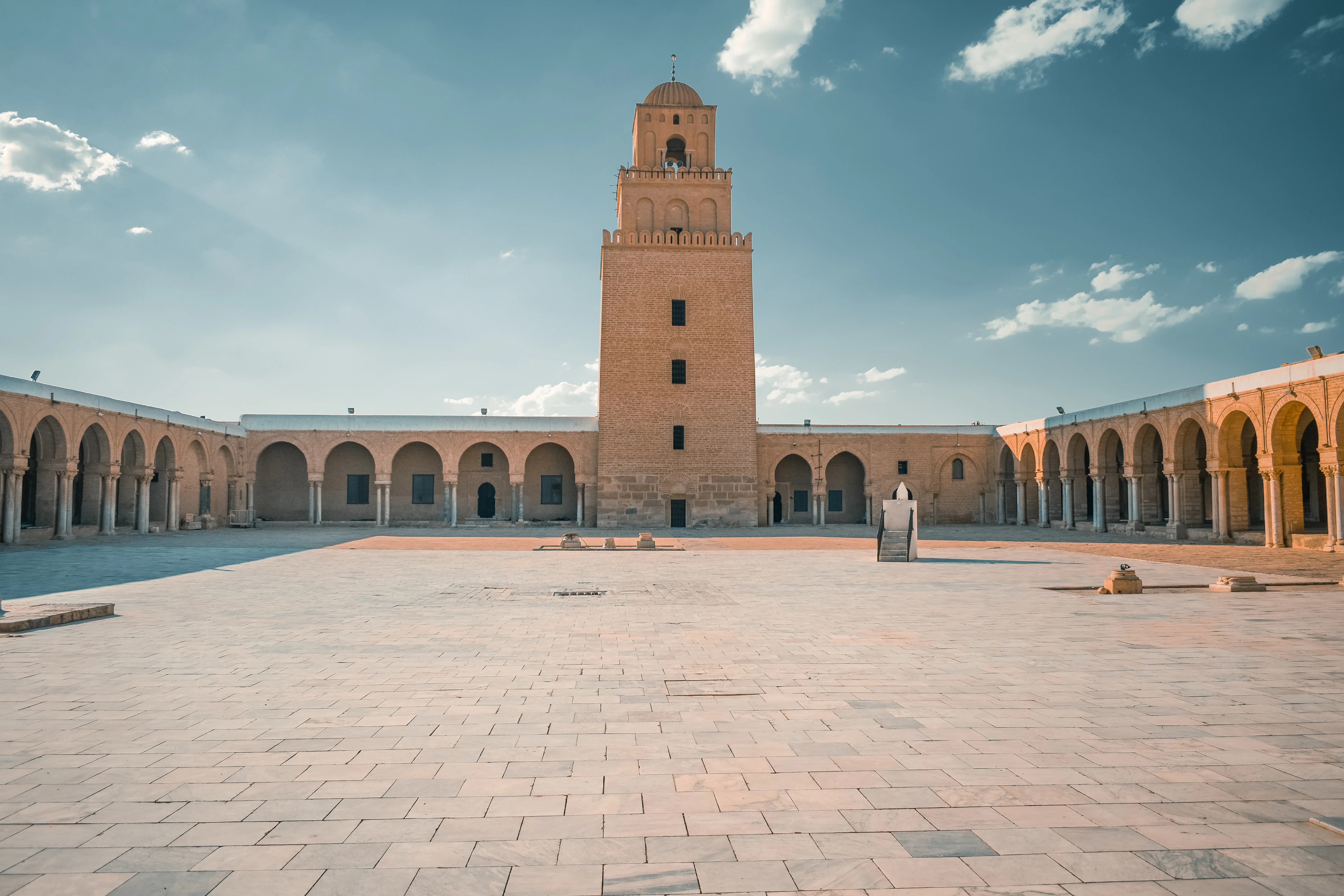
Uqba ibn Nafi ibn Abd al-Qays al-Fihri (c. 622-683 CE / c. 1-63 AH) was the Arab Muslim commander who led the definitive conquest of North Africa (Ifriqiya and the Maghreb) for the Umayyad Caliphate, founded the city of Qayrawan (Kairouan, in modern Tunisia) as the base for Islamic governance and learning in the region, and pushed the frontiers of Muslim authority all the way to the Atlantic coast of Morocco. His campaigns, conducted over two governorships spanning nearly two decades, transformed North Africa from a Byzantine and Berber-controlled territory into an integral part of the Islamic world — a transformation that was permanent and that laid the groundwork for the subsequent conquest of Al-Andalus.
Uqba's story is one of extraordinary military ambition combined with the tragic end that the Islamic tradition honors as martyrdom (shahada). After sweeping across the entire breadth of North Africa — from modern Libya to modern Morocco — in one of the most audacious cavalry campaigns of the medieval world, he was killed by a Berber coalition under the chief Kusayla on his return march in 683 CE. His death temporarily reversed Muslim gains in the western Maghreb, but his legacy — the city of Qayrawan, the framework of Islamic administration in North Africa, and the inspiration of his example — ensured that the retreat was temporary and the conquest would be completed by his successors.
Lineage and Early Life
A Companion's Son
Uqba ibn Nafi belonged to the Banu Fihr — a subdivision of the Quraysh — making him a member of the Prophet's own tribe, though from a different clan than the Banu Hashim. His father, Nafi ibn Abd al-Qays, was a companion of the Prophet, and Uqba himself was born in approximately the year of the Hijra (622 CE), making him a member of the generation that grew up in the first Islamic community in Medina. Some sources classify Uqba himself as a companion (sahabi) if he is understood to have been born early enough to have met the Prophet as a child; others classify him as a Successor (tabi'i) from the next generation.
His connection to the Quraysh — and specifically to the Fihr clan, from which the Quraysh's very name derived — gave him social standing within the Arab military elite. But his fame rested entirely on his military achievements rather than on his lineage: he earned his place in history through conquest, not birth.
Early Military Service
Uqba participated in the early Muslim campaigns in Egypt under the command of Amr ibn al-As (the conqueror of Egypt in 641 CE), and it was from Egypt that the Muslim advance into North Africa was launched. His early experience of warfare in the relatively organized environment of the Egyptian conquest — where the Muslim forces faced and defeated the Byzantine army — prepared him for the very different challenges of North Africa, where the enemies were dispersed, the terrain was vast, and the resistance was guerrilla in character rather than conventional.
The First Governorship and the Founding of Qayrawan
The North African Context
When the Muslim armies first pushed west from Egypt into Libya and Tunisia in the 640s-660s CE, they encountered a landscape very different from the settled civilizations of Syria, Iraq, and Egypt. North Africa was inhabited by the Berbers — the indigenous peoples of the Maghreb — who lived in a mix of settled agricultural communities, semi-nomadic pastoralist groups, and fortified mountain societies. The Byzantine Empire controlled the coastal cities and the eastern portions (modern Libya and Tunisia), but its authority was thin and contested.
The Berbers were divided among themselves — numerous tribes and confederations with shifting alliances and frequent inter-tribal conflict. Some had been Christianized under Byzantine influence; others maintained their indigenous religious practices; and a few communities were Jewish. They were fierce warriors, intimately familiar with their own terrain, and resistant to any external authority — whether Byzantine, Arab, or other.
The Founding of Qayrawan (670 CE)
Uqba's most enduring achievement was the founding of the city of Qayrawan (Kairouan) in 670 CE (50 AH) in what is now central Tunisia. The site was chosen with strategic deliberation: it was inland (protected from Byzantine naval raids on the coast), located on a plain suitable for the Arab cavalry, and positioned at the junction of routes that controlled access to both the coastal cities and the interior.
Qayrawan was designed from the beginning as a permanent garrison and administrative center — not merely a military camp but the nucleus of a city that would anchor Muslim presence in North Africa for centuries. Uqba personally supervised the city's layout: he established the site for the great mosque (which still stands today as one of the oldest mosques in the Muslim world), designated areas for different tribal groups, and laid out the basic urban plan.
The Great Mosque of Qayrawan — founded by Uqba in 670 CE and rebuilt in its current form in the ninth century — is one of the most important mosques in Islamic history. It served as the mother mosque of the entire western Islamic world (the Maghreb and Al-Andalus) and as a center of learning that trained generations of scholars. Its foundation by Uqba connects the physical structure directly to the earliest period of the North African conquest.
Consolidating Ifriqiya
From Qayrawan, Uqba conducted campaigns to consolidate Muslim control over Ifriqiya (roughly modern Tunisia and eastern Algeria). He confronted both Byzantine remnants (who held fortified coastal cities) and Berber resistance (which was concentrated in the mountainous interior). His approach combined military force with diplomacy — some Berber groups were defeated in battle and compelled to submit; others were persuaded to convert to Islam and join the Muslim forces as allies.
However, Uqba's first governorship was cut short when he was replaced by a rival governor (Abu al-Muhajir Dinar) around 675 CE, apparently due to political changes in the caliphal court. He was recalled from his position and spent several years in a kind of political limbo before being reappointed.
The Second Governorship and the Great Western Campaign
Reappointment (681 CE)
In 681 CE (62 AH), the Umayyad caliph Yazid ibn Muawiyah (or, in some chronologies, his predecessor Muawiyah) reappointed Uqba as governor of Ifriqiya. Uqba returned to Qayrawan and immediately began planning the most ambitious military campaign of his career: a sweep across the entire breadth of North Africa to the Atlantic coast.
The March to the Atlantic
Uqba assembled a large army and marched westward from Qayrawan in what became one of the most celebrated cavalry campaigns in Islamic military history. His force swept through central and western Algeria, defeating or bypassing Berber resistance, and through Morocco, pushing through the Middle Atlas and descending to the Atlantic plains. At the Atlantic coast, according to the famous tradition, Uqba rode his horse into the ocean and declared: "O God, if the sea did not stop me, I would go on further in Your cause, fighting those who disbelieved in You, until I reached the end of the land!"
This declaration — whether historical or legendary — captures the spirit of Uqba's campaign: a drive of seemingly limitless ambition, pushing the boundaries of the Muslim world as far as geography would allow. The image of a Muslim warrior on horseback, gazing westward from the African shore of the Atlantic with nothing but ocean before him, became one of the most powerful symbols of the early Islamic expansion.
The Extent of the Campaign
The geographic scope of Uqba's march was extraordinary. From Qayrawan in central Tunisia to the Atlantic coast of Morocco is approximately 2,500 kilometers — a distance that Uqba's cavalry covered while fighting battles, reducing fortifications, and compelling submission from the populations they encountered. The campaign extended Muslim authority (at least nominally) across the entire breadth of North Africa for the first time.
However, the campaign's very scale was also its weakness. Uqba moved too fast to consolidate: he swept through territories without leaving sufficient garrisons, accepted submissions that were based on fear rather than genuine conversion, and left behind populations whose allegiance was uncertain. When he turned back eastward toward Qayrawan, the lands behind him were not truly pacified — and the revenge of the Berbers was waiting.
The Death of Uqba: Martyrdom at Tehuda
The Berber Ambush
On his return march toward Qayrawan in 683 CE (63 AH), Uqba was ambushed and killed by a coalition of Berber forces under the command of Kusayla ibn Lemzem — a Berber chief of the Awraba tribe who had been humiliated by Uqba during the westward campaign (the sources record that Uqba had treated Kusayla with contempt, and the chief had nursed his resentment while waiting for an opportunity to strike).
The ambush occurred at Tehuda (near modern Biskra in eastern Algeria). Uqba's force, depleted and strung out after the long campaign, was overwhelmed. Uqba himself fought until he was killed, along with approximately 300 of his companions — including Abu al-Muhajir Dinar, his former rival whom he had brought along as a prisoner (and who reportedly fought alongside Uqba in the final battle despite their personal enmity).
The Aftermath
Uqba's death was a severe blow to the Muslim position in North Africa. Kusayla and the Berber coalition advanced on Qayrawan and captured it, and for approximately five years (683-688 CE), the western Maghreb was effectively lost to Muslim control. The Muslims retreated to their eastern positions (Barqa/Cyrenaica), and North Africa seemed on the verge of reverting to its pre-Islamic status.
However, the reversal was temporary. The Umayyad caliphate dispatched new forces under Zuhayr ibn Qays al-Balawi (who defeated and killed Kusayla in 688 CE) and later Hasan ibn al-Nu'man (who defeated the Berber queen al-Kahina), completing the conquest that Uqba had begun. By approximately 710 CE — less than three decades after Uqba's death — the entire Maghreb was firmly under Muslim control, and Tariq ibn Ziyad was crossing into Spain.
Legacy
The Founder of Islamic North Africa
Uqba ibn Nafi's legacy rests on three foundations. The first is Qayrawan itself: the city he founded became one of the most important in Islamic history — a center of governance, learning, and commerce that served as the capital of Islamic North Africa for centuries and whose great mosque remains one of the holiest sites in the western Islamic world. The second is the framework of conquest: while Uqba did not complete the conquest of North Africa himself, that task falling to his successors, he established the framework — the base at Qayrawan, the routes of advance, the relationships with Berber groups — that made the completion possible. The third is the model of heroic expansion: his Atlantic march, pushing the boundaries of Islam to the literal edge of the known world, became a powerful symbol of the early community's ambition and faith, and his death in battle, fighting to the last, earned him the status of martyr (shahid) and placed him among the most honored figures of the conquest era.
Veneration
Uqba's tomb at Sidi Okba (the village that grew up around his burial place near Biskra, Algeria) remains a site of visitation. The mosque built over or near his grave is one of the oldest in Algeria, and the community that developed around it testifies to the enduring veneration of a figure who, in the Islamic understanding, gave his life in the cause of spreading God's word to the farthest reaches of the known world.
The Berber Resistance and Its Context
The Challenge of North Africa
The Muslim conquest of North Africa was the longest and most difficult of all the early Islamic conquests — taking approximately seventy years (from the first Arab raids on Libya in the 640s to the final pacification of the Maghreb around 710 CE) compared to the much faster conquests of Syria (6 years), Egypt (3 years), and Iraq/Persia (20 years). The primary reason for this prolonged resistance was the Berbers themselves — a people of extraordinary martial vigor, intimate knowledge of their own terrain, and a tradition of independence that made them among the most formidable opponents the Arab armies faced anywhere.
The Berber resistance was not a single unified movement but a series of regional uprisings led by different chiefs and chieftainesses. Kusayla (d. 688 CE) was the Awraba chief who killed Uqba and briefly recaptured Qayrawan; al-Kahina (d. c. 700 CE) was the legendary Berber queen, possibly Jewish or Christian Berber, who led the final major resistance before the Muslim conquest was completed; and numerous smaller leaders conducted guerrilla warfare in the mountains and deserts.
Uqba's career must be understood within this context of prolonged, multi-generational resistance. His campaigns did not conquer the Berbers definitively — that took another generation after his death — but they established the framework (the base at Qayrawan, the routes of advance, the demonstration that Muslim armies could operate across the full breadth of the Maghreb) that made the final conquest possible.
The Conversion of the Berbers
The ultimate resolution of the North African conquest came not through military force alone but through mass conversion of the Berber populations to Islam. The Berbers who had resisted Arab conquest with such ferocity embraced Islam with equal enthusiasm once they were exposed to its message. Within a generation of the final military pacification, large portions of the Berber population had converted — and these newly Muslim Berbers became, as Tariq ibn Ziyad's conquest of Spain demonstrated, the most dynamic agents of further Islamic expansion.
This pattern — fierce resistance followed by enthusiastic conversion — distinguishes the Berber experience from that of other conquered peoples (like the Egyptians or Syrians, who largely remained Christian for centuries after the conquest). The Berbers found in Islam something that spoke to their values: a religion of martial vigor, egalitarian social principles, and direct relationship with God that appealed to a people whose traditional values included independence, warrior courage, and contempt for hierarchy.
Uqba's role in this process was primarily military — he conquered rather than converted — but his establishment of Qayrawan created the institutional base (the great mosque, the scholarly community, the administrative center) from which Islam would be taught to the Berbers in the generations after his death.
Qayrawan: The City That Outlived Its Founder
The Mother City of the Western Islamic World
The city that Uqba founded in 670 CE became one of the most important in Islamic history — a significance that far outlasted its founder's lifetime:
Religious center: The Great Mosque of Qayrawan (rebuilt in the ninth century by the Aghlabid dynasty but on Uqba's original site) became one of the holiest mosques in Islam — some traditions rank it fourth after Mecca, Medina, and Jerusalem. It was the mother mosque of the entire western Islamic world, from which the faith radiated across North Africa, into the Sahara, and across the strait into Spain.
Educational center: Qayrawan developed into one of the great centers of Islamic learning — producing scholars of hadith, fiqh, and Quranic studies whose influence extended across the Maliki world. The city's scholarly tradition trained generations of West African Muslims who carried Islam south of the Sahara.
Political center: Qayrawan served as the capital of Islamic North Africa under successive dynasties — the Umayyad governors, the Aghlabids, and the Fatimids — until the eleventh century CE, when invasions by the Banu Hilal Arab nomads devastated the surrounding agricultural land and the capital shifted elsewhere.
Architectural influence: The Great Mosque of Qayrawan influenced mosque design across the western Islamic world — its plan, its minaret form, and its decorative vocabulary were reproduced in mosques from Morocco to Sub-Saharan Africa.
The city's location — chosen by Uqba for its strategic advantages (inland, on a plain, at a route junction) — proved ideal for all these functions. Uqba's strategic vision in selecting the site was validated by over three centuries of Qayrawan's dominance of North African Islamic life.
Uqba's March to the Atlantic: A Military Analysis
The Scale of the Achievement
The westward march of 681-682 CE — from Qayrawan in central Tunisia to the Atlantic coast of Morocco — covered approximately 2,500 kilometers of hostile territory. This distance is comparable to the march of Alexander the Great from Persia to India or to Napoleon's march on Moscow — campaigns that are celebrated in Western military history as extraordinary logistical and strategic achievements. Uqba's march deserves similar recognition: it was accomplished by a cavalry force operating far from its base, without secure supply lines, through territory inhabited by hostile populations, and across some of the most difficult terrain in North Africa.
The march's route took Uqba through the High Plateaus of eastern Algeria, arid grassland suitable for cavalry but sparsely populated; the Atlas Mountains, which required either finding passes or bypassing through the coastal plain; the Moroccan Atlantic Plain, fertile land inhabited by Berber agricultural communities; and the Atlantic coast, where Uqba reportedly reached the ocean at or near modern Agadir or Tangier.
The Military Limitations
Despite the march's extraordinary geographic scope, it had significant military limitations that Uqba's death would expose. There was no consolidation: Uqba moved too fast to garrison the territories he passed through, so his army swept forward like a wave but left nothing permanent behind it. The submissions came without conversion, since many of the Berber groups that submitted did so out of temporary fear rather than genuine acceptance of Muslim authority, and once the army passed their submission evaporated. And the campaign overextended: by the time Uqba turned back eastward, his army was far from any base of support, tired from months of campaigning, and traveling through territory whose inhabitants had reason to seek revenge.
These limitations made the return march — not the advance — the vulnerable phase of the campaign. Kusayla, who had been humiliated by Uqba and who had been biding his time, struck precisely at this moment of maximum vulnerability.
The Death at Tehuda: Detailed Account
The Confrontation
The encounter at Tehuda (near modern Biskra, in the Zab region of eastern Algeria) was not a random ambush but a deliberately planned revenge. Kusayla — the Awraba Berber chief whom Uqba had humiliated during the westward campaign — had quietly assembled a coalition of Berber warriors and possibly some disaffected Byzantine remnants. He chose his moment carefully: Uqba's army was returning eastward, depleted by months of campaigning, strung out along the route, and separated from any reinforcement.
The sources record that Uqba was warned of the danger but refused to alter his route or to take precautions that he considered beneath his dignity. When the attack came, Uqba reportedly dismissed his cavalry escort, keeping only a small bodyguard — some sources say he sent most of his army ahead to Qayrawan and retained only 300 men. Whether this reflects historical overconfidence or is a literary device to emphasize his bravery (choosing to face death with a small band rather than using his army to avoid it), the result was the same: overwhelmed and unable to retreat, Uqba and his companions fought to the death.
Martyrdom in Islamic Understanding
In the Islamic tradition, Uqba's death at Tehuda is classified as martyrdom (shahada) — death in the path of God during military service for the expansion of Islam. This classification gives his death positive theological significance: rather than being merely a military failure, it is an act of devotion that earns him Paradise and that places him among the most honored category of the faithful dead.
The association of his burial place with sanctity — the development of the village of Sidi Okba (Sayyidi Uqba, "my master Uqba") around his grave and the construction of a mosque at the site — reflects this understanding. Uqba's tomb is not merely a historical monument but a religious site — a place where the faithful visit to pray, to seek blessings, and to honor a man who died fulfilling what they understand as God's command.
The Great Mosque of Qayrawan: Uqba's Architectural Legacy
The Foundation (670 CE)
When Uqba founded Qayrawan in 670 CE, the first structure he ordered built was the city's congregational mosque — reflecting the Islamic principle that a mosque is the heart of any Muslim community and that its construction takes priority over all other buildings. The original mosque was simple — built of mud brick and palm trunks, like the earliest mosques of the Prophetic era — but its placement and its consecration by Uqba himself gave it a sanctity that subsequent, more elaborate structures would inherit.
Uqba reportedly prayed at the site, sought divine guidance for the mosque's exact orientation (the qibla direction, toward Mecca), and personally supervised the laying of the first foundations. The tradition records that he cleared the site of snakes and scorpions (or, in more legendary accounts, that God caused the creatures to flee at his command), making it safe for habitation. These foundation narratives — whether historical or legendary — established the mosque's sacred character from its very beginning.
Subsequent Rebuilding
The mosque that Uqba founded was rebuilt and expanded multiple times over the following centuries. Hasan ibn al-Nu'man (c. 698-703 CE) demolished and rebuilt the mosque on a larger scale after reconquering Qayrawan from the Berbers, and Bishr ibn Safwan (724-727 CE) added a minaret that is one of the oldest surviving in the Islamic world. The Aghlabid dynasty in the ninth century CE undertook the most comprehensive reconstruction, producing the mosque substantially as it stands today: a vast hypostyle hall with 414 ancient columns, many salvaged from Roman ruins, a monumental mihrab decorated with carved marble and luster tiles, and the distinctive square minaret that defines the city's skyline.
The Mosque's Significance
The Great Mosque of Qayrawan holds a unique position in Islamic sacred geography. Some scholars and traditions rank it as the fourth holiest mosque in Islam — after Masjid al-Haram in Mecca, Masjid al-Nabawi in Medina, and Masjid al-Aqsa in Jerusalem. A tradition attributed to the Prophet (though its authenticity is debated) states that seven pilgrimages to Qayrawan equal one to Mecca. Whether this tradition is authentic or a later development, it reflects the esteem in which the western Islamic world held the mosque that Uqba founded.
The mosque also served as the model for subsequent mosque construction across the western Islamic world. Its plan, its minaret form, and its decorative vocabulary were reproduced — with local variations — in mosques from Morocco to sub-Saharan Africa. The spread of Islam southward from North Africa into the Sahel and West Africa was facilitated in part by the scholarly and religious networks centered on Qayrawan, and the mosques that African Muslims built reflected the architectural traditions that originated in Uqba's foundation.
Uqba in North African Memory
Algeria and the Sidi Okba Tradition
In Algeria, where Uqba died and is buried, his memory is preserved through the town of Sidi Okba, named directly after him and centered on his tomb; the mosque at Sidi Okba, one of the oldest in Algeria, continuously maintained since at least the early Islamic period; local traditions and genealogies that claim descent from his companions or from the community that formed around his grave; and the national narrative of Algeria's Islamization, in which Uqba figures as the pioneer who first brought the faith to the region.
Tunisia and Qayrawan
In Tunisia, where he founded Qayrawan, Uqba is honored as the father of the city — the man whose strategic vision created what became the spiritual and intellectual capital of the western Islamic world for three centuries. Qayrawan's identity is inseparable from its founder, and the Great Mosque's association with Uqba gives it a pedigree that connects it directly to the earliest generation of the Islamic conquests.
The Broader Maghreb
Across the Maghreb generally, Uqba represents the beginning of Islamic history in North Africa — the first chapter of a story that would produce the great Islamic civilizations of the region: the Aghlabids, the Fatimids, the Almoravids, the Almohads, the Marinids, and the Hafsids. Each subsequent dynasty built upon foundations that Uqba had laid — literally (the infrastructure of Qayrawan) and figuratively (the establishment of Islam as the dominant religion of the region).
Historiographical Note
The Sources for Uqba's Life
The primary sources for Uqba's career are Ibn Abd al-Hakam's Futuh Misr wa al-Maghrib (9th century CE), al-Baladhuri's Futuh al-Buldan (9th century CE), and the relevant sections of al-Tabari's comprehensive history. Ibn Khaldun (14th century CE) provides additional information, drawing on North African sources that the eastern historians did not use.
These sources present certain challenges. They were written 150 to 700 years after the events they describe, they sometimes contradict each other on details — particularly regarding the chronology of the two governorships and the exact date of the Atlantic march — and they reflect the interests of their authors and eras rather than providing neutral historical reportage.
Modern historians (particularly Jamil Abun-Nasr, Michael Brett, and Hugh Kennedy) have sifted these sources critically, attempting to reconstruct the most probable sequence of events while acknowledging the uncertainties that inevitably attend the study of seventh-century North African history.
The Atlantic March: History or Legend?
The most famous episode of Uqba's career — his march to the Atlantic and his declaration upon reaching the ocean — has been questioned by some modern historians. The logistical challenges of moving a cavalry army 2,500 kilometers through hostile territory in a single campaign are formidable, and some scholars have suggested that the tradition may compress multiple campaigns into a single narrative or may exaggerate the westward extent of a campaign that actually reached only central Morocco rather than the coast.
Other scholars accept the basic historicity of the Atlantic march while acknowledging that some details (particularly the speech at the ocean) may be literary embellishment. The question remains open, but the tradition's persistence — and the subsequent history that confirms Muslim presence at the Atlantic coast within a generation of Uqba's death — suggests that even if the precise details are uncertain, the general direction and ambition of his campaign are historical.
The North African Context: Byzantine Remnants and Berber Kingdoms
The Byzantine Presence
When Uqba began his campaigns in North Africa, the region was not a vacuum — it contained significant Byzantine (Eastern Roman) remnants. The Byzantine Empire had reconquered North Africa from the Vandals in the sixth century under Justinian and had maintained control of the coastal cities (Carthage, Hadrumetum/Sousse, Leptis Magna) through a system of fortifications and garrisons. By the mid-seventh century, Byzantine control was weakening but not yet extinguished. Carthage remained the Byzantine capital of North Africa until its final capture by Hasan ibn al-Nu'man in 698 CE, after Uqba's death; coastal cities maintained Byzantine garrisons connected by sea to Constantinople; the Byzantine fleet could strike at Muslim positions from the Mediterranean; and local Christian populations in some areas maintained loyalty to Constantinople.
Uqba's campaigns thus operated in a landscape where the primary threat was not a single powerful enemy but a dual threat: Byzantine remnants holding the coast and Berber confederations controlling the interior. His strategy addressed both — striking inland to bypass the coastal fortresses (which required naval power he did not possess to reduce) while subjugating the Berber populations who controlled the hinterland.
The Berber Political Landscape
The Berber populations of seventh-century North Africa were organized into numerous tribal confederations — political units varying in size from small family groups to large confederations controlling significant territory. The major groupings relevant to Uqba's campaigns included the Sanhaja, a large confederation concentrated in the central Maghreb (modern central Algeria); the Zanata, a confederation of the High Plateaus and the northern Sahara; the Masmuda, concentrated in the Atlas Mountains of Morocco; the Kutama in eastern Algeria, who would later play a crucial role in the Fatimid revolution; and the Awraba, the confederation of Kusayla, who would ultimately kill Uqba.
These confederations were not united — they fought each other as frequently as they fought external enemies. Uqba exploited these divisions, making alliances with some groups while fighting others, and incorporating defeated groups into his army as auxiliary forces. This divide-and-conquer approach was effective in the short term but created resentments (particularly among leaders like Kusayla who were humiliated rather than co-opted) that would prove fatal.
The Religious Diversity of Pre-Islamic North Africa
The religious landscape of North Africa before the Islamic conquest was complex. Christianity had deep roots, particularly in the cities and among Romanized populations: North Africa had produced major Christian thinkers such as Augustine of Hippo, Tertullian, and Cyprian, and the church remained an organized institution with bishops, monasteries, and a literate clerical class. Judaism was practiced by scattered communities, particularly in cities and trading towns; indigenous Berber religions persisted in the rural interior and in mountain communities that had never been fully Christianized; and Donatism and other Christian heterodox movements had a presence that weakened the unity of the Christian church in the region.
Uqba's campaigns did not directly target religious communities — the immediate goal was political submission and military control rather than religious conversion. But the establishment of Muslim political authority (and particularly the founding of Qayrawan as a center of Islamic learning) created the conditions within which conversion would gradually occur over the following centuries — transforming North Africa from a predominantly Christian/indigenous-religion region into the overwhelmingly Muslim territory it remains today.
The Two Governorships: A Detailed Chronology
The First Governorship (c. 663-675 CE)
Uqba's first tenure as governor of Ifriqiya began around 663 CE (43 AH), when he was appointed by the Umayyad governor of Egypt (either Amr ibn al-As or his successor) to lead the Muslim forces in what is now Tunisia. During this first governorship:
In terms of military campaigns, Uqba conducted raids westward into the interior, subjugating Berber communities that had not yet submitted and establishing the security perimeter within which Qayrawan would be built. The most consequential act of the first governorship was the founding of Qayrawan in 670 CE — the establishment of a permanent Muslim city in the interior of North Africa, during which the choice of location, the layout of the city, the construction of the mosque, and the settlement of Arab-Muslim populations all occurred. On the administrative side, Uqba appointed governors for sub-regions, established systems of tribute collection from submitted Berber groups, and created the basic framework that would govern Muslim North Africa. Around 675 CE he was removed from office and replaced by Abu al-Muhajir Dinar, apparently due to caliphal politics, as the caliph Muawiyah may have wished to assert control by rotating governors; the sources suggest personal animosity between Uqba and Abu al-Muhajir, which would have consequences during the second governorship.
The Interregnum Under Abu al-Muhajir (c. 675-681 CE)
During the approximately six years when Abu al-Muhajir governed Ifriqiya, Uqba was sidelined — possibly in Egypt, possibly in Arabia, the sources are unclear. Abu al-Muhajir adopted a different approach to the Berbers than Uqba had: he emphasized diplomacy and co-optation rather than force, forming alliances with Berber leaders (including Kusayla) and converting them to Islam through persuasion rather than compulsion.
This gentler approach was, by some measures, more successful than Uqba's — it produced willing converts rather than resentful subjects. But it also created a Berber leadership class that expected to be treated as partners rather than subordinates — an expectation that Uqba would violate when he returned to power.
The Second Governorship (681-683 CE)
When Uqba was reappointed governor in 681 CE by Yazid ibn Muawiyah, he returned to Qayrawan with a determination to complete what he had begun — to push Muslim authority to the farthest possible extent. His treatment of Abu al-Muhajir (whom he reportedly arrested and brought along in chains) and of Kusayla (whom he humiliated publicly) reflected a personality that prioritized authority over diplomacy — a preference that would ultimately cost him his life.
The great western campaign of 681-682 CE — and its catastrophic aftermath at Tehuda — occurred entirely within this brief second governorship. In less than two years, Uqba marched 2,500 kilometers to the Atlantic, then died on his return at the hands of the Berber leader he had humiliated. The arc from triumph to tragedy was compressed into a single explosive chapter of twenty months.
The Aftermath: From Tehuda to the Completion of the Conquest
Kusayla's Brief Triumph (683-688 CE)
After killing Uqba at Tehuda, Kusayla's Berber coalition advanced eastward and captured Qayrawan itself — the city Uqba had founded. For approximately five years (683-688 CE), the western Maghreb was effectively lost to Muslim control. The remaining Muslim forces retreated to Barqa (Cyrenaica, in modern eastern Libya), and it appeared possible that the entire North African conquest would be reversed.
Kusayla governed from Qayrawan — reportedly treating the remaining Muslim population reasonably and maintaining the city's basic functions. But his position was not sustainable against the resources of the Umayyad caliphate, which eventually dispatched a new army under Zuhayr ibn Qays al-Balawi. At the Battle of Mams (688 CE), Zuhayr defeated and killed Kusayla, recovering Qayrawan and beginning the process of reconquest.
Al-Kahina and the Final Resistance (c. 688-703 CE)
The reconquest of the western Maghreb was not immediate. After Kusayla's death, resistance continued under al-Kahina (the Priestess/Prophetess) — a legendary Berber queen or tribal leader (possibly Jewish Berber, possibly Christian, possibly pagan — the sources disagree) who led the Zenata and Jerawa Berbers in fierce resistance. Al-Kahina defeated the Muslim general Hasan ibn al-Nu'man in battle (c. 698 CE) and briefly drove the Muslims back from the western positions.
However, Hasan returned with reinforcements, and al-Kahina was defeated and killed around 700-703 CE. Her death marked the end of organized large-scale Berber resistance to the Muslim conquest. The remaining years of the decade saw the pacification of Morocco under Musa ibn Nusayr, who built on the foundations Uqba had laid and completed the work his predecessor had begun.
Uqba's Role in the Larger Narrative
In the grand narrative of the Islamic conquest of North Africa, Uqba occupies the position of the pioneer — the man who first demonstrated that Muslim authority could extend across the full breadth of the Maghreb, who established the base (Qayrawan) from which all subsequent operations would be launched, and who pushed the frontier to the Atlantic for the first time (even if that initial advance was not sustained). His death was a setback, but the framework he created — the city, the routes, the demonstration of possibility — survived him and was used by his successors to complete what he had started.
The completion of the North African conquest (c. 710 CE), the subsequent crossing into Spain by Tariq ibn Ziyad (711 CE), and the establishment of Al-Andalus all built upon Uqba's pioneering work. Without Qayrawan as a base, without the demonstration that the Maghreb could be traversed and its peoples subdued, without the administrative and military framework that the first generation of conquerors had established, none of what followed would have been possible. Uqba did not live to see the fruits of his labor, but those fruits — the entire western Islamic world — grew from the seeds he planted.
The Character of Uqba: Sources and Assessment
A Man of Intensity
The sources portray Uqba as a man of extraordinary intensity — driven, relentless, and intolerant of anything short of complete submission. His campaigns were characterized by speed and aggression rather than by caution or consolidation. He pushed forward constantly, covering vast distances in short periods, and he demanded absolute acknowledgment of Muslim authority from those he encountered.
This intensity had both positive and negative consequences. Positively, it enabled him to cover the immense distances of the North African conquest in relatively short timeframes, establishing Muslim presence across territories that more cautious commanders might have taken decades to traverse. Negatively, it prevented proper consolidation, created resentments among humiliated local leaders, and ultimately contributed to his death, since Kusayla's revenge was provoked by Uqba's contemptuous treatment of him.
The Humiliation of Kusayla
The specific incident that triggered Uqba's death — his humiliation of Kusayla — illustrates his character and its limitations. According to the sources, Uqba publicly degraded Kusayla during the westward campaign — some accounts say he forced him to slaughter sheep for the army (treating a chief as a servant), others that he struck him or insulted him verbally. Whatever the precise nature of the humiliation, it violated the unwritten rules of Arab-Berber interaction: a chief could be defeated and required to submit, but he should not be gratuitously degraded.
Abu al-Muhajir Dinar — Uqba's predecessor as governor, who had cultivated Kusayla as an ally rather than humiliating him — reportedly warned Uqba that his treatment of the Berber chief was dangerous. Uqba dismissed the warning, either from arrogance (believing his military power made him invulnerable) or from a principled refusal to treat pagans or recent converts with the respect he reserved for established Muslims. Either way, the humiliation planted the seed of the revenge that would kill him.
The Question of Overconfidence
Some sources record that Uqba made the fatal decision to dismiss most of his army on the return march — sending the bulk of his forces ahead to Qayrawan while retaining only a small bodyguard of approximately 300 men. If this detail is historical, it suggests a catastrophic overconfidence: a belief that the Berbers were so thoroughly cowed by his westward march that they posed no threat, even to a small, isolated detachment.
Alternative explanations include the possibility that the army had fragmented naturally during the long campaign, with troops peeling off to return to their home bases; that Uqba deliberately chose to die with a small band rather than risk his entire army, turning his death into a deliberate martyrdom rather than a military miscalculation; or that the sources exaggerate the smallness of his force to heighten the drama of the narrative.
Whatever the explanation, the result was the same: Uqba was caught with insufficient forces to resist Kusayla's ambush, and he and his companions were overwhelmed and killed.
The North African Conquest in World History
One of the Great Transformations
The Muslim conquest of North Africa — of which Uqba's campaigns were the pioneering phase — constitutes one of the great civilizational transformations in world history. Before the conquest (pre-640 CE), North Africa was religiously Christian, with indigenous Berber religions in the interior; linguistically Latin or Romance in the cities and Berber in the countryside; politically under weakening Byzantine authority; and culturally a provincial extension of the Greco-Roman Mediterranean world. After the conquest (by c. 750 CE), it was religiously overwhelmingly Muslim, with Christianity virtually disappearing within a few centuries; linguistically Arabic in the cities and increasingly in the lowlands, though Berber survived in the mountains; politically part of the Islamic caliphate, later divided into independent Muslim states; and culturally part of the Islamic world, contributing to Islamic civilization and oriented toward Mecca and Baghdad rather than toward Rome or Constantinople.
This transformation — complete and permanent — was one of the most thorough civilizational changes ever effected by military conquest. Unlike many conquests (which impose political authority without fundamentally altering religion, language, or culture), the Islamic conquest of North Africa eventually transformed all four dimensions: religion, language, politics, and culture. North Africa today is Arabic-speaking, Muslim, and culturally oriented toward the Islamic world — a reality that traces directly to the campaigns that Uqba ibn Nafi and his successors conducted in the seventh century.
Comparison with Other Transformations
The thoroughness of the North African transformation can be compared with other historically significant civilizational changes. The Romanization of Gaul (1st century BCE – 5th century CE) transformed the Celtic Gauls into Latin-speaking, Christianized Romans over approximately 500 years, but the transformation was incomplete — Celtic elements survived in language and culture — and it was eventually reversed by the Germanic invasions. The Christianization of the Roman Empire (4th century CE) was a transformation in religion without a change in language or political structure, unlike the North African case, which changed everything simultaneously. And the Arab-Islamic transformation of North Africa (7th–10th century CE) changed religion, language, political orientation, and cultural identity comprehensively and permanently — a transformation unmatched in thoroughness by any other conquest of a comparably large territory.
Uqba's role in this transformation was as the initiator — the man who demonstrated that the transformation was possible, who established the first permanent institution (Qayrawan) within which it could develop, and who pushed the frontier to the boundaries within which it would ultimately be completed. He did not live to see the transformation completed, but every subsequent development — from the conversion of the Berbers to the founding of Al-Andalus to the spread of Islam into sub-Saharan Africa — built upon the foundations he laid.
The Cavalry Culture of the Early Conquests
Arab Cavalry in North Africa
Uqba's campaigns were conducted almost entirely by cavalry — mounted Arab warriors whose mobility, speed, and shock capability were the primary tactical advantages of the early Islamic armies. The North African terrain — vast distances of arid steppe, punctuated by oases and mountain ranges — was ideally suited to cavalry operations: horsemen could cover enormous distances quickly, could outmaneuver foot-bound defenders, and could concentrate force at unexpected points before the enemy could react.
The Arab cavalry of the seventh century combined several tactical elements: speed of movement, with the ability to cover 50 to 80 kilometers per day when needed, far outpacing any infantry force; shock combat through the mounted charge with lance and sword that could break infantry formations; mobility, the ability to disengage, reposition, and re-engage from a different direction; and self-sufficiency, since Arab horsemen accustomed to desert conditions could operate with minimal logistical support in the arid North African environment.
Uqba's campaigns exploited all these advantages. His march to the Atlantic — 2,500 kilometers through hostile territory — was essentially a cavalry raid on a continental scale: a force of horsemen moving faster than the enemy could respond, striking where it was least expected, and advancing beyond the range where conventional armies could operate.
The Horse in Islamic Military Culture
The horse held a special place in Islamic military culture — the Prophet had praised horses and their riders, and the Quran references war horses in its encouragement of military preparation (8:60: "And prepare against them whatever you are able of power and of steeds of war"). For warriors like Uqba, the horse was not merely a vehicle of war but a sacred trust — an animal whose maintenance and training was itself an act of worship.
The breeds of horse used in the North African campaigns were primarily Arabian horses (renowned for endurance rather than speed or size) and possibly some Barb horses (the indigenous North African breed that Berber cavalry employed). The combination of Arabian endurance and Barb familiarity with North African terrain gave the Muslim armies an advantage in long-range operations that no other force in the region could match.
Uqba and the Spread of Islam to Sub-Saharan Africa
Qayrawan as a Gateway South
While Uqba's own campaigns were directed westward (toward the Atlantic) rather than southward (toward the Sahara and sub-Saharan Africa), the city he founded — Qayrawan — became the primary gateway through which Islam eventually spread south across the Sahara Desert into West Africa. The scholarly and commercial networks centered on Qayrawan connected the Muslim Mediterranean to the trans-Saharan trade routes that linked North Africa to the gold-producing regions of West Africa (the Ghana Empire, the Mali Empire, and the Songhai Empire).
The chain of transmission ran from Qayrawan, founded by Uqba in 670 CE as a center of Islamic learning and Maliki jurisprudence, along the trans-Saharan trade routes that carried merchants, scholars, and the Islamic faith southward, to the West African trading cities of Ghana, Timbuktu, and Gao that received Islam through trade and scholarly contact, and finally to the great West African Islamic empires of Mali and Songhai that eventually embraced Islam and sent their own scholars to study at Qayrawan and other North African centers.
This chain — stretching from Uqba's seventh-century garrison city to the medieval empires of West Africa — represents one of the most far-reaching consequences of the North African conquest. The Islam that reached Mansa Musa in fourteenth-century Mali, or the scholars of sixteenth-century Timbuktu, was transmitted through networks that originated in (or passed through) the city Uqba had founded six or seven centuries earlier.
The Maliki School and Its Spread
The Maliki school of Islamic jurisprudence — based on the teachings of Imam Malik of Medina — became dominant in North Africa through the scholarly networks centered on Qayrawan. From Qayrawan, the Maliki school spread westward across the Maghreb (Morocco, Algeria), southward across the Sahara into West Africa, and northwestward into Al-Andalus (Islamic Spain).
The Maliki school's dominance across this vast region — from Senegal to Spain, from Morocco to Nigeria — is one of the defining features of western Islamic civilization. And while the school's intellectual origins lie in Medina (where Imam Malik taught), its institutional base in the western Islamic world was Qayrawan — the city Uqba founded, whose Great Mosque became the mother institution of Maliki learning in the West.
In this sense, Uqba's founding of Qayrawan had consequences not only for the military and political history of North Africa but for the religious and intellectual history of the entire western and sub-Saharan Islamic world. The legal tradition that governs Muslim life from Senegal to Libya, from Morocco to Nigeria, traces its western institutional origins to the mosque Uqba built in a Tunisian oasis in 670 CE.
The Companions Who Fell at Tehuda
The Three Hundred Martyrs
The sources record that approximately 300 Muslim fighters died alongside Uqba at the Battle of Tehuda — men who could have fled but chose to stand and die with their commander. Among them was, remarkably, Abu al-Muhajir Dinar — Uqba's predecessor as governor and his political rival, whom Uqba had arrested and brought along in chains. When the ambush came, Abu al-Muhajir reportedly asked to be freed so that he could fight and die as a Muslim warrior rather than as a prisoner. Uqba freed him, and the two men — who had been enemies throughout their careers — fought side by side and died together.
This episode — two rivals united in death, fighting the same enemy after years of personal enmity — has become one of the iconic images of the North African conquest. It demonstrates that whatever personal tensions divided the Arab commanders, they shared a common faith and a common commitment that could override individual grievances when the ultimate test came. Abu al-Muhajir did not flee when given the opportunity; he chose to die fighting for the same cause he had always served, alongside the man who had humiliated him.
The 300 martyrs of Tehuda are commemorated alongside Uqba in the Islamic tradition — their names largely lost to history but their collective sacrifice honored as testimony to the sincerity of the early conquerors' faith. They chose death over surrender when retreat was still possible, and their choice — made collectively, without coercion, in full knowledge of the consequences — places them among the most honored casualties of the early Islamic expansion.
The Burial Site
Uqba and his companions were buried at or near the site of the battle — the location that became known as Sidi Okba (near modern Biskra, Algeria). The burial was apparently performed by the enemy (Kusayla's forces) or by Muslims who came to the site after the battle — the sources are not clear on this point. What is certain is that the gravesite was remembered, maintained, and eventually developed into the village and mosque that exist today.
The fact that the burial site was preserved — rather than being abandoned or deliberately obliterated — suggests that even Kusayla and the victorious Berbers recognized something honorable in Uqba's death. He had fought to the last rather than fleeing or surrendering; he had not begged for mercy; and he had died in a manner that the martial culture of the Berbers (who valued warrior courage above all other qualities) could respect. The enemy honored his grave because his death was honorable — even if his life had included acts (like the humiliation of Kusayla) that were not.
The Terrain and Climate of Uqba's Campaigns
The Geographic Challenge
The territory through which Uqba campaigned — from the Libyan coast through Tunisia, Algeria, and Morocco to the Atlantic — presents some of the most varied and challenging terrain in the Mediterranean world. The Tunisian Tell, a relatively fertile coastal strip where Qayrawan was built, was the most hospitable zone, suitable for settled agriculture and urban life, while the High Plateaus of Algeria formed an arid steppe region between the coastal mountains and the Sahara — vast, sparsely populated, and difficult for armies that required regular water sources. The Atlas Mountains, a series of ranges (Tell Atlas, Saharan Atlas, High Atlas, Middle Atlas) that cross North Africa from northeast to southwest, provided natural fortresses for Berber resistance but also required Muslim armies to find passes or circumvent them. The Moroccan Atlantic Plain, a relatively fertile lowland between the Atlas and the ocean, was the destination of Uqba's great western march, and the Saharan fringe — the northern edge of the world's largest desert — was a zone where water sources were critical and logistical failure meant death.
Uqba's ability to move cavalry armies across this diverse terrain — maintaining supply, finding water, navigating passes, and arriving at objectives in fighting condition — testifies to a logistical competence that the dramatic narratives of battle and ambush tend to overshadow. The greatest challenge of North African warfare was not fighting the enemy but reaching the enemy — and Uqba's consistent ability to project force across enormous distances was itself one of his most significant military achievements.
Climate and Seasonal Considerations
The campaigns were constrained by seasonal factors that the sources rarely make explicit but that would have been central to operational planning. Summer heat in the interior of Algeria and Morocco, where temperatures regularly exceed 40°C, made long marches dangerous for both men and horses, while winter cold in the Atlas Mountains and on the High Plateaus brought snow and freezing temperatures that could immobilize cavalry forces. Water availability was a further constraint, since the intermittent streams (wadis) of North Africa flowed only in the rainy season of autumn and winter, so in summer armies depended on permanent springs and wells whose locations had to be known in advance, and pasture for horses — required by cavalry armies — was available on the steppe in spring but scarce in summer and in mountain terrain.
These constraints meant that the optimal campaigning season was spring and early summer (before the worst heat) or autumn (after the heat broke and before winter set in). Uqba's great western march — covering 2,500 kilometers — would have taken several months at minimum, requiring careful planning to ensure that the army moved through each zone during its most favorable season.
Uqba's Place Among the Great Muslim Commanders
The Pantheon of Early Islamic Generals
In the gallery of great military commanders of the early Islamic period, Uqba holds a position that is distinctive but not supreme. Khalid ibn al-Walid, the "Sword of God," is generally regarded as the greatest tactical commander of the conquests, undefeated in battle across Syria and Iraq; Amr ibn al-As, the conqueror of Egypt, is remembered for diplomatic subtlety as well as military capability; Sa'd ibn Abi Waqqas, the conqueror of Persia at Qadisiyyah, achieved the most strategically consequential single victory; and Tariq ibn Ziyad, Uqba's successor in the western sphere, achieved the most dramatic single campaign in the conquest of Spain.
Uqba's place among these figures is that of the pioneer and path-breaker rather than the decisive victor. He did not win a single battle as famous as Qadisiyyah or Guadalete; he did not conquer a civilization as thoroughly as Amr conquered Egypt. What he did was open a frontier that all subsequent western Islamic achievement would exploit: the North African corridor from Egypt to the Atlantic. Without this opening — without Qayrawan, without the Atlantic march, without the demonstration that the Maghreb could be traversed — none of what followed (including Tariq's conquest of Spain) would have been possible.
His rank among the commanders is thus one of foundational importance rather than tactical brilliance: less celebrated than Khalid or Tariq in popular memory, but no less essential to the ultimate shape of the Islamic world. He laid the foundation; others built the structure. But without the foundation, the structure could not have stood.
Conclusion: The Pioneer and His Legacy
Uqba ibn Nafi's life — from his birth in the generation of the Prophet's companions to his death on a North African battlefield — spans the entire first half-century of the Islamic conquests. He was present at the beginning (the Egyptian campaigns of the 640s), he created the institutional foundation (Qayrawan in 670 CE), he demonstrated the possible scope (the Atlantic march of 681-682 CE), and he died in the cause (Tehuda in 683 CE). His career encompassed the full arc of the North African conquest — from its tentative beginnings to its dramatic expansion to its temporary setback.
He did not live to see the conquest completed. That achievement belonged to his successors — Zuhayr ibn Qays, Hasan ibn al-Nu'man, and Musa ibn Nusayr — who between them finished what Uqba had started. But every subsequent achievement built upon his foundations: the city he established, the routes he pioneered, the relationships he initiated (however imperfectly), and the demonstration of possibility he provided. Uqba showed that the Maghreb could be crossed, that its peoples could be engaged, and that a permanent Muslim presence could be sustained in the far west of the known world. Everything that followed — including the eight centuries of Al-Andalus — was an elaboration of that initial demonstration.
The man who rode his horse into the Atlantic Ocean and declared that he had reached the end of the land established, in that theatrical gesture, the ambition that would define western Islam for the next millennium: the determination to carry God's message to the farthest boundaries of the world, regardless of distance, difficulty, or danger. That ambition — embodied in Uqba's life and consecrated by his death — is his enduring legacy to the Islamic civilization of the west.
References and Further Reading
Primary Islamic Sources
- Sahih Muslim, Book of Jihad — traditions on the conduct and merit of military expansion
- Quran, Surah al-Saff (61:4) — "Indeed, Allah loves those who fight in His cause in a row as though they are a single structure joined firmly"
Classical Islamic Sources
- Ibn Abd al-Hakam. Futuh Misr wa al-Maghrib wa al-Andalus. [9th century CE] — the earliest detailed Arabic account of the North African conquest
- Al-Baladhuri, Ahmad ibn Yahya. Futuh al-Buldan. [c. 892 CE]
- Al-Tabari, Muhammad ibn Jarir. Tarikh al-Rusul wa al-Muluk. Leiden: Brill, 1879-1901. [c. 915 CE]
- Ibn al-Athir. Al-Kamil fi al-Tarikh. [c. 1231 CE]
- Ibn Khaldun. Kitab al-'Ibar. [14th century CE] — extensive treatment of the Berbers and the Islamic conquest of North Africa
Academic and Scholarly Sources
- Abun-Nasr, Jamil M. A History of the Maghrib in the Islamic Period. Cambridge: Cambridge University Press, 1987.
- Brett, Michael, and Elizabeth Fentress. The Berbers. Oxford: Blackwell, 1996.
- Kennedy, Hugh. The Great Arab Conquests. London: Weidenfeld and Nicolson, 2007.
- Julien, Charles-André. History of North Africa: Tunisia, Algeria, Morocco. London: Routledge, 1970.
Further Reading
- Donner, Fred M. The Early Islamic Conquests. Princeton: Princeton University Press, 1981.
- Hrbek, Ivan, ed. UNESCO General History of Africa, Vol. III: Africa from the Seventh to the Eleventh Century. Berkeley: University of California Press, 1992.
- Previté-Orton, C.W. The Shorter Cambridge Medieval History. Cambridge: Cambridge University Press, 1952.
Mentioned In
5 articles reference this topic
More from Umayyad Caliphate
The Battle of Tours - Turning Point in European History
The Battle of Tours (732 CE) between Charles Martel's Frankish forces and the Umayyad army halted Muslim expansion into Western Europe, marking a decisive turning point that shaped the continent's political and religious landscape for centuries.
Umayyad Caliphate
The Umayyad Caliphate (661-750 CE) was the first major Islamic dynasty, ruling from Damascus and expanding the Islamic empire from Spain to Central Asia through unprecedented territorial growth and administrative innovation.
Al-Aqsa Mosque: The Farthest Sanctuary
Al-Aqsa Mosque in Jerusalem is the third holiest site in Islam, central to the Night Journey (Isra and Miraj) of Prophet Muhammad, and a symbol of Islamic heritage and Palestinian identity for over 1,300 years.
Battle of Karbala
The Battle of Karbala (680 CE) was a confrontation in which Husayn ibn Ali, grandson of Prophet Muhammad, was killed with his companions by Umayyad forces near the Euphrates. It became one of the most consequential events in Islamic history, shaping the development of Shia Islam.