Ibn Khaldun
Abd al-Rahman Ibn Khaldun (1332–1406 CE) was the greatest historian and social theorist of the medieval Islamic world. His Muqaddimah founded a science of civilization, explaining the rise and fall of dynasties through asabiyyah and anticipating modern sociology and economics.
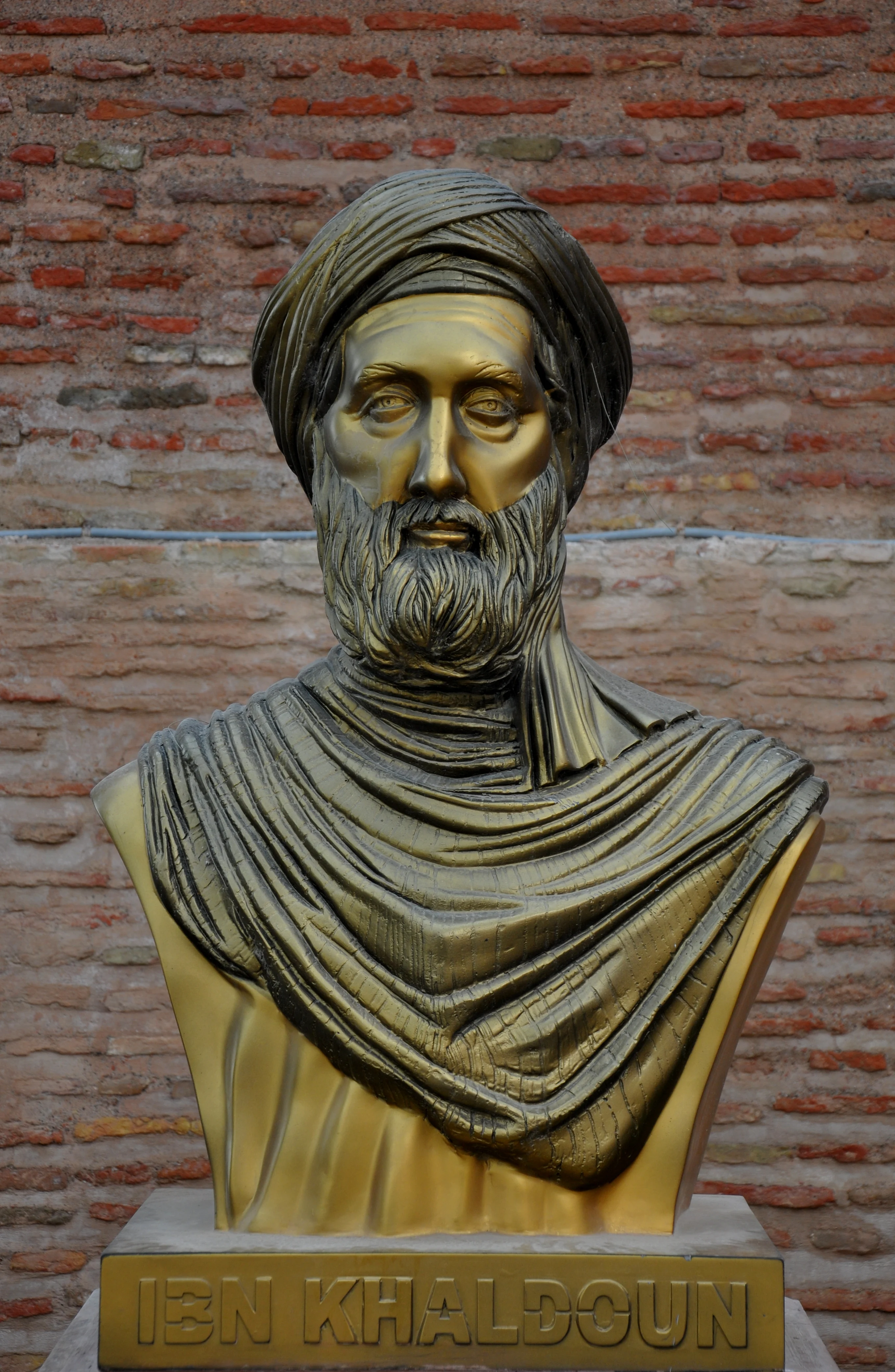
Abd al-Rahman ibn Muhammad ibn Khaldun (1332–1406 CE / 732–808 AH) was the greatest historian and social theorist of the medieval Islamic world, and one of the most original thinkers in the history of human civilization. His masterwork, al-Muqaddimah (The Introduction), written in 1377 CE, was the first systematic attempt to identify the laws governing the rise and fall of human societies — to treat history not as a chronicle of events but as a science with discoverable principles. In it, he developed the concept of asabiyyah (social cohesion), a theory of civilizational cycles, an early labor theory of value, and a methodology for historical criticism that anticipated modern sociology, economics, and historiography by several centuries.
Ibn Khaldun's ideas did not emerge from a library. They were forged by one of the most turbulent political careers in medieval Islamic history — decades of service to rival sultans across the Maghreb and Al-Andalus, imprisonment, exile, the loss of his entire family in a shipwreck, and a final encounter with Timur (Tamerlane) outside the walls of besieged Damascus that he recorded in his autobiography with the detachment of a man who had seen too much to be easily surprised. His theory of how civilizations rise and fall was, in large part, a theory he had lived.
Historical Context: The Fourteenth-Century Islamic World
Ibn Khaldun was born into a world very different from the classical Islamic Golden Age that had produced al-Kindi, al-Razi, and Ibn Rushd. The Abbasid Caliphate had been destroyed by the Mongols in 1258 CE — the fall of Baghdad that ended the institutional center of Sunni Islamic civilization. The Crusades had reshaped the Levant. The Seljuk Empire had fragmented. Al-Andalus was in slow retreat before the Christian Reconquista, with the Nasrid Kingdom of Granada as its last remnant.
The Maghreb — the northwestern corner of Africa, encompassing modern Morocco, Algeria, and Tunisia — was the world Ibn Khaldun knew best, and it was a world of extraordinary political instability. Multiple dynasties competed for control: the Marinids in Morocco, the Zayyanids in western Algeria, the Hafsids in Tunisia. Berber tribal confederations rose and fell. Arab nomadic groups pressed against settled urban populations. The Black Death, which reached North Africa in 1348–1349 CE, killed perhaps a third of the population and disrupted the social and economic structures that had sustained urban civilization for centuries.
It was this world — fragmented, turbulent, marked by the memory of a greater past and the reality of present decline — that Ibn Khaldun observed, participated in, and eventually theorized. His Muqaddimah was not an abstract philosophical exercise; it was an attempt to understand, through systematic analysis, why the world around him was the way it was.
Early Life and the Shadow of the Black Death
Ibn Khaldun was born on May 27, 1332 CE in Tunis, into a family of distinguished Andalusian Arab origin. His ancestors had migrated from Al-Andalus to North Africa in the thirteenth century as the Christian Reconquista advanced, settling in Tunis under the Hafsid dynasty. The family had a strong tradition of scholarship and public service — his father and grandfather had both held administrative positions — and Ibn Khaldun received the comprehensive Islamic education appropriate to his social standing: memorization of the Quran, Arabic grammar and literature, Islamic jurisprudence in the Maliki tradition (the dominant legal school of North Africa, associated with Imam Malik), logic, and philosophy.
His education was interrupted and permanently marked by catastrophe. In 1349 CE, when Ibn Khaldun was seventeen, the Black Death swept through Tunis. Both his parents died, along with most of his teachers. The plague killed with indiscriminate speed, collapsing households, disrupting institutions, and leaving survivors to make sense of a world that had been transformed almost overnight. Ibn Khaldun later wrote about the plague's effects with the analytical detachment that would characterize his mature work — noting how it had depopulated cities, disrupted trade, and accelerated the decline of dynasties that were already weakening. But the personal loss was real, and the experience of civilizational disruption at close range shaped everything he would later think and write.
Among the teachers the plague took from him, one loss mattered more than the rest. Muhammad al-Abili, a scholar of logic, mathematics and philosophy who had arrived in Tunis in 1347 after fleeing an administrative post in his native Maghreb, had introduced the teenage Ibn Khaldun to the philosophical and rational sciences beyond the standard religious curriculum. Al-Abili survived the plague and left Tunis for Fez shortly afterward; Ibn Khaldun, still in his teens and newly orphaned, did not follow him immediately, but the intellectual debt was lasting. It was al-Abili, more than any other of his teachers, who had opened to him the disciplines of logic and philosophy that would later shape the analytical method of the Muqaddimah, and the two would cross paths again years afterward in Fez.
A Career Across Rival Courts
Ibn Khaldun's political career, which occupied the two decades between his early twenties and his mid-forties, was a sustained exercise in navigating the treacherous politics of the fourteenth-century Maghreb. He served, at various points, as a secretary, administrator, diplomat, and advisor to the Hafsid sultans of Tunis, the Marinid sultans of Morocco, the Zayyanid rulers of Tlemcen, and the Nasrid sultan of Granada — rulers who were frequently at war with each other and who regarded their servants' loyalties with justified suspicion.
The clearer of his two imprisonments came at Fez, where he had entered the service of the Marinid sultan Abu Inan Faris in 1352. In early 1356 his loyalty came under suspicion — the sources describe intrigue among rival courtiers rather than any specific act of treason on his part — and Abu Inan had him thrown into prison. He remained confined for nearly two years, until Abu Inan died in 1358 and the vizier al-Hasan ibn Umar, who assumed control of the state, ordered his release and restored him to his former rank. The episode is one of the clearest illustrations in his own career of the instability he would later theorize: a court in which a sultan's death could instantly reverse the fortunes of everyone attached to it, for better or for worse.
He was exiled as well as imprisoned. He switched allegiances when circumstances required it, and he was not always on the winning side. At Fez he also renewed his acquaintance with Ibn al-Khatib, the historian, poet and vizier of Nasrid Granada, whom he had likely first encountered as a fellow scholar-official caught up in the same web of Maghrebi and Andalusi courts; the relationship between the two men combined genuine intellectual respect with the wariness of rivals who served competing patrons, and it ended badly — Ibn al-Khatib was later imprisoned and killed in Granada in circumstances in which political opponents at the Nasrid court played a part. In Granada itself, Ibn Khaldun served as a diplomat to the Castilian king Pedro I, negotiating on behalf of the Nasrid sultan Muhammad V — an experience that gave him direct contact with Christian Iberian politics and deepened his understanding of how different civilizations organized themselves. He observed the Berber tribal confederations of the Maghreb at close range, watching how groups with strong internal solidarity could sweep away settled dynasties that had grown soft and divided.
All of this was, in retrospect, fieldwork. Ibn Khaldun was accumulating the empirical material — the observations of how power actually worked, how dynasties actually rose and fell, how tribal solidarity actually translated into political dominance — that he would later systematize in the Muqaddimah. His theory was not derived from books alone; it was derived from experience, and the experience was unusually rich.
The Retreat at Qal'at Ibn Salama
In 1375 CE, exhausted by decades of political turbulence and increasingly disillusioned with court life, Ibn Khaldun withdrew from active politics. He accepted the hospitality of the Awlad Arif tribe in the region of Oran (in present-day Algeria) and settled in the remote fortress of Qal'at Ibn Salama, where he would spend the next three and a half years in scholarly retreat.
It was here, between 1375 and 1379 CE, that he wrote the Muqaddimah. He later described the experience in his autobiography with a sense of wonder at his own productivity: the ideas had been accumulating for years, and once he began writing, they poured out. He completed the first draft of the Muqaddimah — a work of approximately 600 pages in modern translation — in approximately five months. He then spent the following years revising and expanding it, and began work on the larger historical work of which the Muqaddimah was intended as the introduction: Kitab al-Ibar (The Book of Lessons), a comprehensive history of the Arab and Berber peoples.
The choice of location was not accidental. Removed from the courts and their intrigues, surrounded by the Berber tribal world that had provided so much of his empirical material, Ibn Khaldun could finally think systematically about what he had observed. The Muqaddimah was the result.
The Muqaddimah: A New Science of Civilization
The Muqaddimah opens with a diagnosis of what was wrong with previous historical writing. Earlier historians, Ibn Khaldun argued, had been too credulous — they had accepted reports without evaluating their plausibility, transmitted legends as facts, and failed to ask whether the events they described were actually possible given what we know about how human societies work. The remedy was a new discipline that Ibn Khaldun called ilm al-umran — the science of human civilization — which would establish the principles governing social organization and use those principles to evaluate historical claims.
This was a genuinely revolutionary methodological proposal. Ibn Khaldun was arguing that history could not be understood without a theory of society, and that a theory of society had to be grounded in systematic observation of how human communities actually behave. He was, in effect, proposing what we would now call social science as a prerequisite for reliable historical knowledge.
Asabiyyah: The Engine of History
The central concept of the Muqaddimah is asabiyyah — a term that is usually translated as "group feeling," "social cohesion," or "tribal solidarity," though none of these translations fully captures its meaning. Asabiyyah is the bond that holds a group together, the willingness of its members to support and defend each other, the shared identity and mutual loyalty that enables collective action. It is strongest in small, close-knit groups living under harsh conditions — nomadic desert tribes, mountain communities, groups that have been forged by shared hardship into a coherent social unit.
Ibn Khaldun's theory of history is built on the observation that groups with strong asabiyyah consistently defeat groups with weak asabiyyah, regardless of the relative size or wealth of the two groups. A small, cohesive desert tribe can conquer a large, wealthy, but internally divided urban dynasty — not because the tribe is militarily superior in any technical sense, but because its members fight as a unit while the dynasty's soldiers fight as individuals or factions.
This insight generates Ibn Khaldun's theory of civilizational cycles, which he saw playing out repeatedly in the history of the Maghreb and the broader Islamic world. A tribe with strong asabiyyah conquers a settled civilization and establishes a new dynasty. The dynasty's rulers, now wealthy and powerful, begin to enjoy the pleasures of urban life. They surround themselves with luxury, rely on mercenary soldiers rather than their own tribal warriors, and gradually lose the cohesion that made them formidable. Within three or four generations — Ibn Khaldun was remarkably specific about the timeline — the dynasty has become soft and divided, vulnerable to conquest by the next wave of desert tribes with strong asabiyyah. The cycle repeats.
This was not merely a theory about the Maghreb. Ibn Khaldun saw the same pattern in the history of the Arab conquests that had established the Rashidun Caliphate, in the rise of the Umayyad Caliphate and its replacement by the Abbasid Caliphate, in the Seljuk conquests, and in the Mongol destruction of Baghdad. The asabiyyah cycle was, he argued, a fundamental law of human social organization — as regular and predictable as the cycles of nature.
The Five Stages of a Dynasty
Ibn Khaldun gave the cycle a specific internal structure, dividing the life of a dynasty founded on asabiyyah into five stages and arguing that the whole sequence typically exhausted itself within about four generations, or roughly a century and a quarter — the span, he noted, over which the hardship that had forged the founding generation's cohesion faded from lived memory into inherited story.
The first stage is that of success: the overthrow of the preceding dynasty and the seizure of authority, achieved by the collective effort of the conquering group and still exercised, in this stage, more or less collectively among its leading men. The second is the stage in which the new ruler moves to concentrate power in himself alone, easing out the companions and kinsmen who had shared the original struggle and who might expect to share its fruits, because a monarchy divided among many claimants is one Ibn Khaldun regarded as inherently unstable. The third is a stage of leisure and tranquillity, in which the dynasty, now secure, turns its resources to the enjoyment of what it has won — the building of monuments, the accumulation of revenue, the cultivation of a reputation for magnificence. The fourth is a stage of contentment and peaceableness, in which the ruler no longer innovates but follows the precedents of his predecessors, preserving what has been built rather than adding to it. The fifth and final stage is one of waste and squandering, in which the ruler indulges his own pleasures, surrounds himself with unworthy favourites at the expense of the men whose service had sustained the dynasty, and allows the fiscal and military foundations of the state to decay — a stage Ibn Khaldun compares to the terminal illness of an ageing body, from which a dynasty can no more recover than an old man can return to youth, and at the end of which it falls to a fresh asabiyyah descending on it from outside.
The mechanism binding this decline to its origin is the very success of the first stage. A dynasty that has pacified its territory removes the conditions of hardship and mutual dependence that produced the founding group's solidarity in the first place; the ruling family and its clients, raised in security and luxury rather than in the desert or the mountains, do not reproduce the asabiyyah their grandfathers possessed, however much they may inherit their title. Ibn Khaldun treats this as close to a law of social physics rather than a moral failing to be blamed on any particular ruler, which is part of what distinguishes his account from the conventional moralizing history — of virtuous founders and decadent heirs — that had preceded him.
Economic Theory: Labor, Value, and the State
The Muqaddimah contains a substantial section on economics that is remarkable for its sophistication. Ibn Khaldun developed what is recognizably a labor theory of value — the argument that the value of goods and services is ultimately derived from the human labor that produces them — more than four centuries before Adam Smith and Karl Marx developed similar ideas in the European tradition.
He also analyzed the relationship between taxation and economic activity in a way that anticipates what modern economists call the Laffer curve. He argued that low tax rates on a large, productive population generate more revenue than high tax rates on a shrinking, discouraged population — that excessive taxation destroys the economic activity it is meant to tax. He observed that dynasties in their early, vigorous phase tend to tax lightly and grow wealthy, while dynasties in their declining phase tax heavily and grow poor, accelerating their own collapse.
His analysis of the division of labor, the role of cities as centers of economic specialization, the relationship between population density and economic productivity, and the dynamics of supply and demand all reflect a systematic empirical approach to economic questions that was genuinely original. These ideas were not developed in isolation from his broader theory — they were integrated into his account of how civilizations rise and fall, explaining the economic dimensions of the asabiyyah cycle.
Historical Methodology: Criticism and Causation
Ibn Khaldun's contribution to historical methodology was as significant as his theoretical contributions. He argued that historians had to evaluate their sources critically — asking not just whether a report was transmitted reliably but whether the event it described was plausible given what we know about human nature and social organization.
He gave specific examples of historical claims that failed this test. Reports of enormous armies — hundreds of thousands or even millions of soldiers — were implausible, he argued, because the logistics of feeding and supplying such forces were impossible given the agricultural productivity of the regions involved. Reports of miraculous events had to be evaluated against the known regularities of natural causation. Claims about the wealth of ancient civilizations had to be assessed against what we know about the economic capacity of pre-modern societies.
This critical approach — using knowledge of social and natural regularities to evaluate historical claims — was a genuine methodological innovation. It anticipated the kind of source criticism that would become standard in European historical scholarship only in the nineteenth century, and it was grounded in a more sophisticated theory of social causation than most European historians of that period possessed.
Egypt, the Judgeship, and the Meeting with Timur
In 1382 CE, Ibn Khaldun left the Maghreb for Egypt, settling in Cairo under the Mamluk sultanate, then the wealthiest and most stable Islamic state of the age. He had intended the move as a stage on the way to the pilgrimage, but Cairo's scale — he later described it, with the wonder of a man who had spent his career among the modest cities of the Maghreb, as "the metropolis of the world" — and the opportunities it offered a scholar of his reputation persuaded him to stay. He was appointed to a teaching position at al-Azhar and later served as Chief Maliki Judge (qadi al-qudat) — a position of considerable prestige and responsibility, and one of the four such judgeships the Mamluk state maintained, one for each Sunni legal school.
His tenure as judge was not smooth, and the pattern deserves setting out because it is as revealing of Mamluk institutional life as of Ibn Khaldun's own temperament. He took the office with genuine seriousness, insisting that he judged cases strictly on their merits rather than through the networks of favour and intercession that had commonly influenced Cairo's courts, and he moved to correct abuses in the administration of justice that he found entrenched. This made him enemies among the officials and litigants whose interests the informal system had served, and he was dismissed within his first year. Over the remainder of his life in Egypt he was appointed and dismissed from the chief judgeship a further five times — six terms in total, by the reckoning of the Mamluk biographical sources — as the shifting alliances of the sultan's court repeatedly raised him to the office and then removed him from it. Between judgeships he continued to hold an endowed teaching chair, of which Cairo had a considerable supply, and he used the intervals to teach, write and revise the Muqaddimah, work he continued for the rest of his life.
The move to Egypt cost him his family before it brought him any of these rewards. He had sent for his wife and children to join him from Tunis, and the ship carrying them was lost at sea, apparently in a storm, with his wife and several of his children among the dead; a family library and papers he had also arranged to have sent are reported to have gone down with them. The loss is recorded in the sources on his life, though the fullest circumstantial detail comes from the same biographical tradition that supplies much else about him and should be read with the same caution applied elsewhere in this article to that tradition. What is not in question is that he arrived in Egypt to build a new career very largely alone.
The most extraordinary episode of his Egyptian years — and one of the most remarkable encounters in medieval intellectual history — came in 1401 CE, when the Mongol conqueror Timur (Tamerlane) besieged Damascus. Ibn Khaldun was in the city as part of a Mamluk diplomatic mission. When the situation became desperate, he had himself lowered by rope from the city walls to meet Timur in his camp.
The two men — the aged scholar and the conqueror who had devastated Central Asia and Persia — met multiple times over the following weeks. Ibn Khaldun later recorded their conversations in his autobiography with remarkable detail. Timur questioned him about the geography of North Africa, about the history of the Maghrebi dynasties, about the nature of political power. Ibn Khaldun answered carefully, observing Timur with the same analytical attention he had brought to every ruler he had served. He recognized in Timur the embodiment of his own theory — a man of extraordinary asabiyyah, a conqueror whose tribal cohesion had overwhelmed settled civilizations across half the known world.
Ibn Khaldun secured a safe conduct from Timur for the civilian population left in besieged Damascus and for himself, though not before he witnessed the city's sack and the burning of its great mosque. His route back to Egypt was itself eventful — he was robbed and stripped by Bedouin raiders on the road and reached the coast with difficulty, eventually obtaining passage on a ship carrying an Ottoman ambassador to the Mamluk court, his only recorded contact with the power that would later inherit much of the region he had spent his life observing.
He returned to a Cairo that had briefly required his loyalty elsewhere: in 1389 he had been drawn, evidently against his own preference and under duress, into a palace revolt against the reigning sultan Barquq, though Barquq bore him no lasting grudge for it once restored. His final years were quiet by comparison with everything before them — further short terms in the chief judgeship, continued teaching from an endowed chair, and the ongoing revision of the Muqaddimah and of the historical work it introduced. He died in Cairo in March 1406 CE, aged seventy-three by the solar reckoning, and was buried in the cemetery outside the Bab al-Nasr, one of the city's great gates.
Influence and Legacy
Ibn Khaldun's influence on subsequent Islamic scholarship was real but did not match the scale of his ambition. His Muqaddimah was read and admired by later historians, but he had, in Franz Rosenthal's phrase, no known predecessors and no worthy successors: no school of social analysis formed around his method in the Islamic world in the way legal and theological schools had formed around earlier masters. The clearest direct legacy was closer to home than a school of thought — his student al-Maqrizi, the great historian and topographer of Mamluk Cairo, brought an analytical seriousness to his own study of Egyptian inflation and social conditions that later readers have traced to his teacher's example, and the revival of ambitious historical writing in fifteenth-century Egypt owes something to the standard Ibn Khaldun had set. Several Ottoman scholars and statesmen of the sixteenth and seventeenth centuries took a considerable interest in his work; the historian Mustafa Naima drew on the cyclical theory of dynastic decline in his own chronicle, and a partial Turkish translation of the Muqaddimah was made in the eighteenth century.
His wider rediscovery came through European scholarship and came late. The French orientalist Silvestre de Sacy drew attention to the Muqaddimah in the early nineteenth century, a complete French translation appeared in the 1860s, and Franz Rosenthal's monumental three-volume English translation, published in 1958, made the full text accessible to the English-speaking world for the first time. Since then his reputation has grown steadily and, in some settings, run ahead of the evidence: sociologists have proposed him as a forerunner of Auguste Comte and Max Weber, and economists have found in him anticipations of ideas later associated with Adam Smith and John Maynard Keynes, though — as with the parallel claims made for other scholars in this encyclopaedia's coverage of the medieval Islamic sciences — these are analogies drawn by modern readers rather than lines of direct influence Ibn Khaldun could have transmitted forward into the traditions that produced Smith or Keynes. The title "Father of Sociology," which he would probably have found puzzling applied to a jurist and civil servant of the Maliki school, nonetheless reflects something genuine about the originality of his attempt to study society systematically rather than merely narrate it.
His asabiyyah concept has proven the most durable single element of his thought. It has been applied, with varying degrees of rigour, to the analysis of modern political movements, the dynamics of ethnic and sectarian conflict, and the study of state formation well beyond the Islamic world he wrote about. The core insight — that social cohesion is a measurable variable in political and military effectiveness, and that it tends to erode as the groups that possess it become more secure and more prosperous — has outlasted the specific historical material, drawn from the fourteenth-century Maghreb, that first suggested it to him.
Historiographical Note
Ibn Khaldun is unusually well documented for a medieval Islamic scholar, and the documentation is substantially his own doing: he wrote an autobiography, Al-Ta'rif bi-Ibn Khaldun, that Franz Rosenthal has called the most detailed autobiography in medieval Muslim literature, quoting official correspondence, court appointments and the safe-conducts and letters exchanged with Timur at Damascus. That density of documentary detail should not be mistaken for a complete personal record; the autobiography is notably reticent about his inner life, about his family beyond the bare fact of the losses recorded above, and about the reasoning behind several of the political switches his career required, and modern biographers including Allen Fromherz have had to read the Muqaddimah itself, and the pattern of his moves between courts, to reconstruct what the autobiography leaves out.
A second caution concerns his theoretical claims. The asabiyyah cycle and the theory of umran were developed from Ibn Khaldun's observation of a specific set of societies — the Berber and Arab tribal confederations and the Arab dynasties of the medieval Maghreb and al-Andalus — and he offered them as a general theory of human civilization. Modern scholars including Aziz al-Azmeh have questioned how far a theory built from that material travels to societies organized on entirely different lines, and the confident modern habit of applying asabiyyah to contemporary politics anywhere in the world should be treated as an extension of his thought rather than as something he demonstrated himself.
Assessment
Ibn Khaldun occupies a unique position in the history of Islamic thought. He was not a theologian or a jurist in the tradition of al-Ghazali or Imam Ahmad ibn Hanbal. He was not a philosopher in the tradition of al-Farabi or Ibn Rushd. He was something rarer: a thinker who looked at the world as it actually was — turbulent, cyclical, governed by social forces that operated independently of individual will or divine intervention — and tried to understand it systematically.
His life gave him the material. The courts of the Maghreb, the tribal confederations of the Berber world, the declining civilization of Al-Andalus, the plague-ravaged cities of North Africa, the encounter with Timur outside Damascus — all of it fed into a theory of how human societies work that remains, more than six centuries later, one of the most ambitious and original contributions to the understanding of civilization that any single thinker has produced.
References and Further Reading
Primary Islamic Sources
- Ibn Khaldun, Abd al-Rahman. Al-Muqaddimah (The Prolegomenon). Translated by Franz Rosenthal. 3 vols. Princeton: Princeton University Press, 1967. [Original c. 1377 CE]
- Ibn Khaldun, Abd al-Rahman. Kitab al-Ibar wa Diwan al-Mubtada wa al-Khabar (Book of Lessons and Record of Beginnings and Events). 7 vols. Bulaq: Dar al-Taba'ah al-Amiriyyah, 1867. [Original c. 1377 CE]
- Ibn Khaldun, Abd al-Rahman. Al-Ta'rif bi-Ibn Khaldun wa Rihlatihi Gharban wa Sharqan (Autobiography). Cairo: Lajnat al-Ta'lif, 1951. [Original c. 1405 CE]
Classical Islamic Sources
- Al-Maqrizi, Ahmad ibn Ali. References to Ibn Khaldun in his historical and topographical works. [Original c. 1440 CE]
- Ibn Hajar al-Asqalani. Inba al-Ghumr bi-Abna al-Umr, biographical notice on Ibn Khaldun. [Original c. 1449 CE]
- Al-Sakhawi, Shams al-Din. Al-Daw al-Lami' li-Ahl al-Qarn al-Tasi', entry on Ibn Khaldun. [Original c. 1497 CE]
Academic and Scholarly Sources
- Rosenthal, Franz. Introduction to The Muqaddimah: An Introduction to History. Princeton: Princeton University Press, 1967.
- Mahdi, Muhsin. Ibn Khaldun's Philosophy of History. London: George Allen and Unwin, 1957.
- Lacoste, Yves. Ibn Khaldun: The Birth of History and the Past of the Third World. London: Verso, 1984.
- Irwin, Robert. Ibn Khaldun: An Intellectual Biography. Princeton: Princeton University Press, 2018.
- Fromherz, Allen James. Ibn Khaldun: Life and Times. Edinburgh: Edinburgh University Press, 2010.
- Alatas, Syed Farid. Ibn Khaldun. New Delhi: Oxford University Press, 2013.
- Dale, Stephen F. The Orange Trees of Marrakesh: Ibn Khaldun and the Science of Man. Cambridge: Harvard University Press, 2015.
Further Reading
- Hodgson, Marshall G.S. The Venture of Islam, Vol. 2. Chicago: University of Chicago Press, 1974.
- Robinson, Chase F. Islamic Historiography. Cambridge: Cambridge University Press, 2003.
- Lapidus, Ira M. A History of Islamic Societies. 3rd ed. Cambridge: Cambridge University Press, 2014.
- Berkey, Jonathan P. The Formation of Islam. Cambridge: Cambridge University Press, 2003.
Mentioned In
24 articles reference this topic
and 12 more articles
More from Medieval Islamic World
Ayyubid Dynasty - Saladin's Legacy and the Unification of the Muslim East
The Ayyubid Dynasty (1171-1260 CE) was founded by Saladin and ruled Egypt, Syria, and Yemen. The Ayyubids recaptured Jerusalem from the Crusaders, promoted Sunni Islam, and created a sophisticated state combining military power with cultural patronage.
Battle of Ain Jalut: Turning Back the Mongol Tide
The 1260 CE battle where the Mamluk Sultanate defeated the Mongol Empire in the Jezreel Valley, marking the first major Mongol defeat and halting their westward expansion into the Islamic heartlands.
Battle of Hattin - Saladin's Decisive Victory
The decisive battle of July 4, 1187 CE, where Saladin's forces crushed the Crusader armies near Hattin in Palestine. This pivotal victory led to the recapture of Jerusalem and marked the beginning of the end of Crusader dominance in the Holy Land.
Fatimid Caliphate (909-1171 CE)
A major Shia Islamic caliphate (909-1171 CE) that ruled North Africa, Egypt, and parts of the Middle East. Founded by the Ismaili Shia dynasty claiming descent from Fatimah, the Fatimids established a powerful empire centered in Cairo rivaling the Abbasid and Umayyad caliphates.