Allama Iqbal: The Poet-Philosopher of the East
Allama Muhammad Iqbal (1877-1938 CE) was a poet-philosopher and political leader considered the spiritual father of Pakistan. His poetry, philosophical works, and vision of Islamic revival profoundly influenced the Muslim world.
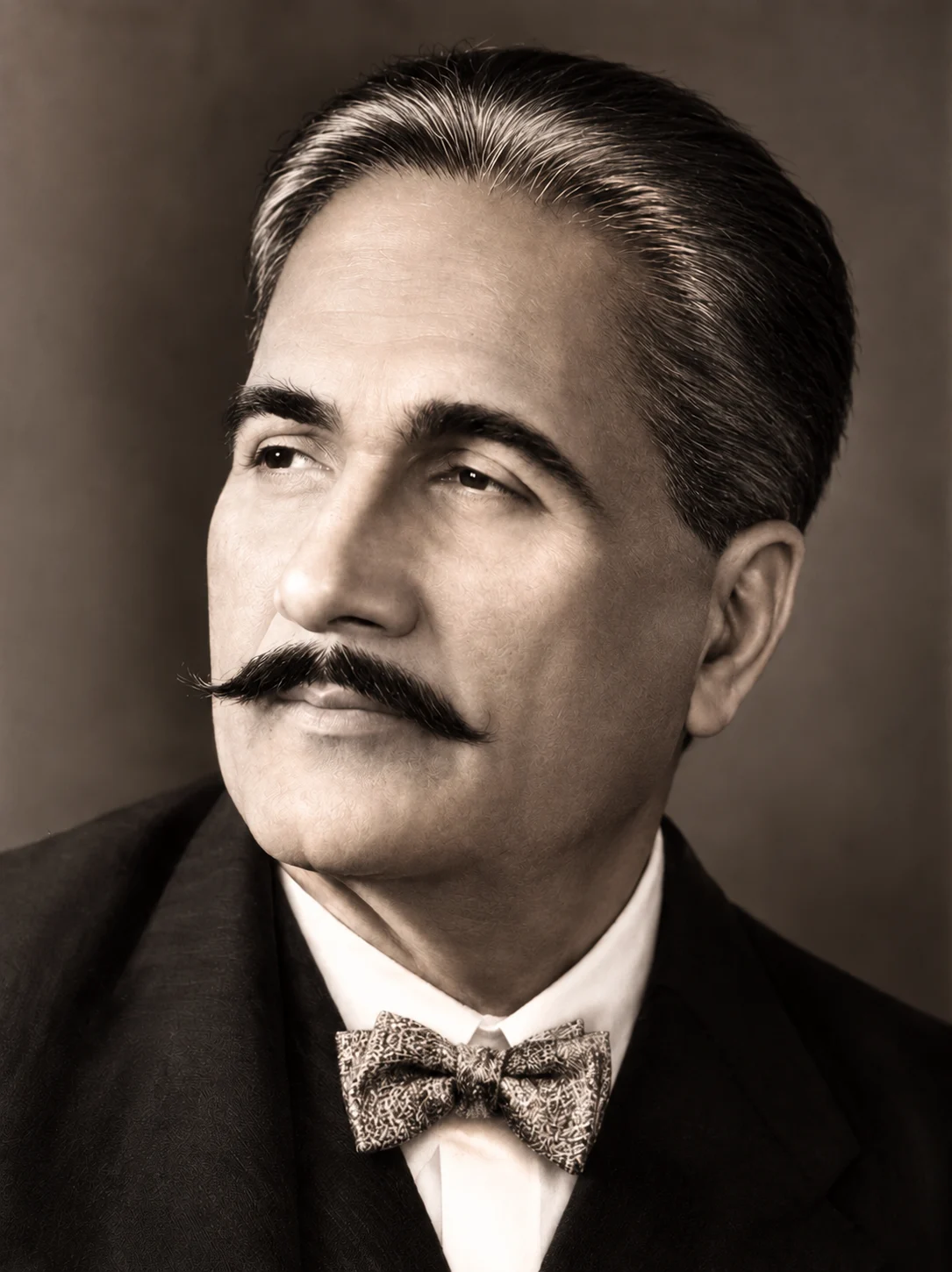
Allama Muhammad Iqbal (1877-1938 CE) was among the most influential Muslim thinkers, poets, and political figures of the modern era. Often described as the "Poet-Philosopher of the East" and the "Spiritual Father of Pakistan," he wrote extensively in Urdu and Persian, produced philosophical works on Islamic thought, and articulated a political vision that shaped how many Muslims of the Indian subcontinent responded to modernity and colonial rule. His concept of Khudi (selfhood), his call for Islamic revival, and his articulation of the ideas underpinning the Two-Nation Theory contributed to the intellectual background of the movement for Pakistan and continue to be studied in Islamic thought worldwide.
Early Life and Education
Birth and Family Background
Muhammad Iqbal was born on 9 November 1877 CE (1294 AH) in Sialkot, in the Punjab region of what is now Pakistan. His father, Sheikh Noor Muhammad, was a devout Muslim who worked as a tailor, and his mother, Imam Bibi, was a pious woman whose influence Iqbal himself credited in his spiritual development. The household was of middle-class means and placed a strong emphasis on Islamic values, education, moral character, and spiritual development. Sialkot itself was a centre of learning and culture in the Punjab, an environment that shaped Iqbal's early formation.
Several influences marked his childhood. He received a firm religious grounding from an early age, and through family connections he was exposed to Sufi poetry and mysticism. He was immersed in Persian literary and philosophical traditions and grew up surrounded by a rich Urdu literary heritage. Throughout, his family maintained a strong emphasis on both religious and secular education.
Traditional Islamic Education
Iqbal's schooling began with traditional Islamic studies. He memorised and studied the Quran under qualified teachers, learned classical Arabic for religious study, and undertook a close reading of Persian poetry and prose. He was taught the history of Islamic civilisation and its major figures, and was exposed early to the works of Sufi poets such as Rumi, Hafez, and others.
His first teacher was Maulvi Mir Hassan, who introduced him to Arabic and Persian, and he later studied Islamic subjects at a more advanced level under Maulvi Ghulam Hassan. His early education followed the traditional methods of memorisation and recitation, guided by teachers who emphasised both knowledge and spiritual development, and it fostered in him a deep appreciation for Islamic literature and poetry.
Modern Education
In 1895 Iqbal enrolled at Government College Lahore, where his studies broadened considerably. He read English literature and Western philosophy, engaging deeply with Western philosophical traditions, and studied under the British orientalist Professor Thomas Arnold. This period marked an intellectual awakening in which he encountered modern ideas and critical methods of thought, and began the work of synthesising Eastern and Western thought that would characterise his later career.
He was an outstanding student who excelled in both traditional and modern subjects. During these years he began writing poetry in Urdu and Persian, developed interests in philosophy and metaphysics, showed qualities of leadership among his fellow students, and received recognition for his academic and literary achievements.
Early Career and Literary Beginnings
Teaching and Legal Career
After completing his early education, Iqbal began his professional life. He taught at Oriental College Lahore and at Government College, later practised law after completing his legal studies, and continued his poetry and literary work alongside these occupations. He developed his skills as a public speaker and lecturer and took an active part in educational and social causes.
Iqbal's outlook in this period was influenced by the educational reform movement associated with Sir Sayyid Ahmad Khan. He supported the cause of modern education for Muslims, favoured rational approaches to Islamic thought, encouraged a scientific temperament, and backed social reform pursued within an Islamic framework.
Early Poetry
Iqbal's early Urdu poetry established his reputation. It included patriotic verse expressing love for his homeland, poetry celebrating Islamic history and civilisation, and work that addressed contemporary social issues, combining poetic expression with philosophical reflection.
He also wrote in Persian, following classical Persian poetic traditions and exploring mystical and spiritual themes. Writing in Persian allowed him to reach the broader Muslim world beyond the subcontinent, and he used the form to express complex philosophical ideas. His long philosophical poem Asrar-e-Khudi (Secrets of the Self), on the philosophy of the self, was composed in Persian and became one of his best-known works.
European Education and Intellectual Development
Cambridge University
In 1905 Iqbal travelled to England for higher studies at Trinity College, Cambridge, where he pursued advanced work in philosophy and engaged closely with Western philosophical traditions. He undertook research on Islamic philosophy and metaphysics, a period he regarded as one of significant intellectual growth.
He completed his Bachelor's degree with distinction, carried out original research in philosophy, and worked on questions related to Islamic metaphysics. During these years he earned recognition from professors and peers and built networks with scholars and intellectuals.
Germany and Heidelberg
Iqbal continued his studies in Germany, where he pursued doctoral work at the University of Heidelberg and immersed himself in German philosophical traditions. His dissertation was on "The Development of Metaphysics in Persia." Through this work he acquired advanced research methods and developed a lasting expertise in comparative philosophy.
His European years exposed him to a range of intellectual influences. He studied Kant, Hegel, and other exponents of German idealism; engaged with Nietzsche's ideas on self-development; and examined Henri Bergson's philosophy of creative evolution. Out of these encounters he worked toward a synthesis of Eastern and Western thought and began to develop original philosophical positions of his own.
Return to India and Philosophical Maturity
Legal and Academic Career
Returning to India in 1908, Iqbal established himself professionally in Lahore. He built a successful legal practice, taught philosophy and literature, delivered influential public lectures, and continued his philosophical and poetic work, gaining recognition as a leading intellectual. Through these years he contributed to philosophical discourse, advanced Urdu and Persian literature, promoted educational reform, conducted research in Islamic philosophy, and published works that were widely read.
The Philosophy of Khudi (Selfhood)
Iqbal's philosophy centred on the concept of Khudi, or selfhood. He emphasised the development of the individual personality and treated self-realisation as the goal of human life. He conceived the self as dynamic and creative, capable of spiritual evolution, and understood in terms of its relationship with the Divine.
This framework drew on several sources. It was influenced by Bergson's idea of creative evolution while being grounded in Islamic principles, finding its basis in Quranic teachings and incorporating Sufi concepts of spiritual development. Iqbal presented the philosophy as directly relevant to modern conditions rather than as an abstraction.
The practical implications of Khudi were central to his thought. He stressed individual responsibility and connected the development of the individual to social reform, drawing out consequences for educational philosophy and for political and social thought, as well as for spiritual practice in daily life.
Major Literary Works
Asrar-e-Khudi (Secrets of the Self)
Asrar-e-Khudi, published in 1908, became one of Iqbal's most famous works. Written in classical Persian, it combined poetry with philosophy and took as its central theme the development and strengthening of the self, describing the soul's journey toward perfection and addressing universal human concerns.
Among its key ideas were the necessity of developing one's personality, the importance of creative and purposeful action, and love as the driving force of self-development. It traced the soul's ascension through various stages and linked individual development to the wider social benefit that could follow from it.
The work was translated into many languages and influenced philosophical thought beyond the subcontinent. It has been regarded as a significant achievement in Persian poetry, has been used in educational curricula, and has continued to find readers.
Rumuz-e-Bekhudi (Mysteries of Selflessness)
Rumuz-e-Bekhudi, published in 1918, was conceived as a companion to Asrar-e-Khudi. Where the earlier work focused on the individual self, this one addressed social and communal life, seeking a balance between individualism and social responsibility. It emphasised the importance of community and society, set out a vision of an ideal Islamic society, and treated individual and collective development together.
Its themes included social solidarity and cooperation, a vision of a united Islamic community or Ummah, the preservation and development of cultural identity, the need for educational and social reform, and principles of political organisation.
Bang-e-Dara (The Call of the Marching Bell)
Bang-e-Dara, published in 1908, was an Urdu poetry collection that established Iqbal's reputation in the language. It contained patriotic poetry expressing love of homeland, verse celebrating Islamic history and civilisation, and commentary on contemporary social issues, and it sought to inspire Muslims toward action and reform while demonstrating his command of Urdu poetic form.
The collection included several notable poems: "Tarana-e-Hindi," a well-known patriotic song; "Shikwa," a complaint addressed to God about the condition of Muslims; and "Jawab-e-Shikwa," presented as God's response to that complaint. It also contained poems celebrating figures from Islamic history and poems expressing philosophical ideas.
Bal-e-Jibril (Gabriel's Wing)
Bal-e-Jibril, published in 1935, is generally taken to represent Iqbal's mature thought. Its Persian and Urdu verse explored spiritual themes and combined mysticism with philosophy, while also addressing contemporary political and social issues and expressing a broad vision of human development.
The collection engaged deep metaphysical questions, reflected on human destiny and purpose, and explored the relationship between the Divine and the human. It also offered a critique of contemporary social and political conditions and set out a vision of a better future.
The Reconstruction of Religious Thought in Islam
Philosophical Work
The Reconstruction of Religious Thought in Islam, published in 1930, represents Iqbal's mature philosophical thought in prose. It offered a systematic presentation of Islamic philosophy addressed to the modern context, applying a rational approach to religious questions and drawing on wide scholarship in an effort to make Islamic thought relevant to the contemporary world.
Its key themes included the relationship between knowledge and religious experience, a modern understanding of the nature of God, the development and significance of the human ego or personality, the essential spirit of Muslim culture, the principle of movement as it bears on the dynamic character of Islamic thought, and, in its final chapter, the question of whether religious knowledge is possible at all.
Philosophical Contributions
In epistemology, Iqbal treated religious experience as a legitimate source of knowledge, recognised intuitive knowledge alongside rational knowledge, and incorporated mystical experience into his account. He sought to relate religious knowledge to scientific method and emphasised the practical dimensions of religious knowledge.
In metaphysics, he conceived reality as dynamic and creative, examined time and space within an Islamic frame of reference, and addressed causation and natural law from that standpoint. He defended human free will and moral responsibility and offered a modern reading of the Divine attributes.
On ethics and society, he set out principles of individual moral development and of ethics in social and political life, discussed economic justice in Islam, addressed Islamic principles of political organisation, and considered an Islamic approach to international relations.
Political Philosophy and the Pakistan Movement
Political Awakening
Iqbal's political consciousness developed gradually. He formulated a critique of British colonial rule, advocated for the political rights of Muslims, and came to recognise what he regarded as a distinct Muslim political identity. He supported constitutional reform and encouraged Muslim participation in political life.
This development drew on several sources. He looked to Islamic political history for lessons, responded to the political events of his own time, engaged with Western political theories, was influenced by other Muslim political thinkers, and learned from practical political experience.
The Allahabad Address (1930)
In his 1930 presidential address to the All-India Muslim League, delivered at Allahabad, Iqbal set out ideas that would become closely associated with the Two-Nation Theory. He proposed the consolidation of a Muslim-majority region in the north-west of India, emphasised a distinct Muslim cultural identity, argued for the political necessity of such an arrangement, and presented a vision of a Muslim polity within or alongside a larger Indian structure.
His arguments in the address rested on several claims: that religion could serve as a basis of nationhood, that there were fundamental cultural differences between the communities of India, that Muslim interests required political protection, that Muslims had a right to self-determination, and that a form of territorial consolidation offered a practical response to communal problems.
The address is widely regarded as part of the intellectual background to the later movement for Pakistan. It contributed to the mobilisation of Muslim political opinion, helped establish Iqbal's standing as a leading Muslim political thinker, and drew attention to the political questions he raised. Historians differ on precisely how far his proposals anticipated the state later created in 1947, and his own statements in the address concerned a Muslim region within India rather than a fully separate sovereign state; the connection between his ideas and the eventual outcome is a matter examined in the scholarship rather than a straightforward equivalence.
Political Philosophy
Iqbal's writings sketch a vision of a state founded on spiritual principles that also incorporated consultative and democratic elements. Such a state, in his account, would emphasise social and economic justice, protect individual rights and freedoms, and rest its authority on moral principles.
The principles he associated with this vision included the ultimate sovereignty of God, the understanding of human beings as vicegerents of God on earth, the principle of consultation (shura) in governance, justice as a fundamental principle of government, and the government's responsibility for public welfare.
He also considered the modern application of these principles, treating them as relevant to contemporary political questions, as a possible framework for an Islamic constitution and for political institutions, as a basis for integrating Islamic law with modern legal systems, and as a guide for international relations.
Educational Philosophy
Vision of Education
Iqbal's educational philosophy was comprehensive in scope. He conceived education as aimed at the complete development of the human being, balancing spiritual and material learning and serving both individual and social needs. He favoured the integration of traditional and modern knowledge and an education with a practical orientation.
Its objectives, as he described them, were the formation of character as the primary aim, the development of critical and creative thinking, the fostering of spiritual growth, the instilling of a commitment to collective welfare and civic duty, and the strengthening of the student's connection to their civilisational heritage and traditions.
Educational Reform
Iqbal was sharply critical of the existing colonial educational system. He objected to its mechanical, rote character, to what he saw as its suppression of creativity and originality, to the cultural alienation it produced, and to the spiritual vacuum he believed it left in students.
His proposals for reform included revising the curriculum to include Islamic content, promoting active and creative teaching methods, emphasising the proper training of teachers, establishing institutions grounded in Islamic principles, and encouraging research and original thinking.
For implementation he suggested practical steps toward reform, supported the development of educational institutions, advocated changes in educational policy, worked to create public awareness of educational issues, and encouraged cooperation in educational development.
Influence on Islamic Thought
Philosophical Impact
Iqbal's influence on modern Islamic philosophical thought was considerable. He promoted a rational approach to Islamic thought and a dynamic rather than static interpretation of Islam, sought to demonstrate Islam's capacity to address the challenges of modernity, offered a philosophical methodology, and contributed to a wider Islamic intellectual revival.
His particular contributions in this area included the revival of ijtihad, the principle of independent reasoning; arguments for the compatibility of Islam with science; the synthesis of Eastern and Western thought; an attempt to balance spiritual and material concerns; and the promotion of a progressive understanding of Islam.
Influence on Scholars
Iqbal engaged with a number of contemporary thinkers and reformers. His thought has been discussed in relation to the Egyptian reformer Muhammad Abduh and the Pan-Islamic thinker Jamal al-Din al-Afghani; he collaborated with the Indian scholar Shibli Nomani; his ideas influenced Muhammad Ali Jinnah, a leading figure of the Pakistan movement; and his work drew attention from scholars internationally.
Among later generations, his influence has been noted on Pakistani intellectuals, on Islamic modernist movements, on Muslim philosophers in various countries, on successive generations of poets, and on political leaders and movements.
Literary Legacy
Poetry and Literature
Iqbal's contribution to Urdu literature lay in the introduction of new themes and styles, in the combining of philosophy with poetry, in the creation of national and patriotic verse, in the expression of spiritual themes, and in the use of poetry for social commentary.
In Persian literature he worked within and enriched the classical tradition, contributed to the tradition of mystical poetry, used Persian as a vehicle for philosophical expression, and reached an international Persian-reading audience, achieving a high standard of literary craft.
Influence on Literature
His literary influence extended across genres. He inspired generations of Urdu poets and influenced Persian poetry, prose writers and essayists, and dramatists, and his work has continued to be felt in later literature.
In terms of themes and styles, he introduced philosophical themes into poetry, helped develop a sense of national consciousness through literature, enriched spiritual literature, used literature for social criticism, and addressed universal human themes.
Later Life and Death
Final Years
In his final years, despite declining health, Iqbal continued to write poetry and prose, remained active in political affairs, delivered lectures and speeches, maintained an extensive correspondence, and offered guidance to a younger generation.
His health, however, deteriorated. He suffered from various ailments, developed serious kidney disease, and received medical treatment, continuing his work through his illness while, according to contemporaries, preparing himself spiritually.
Death and Burial
Iqbal's condition worsened in April 1938. Surrounded by family and friends, and by accounts of those present maintaining his composure, he died on 21 April 1938. He was buried in Lahore, near the Badshahi Mosque, and was given a funeral with public honours. His death was widely mourned, a mausoleum was later constructed over his grave, and the site became a place of visitation.
Legacy and Historical Significance
Pakistan's National Poet
Iqbal is officially recognised as Pakistan's national poet. His poetry appears in national symbols, his image has featured on Pakistani currency, his works are studied in the educational curriculum, and monuments and institutions have been named after him.
His cultural impact in Pakistan has been significant: his work has been associated with the shaping of national identity, has influenced cultural values and norms, has helped establish literary traditions, has shaped intellectual and academic life, and has left a mark on popular culture and media.
Global Influence
Internationally, Iqbal's works have been translated into many languages, are studied in universities around the world, and have been the subject of extensive scholarly research, with regular conferences devoted to his thought and appreciation from a range of cultural backgrounds.
Philosophical Legacy
In the field of Islamic philosophy, Iqbal is associated with the promotion of a rational approach to Islam, the encouragement of dynamic interpretation, the provision of an intellectual method, and the offering of a broader philosophical framework.
Conclusion
Allama Muhammad Iqbal was among the most influential Muslim thinkers, poets, and political figures of the modern era. His engagement with both Eastern and Western intellectual traditions, his poetry in Urdu and Persian, and his political thought shaped the way many Muslims of the subcontinent responded to modernity and colonial rule. His political philosophy is widely regarded as part of the intellectual background to the creation of Pakistan.
His philosophy of Khudi (selfhood) offered a dynamic account of human development that sought to balance individual growth with social responsibility. His emphasis on the creative, evolving self was intended to give Muslims a framework for engaging with modernity while retaining their spiritual and cultural identity, a framework he grounded in Islamic principles while presenting it as responsive to contemporary conditions.
His literary contributions, particularly Asrar-e-Khudi and Rumuz-e-Bekhudi, are regarded as significant works of philosophical poetry that combine spiritual reflection with literary craft. His practice of expressing philosophical ideas through poetry helped make his thought accessible to a wide readership.
His political vision, expressed most prominently in the Allahabad Address of 1930, formed part of the intellectual background to the movement for Pakistan. His arguments about the relationship between religion, culture, and political organisation reflected a particular reading of that relationship, and, as noted above, the precise connection between his stated proposals and the state created in 1947 remains a subject of scholarly discussion rather than a settled equivalence.
The Reconstruction of Religious Thought in Islam remains his most systematic prose work, in which he engaged with modern philosophical and scientific thought while working within an Islamic framework. It has continued to be read by Muslim intellectuals concerned with the relationship between Islam, modernity, and science.
Iqbal's educational philosophy, with its emphasis on integrating spiritual and material knowledge, on character development, and on creative thinking, has continued to feature in educational debates, as has his critique of mechanical learning and his advocacy of a more holistic education.
His influence extends beyond Pakistan and the wider Muslim world. His poetry is studied and appreciated internationally, his philosophical writing has contributed to broader discussions of human development and spirituality, and his political thought has been drawn upon in debates about religion, culture, and governance.
As a poet-philosopher who worked at the meeting point of traditional and modern intellectual currents, Iqbal has remained a figure of continuing interest to those concerned with the relationship between tradition and modernity. Whether regarded primarily as Pakistan's national poet, as an Islamic philosopher, or as a political thinker, his contributions to literature, philosophy, and politics account for his enduring study and influence.
Detailed Analysis of Major Works
Asrar-e-Khudi: A Philosophical Journey
Asrar-e-Khudi, the "Secrets of the Self," is structured as a spiritual and philosophical journey. It opens with an invocation praising God and the Prophet Muhammad (Peace Be Upon Him), establishes the metaphysical basis of selfhood, describes various stages of self-development, offers practical guidance for spiritual growth, and presents its concepts as applicable to all humanity.
On the nature of the self, the work presents the self as a dynamic, creative force connected to the Divine reality — a "divine spark" — with an unlimited potential for development and expansion, a capacity for creative action and thought, and an individual responsibility for its own development. It describes the stages of self-development as a movement from an initial awakening to one's potential, through a necessary struggle against limitations, to the purification of the self from negative qualities, the building of inner strength and resilience, and finally the use of the developed self in service to humanity.
Love figures in the poem as the driving force of this development, encompassing love of God as the ultimate motivation, love of humanity and creation, a proper love and respect for oneself, love as a creative and transformative force, and a love expanding to embrace all existence. The work likewise emphasises action and creativity: meaningful and purposeful action, self-expression through creative activity, contribution to society and civilisation, the development of intellectual capacities, and engagement in spiritual practices and disciplines.
Rumuz-e-Bekhudi: The Social Dimension
Rumuz-e-Bekhudi complements Asrar-e-Khudi by turning from the individual to the social. It examines the relationship between the individual and the community, the individual's responsibility to society, the way societies develop and progress, the maintenance of cultural identity and values, and the principles of social reform and improvement.
The work sets out a picture of the ideal community as one founded on spiritual principles, ensuring justice and equality for its members, in which members support one another's development, share a common vision and purpose, and remain capable of growth and adaptation. This connects to Iqbal's vision of the Islamic Ummah as a worldwide community marked by unity amid diversity, shared values and principles, mutual cooperation across national boundaries, and collective strength drawn from unity.
On cultural identity, the work argues for the preservation of valuable traditions, their development to meet contemporary needs, the maintenance of an authentic identity, innovation within a cultural framework, and the transmission of culture to future generations. Its treatment of social justice encompasses economic justice through the fair distribution of resources, political justice through just systems of governance, social equality of opportunity, the protection of individual and collective rights, and the maintenance of a moral order in society.
The Reconstruction of Religious Thought: Detailed Analysis
The Reconstruction of Religious Thought in Islam represents Iqbal's most systematic philosophical effort. It proceeds with methodological rigour, aims at a comprehensive scope covering the major aspects of religious thought, addresses contemporary philosophical challenges, works within an Islamic intellectual framework, and offers insights that Iqbal presented as relevant to religious traditions more broadly.
The work can be read chapter by chapter. On knowledge and religious experience, it establishes a foundation for religious knowledge, distinguishes different types of knowledge, affirms mystical and spiritual encounter as a legitimate epistemological source, balances rational and intuitive approaches, and draws out the practical implications for religious life. In examining the philosophical test of the revelations of religious experience, it considers methods for verifying religious experiences, proposes philosophical criteria for their evaluation, analyses historical religious experiences, applies these criteria to contemporary experiences, and stresses intellectual honesty in the process.
On the conception of God and the meaning of prayer, the work discusses the nature of God, analyses the Divine attributes, examines the meaning and significance of prayer, considers the relationship between the human and the Divine, and addresses the practical aspects of spiritual life. In its treatment of the human ego, its freedom, and its immortality, it examines essential human nature, the reality and significance of human freedom, the implications of that freedom for moral responsibility, the question of human immortality, and the process of spiritual development.
The chapter on the spirit of Muslim culture analyses the essence of Muslim culture, traces its historical development, identifies its core values, addresses the contemporary challenges facing it, and suggests directions for its future development. The chapter on the principle of movement in the structure of Islam presents Islam as a dynamic rather than static system, discusses the principle of ijtihad or independent reasoning, considers the development of Islamic law, examines how social change may be accommodated within an Islamic framework, and argues for a progressive interpretation of the Islamic sources. The final chapter, "Is Religion Possible?", defends the possibility of religious knowledge, addresses modern challenges to religion, argues for its compatibility with a scientific worldview, seeks a rational foundation for religious belief, and considers the relevance of religion to the contemporary world.
Political Thought and the Pakistan Movement
Evolution of Political Ideas
Iqbal's political thought evolved gradually. He developed a systematic critique of colonialism, began with an emphasis on cultural nationalism, moved toward a growing emphasis on religious identity, developed a form of political realism, and increasingly sought practical solutions to political problems.
Several factors shaped this development. He studied the successes and failures of historical Muslim governance, engaged with Western political theory, responded to contemporary political developments, learned from his own political experience, and exchanged ideas with other political thinkers.
The Two-Nation Theory: Detailed Analysis
The set of arguments associated with the Two-Nation Theory rested, in Iqbal's presentation, on several foundations: the treatment of religion as a fundamental basis of nationhood, the assertion of deep cultural differences between communities, the invocation of different historical experiences and memories, the identification of different principles of social organisation, and the projection of different visions for the future.
The arguments for a separate political arrangement centred on the protection of Muslim cultural and religious identity, the securing of political rights and representation, the safeguarding of economic interests, the meeting of specific educational needs, and the enabling of social development along Islamic lines.
These arguments were advanced in response to criticism. Iqbal engaged with advocates of secular nationalism, addressed arguments for maintaining a united India, responded to practical concerns about separation, considered the question of minority rights, and reflected on the international implications of his proposals.
The scholarship on this subject also notes the challenges of implementation that such ideas raised, including the practical difficulties involved, transitional issues, questions of boundaries and territory, questions concerning the movement of populations, and questions about the economic viability of any separate arrangement. These are analytical points examined by historians of the period rather than a programme Iqbal himself worked out in detail, and the extent to which his 1930 proposals anticipated the eventual partition of 1947 remains contested.
Vision of Islamic State
Iqbal's vision of an Islamic state was organised around several principles: the ultimate sovereignty of God, the understanding of human beings as trustees and vicegerents, the principle of consultation in governance, justice as a fundamental principle, and the state's responsibility for public welfare.
In constitutional terms, he considered the role of Islamic law, the embedding of consultative governance within an Islamic framework, the guarantee of personal liberties within a morally grounded polity, the securing of the rights of religious minorities, and the possibility of a federal structure for diverse populations. On the institutional level, discussion of his thought has addressed the structure and powers of an executive branch, the composition and functions of a legislature, an independent judiciary based on Islamic principles, an efficient and just administrative system, and strong institutions of local government.
His writing on an economic system took up the principles of an Islamic economic order, the securing of economic justice and equality, the balancing of individual and collective property rights, the role of the state in ensuring public welfare, and principles for international economic relations.
Educational Philosophy: Comprehensive Analysis
Critique of Colonial Education
Iqbal offered a systematic critique of the colonial educational system. He argued that it produced cultural alienation, that it emphasised rote learning and memorisation, that it suppressed creativity and original thinking, that it created a spiritual vacuum in students, and that it disconnected education from social needs.
He identified specific problems within the system, including inappropriate curriculum content, ineffective teaching methods, inadequate teacher training, unclear or inappropriate educational objectives, and unsuitable methods of assessment and evaluation. In his analysis, the effects of these problems on society included a crisis of authentic leadership, cultural confusion and a crisis of identity, contributions to various social problems, the perpetuation of economic dependence, and a contribution to political weakness.
Alternative Educational Vision
Iqbal's alternative educational philosophy rested on several principles: the holistic development of the intellectual, spiritual, and moral dimensions of the student; the integration of spiritual and material knowledge; the maintenance of cultural authenticity; the relevance of education to contemporary needs; and the service of both individual and social development.
The curriculum framework he favoured gave a central place to Islamic studies while including the modern sciences and technology, emphasised both native and international languages, incorporated the arts and literature, and developed practical and vocational skills. His preferred teaching methodology promoted active and participatory learning, developed critical and analytical thinking, encouraged creative expression, cultivated problem-solving skills, and emphasised character and moral development. In terms of institutional structure, he looked to a strong foundation in primary education, comprehensive secondary education, excellence in higher education and research, thorough teacher-training programmes, and efficient educational administration.
Implementation Strategies
The practical steps associated with Iqbal's educational thought included systematic curriculum reform, the building of the capacity and vision of educators through rigorous training, the development of educational infrastructure, the mobilisation of resources for education, and the engagement of local stakeholders in shaping educational priorities.
At the level of institutional development, the emphasis fell on establishing model educational institutions, creating research and development centres, establishing teacher-training institutions, developing educational publishing, and making appropriate use of educational technology. In terms of policy advocacy, the concerns included advocating appropriate government policies, raising public consciousness about the transformative power of education, building cross-border partnerships for educational advancement, encouraging involvement from the private sector, and mobilising civil society for educational reform.
Influence on Contemporary Islamic Thought
Iqbal's educational thought has been associated with a number of educational reform movements. It exerted a fundamental influence on the Pakistani educational system, contributed to educational reform in other Muslim countries, affected the development of Islamic universities, shaped the development of Islamic curricula, and helped shape Islamic educational philosophy more generally. Contemporary applications of this thought have included addressing modern educational challenges, integrating modern technology with Islamic values, responding to the educational challenges of globalisation, maintaining cultural identity within a global context, and pursuing quality education within an Islamic framework.
Political Influence
In the domain of Islamic political movements, Iqbal's ideas have been associated with a fundamental role in the creation of Pakistan, an influence on Islamic political parties, an impact on Islamic constitutional development, a role in shaping Islamic political theory, and an influence on concepts of Islamic governance. Discussion of his contemporary relevance has considered its bearing on modern Muslim-majority states, its contribution to Islamic democratic theory, its influence on Islamic human-rights discourse, its impact on Islamic thinking about international relations, and its role in inspiring movements of political reform.
Literary and Cultural Legacy
Impact on Literature
Iqbal's lasting impact on Urdu literature is generally described in terms of his pioneering of fresh subjects and stylistic experimentation in verse, his establishment of a tradition of philosophical poetry, his contribution to a national literary tradition, his setting of high literary standards, and his provision of inspirational themes for later poets.
In Persian literature, he is credited with enriching the classical literary tradition, introducing modern themes within classical forms, gaining international recognition for his Persian poetry, serving as a bridge between different Persian-speaking cultures, and setting an enduring benchmark for poetic craftsmanship. His influence on contemporary writers has been felt among poets in multiple languages, among essayists and authors whose intellectual and stylistic direction he helped shape, among dramatists and those producing theatrical works, among novelists and fiction writers, and among literary critics and theorists.
Cultural Impact
In relation to national identity, Iqbal's work has been associated with a fundamental role in shaping Pakistani national identity, with the shaping of societal norms and collective aspirations, with the use of his poetry in national symbols and ceremonies, with a central place in the educational curriculum, and with an influence on popular culture and media.
His international recognition is reflected in worldwide appreciation of his work, in the translation of his writings into numerous languages, in their study in universities around the world, in their role in facilitating cultural exchange and understanding, and in the appeal of the universal themes in his work. His continuing influence extends to contemporary artists, to cultural institutions and policies, to the festivals and celebrations regularly devoted to his work, to ongoing scholarly research and publication, and to the adaptation of his work to digital media.
Challenges and Criticisms
Contemporary Criticisms
Iqbal's thought has attracted a range of criticism. Philosophically, critics have questioned what they regard as an excessive emphasis on individualism, have raised the charge of an elitist approach to human development, have pointed to a strong Western philosophical influence, have asked how his philosophy applies in practice, and have debated the systematic coherence of his thought.
Politically, his critics have questioned the Two-Nation Theory and its consequences, have criticised the religious basis of the nationalism associated with him, have raised concerns about the position of minorities within his political vision, have asked how his political ideas could be implemented in practice, and have debated the historical consequences of his political thought. In the literary sphere, some have argued that his poetry is too philosophical and difficult to be accessible, have debated his use of Persian rather than Urdu, have criticised what they see as repetitive themes, have discussed his poetic style and technique, and have questioned the contemporary relevance of his literary work.
Responses and Defenses
In response, scholars sympathetic to Iqbal have emphasised the need for a contextual understanding of his work, have argued for viewing it in historical perspective, have promoted a systematic study of his complete writings, have called for a balanced assessment of his contributions, and have explored contemporary applications of his ideas. On more practical grounds, defenders have pointed to what they regard as the positive historical impact of his ideas, have sought to demonstrate their continuing relevance, have emphasised the inspirational value of his work, have highlighted his educational contributions, and have underlined his cultural significance.
Contemporary Debates
Academic engagement with Iqbal continues through regular scholarly conferences and symposiums, ongoing research publications and studies, comparative studies setting him alongside other thinkers, interdisciplinary approaches to his work, and international perspectives on his thought. In public discourse, his work features in media discussions and programmes, in debates about his place in the educational curriculum, in discussions about the political relevance of his ideas, in debates about his cultural significance, and in discussions of the contemporary application of his thought.
Detailed Examination of Key Poems and Their Philosophical Significance
Shikwa and Jawab-e-Shikwa: The Divine Dialogue
The two complementary poems "Shikwa" and "Jawab-e-Shikwa" are among Iqbal's most famous and, in their time, most debated works. "Shikwa" (The Complaint) was written in 1909 and expresses Muslim grievances addressed to God; "Jawab-e-Shikwa" (The Answer to the Complaint), written in 1913, presents a response in the voice of God. Initially controversial, the poems were later widely accepted, came to be regarded as accomplished works of Urdu poetry, and combined theological, historical, and social commentary.
"Shikwa," the Muslim complaint, opens with a respectful but bold address to the Divine, recounts the past glories of Islamic civilisation, laments the present state of Muslim decline, questions apparent divine neglect, and maintains a passionate and emotional tone throughout. Its central arguments dwell on the past service of Muslims to God and humanity, the sacrifices made for the faith, the present suffering and humiliation of Muslims, the apparent injustice by which the faithful suffer while others prosper, and an appeal for divine justice and intervention. Iqbal uses the form of the dramatic monologue to effect, draws richly on Islamic historical references, employs powerful emotional and rhetorical language, works with a strong rhythmic and musical structure, and makes effective use of symbolic imagery.
"Jawab-e-Shikwa," the divine response, answers the complaint in the voice of God. It acknowledges past Muslim achievements, offers a critique of the present Muslim condition, places responsibility on Muslims themselves, and closes with hope and guidance for renewal. Its key messages hold Muslims responsible for their own condition, critique a weakened faith and commitment, address moral and spiritual decline, outline a path to renewal and revival, and affirm continued divine mercy and support. In philosophical terms, the pair of poems engages the problem of evil and suffering, emphasises human responsibility and agency, cultivates historical consciousness, offers a spiritual diagnosis of the Muslim condition, and issues a call to action and reform.
Tarana-e-Hindi: The Indian Anthem
"Tarana-e-Hindi" is a patriotic song that became one of the most widely known expressions of Indian nationalism of its time. Composed in 1904, during Iqbal's early nationalist phase, it became extremely popular across India, was sung across religious and linguistic lines, appeared during the period of the independence movement, and has continued to be sung and remembered.
The poem uses simple, accessible language, draws on natural and cultural imagery, has a strong rhythm suited to singing, makes a direct emotional appeal to patriotic feeling, and addresses themes that resonated across communities. Its themes include a passionate expression of love for India, a celebration of the country's natural beauty, an acknowledgment of its cultural diversity, a call for unity among Indians, and an expression of pride in Indian civilisation. The poem is also read as marking a particular moment in the development of Iqbal's thought: it belongs to his early nationalist phase and expresses an inclusive vision of Indian identity, whereas his later thought moved toward an emphasis on Muslim political identity. It has retained its relevance despite this evolution and is treated as an important historical document of Indian nationalism.
Khizr-e-Rah: The Guide of the Path
"Khizr-e-Rah" explores mystical and spiritual themes, drawing on the figure of Khizr, the mystical guide of Islamic tradition. It describes a spiritual journey and the guidance received upon it, employs a rich mystical symbolism, shows the clear influence of the Sufi mystical tradition, and takes up themes of universal spiritual guidance.
Its philosophical content addresses the human quest for spiritual truth, the role of divine guidance in human life, the emphasis on an inner spiritual journey, the description of mystical experience, and the connection of mysticism with practical life. As a literary achievement, the poem is marked by a masterful use of symbolic language, a rich mystical imagery and range of metaphors, considerable emotional and spiritual depth, a high level of technical poetic accomplishment, and a strong spiritual effect on its readers.
Bal-e-Jibril: Selected Poems Analysis
Among the poems of Bal-e-Jibril, "Iblees ki Majlis-e-Shura" (Satan's Advisory Council) is a satirical work that critiques modern civilisation. It uses satire to that end, casts Satan and his advisers as symbolic characters, mounts a systematic critique of modern civilisation, offers sharp moral commentary on contemporary issues, and makes innovative use of dramatic dialogue. Its themes include a critique of excessive materialism, a questioning of narrow nationalism, a critique of exploitative capitalism, a questioning of the secular worldview, and an address to moral decay in modern society.
"Masjid-e-Qurtuba" (The Mosque of Cordoba) is a meditation on Islamic civilisation in Spain. It reflects on Islamic Spain, celebrates Islamic cultural achievement, expresses a sense of loss and nostalgia, opens a dialogue between civilisations, and considers the spiritual significance of Islamic architecture. Its philosophical themes take in the patterns of civilisational rise and fall, the importance of cultural memory, the preservation of spiritual heritage, reflection on interfaith relations, and the cultivation of an awareness of civilisational memory and its lessons.
Iqbal's Correspondence and Personal Relationships
Letters and Personal Writings
Iqbal maintained an extensive correspondence throughout his life. It included personal letters to family members, scholarly correspondence with scholars and intellectuals, letters on political matters, letters to students and disciples, and correspondence with international figures.
Among his notable correspondents were the scholar Shibli Nomani, with whom he corresponded extensively; Muhammad Ali Jinnah, with whom he exchanged politically important letters; his close friend Sayyid Nazeer Niazi; European orientalists; and members of his own family. The themes of this correspondence ranged across deep philosophical discussion, analysis of contemporary political events, personal reflection and experience, educational matters, and literary criticism and appreciation.
Relationships with Contemporary Figures
Iqbal's relationship with Muhammad Ali Jinnah was significant in the history of Pakistan. Accounts of it describe their first meeting and mutual recognition, their collaboration on political matters, Iqbal's influence on Jinnah's thinking, a shared vision for a Muslim political future, and a mutual respect between the two men.
His relationship with the scholar and historian Shibli Nomani involved a rich intellectual exchange, collaboration on literary projects, deep scholarly discussion, mutual intellectual influence, and a lasting friendship. His connection with his Cambridge professor Sir Thomas Arnold is described in terms of Arnold's influence on his thinking, his engagement with orientalist scholarship, Arnold's role in his intellectual development, a correspondence that continued after Cambridge, and a mutual academic respect. Among contemporary poets and writers, Iqbal is associated with the satirist Akbar Allahabadi, the reformist poet Hali, and the Urdu poet Josh Malihabadi, as well as with participation in literary circles and mutual influence among the writers of his time.
Family Life and Personal Character
Accounts of Iqbal's family life note his love and respect for his parents, his marriages and family relationships, his relationship with his children, his connections with his extended family, and his strong emphasis on family values.
His personal character is commonly described in terms of intellectual curiosity, spiritual and mystical inclination, a strong social consciousness, an artistic and aesthetic sensitivity, and moral integrity. His daily life is described as ordered around a regular routine of study and writing, regular prayer and spiritual practice, interaction with students and visitors, the management of his health concerns, and a preference for simple living.
Final Assessment and Enduring Significance
Iqbal's work spans several domains. It includes a substantial contribution to Islamic philosophy, a body of poetic and literary expression, a body of political thought, an educational philosophy, and prose writings on Islamic religious thought.
His impact has likewise been described across several fields: a role in the intellectual background to the creation of Pakistan, an influence on modern Islamic thought, a contribution to Urdu and Persian literature, and an influence on educational philosophy. His work has continued to be studied across cultures and generations, and is characterised by an attempt to combine intellectual argument with spiritual reflection, and individual development with social responsibility.
Conclusion: The Enduring Legacy
More than eight decades after his death, Allama Muhammad Iqbal's work as the Poet-Philosopher of the East has continued to be read across the Muslim world and beyond. His engagement with both Eastern and Western intellectual traditions, his poetic expression of philosophical ideas, and his political thought left a lasting mark on modern Islamic intellectual history and have continued to be studied by later thinkers, poets, and readers.
His philosophical contribution, centred on the concept of Khudi (selfhood), offered a framework for thinking about human potential and development that has remained a reference point in later discussions of personal growth, spiritual development, and social responsibility. By emphasising the creative, evolving nature of the human self while grounding that development in Islamic spiritual principles, Iqbal set out a path intended to balance individual fulfilment with social service and material progress with spiritual growth.
The creation of Pakistan is often cited as the most tangible development connected with Iqbal's political thought, though the precise relationship between his stated proposals and the state established in 1947 remains a matter of scholarly discussion rather than direct equivalence, and the practical questions of nation-building that followed lay beyond what he set out. His arguments about the significance of cultural and religious identity in political organisation have continued to feature in discussions of governance, democracy, and rights in Muslim-majority societies.
His literary achievements, particularly his Persian and Urdu masterworks, are regarded as significant works of philosophical poetry that combine intellectual content with artistic expression. His practice of rendering philosophical ideas in accessible poetic form helped ensure that his work reached a readership beyond scholars and intellectuals.
The Reconstruction of Religious Thought in Islam remains his most systematic prose contribution, offering a framework for considering the relationship between Islam and modernity, science, and contemporary challenges. It has continued to be read by Muslim intellectuals concerned with developing Islamic responses to contemporary questions while remaining rooted in their intellectual and spiritual heritage.
His educational philosophy, with its emphasis on the integration of spiritual and material knowledge, on character development, and on creative thinking, has remained relevant to educational debate, as has his critique of mechanical learning and his advocacy of a more holistic education.
His influence extends beyond the Muslim world. His poetry is studied and appreciated internationally, his philosophical insights have contributed to broader discussions of human development and spirituality, and his political thought has been drawn upon in debates about religion, culture, and governance in a variety of contexts.
The continuing scholarly interest in his work — reflected in regular international conferences, ongoing research and publication, and new translations — indicates the durability of that interest, as successive generations have found new points of engagement in his account of human development and social organisation.
A recurring observation in discussion of Iqbal is that his life and work combined a deep rootedness in his own tradition with an openness to learning from other cultures and an engagement with the questions of his time — an approach that treated tradition and modernity as capable of being brought into relation with one another.
Whether regarded as Pakistan's national poet, as an Islamic philosopher, or as a political thinker, Iqbal's contributions to literature, philosophy, and politics account for his continuing study and influence. His idea of individuals developing themselves while working within principled communities has continued to be discussed across cultures and generations.
Read through the lens of his poetry, his philosophy, his political thought, or his educational writing, Iqbal emerges as a figure of considerable intellectual breadth. His work is often taken to illustrate the integration of thought and feeling, tradition and innovation, and individual development and social service.
In an age often characterised by fragmentation and specialisation, Iqbal's combination of poetry and philosophy, spirituality and politics, and tradition and modernity has been cited as an example of a more integrated mode of thinking, one that has continued to interest those seeking to contribute to intellectual and cultural life while remaining connected to their own spiritual and cultural values.
As readers have continued to engage with the questions of the modern world, Iqbal's account of creative individuals working within principled communities has remained a point of reference. His work continues to be studied by later generations concerned with personal development, social justice, and questions of spiritual meaning.
References and Further Reading
Primary Islamic Sources
- Quran, Surah Ar-Ra'd (13:11) — "Indeed, Allah will not change the condition of a people until they change what is in themselves." (Central to Iqbal's philosophy of self-realization)
- Quran, Surah Al-Baqarah (2:30) — The concept of khalifah (vicegerent) central to Iqbal's thought.
- Iqbal, Muhammad. The Reconstruction of Religious Thought in Islam. Lahore: Sh. Muhammad Ashraf, 1930.
- Iqbal, Muhammad. Asrar-i Khudi (Secrets of the Self). Translated by Reynold A. Nicholson. London: Macmillan, 1920. [Original 1915]
- Iqbal, Muhammad. Rumuz-i Bekhudi (Mysteries of Selflessness). [Original 1918]
- Iqbal, Muhammad. Bang-i Dara (The Call of the Marching Bell). Lahore, 1924.
- Iqbal, Muhammad. Javid Nama (Book of Eternity). [Original 1932]
Classical Islamic Sources
- Rumi, Jalal al-Din. Masnavi-yi Ma'navi — Primary spiritual influence on Iqbal. [Original c. 1273 CE]
- Al-Ghazali, Abu Hamid. Ihya Ulum al-Din — Philosophical and spiritual framework. [Original c. 1097 CE]
- Ibn Arabi, Muhyi al-Din. Fusus al-Hikam — Metaphysical influences on Iqbal's thought. [Original c. 1229 CE]
Academic and Scholarly Sources
- Schimmel, Annemarie. Gabriel's Wing: A Study into the Religious Ideas of Sir Muhammad Iqbal. Leiden: Brill, 1963.
- Singh, Iqbal. The Ardent Pilgrim: An Introduction to the Life and Work of Muhammad Iqbal. Delhi: Oxford University Press, 1997.
- Mir, Mustansir. Iqbal. London: I.B. Tauris, 2006.
- Majeed, Javed. Muhammad Iqbal: Islam, Aesthetics and Postcolonialism. London: Routledge, 2009.
- Hassan, Riffat. "The Development of Political Philosophy." In Iqbal: Poet-Philosopher of Pakistan, edited by Hafeez Malik. New York: Columbia University Press, 1971.
- Shackle, Christopher, and Javed Majeed. Hali's Musaddas: The Flow and Ebb of Islam. Delhi: Oxford University Press, 1997.
Further Reading
- Nicholson, Reynold A. Introduction to The Secrets of the Self. London: Macmillan, 1920.
- Vahid, Syed Abdul. Iqbal: His Art and Thought. London: John Murray, 1959.
- Hourani, Albert. Arabic Thought in the Liberal Age, 1798–1939. Cambridge: Cambridge University Press, 1983.
- Kurzman, Charles, ed. Modernist Islam, 1840–1940: A Sourcebook. Oxford: Oxford University Press, 2002.
- Islamic Poetry — the wider literary tradition in which he wrote
Mentioned In
11 articles reference this topic
More from South Asian Islam
Ahmed Raza Khan Barelvi and the Barelvi Movement
Ahmed Raza Khan of Bareilly (1856-1921) was an Indian Hanafi jurist, Sufi of the Qadiri order and prolific writer whose defence of the veneration due to the Prophet and the saints gave rise to the movement known as Barelvi, whose adherents call themselves the ulama of the Ahl-i Sunnat wa Jamaat.
Darul Uloom Deoband: The Seminary and the School of Thought
Darul Uloom Deoband is an Islamic seminary founded in northern India in 1866 or 1867 and the origin of the Deobandi school of thought. Its innovation was institutional: it carried the traditional religious sciences in the form of a modern school funded by public subscription.
Delhi Sultanate: Islamic Rule in Medieval India
The Delhi Sultanate (1206-1526 CE) was a series of five successive Islamic dynasties that ruled northern India for over three centuries, establishing Muslim political power in the subcontinent, creating a unique Indo-Islamic culture, and leaving an enduring architectural and administrative legacy.
The Ahl-i Hadis Movement
A nineteenth-century Indian Sunni movement that set aside the authority of the historic schools of law in favour of direct recourse to the Qur'an and hadith. Led by scholars at Delhi and Bhopal, it was marked by its manner of prayer and an austere standard of interpretation.