Muhammad Yusuf Kandhlawi
The second leader of the Tablighi Jamaat, who directed it from 1944 to 1965 and oversaw its spread beyond South Asia. A graduate of Mazahir Uloom Saharanpur, he compiled Hayat al-Sahaba, a three-volume Arabic collection on the lives of the Prophet's Companions.
Muhammad Yusuf Kandhlawi (20 March 1917 – 2 April 1965) was an Indian religious scholar who led the Tablighi Jamaat as its second amir from 1944 until his death in 1965. He was the son of the movement's founder, Muhammad Ilyas Kandhlawi, and his twenty-one-year leadership covers the period in which a movement that had begun in a single rural district of northern India established itself across the subcontinent and began to operate abroad.
He was also a scholar of hadith in his own right. His principal work, Hayat al-Sahaba, is a three-volume Arabic compilation on the lives of the Companions of the Prophet Muhammad (Peace Be Upon Him), arranged by theme and drawn from the hadith and early historical literature. It has been among the most widely circulated works of its kind in the modern period, and it gave the movement he led a substantial body of narrative material rooted in the earliest generation of Muslims.
Early Life and Education
Yusuf was born on 20 March 1917. He memorised the Qur'an at the age of ten, under a teacher named Hafiz Imam Khan Mewati — the nisba marking him as a man of Mewat, the region in which Yusuf's father had begun his preaching work. On completing his memorisation he was sent an honorary certificate by Sayyid Ahmad Faizabadi, the elder brother of Husain Ahmad Madani, then among the most senior scholars of Darul Uloom Deoband.
He studied at Mazahir Uloom in Saharanpur, the seminary at which his uncle Muhammad Yahya had taught hadith and where his cousin Muhammad Zakariya Kandhlawi was by then a member of the teaching staff. He graduated in 1936, corresponding to 1355 AH, at the age of twenty.
The training was the conventional one for a scholar of his background. Barbara Metcalf's history of the reformist seminaries describes a curriculum culminating in the dawra of hadith, an intensive final year in which the major collections are read through under the most senior available teachers. Mazahir Uloom stood second only to Deoband itself in the estimation of that tradition, and its emphasis on hadith is directly reflected in the character of Yusuf's later writing, which is compilation and arrangement of transmitted reports rather than argument or exegesis.
Among the scholars named as having shaped him are his father, Khalil Ahmad Saharanpuri, and Zakariya Kandhlawi.
Leadership of the Tablighi Jamaat
Muhammad Ilyas died on 13 July 1944, and Yusuf succeeded him as the movement's second amir. He was twenty-seven.
The period of his leadership coincided with the partition of India in 1947, an event that divided the movement's constituency between two states and, before long, three. The response was to work in both countries at once rather than to choose between them, and centres were maintained at Nizamuddin in Delhi, which had been Ilyas's base, and at Raiwind near Lahore. Yusuf himself died at Lahore, and the pattern of a leadership moving between India and Pakistan was established in his time.
It was under his direction that the movement began to operate outside the subcontinent. Muhammad Qasim Zaman, writing of the Tablighi Jamaat as it stood at the end of the twentieth century, describes it as a movement that "began in India in the 1920s and which now has operations worldwide" — a large body with activities in many countries and involving very large numbers of people. The expansion from a regional to an international movement belongs substantially to the two decades Yusuf led it, carried in significant part by migration from South Asia to Britain, southern Africa and elsewhere.
Among those associated with him who went on to lead the movement's work abroad were Hafiz Patel, later prominent in Britain, and Muhammad Umar Palanpuri.
Writings
Yusuf's scholarship was of a particular kind: he assembled and arranged transmitted material rather than composing commentary or legal argument. Three works are principally associated with him.
Hayat al-Sahaba, in three volumes, is his best-known book. Written in Arabic, it gathers reports on the conduct of the Companions of the Prophet Muhammad (Peace Be Upon Him) — their faith, their devotional practice, their generosity, their bearing under hardship — arranged by subject rather than by narrator or chronology. The organising principle is practical: the reader is presented with the early community as a model to be imitated. Zaman's account of the movement's literature identifies exactly this approach in the texts written for it, which drew on "selections from hadith and edifying anecdotes from the life of Muhammad and, especially, the lives of Muhammad's Companions" in order to "present a model of orthodox and orthoprax Islam that all readers are called upon to emulate and put into practice". Hayat al-Sahaba is the fullest expression of that method, and because it was written in Arabic it reached readers well beyond the Urdu-speaking world.
Amani al-Ahbar fi Sharh Ma'ani al-Athar, in four volumes, is a commentary on the Sharh Ma'ani al-Athar of Abu Ja'far al-Tahawi, the tenth-century Egyptian jurist whose work is a foundational text of Hanafi hadith scholarship. This is his most technical work and belongs to the same tradition of Hanafi hadith commentary as the writings of his cousin Zakariya and of Zafar Ahmad Usmani.
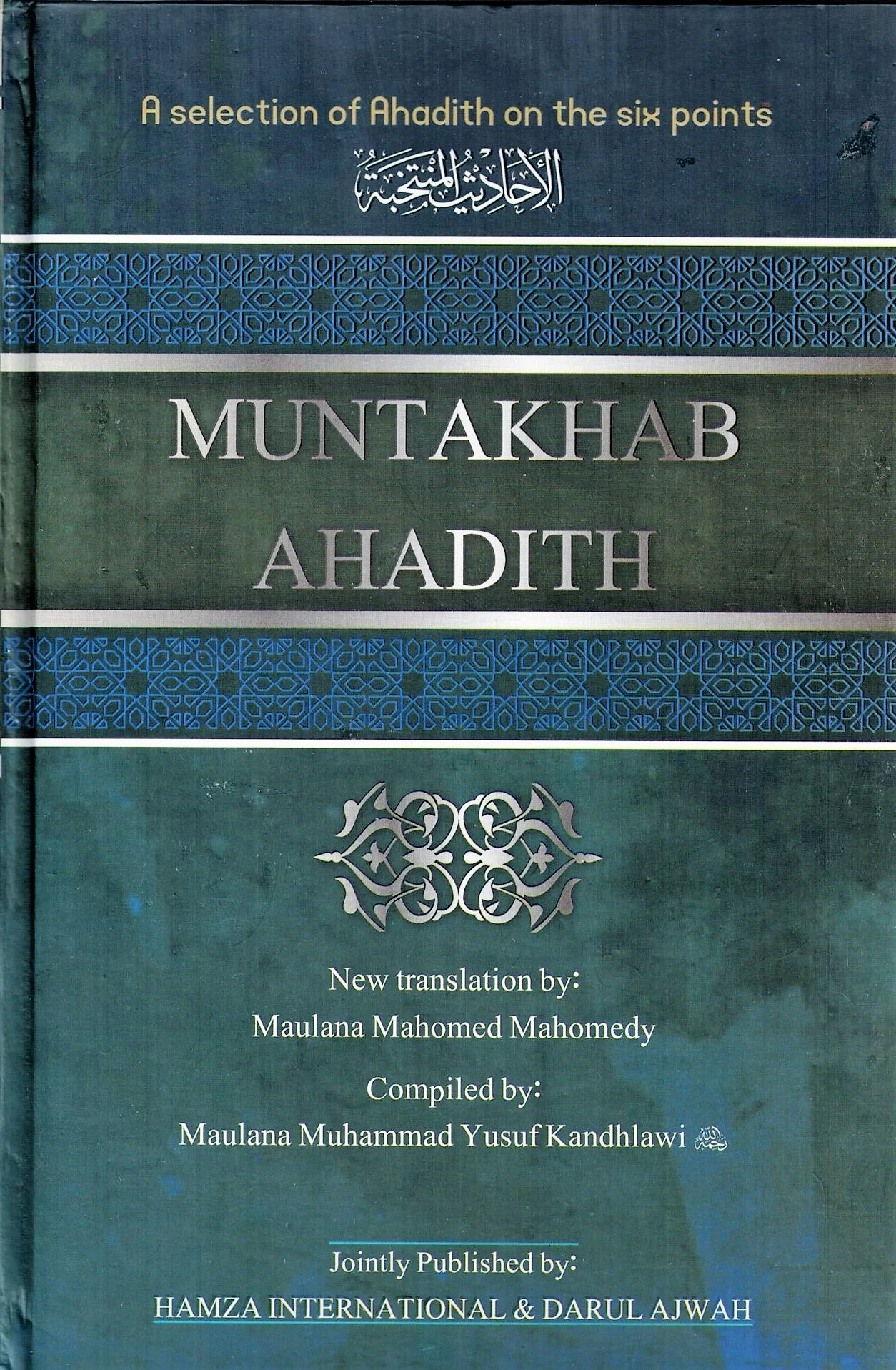
Muntakhab Ahadith is a selected collection of hadith, compiled in Arabic with Urdu rendering, organised around the themes of the movement's teaching.
He is also associated with the formulation of the six points — the short summary of the movement's programme, covering the profession of faith, prayer, religious knowledge and remembrance, respect for fellow Muslims, sincerity of intention, and the giving of time to preaching — which became the standard framework for its instruction.
Death
Yusuf died on 2 April 1965 at Lahore, in what was then West Pakistan, at the age of forty-eight. His body was taken to Delhi, where his funeral prayer was led by Muhammad Zakariya Kandhlawi, and he was buried beside his father at Nizamuddin.
He was succeeded as amir by Inamul Hasan Kandhlawi. With Ilyas, Yusuf and Inamul Hasan, the movement's first three leaders were drawn from the same extended family of Kandhla, and that continuity carried it through partition and into its period of international growth.
His work has attracted academic attention in India: a doctoral study at Gauhati University has been devoted to his contribution to hadith literature, and his writings are treated in research on Indian hadith scholarship after independence at Aligarh Muslim University.
Historiographical Note
Accounts of Yusuf's funeral report a figure for the number of mourners who attended at Delhi. The figure appears in devotional and web sources rather than in scholarly ones, and no independent record supports it, so it is not given here. That the funeral was held at Delhi and that he was buried beside his father are consistently reported and are stated above.
A note on names is also useful, because the family produced several scholars whose names are easily confused. Muhammad Yusuf Kandhlawi, the subject of this article, was the son of Muhammad Ilyas and the movement's second leader. Muhammad Zakariya Kandhlawi was his cousin, the son of Muhammad Yahya, and was a hadith teacher at Saharanpur rather than a leader of the movement. Muhammad Idris Kandhlawi, who shares the nisba and came from the same town, belonged to a different family and had no part in the Tablighi Jamaat.
References and Further Reading
Primary Islamic Sources
- The Qur'an — memorised by him at the age of ten
- The six canonical hadith collections, read in the dawra year at Mazahir Uloom Saharanpur
- Sharh Ma'ani al-Athar of Abu Ja'far al-Tahawi — the Hanafi hadith work on which he wrote his four-volume commentary
- Hayat al-Sahaba by Muhammad Yusuf Kandhlawi — his own compilation on the Companions of the Prophet Muhammad (Peace Be Upon Him)
- Muntakhab Ahadith by Muhammad Yusuf Kandhlawi — his selected hadith collection
Classical Islamic Sources
- The Hanafi school of law, within which his hadith scholarship was conducted
- The early biographical and historical literature on the Companions, the material from which Hayat al-Sahaba was assembled
- The Dars-i Nizami curriculum, the course of study he completed in 1936
- Fada'il-i a'mal by Muhammad Zakariya Kandhlawi — the companion body of devotional texts used alongside his own works
Academic and Scholarly Sources
- The Ulama in Contemporary Islam: Custodians of Change by Muhammad Qasim Zaman — for the movement's texts and their method, its worldwide operations, and the use of narratives of the Companions as a model of practice
- Islamic Revival in British India: Deoband, 1860-1900 by Barbara Daly Metcalf — for the Saharanpur seminary tradition and the hadith curriculum
- Wikipedia, "Yusuf Kandhlavi", https://en.wikipedia.org/wiki/Muhammad_Yusuf_Kandhlawi — consulted with the owner's authorisation for the biographical framework, dates, education and works
- Md. Arif Uddin, "A Study on Hadith Literature in India with Special Reference to Muhammad Yusuf Kandhlavi", doctoral thesis, Department of Arabic, Gauhati University (2025) — a study devoted to his hadith scholarship; cited in the source consulted rather than read directly for this article
- Aaisha Khatoon, "Aazadi ke Baad Hindustan ki Khidmaat e Hadith", doctoral thesis, Department of Sunni Theology, Aligarh Muslim University (2017) — on Indian hadith scholarship after independence; cited in the source consulted rather than read directly for this article
Further Reading
- Mehmet Özşenel, "Kandehlevî, Muhammed Yûsuf", in the TDV Encyclopedia of Islam (Centre for Islamic Studies, Istanbul) — a reference notice in Turkish
- The Tablighi Jamaat — the movement he led for twenty-one years
- Muhammad Ilyas Kandhlawi — his father and predecessor
- Muhammad Zakariya Kandhlawi — his cousin, who led his funeral prayer
- Darul Uloom Deoband — the parent institution of the tradition in which he was trained
Mentioned In
3 articles reference this topic
More from South Asian Islam
Darul Uloom Deoband: The Seminary and the School of Thought
Darul Uloom Deoband is an Islamic seminary founded in northern India in 1866 or 1867 and the origin of the Deobandi school of thought. Its innovation was institutional: it carried the traditional religious sciences in the form of a modern school funded by public subscription.
Delhi Sultanate: Islamic Rule in Medieval India
The Delhi Sultanate (1206-1526 CE) was a series of five successive Islamic dynasties that ruled northern India for over three centuries, establishing Muslim political power in the subcontinent, creating a unique Indo-Islamic culture, and leaving an enduring architectural and administrative legacy.
The Ahl-i Hadis Movement
A nineteenth-century Indian Sunni movement that set aside the authority of the historic schools of law in favour of direct recourse to the Qur'an and hadith. Led by scholars at Delhi and Bhopal, it was marked by its manner of prayer and an austere standard of interpretation.
The Deobandi Movement
A school of Sunni thought and practice that grew from the seminary founded at Deoband in northern India in 1866 or 1867. Its scholars combined the roles of jurist and Sufi guide, built a madrasa funded by public subscription, and made hadith the centre of religious education.