Muhammad Ilyas Kandhlawi
The Indian scholar who founded the Tablighi Jamaat in the Mewat region during the 1920s. Trained at Darul Uloom Deoband under Mahmud Hasan, he built a movement of lay religious preaching that later spread across the Muslim world.
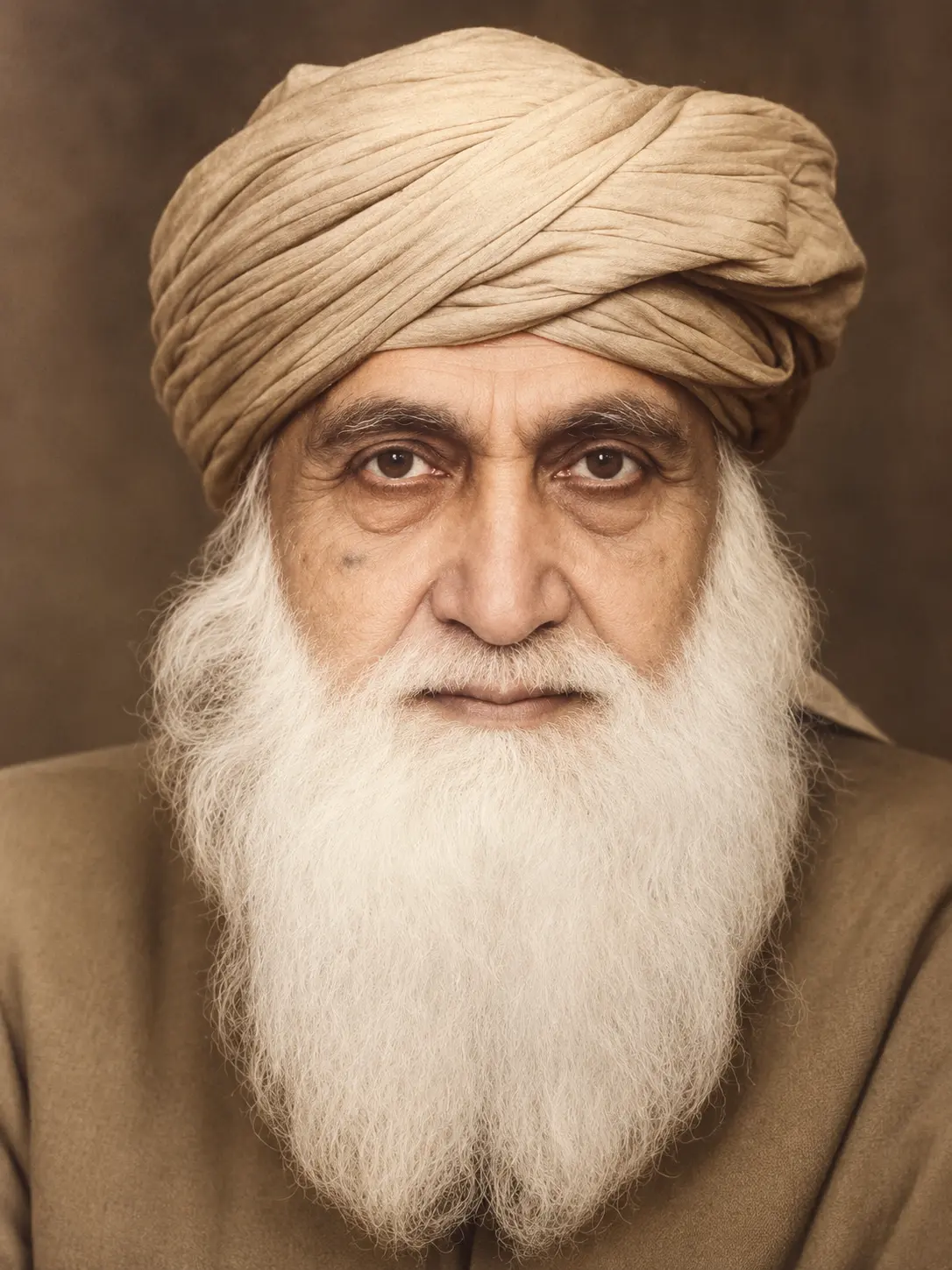
Muhammad Ilyas Kandhlawi (1885 – 13 July 1944) was an Indian religious scholar of the Deobandi tradition who founded the Tablighi Jamaat, a movement of lay religious preaching that began in the Mewat region south of Delhi and became, in the decades after his death, one of the most widely distributed Islamic movements in the world. He led it from its foundation until his death, and was succeeded by his son Muhammad Yusuf Kandhlawi.
His significance lies in an organisational idea rather than a body of writing. Ilyas published little, and his reputation does not rest on commentaries or legal rulings. What he devised was a method: ordinary Muslims, not scholars, travelling in small groups for fixed periods to call other Muslims to the regular practice of their religion. Muhammad Qasim Zaman's study of the modern ulama notes the point that gives this its edge, quoting Barbara Metcalf's observation that the movement "explicitly proclaims that any Muslim can be a preacher, not only the 'ulama'". Coming from a scholar trained in the most rigorous seminary tradition of his day, that was a considerable widening of who might legitimately speak for the faith.
Family and Background
Ilyas was born in 1885 at Kandhla, in the Muzaffarnagar district of what were then the North-Western Provinces of British India, in what is now the Shamli district of Uttar Pradesh. His full name is given as Muhammad Ilyas ibn Muhammad Ismail Kandhlawi Dihlawi, the final element reflecting his long residence in Delhi.
He was given the name Akhtar Ilyas, which functions as a tarikhi or chronogrammatic name: the numerical values of its letters under the abjad system encode the year of his birth. The device was a common one in Indian Muslim families and was used to fix a date of birth in a form easily remembered.
His father, Muhammad Ismail Kandhlawi, was a religious scholar. Ilyas's elder brother, Muhammad Yahya Kandhlawi, born about 1870, was a student and disciple of Rashid Ahmad Gangohi and became a teacher of hadith at Mazahir Uloom in Saharanpur. Yahya's son, Muhammad Zakariya Kandhlawi, was therefore Ilyas's nephew, and it was Ilyas who taught the boy his introductory Persian at Gangoh. In 1938 Zakariya married Ilyas's daughter, so that the two men were also father-in-law and son-in-law. The relationship matters for the movement's history, because Zakariya wrote the devotional texts that became its standard reading.
Education
Ilyas memorised part of the Qur'an at a local maktab and completed his memorisation under his father's supervision at Nizamuddin in Delhi — the quarter that would later become his movement's centre. He then studied the elementary books of Arabic and Persian, largely with his father.
He subsequently lived with and studied under Rashid Ahmad Gangohi, one of the two principal founders of the Deobandi school. Metcalf's history describes Gangohi as a mufti and Sufi guide whose authority combined juristic and spiritual roles, and whose household functioned as a centre of instruction in its own right. Gangohi died in 1905, when Ilyas was twenty.
In 1908 Ilyas enrolled at Darul Uloom Deoband, where he studied under Mahmud Hasan Deobandi, known as Shaykh al-Hind, the seminary's most prominent teacher of hadith. He also studied with Khalil Ahmad Saharanpuri at Mazahir Uloom, and the biographical literature names Husain Ahmad Madani, Abdul Qadir Raipuri and Ashraf Ali Thanawi among those who shaped him.
His training was therefore of the most orthodox kind available in the reformist seminaries of his generation, drawn from Deoband and Saharanpur alike. This is the background against which the character of his later work should be read: the Tablighi method was not devised in reaction against seminary learning but by someone thoroughly formed within it.
The Founding of the Tablighi Jamaat
Ilyas founded the Tablighi Jamaat in the Mewat region in 1925. Mewat lies south of Delhi, and its Muslim population, the Meos, were cultivators whose religious observance the reformist scholars of the period regarded as needing attention. Ilyas's method was to build a network of mosques and religious schools in the region and to send groups out to call people to prayer, to the profession of faith, and to the ordinary duties of religious practice.
The name attached itself from outside rather than by design. Those who took part came to be called tablighi, from tabligh, the conveying of a message, and the usage became general. Accounts record that Ilyas himself would have preferred to call it a movement of faith, Tehreek-e-Imaan.
Zaman describes the movement as one that "began in India in the 1920s and which now has operations worldwide", and identifies the source of its teaching material: the tracts written by Muhammad Zakariya, collected first as Tablighi nisab — the curriculum for proselytising — and later retitled Fada'il-i a'mal, the merits of virtuous practices. Drawing on hadith and on accounts of the Prophet Muhammad (Peace Be Upon Him) and his Companions, these texts set out a model of belief and practice that readers were called upon to imitate. Zaman notes that the movement did not encourage its followers to read much beyond that handbook, which gave it an unusually uniform body of doctrine for so dispersed a body of people.
Method and Character
The distinguishing features of what Ilyas established were simplicity and repeatability. A group of lay Muslims would set out for a fixed period, stay at a mosque, and invite local Muslims to join them in prayer and in the study of the basic obligations. No scholarly qualification was required to take part. The activity was funded by the participants themselves, who bore their own costs.
The consequence was a movement that could be reproduced almost anywhere without central direction, and this accounts for its later geographical spread. By the end of the twentieth century it had operations in many countries, including Britain, Canada and South Africa.
Zaman also records a question that has occupied scholars writing about the movement: whether its avoidance of political involvement is a settled principle or an observation that does not hold everywhere. Some students of the Tablighi Jamaat have discerned a deliberate abstention from politics on the part of its members, while others have disputed that conclusion. Zaman's own caution is that broad generalisations about so large and dispersed a body — operating in many countries and involving very large numbers of people — are difficult to sustain in either direction. The disagreement is a live one in the scholarly literature and is recorded here as such rather than resolved.
Death and Succession
Ilyas died on 13 July 1944, at the age of fifty-eight or fifty-nine, in Delhi. He was buried there, at Nizamuddin, which had been both the place of his own early study and the centre of his movement's work; his son Muhammad Yusuf was later buried beside him.
Yusuf succeeded him as the movement's second amir and led it until his own death in 1965, when he was followed by Inamul Hasan Kandhlawi. The succession of three leaders drawn from the same extended family gave the movement continuity through the partition of India and the decades of its international expansion.
Abul Hasan Ali Nadwi, the Lucknow scholar whose writings Zaman describes as addressed to ordinary Muslims in India and the Arab world alike, wrote his biography, published in Urdu and translated into English as Life and Mission of Maulana Muhammad Ilyas. It remains the standard account of his life.
Historiographical Note
Two matters of dating should be stated openly.
The year of his birth is given as 1885, and this is generally derived from the abjad value of his chronogrammatic name, Akhtar Ilyas. The corresponding Hijri year is reported inconsistently in the sources, appearing as both 1302 and 1303 AH, which straddle 1885 and 1886 in the Common Era. The Common Era year 1885 is the figure the accounts agree on, and it is used here; the Hijri equivalent is left unstated because the sources do not agree.
The year in which the movement began is given as 1925 in the account consulted for this article. Zaman, writing in a scholarly study, dates its beginning only to "the 1920s" without naming a year. Readers will encounter other years in the wider literature, and the imprecision is not accidental: a movement that grew out of a scholar's preaching in a rural district has no single founding act to date, unlike a seminary with a foundation ceremony or an organisation with a constitution. This article gives 1925 as the year reported, while noting that the more cautious scholarly formulation is a decade rather than a year.
A third point concerns a claim that circulates about the movement's origins — that Ilyas assembled a team of young madrasa graduates from Deoband and Saharanpur and despatched them to Mewat to build up a network of mosques and schools. The account consulted carries this without a supporting citation, and it is therefore not asserted here. That Ilyas built such a network in Mewat is established; the particular means described is not.
References and Further Reading
Primary Islamic Sources
- The Qur'an — memorised by Ilyas in part at a local maktab and completed under his father at Nizamuddin
- The hadith collections of the dawra curriculum, studied by him under Mahmud Hasan at Deoband and Khalil Ahmad Saharanpuri at Saharanpur
- Fada'il-i a'mal by Muhammad Zakariya Kandhlawi — the compilation of hadith and edifying narrative that became the movement's standard text
- The accounts of the Companions of the Prophet Muhammad (Peace Be Upon Him), which supplied the model of conduct the movement's texts set out to convey
Classical Islamic Sources
- The Hanafi school of law, the juristic tradition of the Deobandi seminaries in which Ilyas was trained
- The Dars-i Nizami curriculum, the course of study he followed at Deoband
- The Chishti and Naqshbandi traditions of the Deobandi scholars among whom he was formed
- The classical literature of da'wa, the calling of others to religion, which supplied the vocabulary of tabligh
Academic and Scholarly Sources
- The Ulama in Contemporary Islam: Custodians of Change by Muhammad Qasim Zaman — for the movement's emergence in the 1920s, its reformist texts and their renaming, its worldwide operations, and the scholarly dispute over its political character
- Islamic Revival in British India: Deoband, 1860-1900 by Barbara Daly Metcalf — for Rashid Ahmad Gangohi, Mahmud Hasan, the seminary curriculum, and the reformist programme Ilyas inherited
- Wikipedia, "Ilyas Kandhlavi", https://en.wikipedia.org/wiki/Muhammad_Ilyas_Kandhlawi — consulted with the owner's authorisation for the biographical framework, education, and the founding of the movement
- Wikipedia, "Muhammad Zakariyya Kandhlawi", https://en.wikipedia.org/wiki/Muhammad_Zakariyya_Kandhlawi — consulted with the owner's authorisation for the family relationships and the marriage of 1938
- Riyaz Timol, "Structures of Organisation and Loci of Authority in a Glocal Islamic Movement: The Tablighi Jama'at in Britain", Religions, vol. 10 no. 10 (2019), article 573 — a peer-reviewed study of the movement's organisation outside South Asia; cited in the source consulted rather than read directly for this article
Further Reading
- Abul Hasan Ali Nadwi, Life and Mission of Maulana Muhammad Ilyas, translated by Mohammad Asif Kidwai (Academy of Islamic Research and Publications, Lucknow) — the standard biography
- Ömer Mahir Alper, "Kandehlevî, Muhammed İlyas", in the TDV Encyclopedia of Islam (Centre for Islamic Studies, Istanbul) — a reference notice in Turkish
- The Tablighi Jamaat — the movement he founded, its method and its spread
- Muhammad Zakariya Kandhlawi — his nephew and son-in-law, author of the movement's texts
- Muhammad Yusuf Kandhlawi — his son and successor
- Darul Uloom Deoband — the seminary where he trained
Mentioned In
6 articles reference this topic
More from South Asian Islam
Darul Uloom Deoband: The Seminary and the School of Thought
Darul Uloom Deoband is an Islamic seminary founded in northern India in 1866 or 1867 and the origin of the Deobandi school of thought. Its innovation was institutional: it carried the traditional religious sciences in the form of a modern school funded by public subscription.
Delhi Sultanate: Islamic Rule in Medieval India
The Delhi Sultanate (1206-1526 CE) was a series of five successive Islamic dynasties that ruled northern India for over three centuries, establishing Muslim political power in the subcontinent, creating a unique Indo-Islamic culture, and leaving an enduring architectural and administrative legacy.
The Ahl-i Hadis Movement
A nineteenth-century Indian Sunni movement that set aside the authority of the historic schools of law in favour of direct recourse to the Qur'an and hadith. Led by scholars at Delhi and Bhopal, it was marked by its manner of prayer and an austere standard of interpretation.
The Deobandi Movement
A school of Sunni thought and practice that grew from the seminary founded at Deoband in northern India in 1866 or 1867. Its scholars combined the roles of jurist and Sufi guide, built a madrasa funded by public subscription, and made hadith the centre of religious education.