Muhammad Zakariya Kandhlawi
A hadith scholar of Mazahir Uloom Saharanpur who taught for over fifty years and wrote a six-volume Arabic commentary on Malik's Muwatta. His Urdu devotional tracts, collected as the Faza'il series, became the standard reading of the Tablighi Jamaat.
Muhammad Zakariya Kandhlawi (2 February 1898 – 24 May 1982) was a Hanafi scholar of hadith who taught at Mazahir Uloom in Saharanpur for more than half a century and became one of the most widely read religious authors in the Urdu language. He is generally known by the title Shaykh al-Hadith. His scholarly reputation rests on a series of Arabic commentaries on the canonical hadith collections, above all Awjaz al-Masalik, his commentary on the Muwatta of Malik ibn Anas. His popular reputation rests on something quite different: a set of Urdu devotional tracts, written for ordinary readers and collected as the Faza'il series, which became the standard reading of the Tablighi Jamaat and circulated in numbers few religious books of the century matched.
Muhammad Qasim Zaman's study of the modern ulama places him precisely at this junction. Zaman describes Zakariya as a renowned teacher of hadith at the Mazahir al-Ulum madrasa of Saharanpur and as the glossator and publisher of many hadith commentaries, who was also the author of tracts written for the guidance of ordinary Muslims — tracts gathered into a single volume under the title Tablighi nisab, "the curriculum for proselytising", later changed to Fada'il-i a'mal, "the merits of virtuous practices". Zaman's point is that the two activities were not in tension. The same scholar could sustain a demanding technical literature for specialists and, in a separate register, address a mass readership, and the capacity to do both was central to how the ulama held their ground in an age of cheap print.
Name and Lineage
His given name was Muhammad Zakariya, and his full name with its chain of descent is given as Muhammad Zakariya ibn Muhammad Yahya ibn Muhammad Ismail ibn Ghulam Husain, continuing back through a line of scholars and shaykhs. By lineage he was Siddiqi, denoting descent from Abu Bakr al-Siddiq.
His name usually carries a series of nisbas that together sketch his life's geography: Kandhlawi, from Kandhla, his family's town; Gangohi, from Gangoh, where he spent his childhood; Saharanpuri, from Saharanpur, where he taught; and Madani, from Medina, where he settled at the end of his life. The form Muhajir Madani marks that final migration.
Family
Zakariya's father, Muhammad Yahya Kandhlawi, born in 1287 AH (1870 or 1871), was a student and disciple of Rashid Ahmad Gangohi, one of the two principal founders of the Deobandi school. Yahya studied hadith under Gangohi and under Khalil Ahmad Saharanpuri, and after completing the dawra of hadith he remained with Gangohi at Gangoh. He is recorded as having recited the whole of the Qur'an daily.
Zakariya was his father's only son. His paternal grandfather, Muhammad Ismail Jhanjhanawi, died twenty days after Zakariya's birth.
The family connection that shaped his later life most is that Muhammad Ilyas Kandhlawi, the founder of the Tablighi Jamaat, was his father's brother and therefore his paternal uncle. Ilyas taught the young Zakariya his introductory Persian. In 1356 AH (1938) Zakariya married Ilyas's daughter, his first cousin, so that he was both nephew and son-in-law to the movement's founder.
He married twice. His first wife was the daughter of Shaikh Ra'uf al-Hasan of Kandhla, who bore him eight children, three sons and five daughters, and died in 1355 AH (1937). His second marriage, to Ilyas's daughter, produced three further children.
Birth and Childhood at Gangoh
Zakariya was born on 11 Ramadan 1315 AH, corresponding to 2 February 1898, at Kandhla, in what is now Uttar Pradesh, in the house of his mother's step-grandmother.
In 1318 AH (1900), when he was two, the family moved to Gangoh, where his father was living with Rashid Ahmad Gangohi. Zakariya was one of some eighty students in his father's madrasa there. His formal education began with Hakim Abd al-Rahman of Muzaffarnagar, with whom he studied the Qa'ida Baghdadi, the standard primer for the Arabic script. He then memorised the Qur'an under his father, who required his students to revise each day's lesson a hundred times. After completing hifz he read the Bahishti Zewar of Ashraf Ali Thanawi, the Hamasa anthology, the first volume of the Hidaya, and other works in Urdu and Persian. His uncle Muhammad Ilyas taught him the introductory Persian texts; his father taught him Arabic morphology and syntax.
He saw Rashid Ahmad Gangohi frequently during these years and the accounts describe an affectionate relationship between the old shaykh and the child. Gangohi died on 8 Jumada al-Thani 1323 AH (11 August 1905), when Zakariya was seven. Barbara Metcalf's history of the movement treats Gangohi as one of its two decisive figures, a mufti and Sufi guide whose authority rested on both roles at once; Zakariya's earliest memories were formed in that household.
Mazahir Uloom Saharanpur
In Rajab 1328 AH (July 1910), aged twelve, Zakariya travelled with his father to Saharanpur. Muhammad Yahya had been asked by Khalil Ahmad Saharanpuri to teach hadith at Mazahir Uloom, the second of the great reformist seminaries of the region after Deoband itself.
There Zakariya worked through Arabic grammar, morphology, literature and logic. The texts he read with his father included Sarf-i Mir, Panj Ganj, Fusul-i Akbari, the Kafiya, the Qasidat al-Burda and the Qasidat Banat Su'ad, together with the thirtieth part of the Qur'an and a collection of forty hadith. His teachers in the rational sciences were Abd al-Wahid Sanbhali and Abd al-Latif, the madrasa's director.
His final year, 1333 AH (1914–15), was the dawra of hadith, the culminating stage of the Dars-i Nizami curriculum in which the major collections are read through intensively. He studied the six principal collections under his father, with the exception of the Sunan of Ibn Maja, which he read with Thabit Ali. By his own account he never missed a lesson and always attended in a state of ablution.
His father taught him under stricter conditions than the other students. When reading Mishkat al-Masabih he was forbidden to consult its Urdu translation and commentary, the Mazhar-i Haq, and had to work from the Arabic alone. A further rule required him, for each hadith, to state whether it was consistent with Hanafi law, and where it was not, to set out the reasoning supporting the Hanafi position. The requirement is worth noting because it describes in miniature the intellectual task that occupied his later scholarly life: the reconciliation of the hadith corpus with the rulings of his school, which is the central concern of his Arabic commentaries.
He graduated in 1333 AH (1915). In the same year he gave bay'a — the pledge of allegiance to a Sufi guide — to Khalil Ahmad Saharanpuri, shortly before the latter left for the Hijaz.
His father died in Dhu al-Qi'da 1334 AH (September 1916), when Zakariya was eighteen. Khalil Ahmad returned to India at about the same time and asked Zakariya to read Sahih al-Bukhari and the Jami of al-Tirmidhi with him a second time. He then chose Zakariya as his assistant in the composition of Badhl al-Majhud, his commentary on the Sunan of Abu Dawud — the young scholar's first involvement in a major work of hadith commentary.
Fifty Years of Teaching
Zakariya was appointed to the teaching staff of Mazahir Uloom on 1 Muharram 1335 AH, about the end of October 1916. He was eighteen, and among the youngest teachers in the madrasa.
He began, as new teachers did, with the elementary and intermediate books: works on morphology, syntax, Arabic literature, and the introductory texts of jurisprudence such as the Usul al-Shashi and the Quduri. His assignments were enlarged year by year — the Maqamat of al-Hariri and the Mu'allaqat in 1336 AH, the Hamasa and the first part of the Hidaya in 1337 AH. He notes drily that the texts of logic, Qutbi and Mir Qutbi and the Tahdhib, came to him almost every year because the senior teachers disliked teaching the subject.
From 1341 AH (1923) he was given hadith. Three sections of Sahih al-Bukhari were transferred to him from Abd al-Latif, the madrasa's director, and from 1341 to 1344 AH he taught Mishkat al-Masabih. In Shawwal 1344 AH (1926) he travelled to the Hijaz for more than a year, reaching Medina in Muharram 1345 AH, and while there taught the Sunan of Abu Dawud at the Madrasa al-Ulum al-Shar'iyya.
On his return to Saharanpur in Safar 1346 AH (1927) the Sunan of Abu Dawud was transferred to him permanently, and he took on the Sunan of al-Nasa'i, the Muwatta of Malik in al-Shaybani's transmission, and further parts of Sahih al-Bukhari. After that year's Eid al-Adha the first volume of Sahih al-Bukhari passed to him, the second remaining with Abd al-Latif. From this point he also taught the Jami of al-Tirmidhi, Sahih Muslim, and other final-year texts when colleagues were absent.
The division of Sahih al-Bukhari persisted for nearly three decades. In 1373 and 1374 AH he taught both volumes while Abd al-Latif was travelling and then ill, and after Abd al-Latif's death in 1375 AH (1956) the whole of Sahih al-Bukhari was assigned to him.
He continued teaching until 1388 AH (1968), when cataracts affected his sight. Over the course of his career he taught half of Sahih al-Bukhari twenty-five times, the complete work sixteen times, and the Sunan of Abu Dawud thirty times.
Sufi Affiliation
Zakariya's Sufi allegiance was to the Chishtiyya in its Sabiri-Imdadi line. Having given bay'a to Khalil Ahmad Saharanpuri in 1915, he received khilafa — authorisation to initiate and guide others — during his second journey to the Hijaz with his shaykh, and it was conferred in four lineages at once: the Chishtiyya, Suhrawardiyya, Qadiriyya and Naqshbandiyya.
The combination of a hadith professorship with authority in four Sufi orders was not thought anomalous. Metcalf's account of the Deobandi founders describes exactly this pairing of the jurist and the shaykh, and Zakariya's own book Shari'at wa Tariqat ka Talazum — "the inseparability of shari'a and tariqa" — was a direct statement of the position. He also wrote a history of the Chishti masters, Tarikh-i Masha'ikh-i Chisht.
Writings
His first book was a three-volume commentary on the Alfiyya of Ibn Malik, the versified Arabic grammar, written when he was a student of thirteen.
His major Arabic works are commentaries on the canonical collections:
| Work | Subject |
|---|---|
| Awjaz al-Masalik ila Muwatta Malik | Commentary on the Muwatta of Malik ibn Anas |
| Lami al-Darari ala Jami al-Bukhari | Commentary on Sahih al-Bukhari |
| al-Kawkab al-Durri ala Jami al-Tirmidhi | Commentary on the Jami of al-Tirmidhi |
| al-Abwab wa al-Tarajim li-Sahih al-Bukhari | On the chapter headings of Sahih al-Bukhari |
| Juz Hajjat al-Wida wa Umrat al-Nabi | On the Farewell Pilgrimage and the Prophet's lesser pilgrimages |
Awjaz al-Masalik is the work on which his standing among specialists chiefly rests. al-Abwab wa al-Tarajim addresses a technical question of long standing in hadith scholarship — why al-Bukhari headed his chapters as he did, and what the headings reveal about the arrangement of his material.
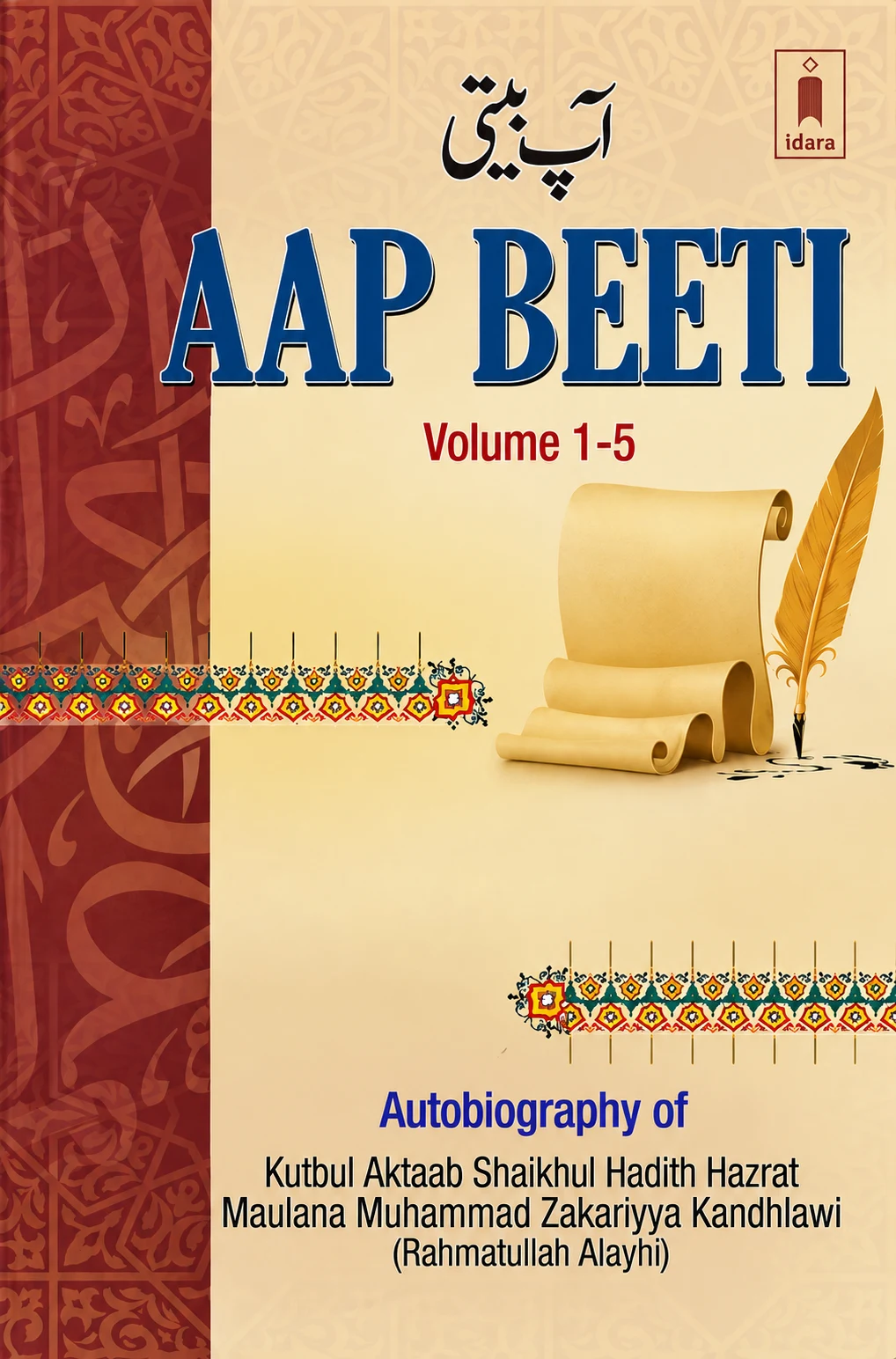
In Urdu he wrote for a general readership. Khasa'il-i Nabawi is his translation of and commentary on al-Tirmidhi's Shama'il, the collection describing the Prophet's appearance and manner. The Faza'il tracts treat the merits of particular acts of devotion — the Qur'an, prayer, Ramadan, remembrance, pilgrimage, charity, the invocation of blessings on the Prophet, and honest trade — and were gathered into the single volume that became Fada'il-i a'mal. Hikayat-i Sahaba presents accounts of the Prophet's Companions. He also wrote a two-part autobiography, Aap Beeti, which is the source for much of what is known about his own education and teaching.
The reach of the Urdu works was very wide. Faza'il-i Qur'an was translated into eleven languages, Faza'il-i Ramadan into twelve, and Faza'il-i Namaz into fifteen.
Later Life and Death
Zakariya migrated to Medina, taking Saudi Arabian nationality in 1976 and living there for the last years of his life; the nisba Muhajir Madani records the move.
He fell ill on 16 May 1982 at Medina. His condition worsened over the following week and he died on 24 May 1982, at the age of eighty-four. His funeral prayer was led by Abdullah al-Zahim, an imam of the Prophet's Mosque, and he was buried the same night in the Jannat al-Baqi cemetery. He had asked to be buried near the graves of the Prophet's family, and his grave was made just outside their enclosure.
Among his students were Muhammad Yunus Jaunpuri, Yusuf Motala, and Mazhar Alam. Muhammad Taqi Usmani holds his authorisation in hadith. Two of his sons-in-law, Salman Mazahiri and Aaqil Saharanpuri, were themselves scholars of the Saharanpur tradition.
His standing outside South Asia is indicated by his correspondence with Abd al-Fattah Abu Ghudda, the Syrian hadith scholar and editor, who wrote to him in terms of considerable deference. Zaman's account of Abu Ghudda describes how his interest in South Asian writing on hadith and law drew him to the scholars of the region and led him to publish their work in the Arab world, and how his circles of hadith transmission extended across Syria, Arabia, Turkey, Egypt, India and Pakistan. The exchange between Saharanpur and Damascus belongs to that pattern.
Historiographical Note
The number of his works is reported differently by different authorities, and the discrepancy is substantial rather than trivial.
Wali al-Din Nadwi's account gives a breakdown by subject: four books on Qur'anic commentary and recitation, forty-four on hadith and its ancillary sciences, six on law, twenty-four historical and biographical works, four on doctrine, twelve on asceticism and the softening of hearts, three on Arabic grammar and logic, and six on contemporary movements. Muhammad Shahid Saharanpuri, Zakariya's maternal grandson, gives a total of one hundred and three works, of which forty-two were published and sixty-one remained unpublished, and distributes them differently — two on commentary, sixty on hadith, four on law and legal theory, twenty-two on history and biography, two on recitation, three on grammar, logic and geometry, three on the Sufi path, four in defence of Islam, and three on miscellaneous subjects.
The two counts cannot be reconciled, and the difference probably reflects what each compiler treated as a separate book, and whether unpublished manuscripts and short treatises were included. Both are reported here rather than one being chosen. What both establish is the scale of the output and its concentration in hadith.
A second point concerns his date of birth. He was born at eleven at night on 11 Ramadan 1315 AH. Because the day in the Islamic calendar begins at sunset, that hour fell on the night that Islamic reckoning counts as Thursday while the Western calendar was still on Wednesday, 2 February 1898. The two systems therefore name different weekdays for the same moment, which is why the sources differ.
References and Further Reading
Primary Islamic Sources
- The Qur'an — memorised under his father at Gangoh, and the subject of his Faza'il-i Qur'an
- al-Muwatta of Malik ibn Anas — the collection on which he wrote Awjaz al-Masalik, his principal scholarly work
- Sahih al-Bukhari — taught by him sixteen times in full, and the subject of two of his commentaries
- Sahih Muslim — among the final-year collections he taught at Mazahir Uloom
- Sunan Abu Dawud — taught thirty times, and the collection on whose commentary Badhl al-Majhud he assisted Khalil Ahmad Saharanpuri
- al-Shama'il al-Muhammadiyya of al-Tirmidhi — translated and commented upon by him as Khasa'il-i Nabawi
Classical Islamic Sources
- The Hanafi school of law, whose positions he was trained from boyhood to reconcile with the hadith corpus
- Mishkat al-Masabih — the hadith compendium he studied in Arabic without recourse to translation, and later taught for four years
- The Alfiyya of Ibn Malik — the versified Arabic grammar on which he wrote his first book at thirteen
- The Maqamat of al-Hariri, the Hamasa, and the Mu'allaqat — the literary texts of the curriculum he taught
- The Chishti tradition, whose masters he treated in Tarikh-i Masha'ikh-i Chisht
Academic and Scholarly Sources
- The Ulama in Contemporary Islam: Custodians of Change by Muhammad Qasim Zaman — for his position at Mazahir al-Ulum, his authorship of the Tablighi Jamaat's reformist texts, the renaming of Tablighi nisab, and the culture of hadith commentary and transmission in which he worked
- Islamic Revival in British India: Deoband, 1860-1900 by Barbara Daly Metcalf — for Rashid Ahmad Gangohi, the Gangoh and Saharanpur circles, the Dars-i Nizami curriculum, and the pairing of juristic and Sufi authority
- Wikipedia, "Muhammad Zakariyya Kandhlawi", https://en.wikipedia.org/wiki/Muhammad_Zakariyya_Kandhlawi — consulted with the owner's authorisation for the biographical framework, the teaching chronology, the family relationships, and the list of works
- M. Gaborieau, "Zakariyya Kandhalawi Saharanpuri", in Encyclopaedia of Islam, Second Edition (Brill) — the standard reference notice; cited in the source consulted rather than read directly for this article
- Iffat Masood Javed, "Contribution of Mazahir-e-Uloom of Saharanpur to Tasawwuf", doctoral thesis, Jamia Millia Islamia, New Delhi (1996) — on the seminary and its Sufi tradition; cited in the source consulted rather than read directly for this article
Further Reading
- Muhammad Zakariya Kandhlawi, Aap Beeti — his autobiography in Urdu, the primary record of his own education and teaching career
- Abul Hasan Ali Nadwi, Life and Mission of Maulana Mohammad Ilyas, translated by Mohammad Asif Kidwai (Academy of Islamic Research and Publications, Lucknow) — the standard biography of his uncle
- Yusuf Motala, Manifestations of Prophet Muhammad's Beauty (Azhar Publications, London, 2011) — includes an account of Zakariya by one of his students
- Muhammad Ilyas Kandhlawi — his uncle, teacher, and father-in-law
- The Tablighi Jamaat — the movement whose principal texts he wrote
- The Deobandi Movement — the tradition of learning in which he was formed
Mentioned In
7 articles reference this topic
More from South Asian Islam
Darul Uloom Deoband: The Seminary and the School of Thought
Darul Uloom Deoband is an Islamic seminary founded in northern India in 1866 or 1867 and the origin of the Deobandi school of thought. Its innovation was institutional: it carried the traditional religious sciences in the form of a modern school funded by public subscription.
The Ahl-i Hadis Movement
A nineteenth-century Indian Sunni movement that set aside the authority of the historic schools of law in favour of direct recourse to the Qur'an and hadith. Led by scholars at Delhi and Bhopal, it was marked by its manner of prayer and an austere standard of interpretation.
The Deobandi Movement
A school of Sunni thought and practice that grew from the seminary founded at Deoband in northern India in 1866 or 1867. Its scholars combined the roles of jurist and Sufi guide, built a madrasa funded by public subscription, and made hadith the centre of religious education.
The Sufi Orders in South Asian Islam
Four Sufi orders shaped religious life in the Indian subcontinent: the Chishti, Naqshbandi, Qadiri and Suhrawardi. This article traces how they functioned there in the eighteenth and nineteenth centuries, and how initiation into several orders at once weakened the identity of each.