The Tablighi Jamaat
A movement of lay religious preaching founded by Muhammad Ilyas Kandhlawi in the Mewat region of northern India in the 1920s. Built on short preaching tours undertaken by ordinary Muslims, it grew from one rural district into a presence across much of the Muslim world.
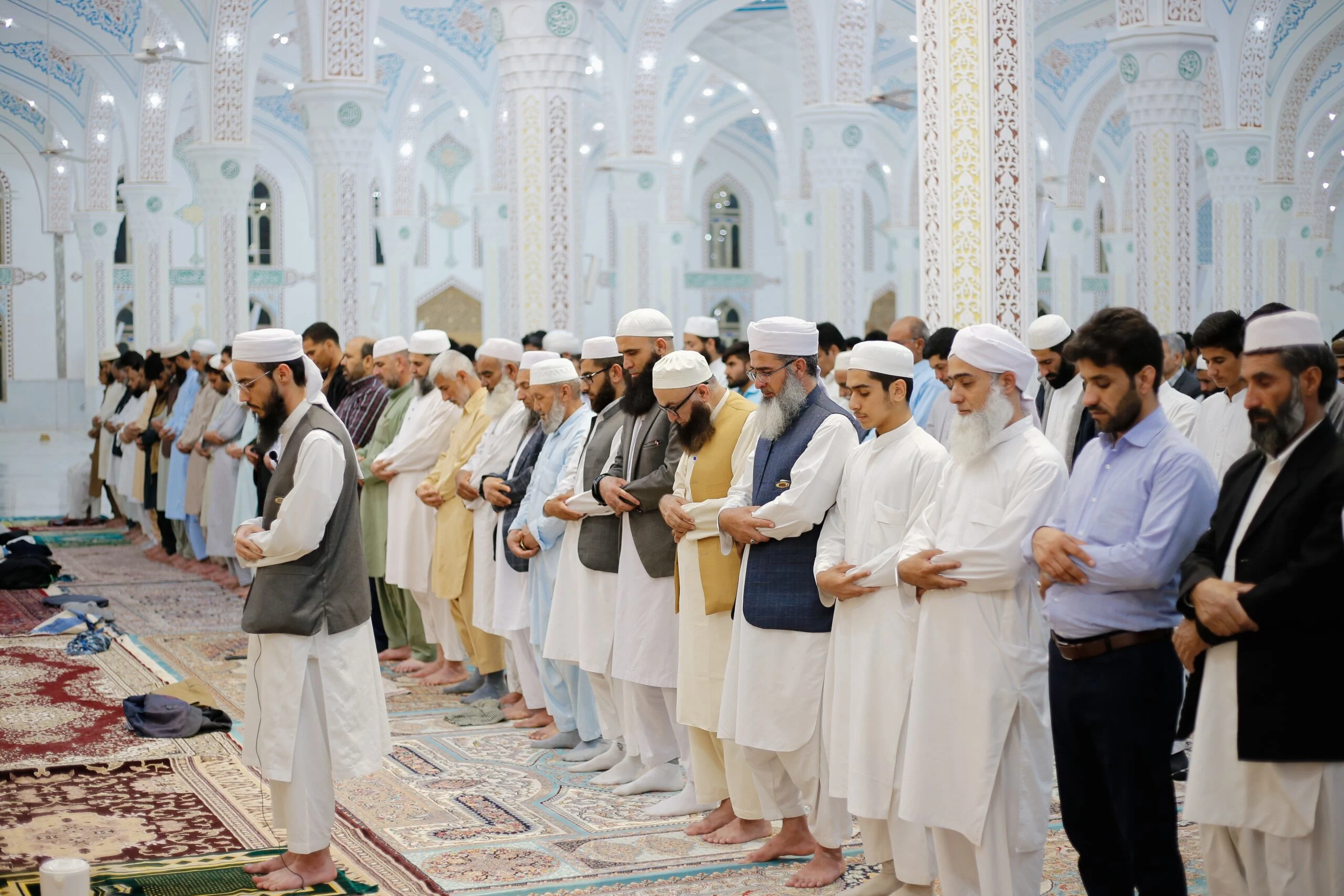
The Tablighi Jamaat is a movement of lay religious preaching that began in the Mewat region south of Delhi in the 1920s and has since established a presence in a very large number of countries. Its name, from the Urdu, may be rendered as the society of preachers or the preaching party. Its purpose, as its own literature states it, is to call Muslims to the regular practice of their religion, and its distinctive instrument is the short preaching tour undertaken not by scholars but by ordinary believers.
It was founded by Muhammad Ilyas Kandhlawi, a scholar trained at Darul Uloom Deoband and at Mazahir Uloom in Saharanpur, and it grew out of the reformist tradition of the Deobandi school. Muhammad Qasim Zaman describes it as "a proselytizing movement that began in India in the 1920s and which now has operations worldwide", and identifies what set it apart in a sentence he takes from Barbara Metcalf: the movement "explicitly proclaims that any Muslim can be a preacher, not only the 'ulama'". That proposition is the key to its history. A body of learning that had been the preserve of trained scholars was reduced to a small set of practical duties that any believer could both perform and commend to others, and the result proved reproducible almost anywhere.
Origins
Ilyas had been teaching at Mazahir Uloom in Saharanpur when he gave up his post to devote himself to preaching. He moved to the quarter of Delhi around the shrine of Nizamuddin, where he had completed his own memorisation of the Qur'an as a boy, and it was from there that the work was organised. His attention was directed first to Mewat, a district whose Muslim population, the Meos, were cultivators whose religious observance the reformist scholars of the period considered to stand in need of instruction.
Accounts of the movement's beginning record that the idea came to Ilyas during a pilgrimage to Mecca, and that he was pursuing a purpose his teacher Rashid Ahmad Gangohi had entertained before him. Gangohi, who died in 1905, was one of the two principal founders of the Deobandi school, and Metcalf's history describes his combination of juristic authority with the role of a Sufi guide, and the reformist programme — insistence on correct practice, opposition to what its advocates regarded as accreted custom — that the movement inherited.
Ilyas's slogan expressed the aim compactly: Ai musalmano, musalman bano — "O Muslims, become Muslims." The object was not conversion but the reform of practice among those already within the faith. Ilyas did not advocate preaching to non-Muslims, and the movement's activity has been directed principally at Muslims throughout its history.
Its growth in the founder's lifetime was rapid. Some twenty-five thousand people are recorded as having attended its annual gathering in November 1941.
The Six Principles
The movement's teaching is summarised in six principles, which function as the framework for its instruction and for the conduct expected of those who take part:
| Principle | Substance |
|---|---|
| Kalima | The declaration of faith |
| Salah | The performance of prayer |
| Ilm o Zikr | Religious knowledge and the remembrance of God |
| Ikram-i Muslim | Respect for fellow Muslims |
| Ikhlas-i Niyyat | Sincerity of intention |
| Dawat o Tabligh | Calling others and conveying the message |
The list is deliberately short and practical. It contains no point of contested doctrine and nothing requiring specialist training to understand, which is what allows it to be taught by one lay participant to another. The movement states that it does not enter into debate on political questions or on disputed matters of law, confining itself to the Qur'an, the hadith, and the conduct of the first generation of Muslims, on the understanding that personal renewal will in time produce the reform of society.
Method: The Preaching Tour
The characteristic activity is the khuruj, a preaching tour lasting from a few days to several months. A small group travels together, stays at a mosque, and invites local Muslims to join them in prayer and in study of the basic obligations. Participants travel, eat and pray as a body, and meet their own costs.
Several features follow from this design. The activity requires no funding structure, since participants pay for themselves. It requires no scholarly credential, since the six principles can be conveyed by anyone who observes them. It requires no permanent local organisation, since the mosque provides the venue. A movement built this way can be carried by individual believers into any place where there is a mosque, and its later geographical spread is largely explained by that portability.
Texts
The movement's reading is unusually concentrated for a body of its size. Its principal text is the collection of Urdu tracts written by Muhammad Zakariya Kandhlawi, Ilyas's nephew and son-in-law and a teacher of hadith at Saharanpur. Zaman records that these tracts, written for the guidance of ordinary Muslims, were "collected and published in a single volume entitled Tablighi nisab (The curriculum for proselytizing) — later changed to Fada'il-i a'mal (The merits of [virtuous] practices)". Drawing on selections from hadith and on narratives from the life of the Prophet Muhammad (Peace Be Upon Him) and the lives of his Companions, they set out, in Zaman's description, "a model of orthodox and orthoprax Islam that all readers are called upon to emulate and put into practice".
Alongside it stands Hayat al-Sahaba, the three-volume Arabic compilation on the Companions by Muhammad Yusuf Kandhlawi, Ilyas's son and successor, together with his Muntakhab Ahadith.
Zaman makes an observation about this body of literature that bears on how the movement holds together. Even the Tablighi Jamaat, he writes, "does not encourage its supporters to read much beyond Muhammad Zakariyya's handbook". A shared and narrow canon gives a movement without central doctrinal authority a considerable uniformity of teaching across very great distances, and it is one of the reasons the movement has remained recognisably itself in widely separated settings.
Leadership and Organisation
Ilyas led the movement from its foundation until his death on 13 July 1944. He was succeeded by his son Muhammad Yusuf Kandhlawi, who led it until his own death in 1965, and then by Inamul Hasan Kandhlawi. The first three leaders were drawn from the same extended family of Kandhla, and that continuity carried the movement through the partition of India and into its period of international expansion.
Partition divided its constituency between states, and the response was to maintain centres in each rather than to choose between them. Nizamuddin in Delhi remained the original base; a second major centre was established at Raiwind, near Lahore. Yusuf died at Lahore and was buried at Delhi beside his father, which indicates how continuously the leadership moved between the two countries.
Spread Beyond South Asia
The movement's expansion outside the subcontinent began under Yusuf's leadership and accelerated thereafter, carried in large part by migration from South Asia to Britain, southern Africa, North America and elsewhere. Figures associated with its work abroad include Hafiz Patel in Britain and Muhammad Umar Palanpuri.
Its present size is genuinely uncertain. Estimates of its adherents range from around twelve million to as many as eighty million, distributed across some hundred and fifty countries, with the majority in South Asia. The breadth of that range is itself informative: a movement with no membership roll, no subscription, and no formal act of joining does not admit of precise counting, and any figure depends on whether one counts those who have ever taken part in a preaching tour, those who attend its gatherings, or those who identify with it more loosely. The estimates are reported here as estimates.
Scholarly Discussion of Its Character
Two questions recur in academic writing on the movement, and Zaman's treatment of both is careful.
The first is whether it is properly described as apolitical. Zaman records that students of the Tablighi Jamaat "have discerned a conscious avoidance of political involvements on the part of its members, though other scholars have disputed this conclusion". His own reservation is one of method: this is "a large movement, however, with operations in many countries and involving thousands of people, which means that any broad generalizations about an apolitical stance, or the lack of it," are difficult to sustain. The movement's own statements disclaim political affiliation. The scholarly disagreement concerns whether that self-description holds uniformly across so dispersed a body, and it has not been settled.
The second concerns the movement's relationship to the authority of the ulama. Zaman sets the Tablighi Jamaat within a wider argument about religious authority in the modern period, in which print, mass education and new media allowed people who were not trained scholars to speak about Islam. The movement is an instructive case because it arose from within the seminary tradition rather than against it: Ilyas, Yusuf and Zakariya were all products of Deoband or Saharanpur, and the texts the movement reads were written by a professor of hadith. Yet the practice it instituted placed the work of religious exhortation in lay hands. Zaman's conclusion about the ulama in general applies here — that their authority has not simply declined but has been reconstructed, and that they have often been the agents of the changes that appear to bypass them.
Historiographical Note
The year of the movement's foundation is reported inconsistently, and the variation is not trivial. The founding is given as 1925 in some accounts, as 1926 in others, and as 1927 in others still, and a single reference work may carry more than one of these. Zaman, writing as an academic historian, dates the beginning only to "the 1920s" and names no year.
The imprecision has a cause. A seminary can be dated from its foundation ceremony and an organisation from its constitution, but the Tablighi Jamaat began as one scholar's preaching in a rural district, and there is no single act that constitutes its establishment. Depending on what is treated as the founding moment — the decision to leave Saharanpur, the first tours into Mewat, the move to Nizamuddin, or the first organised gathering — different years follow. This article follows the practice of giving the 1920s as the period and notes 1926 as the year most commonly stated, without asserting that the question is settled.
A second point concerns the account of the movement's inspiration. Several sources record that the idea came to Ilyas in a dream during a pilgrimage to Mecca. This is reported in the movement's own literature and in works drawing on it, and it is presented above as what those accounts record rather than as an independently established fact, since the nature of the claim does not admit of external verification.
References and Further Reading
Primary Islamic Sources
- The Qur'an — the first of the movement's two scriptural authorities, and the basis of its teaching on faith and prayer
- The canonical hadith collections — the source of the reports gathered in its devotional literature
- Fada'il-i a'mal by Muhammad Zakariya Kandhlawi, first published as Tablighi nisab — the movement's principal handbook
- Hayat al-Sahaba by Muhammad Yusuf Kandhlawi — the three-volume compilation on the Companions of the Prophet Muhammad (Peace Be Upon Him)
- Muntakhab Ahadith by Muhammad Yusuf Kandhlawi — the selected hadith collection used in its instruction
Classical Islamic Sources
- The accounts of the Companions of the Prophet Muhammad (Peace Be Upon Him) in the early biographical and historical literature, which supply the model of conduct the movement commends
- The Hanafi school of law, the juristic tradition of the seminaries from which the movement's founders came
- The classical literature of da'wa, the calling of others to religion, from which the vocabulary of tabligh derives
- The Chishti and Naqshbandi traditions of the Deobandi scholars among whom the movement's founders were formed
Academic and Scholarly Sources
- The Ulama in Contemporary Islam: Custodians of Change by Muhammad Qasim Zaman — for the movement's emergence, its texts and their renaming, its worldwide operations, the proposition that any Muslim may preach, and the unresolved scholarly dispute over its political character
- Islamic Revival in British India: Deoband, 1860-1900 by Barbara Daly Metcalf — for the Deobandi reformist programme, Rashid Ahmad Gangohi, and the seminary tradition from which the movement came
- Wikipedia, "Tablighi Jamaat", https://en.wikipedia.org/wiki/Tablighi_Jamaat — consulted with the owner's authorisation for the six principles, the practice of khuruj, the estimates of size and distribution, and the founding accounts
- Wikipedia, "Ilyas Kandhlavi", https://en.wikipedia.org/wiki/Muhammad_Ilyas_Kandhlawi — consulted with the owner's authorisation for the founder's training and the work in Mewat
- Riyaz Timol, "Structures of Organisation and Loci of Authority in a Glocal Islamic Movement: The Tablighi Jama'at in Britain", Religions, vol. 10 no. 10 (2019), article 573 — a peer-reviewed study of the movement's organisation outside South Asia; cited in the sources consulted rather than read directly for this article
Further Reading
- Abul Hasan Ali Nadwi, Life and Mission of Maulana Muhammad Ilyas, translated by Mohammad Asif Kidwai (Academy of Islamic Research and Publications, Lucknow) — the standard biography of the founder
- Muhammad Ilyas Kandhlawi — the movement's founder and first leader
- Muhammad Yusuf Kandhlawi — its second leader, and the compiler of Hayat al-Sahaba
- Muhammad Zakariya Kandhlawi — the author of its principal handbook
- The Deobandi Movement — the reformist tradition from which it grew
- Darul Uloom Deoband — the seminary at which its founder trained
Mentioned In
6 articles reference this topic
More from South Asian Islam
Anwar Shah Kashmiri
A Kashmiri scholar of hadith who rose to be chief teacher and shaykh al-hadith at Darul Uloom Deoband, and led it after 1915. His lectures became the Arabic commentaries Fayd al-Bari on Sahih al-Bukhari and al-Arf al-Shadhi on Jami al-Tirmidhi.
Darul Uloom Deoband: The Seminary and the School of Thought
Darul Uloom Deoband is an Islamic seminary founded in northern India in 1866 or 1867 and the origin of the Deobandi school of thought. Its innovation was institutional: it carried the traditional religious sciences in the form of a modern school funded by public subscription.
Mahmud Hasan Deobandi
The first student of Darul Uloom Deoband, afterwards its chief teacher and rector, known by the title Shaykh al-Hind. He organised the Silken Letters scheme of 1916 against British rule, was interned at Malta for three years, and opened Jamia Millia Islamia on his return.
Mufti Kifayatullah Dehlawi
An Indian Hanafi jurist widely titled Mufti-e-Azam, or Grand Mufti of India. He led Madrasa Aminia in Delhi for nearly half a century, was a founder and twice president of the Jamiat Ulama-i-Hind, and left some four and a half thousand legal rulings collected as Kifayat al-Mufti.