Variyankunnath Kunjahammad Haji: Military Leader of the Malabar Rebellion
Variyankunnath Kunjahammad Haji (c. 1875-1922) directed the Malabar Rebellion of 1921-22 in eastern Ernad after Ali Musliyar's capture, organising a parallel administration before his own capture and execution.
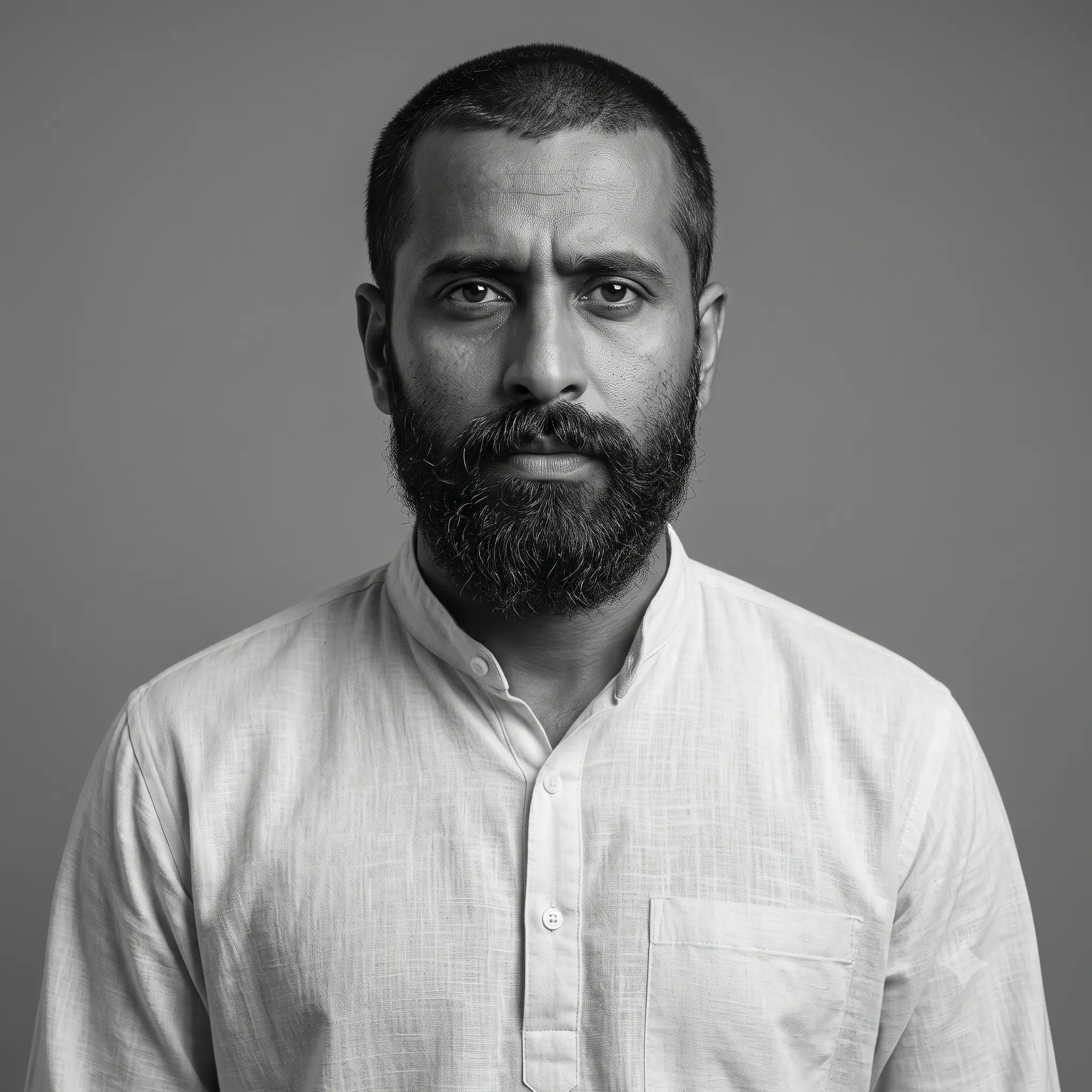
Variyankunnath Kunjahammad Haji was a Mappila Muslim of Ernad taluk in south Malabar who, after Ali Musliyar's capture at Tirurangadi at the end of August 1921, emerged as the most capable of the rebellion's remaining leaders, sustaining the Malabar Rebellion in the district's interior for months afterward. Sharing the direction of eastern Ernad with the Chembrasseri Tannal, he organised a parallel administration, issued proclamations in his own name, and sustained an armed resistance against British forces for roughly five months before his own capture and execution. Historians treat him, alongside Ali Musliyar and the rebellion's other principal leaders, as one of a small number of men who pursued a consciously political and religious objective for the whole Mappila community, distinct from the broader mass of tenants and labourers whose participation was driven more directly by agrarian grievance.
Variyankunnath Kunjahammad Haji was closely tied to Ali Musliyar. Both men came from the same village, Nellikkuth near Pandikkad, and — according to Stephen Frederic Dale's academic study of the Mappila community — were related by marriage; K.N. Panikkar's history of the rebellion describes Haji as a distant relative of Ali Musliyar. Before August 1921 he had not been a prominent figure in the Khilafat movement in the way Ali Musliyar was; it was the outbreak of the rebellion itself that thrust him into the leadership he went on to exercise.
Family, Early Life, and the Years Before 1921
The sources give differing and non-overlapping accounts of Variyankunnath Kunjahammad Haji's early life, and they are set out here as they stand rather than combined into a single narrative, since neither corroborates the other and they cannot be reconciled from the material available.
Dale's account connects him to the district's history of agrarian and religious unrest through the loss of most of his male relatives in the Mappila outbreak of 1894, in which he himself was not implicated. He later spent five years in Mecca, returning to Malabar in 1915; officials suspected, without confirming, that he might have had some connection to a further Mappila outbreak that occurred that same year, immediately after his return. Because of this family background he remained closely watched by the police, and when Ali Musliyar visited Nellikkuth in May or June 1921 to organise a Khilafat committee in the village, Haji did not take a direct part in Khilafat activities there.
Panikkar's account instead describes Haji as having been transported to Mecca together with his father on account of his own complicity in the Mappila revolts of 1891 and 1896, returning to Malabar some years afterward and earning his livelihood by plying a buffalo-cart. On this account he was drawn into the Khilafat movement in Ernad, though not as one of its prominent leaders, and in February 1921 the district authorities prohibited him from organising or addressing meetings there — an order served on him together with two Congress figures, K. Madhavan Nair and U. Gopala Menon, neither of whom, according to Panikkar, had even heard his name at the time.
The Outbreak of the Rebellion and the Assumption of Command
The Malabar Rebellion began on 20 August 1921, when a raid on Tirurangadi intended to arrest Ali Musliyar and his associates instead triggered a rising that spread rapidly across the district. Variyankunnath Kunjahammad Haji and Otakath Kunhi Koya Tannal, known as the Chembrasseri Tannal, president of the Khilafat committee at Chembrasseri near Tuvur, both responded to the news of the raid, and it was they who came to dominate the revolt in eastern Ernad after Ali Musliyar's capture on 30 August. At a meeting held at Pandikkad on 21 August, the principal leaders divided the areas under their control: the Ernad taluk was shared between the Chembrasseri Tannal and Variyankunnath Kunjahammad Haji, the Tirurangadi area remained under Ali Musliyar, and parts of Valluvanad fell to a fourth leader, Sithi Koya Tangal.
Whatever their personal motives, both Haji and the Chembrasseri Tannal had plainly been influenced by the political ideal the Khilafat campaign had articulated, and Dale notes that they may well have received this from Ali Musliyar himself during his visit to the area in the preceding months. On entering Manjeri, Haji proclaimed himself king; on this occasion, as at Tirurangadi, the leaders had apparently agreed to conciliate the Hindu population, for Haji refrained from looting the Nambitiri bank at Manjeri and made a point of returning jewels and other valuables to their owners. Panikkar records a proclamation issued at Manjeri on 24 August in which Haji assured the safety and protection of the local Hindu population, consistent with his need, as a leader without an established following of his own, to secure the goodwill of a community he could not otherwise hope to govern. He went on to proclaim himself, in Panikkar's account, Raja of the Hindus, Amir of the Muslims, and Colonel of the Khilafat army — a set of titles that captured both the religious framing of his movement and its practical need to hold the allegiance of Hindus as well as Muslims within the territory he controlled.
The Administration of Eastern Ernad
Neither Haji nor the Chembrasseri Tannal ever established a fully effective, regular administration, hampered as they were by political inexperience, personal rivalries, and — above all — the near-constant pressure of British military operations. What they did establish was substantial for the circumstances: the mosque, as the only Islamic institution available to the Mappilas for political purposes, became the administrative centre of the new order, personal movement across the territory was regulated by a system of passes sold to raise revenue for arms, and an intelligence network was organised to track the movement of troops. Haji proclaimed the abolition of the kanam tenure system, declared all occupancy tenants to be janmis in their own right, and remitted land tax for a year — measures that, however elementary and however little developed in principle or procedure, addressed directly the agrarian grievances that had fed into the rebellion.
Haji and the Chembrasseri Tannal maintained contact through correspondence and occasional meetings, and coordinated at times with other rebel bands, though each leader's authority in practice rested on a local base centred on his own mosque and village, and neither could easily extend direct control much beyond it. Both men were, in the beginning, opposed to the forced conversion of Hindus, as were Ali Musliyar and Sithi Koya Tangal, and Haji in particular exerted himself to prevent such conversions and to punish those responsible, generally after some form of inquiry. This restraint did not hold without exception as the rebellion wore on: Panikkar records that once the two leaders were forced into guerrilla warfare and cut off from voluntary local support, they were reported to have later sanctioned the looting of Hindu houses to procure provisions for their followers, in contrast to their earlier conduct.
Violence directed specifically against those who had aided the colonial authorities did occur under Haji's own command. In September, after a British column withdrew from Tuvur following a stay in the town, Haji's forces reoccupied it and executed thirty-three Hindus and two Mappilas who had assisted the troops during the occupation — killings that belonged to a pattern Dale identifies across the guerrilla phase of the rebellion, in which the largest groups of those killed were targeted specifically to terrorise the civilian population into withholding aid from the colonial administration, rather than as part of indiscriminate plunder.
Haji's own account of his conduct survives in a letter he wrote to the editor of The Hindu, published on 18 October 1921, in which he denied that his men had engaged in forced conversions, and attributed reports of such conversions to government agents operating within his ranks.
Military Operations
The first major engagement of the rebellion, in the opening week of August, saw an estimated four hundred Mappilas ambush a British detachment attempting to relieve the garrison at Malappuram; roughly three hundred Mappilas were killed. After this, the rebels generally confined themselves to guerrilla operations against the columns sent to hunt them down, since neither Haji nor the Chembrasseri Tannal, nor the other local leaders, had the numbers or organisation to mount sustained offensive operations of their own. On 20 September the two leaders met and resolved not to risk a further direct assault on government forces, choosing instead to try to preserve their own autonomy — a decision that may also have reflected a belief, reported among both Hindu and Muslim refugees that October, that the trial of the Khilafat leaders Muhammad Ali and Shaukat Ali, scheduled for 18 October, would prompt a rising across India. No such rising took place, and through October the British steadily reasserted control across the district.
In what proved to be the rebellion's last significant concerted action, Haji and the Chembrasseri Tannal organised a joint night assault on 14 November against a British and Gurkha force encamped at Pandikkad — a date Dale suggests was chosen for its significance as the thirteenth of Rabi al-Awwal, the traditional anniversary of the Prophet's death. Nearly five hundred handpicked Mappilas took part; close to two hundred were killed outside the camp, and a further fifty-eight died after penetrating its defences, against minimal losses on the government side. The defeat accelerated the rebellion's disintegration: the rate of surrender, already rising before the battle, increased sharply afterward, and the forces under both leaders fragmented further as they were pursued by troops and pressed for food and ammunition.
Capture and Execution
The two principal sources for Haji's life give differing and irreconcilable accounts of the end of his resistance, and both are set out here rather than resolved by choosing between them. Dale states simply that he was captured on 7 January 1922, without recording where or under what circumstances. Panikkar, citing R.H. Hitchcock's official history of the rebellion, states that he was arrested at Kallamoola in the Western Ghats, on the border between the Malabar and Coimbatore districts, and was shot dead on 20 January 1922. The Chembrasseri Tannal, according to Dale, had already surrendered with his chief lieutenant in mid-December; Panikkar's more general account of the rebellion's final surrenders places his death, by contrast, on 9 January 1922.
Assessment
Historians who have examined the Malabar Rebellion have generally placed Variyankunnath Kunjahammad Haji, together with Ali Musliyar and the rebellion's other principal leaders, at one end of a spectrum of motivation running through the rising's leadership: men who consciously sought a religiously and politically defined outcome for the Mappila community as a whole, as distinct from the far larger number of tenants and labourers whose participation is more directly explained by immediate agrarian grievance. Dale describes him as the more capable of the two leaders who directed the rebellion in eastern Ernad, ahead of the Chembrasseri Tannal; Panikkar goes further, calling him the most outstanding leader of the rebellion as a whole in his effort to control and guide its course. Both accounts agree in substance: Haji sustained organised resistance in the interior of Ernad for months after Ali Musliyar's capture, attempted — not always successfully — to hold the loyalty of both the Mappila and Hindu populations within the territory he controlled, and continued the struggle until his own capture brought the rebellion's most sustained phase of local self-government to an end.
References and Further Reading
Academic and Scholarly Sources
- Dale, Stephen Frederic. Islamic Society on the South Asian Frontier: The Mappilas of Malabar, 1498–1922. Oxford: Clarendon Press, 1980.
- Panikkar, K.N. Against Lord and State: Religion and Peasant Uprisings in Malabar, 1836–1921. Delhi: Oxford University Press, 1989.
Further Reading
- Wood, Conrad. "The First Moplah Rebellion against British Rule in Malabar." Modern Asian Studies. Cambridge University Press. [On the longer nineteenth-century tradition of Mappila uprisings preceding 1921]
Mentioned In
1 article references this topic