Ali Musliyar: Religious Leader of the Malabar Rebellion
Ali Musliyar (1861-1922), a scholar trained at Ponnani and Mecca, served as chief musaliar of the Tirurangadi mosque in south Malabar from 1907 and became the central religious authority of the Malabar Rebellion of 1921-22, before his capture and execution.
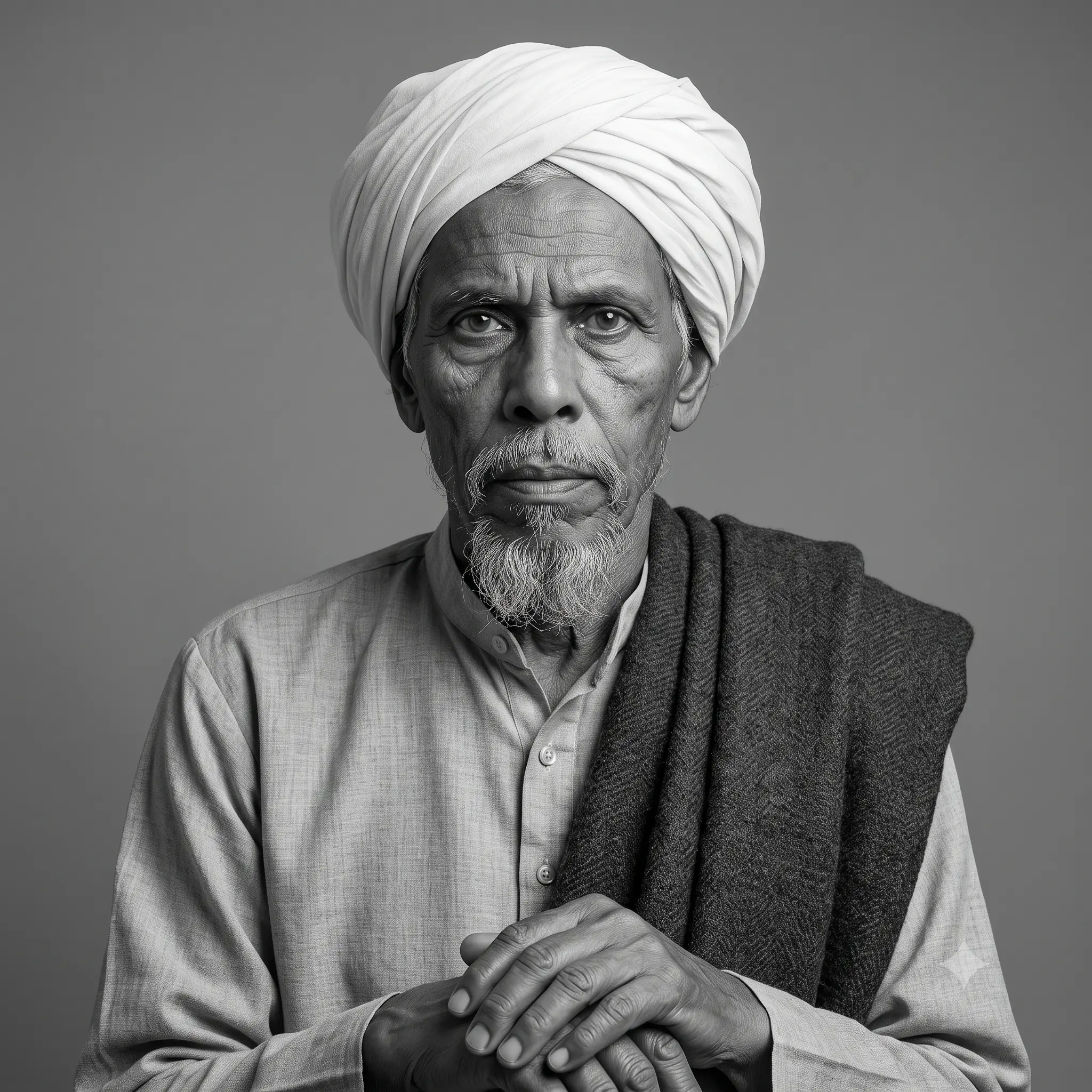
Ali Musliyar was a Mappila Muslim religious scholar of south Malabar who became the central religious figure of the Malabar Rebellion of 1921–1922, one of the largest and most contested Muslim peasant uprisings of colonial India. He served as the chief musaliar — the officiating religious leader — of the Tirurangadi mosque from 1907, built a wide following through his teaching and his sermons on the Khilafat question, and was proclaimed by his followers as leader of a short-lived Khilafat administration at Tirurangadi in August 1921. He surrendered after roughly ten days and was executed at Coimbatore in early 1922.
The rebellion Ali Musliyar led is understood differently depending on the historian consulted. It combined a Khilafat agitation against British rule with long-standing agrarian grievance between Mappila tenants and Hindu landlords, and its course included violence against Hindus in some areas that neither Ali Musliyar nor several of the other principal leaders sanctioned or wished to see. The academic treatments of Stephen Frederic Dale and K.N. Panikkar, on which this article draws, treat the rising as a complex event with religious, agrarian, and communal dimensions rather than reducing it to any single cause.
Family, Education, and the Tirurangadi Mosque
Ali Musliyar was born in 1861 in the village of Nellikkuth in the Ernad taluk of Malabar district. On his mother's side he descended from the Maqdum family of Ponnani, a lineage long associated with religious scholarship in the region, and he received his early education in theology and philosophy at Ponnani under Sheikh Zainuddin Maqdum. This was followed by a seven-year period of study at Mecca. On his return he served for a period as chief qazi of Kavaratti, an island in the Lakshadweep archipelago, before coming back to Malabar in 1894 — the same year in which his brother and several close relatives were killed in a Mappila uprising. He lost further relatives and disciples in a second such rising in 1896.
Before establishing himself at Tirurangadi, Ali Musliyar had already taught for at least a decade at the Mambram mosque, a connection that placed him within the same devotional tradition as the Mambram Tannals, whose memory the district's Mappilas held in particular reverence. From 1907 he served as chief musaliar of the Tirurangadi mosque, known locally as the Kizhakkepalli, in south Malabar. He was widely venerated for his knowledge of theology and his religious fervour, and — in a district where the influential nineteenth-century religious leader Sayyid Fadl had once commanded similar standing before his exile — no other figure in the area commanded comparable respect among the Mappilas after Fadl's departure. He organised a network of madrasas across the Ernad and Valluvanad taluks and drew disciples from across the district; the Mamburam shrine, a popular pilgrimage site, brought large numbers of Mappilas to Tirurangadi to pray, giving Ali Musliyar's teaching a reach well beyond his own congregation. By 1921, at the age of sixty, he was among the most senior religious figures in the district.
The Khilafat Movement in Tirurangadi
The Khilafat agitation reached Malabar in the aftermath of the First World War, as Indian Muslims mobilised in defence of the Ottoman caliphate, and Tirurangadi under Ali Musliyar became the most active centre of Khilafat activity in the district. He was initially drawn to Gandhian methods, adopting khadi and non-violence, but this phase was short-lived: he came to advocate resistance to the movement's opponents and justified this position on religious grounds. Khilafat volunteers at Tirurangadi were organised and drilled along military lines and paraded through the town.
Two episodes in mid-1921 illustrate the increasingly assertive character of the movement under his leadership. On 8 June, the anniversary of the deaths of Mappilas killed in an 1843 uprising, Ali Musliyar led three to four hundred armed and uniformed Khilafat volunteers in a procession to the graves of those killed, a practice that became a regular Friday occurrence afterward; officials watching the movement's growth read the pilgrimage as an ominous sign, not least because a constable who attempted to question Ali Musliyar on 18 June could not even approach him, and when he agreed to be questioned the following day he came attended by an estimated six hundred supporters. On 24 July, he led a large procession from Tirurangadi to a rival meeting convened by the Ulama Association at Ponnani, in opposition to a government-sponsored anti-Khilafat conference; police tried to obstruct the march, a scuffle followed, and a serious confrontation was averted only through the intervention of the Khilafat organiser Muhammad Abdu Rehman. Karat Muhi al-Din Kutti Haji, a close friend and disciple who had accompanied Ali Musliyar on the pilgrimage to Mecca and attended his sermons, later described him as "a religious fanatic" who "had the hope of obtaining Khilafat Government," whose teachings held that opposition to the movement should be met with force rather than recourse to the courts, and whose volunteers swore to remain with the movement until death.
By late July, with a Malayalam translation of the resolutions of the Karachi Khilafat Conference in circulation, Ali Musliyar read the resolutions to the congregation at the Tirurangadi mosque, and the district's Mappilas had come to believe that a Khilafat republic was imminent and that colonial rule was on the point of collapse. This growing agitation coincided with rising agrarian tension between Mappila tenants and Hindu landlords, most sharply at the nearby estate of Pukkottur, and by early August the district magistrate had requested reinforcements to disarm the Mappilas and arrest the principal Khilafat leaders, warning of the open manufacture of swords and knives in the area.
The Raid on Tirurangadi and the Outbreak of Rebellion
Before dawn on 20 August 1921, a force of soldiers and police — a hundred special police together with either seventy or a hundred British troops, the accounts differing on the exact number — moved on Tirurangadi with orders to arrest Ali Musliyar and his close associates in the Khilafat movement. The raid surprised the town but achieved none of its objective: officers searching the mosque found neither arms nor the men they sought, and Ali Musliyar was not present. The government took the view that he had been forewarned and had deliberately absented himself; Ali Musliyar himself, in an interview given some months later from Coimbatore jail, maintained that he had received no warning at all and was simply on his way to the mosque for his own morning prayers when he found it already surrounded, learning only then that the siege was intended to arrest him. The two accounts cannot be reconciled from the sources and are presented here as they stand. What is not disputed is that the Mappilas who had gathered for the dawn prayer found their entry to the mosque barred by the army and the police; Ali Musliyar and other eyewitnesses stated that the police entered the mosque in uniform and with their boots on, which the government denied, saying the boots had been removed beforehand. Word of the confrontation, understood locally as a desecration of the mosque, spread through the town and the surrounding villages within hours.
Word — including the false report that the mosque had been fired on and that Ali Musliyar and the district magistrate and police superintendent had all been killed — reached Tanur, Tirur, Kottakkal, and Parappanangadi. Crowds converged on Tirurangadi from several directions, and by afternoon a confrontation between a crowd advancing from Tanur and a police detachment ended in gunfire that killed twenty and wounded thirty among the Mappilas, and killed two British officials and an Indian constable. In Tirurangadi itself, Mappilas burned government buildings once the British had withdrawn, and Ali Musliyar emerged to proclaim himself a Khilafat ruler, establishing his headquarters at the mosque and the adjoining Khilafat office. He ordered that ferry and market dues, previously paid to the colonial administration, would now be collected by the Mappilas themselves, and directed that the town assemble at the mosque to resist the British. Whether he had deliberately spread the report of an attack on the mosque in order to rouse his followers, as the government maintained, or whether the rumour arose independently of any instruction from him, as he himself insisted, could not be established even at the time; what is clear is that his authority in the town was, for a period of ten days, effectively unchallenged.
News of the Tirurangadi raid, and of the false report accompanying it, carried the rebellion outward at the pace at which Ali Musliyar's own messengers could reach outlying villages. In Pukkottur a crowd gathered that Saturday intending to go to his aid, deflected instead toward Nilambur, where they killed seventeen members of a landlord family; other centres, including Manjeri and Karuvarakkundu, rose on similar reports of a general collapse of British authority rather than on any direct instruction from Tirurangadi. Three other men — Variyankunnath Kunjahammad Haji, the Chembrasseri Tannal, and Sithi Koya Tangal — went on to direct the rebellion elsewhere in the district, and it was these leaders, together with Ali Musliyar in Tirurangadi, who between them controlled most of the rebellion once it was under way. A rough division of territory was agreed among them: the Ernad taluk was shared between the Chembrasseri Tannal and Variyankunnath Kunjahammad Haji, parts of Valluvanad fell to Sithi Koya Tangal, and the Tirurangadi area remained under Ali Musliyar's own authority.
Conduct During the Rebellion
Ali Musliyar's actual conduct once the rebellion was in progress was markedly more restrained than his earlier rhetoric might have suggested. Although proclaimed a Khilafat king by his followers, he largely remained at the mosque rather than taking an active part in the fighting, relying for military organisation on a principal lieutenant who had made his reputation as a Khilafat recruiter, and historians have since read his conduct in this period as cautious and increasingly resigned to the likely outcome rather than as decisive command. He made arrangements to guard the property of local Hindu landlords, with the result that, up to his arrest, prominent Hindu families in the Tirurangadi area were protected from the plunder that occurred elsewhere in the rebellion; he was, along with Variyankunnath Kunjahammad Haji, the Chembrasseri Tannal, and Sithi Koya Tangal, opposed to the forced conversion of Hindus, and used his influence to try to prevent it. This placed him on one side of a division among the rebellion's leadership: the forced conversions and killings that did occur in other areas, most extensively around Arikode and Pukkottur, were the work of separate leaders — among them Abdu Haji, Abu Bakr Musaliar, and Moideen Kutty Haji — whose commitments were narrowly religious rather than tied to the wider Khilafat and Non-cooperation politics that had shaped Ali Musliyar's own activism, and none of the historians consulted for this article associate Ali Musliyar personally with these acts.
By 30 August, British forces reoccupied Tirurangadi. Two of Ali Musliyar's lieutenants, Kunhalavi and Lavakutty, chose to fight; Kunhalavi was killed in the encounter and Lavakutty escaped, but Ali Musliyar and forty-one of his followers surrendered. On 26 August, shortly before his capture, the Congress leader K.P. Keshava Menon had led a delegation of Congress workers to Tirurangadi in an attempt to persuade Ali Musliyar to surrender to the authorities; Ali Musliyar himself appeared inclined to accept the advice, though his lieutenants were not, and the mission achieved little beyond that impression before his capture followed regardless days later. After Ali Musliyar's capture, leadership of the wider rebellion passed to Variyankunnath Kunjahammad Haji and the Chembrasseri Tannal, who continued the resistance in eastern Malabar for several further months before the rebellion was finally suppressed by December 1921.
Execution
Ali Musliyar was tried and sentenced to death. He was executed by firing squad at Coimbatore, together with twelve of his followers.
Assessment
Historians who have examined the Malabar Rebellion have generally placed Ali Musliyar, together with Variyankunnath Kunjahammad Haji and the rebellion's other principal leaders, at one end of a spectrum of motivation running through the rising's leadership: men who consciously sought a religiously defined political outcome for the whole Mappila community, as distinct from the greater number of tenant farmers and labourers whose participation was driven more directly by immediate economic grievance or the promise of Islamic renewal. Ali Musliyar was, in this reading, not the most militarily active of the rebellion's leaders, but he was in a real sense its central figure: the man whose sermons, processions, and standing as chief musaliar of Tirurangadi gave the Khilafat movement in south Malabar its religious authority, and whose capture marked the effective end of the rebellion's first and most concentrated phase.
References and Further Reading
Academic and Scholarly Sources
- Dale, Stephen Frederic. Islamic Society on the South Asian Frontier: The Mappilas of Malabar, 1498–1922. Oxford: Clarendon Press, 1980.
- Panikkar, K.N. Against Lord and State: Religion and Peasant Uprisings in Malabar, 1836–1921. Delhi: Oxford University Press, 1989.
Further Reading
- Wood, Conrad. "The First Moplah Rebellion against British Rule in Malabar." Modern Asian Studies. Cambridge University Press. [On the longer nineteenth-century tradition of Mappila uprisings preceding 1921]
Mentioned In
1 article references this topic