Alhambra
A magnificent palace and fortress complex in Granada, Spain, built by the Nasrid dynasty. Considered the pinnacle of Islamic architecture in Western Europe, the Alhambra represents the final flowering of Islamic art and culture in Al-Andalus.
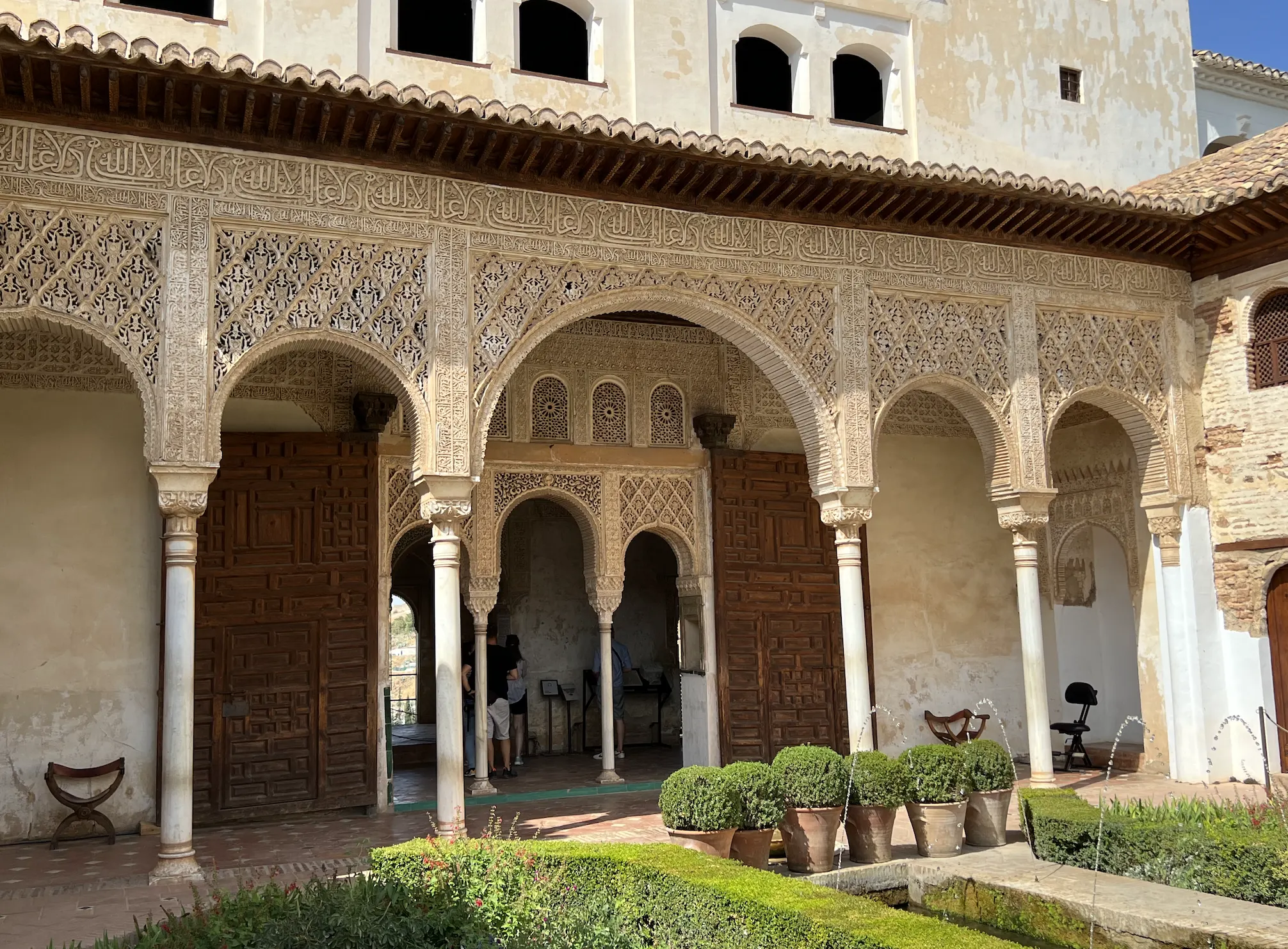
The Alhambra (Arabic: قلعة الحمراء, Qal'at al-Hamra, "The Red Castle") is a magnificent palace and fortress complex located in Granada, Spain. Built primarily during the 13th and 14th centuries by the Nasrid dynasty (see Granada), the Alhambra represents the pinnacle of Islamic architecture in Western Europe and stands as the most complete surviving example of a medieval Islamic palace complex. This UNESCO World Heritage Site embodies the final flowering of Islamic art and culture in Al-Andalus before the Christian Reconquista.
Historical Context
The Nasrid Kingdom of Granada
The Alhambra was built during the twilight of Islamic rule in Iberia. The Nasrid dynasty, which governed from 1238 to 1492 CE, was the last Muslim dynasty in Spain, and it survived only by paying tribute to the neighbouring Christian kingdoms. Granada under the Nasrids became a haven for Muslims fleeing the Christian reconquest, and, in a paradox that defines the period, it experienced a cultural renaissance and artistic flowering even as its political fortunes declined.
Granada's position gave the kingdom considerable natural advantages. It was sheltered by the Sierra Nevada mountains, and the fertile plains of the Vega de Granada provided rich agricultural land. The city controlled important commercial pathways, while its elevated location overlooking the surrounding country gave it a strong defensive position.
The Sabika Hill
The Alhambra sits on the Sabika Hill, a natural fortress that rises roughly 150 metres above Granada. Steep slopes on three sides supplied a natural defence, springs on the hill offered a reliable water supply, and the elevation gave a commanding view of the surrounding territory.
The site had been used long before the Nasrids. There may have been early fortifications in the Roman period, and military use continued through the Visigothic era. A basic fortress, or alcazaba, was established in the early Islamic period, and the Zirid dynasty carried out improvements and expansion in the 11th century.
Foundation and Early Development
Muhammad I ibn al-Ahmar (1238-1273 CE)
Muhammad I ibn al-Ahmar founded the Nasrid dynasty. A member of the Banu Nasr tribe from Arjona, he capitalised on the political chaos that followed the decline of the Almohads, established his capital at Granada in 1238, and began the fortification of the Sabika Hill.
His early building phase laid the foundations of the later complex. It included the alcazaba, which served as both military fortress and residential quarters, and an aqueduct drawing water from the Darro River. Simple royal residences were raised, and defensive walls were built to fortify the entire hill.
Muhammad II (1273-1302 CE)
Under Muhammad II the site was expanded and developed. He oversaw the first major palatial buildings, navigated the complex relationships with the Christian kingdoms, extended his patronage to the arts and literature, and improved the water systems and gardens.
Muhammad III (1302-1309 CE)
Muhammad III introduced several architectural innovations. He built the Partal Palace, one of the earliest surviving palace structures in the complex, along with a royal mosque, sophisticated bathing facilities, and the early palace gardens.
The Golden Age: Yusuf I and Muhammad V
Yusuf I (1333-1354 CE)
Yusuf I was responsible for many of the Alhambra's most famous structures. Chief among them was the Comares Palace, which contained the Hall of the Ambassadors, a magnificent throne room; the Court of the Myrtles, an elegant courtyard with a reflecting pool; and the Comares Tower, the tallest tower in the complex. Its rooms were finished with intricate muqarnas and tilework.
The architecture of Yusuf I's reign was distinguished by complex geometric patterns worked out with mathematical care, by Arabic calligraphy carrying Quranic verses and poetry, by a masterful handling of natural light and shadow, and by the integration of fountains and pools throughout.
Muhammad V (1354-1391 CE)
The reign of Muhammad V saw the completion of the Alhambra's most celebrated spaces. Foremost among them was the Palace of the Lions, which centred on the iconic Court of the Lions with its twelve-lion fountain, and included the Hall of the Two Sisters with its spectacular muqarnas dome, the Hall of the Abencerrajes long associated in legend with political intrigue, and the Hall of the Kings with its unusual figurative paintings on leather.
The artistic achievements of this period included the most sophisticated stalactite vaulting, or muqarnas, in the complex, poetic inscriptions by Ibn Zamrak and other court poets, a refined use of blue, gold, and white, and an unusually complete unity of structure and decoration.
Architectural Masterpieces
The Nasrid Palaces
The Mexuar served as the administrative and judicial area of the palace. It contained a small oratory oriented towards Mecca and a simple but elegant open courtyard, and it was finished with geometric tilework and carved plaster.
The Comares Palace, built by Yusuf I, was arranged around the Court of the Myrtles, a rectangular courtyard with a central pool. From the Hall of the Boat, an antechamber, one passed into the Hall of the Ambassadors, a cubic throne room roofed with a star-pattern ceiling. Its decorative programme was symbolic, representing both earthly and celestial power.
The Palace of the Lions, built by Muhammad V, was organised around the Court of the Lions with its famous fountain. Four halls of different functions surrounded the court, which was conceived as a representation of the Islamic paradise garden and carried an extensive programme of literary inscriptions.
The Court of the Lions
The Court of the Lions is the most famous space in the Alhambra. The rectangular courtyard measures about 35 by 20 metres, its colonnade rests on 124 slender marble columns, and its central fountain sets a marble basin on twelve stylised lions. Four water channels divide the courtyard into four gardens.
The design carries a symbolic meaning. It represents the Quranic paradise, its four channels evoke the rivers of paradise, and the lions serve as symbols of strength and royal power, while Ibn Zamrak's poetry, inscribed in the space, describes it directly.
The court is also a technical achievement. It relies on a complex hydraulic system to distribute water, on slender columns that carry a heavy roof, on a plan designed for favourable acoustics, and on the careful control of natural illumination.
Decorative Arts
The muqarnas, or stalactite vaulting, reaches its height in the Hall of the Two Sisters, where some 5,000 individual cells were assembled with mathematical precision. The vaulting creates shifting patterns of light and shadow and was understood to represent the celestial dome.
The tilework, known as alicatado, was composed of star and polygon patterns in a palette of blue, white, green, and black. Each piece was cut and fitted with precision, and the designs were arranged to suggest an infinite, eternal continuation.
Calligraphy runs throughout the palace. Quranic verses appear as religious texts, while secular poetry praises the rulers and the palace itself. Angular Kufic script was used for formal inscriptions and flowing cursive scripts for the poetic texts.
The carved plaster combined stylised vegetal patterns known as ataurique with complex geometric interlace and epigraphic bands of calligraphic frieze. Deep carving gave these surfaces a three-dimensional quality and pronounced shadow patterns.
Gardens and Water Features
The Generalife
The Generalife was the royal summer palace, its name derived from Jannat al-Arif, the Garden of the Architect. It served as a summer residence with gardens, standing on an adjacent hill connected to the Alhambra by a bridge, and dates from the late 13th to the early 14th century.
Its garden design centred on the Patio de la Acequia, a long courtyard with a central water channel, and included a cypress gallery, a covered walkway with garden views, and terraced upper gardens with panoramic views. Fountains, channels, and pools were distributed throughout. The horticultural programme combined fruit trees such as oranges, lemons, and pomegranates with flowers including roses, jasmine, and other aromatic plants, kitchen gardens of vegetables for the palace, and medicinal herbs for the palace pharmacy.
Water Systems
The water supply depended on considerable hydraulic engineering. The Acequia Real, the main aqueduct, drew water from the Darro River into a complex distribution network of channels and pipes, gravity-fed fountains and jets, and reservoirs that stored the supply.
Water served both practical and symbolic ends. Its evaporation provided a natural form of cooling, its sound masked conversation, it stood as a symbol of purity and paradise, and its visual beauty and movement enriched every space it entered.
Literary and Poetic Program
Ibn Zamrak (1333-1393 CE)
Ibn Zamrak was the poet laureate to Muhammad V and is regarded as the greatest poet of Nasrid Granada. His poems were carved directly into the palace walls, and their themes praised the rulers and described the beauty of the palace.
His famous verses from the Court of the Lions read:
"Blessed be He who gave the Imam Muhammad the beautiful ideas for decorating his mansions! For there are gardens here that art has made so beautiful that they surpass nature itself."
Poetic Themes
Much of the poetry presented the palace as a paradise. It used garden imagery to describe an earthly paradise, water metaphors in which the verses flow like water, and light symbolism casting the palace as a source of divine light, while praising the rulers as shadows of God on earth.
The inscriptions also created an architectural dialogue. The walls seem to speak through their inscriptions, the verses respond to the presence of the visitor, the poetry lends permanence to passing moments, and it preserves the memory of Nasrid achievements.
Daily Life in the Alhambra
Royal Court
The palace was organised in a clear hierarchy. At its head stood the sultan, an absolute ruler with divine sanction, followed by the royal family of wives, children, and relatives, the court officials such as viziers, secretaries, and administrators, and a large staff of servants who maintained the palace.
Court ceremonies filled the year. Formal audiences were held in the Hall of the Ambassadors, religious and seasonal festivals were celebrated, negotiations with the Christian kingdoms took place at diplomatic meetings, and cultural events brought poetry recitations and musical performances.
Harem and Private Life
The women's quarters occupied distinct areas set apart for women and children, with access to private courtyards and garden spaces. Educational programmes taught literature and the arts, and the royal women maintained complex social networks among themselves.
Children of the court received a broad education. It included Islamic studies of the Quran, hadith, and religious law; literature in Arabic poetry and prose; the arts of calligraphy, music, and decoration; and physical training in riding, archery, and the martial arts.
Artisans and Craftsmen
The palace was served by specialised workshops. Mudéjar craftsmen, Christian artisans working in the Islamic style, laboured alongside master builders who supervised architecture and construction, decorative artists specialising in tilework, carving, and painting, and garden designers expert in landscape and hydraulic engineering.
Their work rested on established artistic techniques. Production was organised through a guild system, new generations were trained by apprenticeship, techniques were continually developed, and royal commissions were held to high standards of quality control.
The Fall of Granada and Christian Conquest
Final Years (1482-1492 CE)
Internal strife weakened Granada in its final years. A civil war set Boabdil against his father, internal divisions undermined resistance, economic decline reduced the resources available for defence, and the kingdom lost its external allies to diplomatic isolation.
At the same time, Christian pressure intensified. The Catholic Monarchs, Ferdinand and Isabella, mounted a unified campaign backed by superior artillery and siege techniques, an economic blockade that cut off trade and supplies, and a sustained effort of propaganda and intimidation.
The Surrender (January 2, 1492 CE)
The city surrendered by a negotiated capitulation. Its terms guaranteed religious freedom and property rights; Boabdil, the last Nasrid ruler, departed into exile in North Africa; the keys of the city were handed over in a symbolic transfer; and the surrender brought to an end nearly eight centuries of Islamic rule in Iberia.
Legend records Boabdil's final look back at Granada. It tells of an emotional departure marked by tears at leaving his kingdom and of his mother's reproach, "Weep like a woman for what you could not defend like a man." The moment came to symbolise the end of Islamic civilisation in Iberia, and the story has been preserved in literature and folklore.
Christian Period and Transformations
Immediate Changes (1492-1516 CE)
Religious conversion followed the conquest. The royal mosque was converted into a Christian chapel, Islamic religious symbols were removed, Christian imagery was added, and spaces were adapted for Christian use.
Architectural additions soon followed. The Renaissance Palace of Charles V was raised within the complex, the Church of Santa María was built over the main mosque, the Convent of San Francisco was established as a Franciscan monastery, and the military installations were modified for defence.
Habsburg Period (1516-1700 CE)
The Palace of Charles V was the dominant addition of the Habsburg period. Its Renaissance design centred on a circular courtyard in the classical style, made an emphatic statement of imperial power over the Islamic heritage of the site, contrasted starkly with the Nasrid style around it, and was never fully finished as planned.
Conservation during this period was modest. It amounted to basic maintenance of the existing structures, early written descriptions and drawings, the selective preservation of the most impressive spaces, and the adaptive reuse of the palace for continued residential and ceremonial functions.
Bourbon Period (1700-1808 CE)
The Bourbon period brought Enlightenment interest to the Alhambra. The first systematic architectural surveys were carried out, appreciation for the monument's exotic beauty grew in Romantic taste, foreign visitors described it in travel literature, and its decorative art began to influence European design.
Rediscovery and Restoration
19th Century Revival
The Romantic movement revived interest in the Alhambra. Washington Irving published his Tales of the Alhambra in 1832, and Owen Jones produced his Plans, Elevations, Sections and Details of the Alhambra between 1842 and 1845. Orientalist art expressed a European fascination with Islamic culture, and the beginnings of heritage tourism took shape.
Restoration campaigns accompanied this revival. Rafael Contreras undertook the first systematic restoration between 1847 and 1890, applying an archaeological approach to the study of original techniques. Some of these restorations were later criticised, though the work was carefully documented.
20th Century Conservation
The 20th century brought professional standards to conservation. Leopoldo Torres Balbás introduced scientific restoration methods between 1923 and 1936, UNESCO became involved, modern conservation technologies were adopted, and the emphasis shifted towards preventive conservation aimed at forestalling deterioration.
Research and study advanced alongside conservation, through archaeological excavations that uncovered buried structures, documentary studies of the Nasrid period, technical analysis of materials and techniques, and digital documentation using 3D scanning and virtual reconstruction.
Artistic and Cultural Influence
Islamic Art Tradition
The Mudéjar style carried Islamic techniques into the buildings of Christian Spain, producing a hybrid culture that fused Islamic and Christian elements. Its influence spread throughout the Iberian Peninsula and continued for centuries after 1492.
The later Orientalist movement drew on the Alhambra in European architecture through Islamic-inspired buildings, in the decorative arts through the use of Alhambra patterns, and in the Alhambra pavilions and reproductions shown at world's fairs, all expressing a Romantic idealisation of Islamic culture.
Modern Architecture
The Alhambra's geometric principles have influenced modern design. Its mathematical beauty has shaped modern geometric design, its patterns have inspired modular and prefabricated systems, its handling of light and space has offered lessons in architectural lighting, and its integration of indoor and outdoor space has influenced contemporary design.
Individual artists have engaged with it directly. M.C. Escher drew on the Alhambra's mathematical patterns, its inscriptions contributed to a revival of Islamic calligraphy, contemporary artists have offered modern interpretations of it, and its patterns have been reworked in computer-generated digital art.
Scientific and Technical Achievements
Mathematical Principles
The geometric patterns of the Alhambra embody sophisticated mathematics. All 17 plane symmetry groups, the crystallographic groups, are represented; some patterns anticipate quasi-crystalline structures later described in modern science; self-similar designs suggest fractal geometry at different scales; and the muqarnas display complex three-dimensional, topologically intricate geometries.
Its proportional systems are equally deliberate. They draw on the golden ratio and other mathematical proportions, on a modular design of standardised elements and measurements, on harmonic relationships comparable to musical ratios, and on optical corrections that adjust for visual perception.
Engineering Innovations
The structural systems achieved much with little. Lightweight construction produced maximum effect from minimal material, flexible construction gave a measure of seismic resistance in an earthquake zone, the design responded to the Mediterranean climate, and prefabricated elements allowed efficient modular assembly.
The hydraulic engineering was equally refined. It relied on gravity-fed pressure systems, on the precise regulation of water flow, on an acoustic design in which the sound of water afforded privacy and ambiance, and on systems laid out so that they could be maintained and repaired easily.
Contemporary Significance
UNESCO World Heritage Site
The Alhambra was designated a UNESCO World Heritage Site in 1984. The designation recognised its outstanding universal value, the substantial integrity of its preserved original fabric, the authenticity of its maintained historical character, and the comprehensive conservation programme that manages it.
Conservation faces ongoing challenges, among them the impact of mass tourism from millions of annual visitors, the effects of climate change and shifting weather patterns, development pressure on the surrounding areas, and the continuing need for conservation funding.
Cultural Diplomacy
The Alhambra has become a site of Islamic-Christian dialogue. It represents a shared heritage appreciated across cultures, supports educational programmes that promote understanding of Islamic culture, fosters international academic cooperation, and sustains cultural exchange programmes connecting Spain with the Islamic world.
It is also often taken as a symbol of tolerance. It recalls the medieval convivencia, or coexistence of cultures; its artistic achievement is seen to transcend religious boundaries; its beauty appeals across cultural differences; and it is invoked as a form of architecture that bridges civilisations.
Tourism and Economy
The Alhambra draws over 2.7 million visitors each year, making it a major contributor to Granada's economy, a source of thousands of jobs in the tourism sector, and the basis of cultural industries in crafts, publications, and reproductions.
Efforts to keep this tourism sustainable rely on visitor management through timed entry and capacity limits, on balancing conservation with public access, on an educational focus that favours understanding over mere sightseeing, and on local community involvement in the benefits of tourism.
Educational and Research Value
Academic Studies
The Alhambra is central to the study of architectural history. It is the premier example of the Nasrid style, invites comparative study alongside other Islamic monuments, rewards technical analysis of its construction methods and materials, and offers, through its own restoration history, a record of the evolution of conservation practice.
It is equally important to cultural studies. It opens a window onto the civilisation of Al-Andalus and medieval Islamic culture, documents the Christian-Islamic artistic dialogue, supports literary study of its poetry and calligraphy, and illuminates the social history of daily life in a medieval Islamic palace.
Educational Programs
School visits use the Alhambra to connect history and art education, to offer interactive, hands-on exploration of Islamic culture, to promote cross-cultural understanding and appreciation, and to teach the mathematics and engineering embedded in Islamic art.
University research engages it through specialised graduate programmes in Islamic art and architecture, international research partnerships, digital humanities methods that enhance study, and interdisciplinary approaches that combine several academic fields.
Conclusion
The Alhambra stands as one of humanity's greatest architectural achievements, representing the pinnacle of Islamic art and culture in Western Europe. More than just a magnificent palace complex, it embodies the sophisticated civilization of Al-Andalus and demonstrates the heights that human creativity can reach when artistic vision, technical skill, and cultural refinement converge.
As the last great flowering of Islamic architecture in Iberia, the Alhambra captures both the glory and the poignancy of a civilization in its final phase. The extraordinary beauty of its courtyards, the mathematical precision of its decorative patterns, and the poetic eloquence of its inscriptions all speak to a culture that valued beauty, learning, and spiritual refinement even in the face of political decline.
The Alhambra's influence extends far beyond its historical period and geographical location. Its geometric patterns have inspired mathematicians and artists, its architectural principles have influenced designers worldwide, and its integration of architecture, decoration, poetry, and landscape design continues to provide lessons for contemporary creators.
Today, as a UNESCO World Heritage Site and one of the world's most visited monuments, the Alhambra serves as a bridge between cultures and a symbol of the shared human heritage that transcends religious and political boundaries. Its preservation and study contribute not only to our understanding of Islamic civilization but also to our appreciation of the universal human capacity for creating beauty and meaning through art and architecture.
The Alhambra reminds us that true architectural greatness lies not merely in size or technical achievement, but in the ability to create spaces that elevate the human spirit and provide glimpses of transcendent beauty. In its perfect integration of form and meaning, structure and decoration, earthly function and spiritual aspiration, the Alhambra continues to inspire and instruct, offering timeless lessons about the power of human creativity to transform stone and water, light and shadow, into poetry made manifest in space.
References and Further Reading
Primary Islamic Sources
- Ibn al-Khatib, Lisan al-Din. Al-Ihata fi Akhbar Gharnata (Comprehensive Account of Granada). Cairo: Maktabat al-Khanji, 2003. [Original c. 1374 CE]
- Ibn al-Khatib, Lisan al-Din. Al-Lamha al-Badriyya fi al-Dawla al-Nasriyya (The Nasrid Dynasty). Beirut: Dar al-Afaq al-Jadidah, 1978. [Original c. 1374 CE]
- Ibn Zamrak (court poet). Inscriptions and poems adorning the walls of the Alhambra, particularly the Hall of the Two Sisters and the Court of the Lions. [c. 1370s CE]
- Al-Maqqari, Ahmad ibn Muhammad. Nafh al-Tib, descriptions of Nasrid Granada. Cairo: Dar al-Kutub al-Misriyyah, 1949. [Original c. 1629 CE]
Classical Islamic Sources
- Anonymous. Nubdhat al-Asr fi Akhbar Muluk Bani Nasr (Chronicle of the Nasrid Kings). Granada: Universidad de Granada, 2002. [Original c. 1492 CE]
- Al-Himyari, Muhammad ibn Abd al-Munim. Kitab al-Rawd al-Mi'tar, entry on Granada. Beirut: Librairie du Liban, 1975. [Original c. 1461 CE]
Academic and Scholarly Sources
- Grabar, Oleg. The Alhambra. Cambridge: Harvard University Press, 1978.
- Ruggles, D. Fairchild. Gardens, Landscape, and Vision in the Palaces of Islamic Spain. University Park: Penn State University Press, 2000.
- Dodds, Jerrilynn D., ed. Al-Andalus: The Art of Islamic Spain. New York: Metropolitan Museum of Art, 1992.
- Bush, Olga. Reframing the Alhambra: Architecture, Poetry, Textiles and Court Ceremonial. Edinburgh: Edinburgh University Press, 2018.
- Hillenbrand, Robert. Islamic Architecture: Form, Function, and Meaning. Edinburgh: Edinburgh University Press, 1994.
- Puerta Vílchez, José Miguel. Reading the Alhambra: A Visual Guide to the Alhambra Through Its Inscriptions. Granada: Edilux, 2011.
Further Reading
- Irving, Washington. Tales of the Alhambra. Philadelphia: Lea & Blanchard, 1832.
- Bargebuhr, Frederick P. The Alhambra: A Cycle of Studies on the Eleventh Century in Moorish Spain. Berlin: De Gruyter, 1968.
- Catlos, Brian A. Kingdoms of Faith: A New History of Islamic Spain. New York: Basic Books, 2018.
- Menocal, María Rosa. The Ornament of the World. Boston: Little, Brown, 2002.
Mentioned In
14 articles reference this topic
and 2 more articles
More from Al-Andalus
Al-Andalus
Al-Andalus was the Islamic territory in the Iberian Peninsula from 711 to 1492 CE. Over nearly eight centuries it produced major intellectual and architectural achievements, and its mix of Muslim, Christian, and Jewish communities left a lasting mark on European and Islamic civilization.
Fall of Granada
Comprehensive history of the fall of Granada in 1492, marking the end of Islamic rule in the Iberian Peninsula after nearly 800 years and the conclusion of the Reconquista
Granada
Granada was the capital of the last Islamic kingdom in Iberia, ruled by the Nasrid dynasty from 1238 to 1492 CE. Home to the Alhambra, it was the final chapter of Islamic Al-Andalus, surviving two and a half centuries through diplomacy and culture before falling in 1492.
Islamic Influence on Europe - The Andalusian Legacy
The Islamic civilization of Al-Andalus profoundly shaped European development through the transmission of knowledge, architecture, technology, and culture. From translating classical texts to introducing new agriculture, Islamic Spain bridged the Islamic world and medieval Europe.