The Children of Prophet Muhammad (Peace Be Upon Him)
Prophet Muhammad (Peace Be Upon Him) had seven children: three sons, al-Qasim, Abdullah and Ibrahim, who all died in childhood, and four daughters, Zaynab, Ruqayyah, Umm Kulthum and Fatimah. Six were born at Mecca to Khadijah bint Khuwaylid; Ibrahim to Mariya al-Qibtiyya. Only Fatimah outlived him.
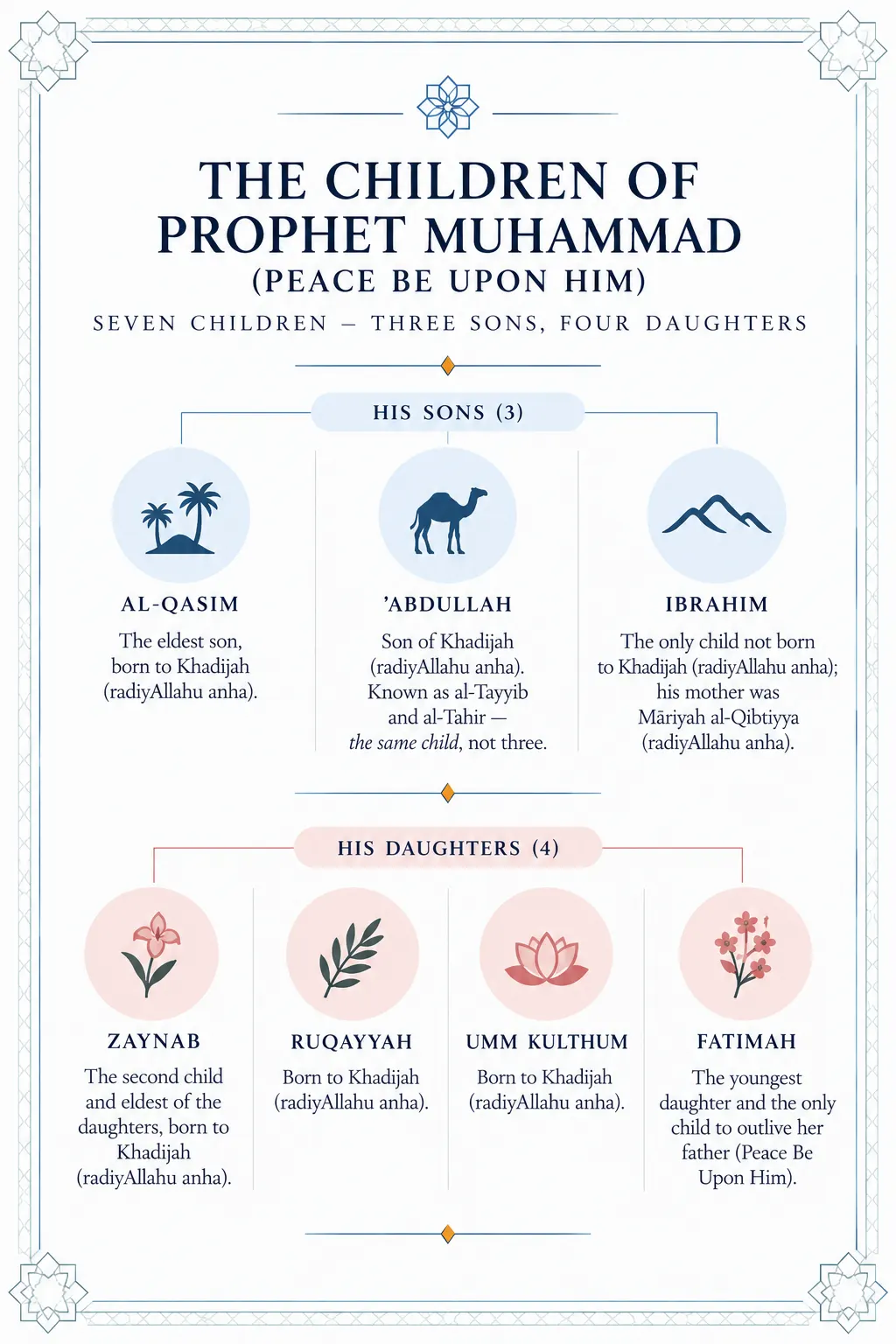
Prophet Muhammad (Peace Be Upon Him) had seven children: three sons and four daughters. The sons were al-Qasim, Abdullah — called also al-Tayyib and al-Tahir — and Ibrahim; the daughters were Zaynab, Ruqayyah, Umm Kulthum and Fatimah.
Six of the seven were born at Mecca to Khadijah bint Khuwaylid, his first wife, during the twenty-five years of a marriage in which he took no other. The seventh, Ibrahim, was born at Medina many years later to Mariya al-Qibtiyya. None of his other marriages produced children. Al-Mubarakpuri states the position in a sentence: with the exception of Ibrahim, Khadijah bore all of his children, all the sons died in childhood, and all the daughters but Fatimah died in their father's lifetime.
All three sons died as small children. Of the four daughters, three died before their father — Ruqayyah in 2 AH, Zaynab in 8 AH, Umm Kulthum in 9 AH — and Fatimah survived him by about six months. Of his descendants, only Fatimah's line continued.
A note on the evidence
The early record of the Prophet's children is uneven, and a reader is better served by knowing where it is thin than by a smooth account that conceals the gaps.
Fatimah is documented in detail. Zaynab is well recorded, chiefly through her marriage and the episodes at Badr. Ruqayyah and Umm Kulthum are known mainly through their marriages, their emigrations and their deaths. The three sons appear almost entirely as names attached to notices of birth and death, and the reports of how long each lived disagree with one another.
Two consequences follow for this article. Where a figure is contested — an age, an interval, a sequence — the variants are given rather than one being chosen silently; the fullest set of these is gathered in the Historiographical Note at the end. And where the sources establish nothing, nothing is stated: several ages and dates that later writers supply have no early authority and are omitted rather than reported with qualifications.
The household at Mecca
Ibn Sa'd preserves, in the words of Khadijah's friend Nafisa bint Umayya, a compact account of the household into which these children were born. Khadijah bore al-Qasim, Abdullah, Zaynab, Ruqayyah, Umm Kulthum and Fatimah. Her midwife was Salma, the client of Uqba. There were two years between each two children. She would find wet-nurses for them, and made the arrangements before they were born.
To that Ibn Abbas adds one exception, recorded by Ibn Kathir: when Khadijah had a child she would give it out to be nursed, but Fatimah she nursed herself.
The births therefore spanned a long period — on Nafisa's two-year interval, something approaching a decade and a half — and they straddle the central event of the family's life. Al-Zubayr ibn Bakkar, quoted by Ibn Kathir, draws the line precisely: all the daughters were born before the call to prophethood, and Abdullah was born after it.
The sons
Al-Qasim
Al-Qasim was the first of the children and the elder of the two sons born at Mecca. Al-Zubayr ibn Bakkar calls him "his elder son, by whose name he was himself known" — for from him the Prophet took the kunya by which he was commonly addressed, Abu al-Qasim, the father of al-Qasim. That kunya is widely attested in the hadith literature, and a prophetic statement about its use by others is transmitted in both Sahih al-Bukhari and Sahih Muslim in their chapters on names.
He was born at Mecca before the revelation and died there as a small child. Ibn Kathir records that he was the first of the Prophet's children to die.
How long he lived is not established. Ibn Kathir sets the reports side by side: Mujahid said he lived seven days and then died; al-Mufaddal called that an error and said he lived seventeen months; the hafiz Abu Nu'aym also quoted Mujahid for the seven days; al-Zuhri said he was two years old; and Qatada said he lived until he could walk. The TDV İslâm Ansiklopedisi gives two years. A further report in Ibn Kathir, from a shaykh who had been a contemporary of the Prophet, says only that "al-Qasim lived until he could walk; Abd Allah died while still small".
It is a small detail that carries real weight: for the remainder of his life the Prophet was addressed by a name recalling a son who had died in infancy.
Abdullah, called al-Tayyib and al-Tahir
Abdullah was born at Mecca after the call to prophethood and died there as a small child. He is referred to in the sources by two epithets, al-Tayyib, the good, and al-Tahir, the pure.
The epithets belong to him and are not the names of further sons. This is the position of the great majority of the sources. Al-Zubayr ibn Bakkar, quoted by Ibn Kathir, states it directly: "It was Abd Allah who was known as 'al-Tayyib' and 'al-Tahir'. He was given these appellations because he was born after the call to prophethood." Ibn Sa'd's list has "Abdullah, who is at-Tahir, and at-Tayyib, who was called that because he was born in Islam". Al-Mubarakpuri writes of "Abdullah who was also called Taiyyib and Tahir". The TDV entry records that al-Baladhuri, Ibn Abd al-Barr and al-Mizzi all identify the three names as one child, so called because he was born after the coming of Islam. And Watt, in the Encyclopaedia of Islam, states that "it is generally agreed that al-Tahir and al-Tayyib are names of Abd Allah". The minority reports that treat them as separate children are set out in the Historiographical Note.
His death occasioned an episode the sources connect with revelation. Ibn Kathir records, on the authority of Ibn Abbas, that after Abdullah was born there was a period in which no further child came to the Prophet. Al-As ibn Wa'il al-Sahmi said of him that his line had been severed and that he was abtar, "cut off" — among Quraysh, Ibn Abbas explains, when a man had a child and then there was a delay before the next, they would say the man was abtar. Ibn Kathir reports that it was then that God sent down the chapter al-Kawthar: "Indeed, We have granted you al-Kawthar. So pray to your Lord and sacrifice. Indeed, it is your enemy who is the one cut off" (Qur'an 108:1–3). The force of the reply, as Ibn Abbas puts it, is that it is the one who angers him who is cut off from all good.
Ibrahim
Ibrahim was the last of the Prophet's children and the only one not born to Khadijah. His mother was Mariya al-Qibtiyya, and he was born at Medina in Dhu al-Hijja of 8 AH.
Ibn Kathir records her circumstances. She was Mariya, daughter of Sham'un, a Copt; al-Muqawqis, the governor of Alexandria, had sent her to the Prophet together with her sister Shirin and a eunuch named Mabur. The Prophet gave Shirin to the poet Hassan ibn Thabit, to whom she bore a son, Abd al-Rahman.
Of Ibrahim's infancy the sources preserve more than they do of either of his brothers, and what they preserve is domestic. Anas ibn Malik said: "I never saw any person more kind with children than the Messenger of God. Ibrahim was being suckled in the heights of Medina. He would hurry off there, in our company. He would enter the house while Ibrahim was being fed. His wet nurse lived among us. He would take hold of him and kiss him, then leave."
Ibn Kathir also records a report that when Mariya was expecting the child Gabriel came to the Prophet and greeted him as "father of Ibrahim", telling him that God had given him a son and commanded him to give him that name.
He died in infancy. Al-Bara ibn Azib reported, through several chains, that "Ibrahim, the son of the Messenger of God, died while a child of sixteen months", and that the Prophet said, "Bury him in al-Baqi'; he has a nursemaid in Paradise." A related saying is preserved in more than one form: "Ibrahim is my son; he died on the breast. He has two wet nurses who will complete his suckling in Paradise." Abdullah ibn Abi Awfa, asked about him, said: "He died while still young. If it had been decreed that there be a prophet after the Prophet, he would certainly have lived."
Two points about his death are not agreed, and both are recorded in the Historiographical Note: his age, given as sixteen months and as eighteen; and whether the Prophet prayed the funeral prayer over him, which one report affirms and another denies.
Ibn Kathir gives Ali's account of the burial: the Prophet sent Ali to Mariya, who was in an upper chamber; Ali carried the child out in a basket, set before him on his horse, and brought him to the Prophet, who washed him and wrapped him in his shroud; Ali went down into the grave and smoothed the soil over him, and water was sprinkled over the grave.
The eclipse. The sun was eclipsed on the day Ibrahim died, and people said that it was eclipsed for the death of the Prophet's son. The Prophet corrected them in terms preserved in Sahih al-Bukhari: the sun and the moon are two of the signs of God, and neither is eclipsed at the death or the life of anyone. It is a brief exchange with a long reach, since it refuses on the occasion of his own bereavement the connection between a natural event and a human death that his hearers had drawn.
The daughters
Zaynab
Zaynab was the eldest of the daughters and the second of the children, born after al-Qasim. Ibn Sa'd states plainly that she was the oldest of the Prophet's daughters and the first of them to marry, and al-Mubarakpuri's list places her immediately after al-Qasim.
She was married, before the call to prophethood, to her cousin Abu'l-As ibn al-Rabi'. The relationship ran through her mother: Ibn Sa'd records that Abu'l-As's mother was Hala bint Khuwaylid, Zaynab's maternal aunt. They had two children, Ali, who died a child, and Umama, who grew up and later married Ali ibn Abi Talib after Fatimah's death.
Zaynab accepted Islam and emigrated with her father while her husband remained outside it. At Badr Abu'l-As fought with the idolaters and was taken prisoner by Abdullah ibn Jubayr al-Ansari. When the Meccans ransomed their captives his brother Amr came for him, and Zaynab, still at Mecca, sent as part of his ransom a necklace of Zafar onyx — Zafar being a mountain in Yemen — which Khadijah had given her when she went to her husband's house. Ibn Sa'd records what followed: when the Prophet saw the necklace he recognised it, and it moved him, and he remembered Khadijah and felt pity, and he said that if the Companions could see their way to releasing her captive to her and returning her property they should do so. They released Abu'l-As, returned the necklace, and the Prophet took from him a promise to let Zaynab join him, which he gave and kept.
One further episode belongs to her. Ibn Sa'd records, on the authority of Yazid ibn Ruman, that during the dawn prayer, after the Prophet had stood for the prayer, Zaynab called out: "I have given safe-conduct to Abu'l-As ibn al-Rabi'." When the prayer was finished the Prophet asked whether the others had heard what he had heard, and said: "By the One who has the soul of Muhammad in His hand, I did not know anything about what was going to happen until I heard what you heard. Safe-conduct can be given by the least of people." Abu'l-As afterwards accepted Islam, and Ibn Sa'd records that the Prophet did not separate them.
Her death is placed in 8 AH, which Ibn Kathir reports from Qatada through several authorities, Ibn Hazm placing it at the beginning of that year. Ibn Kathir also preserves, from Hisham ibn Urwa, an account of its cause: that when Zaynab set out on the emigration a man pushed her and she fell on a rock and suffered a miscarriage, and that she remained in pain from it until she died, so that the Muslims counted her a martyr.
Ruqayyah
Ruqayyah was married before the call to prophethood to Utba ibn Abi Lahab, her cousin, while Utba's brother Utayba married her sister Umm Kulthum. When the chapter al-Lahab was revealed, both marriages were broken off on their father's demand and before either had been consummated. Ibn Sa'd preserves Abu Lahab's words to his son: "My head is unlawful to your head if you do not divorce his daughter."
She became Muslim when her mother did, and she and her sisters gave their allegiance to the Prophet when the women gave theirs. She then married Uthman ibn Affan, and emigrated with him to Abyssinia on both of the emigrations there. Of that first departure the Prophet said, in Ibn Sa'd's report, "They are the first to emigrate for God Almighty since Lut."
She suffered a miscarriage on the first emigration. Afterwards she bore Uthman a son named Abdullah, from whom Uthman took his kunya in Islam. The child died young, after a cock pecked his face and his face swelled; Ibn Sa'd gives his age at death as two years and Ibn Kathir as six. She bore no further children.
She emigrated to Medina after her husband, once the Prophet had emigrated. She fell ill while the Prophet was preparing for Badr, and he left Uthman behind to care for her. She died in Ramadan, seventeen months after the Hijra, while the Prophet was at Badr. Ibn Sa'd records the moment the two events met: Zayd ibn Harithah brought the news of the victory and entered Medina as the earth was being levelled over Ruqayyah's grave.
Ibn Sa'd preserves one exchange from the burial, on the authority of Ibn Abbas. The women wept over her, and Umar ibn al-Khattab came and began to strike them with his whip; the Prophet took hold of his hand and said, "Let them weep, Umar." Then he said: "Weep, but beware of the braying of Shaytan. Whatever comes from the heart and the eye is from God and is mercy."
Umm Kulthum
Umm Kulthum's early history runs parallel to her sister's. She was married before the call to prophethood to Utayba ibn Abi Lahab, and the marriage was dissolved on Abu Lahab's demand when al-Lahab was revealed, without having been consummated. She remained with the Prophet at Mecca, became Muslim when her mother did, gave her allegiance with the women, and emigrated to Medina with the Prophet's household.
After Ruqayyah's death Uthman ibn Affan married her, Ibn Sa'd noting that she was then a virgin. He dates the marriage to Rabi' al-Awwal of 3 AH and its consummation to Jumada al-Akhira of the same year. She remained with him until her death and bore no children. Ibn Sa'd places her death in Sha'ban of 9 AH.
It is in connection with these two marriages that Ibn Sa'd records the Prophet's words: "If I had had ten, I would have married them to Uthman."
Ibn Sa'd preserves several accounts of her burial, in which the women who prepared her body included her father's own sister, Safiyya bint Abd al-Muttalib. Asma bint Umays said: "I and Safiyya bint Abd al-Muttalib washed Umm Kulthum, daughter of the Messenger of God. I put her on a bier which I ordered be made from freshly cut palm boughs, and I buried her." Amra bint Abd al-Rahman said that women of the Ansar washed her, Umm Atiyya among them. Anas ibn Malik said: "I saw the Prophet sitting on her grave with his eyes flowing with tears." The reports of who went down into the grave disagree, and the disagreement is recorded in the Historiographical Note.
Fatimah
Fatimah was the youngest of the four daughters, and the only one of the Prophet's children to outlive him. She has her own article; what follows is what belongs to an account of the children as a group.
Ibn Sa'd supplies the one firm date among the births: she was born while Quraysh were rebuilding the Kaaba, five years before prophethood. She was also, on Ibn Abbas's report in Ibn Kathir, the only one of Khadijah's children whom her mother nursed herself.
Ibn Sa'd records that both Abu Bakr and Umar asked the Prophet for her hand and received the same answer — to wait for a decision about her — and that when Ali's family urged him to propose, the Prophet gave her to him. On the authority of Hujr ibn Anbas the reason is given: "She is yours, Ali. You are not a fraud" — meaning, Ibn Sa'd explains, that he had promised her to Ali before the other two asked. Several reports describe the dower: Ali had nothing to give, and the Prophet asked him for the coat of mail he had given him and told him to give it to her. Ikrima says it was worth four dirhams. Another report has Ali sell a camel and some goods for 480 dirhams, the Prophet directing him to put two-thirds into scent and a third into household goods.
She died about six months after her father. Ibn Kathir gives six months as the most widely accepted period, resting on Aishah's report in the sahih collections and supported by al-Zuhri and Abu Ja'far al-Baqir, and al-Mubarakpuri gives the same. The other intervals reported are collected in the Historiographical Note. Through her sons al-Hasan and al-Husain the Prophet's line continued.
The order of the births
Al-Qasim was the first child, and Zaynab the second and the first of the daughters. Abdullah, being born after the call to prophethood when all the daughters had already been born, was the last of Khadijah's children. Fatimah was the youngest of the daughters, which the date of her birth — five years before prophethood — supports.
Between Zaynab and Fatimah, the order of Ruqayyah and Umm Kulthum is not established. Al-Mubarakpuri's sequence puts Ruqayyah before Umm Kulthum, and the TDV entry gives the same, but Ibn Kathir's narrative and al-Zubayr ibn Bakkar's list both place Umm Kulthum earlier and Ruqayyah last, and Ibn Sa'd's chapter is arranged by subject rather than by age. No reconstruction can be preferred on the available evidence, and no ages are given here for the daughters at the time of their marriages, their emigrations or their deaths, since any such figure depends on the order.
Historiographical Note
The disagreements in the sources about the Prophet's children are numerous and mostly concern number, sequence and age. They are gathered here rather than scattered through the narrative.
How many children, and whether al-Tayyib and al-Tahir were separate sons. The account above follows the majority: seven children, of whom Abdullah bore both epithets. The minority positions are these. Ibn Abbas, in a report preserved by Ibn Kathir, lists nine names — Zaynab, Ruqayyah, al-Qasim, al-Tahir, al-Munahhar, al-Tayyib, al-Mutayyab, Umm Kulthum and Fatimah — which treats the epithets as belonging to separate children. Abu Bakr ibn al-Barqi reports that al-Tayyib and al-Mutayyab were twins, as were al-Tahir and al-Mutahhar. Al-Haytham ibn Adi transmits a report that the Prophet had two sons, al-Tahir and al-Tayyib. Against all of these, Hisham ibn Urwa is quoted by Ibn Kathir as saying that it was the Iraqis who invented reference to al-Tayyib and al-Tahir. In the other direction, Watt notes in the Encyclopaedia of Islam that al-Qasim and Abdullah "may be the same", which would reduce Khadijah's children to five; he gives the total as "at least five", namely four girls and "one or possibly two boys".
Al-Qasim's age at death. Seven days (Mujahid, in two separate transmissions); seventeen months (al-Mufaddal, who calls the seven days an error); two years (al-Zuhri, and the TDV entry); and "until he could walk" (Qatada).
Ibrahim's age at death. Sixteen months, reported from al-Bara ibn Azib through several chains, against eighteen months in Ibn Kathir's own narrative and in the report of Muhammad ibn Talha ibn Yazid ibn Rukana.
Whether the Prophet prayed over Ibrahim. Abdullah ibn Abi Awfa said: "The Messenger of God prayed over his son, and I prayed behind him. He spoke the words Allahu akbar four times." Al-Bara's report likewise has the Prophet pray over him. Against these, Muhammad ibn Talha ibn Yazid ibn Rukana, through Ibn Ishaq, states that Ibrahim died at eighteen months "and he did not pray over him". Ibn Kathir sets the reports down together without resolving them.
Ruqayyah's son Abdullah. Ibn Sa'd gives his age at death as two years; Ibn Kathir gives six.
Who went down into Umm Kulthum's grave. Asma bint Umays says that she herself buried her. Amra bint Abd al-Rahman reports that Abu Talha went down into the grave, and Anas ibn Malik's account supplies the occasion — the Prophet asked which of them had not been with his wife that night, and Abu Talha answered that he had not, and was told to go down. Against this, Muhammad ibn Abd al-Rahman ibn Sa'd ibn Zurara reports that the Prophet prayed over her and sat by her grave, and that Ali ibn Abi Talib, al-Fadl ibn Abbas and Usama ibn Zayd went down into it.
How long Fatimah survived her father. Six months is the most widely accepted figure and rests on Aishah's report in the sahih collections. Ibn Kathir records the alternatives: three months (al-Zuhri), two months (Abu al-Zubayr), seventy days and nights (Abu Burayda), four months and eight months (both from Amr ibn Dinar, the latter also from Abdullah ibn al-Harith).
The order of the births is treated in its own section above and is not established beyond the first two children and the youngest.
References and Further Reading
Primary Islamic Sources
- Sahih al-Bukhari and Sahih Muslim, the chapters on names — the prophetic statement concerning the use of the kunya Abu al-Qasim
- Sahih al-Bukhari, the report of the eclipse on the day Ibrahim died — "the sun and the moon are two of the signs of God; neither of them is eclipsed at the death or the life of anyone"
- Sahih al-Bukhari and Sahih Muslim, Aishah's report of the interval between the Prophet's death and Fatimah's
- Qur'an 108:1–3, the chapter al-Kawthar — revealed, in Ibn Abbas's report, after al-As ibn Wa'il called the Prophet abtar
Classical Islamic Sources
- Ibn Sa'd. Kitab al-Tabaqat al-Kabir, vol. VIII, The Women of Madina, trans. Aisha Bewley — Chapter Three is devoted to the daughters and is the fullest early account of each; Chapter Two supplies Nafisa bint Umayya's list of the children and the detail of the household
- Ibn Kathir. Al-Sira al-Nabawiyya (The Life of the Prophet Muhammad), trans. Trevor Le Gassick — the dedicated account of the children in volume four, with the competing lists and the reports on the sons' ages
- Al-Zubayr ibn Bakkar. Kitab Azwaj al-Nabi — quoted by Ibn Kathir for al-Qasim as the elder son and for Abdullah's epithets
- Ibn Hisham. Al-Sirah al-Nabawiyyah, the recension of Ibn Ishaq — quoted by Ibn Kathir for Mariya al-Qibtiyya and the birth of Ibrahim
- Hisham ibn Urwa, al-Waqidi, Qatada, al-Zuhri and Mujahid — quoted in Ibn Sa'd and Ibn Kathir on the number of the children, the sequence of the births and the ages at death
Academic and Scholarly Sources
- Al-Mubarakpuri, Safi-ur-Rahman. The Sealed Nectar (Ar-Raheeq Al-Makhtum)
- Watt, W. Montgomery. "Khadidja", in The Encyclopaedia of Islam, 2nd edition, vol. IV
- "Hatice", TDV İslâm Ansiklopedisi, vol. 16 (Istanbul, 1997; revised 2025)
- Golden Stories of Sayyida Khadijah — on the household at Mecca
Further Reading
- Kister, M. J. "The Sons of Khadīja", Jerusalem Studies in Arabic and Islam, XVI (1993), pp. 59–95 — a dedicated study of the disputed question of the sons, cited in the bibliography of the TDV entry
- Ibn Hajar al-Asqalani. Al-Isabah fi Tamyiz al-Sahabah — the biographical notices on the daughters
- Al-Dhahabi. Siyar A'lam al-Nubala' — the notices on the Prophet's family
- Lings, Martin. Muhammad: His Life Based on the Earliest Sources
More from Prophetic Era
Al-Masjid al-Nabawi: The Prophet's Mosque
Al-Masjid al-Nabawi (the Prophet's Mosque) in Medina is the second holiest mosque in Islam. Founded by Prophet Muhammad in 622 CE after the Hijra, it served as the center of the early Muslim community and contains the Prophet's tomb beneath the Green Dome.
Battle of Badr - The First Great Victory
The first major military victory of the Muslim community on March 13, 624 CE, where 313 Muslims defeated a much larger Meccan army. This decisive battle established the military credibility of the Islamic state and marked the beginning of Islamic expansion.
Battle of Hunayn
The Battle of Hunayn (630 CE) was fought a month after the conquest of Mecca between the Muslims and a coalition of the Hawazin and Thaqif tribes. A near-disastrous ambush was reversed into a decisive Muslim victory, followed by the siege of Ta'if and a generous distribution of captives and spoils.
Battle of Khandaq
The Battle of Khandaq (627 CE), also called the Battle of the Trench, was a twenty-seven-day siege of Medina by a coalition of some ten thousand Quraysh and allied tribes. On Salman al-Farsi's advice the Muslims dug a defensive trench, and the coalition withdrew without a decisive battle.