Muhammad Taqi Usmani
A Pakistani Hanafi jurist and writer on Islamic law, trained at Darul Uloom Karachi and in economics and law at Karachi and Punjab. He served on Pakistan's higher courts, completed the hadith commentary Fath al-Mulhim, and shaped the standards of modern Islamic finance.
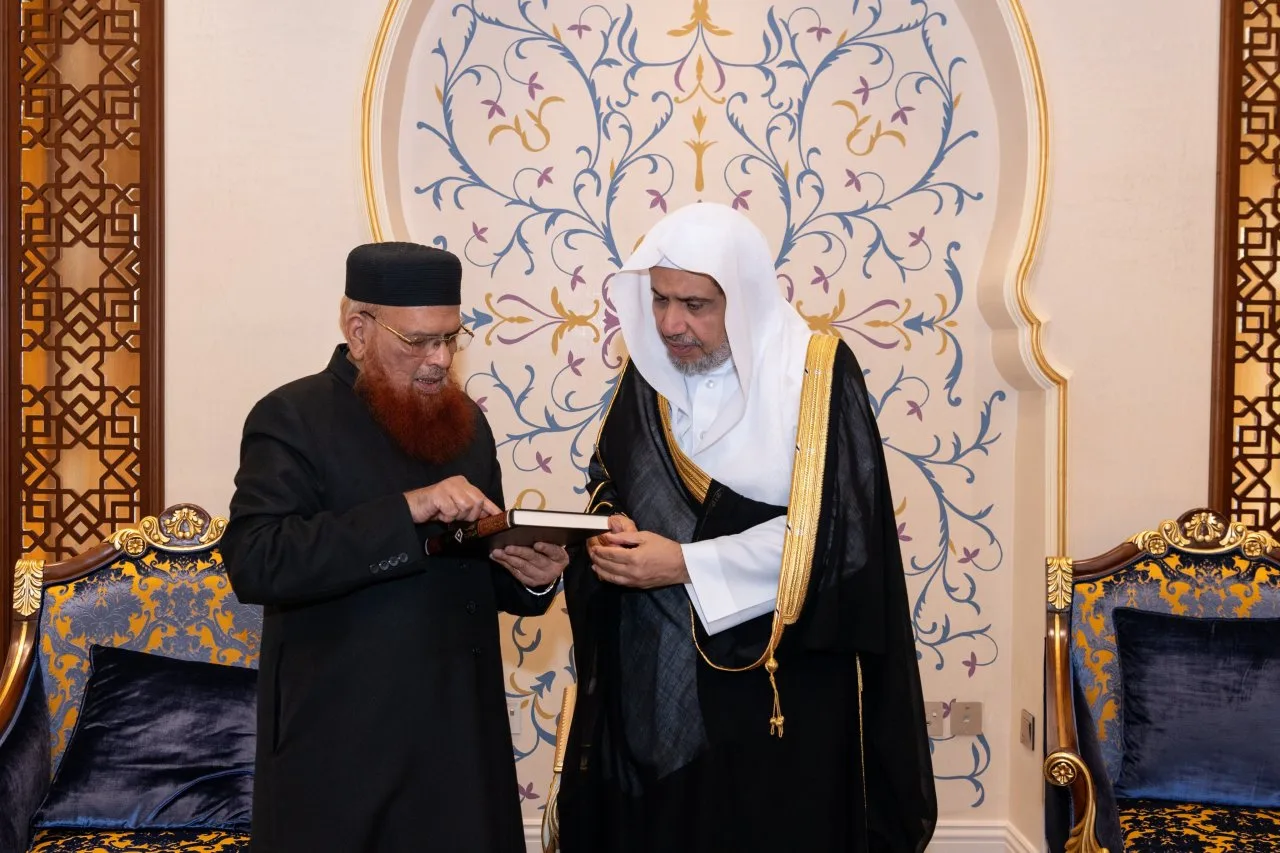
Muhammad Taqi Usmani (born 1943) is a Pakistani Hanafi jurist, teacher of hadith, and writer on Islamic law. He was trained at Darul Uloom Karachi, the seminary founded by his father Mufti Muhammad Shafi, and took further degrees in economics, politics, law and Arabic at the universities of Karachi and the Punjab. He has served on Pakistan's higher courts, has held office in several international bodies of Islamic jurisprudence, and has been among the most influential figures in the development of modern Islamic finance.
His career is of interest because of the combination it represents. Muhammad Qasim Zaman's study of the modern ulama uses him as a case in point when arguing against too tidy a division between political and apolitical religious scholars. Some classifications, Zaman notes, would place Taqi Usmani among the largely apolitical scholars devoted to the memory of Ashraf Ali Thanawi. But "in view of Taqi 'Uthmani's extensive discussion of how the state ought to implement Islamic law, it is hard to consider his work largely apolitical." What Zaman finds instead is "considerable ambivalence in his writings towards the large claims that the state can and does make on the religious sphere, and this is what sets the 'ulama apart from the Islamists" — while there is "little to suggest that politics itself is seen as suspect by such 'ulama."
Family and Background
He was born in 1943 at Deoband, in the Saharanpur district of what was then British India, into a family long established in religious scholarship. His full name is given as Muhammad Taqi Usmani, son of Muhammad Shafi al-Usmani, son of Yasin. His father was the head mufti of Darul Uloom Deoband and, from 1951, the founder and head of Darul Uloom Karachi. His elder brother is Muhammad Rafi Usmani, later president of the same institution.
The family moved to Pakistan after the partition of the subcontinent, and his education was therefore conducted in the institution his father built rather than the one in which his father had been formed.
Education
He began with the religious sciences studied in Persian and Urdu, and then entered Darul Uloom Karachi, where he read the shari'a sciences and graduated in 1959. He had obtained the Fadil Arabi certificate with distinction the previous year, in 1958, and in 1961 he completed the specialist qualification in the issuing of legal rulings, the takhassus fi al-ifta, at the same institution.
He then took a series of degrees in modern subjects. He obtained a bachelor's degree in economics and politics from the University of Karachi in 1964, a bachelor's degree in law from the same university in 1967, and a master's degree in Arabic with honours from the University of the Punjab in 1970.
This double formation is the key to his subsequent work. A seminary training in Hanafi law and a university training in economics and law are separately unremarkable; held together, they equipped him to address questions of contemporary finance in the technical vocabulary of the classical legal tradition, which is what much of his later career consisted of.
Teaching and Judicial Office
He has taught the Islamic sciences at Darul Uloom Karachi at the postgraduate levels, has held a professorship of hadith, and has supervised the specialist programmes in the issuing of rulings and in religious instruction. He served as vice-president of the institution.
He was appointed a judge of the Federal Shariat Court of Pakistan, serving from 1981 to 1982, and then sat on the Shariat Appellate Bench of the Supreme Court of Pakistan from 1982 to 2002 — a tenure of two decades on the highest court's bench for questions of Islamic law.
On the death of his brother Rafi Usmani in November 2022 he succeeded him as president of Darul Uloom Karachi, so that the seminary founded by their father has been led in turn by both of his sons.
International Bodies and Islamic Finance
Taqi Usmani has represented Pakistan at the International Islamic Fiqh Academy since 19 November 1984. He has also been a member of the Islamic Fiqh Academy of the Muslim World League and of the Aal al-Bayt Foundation of Islamic Thought.
His work in finance has been conducted largely through advisory boards. He has served on the shari'a supervisory board of the Islamic Development Bank at Jeddah, chaired the shari'a council of the Accounting and Auditing Organization for Islamic Financial Institutions in Bahrain — the body that sets the accounting and shari'a standards used across the Islamic finance industry — chaired the Islamic Economics Centre in Pakistan, and sat on the shari'a council of a financial group in the United States.
The nature of this work deserves explanation, because it is a genuinely modern development in the history of Islamic law. Classical Hanafi jurisprudence developed detailed rules governing sale, partnership, agency, lease and debt. Applying those rules to instruments such as bonds, mutual funds, insurance and securitisation requires deciding which classical category a modern instrument falls under, and that decision determines whether it is permissible. The boards on which Taqi Usmani has served exist to make such determinations, and his published work includes treatments of sukuk, the Islamic instrument analogous to a bond, and of tawarruq, a form of financing through commodity sale.
Writings
His output is very large. He is credited with some hundred and forty-three books in Arabic, English and Urdu.
His method of publication
Islam and Modernism, one of his own works held in this project's source library, explains in its foreword how much of that output came about. He had been writing for some twenty-seven years, at the time of that foreword, on the practical implementation of Islam and on new questions arising in different areas of life, and most of these articles appeared in the monthly journal Al-Balagh. A collection of them had been published in Urdu about seventeen years earlier under the title Asr-e-Hazir Mein Islam Kaisay Nafiz Ho? — "How is Islam to be implemented in the present age?" — running to some 750 pages. Zaman's bibliography records the same work.
Rather than enlarge that volume, he explains, he judged it better to sort the articles by subject and issue them separately, so that a reader interested in one field need not buy the whole. He accordingly rearranged them into nine Urdu collections: on the implementation of Islamic law and its problems; on Islam and contemporary politics; on Islam and modernism; on the education system; on the reform of individual conduct; on the life and message of the Prophet Muhammad (Peace Be Upon Him); on social reform; on the economic system; and a ninth on a question of doctrine. Islam and Modernism is the English version of the third of these, Islam aur Jiddat Pasandi.
This account is worth recording because it shows how a body of work of this size was assembled: not as a series of monographs but as journalism, written to occasion over decades and subsequently sorted into books. The chapters of Islam and Modernism accordingly treat separate topics — the demands of the age, the interpretation of Islam, science, and ijtihad, the exercise of independent legal reasoning — each originally an article rather than a section of a planned whole.
Principal works
| Work | Subject |
|---|---|
| Fath al-Mulhim (completion) | The Arabic commentary on Sahih Muslim begun by Shabbir Ahmad Usmani, which Taqi Usmani completed |
| Buhuth fi Qadaya Fiqhiyya Mu'asira | Studies on contemporary questions of law, published at Damascus in 1998 |
| Fiqh al-Buyu' | The law of sales across the four schools, with its contemporary applications |
| Ma'arif al-Qur'an (English translation) | His rendering into English of his father's Urdu commentary on the Qur'an |
| Usul al-Ifta wa Adabuhu | On the principles and proprieties of issuing legal rulings |
| Islah-i Mu'ashara | On social reform |
| Nuqush-i Raftagan | Biographical accounts, published at Deoband in 1994 |
| Akabir-e-Deoband Kya Thay | On the senior scholars of Deoband, translated as The Great Scholars of the Deoband Islamic Seminary |
The completion of Fath al-Mulhim connects him to the generation before his own. Shabbir Ahmad Usmani, his father's teacher at Deoband, had begun an Arabic commentary on Sahih Muslim and did not finish it; Taqi Usmani brought the work to completion, so that the commentary carries two authors separated by half a century and by the partition of the subcontinent.
Chains of Transmission
Taqi Usmani holds authorisation in hadith from Muhammad Zakariya Kandhlawi, the Shaykh al-Hadith of Mazahir Uloom Saharanpur. Such an authorisation, an ijaza, records that its holder has read hadith with the grantor and is entitled to transmit it onward, and it links him directly to the chain running back through Khalil Ahmad Saharanpuri and Rashid Ahmad Gangohi to the founding generation of the Deobandi school.
He also wrote the obituary of Abd al-Fattah Abu Ghudda, the Syrian hadith scholar and editor whose work brought South Asian scholarship before Arab readers, and whose own network of transmission Zaman describes as unusually wide.
Zaman notes that Taqi Usmani is "especially devoted to the memory of Ashraf 'Ali Thanawi", the scholar whose collected rulings his father edited and whose spiritual guidance the family had followed for two generations.
Recognition
He has received Pakistani state honours. His wider standing rests principally on his appointment to the international juristic bodies described above, on his two decades on the Shariat Appellate Bench, and on the circulation of his writing on law and finance among readers of Urdu, Arabic and English alike.
Historiographical Note
Two points should be recorded.
His date of birth. Sources agree on the year 1943 and on Deoband as the place. The day is given variously: some accounts give 3 October 1943, others 5 Shawwal 1362 AH, corresponding to 5 October 1943. The approved source consulted for this article gives only the year. This article follows it and does not assert a day.
The transliteration of his name. Zaman writes 'Uthmani; the family and most English-language sources write Usmani; French and some Arabic sources render it Uthmani or al-Usmani. All refer to the same name, and the variation is one of transliteration from Urdu and Arabic. The same applies to the given name, which appears as Taqi and as Taqī.
A third matter concerns the scope of this article. Taqi Usmani is a living scholar who has held public office and taken positions on questions of law and public policy over more than half a century, and a substantial body of commentary exists on those positions, written from various standpoints. This article records his training, his offices, his institutional roles and his writings, and reports the scholarly assessment of his work found in the academic source consulted. It does not attempt to adjudicate contemporary debates.
References and Further Reading
Primary Islamic Sources
- The Qur'an — the subject of his father's commentary, which he translated into English
- Sahih Muslim — the collection whose commentary Fath al-Mulhim he completed
- The canonical hadith collections, in which he holds authorisation from Muhammad Zakariya Kandhlawi and which he has taught at postgraduate level
- Islam and Modernism by Muhammad Taqi Usmani — his own collection of essays, including his treatment of ijtihad
Classical Islamic Sources
- The Hanafi school of law, in which he was trained and in which he issues rulings
- The classical law of contract — sale, partnership, agency, lease and debt — which forms the basis of his work on modern financial instruments
- Imdad al-fatawa by Ashraf Ali Thanawi, edited by his father, and the wider Hanafi fatwa literature
- The classical literature on usul al-ifta, the principles governing the issuing of legal rulings, the subject of one of his own works
Academic and Scholarly Sources
- The Ulama in Contemporary Islam: Custodians of Change by Muhammad Qasim Zaman — for his position at the Dar al-Ulum of Karachi, his relation to the classification of the ulama as political or apolitical, his writing on the state's implementation of Islamic law, his attachment to Ashraf Ali Thanawi, and his bibliography
- International Islamic Fiqh Academy, "His Excellency Sheikh Muhammad Taqi Usmani", https://iifa-aifi.org/en/48384.html — an approved source, consulted for his education, degrees, offices and institutional memberships
- Wikipedia, "Taqi Usmani", https://en.wikipedia.org/wiki/Taqi_Usmani — consulted with the owner's authorisation for his judicial tenures and the number of his published works
Further Reading
- Muhammad Taqi Usmani, The Great Scholars of the Deoband Islamic Seminary, translated by Abdul Rahim Qidawi (Turath Publishing, London, 2013) — his own account of the seminary's leading figures
- Muhammad Taqi Usmani, Buhuth fi Qadaya Fiqhiyya Mu'asira (Dar al-Qalam, Damascus, 1998) — his Arabic studies on contemporary legal questions
- Mufti Muhammad Shafi — his father, and the founder of Darul Uloom Karachi
- Muhammad Rafi Usmani — his elder brother
- Muhammad Zakariya Kandhlawi — the scholar from whom he holds authorisation in hadith
- The Deobandi Movement — the tradition in which he was trained
More from South Asian Islam
Ahmed Raza Khan Barelvi and the Barelvi Movement
Ahmed Raza Khan of Bareilly (1856-1921) was an Indian Hanafi jurist, Sufi of the Qadiri order and prolific writer whose defence of the veneration due to the Prophet and the saints gave rise to the movement known as Barelvi, whose adherents call themselves the ulama of the Ahl-i Sunnat wa Jamaat.
The Deobandi Movement
A school of Sunni thought and practice that grew from the seminary founded at Deoband in northern India in 1866 or 1867. Its scholars combined the roles of jurist and Sufi guide, built a madrasa funded by public subscription, and made hadith the centre of religious education.
The Jamaat-e-Islami
An organisation founded by Abul A'la Maududi at Lahore in August 1941 to form a disciplined body of Muslims who would remake society according to Islamic norms. After the partition of India it divided into separate and independent organisations in Pakistan, India and later Bangladesh.
The Tablighi Jamaat
A movement of lay religious preaching founded by Muhammad Ilyas Kandhlawi in the Mewat region of northern India in the 1920s. Built on short preaching tours undertaken by ordinary Muslims, it grew from one rural district into a presence across much of the Muslim world.