Shabbir Ahmad Usmani
A scholar of hadith and Qur'anic commentary, chancellor of Darul Uloom Deoband. He completed Mahmud Hasan's Qur'an glosses, began the Arabic commentary Fath al-Mulhim on Sahih Muslim, and led the Deobandi scholars who supported the creation of Pakistan.
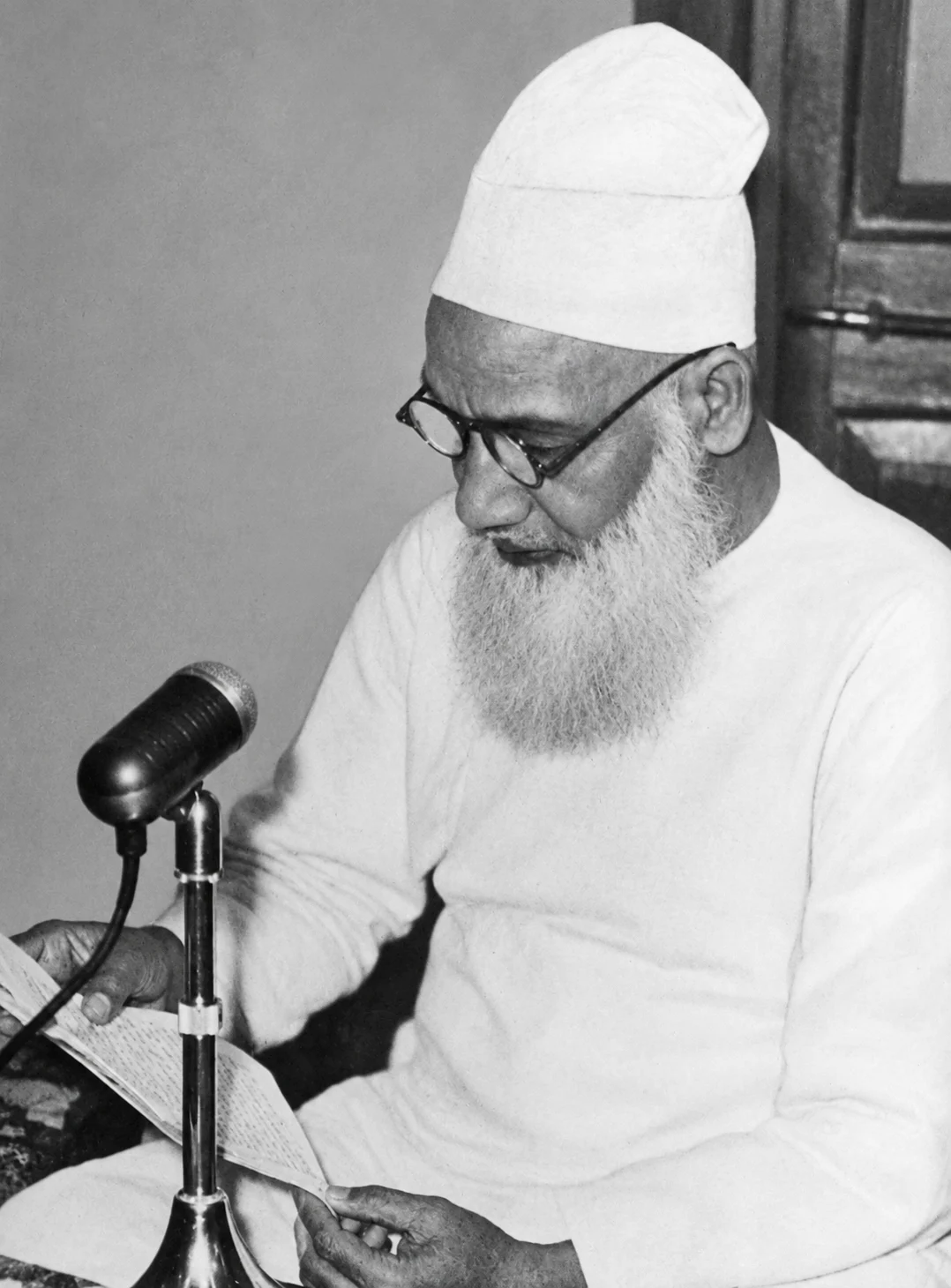
Shabbir Ahmad Usmani (1887 – 13 December 1949) was an Indian scholar of hadith and Qur'anic commentary, a teacher and then chancellor of Darul Uloom Deoband, and in the last decade of his life the leading figure among the Deobandi scholars who supported the creation of Pakistan. Barbara Metcalf's study of the Deobandi revival places him, with Anwar Shah Kashmiri and Hafiz Muhammad Ahmad, among the leaders of the third generation of ulama at the seminary — the generation taught by Mahmud Hasan Deobandi, whose students, his biographer records, numbered more than a thousand and came from as far as Kabul, Qandahar, Balkh, Bukhara, Mecca, Medina and Yemen.1
He was born at Bijnor in the United Provinces, the eldest son of a scholar, entered the Dar al-Ulum at Deoband in 1319 AH and graduated in 1907. After a short period as head-teacher of the Madrasa-e Fatehpuri in Delhi he was recalled to Deoband in 1910, and taught there for some twenty-five years; his lectures on Sahih Muslim were famous, and Sayyid Mahboob Rizvi's history preserves a reminiscence comparing his teaching circle with those of al-Ghazali and al-Razi. In the course of the seminary's long internal quarrel of the later 1920s he left for the Jamia-e Islamia at Dabhel in Gujarat, with Kashmiri and Mufti Aziz al-Rahman, becoming its professor of hadith on Kashmiri's death; and in 1935, at the instance of Ashraf Ali Thanvi and other elders, he returned to Deoband as its chancellor, holding that office until 1944 while keeping his connection with Dabhel.
His two best-known works were both continuations of other men's. He wrote the exegetical glosses on Mahmud Hasan's Urdu translation of the Qur'an, which his teacher had left unfinished at his death, and the pair is known as Tafsir-e-Usmani; and he began the Arabic commentary Fath al-Mulhim on Sahih Muslim, which Rizvi's history calls the first commentary on that collection from the Hanafi point of view, and which was in turn re-edited and completed by a three-volume supplement from Muhammad Taqi Usmani a generation later. In politics he was a member of the Khilafat Committee and for some years sat on the executive of the Jamiat Ulama-i-Hind, but broke with that body over the question of a single Indian nationality and its cooperation with the Congress, joined the Muslim League, and in 1946 was elected president of the Jamiat Ulama-e-Islam, the organisation founded to muster scholarly support for the demand for Pakistan. He migrated in 1947, sat in Pakistan's first Constituent Assembly, and died suddenly at Bahawalpur in December 1949. This article is drawn from the two dedicated memoirs of him in the second volume of Rizvi's institutional history — which survives in two separate printings used here as independent witnesses — together with Muhammad Qasim Zaman's study of the ulama in contemporary Islam, Metcalf's history of the seminary's early decades, and a further work in the approved library.
No dedicated encyclopaedia entry on him exists among the approved external web sources, and the sweep of all eighteen entries on the register found material at one only. The article accordingly rests on the PDF library, and its proportions follow what that library carries.
Family and birth
Rizvi's two notices agree that he was the eldest son of Maulana Fazl al-Rahman, himself a scholar.2 The second of them gives the birth precisely: he was born on the tenth of Muharram, 1305 AH, 1887, at Bijnor.3 Both record the same first step in his education, that at the age of seven he began on the Qur'an.4
Education
Rizvi's second notice gives the dates of his studentship at Deoband exactly: the date of his admission to the Dar al-Ulum was the tenth of Rabi al-Sani, 1319 AH, and of his graduation, 1325 AH, 1907.5 The first notice puts the same thing more generally, that he completed his education under the instruction of the teachers of the Dar al-Ulum in 1325 AH, 1907.6
Both notices record the relationship that shaped him. He was one of the most well-guided disciples of Shaykh al-Hind, Mahmud Hasan Deobandi, and owed spiritual allegiance to him as well.7 Metcalf's account of Mahmud Hasan's teaching supplies the scale on which that relationship stood: having completed his own education in 1873, Mahmud Hasan joined the staff of the school and for the next forty years was a dominating influence in its teaching and administration, a man of extraordinary energy who taught ten lessons a day; his fame was especially great in hadith, and in the course of his career he taught over a thousand students, among them Anwar Shah Kashmiri, Shabbir Ahmad Usmani and Hafiz Muhammad Ahmad, the leaders of the third generation of ulama at the school.8
Rizvi adds that Usmani had a deep insight into the sciences of Muhammad Qasim Nanautavi, one of the seminary's founders, whose intellectual tradition the Deoband teachers preserved.9
Teaching
Fatehpuri, and the recall to Deoband
After graduating he was appointed head-teacher of the Madrasa-e Fatehpuri at Delhi, and in 1328 AH, 1910, he was called from there to the Dar al-Ulum, where he taught various books to the higher classes over a long period.10
The lectures on Sahih Muslim
Rizvi records plainly that Maulana Usmani's lectures on Sahih Muslim had acquired great fame.11 The first volume of the history preserves a longer reminiscence of what the Dar al-Ulum was in those years, which is reproduced here as the recollection of a contemporary rather than as a description of the subject: the seminary was then a cradle of ulema who were the imams of their respective sciences; if on the one hand the teaching circle of Anwar Shah Kashmiri, the dean, was an example of the teaching circles of Ibn Hajar and of Nanautavi, on the other hand the teaching circle of Shabbir Ahmad Usmani reminded one of Imam al-Ghazali and of al-Razi.12
Dabhel
Rizvi's account of his departure from Deoband is brief and does not take sides: having rendered teaching services at the Dar al-Ulum for a long time, he went away, owing to certain dissents with the management, to the Jamia-e Islamia at Dabhel in the Surat district of Gujarat, along with Anwar Shah Kashmiri, Mufti Aziz al-Rahman and others.13 The quarrel itself is described in the first volume of the same history as a dissension that ran from about 1344 AH to 1347 AH, in the course of which Kashmiri resigned and the students struck twice.14
On Kashmiri's death in 1933 Usmani was appointed Shaykh al-Hadith, professor of hadith, at the Jamia-e Islamia at Dabhel.15 Rizvi records that he spoke at Kashmiri's funeral, giving a condolatory address.16
The association between the two men's work outlasted them both. Zaman's notes record a piece by Usmani, a kalima or prefatory word, printed with Muhammad Yusuf Banuri's introduction in the front matter of Kashmiri's own great commentary on Sahih al-Bukhari, Fayd al-Bari, in the Lahore edition of 1978 — so that the two Dabhel colleagues' principal works on the two most authoritative hadith collections carry each other's traces.17
Chancellor of Darul Uloom Deoband
His return to Deoband came by stages. The first volume of the history records that in the year before his appointment, during the vice-chancellor's absence on pilgrimage, Usmani had served as acting vice-chancellor; and that in 1354 AH the Majlis-e Shura, in view of his great personality and learning, selected him to preside over the management as chancellor.18 Rizvi's memoir gives the occasion differently and in terms of persuasion rather than selection: in 1354 AH, 1935, at the instruction of Ashraf Ali Thanvi and other elders, he came to the Dar al-Ulum and served it as chancellor until 1944, his connection with Dabhel continuing in the meantime.19
The arrangement was awkward from the start, and the history is candid about it. At the time of his appointment his permanent residence was still at Dabhel and he was not prepared to break off his relations there completely, so that at first he stayed alternately at Dabhel and at Deoband, until in the end the centrality of the Dar al-Ulum drew him to Deoband.20 The consequence for the institution is set out in the first volume's discussion of its administration: when Usmani was appointed chancellor the powers of the vice-chancellor in respect of safeguarding the Dar al-Ulum were transferred to the chancellor, but in practice the administration remained in the vice-chancellor's hands, because the chancellor stayed very little at Deoband — spending the major part of the year at Dabhel, where he had been appointed dean — so that every kind of responsibility and accountability devolved on the vice-chancellor alone.21 A footnote to the second volume records that throughout the chancellorship the vice-chancellor was Qari Muhammad Tayyib.22
Rizvi also records what he did with the office. Coming to the Dar al-Ulum as its chancellor, Usmani addressed a public gathering in which he set out the causes of the dissension and confusion that had divided the seminary, doing so, in the historian's judgement, in a very succinct manner, and opening with a simile drawn from the boiling and ferment of the sea.23
Writings
The glosses on Mahmud Hasan's translation of the Qur'an
Mahmud Hasan had begun an Urdu translation of the Qur'an in 1909 and finished it during his internment at Malta; the exegetical glosses he started afterwards were left incomplete at his death in 1920, and Usmani continued them. Rizvi records that Maulana Usmani's exegetical marginalia on Shaykh al-Hind's translation of the Holy Qur'an are very famous, and describes the manner of them: confining himself to the range of the predecessors' viewpoint, he annotated the subtle points of knowledge of the Qur'an in such a way that the difficulties rankling in thought and intellect are removed one after another.24
Rizvi records one measure of the work's reach beyond India: the Afghan government had the translation and the marginalia rendered into Persian, and sent a copy of that rendering as a gift to the Dar al-Ulum.25 The first volume of the history lists the work among the seminary's publications as Shaykh al-Hind's translation with scholia by Shabbir Ahmad Usmani Deobandi.26 The commentary circulates widely under the name Tafsir-e-Usmani: archive.org holds it both in volumes and surah by surah, with separate parts for Bani Israel, al-Ahzab, Sad, al-Zumar, al-Mu'min, al-Ahqaf, al-Rahman, al-Hashr, al-Mujadila and al-Najm among others.27
Fath al-Mulhim
His other major work was left unfinished in its turn. Rizvi's assessment of it is the strongest claim his memoir makes: in the science of hadith, his highly valuable Arabic work entitled Fath al-Mulhim is the first commentary on Sahih Muslim from the Hanafi point of view; it is the work that introduced his learning to the whole Islamic world, and for it Zahid al-Kawthari, together with other scholars of Egypt and of Syria, complimented him.28 The first volume lists it among the works of the seminary's men by its full title, Fath al-Mulhim Sharh-e Sahih-e Muslim, in Arabic.29
Zaman's study gives the bibliographical detail and the afterlife. The full title is Fath al-mulhim bi-sharh Sahih al-imam Muslim, and it is an Arabic commentary, first published in 1933, on the canonical hadith collection of Muslim b. al-Hajjaj, who died in 875.30 It was afterwards edited and reissued by Muhammad Taqi Usmani, vice-president of the Dar al-Ulum at Karachi, who also wrote an erudite three-volume takmila, or supplement, to complete the commentary Shabbir Ahmad had begun — a supplement which, Zaman observes, is really an independent work.31 Taqi Usmani's own account of why a new edition was needed is quoted by Zaman, and is a statement about the first edition's fate: the book, though well known among the scholars and students of the Indian subcontinent, had remained unknown elsewhere, the reason for the neglect being the small number of copies published, which disappeared within a few years, together with the lithographic print of the first edition, which does not accord with modern sensibilities.32
Zaman's notes supply the editions of both. He cites Fath al-Mulhim in the Karachi edition of the Maktaba-i Dar al-Ulum, 1989, and Taqi Usmani's Takmilat Fath al-Mulhim in three volumes from the same house, 1407 AH, 1986–87, observing that the second volume of the supplement carries long treatments of the Qur'anic penalties and of the judiciary.33 A further note records the standing the work came to hold among the Deobandi hadith commentaries: it is named, with Khalil Ahmad Saharanpuri's Badhl al-majhud on the Sunan of Abu Dawud and Muhammad Yahya Kandhlawi's Awjaz al-masalik on the Muwatta of Malik ibn Anas, among the modern Arabic works a later scholar proposed should be translated into Urdu.34
Zaman also examines a portion of the commentary itself, for what it shows about how works of the genre argue, and the passage he chooses bears directly on the politics described below. Where Husain Ahmad Madani's advocacy of united nationalism rested on the conviction that the Muslims as a whole comprise a single global community, an umma, which ought not to be divided into Muslim territorial states, Usmani appears in his commentary to follow the territorial conception of Hanafi law, treating political power as necessary to the preservation of Islamic culture and identity. Zaman notes that Usmani does not say so explicitly, but that his position implies that neither the worldwide Muslim community nor the existence of Muslim states elsewhere offers any guarantee for the survival of the Muslims in a Hindu-dominated India.35
Other works
Rizvi's memoir names five further works as his monumental ones.36
- Ilm al-Kalam, on the science of theology.
- Al-Aql wal-Naql, on reason and transmitted authority.
- Ijaz al-Quran, on the inimitability of the Qur'an.
- Hijab-e Shara'i, on the veil as the law prescribes it.
- Al-Shahab li-rajm al-Khatif al-Murtab.
Politics
The Khilafat movement and the Ottoman cause
Rizvi records that Usmani was an important member of the Khilafat Committee, and that during the Balkan war he took a very enthusiastic part in collecting funds for the Turks.37 The second volume's notice of another scholar shows him at the movement's public meetings from the beginning: that man, having a penchant for politics, began in 1919 to attend the functions of the Khilafat Movement along with Maulana Shabbir Ahmad Usmani.38
Mahmud Hasan's last address
One occasion of that period is recorded as a distinction. Rizvi writes that it was Maulana Usmani who received the honour of writing and reading the last address Shaykh al-Hind delivered, on the occasion of the founding of Jamia Millia Islamia, during his teacher's last days.39 Mahmud Hasan performed the opening of that university on 29 October 1920 and died a month afterwards.
The break with the Jamiat Ulama-i-Hind
Rizvi records that Usmani served as a member of the executive council of the Jamiat al-Ulama-e Hind for a number of years and was reckoned among the first-class leaders of that organisation of the ulema; but that later, on the question of the oneness of nationality and the Jamiat's cooperation with the Congress, he dissented from it and joined the Muslim League.40 The position he took is the one Zaman finds argued in his hadith commentary, and the two can be read together: the disagreement with Madani was not only about tactics but about whether political power over a territory is necessary to the survival of a religious community.
The Jamiat Ulama-e-Islam and the demand for Pakistan
In 1365 AH, 1946, Rizvi records, Usmani was elected president of the Jamiat al-Ulama-e Islam.41 Zaman gives the purpose for which that body existed: it was Shabbir Ahmad Usmani and the pro-Pakistan ulama who founded the Jam'iyyat al-Ulama-i Islam as a political party to muster support for the demand for Pakistan — a body which, unlike the Jamiat Ulama-i-Hind from which it had separated, supported that demand.42 Zaman names Ashraf Ali Thanvi and Usmani as the pro-Pakistan scholars whose followers were distinguished, in Seyyed Vali Reza Nasr's analysis, from those of Madani, who had opposed the demand for a separate Muslim state; and he names Zafar Ahmad Usmani, Thanvi's son-in-law and the author of the hadith commentary I'la al-sunan, as another leading pro-Pakistan figure who afterwards served as the organisation's national leader.43
Pakistan and the Objectives Resolution
Rizvi records that he went to Pakistan in Ramadan 1366 AH, 1947, before the partition of India, and settled there; that he was appointed a member of the Pakistan Constituent Assembly and president of the Constituent Committee; and that his academic and political services had a special influence on the paramount power in Pakistan, where he was held in particular esteem as a religious scholar and thinker, his political leadership being acknowledged alongside his religious guidance.44
Rizvi then makes a specific claim about the country's constitutional settlement: that the assurance given in the Objectives Resolution, presented by Liaquat Ali Khan in the Pakistan Constituent Assembly, to the effect that the constitution of Pakistan would be based on the Book and the Sunnah, was in fact due to Usmani's opportune attention and his struggle.45 Zaman, writing as a historian rather than as the seminary's chronicler, puts the same point without the attribution of credit: Shabbir Ahmad Usmani had himself played an influential role in the early debates on an Islamic constitution for the new state.46
A further work in the approved library records a speech of this period. In his presidential address to the Jamiat Ulama-e-Islam conference at Dacca on 10 February 1949, Usmani set out the policy of the Pakistani scholars, and is quoted as declaring:47
No matter what treatment we meet from those in authority, we shall leave no stone unturned to make this new country safe and strong for the pleasure of Allah and supremacy of Islam and believers of Islam.
Rizvi records one of his institutional acts in the new country: in Pakistan, Usmani entrusted Badr-e Alam Mirathi — a former Deoband man who had gone there after partition — with the work of establishing a Dar al-Ulum for the Islamic sciences, for which Mirathi prepared the programme and gathered teachers before leaving for Medina a few years later.48
Death
He died on a journey undertaken on another seminary's behalf. The Jamia-e Abbasiya at Bahawalpur was an old institution whose administrative and educational organisation had much deteriorated, and the Ministry of Education of the Bahawalpur State asked Usmani to come and give his opinion for its improvement. He went; and while the discussion with the ministry had only just begun, he died suddenly, after an illness of a few hours, on the twenty-first of Safar 1369 AH, 13 December 1949. The bier was taken from Bahawalpur to Karachi, and he was buried at his residence near Muhammad Ali Road.49
Assessments
Rizvi's summary places him among a small number: as regards knowledge and learning, intelligence and discernment, and statesmanship and soundness of judgement, Usmani was reckoned among the few outstanding ulema of India. He had equal mastery of tongue and pen; he was a high-ranking man of letters in Urdu and a powerful orator, and both his writings and his speeches were valued for their eloquence and succinctness, the clarity of their arguments and their apt similes; he had a close grasp of current affairs, and his writing and speaking were accordingly appreciated by learned and unlearned alike.50
The seminary's own report for 1333 AH, written when he was a young teacher, is quoted in the same memoir, and is reproduced here as the judgement of his institution at the time rather than as a description of the subject:51
Maulavi Shabbir Ahmed Sahib, as Allah willed, is one of those educated young men who can be called the repository of the sciences of the elders. He has had complete proficiency in all the rational and the traditional sciences, and is unrivalled in writing and speaking; in the science of Hadith particularly he has such consummate mastery which is generally had by aged and experienced professors of Hadith.
A further work in the approved library, written with an avowed admiration for its subject that is not carried into this article, records him as the most renowned of the religious scholars in Pakistan.52
Historiographical Note
The approved base for this article is a single institutional history in two printings, supplemented by two scholarly studies, and most of the divergences below are internal to that history — the same events dated differently in two of its own passages. They are recorded rather than silently harmonised, because a reader who goes to the printed volumes will meet them.
Hijri and Common Era years that do not correspond
Three dates in Rizvi's memoirs pair a Hijri year with a Common Era year that does not convert to it. In each case the Common Era year is corroborated elsewhere and is the one followed here.
| Passage | As printed | Followed here | Why |
|---|---|---|---|
| Anwar Shah Kashmiri's death, after which Usmani became Shaykh al-Hadith at Dabhel | "1359/1933" | 1933 | 1359 AH falls in 1940. The same history dates Kashmiri's death to 3 Safar 1352, which is 1933, and the TDV İslâm Ansiklopedisi gives 1933 independently. |
| The end of the chancellorship, in the first memoir | "1362/1944" | 1944 | 1362 AH falls in 1943. |
| The end of the chancellorship, in the footnote to the second memoir | "1369/1944" | 1944 | 1369 AH falls in 1949–50, the year of his death. Both passages agree on 1944. |
The year he came to Deoband as chancellor
The first volume of the history gives 1354 AH in two places — in the account of his selection by the Majlis-e Shura and in the discussion of the chancellor's powers — and Rizvi's memoir agrees, giving 1354 AH and 1935 together. A third passage in the first volume, introducing his public address on the seminary's quarrel, gives 1355 AH. The article follows 1354 AH, 1935, as the reading of three passages against one.
The Balkan war
Rizvi's memoir dates his fund-raising for the Turks to 1333 AH, which falls in 1914–15, and places it "during the Balkan war". The Balkan wars were fought in 1912 and 1913. The article therefore reports the activity and its purpose, which the source establishes, without asserting the year.
His office at Dabhel
The memoir has him appointed Shaykh al-Hadith at the Jamia-e Islamia at Dabhel on Kashmiri's death, while the first volume's discussion of the Deoband administration describes him as having been appointed dean there. No attempt is made here to decide whether these were the same office under two names or two offices held in succession; both are recorded as the history gives them.
See also
- Mahmud Hasan Deobandi — his teacher, whose Qur'an translation he glossed and whose last address he wrote and read
- Anwar Shah Kashmiri — with whom he left Deoband for Dabhel, and whom he succeeded there as professor of hadith
- Darul Uloom Deoband — the seminary he studied at, taught at for some twenty-five years, and led as chancellor from 1935
- The Deobandi movement — the tradition and the organisations in which he worked
- Mufti Kifayatullah Dehlawi — his contemporary on the Jamiat Ulama-i-Hind, who took the opposite side on nationality
- Husain Ahmad Madani — whose doctrine of united nationalism he opposed
- Jamia Millia Islamia — at whose founding Mahmud Hasan's last address, written by Usmani, was read
- Imam Muslim — compiler of the collection on which Fath al-Mulhim comments
References
Citations
Footnotes
-
Metcalf, Islamic Revival in British India: Deoband, 1860–1900 — Usmani's place with Anwar Shah Kashmiri and Hafiz Muhammad Ahmad among the leaders of the third generation of ulama at the school, and the more than a thousand students Mahmud Hasan taught, from Kabul, Qandahar, Balkh, Bukhara, Mecca, Medina and Yemen. ↩
-
Rizvi, History of the Dar al-Ulum Deoband, vol. 2 — both notices give him as the eldest son of Maulana Fazl al-Rahman. ↩
-
Rizvi, History of the Dar al-Ulum Deoband, vol. 2, the second notice — his birth on 10 Muharram 1305 AH, 1887, at Bijnor. ↩
-
Rizvi, History of the Dar al-Ulum Deoband, vol. 2 — that at the age of seven he began on the Qur'an. ↩
-
Rizvi, History of the Dar al-Ulum Deoband, vol. 2, the second notice — admission to the Dar al-Ulum on 10 Rabi al-Sani 1319 AH, and graduation in 1325 AH, 1907. ↩
-
Rizvi, History of the Dar al-Ulum Deoband, vol. 2, the first notice — the completion of his education under the Dar al-Ulum's teachers in 1325 AH, 1907. ↩
-
Rizvi, History of the Dar al-Ulum Deoband, vol. 2 — that he was among the most well-guided disciples of Shaykh al-Hind and owed spiritual allegiance to him. ↩
-
Metcalf, Islamic Revival in British India — Mahmud Hasan's completion of his education in 1873, his forty years of dominating influence in the school's teaching and administration, his ten lessons a day, his fame in hadith, and the students he taught. ↩
-
Rizvi, History of the Dar al-Ulum Deoband, vol. 2 — his deep insight into Muhammad Qasim Nanautavi's sciences. ↩
-
Rizvi, History of the Dar al-Ulum Deoband, vol. 2 — his appointment as head-teacher at the Madrasa-e Fatehpuri in Delhi, and his recall to the Dar al-Ulum in 1328 AH, 1910, to teach the higher classes. ↩
-
Rizvi, History of the Dar al-Ulum Deoband, vol. 2 — the fame of his lectures on Sahih Muslim. ↩
-
Rizvi, History of the Dar al-Ulum Deoband, vol. 1 — the quoted recollection of the seminary in those years, comparing Kashmiri's teaching circle with those of Ibn Hajar and Nanautavi and Usmani's with those of al-Ghazali and al-Razi. ↩
-
Rizvi, History of the Dar al-Ulum Deoband, vol. 2 — his departure for the Jamia-e Islamia at Dabhel, owing to certain dissents with the management, together with Anwar Shah Kashmiri, Mufti Aziz al-Rahman and others. ↩
-
Rizvi, History of the Dar al-Ulum Deoband, vol. 1 — the dissension at the Dar al-Ulum from about 1344 to 1347 AH, Kashmiri's resignation, and the two student strikes. ↩
-
Rizvi, History of the Dar al-Ulum Deoband, vol. 2 — his appointment as Shaykh al-Hadith at the Jamia-e Islamia, Dabhel, on Kashmiri's death. The Hijri year printed there does not match the Common Era year; see the Historiographical Note. ↩
-
Rizvi, History of the Dar al-Ulum Deoband, vol. 2 — the condolatory speech he gave on Kashmiri's death. ↩
-
Zaman, The Ulama in Contemporary Islam, notes to chapter 2 — Shabbir Ahmad Usmani's "Kalima li-muhaqqiq al-asr al-ustadh al-muhaddith al-shaykh Shabbir Ahmad al-Uthmani", appended to Banuri's "Muqaddima" in Anwar Shah Kashmiri, Fayd al-Bari ala Sahih al-Bukhari (Lahore: al-Matba'a al-Islamiyya al-Sa'udiyya, 1978), vol. 1. ↩
-
Rizvi, History of the Dar al-Ulum Deoband, vol. 1 — his service as acting vice-chancellor during the vice-chancellor's pilgrimage, and the Majlis-e Shura's selection of him as chancellor in 1354 AH in view of his personality and learning. ↩
-
Rizvi, History of the Dar al-Ulum Deoband, vol. 2 — his coming to the Dar al-Ulum in 1354 AH, 1935, at the instruction of Ashraf Ali Thanvi and other elders, and his service as chancellor until 1944 while his connection with Dabhel continued. ↩
-
Rizvi, History of the Dar al-Ulum Deoband, vol. 1 — that his permanent residence was at Dabhel, that he would not break off his relations there, that he at first divided his time between the two places, and that the centrality of the Dar al-Ulum drew him to Deoband in the end. ↩
-
Rizvi, History of the Dar al-Ulum Deoband, vol. 1 — the transfer of the vice-chancellor's safeguarding powers to the chancellor on Usmani's appointment, the administration remaining in practice with the vice-chancellor, and the reason: that the chancellor stayed very little at Deoband, spending most of the year at Dabhel where he had been appointed dean. ↩
-
Rizvi, History of the Dar al-Ulum Deoband, vol. 2, the footnote to the second notice — that Qari Muhammad Tayyib was vice-chancellor throughout Usmani's chancellorship. ↩
-
Rizvi, History of the Dar al-Ulum Deoband, vol. 1 — the public address in which, on coming to the Dar al-Ulum as chancellor, Usmani set out the causes of the dissension, opening with a simile drawn from the sea. ↩
-
Rizvi, History of the Dar al-Ulum Deoband, vol. 2 — the fame of his exegetical marginalia on Mahmud Hasan's translation of the Qur'an, and his method of confining himself to the predecessors' viewpoint. ↩
-
Rizvi, History of the Dar al-Ulum Deoband, vol. 2 — the Afghan government's Persian rendering of the translation and marginalia, and the copy sent as a gift to the Dar al-Ulum. ↩
-
Rizvi, History of the Dar al-Ulum Deoband, vol. 1 — the work listed as Shaykh al-Hind's translation with scholia by Shabbir Ahmad Usmani Deobandi. ↩
-
archive.org, register entry 12 — copies of Tafsir-e-Usmani held in volumes and surah by surah, consulted to confirm the work's circulation and attribution. ↩
-
Rizvi, History of the Dar al-Ulum Deoband, vol. 2 — Fath al-Mulhim as the first commentary on Sahih Muslim from the Hanafi point of view, as the work that introduced his learning to the Islamic world, and as having drawn the compliments of Zahid al-Kawthari and other scholars of Egypt and Syria. ↩
-
Rizvi, History of the Dar al-Ulum Deoband, vol. 1 — the work listed by its full title, Fath al-Mulhim Sharh-e Sahih-e Muslim, in Arabic. ↩
-
Zaman, The Ulama in Contemporary Islam — the full title, the first publication in 1933, and the collection of Muslim b. al-Hajjaj (d. 875) on which it comments. ↩
-
Zaman, The Ulama in Contemporary Islam — Muhammad Taqi Usmani's re-edition of the commentary and his three-volume takmila completing it, and the observation that the supplement is really an independent work. ↩
-
Zaman, The Ulama in Contemporary Islam — Taqi Usmani's quoted account of why a new edition was needed: the book's obscurity outside the subcontinent, the small number of copies published and their disappearance, and the lithographic print of the first edition. ↩
-
Zaman, The Ulama in Contemporary Islam, notes to chapter 2 — Fath al-mulhim bi-sharh Sahih al-imam Muslim (Karachi: Maktaba-i Dar al-Ulum, 1989), and Muhammad Taqi Usmani, Takmilat Fath al-Mulhim, 3 vols. (Karachi: Maktaba-i Dar al-Ulum, 1407 AH / 1986–87), with the note that volume 2 of the supplement treats the hudud and the judiciary at length. ↩
-
Zaman, The Ulama in Contemporary Islam — Fath al-Mulhim named, with Saharanpuri's Badhl al-majhud and Kandhlawi's Awjaz al-masalik, among the modern Arabic works proposed for translation into Urdu. ↩
-
Zaman, The Ulama in Contemporary Islam — the contrast drawn between Madani's premise of a single global umma not to be divided into territorial states and Usmani's apparent following of the territorial conception of Hanafi law, with the implication Zaman reads from it. ↩
-
Rizvi, History of the Dar al-Ulum Deoband, vol. 2 — the five works named there as his monumental ones. ↩
-
Rizvi, History of the Dar al-Ulum Deoband, vol. 2 — his membership of the Khilafat Committee and his part in collecting funds for the Turks during the Balkan war. On the year printed there, see the Historiographical Note. ↩
-
Rizvi, History of the Dar al-Ulum Deoband, vol. 2 — the notice of a colleague who began attending the functions of the Khilafat Movement in 1919 along with Usmani. ↩
-
Rizvi, History of the Dar al-Ulum Deoband, vol. 2 — that Usmani wrote and read the last address Shaykh al-Hind delivered, at the founding of Jamia Millia Islamia. ↩
-
Rizvi, History of the Dar al-Ulum Deoband, vol. 2 — his years on the executive council of the Jamiat al-Ulama-e Hind, his standing among its leaders, and his dissent from it over the oneness of nationality and its cooperation with the Congress, followed by his joining the Muslim League. ↩
-
Rizvi, History of the Dar al-Ulum Deoband, vol. 2 — his election as president of the Jamiat al-Ulama-e Islam in 1365 AH, 1946. ↩
-
Zaman, The Ulama in Contemporary Islam — the founding of the Jam'iyyat al-Ulama-i Islam by Usmani and the pro-Pakistan ulama as a political party to muster support for the demand for Pakistan, and its support for that demand unlike the body from which it separated. ↩
-
Zaman, The Ulama in Contemporary Islam — Ashraf Ali Thanvi and Usmani named as the pro-Pakistan ulama in Nasr's grouping, the contrast with Madani's followers, and Zafar Ahmad Usmani as another leading pro-Pakistan figure and later national leader of the organisation. ↩
-
Rizvi, History of the Dar al-Ulum Deoband, vol. 2 — his migration in Ramadan 1366 AH, 1947, his membership of the Pakistan Constituent Assembly and presidency of the Constituent Committee, and the standing he held in the new state. ↩
-
Rizvi, History of the Dar al-Ulum Deoband, vol. 2 — the claim that the assurance in the Objectives Resolution presented by Liaquat Ali Khan, that the constitution would be based on the Book and the Sunnah, was due to Usmani's attention and struggle. ↩
-
Zaman, The Ulama in Contemporary Islam — that Usmani played an influential role in the early debates on an Islamic constitution for the new state. ↩
-
Islam and Modernism — the passage quoted from his presidential address to the Jamiat Ulama-e-Islam conference at Dacca on 10 February 1949. ↩
-
Rizvi, History of the Dar al-Ulum Deoband, vol. 2 — the notice of Badr-e Alam Mirathi, whom Usmani entrusted in Pakistan with establishing a Dar al-Ulum for the Islamic sciences, and who prepared its programme and gathered teachers before leaving for Medina. ↩
-
Rizvi, History of the Dar al-Ulum Deoband, vol. 2 — the Bahawalpur State Ministry of Education's request concerning the Jamia-e Abbasiya, his journey there, his sudden death after a few hours' illness on 21 Safar 1369 AH, 13 December 1949, and his burial at Karachi. ↩
-
Rizvi, History of the Dar al-Ulum Deoband, vol. 2 — his standing among the few outstanding ulema of India, his mastery of tongue and pen, his Urdu letters and oratory, and his grasp of current affairs. ↩
-
Rizvi, History of the Dar al-Ulum Deoband, vol. 2 — the seminary's report for 1333 AH on him, quoted there. ↩
-
Islam and Modernism — its description of him as the most renowned of the religious scholars in Pakistan. Only the factual content of that work is taken here; its evaluative framing is not. ↩
Sources
Primary sources. His own works, as named and described by the sources consulted.
- Shabbir Ahmad Usmani, Fath al-Mulhim bi-sharh Sahih al-imam Muslim — Arabic commentary on Sahih Muslim, first published 1933. Karachi: Maktaba-i Dar al-Ulum, 1989; re-edited, and completed by a three-volume takmila, by Muhammad Taqi Usmani.
- Shabbir Ahmad Usmani, "Kalima li-muhaqqiq al-asr al-ustadh al-muhaddith al-shaykh Shabbir Ahmad al-Uthmani", printed with Muhammad Yusuf Banuri's introduction to Anwar Shah Kashmiri, Fayd al-Bari ala Sahih al-Bukhari. Lahore: al-Matba'a al-Islamiyya al-Sa'udiyya, 1978, volume 1.
- Tafsir-e-Usmani — the exegetical glosses on Mahmud Hasan Deobandi's Urdu translation of the Qur'an, continued by Usmani after his teacher's death; translated into Persian at the instance of the Afghan government.
- Shabbir Ahmad Usmani, Ilm al-Kalam; Al-Aql wal-Naql; Ijaz al-Quran; Hijab-e Shara'i; Al-Shahab li-rajm al-Khatif al-Murtab.
- Shabbir Ahmad Usmani, presidential address to the Jamiat Ulama-e-Islam conference, Dacca, 10 February 1949 — quoted in Islam and Modernism.
Academic and scholarly sources.
- Sayyid Mahboob Rizvi, History of the Dar al-Ulum Deoband, Volumes 1 and 2, translated by Murtaz Husain F. Quraishi — the two dedicated memoirs of him, and the account of the seminary's administration under his chancellorship.
- The History of Deoband, Volumes 1 and 2 — an independent printing of the same text, used here as a second witness.
- Muhammad Qasim Zaman, The Ulama in Contemporary Islam: Custodians of Change.
- Barbara Daly Metcalf, Islamic Revival in British India: Deoband, 1860–1900.
- Islam and Modernism — used for the Dacca address of 1949 that it quotes. The work is written with an avowed admiration for its subject, and under the rule on sources written with a slant only its factual content is taken.
Works named by the sources but not consulted. Listed so that the chain of attribution can be followed.
- Muhammad Taqi Usmani, Takmilat Fath al-Mulhim, 3 volumes. Karachi: Maktaba-i Dar al-Ulum, 1407 AH / 1986–87 — the supplement completing the commentary, described in Zaman's study.
- Khalil Ahmad Saharanpuri, Badhl al-majhud, and Muhammad Yahya Kandhlawi, Awjaz al-masalik — the two commentaries with which Zaman's source groups Fath al-Mulhim.
- Zafar Ahmad Usmani, I'la al-sunan — named by Zaman in the same connection.
- Seyyed Vali Reza Nasr's study of sectarianism in contemporary Pakistan, whose grouping of the Deobandi ulama Zaman examines and qualifies.
No approved external web source carries a dedicated treatment of him. All eighteen entries on the register were worked through: entry 12, archive.org, yielded the Tafsir-e-Usmani corpus and is cited above; the other seventeen returned nothing on the subject. In particular the TDV İslâm Ansiklopedisi, which supplies the spine of most articles on this period, has no entry for him.
Further reading
Offered to the reader for further study. Nothing in this article rests on the works below.
- Muhammad Taqi Usmani's edition of Fath al-Mulhim, with his three-volume takmila — for a reader who wishes to see how the commentary was completed and what the completion reveals about the period in which it was written.
- Seyyed Vali Reza Nasr, on the Deobandi ulama and sectarian politics in Pakistan — the study whose categories Zaman discusses.
External links
Approved sources only, each with its number on the Register of Approved External Web Sources.
- Tafsir-e-Usmani — archive.org, register entry 12: the commentary held in volumes and surah by surah
Mentioned In
10 articles reference this topic
More from South Asian Islam
Darul Uloom Deoband: The Seminary and the School of Thought
Darul Uloom Deoband is an Islamic seminary founded in northern India in 1866 or 1867 and the origin of the Deobandi school of thought. Its innovation was institutional: it carried the traditional religious sciences in the form of a modern school funded by public subscription.
The Ahl-i Hadis Movement
A nineteenth-century Indian Sunni movement that set aside the authority of the historic schools of law in favour of direct recourse to the Qur'an and hadith. Led by scholars at Delhi and Bhopal, it was marked by its manner of prayer and an austere standard of interpretation.
The Deobandi Movement
A school of Sunni thought and practice that grew from the seminary founded at Deoband in northern India in 1866 or 1867. Its scholars combined the roles of jurist and Sufi guide, built a madrasa funded by public subscription, and made hadith the centre of religious education.
The Tablighi Jamaat
A movement of lay religious preaching founded by Muhammad Ilyas Kandhlawi in the Mewat region of northern India in the 1920s. Built on short preaching tours undertaken by ordinary Muslims, it grew from one rural district into a presence across much of the Muslim world.