Muhammad Rafi Usmani
A Pakistani Hanafi jurist who led Darul Uloom Karachi as its president from 1986 until his death in 2022. Titled Grand Mufti, he served on Pakistan's Council of Islamic Ideology and wrote on zakat, on Hanafi law, and on the hadith commentary Fath al-Mulhim.
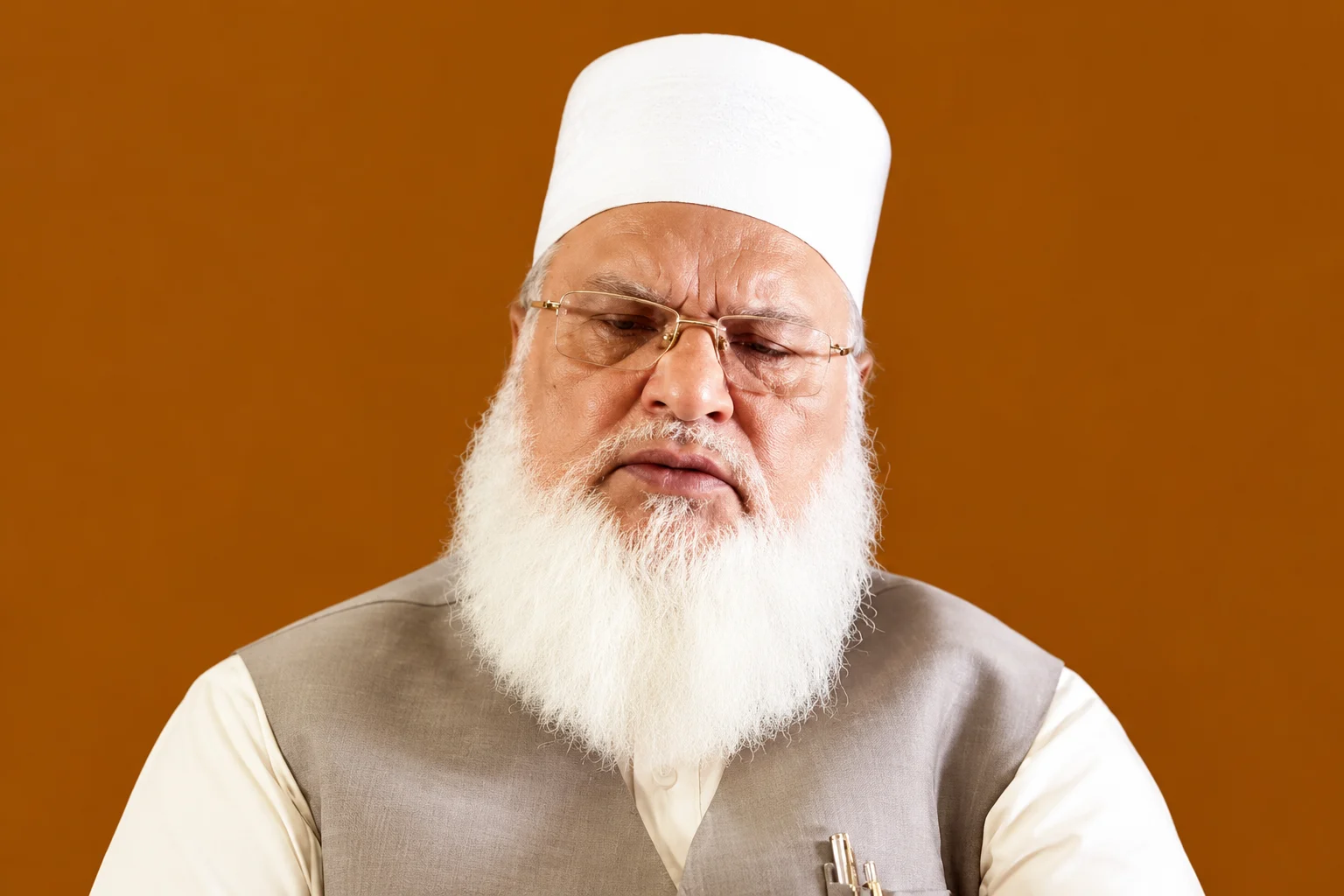
Muhammad Rafi Usmani (21 July 1936 – 18 November 2022) was a Pakistani Hanafi jurist who served as president of Darul Uloom Karachi from 1986 until his death, a tenure of thirty-six years. He held the title of Grand Mufti, sat on Pakistan's Council of Islamic Ideology and several other national bodies, and wrote on zakat, on questions of Hanafi law, and on the hadith commentary Fath al-Mulhim. He was the elder son of Mufti Muhammad Shafi, the seminary's founder, and the elder brother of Muhammad Taqi Usmani.
Muhammad Qasim Zaman's study of the modern ulama treats him as a particularly instructive case. Rafi Usmani is, Zaman writes, "an even more striking illustration of the difficulty of neat categorizations between the political and the apolitical 'ulama" than his younger brother. The reasoning is set out below, and it turns on the observation that a scholar may hold back from electoral politics while pursuing an end that is unmistakably political.
Family and Early Life
Rafi Usmani was born on 21 July 1936 at Deoband, in the United Provinces of British India, into the Usmani family of the town. He was given the name Muhammad Rafi by Ashraf Ali Thanawi, the scholar whose collected legal rulings his father later edited and whose spiritual guidance the family followed across two generations.
His father, Muhammad Shafi, was then head mufti of Darul Uloom Deoband and would afterwards found Darul Uloom Karachi. His younger brother, Muhammad Taqi Usmani, was born in 1943.
He began memorising the Qur'an at Darul Uloom Deoband, completing about half of it there, and migrated to Pakistan on 1 May 1948. He finished his memorisation at a mosque in the Aram Bagh quarter of Karachi.
Education
He entered Darul Uloom Karachi in 1951 — the year his father founded it — and graduated in the Dars-i Nizami curriculum in 1960. He passed the molvi and munshi examinations of the University of the Punjab in 1378 AH, and completed the specialist qualification in the issuing of legal rulings, takhassus fi al-ifta, at Darul Uloom Karachi in 1960.
His teachers in the final year of hadith are recorded individually, which gives an unusually clear picture of how the dawra was distributed among a seminary's staff. He read Sahih al-Bukhari with Rashid Ahmad Ludhianvi, Sahih Muslim with Akbar Ali Saharanpuri, the Muwatta in Muhammad al-Shaybani's transmission and the Sunan of al-Nasa'i with Sahban Mahmud, the Sunan of Abu Dawud with Ri'ayatullah, and the Jami of al-Tirmidhi with Salimullah Khan. He read part of the Sunan of Ibn Maja with Muhammad Haqiq and completed it with Ri'ayatullah.
He held authorisation to transmit hadith from a notably wide group of scholars: Hasan ibn Muhammad al-Mashat, Muhammad Idris Kandhlawi, his own father Muhammad Shafi, Qari Muhammad Tayyib of Deoband, Muhammad Zakariya Kandhlawi, and Zafar Ahmad Usmani. Several of these chains ran back through Khalil Ahmad Saharanpuri and Rashid Ahmad Gangohi to the founding generation of the Deobandi school, and one, through al-Mashat, into the scholarly tradition of Mecca.
Teaching and the Presidency of Darul Uloom Karachi
He taught the full range of the Dars-i Nizami curriculum at Darul Uloom Karachi through the 1360s and 1370s of the Hijri calendar, corresponding to the 1960s, and from 1391 AH, about 1971, concentrated on the hadith sciences.
On the death of Abdul Hai Arifi in 1986 he succeeded to the presidency of the seminary, becoming its third head after Arifi and his own father. He held the office until his death in November 2022, when he was succeeded by his brother Taqi Usmani.
Public Offices
Rafi Usmani held a considerable number of appointments in Pakistani public life. He was a member of the Council of Islamic Ideology, the constitutional body advising on the conformity of legislation with Islamic injunctions; of the All Pakistan Ulema Council; of the Ruet-e-Hilal Committee, which determines the sighting of the new moon for the religious calendar; and of the Zakat Council of the Government of Sindh. He served as an adviser to the Shariat Appellate Bench of the Supreme Court of Pakistan, on which his brother sat as a judge.
He was also a syndicate member of the University of Karachi and of the NED University of Engineering and Technology — appointments that placed a seminary head on the governing bodies of secular universities, including a technical one.
Within the seminary sector he served on the examinations committee and the executive council of Wifaq-ul-Madaris, the federation coordinating the independent religious schools of Pakistan, was its vice-president from 5 October 2017 to 16 June 2021, and afterwards its patron.
The Madrasa, Politics and Islamisation from Below
Zaman's analysis of Rafi Usmani's position is the fullest scholarly treatment available, and it rests on three elements of his thought.
The first is his conception of the madrasa. Rafi Usmani described the seminary as a miniature Islamic society and state — that is, as a community already ordered according to the norms it taught, and therefore as a demonstration in small of what was being argued for in general. Zaman's wider study emphasises the ulama's insistence that the madrasa constituted a distinct sphere to be protected from the encroachment of the state, and Rafi Usmani's formulation gives that insistence a positive form.
The second is his reserve about electoral politics.
The third is his argument that the ulama should apply themselves with greater energy to what Zaman terms Islamisation from below — the reform of society through preaching, teaching and institution-building rather than through the capture of the state.
Taken together, Zaman notes, these "might suggest an apolitical vision." His conclusion is that they do not: "misgivings about electoral politics do not necessarily signify an apolitical stance; and the grass-roots activism that Rafi' 'Uthmani recommends is itself a means towards gradually gaining enough leverage for the 'ulama to act as a force in national politics." The end is political even where the method is not electoral, and Zaman's broader argument — that the activities of the contemporary ulama "are more accurately ranged along a broad spectrum of options and possibilities... than they are fixed in mutually exclusive or dichotomous groupings" — rests substantially on cases of this kind.
Rafi Usmani set out his views on the relation between religious bodies and contemporary politics in Dini Jama'atain awr Mawjuda Siyasat, published at Karachi in 1996.
Writings
| Work | Subject |
|---|---|
| Ahkam-i Zakat | The rules governing zakat |
| al-Ta'liqat al-Nafi'a ala Fath al-Mulhim | Annotations on Fath al-Mulhim, the Arabic commentary on Sahih Muslim |
| Nawadir al-Fiqh | Uncommon and difficult questions of law |
| Dini Jama'atain awr Mawjuda Siyasat | Religious organisations and contemporary politics, Karachi, 1996 |
| Ye Tere Pur-Asrar Bande | An account of his travels in Afghanistan, serialised from 1988 to 1991 and later issued as a book |
His work on Fath al-Mulhim is worth noting alongside his brother's. Shabbir Ahmad Usmani, their father's teacher at Deoband, had begun an Arabic commentary on Sahih Muslim and left it unfinished. Taqi Usmani completed it; Rafi Usmani wrote annotations upon it. Both brothers thus worked on the same text of the preceding generation, from different directions.
He also wrote a treatise on a contested question of public law concerning the headship of state, a subject on which he set out the juristic arguments at length.
Between 1988 and 1991 he published an account of journeys in Afghanistan during the Soviet occupation, serialised in Al-Balagh, the Urdu monthly of Darul Uloom Karachi, and in other periodicals, and subsequently collected as a book. Zaman records that he travelled to the country during the conflict and afterwards wrote a detailed account of it.
Death
Rafi Usmani died at Karachi on 18 November 2022, at the age of eighty-six, and is buried in the cemetery of Darul Uloom Karachi. The presidency of the seminary passed to his brother.
Historiographical Note
The transliteration of the family name varies. Zaman writes 'Uthmani; the family and most English sources write Usmani. His given name appears as Rafi and as Rafi'. All refer to the same person, and the differences are of transliteration from Urdu and Arabic.
On the scope of this article: Rafi Usmani was a public figure in Pakistan for more than half a century, and he took positions on questions of law and public affairs that have been discussed from various standpoints. This article records his training, his teaching, his offices and his writings, and reports the scholarly analysis of his position found in the academic source consulted. It does not attempt to adjudicate contemporary disputes, and it does not reproduce evaluative commentary from any side.
References and Further Reading
Primary Islamic Sources
- The Qur'an — begun at Deoband and completed at Karachi
- Sahih al-Bukhari — read with Rashid Ahmad Ludhianvi in the final year of his studies
- Sahih Muslim — read with Akbar Ali Saharanpuri, and the collection on which he later wrote annotations through Fath al-Mulhim
- The Muwatta of Malik in al-Shaybani's transmission, and the Sunan of al-Nasa'i, Abu Dawud and Ibn Maja, and the Jami of al-Tirmidhi — the collections of his dawra year
- Ahkam-i Zakat by Muhammad Rafi Usmani — his treatment of the law of zakat
Classical Islamic Sources
- The Hanafi school of law, in which he was trained and issued rulings
- Fath al-Mulhim by Shabbir Ahmad Usmani — the commentary on Sahih Muslim on which he wrote his annotations
- Imdad al-fatawa by Ashraf Ali Thanawi, edited by his father, and the wider Hanafi fatwa literature
- The classical law of zakat and of public authority, the fields of his principal legal writing
Academic and Scholarly Sources
- The Ulama in Contemporary Islam: Custodians of Change by Muhammad Qasim Zaman — for his presidency of the Dar al-Ulum of Karachi, his conception of the madrasa as a miniature Islamic society, his reserve about electoral politics, his argument for Islamisation from below, and his place in the classification of the ulama
- Wikipedia, "Muhammad Rafi Usmani", https://en.wikipedia.org/wiki/Muhammad_Rafi_Usmani — consulted with the owner's authorisation for his dates, education, teachers, authorisations in hadith, public offices and writings
- Wikipedia, "Muhammad Shafi Deobandi", https://en.wikipedia.org/wiki/Muhammad_Shafi_Deobandi — consulted with the owner's authorisation for his father's career and the founding of Darul Uloom Karachi
Further Reading
- Mufti Muhammad Shafi — his father, and the founder of Darul Uloom Karachi
- Muhammad Taqi Usmani — his younger brother, and his successor as president of the seminary
- Muhammad Zakariya Kandhlawi — among those from whom he held authorisation in hadith
- Muhammad Idris Kandhlawi — also among his authorities in hadith
- The Deobandi Movement — the tradition in which he was trained and which he led at Karachi
Mentioned In
2 articles reference this topic
More from South Asian Islam
Ahmed Raza Khan Barelvi and the Barelvi Movement
Ahmed Raza Khan of Bareilly (1856-1921) was an Indian Hanafi jurist, Sufi of the Qadiri order and prolific writer whose defence of the veneration due to the Prophet and the saints gave rise to the movement known as Barelvi, whose adherents call themselves the ulama of the Ahl-i Sunnat wa Jamaat.
The Deobandi Movement
A school of Sunni thought and practice that grew from the seminary founded at Deoband in northern India in 1866 or 1867. Its scholars combined the roles of jurist and Sufi guide, built a madrasa funded by public subscription, and made hadith the centre of religious education.
The Jamaat-e-Islami
An organisation founded by Abul A'la Maududi at Lahore in August 1941 to form a disciplined body of Muslims who would remake society according to Islamic norms. After the partition of India it divided into separate and independent organisations in Pakistan, India and later Bangladesh.
The Tablighi Jamaat
A movement of lay religious preaching founded by Muhammad Ilyas Kandhlawi in the Mewat region of northern India in the 1920s. Built on short preaching tours undertaken by ordinary Muslims, it grew from one rural district into a presence across much of the Muslim world.