Surayya Tyabji: The Artist Behind India's National Flag
Surayya Tyabji (1919-1978) was an Indian artist from Hyderabad who, with her husband Badruddin Tyabji, worked on the final design of the Indian national flag in July 1947, replacing the Congress charkha with the Ashoka Chakra. She also drew the graphic version of the National Emblem.
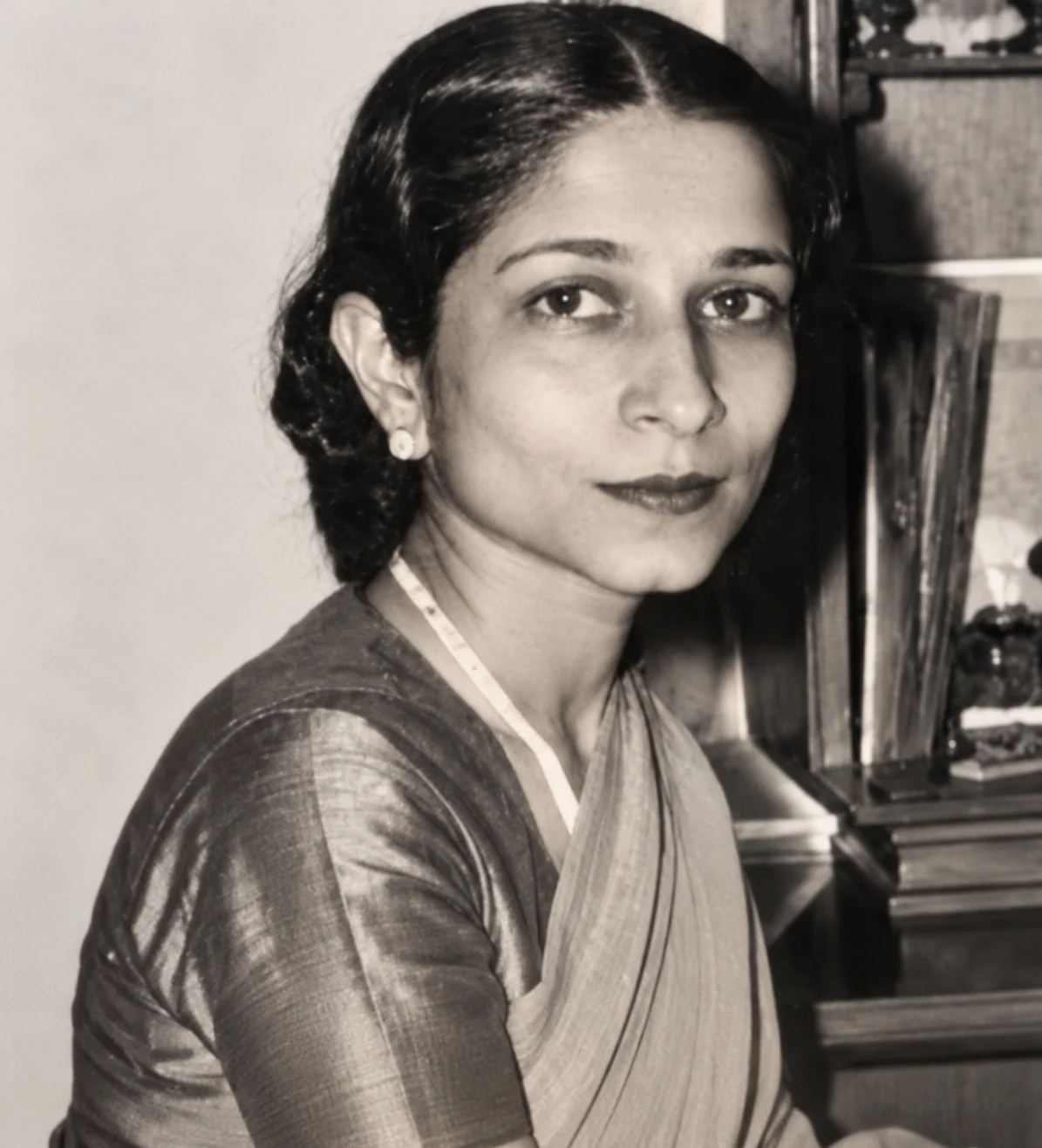
Surayya Tyabji's contribution to Indian national life took a form that resists easy attribution. In July 1947, in the weeks before independence, she and her husband Badruddin Tyabji produced the design that became the Indian national flag — replacing the Congress Party's charkha with the Ashoka Chakra from the Sarnath Lion Capital — and she drew the graphic rendering of the same Lion Capital that became the National Emblem of India. These are not minor achievements. But the precise nature of her role, and its relationship to her husband's, to the Flag Committee under Rajendra Prasad, and to the earlier work of Pingali Venkayya, has been reported with considerable variation over the decades, and an honest article must begin by acknowledging that.
The Attribution Question
The Indian national flag as adopted on 22 July 1947 retained the three colours of the Indian National Congress's Swaraj flag — saffron, white and green — but replaced the charkha (spinning wheel) at its centre with the twenty-four-spoked Dharma Chakra from the Sarnath Lion Capital. Who proposed that substitution, who executed it as a design, and who produced the physical object that first flew — these questions have been answered differently by different sources.
The accounts
Trevor Royle, the British historian, wrote in The Last Days of the Raj (John Murray, 1989): "By one of those contradictions which run through Indian's history, the national flag was designed by a Muslim, Badr-ud-Din Tyabji." Royle's account credits Badruddin with persuading Gandhi to accept the Ashoka Chakra in place of the charkha — on the grounds that the charkha was a Congress party symbol and might strike the wrong note — and credits Surayya with making the first copy that flew on Nehru's car on the night of 14–15 August 1947.
Laila Tyabji, the daughter of Surayya and Badruddin and the founder of the crafts organisation Dastkar, published a first-person family account in The Wire titled "How the Tricolour and Lion Emblem Really Came to Be." In it she relates that Jawaharlal Nehru turned to her father and said: "Badr, you have an eye for this sort of thing, please do something about it." Badruddin then set up a Flag Committee headed by Rajendra Prasad. Laila describes the work as a joint effort by both her parents: "my parents were tasked with re-doing the flag, and they took the Ashoka chakra and put it on the tricolour." She notes that Surayya originally painted the chakra in black, but Gandhi objected, so it became navy blue. She also notes that her parents "would have been amused that my father has been totally written out of the story" in the popular media retelling.
The Times of India (June 2026) describes Surayya as "the artist behind the tricolour" and states that "historical accounts and family records suggest that Surayya Tyabji proposed and illustrated this crucial modification."
The Siasat Daily (August 2026), drawing on Laila's Wire article and on the published work of Hyderabad historian Captain Lingala Panduranga Reddy, reports that Surayya is named as the designer in a Flag Foundation study and that the couple's joint contribution was confirmed by Reddy's research.
Pingali Venkayya designed the original Swaraj flag — the 1921 Congress flag with a charkha — and is widely credited as the designer of the Indian national flag in Indian government materials. The Constituent Assembly adopted the flag on 22 July 1947, with Nehru proposing the resolution. The proceedings do not, in the accessible record, credit any individual designer for the modification.
What can be said with confidence
The following points are established across multiple independent sources and are not contested:
- The Constituent Assembly adopted the flag on 22 July 1947, replacing the charkha with the Ashoka Chakra.
- Badruddin Tyabji was a senior ICS officer serving in the Prime Minister's Secretariat at the time.
- A Flag Committee existed, headed by Rajendra Prasad.
- The Tyabji couple — jointly — were involved in the work of translating the committee's decision into a physical design.
- Surayya produced the graphic execution: she drew the twenty-four-spoked Ashoka Chakra to fit within the central white band, resolved the practical challenge of rendering it in navy blue on coarse khadi cloth, and supervised the stitching of the first flags at Edde Tailors and Drapers in Connaught Place, New Delhi.
- The first flag that flew on Nehru's car on the night of independence was made by Surayya.
- The design choice — the substitution of the Ashoka Chakra for the charkha — is attributed by Royle to Badruddin and by later popular accounts to Surayya. Laila Tyabji's account attributes it to both parents working together.
This article proceeds on the basis of what the sources jointly support: that the Tyabjis worked together, that Surayya's contribution was the artistic execution and physical production of the flag and the emblem, and that whether the conceptual proposal was hers, her husband's, or jointly arrived at cannot be determined from the available evidence.
Life
Family Background
Surayya was born in 1919 into the prominent Hydari family of Hyderabad. She was a niece or granddaughter (sources vary) of Sir Akbar Hydari, who served as Prime Minister of Hyderabad State. The Hydari family occupied a position at the intersection of Deccani Muslim culture, administrative service, and the princely state's governance.
Education and Artistic Formation
The Siasat Daily reports that she grew up around the rich art and craft traditions of the Deccan — a region known for fine weaving, intricate patterns, and careful dyeing techniques — and that this background gave her a practical understanding of fabrics and visual balance. These skills proved directly relevant to the flag work, which was not merely a graphic-design exercise but a problem of rendering a precise symbol on handloom cloth in pre-industrial conditions.
No further details of her formal education or artistic training are available in the accessible sources.
Marriage to Badruddin Tyabji
She married Badruddin Tyabji, an Indian Civil Service officer who subsequently served in the Prime Minister's Secretariat, as a diplomat, and later as Vice-Chancellor of Aligarh Muslim University. Their daughter Laila Tyabji became the founder of Dastkar, a crafts organisation. The Tyabji family is historically prominent in Indian Muslim public life — the nineteenth-century jurist Badruddin Tyabji (a different person, the family's forebear) was the first Muslim president of the Indian National Congress in 1887.
The Flag, July 1947
The Problem
Independence was imminent. India needed a national flag that was not the flag of the Congress party. The Swaraj flag with its charkha was associated with Gandhi and the Congress and therefore, as Royle reports Badruddin arguing, might "strike the wrong note" as the symbol of a nation that was larger than any single party.
The requirement was: retain the three colours; replace the charkha with a symbol that was non-partisan, historically resonant, and acceptable to India's diverse communities.
The Solution
The Ashoka Chakra — the wheel from the Lion Capital of Ashoka at Sarnath — was chosen. The rationale, as recorded by Royle and confirmed in Laila's account, was that the Emperor Ashoka was "venerated by Hindu and Muslim alike" and that the Dharma Chakra (wheel of law) carried associations with justice, truth and progress that transcended any single religious or political tradition.
Laila Tyabji's account records that her parents "loved the sculpture and ethos of that period, so it was a natural choice."
The Execution
The practical challenge was substantial. The Chakra had to be rendered precisely — twenty-four spokes at equal intervals — on coarse hand-spun khadi cloth, in a colour (navy blue, after Gandhi's intervention on the original black) that would not bleed into the white central band. Surayya drew the graphic version on paper, scaled to fit the central band, and then supervised the production of the first flags.
Laila records that the stitching was done at Edde Tailors and Drapers in Connaught Place, New Delhi, in the heat of late July 1947. The deadline was absolute: 15 August.
The National Emblem
The Tyabjis' design work extended beyond the flag. Around the same period, a graphic rendering of the Sarnath Lion Capital was needed for official stationery and documents — what became the National Emblem of India, adopted on 26 January 1950.
According to Sheila Dikshit's memoir Citizen Delhi: My Times, My Life (cited by the Siasat Daily), early designs submitted by local art schools "looked too much like traditional European heraldry." Surayya drew a clean graphic version of the Lion Capital which was taken directly to the Viceregal Lodge printing press to produce the country's first official letterheads.
Later Life
The accessible sources provide very little about Surayya Tyabji's life after 1947. Neither she nor Badruddin ever claimed creative ownership of the flag or the emblem publicly during their lifetimes, according to their daughter's account. This reticence is itself part of the story: the attribution controversy arose after their deaths and in their absence.
She died in 1978. The Times of India gives her dates as 1919–1978. No further details of her later career, artistic work, or circumstances of death have been located in the authoritative sources.
Legacy and the Continuing Debate
In Popular Memory
Every Independence Day and Republic Day, stories about the "Muslim woman who designed the Indian flag" circulate in Indian media and on social platforms. Laila Tyabji has noted that these accounts frequently write her father out of the story entirely, and that her parents would have found this misrepresentation amusing. The framing also sometimes overstates the claim, attributing the entirety of the flag's design history to Surayya when the tricolour itself was Venkayya's and the Chakra substitution was a committee decision that the Tyabjis executed.
What the Record Supports
Surayya Tyabji's contribution is real and documented. She drew the Ashoka Chakra as a graphic, solved the practical problem of rendering it on cloth, supervised production of the first flags, and produced the graphic of the Lion Capital that became the National Emblem. Whether she or her husband originated the conceptual idea of substituting the Chakra for the charkha is a question the sources do not settle, and this article does not pretend to settle it.
What is not in doubt is that an artist from Hyderabad — a Muslim woman from the Deccan — put her hand to the physical production of both the flag and the emblem under which India declared its independence. In a country where the visual symbols of nationhood carry immense emotional and political weight, that is a contribution worth recording accurately.
Historiographical Note
This is a case where the surviving record is thin and the popular narrative has outrun the evidence. The authoritative sources for the flag story are limited to:
- Trevor Royle's The Last Days of the Raj (1989), a published work of history drawing on interviews and documents of the independence period.
- Laila Tyabji's article in The Wire, a first-person family account by the Tyabjis' daughter.
- Sheila Dikshit's memoir, on the National Emblem specifically.
For Surayya Tyabji's life beyond the flag — her childhood, education, artistic career, later decades, and death — the accessible sources provide almost nothing. The Times of India gives dates (1919–1978) and describes her as an artist from Hyderabad; the Siasat Daily identifies her family as the Hydaris. No academic biography, monograph, or even a substantial biographical essay has been identified.
The article has therefore been written at the length the evidence supports. A much longer treatment would require either access to Laila Tyabji's Wire article in full, to Tyabji family papers, or to the records of the Flag Committee — none of which have been located in the publicly accessible online sources as of this writing.
The date of death (1978) is consistent across sources. The birth year (1919) appears in the Times of India and in the Wikiwand summary derived from it; whether it rests on family records or on inference from the Siasat Daily's statement that she was twenty-eight in 1947 is not clear.
References and Further Reading
Primary Islamic Sources
- Quran, Surah Al-Hujurat (49:13) — "O mankind, indeed We have created you from male and female and made you peoples and tribes that you may know one another." (The verse most frequently invoked in the Indian Muslim nationalist tradition's case for shared nationhood — the intellectual context within which the Tyabji family worked)
- Quran, Surah Al-Baqarah (2:148) — "For each [community] is a direction toward which it faces. So race to [all that is] good." (On plurality of communities pursuing the good within a single polity)
- Quran, Surah An-Nahl (16:90) — "Indeed, Allah orders justice and good conduct." (The principle of justice as the foundation of governance — the ethos the Ashoka Chakra was chosen to represent)
- Quran, Surah Al-Ma'idah (5:8) — "Be just; that is nearer to righteousness." (Justice as the duty of those who serve the community)
Classical Islamic Sources
- Shah Waliullah Dehlawi. Hujjat Allah al-Balighah. [Original 18th century CE — the Indian Islamic reform tradition; the intellectual heritage of the Muslim families who participated in Indian nation-building]
- Sir Sayyid Ahmad Khan. Writings on Muslim education and public service. [The tradition of Muslim engagement with modern institutions and governance from which the Tyabji and Hydari families descended]
- Al-Mawardi, Abu al-Hasan. Al-Ahkam al-Sultaniyyah. [Original 11th century CE — on symbols of sovereignty, the visual representation of authority, and the duties of public office]
- Ibn Khaldun, Abd al-Rahman. Al-Muqaddimah. [Original 14th century CE — on the role of symbols, banners, and visual markers in the cohesion of political communities]
Academic and Scholarly Sources
- Royle, Trevor. The Last Days of the Raj. London: John Murray, 1989 (reprinted 1997). [The published historical work that first recorded Badruddin Tyabji's role in designing the flag and Surayya's production of the first copy; available on Archive.org in restricted lending]
- Dikshit, Sheila. Citizen Delhi: My Times, My Life. New Delhi: memoir. [Records Surayya's drawing of the Lion Capital graphic for the National Emblem]
- Constituent Assembly of India. Proceedings, 22 July 1947. [The resolution adopting the national flag, proposed by Jawaharlal Nehru]
- Reddy, Capt. Lingala Panduranga. Research on the designers of the Indian tricolour. Hyderabad: Voice of Telangana. [Cited by the Siasat Daily as having identified the Tyabji couple's role]
- Flag Foundation of India. Study naming Surayya Tyabji as the flag's designer. [Cited in the Siasat Daily; not independently located]
Further Reading
- Tyabji, Laila. "How the Tricolour and Lion Emblem Really Came to Be." The Wire. [First-person family account by the Tyabjis' daughter; the primary narrative source for the flag and emblem story]
- The Siasat Daily. "Crafting Independence: The Hyderabadi connection behind India's flag." August 2026. [Comprehensive reporting drawing on Laila Tyabji's article, Royle, Dikshit, and Reddy]
- Times of India. "She replaced Gandhi's charkha with the Ashoka Chakra on India's national flag." June 2026. [Biographical account giving dates 1919–1978 and summarising the design contribution]
Mentioned In
1 article references this topic